In response to updated guidelines from the CDC to avoid discretionary travel, the Dare County Control Group has made the decision to restrict visitor access to Dare County beginning today, Tuesday, March 17 at 2:00 p.m.
While there are currently no individuals who have tested positive for COVID-19 in Dare County, officials weighed the potential benefits for community health along with the tremendous impacts these restrictions have on our community.
Beginning at 2:00 p.m., checkpoints will be established at entry points to Dare County and no visitors will be allowed access. Permanent residents, non-resident property owners and non-resident employees of Dare County businesses may review entry guidelines at www.darenc.com/entry. Reentry permits from previous years will not be accepted. Staff is working to activate the online permitting system by 1:00 p.m. to apply. We anticipate an influx of users when the system becomes available. To prevent a system overload, if you need an entry permit, please wait and apply closer to the date of your anticipated arrival.
Personnel working at the Emergency Operations Center are available to answer COVID-19 related questions using a dedicated phone line. Please call 252.475.5008. Personnel anticipates a high volume of calls. If you reach a voicemail, please leave a message and your call will be returned as soon as possible.
For regularly updated information on COVID-19 in Dare County and information about how to protect yourself, your family and our community, visit www.darenc.com/covid-19.
You received this message because you are subscribed to the Dare County Emergency Alerts Network.
Because this affects me personally, I will be unable to follow up on this report immediately. I will be back online as soon as possible with additional information.
This is an illustration of the novel coronavirus known as COVID-19 created by the U.S. Centers for Disease Control and Prevention.
Governor Roy Cooper is expected to announce today an executive order to close all North Carolina restaurants and bars to dine-in customers starting at 5 p.m., according to a report by OBX Today. The order will allow these establishments to continue taking takeout and delivery orders, however.
In other news, the Southern Shores Town Council has given notice on the Town website that it will hold its 9 a.m. March 24 budget workshop as previously scheduled, despite the states of emergency declared yesterday by Dare County and the Town to help stop the spread of COVID-19.
The County’s state of emergency restricts mass gatherings of 50 people or more.
The Council’s budget workshop meeting is top-heavy with business, including consideration of a potential beach nourishment project and potential no-left-turn weekends this summer; the Town pay study; and capital street projects.
AT THE PRESS BRIEFING: Dr. Mandy Cohen, Secretary of the NCDHHS, reported that 1,100 people have been tested in North Carolina for COVID-19, and 40 of them have tested positive. No one has died from the virus.
Most of the confirmed cases of COVID-19 are in Wake County, which is where Raleigh is located. No cases have been reported in Northeastern North Carolina.
Dr. Cohen said that the criteria for testing a person for the coronavirus are the following: 1) a fever; 2) a cough; and 3) a negative flu test. No longer is contact with a person who has been in an epidemic area a prerequisite to a test.
The shelves on the bath tissue aisle at Food Lion in the Marketplace are empty, as locals prepare for COVID-19-related self-quarantining by stocking up on toilet paper. You will not find any tissue across the street at Harris Teeter, either. The Beacon did not check Walmart or CVS Pharmacy for supplies.
Mayor Tom Bennett announced a state of emergency in Southern Shores today shortly after Dare County declared a county-wide state of emergency in order to allow the County and individual towns to implement quickly restrictions necessary to thwart the spread of the new coronavirus known as COVID-19.
“I believe it essential to take as many proactive measures as we can in dealing with the potential impact of the Coronavirus (COVID-19),” the Mayor said in a letter to the community.
So far, no COVID-19 cases have been confirmed on the Outer Banks. Thirty-three people have tested positive for the virus in North Carolina.
The World Health Organization has declared COVID-19, which poses the most dire health risk to elderly people and people with underlying medical conditions, a worldwide pandemic. Some nations, including Italy, Germany, Ireland, and Denmark, are in lockdown, tightening their borders and severely restricting the movement of their own citizens.
Effective immediately, the Southern Shores Town Hall is closed to the public. The Town announced today that all business will be conducted by telephone, email, fax, or other “virtual means to the greatest extent possible.”
A notice posted on the Town website further states that all meetings of “all appointed Town advisory boards, commissions and committees will be modified to reduce vulnerability of people and property” of Southern Shores.
Town staff will be in contact with groups expecting to meet on Town property to “outline meeting procedures going forward.”
Tonight’s Planning Board meeting, scheduled for 5:30 p.m. in the Pitts Center, has been canceled.
Adhering to the guidance that the U.S. Centers for Disease Control and Prevention (CDC) provided yesterday, Dare County’s state of emergency restricts “mass” gatherings of 50 people or more.
A mass gathering does not include groups of people in medical facilities, libraries, shopping malls/centers and other retail establishments, restaurants, factories, office environments, or other spaces where people may be incidentally gathered. The restriction apparently applies to organized meetings and events in which more than 50 people may be expected to gather.
The Dare County Control Group made the decision to declare the County’s state of emergency after meeting this morning. Officials of the Control Group are adhering to guidance and recommendations issued by the CDC and the N.C. Dept. of Health and Human Services (NCDHHS). The Control Group said that it will continue to meet and provide updates on a daily basis.
You may access updated County information at darenc.com/covid19 or sign up to receive news directly from the County at darenc.com/enotify.
Dare County has set up a telephone hotline for information about COVID-19 testing and symptoms, travel restrictions, preparation efforts, and prevention suggestions at (252) 475-5008. It will be staffed daily from 8:30 a.m. to 5 p.m.; those hours may be extended, the County said, depending on the call volume.
N.C. Governor Roy Cooper previously ordered the closure of all State public schools, effective today, and restricted mass gatherings of 100 people or more, when the CDC and the NCDHHS had so advised. So far, the Governor has not imposed travel restrictions in North Carolina.
According to the County, the following facilities will be closed until further notice beginning at 2 p.m. today: the Dare County Center, the Thomas A. Baum Senior Center, the Fessenden Center, all Dare County libraries, and all County parks and recreation facilities. You will find a complete list of cancellations and closures at www.darenc.com/closures.
Dare County offices will remain open, but in-person contact may be limited. The County suggests that, before you visit one of its offices, you check its website or call ahead to confirm that face-to-face services will be provided, or if you will have to communicate online or over the telephone.
PLEASE NOTE: This article may be revised as further information becomes known.
Dare County’s glass crusher was in operation last Thursday, when The Beacon visited.
In 2018, Dare County’s glass crusher handled 500 tons of glass, reducing bottles and jars to piles of fine sand and a pebble mulch that are free to the public.
Five hundred tons, according to Doug Huff, the county’s Solid Waste Superintendent. That is a lot of wine, beer, and liquor bottles.
For more than a decade, Dare has been the only county in North Carolina with its own mechanized glass pulverizer. The machine is the crown jewel of the county’s recycling operation, which The Beacon recently toured with Mr. Huff and Dare County Public Works Director Shanna Fullmer. Southern Shores Civic Assn. president Rod McCaughey came along for the ride, at The Beacon’s invitation.
“We want to do everything possible to work with local government entities on responsible recycling efforts,” Mr. McCaughey told The Beacon.
The SSCA owns and manages extensive open spaces in Southern Shores. It is also a voice for its membership, Mr. McCaughey said, in “the health and welfare of our community as a whole.”
According to County Manager/Attorney Bobby Outten, Dare County purchased its glass crusher in 2008 after the State of North Carolina began requiring holders of Alcoholic Beverage Control (ABC) Commission permits to recycle all recyclable beverage containers.
Needless to say, the Outer Banks has many restaurants, convenience stores, and other retail and entertainment establishments that have ABC permits to sell wine, malt beverages, and mixed drinks on their premises. At the urging, and with the powerful assistance of former N.C. State Senator and Senate President Marc Basnight, according to Mr. Outten, the County and the Dare County Tourism Bureau got out in front of the new State law.
The total cost associated with the glass crusher was $225,000, Mr. Outten said, of which the county paid about half.
The glass crusher itself cost about $120,000, which was covered by a state grant.
SOUTHERN SHORES RECYCLABLES GOING TO AN INCINERATOR NOW
As The Beacon has previously reported, Bay Disposal and Recycling, with whom Southern Shores has a three-year contract for curbside recycling pickup that it signed in June 2018, is no longer hauling its loads to a materials recycling facility, also known as a materials re-use or recovery or reclamation facility. Such facilities are referred to as MRFs, an abbreviation pronounced as murfs.
MRFs receive, separate, and prepare recyclables for marketing to end-user manufacturers. There is no MRF in northeastern North Carolina. The closest MRF to the Outer Banks is Tidewater Fibre Corp. (TFC) Recycling’s MRF in Chesapeake, Va.
Last December, however, TFC stopped accepting Bay Disposal’s collected recyclables at its facility. Since then, the Powells Point-based hauler has transported all of its loads to a waste-to-energy facility in Portsmouth that incinerates them.
None of the items that you currently place in your recycling receptacles, which you then wheel to the roadside for the Wednesday morning pickup, are actually being recycled. They are being burned.
This is true of all unsorted so-called “single-stream” recycling that Bay Disposal collects, whether it is from curbside cans or from bins at county and town recycling centers, such as at the joint Dare County-Kitty Hawk Recycling Center, located at 4150 Bob Perry Road in Kitty Hawk.
The N.C. State law that imposed a duty on ABC permittees to recycle and took effect in 2008 also prohibits the incineration of recyclable beverage containers sold by ABC permittees, as well as aluminum cans. Clearly, this is precisely what is happening now with such Outer Banks recyclables.
The N.C. Dept. of Environmental Quality is temporarily allowing Bay Disposal to transport recyclables to Wheelabrator, the energy facility, while it investigates other solutions. This is strictly a short-term arrangement.
(For background, see The Beacon, 12/7/19, 1/3/20, 1/9/20, 2/3/20, 2/14/20.)
DARE COUNTY’S CRUSHER AND OVERALL RECYCLING OPERATION
One obvious solution for glass products that Outer Banks consumers and businesses have been putting in single-stream recycling is to arrange for their transport to the Dare County public works facility for pulverization in the glass crusher. The facility is located at 1018 Driftwood Drive, just outside of downtown Manteo, off of N.C. Hwy. 64.
There is consumer and commercial demand for crushed glass sand or pebbles, which may be used in road and sidewalk construction, on driveway surfaces, and in landscaping projects, as well as in candles, lamps, stained-glass windows, jewelry, and other art objects.
People interested in obtaining some of the sand or mulch must call ahead and put their names on a list, according to Ms. Fullmer. They will be notified when they can pick up their treasure. (Call (252) 475-5890).
In the off-season, the Public Works Director said, the crusher operates about once per month. During the summer, its use increases to about once per week, she estimated.
Hammers inside the glass crusher pound about five tons of glass per hour.
Employed with the county public works department since 1996, Ms. Fullmer previously served as Solid Waste Superintendent and interim director before being named to her current position in October 2018.
In announcing her appointment, Mr. Outten noted her “can-do attitude” and described her as “working daily” to make the public works department run “more efficiently.”
We would just call her a dynamo. She has the high energy and know-how to get things done.
Ms. Fullmer presides over a large domain—what with trash collection for Manteo, the unincorporated Dare County areas, and the Town of Kitty Hawk; annual large-item pickups; maintenance and landscaping of all county facilities; special waste-disposal programs, mosquito control, etc., etc., in addition to myriad recycling operations—that includes the county’s 900-acre landfill in Stumpy Point, which she encouraged me to visit.
Ms. Fullmer assured me the landfill is pristine and nothing like the towering, malodorous landfills that conceal dead bodies on true-crime shows.
We walked on crushed glass when we crossed the public works facility grounds to witness up-close the operation of the mighty crusher. Mr. Huff picked up a handful of the sparkling glass under foot to prove that it was neither sharp nor jagged and, therefore, would pose no threat of injury.
The gray beast itself is a noisy, but efficient machine with a 20-foot-long conveyor belt that transports the bottles, which have already been broken down into pieces, to the inner workings where the pulverization hammers do their work. It screens out wine bottle corks, beer bottle caps, and other debris so that the residue of the process is just glass, which is deposited in two piles on the ground: one, the fine glass sand, the other, the pebble mulch. (See the photo above; the piles are on either side of the shovel.)
Dare County has separate bins for glass at its drop-off recycling centers, which are located, in addition to the Driftwood Drive site, in Buxton and Rodanthe. Its shared drop-off center in Kitty Hawk also has a bin for glass only and is within easy driving distance of Southern Shores. Only pre-sorted glass makes its way into the crusher.
Besides glass, the county public works facility has separate bins for sorted corrugated cardboard, paper, and large metal (not aluminum cans), for which, Ms. Fullmer said, there are markets. She described the recyclables that Dare can sell as “very basic stuff,” and said its profits have fallen off steeply in recent years.
Two years ago, Ms. Fullmer explained, Butler Paper Recycling in Suffolk paid the County $180 per ton for its paper recyclables. Today, the price is only $20 per ton.
“Recycling has never been a moneymaker,” Mr. Huff observed, but its value to the natural environment and the U.S. quality of life is priceless.
(Please note: The Beacon was earlier misinformed by a source about Dare having recycling markets for aluminum cans and plastics. It does not.)
The County makes some money off of recycled tires, thanks to the State’s Scrap Tire Disposal Act, which requires counties to provide for the disposal of scrap tires within their geographic boundaries. A scrap tire disposal tax is applied to the sale of all new tires, and the N.C. Dept. of Revenue distributes these tax proceeds to counties, proportionately.
In 2018, according to Mr. Huff, Dare County processed 750 tons of scrap tires, transporting them to a recycler in Cameron, N.C.
A CULTURAL CHANGE IS NEEDED
Although the County’s drop-off recycling centers accept single-stream recycling, it is going exactly where your curbside recycling is going now: to an incinerator.
Even before TFC stopped taking single-stream recyclables from the Outer Banks, it was having to deal with contamination in the product—which meant that recyclables were being rejected and ending up in landfills.
Contamination means both that consumers are inadequately cleaning accepted recyclables, as well as improperly including in the stream items that are not recyclable or that interfere with MRF processing, such as plastic bags, string, wax-covered food cartons, and styrofoam. (Ms. Fullmer and Mr. Huff say they have seen trash such as soiled diapers, used hypodermic needles, and other disgusting waste in single-stream recycling.)
Dare County Manager Bobby Outten said there have been discussions on the county and state level for the past two years about what to do with recycling—ever since China enacted its “National Sword” policy and banned importation of plastics and other recyclable materials from overseas because of their contamination.
“Sorting on the front end is easier and cleaner” and vital, said Ms. Fullmer, who explained that professionals in the solid waste management industry were always dubious about single-streaming, which may not survive shifts in the marketplace.
As we have previously reported, China is not the only game in the world—India, Thailand, Malaysia, Vietnam, and Indonesia have stepped up to try to fill the voice—but The Beacon believes the future of waste management in the United States rests in large part with reforming our throwaway culture and reducing American reliance on plastic containers, especially the omnipresent plastic water bottle.
It may be up to the grass roots to start the reformation, which could begin simply at the supermarket, when you reach for bottled water and other beverages. Think glass, not plastic or aluminum.
Locally, until a better option presents itself, you also can help by sorting your glass and corrugated cardboard from the rest of your no-longer-recycled recyclables and transporting these products to the Kitty Hawk recycling center. The Beacon is still trying to figure out how to consolidate paper recyclables–newspapers, magazines, paper bags, printer paper, and other products–and arrange for their regular transport to Manteo.
The Dare County/Kitty Hawk center is attended and is open from 8 a.m. to 3 p.m., Monday, Tuesday, Thursday, and Friday, and from 8 a.m. to noon on Saturday. The center also accepts old furniture, electronics, and white goods. If you live in Southern Shores and would like to drop off a large item, you will need to obtain a permit from the Town, which Interim Town Manager Wes Haskett said costs $50. (I have had no trouble leaving old televisions and computers there.)
The Manteo recycling center is open from 8 a.m. to 5 p.m., Monday through Friday, and from 8 a.m. to noon on Saturday. Upon arrival, you drive in and back to the rear of the grounds, where you will find the appropriate bin for disposing of your recyclables.
We have learned recently that a multi-town meeting to discuss local recycling options will be held in Manteo on March 30. When further details become available, we will pass them along.
HAZARDOUS WASTE COLLECTION DAYS SCHEDULED IN MAY
One further note: Thanks to Ms. Fullmer, Dare County will be hosting household hazardous waste collections in three locations this year. The Northern Dare beach collection will occur on Thursday, May 28, from 8 a.m. to 3 p.m., at the Kitty Hawk Recycling Center on Bob Perry Road.
A Buxton collection will take place at the Dare County transfer station there on May 29 from 2 to 4 p.m., and the Manteo collection will be May 30, from 9 a.m. to 1 p.m., at the public works facility.
This program is the brainchild of the dynamo Public Works Director, who smartly decided that you need a place to dispose safely of the following materials:
*Paint, polishes, and varnishes, as well as paint-related materials
*Turpentine
*Aerosol cans
*Adhesives
*Motor oil
*Antifreeze
*Fuel additives
*Household cleaners
*Herbicides and insecticides
*Gasoline
*Batteries (regular and automotive)
*Mercury
*Pool chemicals
*Fluorescent light bulbs
*Automotive fluids (brake, transmission, etc.)
For more information about these drop-off days, contact Mr. Huff at (252) 475-5843.
The Dare County public works facility in Manteo and the recycling center in Kitty Hawk accept batteries and used motor oils throughout the year. Check with the public works department before you make a trip to one of the county’s other recycling centers: (252) 475-5890.
When the Dare County Board of Commissioners meets at 8 a.m. Friday for a special retreat to begin fiscal year 2020-21 budget discussions, members of the Southern Shores library committee will be there.
You could not keep them away. It would be difficult to find a more organized, purposeful, and determined town group. And now these go-getters are seeking your support for the new “Northern Dare” library in the form of emails to the commissioners and signatures on a petition.
“We’re in the budget discussions,” committee member Lilias Morrison reported to the Town Council at its meeting last week. “We’re not in the budget.” (See The Beacon, 3/8/20.)
“So much depends on public support now,” she said at a committee meeting last night.
To get into the Dare County budget, committee members recognize that they need to continue to advocate and to secure public support for the library, which would serve the towns of Duck, Southern Shores, and Kitty Hawk, and the Martin’s Point community.
Dare County currently has library branches in Manteo, Hatteras, and Kill Devil Hills. There also is a Currituck County branch library in Corolla.
According to Dare County Librarian Jonathan Wark, Ms. Morrison said, the county library system has 1800 members who reside in the 27949 zip code.
Ms. Morrison appeared before the Dare Commissioners on Feb.18 to present the committee’s proposal for the library, which would be located in a 2,570-square foot building owned by TowneBank at 6 Juniper Trail in Southern Shores.
“The commissioners were very attentive and interested,” she told the gathering last night.
The potential library space was formerly occupied by Vandeventer Black law firm. The bank has offered to rent the building to the county for $1 per year for 10 years.
Before contacting TowneBank, Ms. Morrison explained, the committee investigated space in the Marketplace, Southern Shores Crossing, and the Harris Teeter shopping center. Members did their shoe-leather research before TowneBank came through with its generous offer, for which it asks in return some acknowledgment as a benefactor.
The library committee is hopeful that county employees will have compiled cost figures for library shelving, equipment, and other expenses for the commissioners to consider Friday. The committee has already secured an estimate for adapting the Juniper Trail office building into a library of $150,000 to $175,000.
According to the county website, Dare County’s FY 2019-20 budget was $168,817,454. Ms. Morrison said that the budget for all of its libraries is about $1 million.
In addition to housing books, periodicals, and other standard library acquisitions, the Northern Dare Library would have computers and meeting space for adult and children’s programs, including speakers and tutorials. Ms. Morrison specifically mentioned the scheduling of adult wellness and enrichment programs that are popular at the other Dare County library branches.
Committee member Loretta Michael said she could envision library walls covered with notices of community events and happenings and referred to the proposed educational resource as a potential “center of the community.”
The committee urges you to email a letter expressing your support and interest in the Northern Dare Library to the Dare County commissioners, who may be contacted, collectively, at DCBOC@darenc.com, or individually, as follows:
Chairman Robert Woodard: woodard@darenc.com
Vice Chairman Wally Overman: wallyo@darenc.com
Commissioner Rob Ross, who is the Commission’s library liaison: rob.ross@darenc.com
Commissioner Steve House, who represents Duck, Southern Shores, and Kitty Hawk: steve.house@darenc.com
Ms. Michael suggests that you mention in your email specifically how you and the community would benefit from a library in Southern Shores. She has prepared some sample wording, which you may access at file:///C:/Users/Annsj/AppData/Local/Temp/suggested%20wording.pdf.
(The Beacon does not know how many of the committee members may be former teachers or librarians, but committee chair Michael Fletcher was wearing a Library of Congress sweatshirt last night–a gift from his librarian daughter, who works there.)
Ms. Michael is also circulating a petition in support of the new library. You will find a copy of the petition at the Town Hall reception desk, along with brochures about the Northern Dare Library. You also may arrange to sign the petition by contacting Ms. Michael at ljbobx@charter.net.
Please direct any general inquiries about the library proposal to Lilias Morrison at liliasm7@gmail.com.
A worker moves bottles through Dare County’s glass crusher at the Manteo public works facility. The Beacon took a tour last Thursday of the County’s recycling operation that included a demonstration of the crusher. We will report on our visit later this week.
A proposal for a beach nourishment financing/tax plan, including suggested municipal service districts that the Town could use if it decides to approve a project and fund it with special obligation bonds, will be presented to the Town Council at its March 24 budget workshop session, according to Interim Town Manager Wes Haskett last Wednesday.
“We have finalized a map showing proposed MSDs,” Mr. Haskett told the Town Council at its March regular meeting, and obtained from the Dare County Tax Dept. “the values of properties within the proposed MSDs.”
These values have been forwarded to the Town’s financial consultant, DEC Associates, Inc., he said, so it can work up “models and funding options for the County to consider” March 24, which is shaping up to be a red-letter day. The workshop will be held at 9 a.m. in the Pitts Center.
(The Beacon has written extensively about beach nourishment and a potential project in Southern Shores. The concept behind municipal service districts is that people who own property within them would benefit more from beach nourishment and, therefore, can justifiably be taxed more to pay for it than people who own property outside of the MSDs. One MSD typically encompasses the oceanfront.)
Mr. Haskett also will be seeking “guidance” at the March workshop from the Council “on projects to include in the proposed budget” for fiscal year 2020-21, he said.
The Interim Town Manager/Planning Director told the Town Council that he and Finance Officer Bonnie Swain have reviewed proposed FY 2020-21 expenditures with Town department heads and are working on revenues, including the revenue-neutral tax rate, which the State requires municipalities to calculate when a property revaluation occurs.
They will present a proposed FY 2020-21 budget at the Council’s April 21 budget workshop meeting, he said.
The public hearing on the Town’s FY 2020-21 budget, as well as the Town Council’s vote on its approval, will be held in June.
The beach-nourishment MSD update was one of a number of items in an unusually full monthly report presented by Mr. Haskett. While The Beacon welcomes current information about the many “pies” that the Town has its fingers in, we found Mr. Haskett’s rundown to be sketchy. (See below.)
Outside of his staff report, Mr. Haskett also reported on decisions made Feb. 26 by the Town Council’s Capital Infrastructure Improvements Planning (CIIP) Committee—of which he is not a member—that resulted in a recommended suspension of top-priority improvement projects on Hillcrest Drive and Sea Oats Trail.
Otherwise, in a matter squarely within his official capacity, the Interim Town Manager was able to give few details about a beach nourishment-related proposal from the Town of Duck that came directly to him and he brought to the Council’s “attention.”
CIIP CO-CHAIRS DROP THE BALL ON PUBLIC INFORMATION
That CIIP Committee Co-Chairpersons and Councilmen Matt Neal and Jim Conners allowed Mr. Haskett to report on their committee’s business and did not inform Town residents about the deliberations that led to its recommendation to halt all work on the Hillcrest and Sea Oats projects is unacceptable to The Beacon.
According to Mr. Haskett, the “Town Engineer,” whom he did not name—the Town has a contract with Deel Engineering—told the CIIP Committee that “insufficient” funds remain in the capital budget to cover both projects.
This is old news. It was known last year already that only one of the dune-street projects could be financed with FY 2019-20 monies.
As of the date of the Council’s meeting, according to Ms. Swain, $355,155 unexpended funds remained in the 2019-20 capital budget, an amount more than sufficient to do one of the dune improvement projects. That both projects are on the vacationer cut-through route is undoubtedly significant, but Mr. Haskett did not mention it. Councilmen Neal and Conners should have.
The Beacon learned only after the Council meeting that the committee discussed the fallout of doing one of the improvement projects during the summer. Apparently not all members were against that prospect.
The public deserves to hear from the policy-makers, the Town Council-appointed committee leaders, about how this citizens’ committee arrived at its recommendation to suspend both major projects and to proceed only with the rebuild of little Dewberry Lane (No. 4 on the priority list) and a pet project of Mayor Tom Bennett’s—a recommendation that the Town Council unanimously approved Wednesday.
Town manager-written CIIP Committee meeting minutes—which have not yet been posted for Feb. 26—are a poor substitute for an executive briefing by co-chairs at a videotaped meeting of the Town Council.
Last year, then-committee co-chair, Mayor Bennett, suggested expanding the eastbound lanes on East Dogwood Trail at the Duck Road intersection, so that large vehicles turning right (south)—such as dump trucks, which have no business using the road—have an easier clearance. By suspending the two major projects that the previous Town Council approved, the capital-budget account becomes flush.
In response to a question by Mayor Pro Tem Elizabeth Morey, Mr. Haskett reported that the lane expansion at East Dogwood Trail into the median would cost $28,150, and construction of a grass buffer there would cost another $5,700, for a total of $33,850.
The lane widening is to be considered a “change order” under the current East Dogwood Trail improvement project, which is on-going between Duck Road and Ocean Boulevard.
The Town Council spent some time discussing how to save money on the grass-buffer landscaping, ultimately deciding unanimously that Mr. Haskett would seek bids on the job, including from the Town Public Works Dept.
Although Ms. Morey said she thought the lane expansion was a “lot of money to pay for a little gain,” she nonetheless voted in favor of it.
The bottom line: The only major top-priority FY 2019-20 project approved by the former Town Council that will be finished this year is the East Dogwood Trail improvement project, which Mr. Haskett said will be done by May 1.
The CIIP Committee further recommended that monies left over from the $1 million that the previous Town Council appropriated from the Town’s undesignated fund balance to pay for the South Dogwood Trail sidewalk be applied to the FY 2020-21 capital budget, which is currently determined by taking .05 of the revenue generated from the Town’s real-property tax base. That amount is currently estimated to be about $282,511.
Here again, The Beacon would have liked to have heard Co-Chairs Neal and Conners explain this recommendation. The South Dogwood Trail sidewalk construction is not under the auspices of the CIIP Committee. Any information about its funding–including the possibility of a reimbursement of some costs from the Dare County Tourism Bureau–should have been presented in the Interim Town Manager’s Report, when Mr. Haskett advised that the sidewalk is 45 percent complete.
We imagine the Committee to Address Cut-Through Traffic in Town would like a chunk of this “leftover” money, too, as would homeowners who may be excessively taxed for beach nourishment they do not support.
The CIIP Committee overreached in making this call, and neither the Town Council nor the Interim Town Manager batted an eye.
INADEQUATE ASSESSMENT OF DUCK’S RFQ, ‘CART BEFORE HORSE’?
The only real substantive discussion that occurred among Council members at last week’s meeting concerned a request for qualifications (RFQ) document that Duck prepared for a shared coastal engineering consultant among the towns of Duck, Southern Shores, Kitty Hawk, and Kill Devil Hills, all of whom nourished beaches in 2017. Southern Shores added sand to the shoreline at and near Pelican Watch.
Mr. Haskett offered little background on this RFQ, beyond saying that Duck Town Manager Chris Layton “asked me if [Southern Shores] would like to be included in it.” But he did not say when Mr. Layton had approached him, nor did he mention any meetings that he may have had about it and with whom.
Mr. Haskett had only speculative answers to anticipated questions by the Council about how an envisioned multi-town collaboration on the RFQ, a subsequent job-bidding process, or any other aspect of beach management and nourishment would work.
Councilman Neal asked specifically about a timeline for the RFQ—Mr. Haskett said he had not been told of one—and about the negotiation process among the towns if the RFQ is released and applications are received. Who decides which consultants meet the qualifications, and how?
Presumably, staff from the towns would be on the front line, but Mr. Haskett’s answers were fuzzy.
Nonetheless, the Council voted 4-1 to join the RFQ, with Councilman Conners protesting that the Town was “putting the cart before the horse” because it has not yet approved a beach nourishment project.
The other four Town Council members adjudged that by voting to include Southern Shores in Duck’s RFQ—which Councilman Conners said he has read “four times and I’m still unclear” about what it covers—they were not making a commitment that they could not withdraw later. They could see no “downside.”
The Beacon regards their approval as largely symbolic of a desire to cooperate.
Councilman Conners agreed with multi-town cooperation, but said, “I don’t see the rush to approve this right now,” and argued that the “optics” suggest that by joining the RFQ, the Town has committed to beach nourishment beyond maintenance at Pelican Watch. He encouraged a delay of a month or two. He also suggested that any county-wide effort to manage the beaches, and provide for their nourishment, should be led by Dare County, not Duck.
The Beacon agrees with Councilman Conners. The RFQ combines elements of a working agreement among the four towns with a request for qualifications that defines a very broad “scope of work” for the beach-nourishment consultant. It makes more sense to us to have an agreement among the towns that is separate from the RFQ, which means doing work now, upfront, rather than later, when confusion and conflict are bound to arise because the towns have not bothered to have a “meeting of the minds.”
Mr. Haskett mentioned that he had spoken earlier Wednesday with Joe Heard, who is Duck’s Director of Community Development and the author of the RFQ. It would have been helpful to have had Mr. Heard at the Council meeting to explain his intent and purpose and to address the questions that arose. It also would have been helpful if Mr. Haskett had identified who he is.
SKETCHY UPDATES OF OTHER TOWN BUSINESS: REMEMBER THE CODE REWRITE?
Mr. Haskett glossed over other major Town issues and projects in his report, receiving no questions from Town Council members. Among them:
BUILDING CODE DEFICIENCIES: The Interim Town Manager followed up on the effort to address N.C. Building Code deficiencies of Town buildings–—which dates to the Town Council’s special planning session last September. Mr. Haskett spoke Wednesday of engaging “a local architect that recently inspected the town’s buildings” and of hoping “to have an estimate soon.”
This architect had to be hired, he explained, because the “contractor initially engaged” to provide an estimate of what it would cost to bring the buildings “up to Code” is “moving from the area.”
The Beacon believes the architect Mr. Haskett hired should have been named; the dates of his/her inspections should have been noted; and an expectation of when his/her estimate would be submitted—if not a firm deadline—should have been given.
BAY DISPOSAL CONTRACT AMENDMENT: Similarly, Mr. Haskett reported that “The Town Attorney has drafted an amendment to the current contract” with Bay Disposal & Recycling, and that the amended contract has been submitted to Bay, which has not yet responded.
The Beacon would like to know when the Town sent the amended contract to Bay Disposal, and what deadline it imposed on Bay Disposal for accepting it.
Is the Town currently paying Bay Disposal an increased service rate, in the absence of a revised contract? If so, that is not what the Town Council authorized. Bay Disposal is in breach of the current contract, but if the Town does not take the necessary action to terminate the contract, then the breach does not matter.
TOWN CODE REWRITE: Our favorite among what Ann Sjoerdsma described at a recent public hearing as the Town’s “languishing” projects is consultant CodeWright Planners’ rewrite of the Southern Shores Town Code. Three years in the making, the final draft went through an exhaustive review by the Town Planning Board, before it stopped dead in its tracks 14 months ago.
At a Jan. 31, 2019 public hearing about the draft, principal Chad Meadows, of CodeWright, advised that Town Attorney Ben Gallop would review the draft in February 2019, and the Town Planning Board would consider it in March and April, with an eye toward recommending those chapters that Mr. Meadows said the Board is required by North Carolina law to recommend. (See The Beacon, 2/1/2019.)
According to Mr. Haskett, Mr. Gallop is “still conducting his review of the zoning chapter” of the Town Code rewrite. After he is finished, CodeWright planners will integrate Mr. Gallop’s changes into the draft, he said, and they will be submitted to the Planning Board for review and recommendation. A public hearing will occur thereafter.
How much time should a town give its attorney to complete a requested task? Mr. Gallop’s tedious review job should have been contracted out months ago to a law clerk with more free time than he has.
The Beacon wonders: Does it matter to any elected officials that more than $100,000 has been spent on a Code rewrite/update that has been languishing for more than a year?
This project was not a popular one when it was proposed by former Town Manager Peter Rascoe. We would like an accounting of how much the Town has spent to date on CodeWright’s work, which started in summer 2015. It is far from over.
LIBRARY COMMITTEE MAKES PROGRESS: FORUM TOMORROW
Lilias Morrison of the Town’s branch library exploratory committee reported to the Town Council Wednesday that the project proposal she made to the Dare County Commission Feb. 18 was well- received.
Ms. Morrison sought both approval of the Northern Dare branch library and funding for it in the County’s fiscal year 2020-21 budget. The new library is expected to be located in a building owned by TowneBank at 6 Juniper Trail in Southern Shores.
“We’re in budget discussions,” Ms. Morrison said about the status of negotiations with the County. “We’re not in the budget.”
(See The Beacon, 3/3/20, for more details about the proposed library.)
The library committee is holding a public forum tomorrow at 6 p.m. in the Pitts Center to drum up support. Ms. Morrison told The Beacon that she believes the library could be operational by this time next year.
“We are making progress,” she said, “but without very wide public support from Duck, Southern Shores, and Kitty Hawk, it may not happen.”
ABOUT THE U.S. CENSUS: Councilman Conners, who is Southern Shores’ representative on Dare County’s Complete Count Committee for the 2020 U.S. Census, reported that Southern Shores had an 88 percent return rate for the 2010 Census. Census forms will begin arriving in the mail after March 12. He asks that when you receive yours, you “take it seriously, fill it out, and send it back.”
You also may complete your application online or by telephone. Anyone who calls you, claims to be working for the U.S. Census, and asks for your Social Security number or for money, is running a scam, Mr. Conners warned.
Bobby Hanig and Steve House emerged victorious in their respective primaries yesterday.
Incumbent Dare County Commissioner Steve House, of Southern Shores, easily defeated challenger Paul Wright of Kitty Hawk in yesterday’s Republican primary for his District 3 seat—setting up a contest in November between two Southern Shores residents.
Mr. House will face Democrat Kathy McCullough-Testa, a long-time management consultant, also of Southern Shores, for election to the County Commission seat that represents Duck, Southern Shores, and Kitty Hawk.
Mr. House received 1,815 votes (60.8 percent) to Mr. Wright’s 1,169 votes (39.2 percent).
Mr. House, who owns First Flight Home Services in Kitty Hawk, is married to Cheryl House, the Dare County Register of Deeds.
In the only other primary yesterday for local office, incumbent N.C. House-District 6 Representative Bobby Hanig, a Republican, defeated Rob Rollason by a decisive margin, earning 6,122 votes (70.8 percent) to Mr. Rollason’s 2,527 votes (29.2 percent).
Mr. Hanig also will face a Democratic challenger from Southern Shores: political consultant Tommy Fulcher, whose wife, Elizabeth Morey, is Mayor Pro Tem of Southern Shores.
Three other seats on the seven-member Dare County Board of Commissioners are up for election this year, but the candidates did not have primary challenges.
Board Chairman and District 2 Republican Robert Woodard will face Democrat Amanda Hooper Walters of Kill Devil Hills in November.
Both District 1 Commissioner Wally Overman of Manteo, a Republican, and District 4 commissioner Danny Couch of Buxton, a Democrat, are running unopposed.
Democrat Tess Judge of Kitty Hawk will challenge Republican State Senator Bob Steinburg of Edenton in November for his N.C. Senate seat. Mrs. Judge previously ran unsuccessfully in 2018 for Mr. Hanig’s House seat.
MIKE BLOOMBERG DROPS OUT, ENDORSES JOE BIDEN, WHO WON N.C.
Earlier this morning former New York City Mayor Mike Bloomberg ended his bid to become the Democratic nominee for U.S. president, after a poor showing in all 14 states that had Super Tuesday primaries, and endorsed Vice President Joe Biden.
Mr. Bloomberg finished third in North Carolina’s Democratic primary, earning 13 percent of the vote to the victorious Mr. Biden’s 43 percent and U.S. Senator Bernie Sanders’s 24 percent.
(Question: Why do you suppose Mr. Bloomberg won American Samoa’s six delegates?)
In North Carolina’s Republican primary for the U.S. presidential nomination, President Donald Trump trounced all contenders, earning 93.5 percent of the votes cast. “No preference” actually finished second with 2.5 percent!
By now you undoubtedly know the results of all of the primary contests in North Carolina. We have discovered that spectrumlocalnews.com presents a nice, tidy rundown of the returns:
Some highlights: Incumbent Republican U.S. Senator Thom Tillis, who garnered 78.1 percent of the votes cast in his primary, will face former N.C. State Senator Cal Cunningham (57 percent), who vied with current State Senator Erica Smith (34.8 percent) for the Democratic nomination; and N.C. Governor Roy Cooper, a Democrat, will run against his Republican lieutenant governor, Dan Forest, for the state’s highest office.
Both Governor Cooper and Lieutenant Governor Forest had overwhelming victories yesterday, earning 87.2 percent and 89 percent, respectively, of the votes cast in their primaries.
The Democratic primary for lieutenant governor remains unresolved because no candidate received the required 30 percent of the vote to win outright. N.C. House Representative Yvonne Holley, of Raleigh, finished first with 26.6 percent, and N.C. State Senator Terry Van Duyn, of Asheville-Buncombe County, came in second with 20.4 percent.
Ms. Van Duyn announced late last night that she would decide today whether or not to seek a runoff. She and Ms. Holley finished ahead of four other candidates.
The winner will face Republican Mark Robinson, a political newcomer from Greensboro, in November.
REMEMBER: THE TOWN COUNCIL MEETS TODAY AT 5:30 p.m. IN THE PITTS CENTER. THERE WILL BE TWO PUBLIC-COMMENT PERIODS ON THE MEETING AGENDA, WHICH IS RELATIVELY LIGHT.
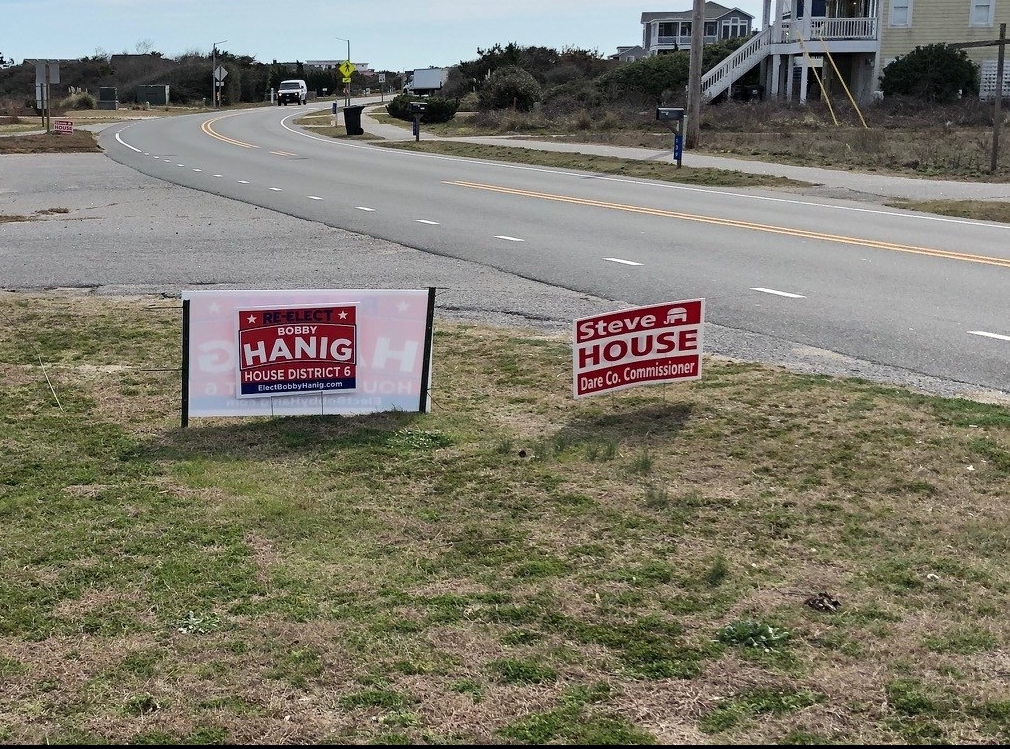
This sign on East Dogwood Trail expresses one voter’s sentiments on Super Tuesday. North Carolina is one of 14 states–also including Virginia–holding their presidential primaries today. Political-party nominations for N.C. state and local offices are also being decided.
The Town has projected that the total cost of the South Dogwood Trail sidewalk will be about $717,489, which is $282,511 less than the $1 million appropriated from the Town’s undesignated fund balance to pay for it, according to an apparent committee report that will be discussed at the Town Council’s regular general meeting tomorrow.
Because of today’s primary, the Council will meet on the first Wednesday this month, rather than the first Tuesday, at 5:30 p.m. in the Pitts Center. Voting will take place at the Pitts Center today until 7:30 p.m.
The Capital Infrastructure Improvement Planning (CIIP) Committee, which met last week and is now co-chaired by Councilmen Matt Neal and Jim Conners, has no jurisdiction over the South Dogwood Trail sidewalk project, but it appears from the meeting packet for tomorrow’s meeting that the committee has included the construction in a budget accounting of capital projects. (The Beacon was unable to cover last week’s CIIP Committee meeting.)
Besides a report, and possible recommendations, from the CIIP Committee co-chairs, the Town Council will take up a Request for Qualifications (RFQ) prepared by the Town of Duck for a coastal engineering and design consultant to manage, among other tasks, the maintenance cycle of the Duck, Southern Shores (at Pelican Watch), Kitty Hawk, and Kill Devil Hills beaches that were nourished in 2017. The RFQ smartly envisions a coordinated effort of beach management among the four towns.
Tomorrow’s Town Council business agenda is otherwise light, with the customary monthly staff reports, approval of the new Planning Board officers, and approval of a consent agenda that includes a resolution in support of a replacement for the Lindsey C. Warren Bridge, which crosses the Alligator River and is a connector along N.C. Hwy. 64, west of Dare County.
Interim Town Manager Wes Haskett’s report presumably will update the public on the status of a financing and tax-increase plan, to include potential municipal service districts, for nourishment of the entire Southern Shores shoreline. The Council requested this data from Mr. Haskett and the Town’s financial consultant, DEC Associates, at its Jan. 21 workshop meeting.
The detailed, but currently incomplete RFQ for what would be a multi-town coastal engineering consultant is broad in scope and ambition: It envisions a coordinated effort among the towns in planning and meeting their “shoreline management goals” and seeks a consultant who will provide “professional engineering consulting services for future beach nourishment and related shoreline management efforts” for all.
The draft RFQ document further reads in part:
“Although the Towns are not anticipating constructing another nourishment project for several years, the Towns wish to obtain consulting assistance now as we consider refinements to our approach, including development of long-term strategies, alternative approaches and associated funding mechanisms, and revisions to the Towns’ maintenance and monitoring plans.”
The dates for issuance by the Duck Town Clerk of the RFQ and for receipt of RFQ submissions have yet to be determined. All submissions are to be sent to Duck Town Hall.
LEFTOVER UNDESIGNATED FUNDS
The Town Council appropriated the money for the South Dogwood Trail sidewalk construction from the Town’s undesignated fund balance, which includes mandatory set-aside funds for emergencies, not from the FY 2019-20 capital-improvements budget.
The current fiscal-year capital budget is $662,340.
The budget report included in tomorrow’s meeting packet proposes that the “amount left from S. Dogwood Path [could be] available to use for other Capital Projects if Council so chooses.”
These monies also could be returned to the undesignated fund balance, if the “Council so chooses,” and applied, for example, to a future beach nourishment project.
The report also shows $377,616 of the fiscal-year capital budget of $662,340 not yet expended on the top four priority infrastructure projects.
The Beacon will give a full accounting of the CIIP Committee’s report and recommendations, as well as budgetary decisions by the Town Council on capital-improvement projects, after tomorrow’s meeting. We regret that we were unable to cover last week’s committee meeting.
The Town Council will hold the first of two fiscal year 2020-21 budget workshop meetings on March 24, at 9 a.m., in the Pitts Center.
PUBLIC FORUMON BRANCH LIBRARY MARCH 9: The Town’s Exploratory Committee for Potential Branch Library will hold a public forum at 6 p.m. on Monday, March 9, in the Pitts Center, to seek support for the Dare County branch library that it has proposed in Southern Shores.
TowneBank has offered to rent the 2,750-square-foot space to Dare County for 10 years at $1.00 per year. The design plan for the library, which is illustrated in the brochure, shows a computers/reading room, a conference/meeting room, and a youth-center room, in addition to a large main open area, a lobby, a librarian’s office, and restrooms.
According to the brochure, estimates for building adaptation costs run between $150,000 and $175,000, and the committee is working on an estimate of annual operating costs. All costs would be the responsibility of Dare County, if the County Commissioners approve the project.
If you support the library, The Beacon urges you to turn out for the forum.
Mayor Tom Bennett expressed support for an expansion of the no-left turn trial tried for one weekend in June 2018 to three weekends this summer during the heavily trafficked months of July and August shortly before the joint Town-sponsored citizens’ exploratory cut-through traffic committee-N.C. Dept. of Transportation (NC DOT) meeting adjourned last Thursday.
Trial expansion was a conclusion reached at earlier public forums about the traffic problem—and notably articulated by Town Councilman Matt Neal, who, with Mayor Pro Tem Elizabeth Morey, serves as an adviser to the committee–but it, curiously, was not the sole focus of last week’s meeting, as The Beacon had thought it would be.
Instead, committee chairperson Tommy Karole allowed free-ranging public comment, much of it repetitive of comments expressed in other meetings, to determine the flow of the dialogue among the six committee members; the four representatives from N.C. DOT who attended upon invitation; Town Police Chief David Kole; and the public.
DOT Division 1 Engineer Jerry Jennings, who said he had visited Southern Shores previously to discuss the traffic problems with Town staff and officials, was the chief spokesperson for the department. Interim Town Manager Wes Haskett also attended the meeting, but did not speak.
During the two-hour open discussion, Mr. Karole elaborated upon another idea for preventing northbound drivers from turning left on to South Dogwood Trail at Hwy. 158 and cutting through Southern Shores’ residential areas: that of installing a gate across both travel lanes of the road and issuing transponders to residents that would elevate the gate’s arms to permit their vehicles’ passage.
As Mr. Karole explained, the transponder, or signaling device, would be a sticker that a resident would place on the front bumper of his or her vehicle. The transponder would not be transferable to other vehicles, nor would non-residents be issued transponders. Instead, visitors who have business in Southern Shores would be able to punch an ever-changing code at the gate to gain access to South Dogwood Trail.
RESIDENTS URGE POSITIVE ACTION, SUPPORT FROM N.C. DOT
The transponder idea, which Mr. Karole said would relieve the police from any direct enforcement, did not receive the support of Chief Kole, who said he is opposed to closing any roads, but neither did the no-left turn trial or any other option suggested for curtailing the cut-through traffic.
Asked by homeowner Ursula Bateman, who lives on Sea Oats Trail where traffic backed up from Duck Road regularly blocks her driveway throughout summer weekends, what the Chief would do to ameliorate the problem, he shrugged his shoulders and replied that he has no solutions.
His humorous suggestion that residents rent out porta potties did not sit well with many residents.
The Beacon believes Seventh Avenue homeowner Paul Borzellino spoke for all residents who live on the cut-through route—which is ever-expanding—when he urged the Chief and the Town to set aside negative thinking and work toward moving the traffic quicker through Southern Shores on N.C. Hwy. 12 and away from the residential streets.
Mr. Borzellino’s sensible suggestion that police officers be stationed at traffic device-controlled intersections along N.C. 12 to move traffic along has been raised before. It met Thursday with the same reaction from Chief Kole as it did previously: The Town lacks “the manpower” to carry it out, he said.
In assessing the feasibility of implementing the no-left-turn option at the Hwy. 158-South Dogwood Trail intersection, DOT Engineer Jennings said he has to consider the “negative impact on the traffic flow of 158,” which is a state road.
South Dogwood Trail and other residential streets in Southern Shores—with the exception of a few private roads, such as a section of Fairway Drive and the road in Mallard Cove—are owned by the Town.
Mr. Jennings enumerated three concerns he would have about travel on Hwy. 158 if eastbound drivers were prohibited from turning left on to South Dogwood Trail:
Driver confusion, resulting from the fact that the road would be clearly open to traffic, but left-turners would not be able to use it.
Driver discouragement, resulting in drivers making U-turns on Woods Road or farther east at Duck Woods Drive.
Residents’ and other locals’ inconvenience.
In response to both Mr. Jennings’s and Chief Kole’s assertions that vacationers will get around the left-turn prohibition by making U-turns, homeowner Joe Van Gieson, who bikes around the area on summer weekends, said, “I don’t think we know what the effects of [the prohibition] will be.”
Mr. Van Gieson stressed that the Town has only one weekend of experience with a left-turn prohibition, and it was a lightly traveled weekend in June 2018, before the summer traffic crush. In July and August, he observed, Woods Road backs up with vacationers heading to the southern beaches by cutting through Kitty Hawk Village. Woods Road—which is the western extension of South Dogwood Trail in Kitty Hawk—is not an easy road on which to make a U-turn, he noted.
Both Ms. Morey and Mr. Neal politely pressed Mr. Jennings and the other N.C. DOT representatives to tell them what resources the department could give the Town of Southern Shores if it were to seek implementation of the no-left-turn option.
“What will N.C. DOT do?” asked Ms. Morey, before suggesting assistance with highway signage, public relations, information dissemination, and other similar support.
Earlier, Mr. Jennings said he would look into reprogramming the left-turn signal on Hwy. 158 so that it would not go through its green-yellow-red rotation and, thus, lead drivers to believe a left turn is still permitted—even though the lane would be blocked by barrels and a police car with its blue light flashing! During the June 2018 trial, the left-turn signal functioned normally, with no adjustment, creating unnecessary confusion.
Mr. Jennings said DOT could again post two signs on Hwy. 158 in Currituck County, just before drivers cross the Wright Memorial Bridge, warning of the upcoming left-turn prohibition, but he made no commitment to installing signage on the eastbound side of the road before the bridge.
Thursday’s meeting did not conclude with a plan of action to present to the Town Council, as The Beacon thought it would—in light of the Council’s upcoming fiscal year 2020-21 budget work sessions this month and in April.
Speaking with The Beacon after the meeting, Mr. Karole said he intends to convene another meeting of his committee soon to finalize its report to the Council, which he hopes to present at the March 24 budget workshop.
As for his transponder idea, Mr. Karole acknowledged that it is “too much for now,” but he intends to study it further.
“The technology is there,” he said. “It exists.”
The breakaway gates would be monitored by cameras, he explained, and they would be on a Town-owned road, so the N.C. DOT’s involvement would not be required.
SOUTHERN ENVIRONMENTAL LAWCENTER DOES NOT CHARGE LEGAL FEES
At Thursday’s meeting Councilman Jim Conners again drew attention to the efforts he has made with elected officials to promote the Mid-Currituck Bridge, which would connect the Currituck mainland with Corolla and allow northern beach vacationers to bypass Southern Shores.
This time the Councilman included U.S. Senator Thom Tillis, along with N.C. House Representative Bobby Hanig and N.C. Senator Bob Steinberg, among the people he said he has lobbied. All three officials are up for reelection this year.
While The Beacon appreciates Mr. Conners’s advocacy for the good of the Town, we cannot ignore a significant factual error he committed. In speaking about the lawsuit that “environmentalists” have filed against N.C. DOT and the Federal Highway Administration and which has halted progress on the bridge, he referred to lawyers running up “billable hours.” This is simply not the case.
The Southern Environmental Law Center (SELC), which represents the plaintiffs in the N.C. DOT-Mid-Currituck Bridge litigation, does not charge legal fees. It is a public-interest environmental law firm whose $9.5 million budget is funded exclusively through charitable gifts from individuals, families, and foundations.
You can send a tax-deductible donation to the SELC, just as you would to the ASPCA, the Wounded Warrior Project, or another non-profit organization of your choice.
Further, the SELC’s clients are exclusively non-profit entities. In the Mid-Currituck Bridge lawsuit, which was filed in federal court last April, its clients are the N.C. Wildlife Federation (NCWF), a conservation organization founded in 1945, and the No Mid-Currituck Bridge-Concerned Citizens and Visitors Opposed to the Mid-Currituck Bridge, abbreviated as “No MCB.”
The plaintiffs’ lawsuit asserts essentially that the $600 million toll bridge across the sound will seriously harm “highly sensitive and important wildlife habitat in the Currituck Outer Banks.” This destruction, according to their complaint, will adversely affect NCWF members who “visit, recreate, fish and hut, observe wildlife, photograph, and otherwise use and enjoy the Currituck Sound and Outer Banks.”
The complaint also states that No MCB is a non-profit organization that was formed in 2009 and is “made up of more than 50 Currituck County residents, visitors, and property and business owners opposed to the construction of the Mid-Currituck Bridge.”
The “mission” of No MCB, it states, “is to protect the unique natural environment of the Currituck mainland and the northern Outer Banks, including the area’s fish spawning habitat, migratory bird habitat, wetlands, and beaches. No MCB believes that there are more cost-effective, and less environmentally damaging ways to address summertime traffic congestion that have been pushed aside in favor of this politically influenced project.”
Founded in 1986 in Charlottesville, Va., the Southern Environmental Law Center is active throughout the Southeast, protecting natural resources. The chances are that among the SELC’s numerous projects, you will find many that you support. Case in point: offshore drilling.
A leading voice against offshore drilling, which the Town of Southern Shores officially has opposed, the SELC joined other conservation groups last year to sue the Trump Administration to stop seismic blasting in the Atlantic Ocean. The use of seismic blasting—airguns to test the ocean floor for fuels—is viewed as a step toward initiating offshore drilling.
MARCH 3 IS SUPER TUESDAY: For links to sample ballots and other information about the primary, see The Beacon, 2/13/20. You may vote at the Pitts Center from 6:30 a.m. to 7:30 p.m.




 The Southern Shores Beacon