4/25/24: FLAT TOP TOUR IS SATURDAY (1 to 5): TOWN TO HOST RIBBON-CUTTING CEREMONY AT ITS NEWLY RENOVATED SKYLINE ROAD FLAT TOP. PLUS New Southern Shores Roastery Café Offers Free Cup of Coffee to Ticketholders and More Details About the Sixth-Ever Tour. 

According to legend, the lot on which the flat top at 23 Porpoise Run sits was won by an early owner, with several other lots, in a poker game. Built in 1958 and designated a historic landmark, the Sokol/Clements Cottage was purchased in 1999 by its current owner, who artistically renovated the cottage while preserving its primary architectural attributes. Check out her before-and-after pictures when you tour the home.

The Town of Southern Shores will host a ribbon-cutting ceremony 11 a.m. Saturday at its newly renovated flat top cottage at 13 Skyline Road, shortly before the start of the sixth-ever flat top cottage tour, which is scheduled from 1 p.m. to 5 p.m. Fourteen mid-century flat tops, including all five of the cottages that have been designated historic landmarks, will be open for viewing.

Tour tickets are $10 each and are available in person, by cash or check, from the Southern Shores Historic Flat Top Cottages group’s box-office tent in the southeast corner of the parking lot of the Southern Shores Crossing shopping center, from 10 a.m. to 1:30 p.m. Saturday; and online, with a $1.50 handling fee, at https://southernshoreshistoricflattops.ticketleap.com.

All ticket proceeds will benefit the Flat Top Preservation Fund of the Outer Banks Community Foundation (OBCF).

The Southern Shores Crossing is located at 1 Ocean Blvd., behind Southern Shores Realty, and is a good place to gather before the tour starts.

Shore Coffee Roasters, a roastery café whose space in the Crossing is being readied for opening, will be set up outside Saturday, offering tour ticketholders a free cup of coffee from 10 a.m. to 1:30 p.m., as well as selling coffee to paying customers.

According to tour organizer Sally Gudas, who will be selling tickets, four merchants in the Crossing will be donating 10 percent of their day’s sales proceeds to the preservation fund. They are Shore Coffee Roasters, Southern Shores Pizza, Sojourn, and Steamers.

You may pick up your ticket, a tour map, and a handout about the 14 cottages’ histories at the box office tent. Those who purchase their tickets online may print out these materials in advance or pick them up at the box office—and grab a cup of coffee nearby. Shore Coffee Roasters is located in the space once occupied by Coastal Provisions.   

RE-OPENING 13 SKYLINE ROAD

Nature artist, real estate developer, and Southern Shores founder Frank Stick designed and built the flat top at 13 Skyline Road in 1953. Mr. Stick (1884-1966), who primarily concerned himself with early oceanfront construction, referred to the flat top as “the cottage in the dunes.”  

Much has been written about Frank Stick’s 1947 purchase of the 4-square-mile tract of land north of Kitty Hawk that would become Southern Shores and the artist’s vision of an exclusive oceanfront-to-soundfront community. We will say only that he sought to build dwellings that blended in with the sand and would be sturdy during harsh weather, and was influenced by houses he saw in Key West, Fla.

On the tour you will learn about the 42-pound blocks of concrete that were made with local sand (son David Stick, historian and author, writes in his memoirs about constructing them!), the juniper paneling that came from local trees (and, thus, was more affordable), the no-pitch roofs, and other flat-top features.

The Town purchased the Skyline Road flat top last year for $400,000 from the Outer Banks Community Foundation, which operated its office out of the cottage for 15 years before it relocated to Manteo.

The OBCF acquired the cottage in 2007 as a gift from longtime owners, Dr. John R. Tietjen and his wife, Norma F. Tietjen. The Tietjens, who are now deceased, sought in the covenants to their deed of gift to preserve Southern Shores history, to honor Frank Stick, and to benefit non-profit causes. (For background about the cottage and the Tietjens, each of whom lived nearly 99 years, see The Beacon, 4/14/24.)

The Town has returned the historic flat top to a residence, the restoration of which has been managed by Town Police Chief David Kole. The flat top is expected to be occupied temporarily by newly hired Southern Shores police officers, who may have difficulty finding affordable permanent housing. 

The flat top is adjacent to a now-vacant lot at 7 Skyline Road that the Town bought in 2015 for $205,000. The Town demolished a small single-story house in need of repair that was on the site and has yet to use the property. This lot is next to the Kern Pitts Center and has been described as part of the “Town complex.”

TAKING THE TOUR

The flat top tour is self-guided, so you may start at any one of the 14 open houses. It is not a walking tour, except where some of the cottages are located in close proximity to each other, so be prepared to look for parking as you move en route. Tour parking will be designated in several areas, but most of the parking will be on the street or in the driveways of the tour homes. Parking will be permissible without a permit on Town roads Saturday, but not on N.C. Hwy. 12.

(For those who are unfamiliar with the area: Ocean Boulevard is N.C. Hwy. 12 until the road splits, going north, at the cell tower park. If you stay to the right of the tower, you will continue on the “local” section of Ocean Boulevard, which is Town-owned; if you veer to the left, you will be on a section of N.C. 12 that is called Duck Road and is State-owned.)

If you start with 13 Skyline Road and travel north, your route will take you to these flat tops, in order of location; those that are asterisked have been designated historic landmarks:

78 Skyline Road: Lambroff Cottage

43 Ocean Blvd.: Powell/Harritt Cottage

69 Ocean Blvd.: Sea Spray Cottage

113 Ocean Blvd.: Knight Cottage

142 Ocean Blvd.*: Seaquel

Just past the cell-tower split on Duck Road, you will make a left turn on to Porpoise Run to see the two flat tops located on Wax Myrtle Trail. They are:

156 Wax Myrtle Trail*: Clarke/Gudas Cottage (the third house on the right, at the corner of Porpoise Run and Wax Myrtle)

159 Wax Myrtle Trail: Falconer Cottage

After you’ve toured these two cottages, we suggest that you return to Porpoise Run and cross Duck Road to see the flat top on the east side of Porpoise Run, which is only a block long. If you choose, you can walk from Wax Myrtle Trail to Porpoise Run (or vice versa). The house on Porpoise Run is:

23 Porpoise Run*: Sokol/Clements Cottage (pictured above)

From Porpoise Run, travel east to Ocean Boulevard and turn left. In order of location, you will come to:

157 Ocean Blvd.: Sea Breezes

169 Ocean Blvd.: Atlantic Breezes

170 Ocean Blvd.*: Pink Perfection (the Edith Pipkin Cottage, the oldest and perhaps the loveliest flat top on the tour, it is currently owned by two great-nieces of Ms. Pipkin)

218 Ocean Blvd.*: Mackey Cottage

Before the Mackey Cottage, you may wish to turn left on East Dogwood Trail and visit:

18 East Dogwood Trail: Oh So Sandy! Newman

Or you can visit it before you walk to the Mackey Cottage.

Homeowners will be present in all of the cottages except those at 142 and 170 Ocean Blvd.

You are likely to encounter a display of vintage photographs and other artifacts from bygone years of tranquil beach living at the homes, as well as personable hosts, a few of whom have memories of Southern Shores when it was predominantly a community of flat tops.  

The Town of Southern Shores established a Historic Landmarks Commission in 2016 to raise awareness of the historic significance of properties in town and to encourage preservation. While only five of the approximately 25 existing flat tops have been designated historic landmarks, others are eligible, but homeowners need to apply for the status.  

SAYING HELLO (AND THANK YOU) TO SALLY AND STEVE

If you prefer to start your tour in the middle, or if there is congestion that sends you in that direction, we recommend that you go by the Clarke/Gudas Cottage and meet Sally and Steve Gudas, the very knowledgeable, friendly, and hard-working organizers of the flat top tour. Steve will be on his own at their charming flat top until Sally closes ticket sales and joins him.

Sally’s history with the Outer Banks goes back to the 1970s and, if yours does, too, you may enjoy reminiscing with her about the good old days.

For all of the tour info you may need, please check out https://southernshoreshistoricflattops.ticketleap.com/ southern-shores-historic-flat-top-cottage-tour/.

We hope to see you out there for this celebration of Southern Shores’ singular architectural history.    

By Ann G. Sjoerdsma, 4/25/24
4/23/24: PLANNING BOARD RECOMMENDS APPROVAL OF LATEST LOT-WIDTH ZTA; WE HAVE QUESTIONS. Early Voting for State Runoff Election Starts Thursday.

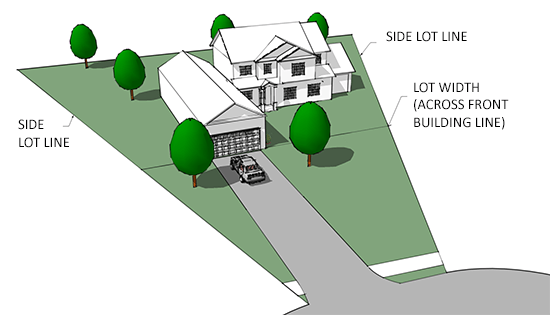
This stock drawing illustrates another method by which to measure minimum lot width: The mandatory minimum width must exist at the front building line, which is not the same as the front setback line, and continue to the rear of the lot. This method applies readily to irregular lots, such as those on a cul de sac, which have been a concern of the Town and the Planning Board.

The Southern Shores Planning Board unanimously recommended approval at its April 15 meeting of the latest Zoning Text Amendment about lot width (ZTA 23-05), accepting a definition that we find questionable, but also amending the proposed ordinance to fix an error. 

Because Board Chairperson Andy Ward arrived late for the meeting, and neither of the two Alternates attended, only four Planning Board members participated in the discussion and vote about ZTA 23-05.

(For background, see The Beacon, 4/12/24. The Beacon has extensively covered the previous versions of the proposed zoning ordinance changes.)

At issue in ZTA 23-05 is the “how to” of measuring the minimally required width of lots created after June 6, 2023, presumably through recombination or subdivision. A stopgap ordinance has been in effect since that date, essentially requiring all newly created lots to meet the mandatory minimum lot width in a zoning district throughout the lot and, thus, be rectangular. It does not permit irregularly shaped lots.

The proposed ordinance creates a “lot width line” at which to measure a lot’s minimum width, which must be 100 feet in the RS-1 single-family residential and the R-1 low-density residential districts; 75 feet in the RS-8 multi-family residential and the RS-10 high density residential districts; and 50 feet in the government and institutional district.

The ZTA eliminates the use of the “building setback line,” which proved to be confusing, as the line where lot width was to be measured.  

Before the Board’s action, the proposed definition of lot width line, which will appear in Town Code sec. 36-57, if the Town Council enacts ZTA 23-05, referred only to 100 feet and not the other mandatory widths in the various districts and read as follows:

“Lot width line means a line established 25 feet from the front lot line, or the point where the lot is 100 feet wide, whichever distance is closer to the front lot line.”

Planning Board Member Robert McClendon picked up on the omission of the other lot widths, as did The Beacon on 4/12/24, and drew it to the attention of Deputy Town Manager/Planning Director Wes Haskett, who had reviewed the ZTA with the Town Attorney. The revised ZTA, which may be presented to the Town Council for public hearing at its May 7 meeting, will refer to the various minimum lots in all of the districts.

Even with this correction, we have a problem with the definition. Perhaps you can tell us what we’re missing. Please comment on the blog web site or email us at ssbeaconeditor@gmail.com. The Planning Director, the Town Attorney, and four members of the Planning Board had no issue with the language, which, with the correction, would read similar to this:

“Lot width line means a line established 25 feet from the front lot line, or the point where the lot is [50/75/100 feet wide, depending on the district], whichever distance is closer to the front lot line.”

Mr. Haskett demonstrated with a visual projection at the meeting how to determine minimum lot width where the width does not measure the mandatory minimum 25 feet from the front lot line: He drew a vertical line from the front line to the area in the lot where the mandatory minimum width, say 100 feet, is achieved, and then drew a horizontal line there from one side lot line to the other, saying that this line is the lot width line.

We follow this thinking, but we ask: When, and how often, is that line ever going to be closer to the front lot line than the line that is 25 feet from the front lot line? And if it is not, won’t the 25-foot line, by the ZTA’s definition, supersede it?  

It seems to us that the qualifying phrase “whichever distance is closer to the front lot line,” should be deleted, and the definition written so that the lot width line is where the minimum lot width is first achieved, going from front to back in the lot. It also makes sense to us to require the width of the lot from that line to the back line measure at least the minimum.

Before June 6, 2023, the minimum front-yard setback, also referred to as the building setback line, served as the measuring line for lot width in all of the districts. This setback is 25 feet from the street right of way. With the Town deciding that there no longer is a need or desire to use this setback line for lot width, we see no reason to mention the 25-foot line in ZTA 23-05 and to present an either-or choice.     

The point of rewriting the lot width requirements for newly created lots was to eliminate any ambiguities in the Town Code language. We do not believe this objective has been achieved and welcome your comments.

You may access the uncorrected ZTA 23-05 here: https://www.southernshores-nc.gov/sites/default/files/fileattachments/planning_board/meeting/3103/4-5-24_zta-23-05_lot_width.pdf.

COMMERCIAL DESIGN STANDARDS PROPOSED

The Planning Board also discussed proposed ZTA 24-03, which the Town submitted and, in its most significant part, establishes design standards for buildings in the commercial district. (See The Beacon, 4/12/24 for the list of proposed standards.)

Mr. Haskett will revise the ZTA to incorporate the feedback he received from the Planning Board and present a new version of the measure at the Board’s May 20 meeting.     

You may access ZTA 24-03 here: https://www.southernshores-nc.gov/sites/default/files/fileattachments/planning_board/meeting/3103/zta-24-03_commercial_design_standards.pdf.

A BREAK ON MEETING REPORTS

We have had great difficulty in recent months in keeping up with the Planning Board and the Town Council and, as a result, have too often written posts belatedly and in haste. Errors have crept into our copy that should not occur. Rather than continue to fight an uphill battle, we are going to take time off from reporting on Town meetings for at least a month. If there is anything of note in the Town Manager’s recommended budget for FY 2024-25, which he will present to the Town Council on May 7, we will bring it to your attention.  

Thank you.

EARLY VOTING FOR MAY 14 RUNOFF ELECTION STARTS THURSDAY

Early voting for the May 14 statewide runoff election—aka the second primary election—begins Thursday and will run until May 11, excluding weekends. On the ballot to become their political party’s nominee for the November general election will be two Republican candidates facing off for the offices of N.C. Lieutenant Governor and N.C. Auditor.

A runoff election is held when no candidate from the primary election, which was held on March 5, receives the required 30 percent of the votes cast to be named the party nominee.

James (Jim) O’Neill is vying with Harold (Hal) Wetherman to represent the Republican Party as its nominee for Lieutenant Governor, and David (Dave) Boliek opposes Gerard (Jack) Clark in the second primary race for Auditor.

Only registered Republicans and Unaffiliated voters who voted in the Republican primary on March 5 may vote in the runoff election.

Early voting will be held at the Kill Devil Hills Town Hall, the Dare County Administration Building, and the Fessenden Center Annex in Buxton. The hours are as follows:

April 25 and April 26: from 8 a.m. to 7:30 p.m.

Weekdays, Monday, April 29, to Friday, May 10: from 8 a.m. to 7:30 p.m.

Saturday, May 11: from 8 a.m. to 3 p.m.

There will be no weekend hours other than on May 11.

By Ann G. Sjoerdsma, 4/23/24   

4/16/24: DELAYED BULK-ITEM PICKUP WILL BE FINISHED TOMORROW, TOWN SAYS. Plus TOWN MANAGER CONFIRMS THERE WILL BE NO TAX INCREASE TO BALANCE FY 2024-25 BUDGET.

The bulk-item pickup scheduled for last Friday will be completed by tomorrow (4/17), according an announcement posted today on the Town of Southern Shores website. The Town thanks you for your patience and requests that you not put any more items out for pickup because they will not be collected.

EARTH DAYS, APRIL 20-22: For information about how you can participate in the cleanups and other activities planned for Earth Days 2024 in Southern Shores, go to https://www.eventbrite.com/e/earth-days-2024-tickets-872011308297.

Earth Day is April 22. It was first celebrated in 1970.

BREAKING NEWS BULLETIN: NO TOWN TAX INCREASE FOR FY 2024-25.

The Town will not seek a tax increase in order to balance the fiscal year 2024-25 Town budget, Town Manager Cliff Ogburn confirmed at this morning’s budget workshop with the Town Council. Any shortfall between revenues and expenditures will be made up by a disbursement of monies from what Mr. Ogburn described as “$4.8 million in spendable fund balance.”

By “fund balance,” Mr. Ogburn refers to the Town’s undesignated fund, which it maintains for emergency purposes, such as natural disaster relief. By order of the Town Council, this fund must contain at least $3.5 million.

The Beacon looked at the big-ticket expenses anticipated in the next fiscal year budget on 4/6/24.

THE BEACON, 4/16/24

4/12/24: REVISED LOT WIDTH ZTA BACK BEFORE PLANNING BOARD MONDAY, ALONG WITH NEW ZTA PROPOSING COMMERCIAL DESIGN STANDARDS.  

For information about how you can participate in the cleanups and other activities planned for Earth Days 2024 in Southern Shores, go to https://www.eventbrite.com/e/earth-days-2024-tickets-872011308297.

The Town of Southern Shores is proposing to define a “lot width line” by which to calculate minimum lot widths in the residential and governmental and institutional (GI) districts and has incorporated this definition into its latest version of Zoning Text Amendment 23-03, which will come before the Planning Board at its regular monthly meeting Monday.

The Board will meet at 5 p.m. in the Pitts Center. You may live-stream its meeting via the Town’s You Tube website.

You may access the Board’s agenda here: https://www.southernshores-nc.gov/sites/default/files/fileattachments/planning_board/meeting/3103/4-15-24_pb_meeting_agenda.pdf.

For background on the handful of versions of ZTA 23-03–which has been renumbered ZTA 23-05–that the Planning Board has considered in the past year, see The Beacon, 4/3/24.

In addition to simplifying the measurement of lot width, the new ZTA 23-05 proposes to amend the Subdivision Ordinance definition section (Town Code sec. 30-2) by importing the meaning of “yard” used in the Zoning Ordinance (Code sec. 36-57), and requiring all preliminary plats for subdivisions to show the proposed lot width line and proposed yards.   

Before untangling ZTA 23-05, we further note that the Town has submitted a new zoning text amendment for the Planning Board to consider Monday: ZTA 24-05, which amends parking space requirements for uses other than single-family residential homes and establishes commercial design standards, among other proposed zoning changes.    

The two ZTAs may be accessed here:

ZTA 23-05: https://www.southernshores-nc.gov/sites/default/files/fileattachments/planning_board/meeting/3103/4-5-24_zta-23-05_lot_width.pdf.

ZTA 24-03: https://www.southernshores-nc.gov/sites/default/files/fileattachments/planning_board/meeting/3103/zta-24-03_commercial_design_standards.pdf.

We do hope members of the Planning Board have received more notice than the public did that these two ZTAs were coming down the pike: The agenda and supporting materials were posted on the Town website this morning. Otherwise, it’s fair to say that they are being inundated.

FIRST UP: ZTA 23-05 AND LOT WIDTH

ZTA 23-05 defines a “lot width line” as a “line established 25 feet from the front lot line, or the point where the lot is 100 feet wide, whichever distance is closer to the front lot line.”

We read this definition to mean that the lot width line is either 25 feet from the front lot line or closer. Clearly, this is not what was intended.

ZTA 23-05 also defines “lot width” as “the width of a lot at the required lot width line.”

The Town previously measured lot width at a point 25 feet from the front lot line, but used different language to define this measurement.

Each of the Town Code sections about minimum lot width in the residential and GI districts now incorporates this concept. For example, proposed section 36-202(d)(2), which applies to the RS-1 single-family residential district, now reads:

“Minimum lot width for lots created after June 6, 2023: 100 feet (measured at the lot width line).”

We do not understand, however, why or how the lot width line, as defined, applies to the RS-8 multifamily residential district and the RS-10 district, both of which have minimum lot widths of 75 feet, or to the GI district, which has a minimum lot width of 50 feet.  

As we reported 4/3/24, the new lot-width measurement only applies to lots newly created through recombination or subdivision. The date, June 6, 2023, references when the Town Council enacted the lot-width measurement that is currently in the Town Code.

ZTA 23-05 also deletes the term “building setback line,” and its definition, in section 36-57 and section 30-2. The term was formerly used in determining minimum lot width and proved to be confusing.

“Yard” actually refers to what we think of more often as a setback. It is a required area of open space that is “unoccupied and unobstructed by any structure or portion of a structure, from 30 inches above the ground level of the graded lot upward.”

There are structural exceptions to this requirement of openness, and they include fences, walls, poles, posts, steps, etc., as qualified in other sections of the Town Code. For example, walls and fences that are higher than 30 inches are allowed in residential-district setbacks, provided they do not exceed six feet. This is Code section 36-97.   

We find a complication with the yard setback provisions and the new definition of lot width. See what you think:

“Yard, rear” is defined currently in sec. 36-57 (and extended to sec. 30-2 by ZTA 23-05) as “a yard extending across the rear of the lot between side lot lines.”

That is clear enough, but there’s more, because the “Depth of a required rear yard shall be measured in such a manner that the yard established is a strip of the minimum width required by district regulations with its inner edge parallel with the rear lot line.”  

Does this mean that the rear setback—which in the single-family residential district is 25 feet in length—must always be 100 feet in width? In other words, the rear yard always must measure 25 by 100?

The same language appears in “Yard, side,” which is defined as a “yard extending from the rear line of the required front yard to the rear yard.” The width of a required side yard, the ordinance says, “shall be measured in such a manner that the yard established is a strip of the minimum width required by district regulations with its inner edge parallel with the side lot line.”

Does this language conflict with the new method of defining lot width? It suggests to us that the lot width must be 100 feet, in the RS-1 district, throughout the lot. Are we missing something?

At the very least, there is confusion.

NEXT: NEW COMMERCIAL DESIGN STANDARDS

We will leave ZTA 24-03’s proposed changes to off-street parking requirements,” (Code sec. 36-163), for a report after the Planning Board has tackled it. According to the preamble of the ZTA, the amendments bring the Town Code in conformance with the N.C. General Statutes.

The proposed commercial design standards in the zoning measure grew out of discussions by the Planning Board that date back to November 2022. The Board initially considered commercial design standards already adopted by Duck, Kill Devil Hills, and Nags Head.

The nine standards set forth in ZTA 24-03 for “new construction and substantial improvements” in the general commercial district are, and we quote:

  1. Paint colors shall be of low reflectance, subtle, neutral and earth tone colors;
  2. Mechanical equipment shall be screened and shall not be visible from any right-of-way;
  3. Fences shall be constructed of wood, or match the materials used for the building;
  4. No commercial building front shall remain unbroken (unpierced) by a window, architectural element, entrance or functional general access doorway for more than 50 feet;
  5. Windows shall comprise no less than 10% and not more than 40% of each building’s vertical wall area;
  6. No awning on any building which encroaches on a sidewalk or pedestrian walkway shall extend out from the building more than 2/3 the width of the sidewalk nor shall it at any point be less than 8 feet above the sidewalk;
  7. Wall articulations (or breaks in the façade or roofline) shall be designed not less than every 50 feet along the building façade;
  8. Architectural embellishments that add visual interest to a façade or roof such as dormers, chimneys, cupolas, watch and clock towers, shutters and other similar elements are encouraged;
  9. Roofs shall be constructed with one or more of the following roofs: hip, gable or mansard.

These standards constitute section (b) of a new ordinance, titled “Commercial design standards,” and numbered section 36-179 in the Town Code. Proposed section (a) applies to “sketch plan review” of plans showing the proposed development of “new construction or substantial improvements,” other than one- and two-family dwelling units, in the general commercial district.

ZTA 24-03 also adds the term, “substantial improvement,” and its definition, to Town Code sec. 36-57. It means “any combination of repairs, reconstruction, rehabilitation, addition, or other improvement of a structure, taking place during any one-year period for which the cost equals or exceeds 50 percent of the market value of the structure before the start of construction of the improvement.” (See the ZTA itself for further stipulations.)

We regret that scheduling conflicts prevent us from attending or live-streaming the Planning Board’s meeting Monday and the Town Council’s FY 2024-25 budget workshop meeting Tuesday at 9 a.m. in the Pitts Center. We do not know when, or if, we will be able to cover either of these meetings, but we definitely plan to report on any developments that come out of them.

Town Manager Cliff Ogburn previously announced that he will present his recommended FY 2024-25 budget to the Town Council at its May 7 meeting.  

By Ann G. Sjoerdsma, 4/12/24    

4/10/24: DARE COUNTY COMMISSIONERS UNANIMOUSLY VOTE TO QUIT AFFORDABLE HOUSING PROJECT, RETURN $35 MILLION GRANT TO THE STATE.

(Stock photo. For illustration purposes only.)

The Dare County Board of Commissioners unanimously voted yesterday to “halt” its efforts to build affordable housing in the county and to return the $35 million loan that the State of North Carolina gave it for this purpose.

The Board’s surprising decision came after the seven commissioners listened to nearly 2 ½ hours of public comment, some of which was critical of chosen developer, Coastal Affordable Housing LLC, and to County Manager/Attorney Bobby L. Outten elaborate in detail upon all of the actions taken by Dare County during the past 4 ½ years to make affordable housing a reality.  

By the time all of the commissioners had an opportunity to speak, it was clear that a majority of them had become frustrated and exhausted with one major hurdle preventing Dare from going forward with an affordable housing project: the “NIMBY” attitude of homeowners in the vicinity of the sites where such projects have been proposed.

“Not in My Back Yard,” some of the commissioners said, defeated the County’s sincere efforts to bring affordable housing to an essential workforce that is increasingly forced to live outside of Dare County because housing rents and prices here are too high.

For our money, the commissioners gave up too soon. No one ever said it was going to be easy. Worthwhile objectives rarely are.  

HOW DID WE GET HERE?     

In explaining “How did we get here?” Mr. Outten went back to Dare’s early efforts to network with housing authorities in Raleigh and to work with the non-profit Development Finance Initiative at the UNC School of Government that was poised to help it by identifying developers willing to participate in a public-private partnership to build the housing that Dare County needs.

During its consultancy with the DFI, the County created a $12 million fund for an affordable housing project. It did not move ahead with DFI, however, because it “got word” in 2021, Mr. Outten said, that the State had budgeted $35 million to Dare County to develop such housing. The State money, he said, came out of an American Rescue Plan (ARP) stimulus fund established by the U.S. government during the COVID-19 pandemic.   

This money, which was set up as a forgivable loan, was not sought by Dare County and came as a surprise to the Board of Commissioners and Mr. Outten.

Because of its source, federal rules attached some “strings,” the County Manager said, one of which was the requirement that Dare County issue an RFQ—Request for Quotation—to solicit developers. It was through the RFQ process that the County identified developers Woda Cooper Cos. and Coastal Affordable Housing and elected to work with both.

Woda Cooper already owned land in Nags Head that was zoned for multifamily housing and planned to develop it, according to Mr. Outten. The County decided to apply its $12 million housing fund to this project, which, unfortunately, fell through after many people in the Nags Head community objected to it, and the Town of Nags Head rezoned the property to prevent it.  

Coastal Affordable Housing offered to invest $65 million of its own money to bring a total of $100 million to what was originally envisioned as a single project of about 400 affordable housing units. The County adjusted this design, however, to include a project of multiple sites, rather than one housing site, because of community opposition to large projects proposed by Coastal on the beach and Roanoke Island.

(We believe four projects, including the one in Nags Head, were defeated. Mr. Outten did not specify the number.)   

During the past year, Coastal Affordable Housing has been unable to locate a suitable property site or multiple sites to buy and develop, Mr. Outten said, but the County Manager concluded his briefing with the indication that the County was “waiting” for the right situation to emerge.

We would have liked to have heard Mr. Outten’s recommendation about how to proceed. We believe he would have advised the Board to stay the course.    

‘UNWINDING’ THE PROJECT, RETURNING MONEY

Commissioner Steve House, who lives in Southern Shores and represents Duck, Southern Shores, and Kitty Hawk, made the motion that led to Dare’s “bailout.”

He prefaced it by saying: “Everyone understands that there’s a need for essential housing, however, they do not want it in their backyards, and there are no backyards left.”

Mr. House then made a vague and awkwardly worded motion that other commissioners sought to clarify.

“I make a motion,” he said, “to halt this project and give the County Manager the authority to take the appropriate steps to unwind it.”  

After Commissioner Bea Basnight seconded the motion, Commissioner Rob Ross (Nags Head, Colington, Kill Devil Hills) pointedly asked: “By unwinding the project, we are saying the money will be returned to the General Assembly, yes or no?”

Mr. House softly replied, “Yes,” then more loudly said, “That’s the only way it can go.”

Mr. Outten then clarified that, besides “stopping [County] efforts on affordable housing,” he would have “to go to the Office of Management and Budget and get instructions on what we have to do.”

(We assume because the money comes from an ARP, Mr. Outten is dealing with the U.S. OMB, not with the North Carolina equivalent, which is the Office of State Budget and Management. Mr. Outten certainly should know that.)

When Mr. Outten reiterated that he would have to go to the “OMB and find out what to do with the money,” Chairman Woodard quickly added, “And how to return it.”

Before Mr. House made his motion, each Commissioner responded to—and, in some instances, pushed back against—the public comments he or she heard and talked about the substantial efforts that the County has made to learn about, contract for, and develop affordable housing.

To truly appreciate the hurdles, the complications, and the commitment and delays of time, we strongly urge you to listen to Mr. Outten’s talk, which begins at two hours, 19 minutes into the meeting videotape, and ends around two hours, 45 minutes. His talk is dense, so you may have to listen a few times to glean all of the details.  

The Commissioners’ frustration with the public—with misinformation and lack of information, with misguided ideas of what the County can and cannot do legally—came through in their remarks, but it wasn’t until Ervin Bateman (At Large), the fifth Board member to speak, that the word, “NIMBY,” was uttered.

Mr. Bateman opened the door, with some regret. Chairman Woodward had no difficulty saying, in his rebuke of the status quo, “It is clearly a NIMBY situation, and I don’t know how we overcome it.”

The plainspoken Commissioner Ross admonished members of the public for their false assumptions and erroneous conclusions and expressed disappointment and sadness about the way things have progressed, while Mr. House wondered if “the citizens of Dare County actually want” affordable housing.

Mr. Bateman, a restaurant owner who provides rental housing for his employees, recalled the euphoria he felt when he learned from a friend in the Governor’s office about the $35 million loan.

“It was a gift from God,” he exhorted. “It just dropped out of nowhere, and all of a sudden $35 million just landed in our laps. . . .”

Mr. Bateman and his fellow commissioners “were excited as the dickens,” he continued. “We were high-fiving each other” as they went into “housing summits.”

“We can make a difference in Dare County!” he said. “We can make things happen here!”

We believe you still can, but not if you quit when the going gets rough. Thirty-five million dollars is a big price to pay when it costs nothing to let things ride for a while.

TASK FORCE MEETING: The Dare County Housing Task Force has not disbanded and will meet next Tuesday, at 9 a.m., in Room 168 of the Dare County Administration Bldg. in Manteo. The task force should feel free to do the creative brainstorming that the Board of Commissioners apparently does not wish to do.

By Ann G. Sjoerdsma, 4/10/24   

4/6/24: COMING TUESDAY: TOWN COUNCIL TO MEET, DARE COMMISSIONERS TO DISCUSS HOUSING EFFORTS, CHART FUTURE. PLUS We Look at the Town’s FY 2024-25 Budget, ‘Big-Ticket’ Expenses.

Replacement of the culvert at the Juniper/Chicahauk trail bridge is estimated to cost $1.6 million.

The Town Council will hold its regular business meeting on Tuesday at 5:30 p.m. in the Pitts Center. The Dare County Board of Commissioners (Dare BOC) will meet earlier that day at 9 a.m. in Manteo for a special public meeting concerning efforts to create essential workforce housing in Dare.  

For the Town’s agenda and meeting packet, see: https://mccmeetings.blob.core.usgovcloudapi.net/soshoresnc-pubu/MEET-Packet-38cd44eae64343eba573eed122bd2f69.pdf.

For the Dare Commissioners’ meeting, see: https://content.govdelivery.com/accounts/NCDARECOUNTY/bulletins/394004b.

You may live-stream the Dare BOC meeting at https://www.youtube. com/DareCounty.

A livestream of the Town Council meeting is available at https://www.youtube.com/@SouthernShores/streams.

The Board of Commissioners will make a decision Tuesday on “where we go from here,” Board Chairman Robert Woodard promised in a press release about the special meeting.

“We’ll open it up and have everything on the table with respects to three and a half years ago when we started,” he elaborated, “what’s been done, what hasn’t been done and what the future might look like.

“This board needs to make a decision on what direction we’re going to go from moving forward with respects to essential housing . . .,” he concluded.

The meeting will be held in the Dare BOC meeting room at the Dare County Administration Bldg., 954 Marshall C. Collins Drive, Manteo.

The Dare County Housing Task Force will next meet on April 16, 9 a.m., in Room 168 of the Dare County Administration Bldg.  

TOWN’S ANTICIPATED FY 2024-25 BUDGET HAS NEW MAJOR EXPENDITURES

The Town of Southern Shores is into its budget season, and we would like to catch you up on the planning for the Town’s fiscal year 2024-25 budget, which must be adopted by June 30.

At the March 12 Town Council meeting, Town Manager Cliff Ogburn presented the FY 2024-25 budget calendar and a list of estimated “big-ticket” capital-improvement costs. The calendar is as follows:

March 7: The heads of the Town’s various departments, such as public works, police, and fire, submitted their projected FY 2024-25 budgets to the Town Manager. Mr. Ogburn anticipated meeting with them in March to discuss their numbers and possible pare-downs.

April 16: Mr. Ogburn will present a preliminary budget to the Town Council at a 9 a.m. workshop in the Pitts Center and seek the Council’s “input and priorities,” he said. The public may comment at this meeting.

May 7: Mr. Ogburn will present his recommended FY 2024-25 budget to the Town Council at its regular first-Tuesday monthly meeting. The Council may or may not discuss the budget then. The public will have its customary two comment periods.

May 21: The Council has the option to hold a 9 a.m. workshop on this Tuesday for further discussions about the Town Manager’s recommended budget.

June 4: A public hearing will be held on the recommended FY 2024-25 budget at the Town Council’s regular monthly meeting, after which the Council may adopt the budget, as it has tended to do in recent years. Alternatively, it may decide to have another 9 a.m. budget workshop on June 18.

The “big-ticket” items, and their cost estimates, that “we need to approach,” Mr. Ogburn told the Town Council at its last meeting are:

Juniper/Chicahauk bridge/culvert replacement:                                      $1,600,000

Duck Road multi-use path extension:                                                        $  325,000

Multi-use path (sidewalk) repairs:                                                              $  150,000

Document scanning:                                                                                   $  180,000

Town building renovations                                                                         $  250,000

TOTAL:                                                                                                         $2,505,000

The Duck Road (N.C. Hwy. 12) path extension would be on the west side and run for about a half-mile from East Dogwood Trail to Hickory Trail.

The document scanning project came about during Town staff-Town Council discussions about physically expanding the space for the Planning and Code Enforcement Department’s file room, where documents about individual properties are stored.

A 101-square-foot addition to the file room, whose “floor’s about to cave in,” Mr. Ogburn said, has been proposed.

The room currently holds 3,240 individual files, each of which represents a different property address, according to the Town Manager.

Sentiment expressed by Town Council members and the public has been to digitize these documents so that they may be accessed electronically, as well as to retain paper copies of them.

To “purge” the paper documents—i.e., physically remove them from the files—going back 20 or so years, Mr. Ogburn told the Town Council, “would just take forever.” Scanning every document could be done “much more efficiently,” he said.

(Of course, you could scan everything and purge at the same time, but we like our visits to Town Hall to peruse paper documents, some of which are quite large.)

The Town already owns the software required to make the scanned documents electronically available, Mr. Ogburn said.

The cost of building the file room addition and making some improvements and security upgrades to the Town Hall complex is included in “building renovations.” The Town Council has had such upgrades on its radar for years.

Mr. Ogburn reported that revenue from land-transfer taxes during FY 2023-24 is down 12 percent from the previous fiscal year, and revenue from occupancy and sales taxes is up only about 3-4 percent. The combined total of revenue from these taxes in FY 2022-23 was $3,876,770.

The Town’s unassigned fund balance, he said, is a healthy $7.8 million, as of the last audit, but $3.5 million of that is reserved and cannot be used for budget expenses.   

The Town Manager advised the Council that the Town may need either to cut services or increase taxes to balance the budget, which is expected to be well over $10 million.

Mayor Elizabeth Morey encouraged residents to make their views known about line items in the budget.

TOWN COUNCIL MEETING AGENDA HIGHLIGHTS

Speaking of cost—and returning to Tuesday’s meeting, the Town Council will discuss a $34,882 proposal submitted by Coastal Protection Engineering of North Carolina for services associated with its 2024 annual beach profile monitoring. CPE’s cost is broken down into two tasks: 2024 annual beach profile data acquisition ($19,217) and 2024 annual beach profile data analysis and report ($15,665).

As previously reported, the public hearing on ZTA 24-02, the tree-removal permit provision for commercial property owners, which we analyzed 4/5/24, will be held Tuesday.

In other meeting highlights, Town Manager Ogburn will address the excessive rate increase proposed by GWWTP, LLC, a subsidiary of SAGA Realty & Construction, for the use of its [Ginguite Woods] Wastewater Treatment Plant by residents of Southern Shores Landing; and the Town Council will consider whether it would like to follow the Town of Duck’s lead and adopt a Town Code ordinance that would ban the release of balloons in Southern Shores.   

The Town Council unanimously approved at its March 12 meeting a resolution to oppose the release of balloons in town because of the hazards they pose for wildlife and the environment. It also asked Town staff for examples of ordinances enacted in other N.C. coastal communities.

The Duck Town Council considered both a resolution and an ordinance at its April 3 meeting and opted for a legally enforceable prohibition. The text of Duck’s new ordinance, which exempts balloons used for scientific or meteorological purposes, is in the meeting packet for Tuesday’s Council meeting.  

Debbie Swick of Chicahauk has spearheaded the campaign on the Outer Banks to ban the release of balloons into the coastal environment. Duck’s ordinance is the first of its kind in our region. The Town Council meeting packet includes balloon-ban ordinances from Wrightsville Beach, Swansboro, Topsail Beach, and Surf City, N.C.

By Ann G. Sjoerdsma, 4/7/24

4/5/24: ANALYSIS: WHAT HAPPENED IN THE PLANNING BOARD TO THE ZTA ON TREE REMOVAL AFTER THE TOWN WITHDREW AND REVISED IT. The Town Council Will Hold a Public Hearing On ZTA Tuesday.   

By a 4-1 vote, the Southern Shores Planning Board recommended approval March 18 of a zoning change that would require all commercial property owners to apply for a lot disturbance-stormwater management (“LDSM”) permit before removing trees that are at least six inches in diameter and stand at least 4 ½ feet tall from the setback yards on any unimproved lot.  

Zoning Text Amendment 24-02 adds this permit requirement to Town Code section 36-171 and makes removal of such trees without an SDSM permit an offense punishable by civil penalty, if the offender does not abate the violation within 30 days after receiving a warning citation. (See The Beacon, 4/3/24, for background.)

The Town Council will hold a public hearing on ZTA 24-02 at its next regular meeting, which is Tuesday, 5:30 p.m. in the Pitts Center. You will find the text of the amendment here:  

https://www.southernshores-nc.gov/sites/default/files/fileattachments/town_council/meeting/3149/3-18-24_zta-24-02_tree_removal.pdf.

What is the point of this zoning change, you may ask?

Originally, it appeared to be a corrective measure designed to address stormwater runoff caused by the removal of trees on a lot being prepared for development—or perhaps even an anti-clear-cutting measure for the same purpose.

Simply put, trees play a crucial role in stormwater management. Their leaves and bark intercept rain, and their roots absorb water.

During the Board’s discussion, Regular Member Ed Lawler spoke about the importance of the “stormwater function” trees play “below ground,” and characterized trees as “infrastructure” that “must be protected.”

The zoning text amendment approved by the Planning Board, however, covers only those trees on commercial property that are located within “a front, side or rear yard (setback)” and may no longer contribute much, if at all, to stormwater management.

What happened to the inclusion of residential property that was in the original wording of the ZTA?

Board Chairperson Andy Ward repeatedly asked Deputy Town Manager/Planning Director Wes Haskett this question, never being satisfied with the response he gave.

Because he was “not good to go” with exempting residential property owners from obtaining an LDSM permit for tree removal, Mr. Ward cast the sole dissenting vote against ZTA 24-02.

THE HISTORY OF ZTA 24-02  

When it was first drafted, ZTA 24-02 was part of the lengthy, wide-ranging ZTA 24-01, which the Town Council approved, 4-0, after a public hearing March 12, with a number of revisions. (Councilman Mark Batenic was absent.)

The original ZTA applied the LDSM permit requirement “in all town zoning districts” and covered all trees measuring at least six inches in diameter and 4 ½ feet in height anywhere on an unimproved lot, not just such larger, older trees in the setback yards.  

(See The Beacon, 2/18, 2/23, and 3/16/24, for background on ZTA 24-01.)

Mr. Haskett announced at the Planning Board’s February meeting that “the Town” was withdrawing the earlier version and redrafting it in a separate zoning text amendment, which became ZTA 24-02. He gave no reason for the revision.

In response to Mr. Ward’s queries at the March 18 meeting, Mr. Haskett said that “we” decided it was “quite a burden to have a surveyor cover all the trees” on a lot, but he did not explain the logical distinction between commercial and residential property and the decision to limit the permit requirement to what he called the “buffer” areas of a lot.

He also did not mention that the Town Code already requires protective buffers and 50-foot setbacks between commercial property and adjacent residential property.

We wonder, when “we” revised the ZTA, were “we” aware that surveyors would be covering trees in 50-foot setbacks, front, side, and rear?

Town Code Section 36-207, which is about the commercial district, already requires 20-foot buffers of “dense vegetative planting or natural vegetation” between a mixed-used development or commercial use, on the one hand, and abutting residential uses, on the other.

The section also specifies that the buffer area shall consist of a minimum of “two rows of planting material placed 10 feet on center that are a minimum of five feet in height when installed that expect to achieve a height of eight feet within three years.”

This language was altered by the recently passed ZTA 24-01 to replace “zone” and “use” with “district” and to extend buffer protection to planned unit developments, such as the Southern Shores Landing.  

Section 36-207 of the Code also already requires that a 50-foot setback exist between a mixed-use or commercial development and an abutting residential district. ZTA 24-01 extended this setback protection to planned unit developments, as well.   

In light of the Code-mandated 20-foot buffers of “dense vegetative planting or natural vegetation,” AND the 50-foot setbacks, ZTA 24-02 would seem to be superfluous.

Isn’t the Town enforcing the current buffer requirements imposed on commercial property owners? We would certainly assume so.

LOT DISTURBANCE AND STORMWATER MANAGEMENT PERMITS

Town Code sec. 36-171, which ZTA 24-02 augments, is titled “Lot disturbance and stormwater management” and already provides that, in all zoning districts, “no grading, filling, or other alteration of the topography or elevation of any unimproved lot, or demolition and clearing of improved property, nor any manmade change to any improved real estate resulting in the discharge of stormwater onto adjacent property and requiring a building permit” shall be undertaken without a LDSM permit.

It then spells out what is required in an LDSM permit application and how the Zoning Administrator (Mr. Haskett) should review and evaluate an application and the authority he has in issuing a permit.

All ZTA 24-02 does is add to these provisions that, “in the general commercial district,” no tree removal may occur, as discussed. If these five words were deleted from the ZTA, then the tree removal permit requirement would apply to all zoning districts.

Mr. Haskett actually pointed this out during the March 18 meeting, but he was not emphatic, even though Mr. Ward said several times that he wanted to see the residential districts covered by the ZTA, and a majority of the Board appeared to agree with him.

The Board lost focus during its discussion by venturing into the question of clear-cutting in the residential districts and by taking up factual scenarios that were not raised by ZTA 24-02.

No one made a motion to amend ZTA 24-02 by deleting those five words and, thereby, including residential “infrastructure.”

Board members seemed to believe either that they could not recommend the ZTA with a proposed amendment—they certainly can; they have done this many times—or that if they were to do that, they would deprive the public of “notice.”

We find this hesitation perplexing.

PUBLIC ‘NOTICE’ REQUIRED

Certainly, when the Planning Board takes up a zoning text amendment, it must hold a public meeting with standard notice, but this is not the same as holding a public hearing on a proposed ZTA. Only the Town Council holds public hearings on proposed legislative changes; the Planning Board’s function is to review the measure and advise the Council.

(See Town Code sec. 36-415(a); N.C. General Statutes 160D-301.)   

The Planning Board’s March 18 meeting was noticed by the Town, and the public could access ZTA 24-02 on the Town website. That was enough. The Planning Board could have recommended the ZTA with any amendment it voted to include.

As we noted on 4/3/24, after recommending approval of ZTA 24-02, the Board, by consensus, recommended to the Town Council that it authorize the draft of another ZTA that would include residential districts. This was Mr. Haskett’s suggestion.

Only Mr. Ward seemed disturbed by the delay, if indeed the Council agrees with the Board, saying that he did not want the tree-removal permit requirement for residential property owners, “just [to] die on the vine.”

UPCOMING PLANNING BOARD BUSINESS    

In their comments at the end of the March 18 meeting, First Alternate Michael Zehner, who substituted for absent Regular Member Jan Collins, asked that affordable housing be added to the Planning Board’s May meeting agenda. He suggested that the Board look at the possibilities in Southern Shores for creating housing that would be affordable for working people.

Both Chairperson Ward and Vice-Chairperson Tony DiBernardo stressed that the Board needs to get back to drafting commercial design standards, and Mr. Ward said he would like to discuss the possible regulation of accessory dwelling units. At previous meetings, the Board has considered the imposition of distance requirements on ADUs, such that they would have to be built in close proximity to the primary residence on a lot.   

The next Planning Board meeting will be April 15, 5 p.m., in the Pitts Center.

**We will publish a preview of the Town Council meeting agenda before Tuesday.

For the Council’s agenda and meeting packet, see https://mccmeetings.blob.core.usgovcloudapi.net/soshoresnc-pubu/MEET-Packet-38cd44eae64343eba573eed122bd2f69.pdf.

By Ann G. Sjoerdsma, 4/5/24

4/3/24: PLANNING BOARD GRAPPLES AGAIN WITH MINIMUM LOT WIDTH, REACHING NO DECISION ON LATEST ZTA; THEN BACKS OFF ON AMENDING ZTA ON TREE REMOVAL TO INCLUDE RESIDENTIAL DISTRICTS.

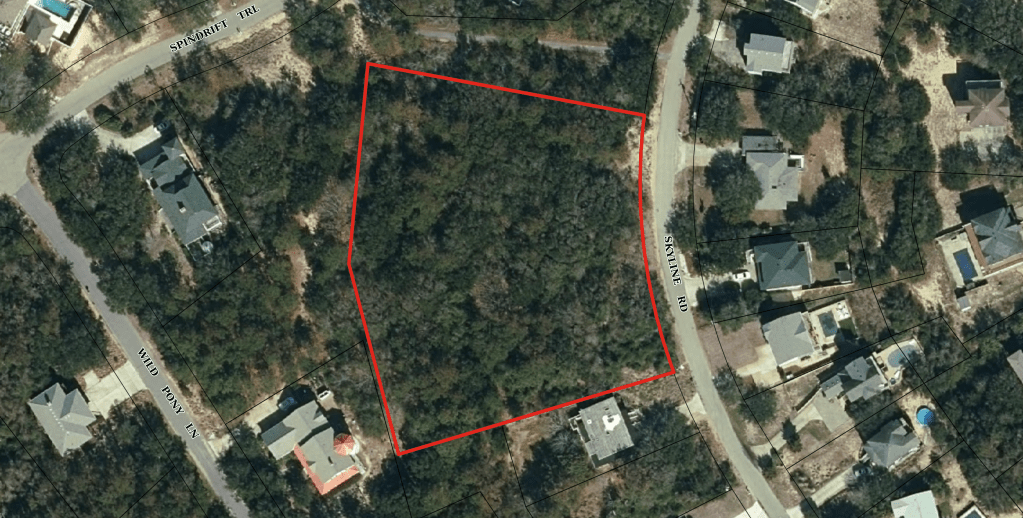
A 2022 Town decision regarding the division into four smaller parcels of the large outlined land tract (above) on Skyline Road prompted the Town Council to ask for a rewrite of Town Code lot-width ordinances, which has yet to be successful.

The Southern Shores Planning Board is stymied.

After nearly a year of trying—albeit with months of interruptions spent on other pressing business (think SAGA)—the Board cannot decide how to measure a lot to determine its width.

Question: Where on a lot do you take a width measurement?

At its most recent meeting March 18, the Board discussed yet again this seemingly simple calculation. And yet again, the Board failed to resolve it, sending the latest Zoning Text Amendment (ZTA) on lot width back to the Town staff for another go-round.

This makes four times, by our count, that the Board has shrugged its collective shoulders.

The hour-and-twenty-minutes consumed two weeks ago by the Planning Board in another discussion about minimum lot width can best be described as bogged down and digressive, albeit earnestly so. Its struggle in reaching a solution seems sincere. Its failure to do so, nonetheless, is perplexing.

(Regular Board member Jan Collins did not attend the meeting; First Alternate Michael Zehner sat in for her, joining the four other regular members.)

How would you measure lot width?

‘A MOVING TARGET’

The Board first took up a lot-width ZTA, designated ZTA 23-01, on April 17, 2023. The ZTA it most recently critiqued is ZTA 23-05. The Board sent a version of a lot-width ZTA back to staff for more work on April 17, May 15, and Dec. 18, 2023, and now March 18, 2024.   

On June 6, 2023, the Town Council enacted, by a 3-2 vote, a “stopgap” ZTA 23-03, mandating that all lots created in the residential and government/institutional districts after June 6, must have the required minimum width uniformly from front to back. This Town Code amendment essentially mandated rectangular lots.

Minimum lot widths, which are set forth in the Town Code, vary according to zoning district. In the RS-1 residential district, where most people live, the minimum lot width is 100 feet, the presumption being that most lots are 100 feet-by-200 feet and measure 20,000 square feet in size, another Town Code minimum requirement.  

Some Planning Board members brought up eliminating minimum lot width—at least, in the RS-1 district— and trusting that the minimum lot size of 20,000 square feet would preserve the low-density character of Southern Shores neighborhoods.

It is only on newly platted lots—created through recombination or subdivision—that the width measurement is relevant. Many lots exist in Southern Shores now that are not 100 feet wide at any point; they are considered legally permitted nonconformities. The concern is with new lots. 

Planning Board Chairperson Andy Ward colorfully described lot width at the meeting as “a moving target.” 

“You’ve got to hit 100 feet somewhere on [a] lot, moving front to back,” said Mr. Ward, who argued strongly in favor of maintaining the minimum 100-foot width, which “has always been there.” We believe most longtime homeowners in Southern Shores would agree.

“You’ve got to hit 100 feet at some point on a newly subdivided lot,” he continued, without, unfortunately, suggesting where. How about in the middle?

Perhaps, Deputy Town Manager/Planning Director Wes Haskett offered, you could require a lot “to maintain 100 feet after it gets to that point,” going from front to back—whatever that point may be. This would account for cul-de-sac lots that are shaped like pieces of a pie and have concerned the Board quite a bit in its deliberations.

By the time Mr. Haskett polled the Board on a few questions relevant to his path forward in drafting another revised Zoning Text Amendment (23-06?)—including whether a lot must be 100 feet wide “at some point”—two members were asking what the “objective” and “goal” of the ZTA currently before them was.

Have they forgotten the context? Or has the context become obscure and/or irrelevant with all of the revisions?

We will refresh their memories, and yours, and risk getting bogged down, too.  

CONTEXT: THE RECOMBINATION THAT EXPOSED AMBIGUITY

On April 20, 2023, we laid out the original context in a report of the Planning Board’s April 17, 2023 meeting that was headlined “Planning Board Grapples With Proposed Revision of Lot Width Requirement; Town Seeks to Eliminate Ambiguity.”

As we explained then, the Town Council requested a ZTA amending the Town Code’s lot-width ordinances after it reversed an October 2022 decision by the Board of Adjustment against property owners who sought to recombine an 80,000-square-foot tract land at 55 Skyline Road into four smaller buildable parcels. (See photo above.)

Operating as Skyline Oaks Properties LC (“Skyline Oaks”), the property owners wanted to situate two of their proposed new smaller lots behind the other two, so that the rear two would not front on Skyline Road. Mr. Haskett turned them down.

Although each of the new lots would measure 100 feet in width, their configuration persuaded Mr. Haskett, serving in his capacity as Zoning Administrator, to deny approval of Skyline Oaks’ recombination plat because it would create nonconforming lots in violation of the lot-width requirement in the RS-1 residential district.

(See The Beacon, 10/1/22, for even more background.)

In reaching his decision, Mr. Haskett applied the then-current language in sec. 36-57 of the Town Code, defining “lot width” as “the width of a lot at a required building setback line measured at right angles to depth” and “building setback line” as a line that is “parallel to or concentric with the street right-of-way establishing the minimum allowable distance between such right of way and the nearest portion of any building.”

Then-Town Code sec. 36-202(d)(2) specified that the 100-foot minimum lot width in the RS-1 district was to be “measured at the building setback line.”

(We appreciate the difficulty in interpreting the Code, but for reasons we do not understand, the word “minimum” was read differently by BOA members and by the Town and the property owners.)

In a written decision, Mr. Haskett explained how he interpreted the applicable ordinances and calculated the 100-foot width: “[A]ll of the proposed lots,” he wrote, “should have a minimum width of 100 feet measured at a line that is parallel to and 25 feet from the current right-of-way, Skyline Rd.”

He essentially equated the “building setback line” with the front setback line, which is 25 feet from the street. The building setback line, therefore, was the same as the lot-width line, or the “point” that Mr. Ward was trying to identify at the Board’s latest meeting.

The Board of Adjustment is a quasi-judicial body comprised of the same five members who sit on the Planning Board. Among its functions, the BOA hears appeals by property owners from administrative decisions by the Town, such as the denial of Skyline Oaks’ recombination.  

After a hearing on the merits, the Board agreed, 3-2, with Mr. Haskett’s interpretation of the ordinances, and the property owners appealed the decision to the Superior Court of Dare County.

The Town Council subsequently (and quickly) intervened to enter into a consent decree with Skyline Oaks, resolving the matter in the property owners’ favor. The Council overruled Mr. Haskett’s interpretation and tasked him with clearing up the ambiguities in the Town Code ordinances pertaining to lot width.

FIRST ATTEMPT AT ELIMINATING AMBIGUITY

In the Town-submitted first proposed draft of ZTA 23-03, the meaning/definition of lot width was changed to “minimum horizontal distance between the side lot lines of a lot measured from the front lot line at right angles to the rear lot” and the RS-1 requirement was changed to “100 feet (measured from the front lot line at right angles to the rear lot line).”

(The new language used for the RS-1 minimum width was repeated in the other relevant  Code sections on residential districts RS-8, RS-10, and R-1 and the GI district. This has been the case all along.)

We understand why the Planning Board rejected this language on April 17, 2023 and asked Mr. Haskett to revisit it. It is cumbersome and does not allow for irregularities, such as the cul-de-sac example. We were disappointed, however, that the Board did not propose alternate language, although it was aware of and considered other definitions.

This is not a wheel that needs reinventing. The American Legal Publishing, e.g., whose attorneys and editors have been assisting municipalities with ordinance codification for nearly 90 years, has posted a serviceable definition of lot width online. We quote it below.  

SECOND ATTEMPT AT ELIMINATING AMBIGUITY

In the second proposed draft of ZTA 23-03, the definition of lot width was changed to “horizontal distance between the side lot lines of a lot,” and the RS-1 requirement was changed to “100 feet (measured at the front lot line).”

Needless to say, the Planning Board asked for another do-over, expressing a continued concern for cul-de-sac lots and other irregular-shaped lots.

THIRD ATTEMPT: A STOPGAP WRITTEN BY THE TOWN ATTORNEY

The draft of ZTA 23-03 approved by the Town Council on June 6, 2023, returned to the earlier language, specifying that “lot width means minimum horizontal distance between the side lot lines of a lot measured from the front lot line at right angles to the rear lot line,” and the calculation of width “for all lots created after June 6, 2023,” in the RS-1 district would be100 feet “measured from the front lot line at right angles to the rear lot line.”

Rectangles are in; irregular lots are out.

LATEST ATTEMPT, ZTA 23-05

Two weeks ago, the Planning Board considered this language:

“Lot width” means the “width of a lot at the required building setback line measured at right angles to the rear lot line.”

“Building setback line” means “a line parallel to or concentric with the front lot line establishing the allowable distance between the front lot line and the nearest portion of any building … [etc.]”

The word “minimum,” modifying “allowable distance,” was deleted.

ZTA 23-05’s language about minimum lot width in RS-1 reverts to the pre-June 6, 2023 language, specifying 100 feet “(measured at the building setback line).”

The new proposed language also states that for “lots that front a cul-de-sac, the building setback line shall be established 25 feet from the front lot line, or the point where the lot is 100 feet wide, whichever distance is closer to the front lot line,” and “for all other lots, the building setback line shall be established 25 feet from the front lot line.”

Before reaching this revision, Mr. Haskett proposed in an earlier draft, considered Dec. 18, 2023 by the Planning Board, that the building setback line on a lot that fronts a cul-de-sac could be established up to 80 feet from the front lot line. The Board rejected this suggestion.

Have you/we bogged down yet? No?

What about ambiguity? Has it been eliminated, as the Town Council requested?

It’s not surprising that the Planning Board bogged down with this new emphasis on “building setback line,” spending too much time on the difference between the building setback line and the “lot-width line,” a term that Mr. Haskett suggested invoking, but which has not been created yet.

The building setback line relates to where on a lot a structure may be built in relation to the front lot line. As Board members pointed out, repeatedly, it should not be used in defining lot width.

GOING FORWARD WITH ANOTHER ZTA

The American Legal Publishing offers the following definitions:

LOT WIDTH: “is the horizontal distance between the side lot lines, measured at right angles to the lot depth at a point midway between the front and rear lot lines.”

LOT DEPTH: “is measured along an imaginary straight line drawn from the midpoint of the front property line of the front property line of the lot to the midpoint of the rear property line.”

If depth runs vertically and width runs horizontally, a right angle can be achieved and measured.

What these definitions do is put the lot width measurement at the midway depth point between the front and rear lot lines.

Whatever the Planning Board—and the Town Council, in time—decide to do about defining lot width, we strongly recommend that they streamline the applicable ordinances so that lot width is only defined in sec. 36-57, and the width requirements in the ordinances for each zoning district refer only to the minimum number of feet.

Thus, if you consulted Code sec. 36-202(d)(2), you would learn that the minimum lot width is 100 feet, but you would have to read the definition of lot width in sec. 36-57 to learn how the 100 feet are measured. A referral to sec. 36-57 could be inserted next to the lot width requirement for each zoning district.  

All the Planning Board has to do is pick its point or points on a lot for measuring horizontal distance—stop its targets from moving—and be fair about its choices.

We are of the mind that the minimum lot widths in the various districts should be maintained.

To be continued.

AND A WORD ABOUT ZTA 24-02 AND TREE REMOVAL

After the Planning Board voted unanimously not to approve ZTA 23-03, it shifted into a discussion about ZTA 24-02, which requires a commercial property owner to get a lot disturbance-stormwater management permit from the Town before removing from an unimproved lot any trees that are greater than 6 inches in diameter, 4.5 feet above the ground, and within a front, side, or rear yard setback area.  

The proposed ZTA, which amends Code section 36-171, makes such tree removal without a permit an offense that is punishable by a civil penalty.

The rub with this ZTA, as we noted in our 3/16/24 preview of the Planning Board’s meeting, is that it is what we termed a “watered-down” version of an earlier version of the measure that imposed this permit requirement on property owners in all zoning districts. We viewed the original ZTA as a tool to prevent stormwater runoff in town, which is a major problem.

The earlier version also did not restrict the location of the trees to what Mr. Haskett referred to as “buffer” areas. It applied to trees throughout an unimproved lot.

Mr. Haskett announced at the Board’s February meeting that “the Town” was withdrawing the earlier version, which was part of ZTA 24-01, and redrafting it in a separate zoning text amendment. He gave no reason for the revision.

The Town Council reportedly passed ZTA 24-01, with a few revisions, at its March 12 meeting. One of its parts amends the Town Code to mandate 20-foot buffers between mixed-use group developments and commercial zoning, whenever they abut a residential district or a planned unit development, such as the Southern Shores Landing.

So what exactly does the new ZTA 24-02 do that the newly enacted ZTA 24-01 has not already done?

Chairperson Ward asked Mr. Haskett several times why “residential tree removal [was] pulled out” of the ZTA and never received a satisfactory response. He also said several times that he wanted to see the residential districts covered by the ZTA, and a majority of the Board appeared to agree with him.

Here’s our rub: Neither Mr. Ward nor any other Planning Board member made a motion to amend ZTA 24-02 by changing the text to include residential districts. It would have been a simple matter of deleting five words. Members seemed to believe either that they couldn’t do that—which they can—or that if they were to do that, they would deprive the public of “notice.”

In our next blog, we will explore the Board’s decision to put the residential districts on “the backburner,” as Mr. Ward said.

After spending an hour criticizing the ZTA, as presented, the Board recommended its approval, by a 4-1 vote, with the Chairperson casting the only dissenting vote.

Upon suggestion by Mr. Haskett, the Board also recommended to the Town Council, by consensus, that it authorize the draft of another ZTA that would include residential districts.  

The Town Council will hold a public hearing on ZTA 24-02 at its April 9 meeting.

To be continued.

By Ann G. Sjoerdsma, 4/3/24