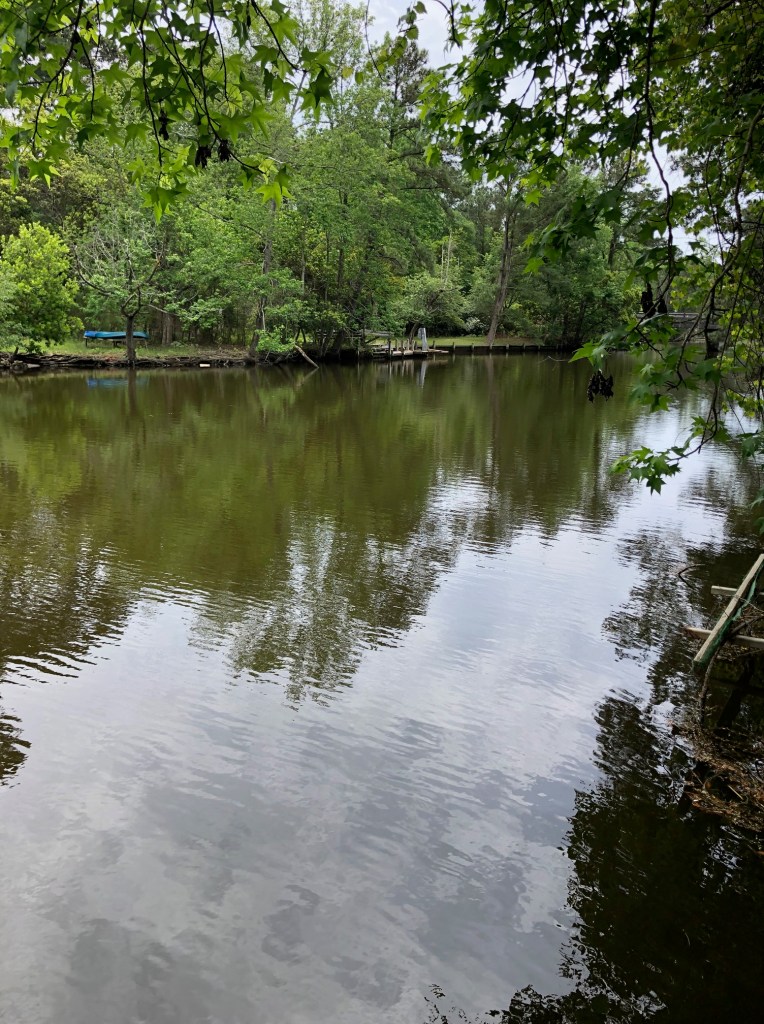
Town Manager Cliff Ogburn will present his recommended budget for fiscal year 2024-25, and the Town Council will consider adopting an ordinance banning the release of balloons in town and partnering with the N.C. Dept. of Environmental Quality to treat Eurasian watermilfoil, a noxious aquatic weed, in the Southern Shores canals and Ginguite Creek, at the Town Council’s regular monthly meeting Tuesday at 5:30 p.m. in the Kern Pitts Center.
The Council also will hold a public hearing on Zoning Text Amendment 23-05, the latest version of the new lot-width ordinance, whose progress The Beacon has covered during the past year (for the latest report, see 4/23/24 post), and will decide whether, and to whom, to award a contract for the construction of a sidewalk on the north side of Skyline Road from Ocean Boulevard to an existing path that connects the road to Spindrift Trail.
Before conducting all of this business, however, the Town Council will take time to meet and recognize Arty, a K-9 in the Police Department, and his K-9 handler, Patrol Officer Thomas Long.
For background, see:
MEETING PACKET: https://mccmeetings.blob.core.usgovcloudapi.net/soshoresnc-pubu/MEET-Packet-1dbdcec1125f49fcbe9abe2a4a444b4a.pdf.
Notes on the issues:
Budget: Mr. Ogburn will distribute his recommended FY 2024-25 budget, which he has previously previewed, to Town Council members at the meeting; the budget is not yet publicly available on the Town website.
A public hearing on the budget will be held during the Council’s June 7 meeting. (See The Beacon, 4/6/24.)
The Town Council held a budget workshop meeting on April 16, at which time Mr. Ogburn said that a property tax increase would not be necessary to balance next year’s budget.
Balloons: The Town Council passed a resolution on March 12 opposing the release of balloons in town. Since then, both Duck and Nags Head have passed ordinances making it unlawful to release balloons within their jurisdictions and imposing fines on offenders—$250 in Duck and $50 in Nags Head. Once balloons lose their buoyancy, they become non-biodegradable far-flung litter that can harm the environment, aquatic creatures, and wildlife. The Council is likely to pass an ordinance—a draft of which is included in the meeting packet—that bans the release of balloons in town and imposes a $250 fine on offenders.
Sidewalk on Skyline Road: The Town has used an informal bidding process to solicit bids for construction of a sidewalk on the north side of Skyline Road from Ocean Boulevard to the Chicahauk Homeowners Assn.’s cut-through path to Spindrift Trail. The Town received two bids, one of which it rejected for “non-responsiveness,” according to the Town’s agenda item report.
“For construction projects within the informal bidding range,” the Town writes, “the record of bids and bid documents become open for public inspection when the contract is awarded.”
The staff has recommended that the Council award the contract to the low bidder.
An aerial map of the sidewalk under consideration is included in the meeting packet on p. 22.
HERBICIDE TREATMENT OF CANALS AND GINGUITE CREEK
A canalfront homeowner has contacted The Beacon with concerns about the chemical product that the N.C. Dept. of Environmental Quality (NCDEQ) would use on Southern Shores’ canals and Ginguite Creek to eradicate watermilfoil, if the Town Council votes Tuesday to partner with the State in a 50-50 cost-sharing treatment plan.
The Town of Southern Shores has requested assistance from the N.C. Aquatic Weed Control Program, which is housed within the NCDEQ, and applied for an Aquatic Weed Control grant. For the program to go forward, the Town Council must vote Tuesday to sign a Memorandum of Understanding (MOU) with NCDEQ, a copy of which is in the meeting packet. The MOU sets the cost of the project at $40,000, for which the Town would pay $20,000.
According to the Town staff summary attached to the MOU, “the Town has been meeting with State Aquatic Weed Specialists to seek State support to treat the milfoil. Representatives from the Southern Shores Civic Association and Martin’s Point Homeowners Association participated in these meetings.
“DEQ performed a survey of the canals and creek last fall. The information received during the survey helped to develop a potential treatment program in the spring of 2024.”
DEQ reportedly identified a treatment map of roughly 32 acres and targeted late June as the treatment time.
Safety of Herbicide Ingredient, 2,4-D
The Eurasian milfoil eradication program in Southern Shores dates to 1971, when pellets of an herbicide containing 2,4-dichlorophenoxyacetic acid, abbreviated as “2,4-D, were reportedly scattered from the air over Ginguite Creek, some of the canals, and sections of Currituck Sound where the weed infestation was severe.
The U.S. Environmental Protection Agency, which was created during the Nixon Administration, had only been in existence then for a matter of months.
We do not have a record of how often and when the Southern Shores waters were treated for milfoil thereafter, what herbicides were used, and what the consequences of their use were to aquatic life.
Since enactment of the Aquatic Weed Control Act of 1991, the N.C. Department of Environmental Quality has directed a statewide program to control, eradicate, and regulate noxious aquatic weeds in order to “protect and preserve human health, safety, and the beneficial uses of the waters,” and to benefit plant and animal life.
According to NCDEQ, Eurasian watermilfoil is a “submersed aquatic perennial” that was introduced to the United States from Eurasia in the 1940s as an aquarium ornamental. Considered one of the worst aquatic weeds, milfoil often forms large infestations, NCDEQ says.
This noxious weed forms a dense canopy along the surfaces of water, shading out the vegetation below; degrades water quality; hinders recreational activities; obstructs water intake; and fouls adjacent beaches, according to NCDEQ, which uses both biological and chemical control to prevent the spread of milfoil.
2,4-D was one of the active ingredients in Agent Orange, a chemical herbicide and defoliant that was used by the U.S. military during the Vietnam War from 1961 to 1971.
Exposure to Agent Orange proved devastating to people, as allegedly thousands of U.S. soldiers and millions of Vietnamese civilians suffered major health problems, including leukemia, Hodgkin’s lymphoma, and other types of cancer, and Vietnamese children, as well as children of U.S. military, experienced a high rate of unusual birth defects.
(The story of Agent Orange’s toxic fallout is a complicated one that we cannot begin to cover. Chemically speaking, it was the trace dioxin in Agent Orange, which resulted from a mixture of 2,4-D and another phenoxy herbicide, that caused the human damage. We are not qualified to delve into the chemistry.)
NCDEQ has used herbicides that contain 2,4-D, but it is unclear from the information in the Town Council’s meeting packet whether it intends to do so in treating the Southern Shores waters.
Lawsuit Against EPA for Its Reapproval of Two Herbicides With 2,4-D
The ingredients in the NCDEQ’s herbicide concern the Beacon’s reader, who referred us to on-going litigation in federal court in Washington, D.C., between three non-profit environmental groups and the Environmental Protection Agency over the EPA’s reapproval in January 2022 of two herbicides that contain 2,4-D. The herbicides, known as Enlist One and Enlist Duo, are manufactured by Corteva Agriscience.
The Center for Food Safety (CFS), the Pesticide Action Network North America (PANNA), and Alianza Nacional de Campesinas allege in their complaint against the EPA that the federal agency unlawfully reapproved the Enlist herbicides without properly considering their environmental and public health risks; that its decision jeopardizes hundreds of endangered species across the country; and that the herbicides harm rural communities and wildlife by increasing concentrations of 2,4-D and glyphosate in the environment, damaging habitats, polluting waters, and affecting native plants and crops.
The reader who contacted The Beacon is especially concerned about the harm that a 2,4-D herbicide would cause fish and other aquatic life in the canals.
The plaintiffs, who targeted the use of Enlist on crops, argue that the EPA’s 2022 registration decisions violated the Federal Insecticide, Fungicide, and Rodenticide Act (FIFRA) and the Endangered Species Act. They seek injunctive and declaratory relief.
You may access their 105-page complaint, which was filed June 6, 2023 in the U.S. District Court for Washington, D.C. (Civil Action 23-1633), here:
https://www.centerforfoodsafety.org/files/2023-06-06-doc-01–cfs-et-al-complaint_92063.pdf. (This link is correct. If it does not work for you, we suggest you manually input it.)
Here’s a link to an article about the lawsuit:
The U.S. District Court recently allowed Corteva to intervene in the action as a defendant.
We share our canalfront reader’s concern and caution about herbicides that NCDEQ may use in Southern Shores’ waters to eradicate milfoil and would like some assurance that they do not pose a health or safety risk to the public or to aquatic life. We would expect the Town Manager and the Town Council to do their due diligence before agreeing to partner with the NCDEQ to treat the milfoil in Southern Shores’ canals and Ginguite Creek with chemicals.
MORE THAN 1,000 TICKETS SOLD FOR FLAT TOP TOUR
We conclude the business of this post, which grew like milfoil from the brief we intended, by reporting that 1,013 tickets were sold for the April 27 Southern Shores Historic Flat Top Cottage Tour, according to tour organizer Sally Gudas, who said that 758 tickets were sold online and 255 were purchased on the day of the tour.
This total is 302 tickets more than were sold for the last tour, which was held in 2022, representing an increase of nearly 40 percent.
Congratulations to everyone who made this year’s tour such a successful and enjoyable event.
****
ON A PERSONAL NOTE, I would like to wish my mother, Fern MacAllister Sjoerdsma, who has resided on North Dogwood Trail since 1996, a happy 100th birthday on May 5. Mom may not be the oldest resident homeowner in Southern Shores, but I don’t know anyone who is older. She continues to amaze and inspire me with her love for life and her ability to adjust to whatever comes her way. May she enjoy every day that she has with loved ones and nature’s creatures in the beautiful maritime forest on the sound.
By Ann G. Sjoerdsma, 5/4/24
 The Southern Shores Beacon