
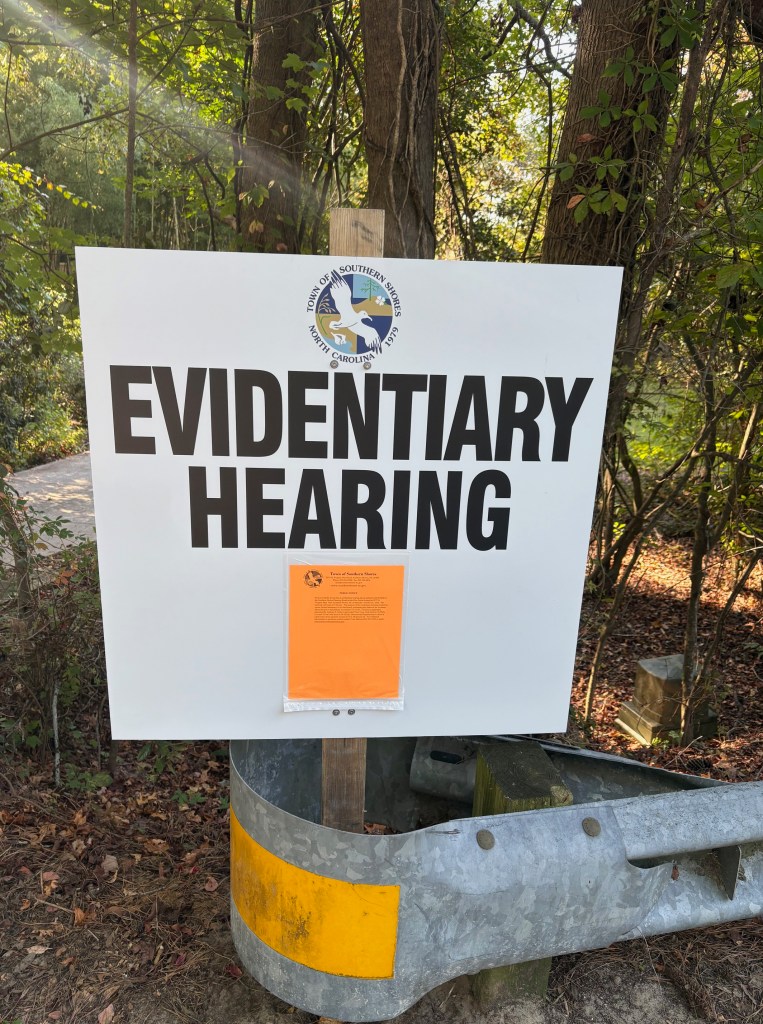
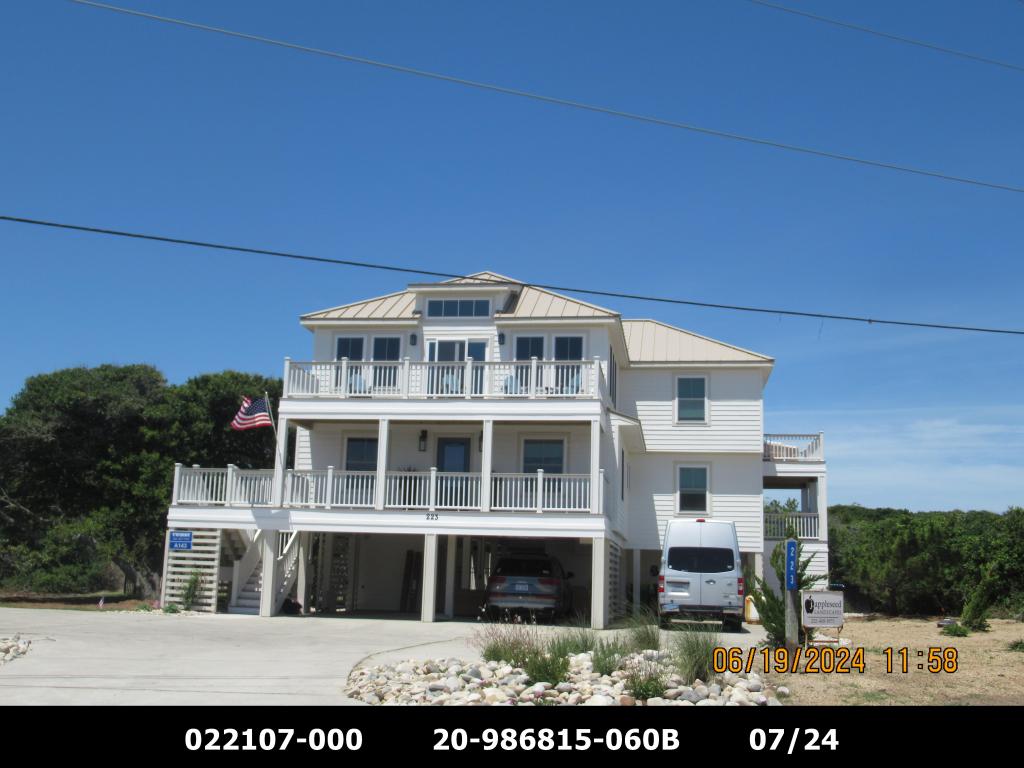
After a 5 ½-hour hearing, with two recesses, the Town Board of Adjustment voted unanimously last night to deny a variance to Anthony Mina that would have allowed him to subdivide the 46,500-square-foot property at 75 E. Dogwood Trail that he owns with his fiancée.
(See The Beacon, 10/19/24, for factual background.)
The hearing may have been excessively long, but the Board’s decision was made quickly and without discussion. It was a foregone conclusion. Mr. Mina did not have a meritorious case, just a personal grievance against the Town, in particular, against Town Deputy Manager/Planning Director Wes Haskett.
We are not acquainted with how this grievance escalated to the point of wasting 5 ½ hours of attendees’ time and public money spent on two attorneys (one representing the Town; the other representing the Board of Adjustment), one court reporter, three police officers (we believe one left early), and overtime for Mr. Haskett and Town Manager Cliff Ogburn, but we trust the Town will conduct a post-mortem and figure out how it could have handled interactions with Mr. Mina better.
We question the Town’s decision even to let Mr. Mina file a request for a variance, inasmuch as a variance is not the “appropriate remedy,” as Town Attorney Lauren Arigaza-Womble of Hornthal, Riley, Ellis & Maland said several times during the hearing, for the hardship that Mr. Mina claimed.
Ms. Arigaza-Womble quoted Professor Adam Lovelady, an expert in land-use law at the University of North Carolina School of Government, for the principle that: “A variance is not the appropriate remedy for a condition or hardship that is shared by the neighborhood or the community as a whole,” such as would be the case where a zoning ordinance, of which an individual complains, affects everyone in the community.
At the beginning of the hearing, it appeared that Mr. Mina had not even wanted to file a request for a variance, for which he paid a $350 fee. He sought to “preclude” the hearing and told the Board of Adjustment that the Town had “no legal basis to force me to be here.”
This posture was one of many confusing revelations by Mr. Mina, whose recourse with the Town is to attempt to change the ordinance that prevents him from subdividing his property in his favor.
TEDIOUS, EXHAUSTIVE HEARING
We did not stay for the conclusion of the hearing, dear readers, taking our leave at 9 p.m., when the second recess was called.
By then, we had heard a tedious and exhaustive recitation of Mr. Mina’s Variance Application 24-01, which BOA Chairperson Andy Ward took him through, section by section, even though the application was available for all Board members and the public to read, and Mr. Mina, who represented himself, could have summarized it in his direct testimony.
We also had heard an excessive amount of irrelevant material introduced by Mr. Mina into the record, through his oral testimony and his documentation, even though Ms. Arigaza-Womble, properly and continuously objected to it.
Mr. Ward allowed Mr. Mina to have his say, while also trying to keep him focused on facts and not on “innuendo” and “accusations.”
But Mr. Mina’s argument was based on fraud, not on any of the criteria relevant to the granting of a variance.
“Fraud,” he said early on, after moving to “preclude” last night’s hearing—a motion that became moot as the hearing continued—“is a big factor in me obtaining the variance.”
Mr. Mina claimed that Mr. Haskett and the Town of Southern Shores had led him to believe falsely that the lot at 75 E. Dogwood Trail, which he purchased July 5, 2023, could be subdivided, when, in fact, regulations in the Town Code of Ordinances prevent such a subdivision. He repeatedly said that Mr. Haskett had “hidden” the zoning code(s) from him.
He alleged a “real estate scam” or conspiracy to defraud him, and he has sued those people he believes are co-conspirators in federal court. Mr. Mina filed his lengthy complaint in the Eastern District of the U.S. District Court of North Carolina. (The case number is 2:24-CV-00042.)
Lest anyone be as confused as Mr. Mina clearly was about the zoning ordinances in the Town Code—which are sometimes referred to as the “Zoning Code” or the “Zoning Ordinance”—we would like to clarify that Southern Shores’ zoning ordinances are part of the Town Code, which is readily available on the Town website.
An ordinance is a municipal law: It is a law enacted by local government.
Mr. Haskett could not “hide” the Town’s ordinances if he wanted to.
When the Southern Shores Town Council passes a Zoning Text Amendment (ZTA) or a Town Code Amendment (TCA), it is passing new law. The ZTA or TCA amends (changes) the text that already exists in the Town Code.
The Town Code is made up of chapters, the 36th of which is about zoning, and, therefore, is often referred to as the “Zoning Code.” The 30th chapter is about subdivisions and is often referred to as the “Subdivision Ordinance.” The so-called Zoning Code and Subdivision Ordinance are not separate from the Town Code; they are part of it.
ACCESS TO SUBDIVISION LOTS
Access to newly created lots is a significant issue with a subdivision.
Before Aug. 3, 2021, the Town Code allowed subdividers to create access by one of two ways: 1) by having all lots front on a public road; or 2) by creating a public-access easement that connected new lots to a public road and met certain standards of width, length, and the like.
On Aug. 3, 2021, however, the Town Council passed TCA 21-06, which eliminated the access-easement option then codifed in the subdivision chapter at section 30-96(f).
So, two years before Mr. Mina bought his property, the Town Council rendered it impossible for him to subdivide his lot without ensuring that each lot fronted on a public road.
Mr. Mina presented no evidence at the hearing to suggest, much less prove, that the required public notice of the hearing on TCA 21-06 was defective in any way. He insinuated that it was, but he presented no facts to bolster that insinuation.
As Mr. Haskett testified, he did not know Mr. Mina in 2021, and he was not the proponent of TCA 21-06. It was the Town Council that asked for a change in the law. (See our report of 10/19/24.)
Mr. Mina submitted to the Town two applications for a subdivision of 75 E. Dogwood, each of which had a preliminary plat and each of which appears to depend upon an easement for access to a back lot. The Town received both on July 3, 2024, and Mr. Haskett denied both. Mr. Mina did not appeal either denial during the 30 days allotted to him by ordinance for an appeal.
One of the denials also cited Mr. Mina’s failure to conform to a newly enacted zoning ordinance defining mandatory minimum lot size in the RS-1 single-family-dwelling residential district.
Contrary to Mr. Mina’s reading of the new lot-width ordinance, which is Town Code section 36-202(d), it only applies to lots created after June 6, 2023 through subdivision or recombination. It does not render all lots that are not 100 feet wide at every width measurement non-conforming.
The facts established that Mr. Mina exchanged many emails with Mr. Haskett in the month before the lot-width ordinance changed on June 6, 2023, which was about a month before he bought 75 E. Dogwood Trail. There were so many emails, according to Mr. Haskett, that it would take him hours to count them.
Mr. Mina states in his application that the Town Planning Director deliberately withheld from him “pertinent information” about the soon-to-be-changed lot-width ordinance.
Mr. Haskett testified that he had no reason to believe that minimum lot width would be relevant to any applications that Mr. Mina might submit.
Mr. Ward sustained objections from Ms. Arigaza-Womble about Mr. Mina’s allegations that the Town did not give proper notice for the public hearings that were held on the ZTA and TCA that changed the ordinances Mr. Mina cited. Mr. Ward stated for the record that the ordinances were legally adopted.
COMMUNICATING WITH AGGRIEVED PROPERTY OWNERS
We are not able to comment with knowledge about what happened between Mr. Haskett and Mr. Mina to sour their communications—and between Mr. Mina and Mr. Ogburn—and we will not make any assumptions.
It is clear from Mr. Mina’s variance application and from everything he said last night that he is confused and operating under misconceptions. It is also clear that he believes people have mistreated him. We are not going to speculate as to why.
Mr. Mina came across at the hearing as frenetic—what people would describe as hyper—and intense, but also polite and respectful.
We all know people who cannot be reasoned with, who cannot accept the truth or their own responsibility, and who look to blame others or even believe others are out to get them.
The question we are left with is the one we started with: How could the Town have prevented the exercise in futility that we witnessed last night?
No one benefited from what occurred, and if Mr. Mina appeals the Board’s decision to the Superior Court of Dare County—he has 30 days to decide, and he indicated last night he probably would—the Town will expend more hours and money on this case, as will Mr. Mina, who professed to be more interested in working on his home-improvement business than on litigation.
All we would suggest is that the next time a “problem” arises with an aggrieved property owner that the Town staff cannot handle that they have a means for resolving it that does not include referring that property owner to the Town Attorney. No one wants to talk to a lawyer. Unless they’re acting as independent dispute mediators, lawyers are adversaries and can be quite intimidating to people who are not accustomed to engaging with them.
A neutral third party might have been helpful in communicating with Mr. Mina.
By Ann G. Sjoerdsma, The Southern Shores Beacon


 The Southern Shores Beacon