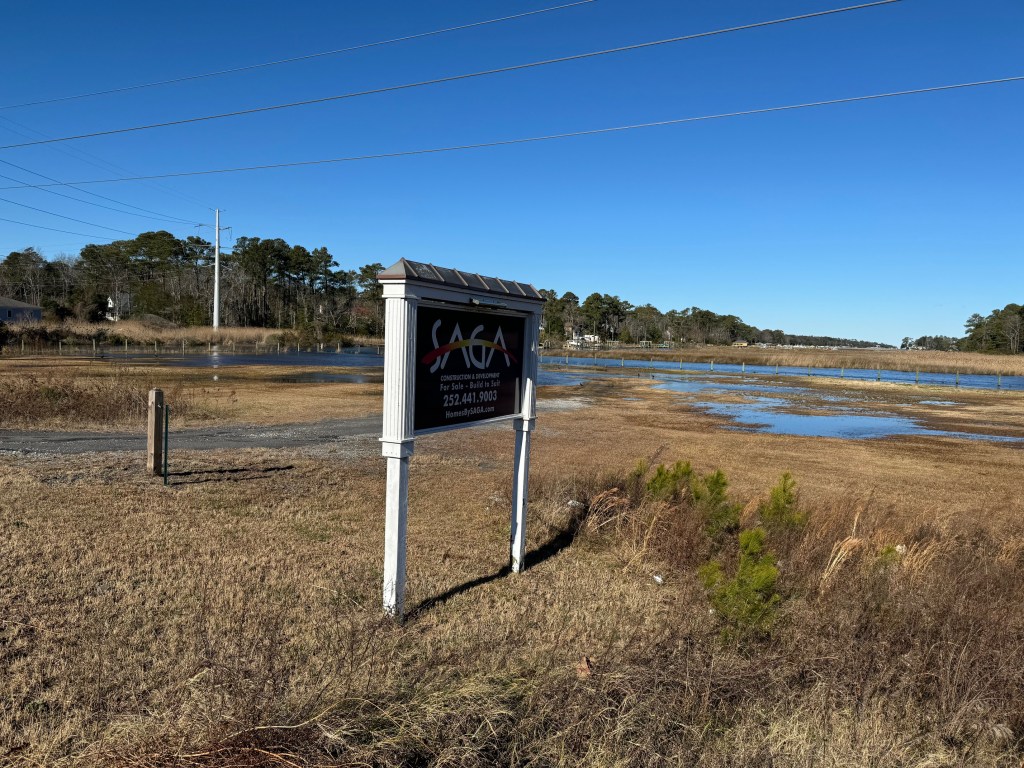
Proposed ZTA 24-01 mandates a 50-foot setback and a 20-foot vegetative buffer between a commercial or mixed-use development and a planned unit development (PUD) on an adjacent property. It applies generally throughout town, but is specifically designed to protect the Southern Shores Landing, which is a PUD, from SAGA’s development of its Ginguite Creek property (above).
The Planning Board unanimously approved Wednesday zoning code changes recently proposed by the Town of Southern Shores, with the exception of an ordinance that would regulate tree removal on an unimproved lot—which Deputy Town Manager/Planning Director Wes Haskett announced was being withdrawn and redrafted in a separate zoning text amendment that “hopefully” would be considered by the Board at its March meeting.
The Board suggested some amendments to the Town-proposed Zoning Text Amendment 24-01, in order to make the language more precise, but it essentially accepted the ZTA, as written.
Apart from making changes emanating from the Board’s wide-ranging hearings last fall on SAGA’s Special Use Permit Application for its Ginguite Creek project, ZTA 24-01 updates the Town’s development ordinances to conform with new Chapter 160D of the N.C. General Statutes. Chapter 160D consolidates previous State statutes governing local land use and “modernizes” land use regulation in North Carolina.
See The Beacon, 2/18/24, for details on ZTA 24-01.
The Town Council will hold a public hearing on the final version of ZTA 24-01 before voting on its enactment. The Planning Board serves only as an advisory board to the Council.
VACANCY ON THE PLANNING BOARD
First Alternate Dan Fink has resigned from the Planning Board. If you would like to be considered for an appointment to the Board to serve out Mr. Fink’s term, you must file an application with the Town.
Planning Board members serve for three years; and terms run with the fiscal year calendar.
According to the Town of Southern Shores website, the term for the seat held by Mr. Fink expires on June 30. Whoever is appointed to his seat would likely serve out the current term and serve a three-year term starting on July 1.
All appointments to the Planning Board are made by the Town Council.
Issues that arose during Planning Board meetings last year to discuss SAGA’s Special Use Permit Application for a condominium/retail/restaurant/office development on land (pictured above) next to Southern Shores Landing prompted many of the proposed changes. SAGA withdrew its application last month.
Primarily to fill zoning regulatory gaps that came to light during the Planning Board’s exceptionally thorough hearings last fall on SAGA’s Special Use Application for its proposed mixed-use development on Ginguite Creek—in particular, to protect residents at Southern Shores Landing from encroachment—the Town of Southern Shores has introduced a sweeping Zoning Text Amendment (ZTA 24-01) that the Planning Board will consider for the first time Wednesday when it meets at 5 p.m. in the Pitts Center.
The proposed ZTA establishes setbacks and vegetative buffers to protect “planned unit developments” (PUDs), such as the Southern Shores Landing, from adjacent commercial and mixed-use development; expands upon permitting requirements for site development, including requiring a lot disturbance/stormwater management permit when large-tree removals are proposed on vacant lots; regulates wastewater treatment plants, and much more. It even prohibits miniature golf courses, warehouses, storage units, and wind farms in town!
ZTA 24-01 was foreshadowed by the Town Council at its Feb. 6 regular meeting when it unanimously passed a motion made by Mayor Elizabeth Morey—without any discussion—to “direct the staff to take some very needed steps to modernize our Town Code and propose changes” to the Town Code in the form of zoning text amendments and Town Code amendments.
This open-ended motion was the only notable business conducted by the Town Council during what proved to be a half-hour-long public meeting, and it was made by the Mayor upon the Council’s return from a closed session with the Town Attorney. We debated whether we should report on it and ask: What does it mean? What sections of the Town Code does the Council seek to “modernize”? What “very needed steps”?
We decided instead to wait and see, and now we know.
Please Note: The Board is meeting on Wednesday, not Monday, because of the Presidents’ Day holiday.
We urge everyone to read Mr. Haskett’s report to familiarize yourselves with the changes being proposed and to attend Wednesday’s meeting, which will have two public-comment periods.
Those who live in the Southern Shores Landing or were otherwise invested in the Planning Board’s decision last November to deny a recommendation of approval of SAGA’s Special Use Application should take some pride in these consequences: The Town is taking swift action to protect Landing residents, as well as the integrity of the Special Use Application process, in part because of their robust participation.
MOST PROPOSED ZONING CHANGES EMANATE FROM SAGA HEARINGS
Among the many changes proposed in ZTA 24-01 are the following, presented in chronological order as they appear in the Town Code:
**To require property owners to obtain a lot disturbance/stormwater management permit to remove trees greater than 6 inches in diameter, measured at 4.5 feet above the ground on any unimproved lot (amends Town Code sec. 36-171);
(This change recognizes that clear-cutting or the destruction of some, but not all old-growth trees on an undeveloped lot can create stormwater problems. Bravo!)
**To establish multifamily dwellings as a special use, not a permitted use, in the C general commercial zoning district with a maximum lot coverage of 30 percent (amends sections 36-207(b)(4) and 36-207(c), and reduces the permissible lot coverage of such dwellings from 40 to 30 percent. Another bravo!);
**To establish a 50-foot setback requirement for:
Restaurants from planned unit developments;
Drive-through facilities or establishments (small) from residential districts and planned unit developments;
Mixed-use group developments from planned unit developments and residential districts;
Commercial buildings and facilities from planned unit developments
(Amends 36-207(c). These setback requirements extend protection to residents of PUDs, the Southern Shores Landing being the only such development in town. The current ordinance only mandates setbacks for residentially zoned property; PUDs are commercial properties, not residential.)
**To establish a 20-foot vegetative buffer requirement where a mixed use group development abuts a residential district or planned unit development, and a 20-foot buffer requirement where a commercial use or zone abuts a residential district or planned unit development (further amends 36-207(c) to provide protective buffers for PUDs);
**To prohibit miniature golf courses, storage units, warehouses, and wind farms in all zoning districts (amends sec. 36-209; we know nothing about the background of this expansion in prohibitions);
**To extend the Town’s time limitations for issuing building and zoning permits after final approval of a site plan (from 180 days to one year), after which site plans expire, and for commencing construction after issuance of a building permit (from 180 days to one year) (amends sec. 36-297);
**To require site plans to show the anticipated final appearances of the front and rear of proposed structures, in addition to the sides and rooflines; to provide a rendering of the anticipated front, sides, and rear appearances of the structure relative to proposed landscaping; and to include the proposed number of bedrooms and/or occupants in a dwelling (amends sec. 36-299; these changes directly emanate from the Planning Board’s SAGA hearings);
**To require that when a site plan is submitted with a permit application, the property owner also provide documented proof from the requisite State agencies that a wastewater treatment facility or connection to a wastewater treatment facility is available and in compliance with all applicable State regulations and permits (amends sec. 36-299; emanates from the SAGA hearings); and
**To require that the written application for a special-use permit be submitted to the Planning and Code Enforcement Department no later than 30 days prior to the Planning Board meeting at which it is to be reviewed, and that it be accompanied by a site plan drawn to scale that complies with all other site-plan requirements set forth in Code section 36-299 (amends sec. 36-300; also comes from SAGA hearings).
ZTA 24-01 also substantially rewrites the Town Code sections setting forth the Special Use Application review process (amending sec. 36-300) and the establishment of vested rights by a property owner in a site-specific development plan (36-304). We leave it to the Planning Board to expound upon and assess these changes. Of more interest to us is a proposed revision of the powers and duties of the Planning Board, as set forth in Code sec. 24-27.
RESTATEMENT OF PLANNING BOARD’S POWERS AND DUTIES
The revision of sec. 24-27 by the Town leaves intact the overriding duty of the Planning Board to “prepare plans and to coordinate the plans of the town and those of others so as to bring about a coordinate and harmonious development of the area.” It also preserves the designation of the Planning Board as “the planning agency for the preparation or revision of the zoning ordinances of the town.”
We would expect Planning Board Chairperson Andy Ward to have been involved in the preparation of ZTA 24-01.
ZTA 24-01, however, rewrites what the Planning Board is “authorized” specifically to do, enumerating its duties with language provided in a N.C. statute, as follows:
To prepare, review, maintain, monitor, and periodically update and recommend to the town council a comprehensive plan, and such other plans as deemed appropriate, and conduct ongoing related research, data collection, mapping, and analysis;
To facilitate and coordinate citizen engagement and participation in the planning process;
To develop and recommend policies, ordinances, development regulations, administrative procedures, and other means for carrying out plans in a coordinated and efficient manner;
To advise the town council concerning the implementation of plans, including, but not limited to, review and comment on all zoning text and map amendments as required by N.C. General Statutes 160D-604;
To exercise any functions in the administration and enforcement of various means for carrying out plans that the town council may direct;
To provide a preliminary forum for review of quasi-judicial decisions, provided that no part of the forum or recommendation may be used as a basis for the deciding board;
To perform any other related duties that the governing board may direct.
The new language is consistent with N.C. General Statutes 160(D)-301(b), a statute about local planning boards. It’s tighter, clearer, and more empowering and relevant than the language that the Southern Shores Town Code currently has. We hope it will encourage the Planning Board to continue to be assertive and preemptive in developing and recommending “policies, ordinances, development regulations, administrative procedures, and other means” to protect the Town of Southern Shores and its residents.
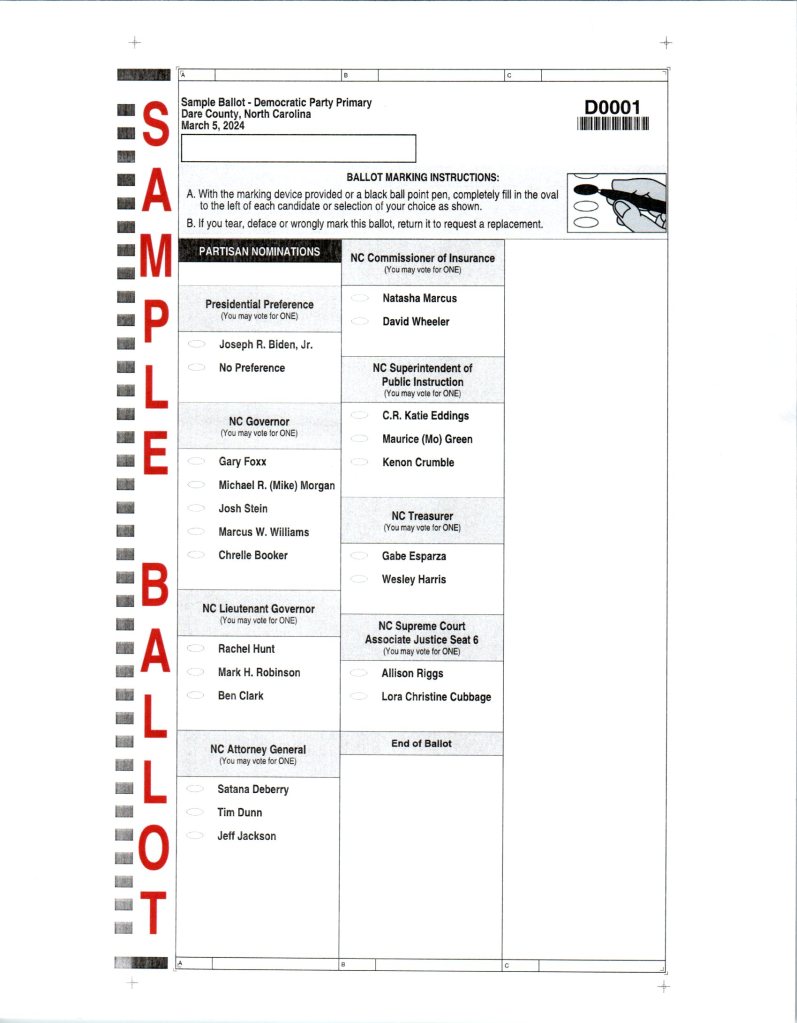
A sample ballot for the Democratic Party Primary Election in Dare County is pictured above. The Republican Party’s Primary ballot runs two pages and includes the only candidates vying for three seats on the Dare Co. Board of Commissioners.
Early voting for the March 5 “Super Tuesday” primary election, in which voters statewide will select nomination preferences for the U.S. presidency and N.C. governorship and Dare County voters who vote in the Republican primary will determine two of three seats up for election on the Dare County Board of Commissioners, will begin tomorrow and run until Sat., March 2.
The voting will take place at Kill Devil Hills Town Hall, the Dare County Board of Elections Office in Manteo, and the Fessenden Annex in Buxton, during the following hours:
Weekdays from Thursday, Feb. 15, through Friday, March 1, from 8 a.m. to 7:30 p.m.
Sat., March 2, from 8 a.m. to 3 p.m., in Manteo and Kill Devil Hills, and March 2, from 8 a.m. to 7:30 p.m., in Buxton.
There will be no early voting over the weekends of Feb. 17-18 and Feb. 24-25.
Voting on March 5, Primary Election Day, will be in the Kern Pitts Center for Southern Shores residents, from 6:30 a.m. to 7:30 p.m.
Registered Republicans, Democrats, and Libertarians will have their own ballots in the primary, while voters registered Unaffiliated, the most popular party designation in North Carolina, with 37 percent of all registered voters, will be able to choose the party primary in which they participate.
Although the two-year terms of all members of the N.C. House of Representatives and the U.S House of Representatives are expiring, none of the political parties has a primary in Dare County for an N.C. or U.S. district office.
Incumbent N.C. House Representative Edward C. Goodwin (R), who represents Dare County in House District 1, will oppose Susan A. Sawin (D) in November.
Congressman Gregory Murphy, who represents Dare in U.S. Congressional District 3, faces opposition from Libertarian Gheorghe Cormos in November, but does not have a Democratic opponent.
Republicans and Unaffiliated voters in the Republican primary, however, will vote on three seats on the seven-member Dare County Board of Commissioners, only one of which will be contested in the Nov. 5 general election. These candidates are:
Wally Overman vs. Carson Creef for one of the two District 1 seats that represent Roanoke Island and the Dare County mainland on the Board;
Christian Thomas Hayman vs. Robert L. Woodard, District 2, representing Nags Head, Colington, and Kill Devil Hills; and
Bea Basnight vs. Mike Burrus, for the other District 1 seat, to fill the unexpired term of the late Jim Tobin that runs until 2026.
Ms. Basnight, a retired teacher and former member of the Dare County Board of Education for 12 years, was appointed in December to fill Mr. Tobin’s seat until the November election. Mr. Burrus, a businessman in Wanchese, ran unsuccessfully in 2022 for the at-large seat now held by Ervin Bateman on the Dare Board of Commissioners.
The victor in the Hayman-Woodard primary race will face Democratic challenger Katie Morgan of Colington in November.
Other highlights on the ballots include nominations for:
U.S. PRESIDENTIAL PREFERENCE
On the Republican ballot, the nominees are (in the order that they appear):
Ron DeSantis
Nikki Haley
Asa Hutchinson
Vivek Ramaswamy
Donald J. Trump
Ryan Binkley
Chris Christie
No Preference
On the Democratic ballot, the nominees are:
Joseph R. Biden, Jr.
No Preference
The Libertarian Party ballot has 10 nominees for U.S. president, in addition to the “No Preference” choice.
N.C. GOVERNOR
On the Republican ballot, the nominees are (in the order that they appear):
Dale R. Folwell, the incumbent state treasurer
Bill Graham, an attorney from Salisbury
Mark Robinson, the incumbent lieutenant governor
On the Democratic ballot, the nominees are:
Gary Foxx, a law enforcement veteran from Edgecombe County
Michael R. (Mike) Morgan, a retired N.C. Supreme Court justice
Josh Stein, the incumbent attorney general
Marcus W. Williams, an attorney from Lumberton
Chrelle Booker, a realtor and mayor pro tem of the Tryon Board of Commissioners
The Libertarian Party has two nominees vying for the Governor’s office: Mike Ross and Shannon W. Bray.
The Green Party is running candidates for U.S. president and N.C. governor in November, but is not holding a primary election.
LIEUTENANT GOVERNOR, ATTORNEY GENERAL
Eleven people are vying for the Republican Party nomination for N.C. lieutenant governor, while Democrats have a choice of three nominees. We refer you to “Your Guide to the Latest Candidates in North Carolina’s Statewide 2024 Elections” by CityView staff, 12/8/24, for a list of the candidates with short biographies on each. The link is posted below.
Democrats will be choosing their party’s nominee for N.C. Attorney General from among three people in the primary: Satana Deberry, incumbent district attorney in Durham County; Tim Dunn an attorney in Fayetteville; and U.S. Representative Jeff Jackson, an attorney who represents parts of Mecklenburg and Gatson counties.
The Republican candidate for N.C. Attorney General in November will be U.S. Representative Dan Bishop, an attorney who represents Anson, Davidson, Montgomery, Rowan, Stanley, and Union counties, and parts of Cabarrus and Richmond counties.
OTHER STATEWIDE OFFICES
Voters in the Republican primary in Dare County have choices for the following offices:
N.C. Auditor
N.C. Commissioner of Agriculture
N.C. Commissioner of Insurance (incumbent Mike Causey is running for reelection)
N.C. Commissioner of Labor
N.C. Secretary of State
N.C. Superintendent of Public Instruction
N.C. Treasurer
N.C. Court of Appeals Judge (Seat 15)
Voters in the Democratic primary have far fewer choices, but the Democratic Party does have a candidate running in each of the above statewide offices in the November election. In the primary, Democrats and Unaffiliateds voting Democratic will decide the party nominees for the following offices:
N.C. Commissioner of Insurance
N.C. Superintendent of Public Instruction
N.C. Treasurer
N.C. Supreme Court Associate Justice (Seat 6)
For more information about N.C. primary candidates, see:
As expected, N.C. Insurance Commissioner Mike Causey rejected on Tuesday a proposal by insurance companies to increase homeowners’ insurance rates by an average of 42.2 percent statewide, saying the increases were “excessive and unfairly discriminatory.”
The Commissioner set a hearing with the N.C. Rate Bureau, which represents the companies that write insurance policies in the state and requested the rate increases, for Oct. 7 at 10 a.m. in Raleigh. He will have 45 days after the hearing to issue an order settling the rates.
In a rate filing that it submitted in early January to the Commissioner in which it requested rate increases statewide, the NCRB asked for increases of 45.1 percent in the “beach areas” of Dare and Currituck counties and 33.9 percent in the two counties’ “coastal areas.”
Calling these proposed increases “astronomical,” the Southern Shores Town Council encouraged residents in a Jan. 19 “Take Action” email to oppose the NCRB’s proposal during the legally mandated public-comment period. All written comments had to be received by Commissioner Causey’s office by Feb. 2.
See The Beacon, 1/20/24.
The NCRB’s highest proposed rate increases were concentrated in the southern coastal area of North Carolina, where it asked for increases of 99.4 percent in the beach areas of Brunswick, Carteret, New Hanover, Onslow, and Pender counties and 71.4 percent in the “eastern coastal areas” of these counties.
The lowest rate increase the Bureau requested was 4.3 percent in some of the mountain counties.
“I haven’t seen the evidence to justify such a drastic rate increase on North Carolina consumers,” Commissioner Causey said in a press release announcing his decision to reject the Bureau’s rate filing.
“The Department of Insurance has received more than 24,000 emailed comments on [the NCRB’s] proposal, with hundreds more policyholders commenting by mail. Scores more consumers spoke during a public comment forum. North Carolina consumers deserve a thorough review of this proposal. I intend to make sure they get that review,” he continued.
The Commissioner professed to being “shocked” by the high increase amounts requested by the NCRB for insurance companies, who, it claimed, are losing money on paying claims.
The last time the NCRB requested a rate increase was November 2020, when it submitted a homeowners insurance rate filing with Commissioner Causey, requesting an average statewide increase of 24.5 percent. The Commissioner rejected that proposal and reached a settlement with the NCRB for an overall average rate increase of 7.9 percent.
In light of this history, it was expected that Commissioner Causey, a Republican whose term is expiring this year, would reject the NCRB’s January rate filing.
Mr. Causey has two opponents in the March 5 primary. If he should be elected the Republican nominee, he would face a Democratic challenger in the November general election.
(NOTE: In-personal early voting for Super Tuesday begins next Thursday, Feb. 15.)
Please read The Outer Banks Voice for an update by Editor Mark Jurkowitz.
According to a Voice article published today, SAGA notified the Town of Southern Shores by email Jan. 26 that it was withdrawing its application and did not cite a reason.
Mr. Jurkowitz interviewed Town Manager Cliff Ogburn and a representative from SAGA for his story, which presumably was prompted by the meeting agenda posted by the Town today. (See our earlier post.)
The Beacon has neither the time nor the staff to do the reporting that The Voice does. We appreciate Mr. Jurkowitz’s update on the application status.
The Beacon, however, did the “heavy lifting” on what happened with the Zoning Text Amendment, enacted by the Town Council last June that opened the door to mixed-use commercial/residential developments in Southern Shores. The Planning Board and the Town Council disagreed on the lot coverage limitation for such building projects.
We strongly believe that the Town should have notified residents of SAGA’s application withdrawal, rather than to leave the impression that the quasi-judicial hearing would be held on Feb. 6, as previously announced.
This is why allegations of a lack of transparency by the Mayor, the Town Council, and the Town Manager arise in Southern Shores.
All of the elected officials and the Town Manager know how passionately invested and interested Southern Shores homeowners have been and still are in SAGA’s permit application, but they did not consider it of compelling or even sufficient public interest to inform homeowners about SAGA’s withdrawal.
We respectfully disagree with their decision. We believe they erred.
SAGA’s property at 6195 N. Croatan Hwy. experienced flooding after the Jan. 9 storm. (Photo submitted by a Southern Shores resident.)
The quasi-judicial hearing before the Southern Shores Town Council about the Special Use Permit application (SUP 23-01) submitted by a subsidiary of SAGA Realty & Construction for a mixed-use development at 6195 N. Croatan Hwy., on Ginguite Creek, will not be held Tuesday during the Council’s regular monthly meeting, as previously announced.
The Town Council will meet Tuesday at 5:30 p.m. in the Pitts Center, but it will not hear SAGA’s application, according to the meeting agenda released by the Town today.
The Town Council had been scheduled to hear SAGA’s application at its Jan. 9 meeting, but that meeting was canceled because of inclement weather, and the Town announced the hearing would be rescheduled to its Feb. 6 meeting.
Since then, the Town has neither updated its rescheduling announcement nor given the legally required notice for the hearing. It has made no mention of the pending SUP 23-01, which the Planning Board unanimously recommended Nov. 20 be denied.
(For background on the SAGA application hearing, see The Beacon, 1/4/24 and 1/8/24.)
The meeting agenda posted on the Town website today appears routine, featuring the usual staff reports, with the exception of a closed Council session with the Town Attorney that is scheduled amid these reports.
The Town Council will adjourn for its closed session after the Police Chief and Fire Chief have given their December and January reports, but before the Planning Director/Deputy Town Manager and Town Manager give their monthly updates.
There is no indication from the agenda that the Town Manager will be breaking any new ground in his report.
As usual, two public comment periods will be held during the meeting.
The Town Council last met Jan. 16 at 9 a.m. for a mid-monthly meeting whose primary purpose was the holding of a closed session with the Town Attorney, pursuant to N.C. General Statutes sec. 143-318.11(a)(3), which is the attorney-client privilege exception to an open meeting. The agenda cites this same statutory exception for the Council’s closed session Tuesday.
Pursuant to NCGS 143-318.11(a)(3), the Council may close a session with a Town-employed or retained attorney to consult regarding the “handling or settlement of a claim, judicial action, mediation, arbitration, or administrative procedure.”
Mayor Pro Tem Matt Neal presided over the mid-monthly meeting, in Mayor Elizabeth Morey’s absence. The public portion of the meeting lasted less than 15 minutes.
The Southern Shores Town Council sent a “Take Action” email yesterday to residents, encouraging them to oppose what it described as “astronomical” homeowners insurance rate increases recently requested by the N.C. Rate Bureau (NCRB) in one of two public comment forums to be held Monday, from 10 a.m. to 4:30 p.m., or to object to the increases by other means before a Feb. 2 deadline.
The NCRB’s request of the N.C. Dept. of Insurance earlier this month for increases in homeowner insurance rates statewide has aroused considerable alarm locally where the Bureau has asked to raise rates 45.1 percent in the “beach areas” of Dare and Currituck counties and 33.9 percent in the two counties’ “coastal areas.”
These areas are in territories 110 and 130, respectively, in the NCRB’s rating system, which uses such factors as population density and loss experience to divide North Carolina territorially.
The NCRB represents companies that write insurance policies in the state. It has asked the Dept. of Insurance for an average statewide increase in homeowner insurance rates of 42.2 percent, claiming that the insurance industry is losing money in paying off claims.
The NCRB’s highest requested rate increases are concentrated in the southern coastal area of North Carolina. It has asked for increases in homeowner insurance rates of 99.4 percent for the beach areas of Brunswick (Bald Head Island, Holden Beach), Carteret (Atlantic Beach, Emerald Isle, Morehead City), New Hanover (Carolina Beach, Wilmington), Onslow and Pender counties (territory 120) and 71.4 percent in the “eastern coastal areas” of these counties, as well as in a long list of eastern coastal area zip codes (territory 140).
A public-comment period is required by law before the Dept. of Insurance can take action on the requested rate increases. Monday’s all-day public forums will be held in a hearing room in Raleigh and, simultaneously, in a virtual hearing.
You also may email public comments to 2024homeowners@ncdoi.gov or write to the Dept. of Insurance c/o Kimberly W. Pearce, Paralegal III, 1201 Mail Service Center, Raleigh, NC 27699-1201. Comments sent by email or regular mail must be received by Feb. 2.
In its “Take Action” email, the Town Council said it “strongly opposes these astronomical homeowners insurance rate increases, which, if implemented, would make homeownership unattainable for many first-time buyers and be extremely difficult for current homeowners to afford—particularly Dare County’s teachers, first responders, medical personnel, government employees and service industry staff, among many others. Many homeowners will opt for higher deductibles in order to avoid the exorbitant insurance premiums. This will result in homeowners receiving smaller insurance claim payments, which will directly impact their ability to recover from storm damage or other disaster events.”
Among the points offered by the OBAR is the following: “N.C. law states that insurance rates shall not be excessive, inadequate, or unfairly discriminatory. It is implausible that the requested rates can be determined to be anything other than excessive.”
The NCRB does not have the authority to regulate insurance rates or to require insurance companies to adopt the rates it files. The Dept. of Insurance is solely responsible for regulating insurance rates in North Carolina.
If Insurance Commissioner Causey does not agree with the NCRB’s requested rates—and he likely will not—he can deny them or negotiate them with the Bureau. If the Department and the Bureau cannot reach a settlement within 50 days, the Commissioner will call for a hearing.
Mr. McGrath expounds upon how climate change and the rising value of coastal property influenced the Rate Bureau’s request and concludes that, if history is any guide, the parties will settle on rate increases that are much less than the industry wants and much higher than homeowners think they should bear.
The NCRB has asked that its requested rate increases take effect Aug. 1.
Ann G. Sjoerdsma, 1/20/24
(We continue to have problems preserving graphics links between the website and the Beacon’s Facebook page, for which we apologize.)
Citing a forecast of severe weather, the Town of Southern Shores has canceled the quasi-judicial hearing scheduled tomorrow at 5:30 p.m. before the Town Council on the special use permit application (SUP 23-01) submitted by Ginguite, LLC, a subsidiary of SAGA Realty & Construction, for a mixed-use group development of luxury condominiums, retail shops, restaurants, and offices at 6195 N. Croatan Hwy. (U.S. Hwy. 158).
The hearing has been rescheduled to Feb. 6, when the Town Council will hold its next regular monthly meeting, according to a Town announcement posted online late this afternoon.
(See The Beacon, 1/4/24, for a preview of the hearing.)
DARE STUDENTS HAVE REMOTE LEARNING DAY TOMORROW
Earlier today, the Dare County Schools announced that tomorrow will be a Remote Learning Day for students and an Early Dismissal Day for staff members because of predicted storm conditions. Staff members are to report for work in the morning.
The Superintendent’s Office will decide at noon tomorrow whether to alter school hours on Wednesday.
Storm conditions forecasted to start tomorrow afternoon are expected to continue into Wednesday.
Weather Forecast: Dare County is already under a Coastal Flood Warning and High Wind Warning, according to the National Weather Service. A cold front with strong winds that is arriving in our area tomorrow is expected to cause both soundside and ocean flooding.
The storm event tomorrow will principally pose a wind threat, according to the NWS, with the high temperature in the mid- to upper-50s. Conditions are expected to worsen tomorrow evening as rain and wind velocity increase and temperature declines.
A roadside view of Ginguite LLC’s property at 6195 N. Croatan Hwy. in its current natural state.
The Southern Shores Town Council will hold a quasi-judicial hearing on the special use permit application (SUP 23-01) submitted by Ginguite, LLC, a subsidiary of SAGA Realty & Construction, for a mixed-use group development of luxury condominiums, retail shops, restaurants, and offices at 6195 N. Croatan Hwy. (U.S. Hwy. 158), on Ginguite Creek, Tuesday at 5:30 p.m. in the Pitts Center.
The Town Council is dedicating its first regular meeting of year to the hearing, according to the agenda posted on the Town website. No other business is scheduled.
The Town Planning Board voted unanimously Nov. 20 to recommend a denial of Ginguite’s SUP 23-01. It reached a decision after devoting three lengthy monthly meetings last fall to a review of the application, all of which were attended by a vocal crowd of opponents from both Southern Shores and the larger Outer Banks community.
(See The Beacon, 11/20/23, as well as articles posted 9/19/23 and 9/29/23 and in October 2023.)
Ginguite proposes to build two three-story wood-framed buildings, 200 parking spaces, and associated infrastructure on what it represents is about 4.55 acres of a 6.96-acre property that is zoned predominantly commercial, with a small section of R-1 low-density residential in the northern end.
Ginguite withdrew its plan to have a marina on the site when the Town advised it that marinas are not a permissible use of the property under the Town Code.
Thirty-six multi-family residences would be constructed, 30 in an exclusively residential building and six in a building that also would house retail shops, offices, and restaurants, according to Sumit Gupta, Co-Founder, Partner, and Chief Executive Officer of SAGA, who has served as Ginguite’s representative since early 2022 when he first started publicly promoting the mixed-use project.
While the Town Council often defers to the Planning Board’s recommendations, it is not bound by them. The Council will make its own factual determinations and exercise its own discretion in reaching a conclusion Tuesday on Ginguite’s application.
A quasi-judicial hearing is similar to a court proceeding. Rules of evidence are observed, and only sworn, factual testimony by parties to the hearing (Ginguite and the Town of Southern Shores) or the witnesses they call may be presented. Such hearings protect the due process rights of the party or parties seeking the municipal administrative action at issue.
The public will have an opportunity to comment before and after the hearing. (See below.)
BACKGROUND ON MIXED-USE ZONING IN TOWN
Ginguite is seeking a permit for the first-ever residential/commercial use (mixed-use) group development in Southern Shores. It cannot apply to the Town for a building permit until it receives a special use permit and meets any conditions that the Town may impose in it.
The Town Council authorized mixed-use group development zoning on June 7, 2022, when it held a public hearing on Zoning Text Amendment (ZTA) 22-06 and unanimously voted to enact an amended version of the ZTA, which Ginguite first proposed in a sketchy form in February 2022.
ZTA 22-06 added a “mixed-use group development of commercial and residential buildings” as a conditional or “special use” in the C general commercial district and specified the requirements for such developments. (See the amendment at Town Code 36-207(c)(11).)
The Planning Board met publicly over a period of months in early 2022 with Mr. Gupta, cautiously considering how to support, yet regulate, mixed-use zoning, before it voted, 4-1, to recommend 1) denial of the ZTA presented by Mr. Gupta, which it viewed as insufficient, and 2) approval of its own version of the ZTA, labeled PB-ZTA 22-06. The Board’s ZTA included lot-coverage restrictions. Both ZTAs went to the Town Council for a hearing.
The Town Council approved a version of the ZTA promoted by Mayor Elizabeth Morey and Mayor Pro Tem Matt Neal that incorporated all of the language of PB-ZTA 22-06, except the Planning Board’s lot coverage restrictions. The Mayor opened discussions by framing the two choices that the Council had on lot coverage, neither of which was what the Planning Board had recommended. (See The Beacon, 6/10/22 and 6/20/22 for background and analysis.)
Four of the five current Town Council members—the exception being newly elected Councilman Robert Neilsen—supported the revised ZTA proposed by Mayor Morey and Mayor Pro Tem Neal, as well as the design plan for the Ginguite Creek project that Mr. Gupta presented, even though the ZTA was not site-specific.
There is no doubt from the public record that the Town Council enacted ZTA 22-06 with the SAGA/Ginguite project specifically in mind.
As The Beacon previously reported, Mayor Morey, Mayor Pro Tem Neal, and Town Manager Cliff Ogburn met privately with Mr. Gupta on the morning that the Council held the public hearing on ZTA 22-06 and took its vote. The Beacon’s source on this meeting is the mayor herself.
Mr. Gupta stated during meetings with the Planning Board that he earlier had met with Planning Director/Deputy Town Manager Wes Haskett and other “Town officials” to negotiate the mixed-use ZTA. The Town shepherded both this ZTA and this project.
There was no public opposition during the Planning Board’s months of meeting publicly with Mr. Gupta to discuss ZTA 22-06. This period coincided with a time when The Beacon was on winter hiatus.
We believe that legitimate questions can be raised about the review process of ZTA 22-06, both before the Planning Board and the Town Council. An argument can be made that the Planning Board should have had another round of review of the ZTA after it made amendments to Ginguite’s version, i.e., it created PB-ZTA 22-06, and the Town Council should have sent its own amended version of the ZTA back to the Planning Board for consideration before it voted.
The Town Attorney advised the Town Council that it could proceed with a vote.
The public would have been given notice and an opportunity to be heard at additional reviews of the revised ordinance.
PLANNING BOARD’S RECOMMENDATION OF DENIAL OF SUP
The Town Planning Board based its unanimous decision Nov. 20 to recommend a denial of Ginguite’s application principally on the allegedly deplorable state of the on-site wastewater treatment plant that currently serves the Southern Shores Landing, Ginguite’s neighbor to the east, and would serve the new development.
The Gupta family owns the wastewater treatment plant, which has been operated on an emergency basis since 2009 because of regulatory noncompliance. We are not aware of any action that the Guptas may have taken since Nov. 20 to correct the plant’s deficiencies.
Planning Board Member Ed Lawler painstakingly went through documentation that he had obtained from online research into the websites of the N.C. Dept. of Environmental Quality and the N.C. Utilities Commission to show the dysfunctionality of the plant, detailing numerous violations for which the owners have been cited.
“There is no treatment occurring there,” said Mr. Lawler, who noted that “the water never gets to the area where it should go,” going instead into an infiltration pond.
The Planning Board also sought a 50-foot side-yard setback between Ginguite’s proposed development and the boundary line with the Southern Shores Landing (SSL).
Although SAGA expanded its original 15-foot side-yard setbacks with the SSL community to setbacks that varied along the boundary from 20 feet to 34 feet, the developer said it could not accommodate wider setbacks. Mr. Gupta argued that because the Landing is commercially zoned, Ginguite is not required by the Town Code to preserve more than a 15-foot setback.
Southern Shores residents turned out at every Planning Board meeting review of SUP 23-01 to express often impassioned opposition to the SAGA project. After the Board voted to deny the SUP, applause broke out in the audience.
A strong public turnout is expected Tuesday.
People who wish to comment about the proposed SAGA project and/or the requested SUP will be able to do so during two periods devoted to public comment, one scheduled before the quasi-judicial hearing and one after. Speakers must limit their remarks to three minutes. There will be sign-up sheets in the rear of the Pitts Center meeting room for those who wish to speak.



 The Southern Shores Beacon