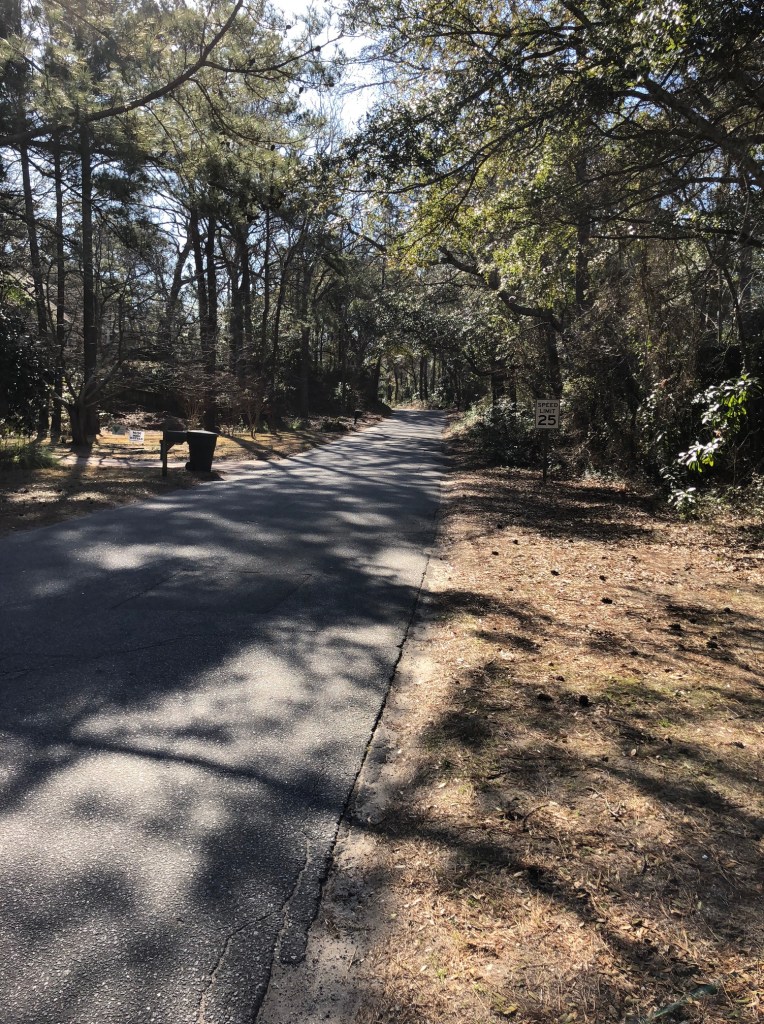
South Dogwood Trail will be undergoing pavement improvements this week, rather than in mid-September, as previously announced, according to a notice released by the Town of Southern Shores this morning.
Contractor Fred Smith Co. was to begin its town-wide pavement work today on Twelfth Avenue and then proceed to Hillcrest Drive, between Sea Oats Trail and East Dogwood Trail, on Aug. 3-5, according to the schedule posted online by the Town.
Town Manager Cliff Ogburn will update the now-revised schedule for pavement work, which currently runs through mid-October, at tomorrow’s Town Council meeting, which will be held at 5:30 p.m. in the Pitts Center.
This week’s work launches an ambitious 10-year road-maintenance plan that will cost more than $1 million per year.
CHANGE IN SPEED LIMIT ON N.C. 12?
We had not planned to return from our summer break until Wednesday, but we thought it was important for residents to know about the construction on South Dogwood Trail, in order to avoid it. Also, residents on the street will not have received much notice from the Town about its commencement.
Now that we’re online, we’ll tell you that the Town Council will be considering at tomorrow’s meeting a change in the speed limit on N.C. Hwy. 12 to 35 mph year-round, a reduction that both the N.C. Dept. of Transportation and the Town staff have recommended.
Currently, the speed limit on N.C. 12 is 45 mph, except from May 15 through Sept. 15 when the speed limit drops to 35 mph from the Kitty Hawk town line north to Trout Run.
In May 2021 the Town asked NCDOT to conduct a traffic study of N.C. 12 in order to provide an informed evaluation of the road’s appropriate speed limit(s).
The Town has authority through the N.C. General Statutes to set the speed limits on a state road, which N.C. 12 is, provided it certifies to the NCDOT that its determination is supported by an engineering and traffic investigation, like the one NCDOT conducted.
We have only skimmed through this material, but think you will find the data on accidents on N.C. 12 from 2017 to 2022 of interest. According to the NCDOT, there were 154 accidents on N.C. 12 in Southern Shores during these six years, of which 97, or 63 percent, were rear-end collisions.
The data reveal that last year was far and away the most hazardous on N.C. 12, with 45 (29 percent) of the 154 accidents.
The one traffic-related fatality on the thoroughfare occurred in 2021 when, many of you will remember, a pedestrian crossing at the Chicahauk Trail traffic light was struck and killed by a vehicle proceeding north on N.C. 12. The pedestrian dashed across the road as the light was changing.
According to NCDOT, 32 of the 154 accidents have involved injuries to people. More than 50 percent of them were in the lowest class of injury (Class C), but we could not find a description of this class or other injury classes included in the report.
This year’s data are incomplete, showing only five accidents on N.C. 12.
IN OTHER BUSINESS AT TOMORROW’S COUNCIL MEETING . . .
*Mr. Ogburn also will update the Town’s beach nourishment project—which, at last report, was expected to start in September—and give a followup on the July 21 water main break at 132 Ocean Boulevard.
*The Town Council is expected to choose a planning consultant to manage the Town’s CAMA Land-Use Plan (LUP) update between two companies that submitted proposals for the contract in response to a Town-issued Request for Proposal. The companies are N-Focus Inc., of Kannapolis and Stewart of Raleigh, which recently assisted the towns of Duck and Manteo with updating their Land-Use Plans.
Although N-Focus’s proposed fee for service is lower than Stewart’s proposed fee—$67,750 as opposed to $80,000—Deputy Town Manager/Planning Director Wes Haskett has recommended that the Council accept Stewart’s proposal because it is “the most qualified and responsible.” The companies’ proposals are included in the meeting agenda packet.
The Town budgeted $80,000 in fiscal year 2022-23 for the LUP update.
As always, we encourage you to attend tomorrow’s Town Council meeting (5:30 p.m., Pitts Center) or watch it on You Tube at https://www.youtube.com/user/TownofSouthernShores. We expect to post an article on Wednesday.
Part of the 10-foot split in the main water line that broke Thursday is visible in this photograph, which Town Manager Cliff Ogburn provided. According to Mr. Ogburn, the water was turned off when this photo was taken. You can see that water has seeped out of a crack on the bottom side, to the right.
Just to follow up with last Thursday’s pandemonium . . . Town Manager Cliff Ogburn confirmed that a lightning strike “in the area” likely caused the main water line break near 132-134 Ocean Boulevard at the pedestrian crosswalk.
According to the Dare County Water Dept., Mr. Ogburn said, the 10-foot split in the pipe that broke (above) was the type of break that a lightning strike causes. It was not the result of a direct lightning hit. Most likely, the impact of the strike on the water in the pipe caused the break.
We thank Mr. Ogburn for keeping people informed after business hours Thursday about the progress of the repairs to the road and its reopening and for immediately responding to us about the cause of the damage and sending a photograph
LOWER YOUR SPEED
No doubt you have read elsewhere about the speed limit on U.S. 158 in Currituck County, from the Wright Memorial Bridge to the H2OBX Water Park, being reduced from 55 mph to 45 mph starting some time this week.
The N.C. Dept. of Transportation announced the speed limit reduction on July 21, explaining that more than 150 crashes, involving four fatalities, have occurred on this 3.4-mile stretch of highway during the past five years.
TIME OFF . . . COUNCIL MEETING
The Beacon is taking a vacation this week and will return in early August.
The next Town Council meeting will be Tues., Aug. 2, at 5:30 p.m. in the Pitts Center. The Town always posts the Council’s meeting agenda and agenda packet on its website the Thursday before each meeting.
Southern Shores homeowner Len Schmitz posted this photograph on Facebook of the closure on Ocean Boulevard, looking north.
UPDATE: THE ROAD REOPENED AT 7:53 P.M. WE WATCHEDAS EMERGENCY VEHICLES DISPERSED. IT IS OPEN IN BOTH DIRECTIONS.
A section of Ocean Boulevard and Duck Road (N.C. Hwy. 12) that has been closed since early morning because of a main water line break on Ocean Boulevard will reopen around 6 p.m., the Town has announced.
Traffic will continue to be re-routed on residential roads around the closure, which extends from the intersection of U.S. Hwy 158-N.C. Hwy. 12 north to the intersection of East Dogwood Trail and Duck Road. The water line break occurred around 130 Ocean Blvd., the Town announced earlier.
Northbound traffic on South Dogwood Trail continues to be backed up and to move slowly. The southbound traffic, diverting from Duck Road on to East Dogwood Trail or another residential access road, is heavier than usual, but moving steadily.
No cause of the water line break has been announced officially, but it is believed to have been caused by a lightning strike during this morning’s severe thunderstorm.
Flooding this morning on Ocean Boulevard near the Duck Road split, caused by a water main break. (Photo submitted by Gray Berryman to OBX Locals Facebook page.)
Ocean Boulevard (N.C. Hwy. 12) is closed from the U.S. Hwy. 158-N.C. 12 intersection north to East Dogwood Trail this morning because of a water main break, the Town of Southern Shores has announced. The break occurred in the vicinity of 130 Ocean Blvd., according to the Town.
The Dare County Water Dept. announced the water break around 8 a.m. and said it affects Southern Shores, Duck, and Martin’s Point. Crews are working on repairing the break, whose cause is unknown at this time. Dare is urging people to conserve water.
We just received a Public Safety Alert from Dare County Emergency Management announcing that heavy traffic backups on “alternate roads” are causing delays. You can expect significant residential cut-through traffic from U.S. Hwy. 158/South Dogwood Trail and Duck Road until Ocean Boulevard has reopened.
Please feel free to update this announcement with any relevant information you may have. We are heading out to take a look now. Thank you.
***
11 a.m. UPDATE: During our scouting, we observed a steady, bumper-to-bumper flow of northbound traffic on South Dogwood Trail to East Dogwood Trail and then to Hickory Trail. Although there was an orange detour sign at the South-East Dogwood Trail intersection, directing people to turn right, there was no detour sign indicating a left turn on Hickory Trail, nor did we see any police officers in this area or farther east on East Dogwood Trail. The southbound traffic through this area was staggered and moving well.
LIGHTNING STRIKE: Neither Dare County nor Southern Shores has announced an official cause of the water main break. Lisa Pair Walters of Kill Devil Hills reported on the OBX Locals Facebook page that a lightning strike caused the break and said she confirmed this with police. Linda Palombo, of 159 Duck Road in Southern Shores, said on Facebook that she “heard it when it hit.” Southern Shores experienced a severe storm this morning that towns to the south did not.
Dare County reports that a “water conservation notice” is in effect “until further notice” for customers in Southern Shores, Duck, and Martin’s Point.
***
NOON UPDATE: Northbound bumper-to-bumper traffic continues unabated on the South Dogwood Trail-East Dogwood Trail-Hickory Trail cut-through route, while southbound traffic traveling from East Dogwood Trail or Hickory Trail to South Dogwood Trail has picked up in volume. We have to wonder where everyone is coming from and going to on such a beautiful beach day when, by now, official and unofficial notice of the Hwy. 12 closure should have circulated.
A 12:18 p.m. ALERT from Dare County Emergency Management continues the water conservation notice and assures the public that the water in Southern Shores, Duck, and Martin’s Point is safe to drink.
We are hearing reports of oversized commercial trucks and tractor-trailers traveling on South Dogwood Trail and other residential roads. We do not believe the temporary closure of N.C. 12 justifies suspension of the Town’s gross weight limit of 10,000 pounds for through trucks (Town Code sec. 20-115) on Town-maintained roads. If police are knowingly permitting oversized trucks to travel on the residential roads, they are doing the Town a disservice. These truck drivers should wait until N.C. 12 reopens before they continue north.
3:30 p.m.: The Southern Shores Police Dept. has announced that the closed portion of N.C. Hwy 12 will reopen around 6 p.m.
Please see our subsequent post for more details about the road’s reopening and repair.
Rack Room Shoes is coming to Southern Shores. (photo of store in Nags Head)
A marked difference of opinion between the Town Council and the Planning Board on the maximum allowable lot coverage and its means of calculation for the Town’s new mixed-use zoning has given rise to a “bit of a disconnect” between the two bodies, according to Planning Board Chairperson Andy Ward, who expressed his disappointment in emails he sent to the Mayor and Council in June and read at last evening’s Planning Board meeting.
The Planning Board expected yesterday to consider a Zoning Text Amendment (ZTA 22-08) submitted by the Pledger Palace that would allow it to convert its childcare facility in Martin’s Point into “affordable” dormitory-like student housing, but the applicant withdrew the ZTA in order to work on it further.
Instead, the Board spent much of its hourlong meeting discussing its relationship with the Town Council, which it will seek to clarify and reconcile, according to Mr. Ward, in a public workshop involving the two boards that Mayor Elizabeth Morey suggested after first failing to respond to the Board Chairperson’s email.
Before we report on the Planning Board’s discussion, we pass along news about the construction at the Southern Shores Marketplace. According to Town Manager Cliff Ogburn, who substituted yesterday for Deputy Town Manager/Planning Director Wes Haskett, both Marshalls and Rack Room Shoes—yes, just as you’ve heard, the discount shoe store will occupy the 6,000-square-foot space next to Marshalls—have received their building permits.
When the Southern Shores Rack Room store opens, there will be three Rack Room stores within about 15 miles, the other two being in the Dare Centre in Kill Devil Hills and the outlet mall in Nags Head. Apparently, the Outer Banks is a market for bargain shoes.
‘A DISCONNECT’
According to Chairperson Ward, he first emailed the Town Council on June 8, the day after the Council unanimously approved a different version of a Zoning Text Amendment (ZTA 22-06) to establish and define a mixed-use development option in the Town’s commercial district than the one recommended by the Planning Board.
The ZTA applicant was Ginguite LLC, a SAGA investor group that owns a 5.2-acre commercial property at 6195 N. Croatan Hwy., which fronts on Ginguite Creek.
SAGA Realty & Construction Co. Partner and CEO Sumit Gupta served as Ginguite LLC’s representative and told both the Planning Board and the Town Council that Ginguite has in mind building luxury condominiums and small retail shops on the picturesque site.
At its May meeting, the Planning Board voted to deny a recommendation to Ginguite’s ZTA 22-06 and agreed to forward to the Town Council its own recommended amendments, without creating a separate ZTA. The principal sticking points between the applicant and the Board concerned the maximum allowable lot coverage and the means by which it would be calculated.
According to Mr. Ward’s June 8 email, the mixed-use maximum lot coverage percentage and calculation that the Council approved allow Ginguite, whose property includes “more than an acre of marsh and wetlands,” an additional 27,182 square feet of “hard structure lot coverage” than the Planning Board recommended and Gupta was “amenable to accepting.”
The Beacon published an analysis of the decision-making about ZTA 22-06 on June 20, 2022, titled “Opinion/Analysis of the Mixed-Use Zoning Change: A Disconnect, a Council of Two, and a Missed Opportunity.”
We concluded, in accord with comments yesterday by Mr. Ward and Planning Board Vice Chairperson Tony DiBernardo, that “A disconnect exists between the Planning Board and the Town Council, which makes us wonder how well they cooperate with, respect, and complement each other.”
As we explained in our article:
“The maximum lot coverage permitted currently in the Town’s RS-8 multifamily residential district is 40 percent of the net parcel area; the maximum lot coverage in the commercial district is 60 percent of the total parcel area, although that can be increased to 67 percent if the developer uses a sufficient amount of permeable pavement.
“The Planning Board arrived at what Mr. Ward called [in the Council’s June 7 public hearing on the ZTA] ‘a pretty good average of 50 percent’ lot coverage for the mixed-use conditional use by ‘blending’ the maximums allowed in the RS-8 district and the commercial district. It essentially viewed mixed-use group development as a new zoning district that combines uses.
“Mayor Morey and Mayor Pro Tem [Matt] Neal disagreed with the Board’s 50 percent, which the Board decided could be extended to 55 percent with permeable pavers. They endorsed the 60 to 67 percent maximum lot coverage permissible in the commercial district.
“The Planning Board also wanted to calculate lot coverage according to the ‘net’ parcel area, the standard used in the RS-8 residential district. Net area is obtained after deducting acreage deemed unbuildable by ‘waterways, marshes, or wetlands.’
“Not surprisingly, Mr. Gupta opposed this limitation for Ginguite’s property. Ms. Morey and Mr. Neal agreed with Mr. Gupta, [with whom they met privately before the public hearing,] advocating that lot coverage be calculated on the basis of the ‘total’ parcel area. They prevailed.”
Mr. Ward strongly opposed the total parcel area basis, writing in his June 8 email: “Given the fragility of this particular parcel and the gateway into our town, I feel we have strayed from our founders’ original vision of Southern Shores which speaks to ‘land use that naturally protects environmental resources and fragile areas by limiting development and growth.’”
He concluded his letter by saying that “Allowing 27,182 sq. feet of lot coverage over-and-beyond what the applicant stated he would accept, is a giveaway I find hard to reckon with. Sometimes, less is more.”
According to Mr. Ward, neither the Mayor nor any other members of the Town Council acknowledged his email, so he sent a second one a week later with the subject, “Reply?” In this email, he questioned Council members’ lack of a response and wrote: “Respect should not get in the way of different viewpoints.”
The Mayor reportedly responded after receiving the second email, and she has since spoken with Mr. Ward and Mr. DiBernardo, who also emailed the Council “voicing his disappointment,” he said, with the ZTA 22-06/mixed-use decision.
There has been “zero response from other Council members,” Mr. Ward said.
Mr. DiBernardo spoke at yesterday’s meeting in favor of the “net parcel area” as the standard for calculating lot coverage in a mixed residential/commercial development and called the amount of coverage the Town Council permitted on the Ginguite property “pretty astounding.” He cited the opinion of an engineer in his family in support of the “net” standard.
Mr. DiBernardo also brought up more generally the Town Council’s failure to follow up with the Planning Board after it takes action on ZTAs that the Board considers.
“We never find out” what action the Town Council takes, the Planning Board Vice Chairperson said, “We don’t hear about it, and we never see the final ZTA.”
He suggested as a courtesy that “final ZTAs” be sent to every Planning Board member.
SOLID WASTE ORDINANCE
Mr. DiBernardo said he had concerns about the Council’s “last three decisions on ZTAs,” but one of the amendments he mentioned—which made changes to the Town’s solid-waste ordinance—was actually a Town Code Amendment (TCA 22-02), over which the Planning Board has no jurisdiction. The Town’s solid-waste (garbage and recycling) regulations are in Chapter 26, which is not in the Zoning Ordinance (Chapter 36).
We were confused by TCA 22-02, as well, because the changes originated with the Planning Board—in particular, with Mr. DiBernardo, who spent considerable time preparing the content of Chapter 26’s revision—but it was not a Zoning Text Amendment.
According to the minutes for the Town Council’s Feb. 1 meeting, Chairperson Ward presented the Planning Board’s suggested improvements for Chapter 26, and the Council directed the Town Manager to prepare a TCA. A draft of TCA 22-02 was then reportedly discussed at the Town Council’s March 9 retreat and further amended.
Because the changes were in a Town Code Amendment, not a ZTA, the Council had no legal obligation to hold a public hearing, and it did not. The Town Council unanimously approved TCA 22-02 at its April 5 meeting. (The Beacon was on hiatus throughout this process.)
We believe the Town’s communication with the public on these major changes was inadequate, and the Council should have held a hearing. Homeowners, especially those with vacation rental property, should have been given notice and an opportunity to be heard on TCA 22-02.
Mr. DiBernardo told The Beacon that the Planning Board never received any feedback from the Council about the work it had done on the solid-waste ordinance revisions.
Mr. Ward described Planning Board members as being disappointed and spoke of the Board being “hopped over” by the Council. He referred to “festering” as a result of the Council’s action on ZTA 22-06, and said, “Their members and our members need to get together and talk.”
Noted Board member Lynda Burek: “We need to understand our relevance in the process, and if we get nothing back from the Town Council except maybe feng shui from Elizabeth, that tells a lot. It really says that our relevance to them is pretty modest.” (We think she said feng shui. We attended the meeting, and listened to the videotape, but cannot be sure.)
Ms. Burek also inquired about the imminent update to the Town’s Land-Use Plan, asking: “Who’s the gatekeeper over the Land Use Plan?”
Mr. Ogburn proposed that the LUP update be discussed by the two boards at their upcoming workshop.
AND FINALLY . . . The Planning Board unanimously reelected Mr. Ward and Mr. DiBernardo as chairperson and vice chairperson, respectively, for the 2022-23 fiscal year, and indicated an interest in taking up design standards for the commercial district. It can have a say in what future mixed-use developments look like.
The Planning Board’s next meeting is Aug. 15, at 5 p.m., in the Pitts Center.
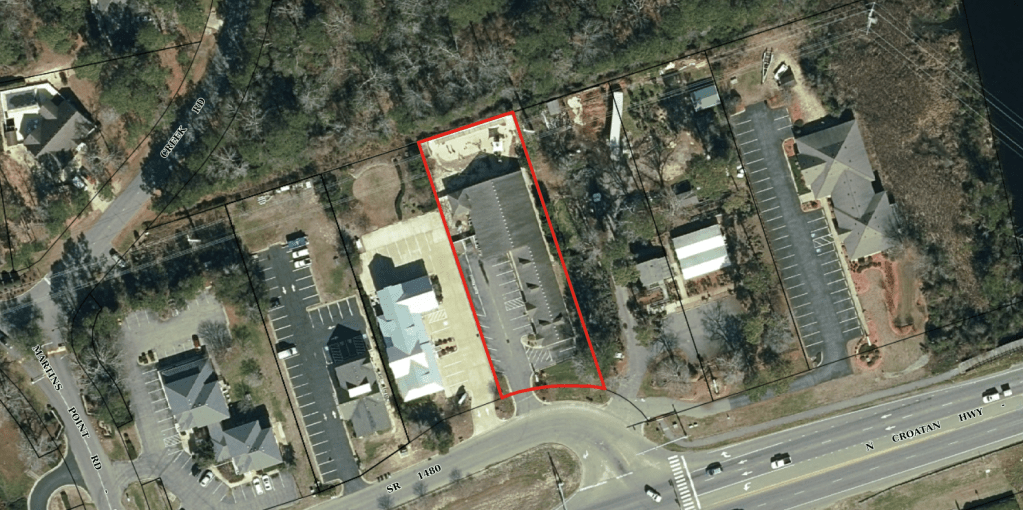
This aerial photo from Dare County gis shows the Pledger Palace childcare facility at 6325 N. Croatan Hwy. (U.S. Hwy. 158) outlined in red. The owner of the business is seeking a change in the Southern Shores Zoning Ordinance to allow for a communal form of affordable housing in the commercial district.
The Town is “waiting until traffic counts are lower before we might put barricades back up,” Mayor Elizabeth Morey told a gathering of Southern Shores residents and Town officials yesterday afternoon at a “Mayor’s Chat” that focused primarily on the weekend cut-through traffic, including the possible restoration of the “Local Traffic Only” road barricades.
Nine residents (excluding The Beacon), Town Manager Cliff Ogburn, Police Chief David Kole, Deputy Police Chief Jonathan Slegel, and Council members Matt Neal, Paula Sherlock, and Leo Holland attended yesterday’s chat, which lasted 90 minutes and was not an official meeting of the Council.
Among the nine residents, seven spoke about the traffic and the problems of congestion and speeding, as well as public urination and trespass by vacationers who exit their vehicles and use residents’ property to relieve themselves. Four of the seven asked for the orange, water-filled barricades that were placed at street intersections in the dunes from Memorial Day weekend through June 25-26 to be restored, saying they helped to reduce cut-through traffic flow.
Among them, Jerrica Rea, who lives on Sea Oats Trail between Hickory Trail and Hillcrest Drive, complained about the bathroom breaks she and her family witness and also said cut-through vacationers use her driveway and her trash cans and even park in her parking space.
Ms. Rea’s neighbor, Susan Adams, said public urination has become old news. Besides supporting the barricades, she called attention to speeding by cut-through drivers and to the road wear-and-tear that their vehicles cause.
Rick Haley of the north end of Wax Myrtle Trail said he had to endure “peeing” and the disposal of “dirty diapers” on his yard every summer weekend since 2017—until the “Local Traffic Only” barricades were employed.
Mr. Haley said that the barricades “helped us 100 percent.”
Mayor Morey seemed surprised by this declaration.
“That’s the first time I’ve heard that,” she told him, apparently referring to his resounding support of the barricades because certainly residents have informed Town officials previously about their effectiveness.
Mayor Morey explained that the road barricades were removed because of “conflicts” that arose between “drivers and residents, residents and residents, and drivers and drivers.” People had heated exchanges in the streets, and too many cut-through drivers were ignoring the barricades.
Robert Green Sr. of Hillcrest Drive also said, “The barricades were working,” and vigorously pressed the Mayor for an accounting of the Town’s decision to remove them.
Ultimately, the Mayor acknowledged “it was a subjective decision,” not based on any incident data, and said the Town could “deploy the barricades again.”
She did not explain the logic of using the barricades when there are fewer vehicles on the cut-through route, and, thus, less need for them. Her chief concern seems to be to minimize the risk of angry confrontations occurring on the streets.
Tommy Karole, former chairperson of the citizens’ committee that studied cut-through traffic and recommended installation of a gate on South Dogwood Trail, renewed the committee’s proposal, explaining that tiny transponders attached to locals’ license plates or windshields would be used to open the gate.
Conditions as they are now are “unsafe,” Mr. Karole said, “and it’s obscene that our Council allows” them to exist. As he has in the past, Mr. Karole warned of the delay that backed-up traffic poses to emergency medical service vehicles and other first responders.
Mr. Karole, who lives on East Dogwood Trail near the North-South-East Dogwood trails intersection, also complained of vehicles speeding on East Dogwood Trail across the Dick White Bridge as cut-through drivers accelerate once they turn right (often without stopping) onto the road from South Dogwood Trail. Speeding also occurs in the other direction, but less flagrantly.
Wendy Hawkins of South Dogwood Trail responded favorably to Mr. Karole’s gate proposal, expanding upon it by suggesting that another means besides a transponder, such as a keycode, could be used to allow access to “people who legally need to get through.” Smart-phone technology opens up other possibilities.
Determining who would require access in addition to local residents—such as non-resident property owners, guests of homeowners and of the Duck Woods Country Club, renters, and essential servicepeople—and how to enable that access are just two of the issues associated with installing a gate.
Before Town officials get to assessing the logistical, technological, and physical requirements of a gate, however, they must resolve the hesitancy they feel about the legal position the Town would be in if it were to close South Dogwood Trail to cut-through drivers. There is no North Carolina law that prevents it from doing so. The Beacon will explore the legal picture in a future blog.
Ms. Hawkins spoke forcefully about the speeding and reckless driving on South Dogwood Trail that pose a danger to people walking on the sidewalk. She described vehicles coming so close to the curbs that their hubcaps scrape them.
A car “could jump the sidewalk,” she said, if drivers persist in rivaling on-coming traffic for passage, instead of yielding. It’s an eye-of-the-needle situation when two wide vehicles meet.
Ms. Hawkins said she had two of the Town’s “Please be respectful” signs in her yard—and she even held one up for passing drivers to see—but she took them down “because they weren’t doing any good.”
“I’m very angry,” she said. “It’s horrible.”
Ms. Hawkins’s suggestion of installing a “Local Traffic Only” barricade on South Dogwood Trail was quickly dismissed as unworkable by Chief Kole and other Town officials.
WHICH CAME FIRST: CHICKENS OR EGGS, ANYONE?
Among other topics discussed at the chat, a Chicahauk homeowner asked about potential construction on Gravey Pond Lane; an Ocean Boulevard homeowner inquired about the Town extending its complimentary trash and recycling receptacle rollback service on Ocean Boulevard beyond the Duck Road split; and Jerrica Rea outed herself as “the chicken lady.”
Ms. Rea has campaigned on the social media site, Next Door, for the Town to allow residents to raise chickens, as the towns of Kitty Hawk and Kill Devil Hills do.
The “keeping and having of livestock and fowl” in town is prohibited by Southern Shores Town Code sec. 4-24. The Code defines “fowl” as “edible birds commonly found on farms, such as chickens, turkeys, ducks, guinea fowl and geese.” (Sec. 4-21)
Ms. Rea revealed yesterday that she had spoken with Mr. Ogburn about the possibility of raising chickens at her home and that she had hired an attorney to assist her. Because of an issue with property covenants, Mr. Ogburn had not yet advised Ms. Rea about the process for repealing a Town Code ordinance.
Mayor Morey indicated that she has heard strong opposition to chickens (or more precisely, hens) being allowed in Southern Shores. She suggested that the topic would be an appropriate one for discussion in one of the public workshops that will be held after the Town initiates its update of its Coastal Area Management Act (CAMA) Land Use Plan. The first such workshop could be held as early as September.
(The Beacon will inform readers about the Land Use Plan update after a consultant is hired to run the process, which is established by State law and regulations. The Town issued a Request for Proposal on July 1 for a “qualified firm” to update the currently adopted Land Use plan, which, although certified by the N.C. Coastal Resources Commission in 2012, was submitted to the State in 2008 and based, in part, on a public workshop and citizens’ survey conducted in 2005. Proposals for the update must be submitted to the Town by 5 p.m. on July 22.)
‘AFFORDABLE HOUSING’: A CHALLENGING ZTA FOR THE PLANNING BOARD
The Town Planning Board will consider at its meeting next Monday a Zoning Text Amendment (ZTA) submitted by the owner of the Pledger Palace day care center to allow a residential structure she is calling a “shared space-occupancy dwelling” to be built in the C general commercial district of Southern Shores.
A document submitted by Patricia Pledger, president of Pledger Palace Child Development and Educational Center, Inc., with ZTA 22-08 indicates she envisions a so-called SSO as “an affordable housing solution” for international students coming to the Outer Banks through the J-1 summer work visa program.
Ms. Pledger is proposing converting her childcare facility at 6325 N. Croatan Hwy. in the Martin’s Point area into communal housing for at least 95 “non-transient” J-1 students.
According to Deputy Town Manager and Planning Director Wes Haskett, the Pledger Palace property is located in Southern Shores’ extraterritorial jurisdiction (ETJ), so it is “subject to the Town’s development requirements.”
John Finelli is the ETJ representative on the Planning Board.
The Pledger Palace is currently operating as a summer camp for children, according to Ms. Pledger’s letter.
The Board will meet Monday in the Pitts Center at 5 p.m. It also will take up a housekeeping ZTA submitted by the Town itself to ensure that the Town Code is consistent with N.C. statute.
ZTA 22-08 proposes to amend the permitted uses section of Town Code sec. 36-207, which regulates the commercial district, to add shared space-occupancy dwellings, as well as to add a definition of an SSO to the Zoning Ordinance’s definitions section 36-57.
The Pledger Palace is being represented by attorney Casey C. Varnell of Sharp, Graham, Baker & Varnell in Kitty Hawk.
The crux of the proposed zoning change is the definition of an SSO, which is described in ZTA 22-08, in significant part, as a “private structure” with “shared spaces . . . offered for rent for the purpose of providing affordable sleeping accommodations” to “persons who do not meet the definition of family.”
Each “shared space” may “accommodate up to 10 bunk units (maximum of 20 occupants).” It is further described as existing within “the confines of four walls, and separate and apart from any other shared space within the structure.”
ZTA 22-08 further specifies that residents of the SSO “shall share a kitchen facility and common living area with all other residents and shall share a bathroom facility with one or more other residents.” The owner of the SSO cannot use it as a primary residence, according to the ZTA.
The proposed definition concludes with this disclaimer: “SSO does not include dormitory and residence halls, single-family dwellings, multi-family dwellings, motels, or vacation cottages.”
Although the terms “dormitory” and “residence halls” are not defined in the Town’s Zoning Ordinance, both are prohibited in all zoning districts in Southern Shores by Code sec. 36-209(9).
ZTA 22-08 also would amend Town Code sec. 36-207(b), the permitted uses section, with details about the parking, bathroom facilities (separate for males and females), permitting, and other matters pertinent to SSOs.
Although Ms. Pledger has submitted ZTA 22-08 in order to convert her childcare facility into “affordable housing” for J-1 students, the Town’s enactment of a new permitted use in the commercial district such as she is proposing would apply throughout the district. What she has submitted is not a building project peculiar to her property.
We think the Planning Board is going to find both the concept of a shared-space occupancy dwelling and the language defining it challenging, even though members may consider the purpose behind ZTA 22-08 laudable.
The Town Council and Town Manager Cliff Ogburn had nothing new to say about the cut-through traffic at last evening’s Council meeting except that, as bad as it was last Saturday, according to Mr. Ogburn, it “would have been worse with the [‘Local Traffic Only’] barricades.”
The more barricades that the Town puts up, said Mayor Elizabeth Morey, “the more potential [there is] for public-safety incidents.”
We wonder how the “potential” for public-safety “incidents” compares with the “potential” for public-safety “incidents” caused by the relentless, all-day stream of traffic clogging the roads.
Unfortunately, one cannot prove potential; nor can one prove that road conditions would have been worse had there been barricades. We don’t have a control group of roads to test Mr. Ogburn’s hypothesis. We only have conjecture.
Although traffic was very heavy last Sunday, too, the tepid discussion that Town Council members had focused on Saturday. At its conclusion, both Council and Manager confirmed that the barricades would not be used in the foreseeable future. They see them as a source of tension and strife between residents and vacationers driving through town on residential streets.
Town Council member Mark Batenic did not attend yesterday’s meeting. He also was absent for the June 21 workshop meeting.
Mayor Pro Tem Matt Neal aptly described conditions Saturday on the South Dogwood Trail cut-through route as “horrendous” and referred to the 4:30 p.m. to 5 p.m. vehicle backup in the dunes as a “parking lot.” He expressed sympathy for residents, but offered no suggestions for traffic mitigation, saying that the volume of traffic through town—on N.C. Hwy. 12 and the cut-through route—is simply too great.
Town Councilwoman Paula Sherlock mentioned emails sent to the Town Council by residents that attest to a strong difference of opinion about the barricades. We wish she had elaborated on this point. Our belief is—and our mail indicates—that residents strongly objected to the closing of Hickory Trail, but not to the barricades on other streets, which inconvenience residents only slightly because they can drive around them.
It was when Hickory Trail was closed that traffic backed up on South Dogwood Trail to the cemetery. Last Saturday, with Hickory Trail open and no other barricades in place, traffic backed up on South Dogwood Trail past the Duck Woods Country Club to the Kitty Hawk Elementary School, Mr. Ogburn said.
The Town Council and Town Manager attributed this backup to the fact that it was a holiday weekend. What will be their reason when it happens this Saturday?
Mr. Neal said that, based on previous traffic data, the weekend traffic flow through Southern Shores will continue to be heavy through July and start to taper off in August.
The Town Manager reported a traffic count of 5069 vehicles on South Dogwood Trail last Saturday, which he compared favorably to a count of 4581 vehicles on the street on July 3, 2021, when the “no left turn” was in effect on U.S. Hwy. 158.
We do not believe it is possible to evaluate the meaning of last year’s count, without knowing what the level of police enforcement of the left-turn prohibition was. A better comparison might have been with Sat., July 4, 2020, when, according to Town traffic data obtained by The Beacon last year, 3249 vehicles traveled on South Dogwood Trail—nearly 2000 fewer than traveled on it last Saturday.
The pandemic 2020 summer season was a boom season for the Outer Banks. We suspect, but cannot say with certainty, that police monitored the illegal left-turning traffic on the July 4th weekend that year. But there also was no 7-Eleven parking lot at the 158-South Dogwood Trail intersection offering vacationers a left-turn work-around.
Mr. Ogburn previously informed The Beacon that the U.S. 158-South Dogwood Trail intersection was lightly monitored in 2021 by Southern Shores police, who issued only 32 citations for its violation all summer. That is an average of 1.78 tickets issued per day that the turn prohibition was in effect.
The Town will continue to put a “strong effort” into “educating” vacationers that they are “better off” staying on U.S. Hwy. 158 and N.C. 12, than driving on the South Dogwood Trail cut-through route, Mr. Ogburn said. The N.C. Dept. of Transportation is assisting the Town by providing road signage that encourages vacationers to stay on the state roads.
POLICE ACTIVITY LAST WEEKEND
In an effort to inform the Town Council and the public about what police were doing over the holiday weekend, Police Chief David Kole ran through the calls and incidents to which the police responded “above and beyond dealing with the traffic.” According to the Chief, they were as follows:
Sat., July 2:
Three traffic accidents, one on South Dogwood Trail, two on Duck Road
A larceny call
Two mutual aid requests, one from Currituck County, which was a “burglary in progress with shots fired” (apparently a resident thought he saw a burglar and fired a gun), and the other from Kitty Hawk
Request from Kitty Hawk Police Dept. for assistance with an “overdose” at McDonald’s; the Southern Shores officers “brought [the victim] back with Narcan,” Chief Kole said
19 traffic stops
Two motorist assistance calls
One response to a water rescue
Two burglar alarms going off
Two “talk with an officer”
K9 training
One traffic hazard (a tree in the road was removed)
Sun., July 3:
An accident with injuries (a vehicle flipped over near Porpoise Run)
Two “domestics in progress”
Two calls about a protest on Ocean Boulevard (no violations cited)
One “underage drinking on the beach”
A “mutual aid” from Kitty Hawk for a foot chase; the K9 “was deployed”
One animal call
One suspicious vehicle
One “talk with an officer”
Chief Kole did not detail any of these calls or incidents beyond what we have described above. Although he mentioned the number of traffic stops that occurred on Saturday, he did not do the same with Sunday.
The Chief also reported on service calls “not related to the traffic” that the police handled on Fri., July 1, and Mon., July 4. Monday’s calls featured an eclectic assortment that included:
One domestic assault
One verbal assault
One noise disturbance
K9 training
A grass fire near 102 Ocean Blvd. (assist the Fire Dept.)
And one whose resolution elicited an undercurrent of laughter from people attending the meeting:
Family that was panhandling at the Marketplace
“We moved them to Kitty Hawk,” Chief Kole reported.
MAYOR’S CHAT
Mayor Morey reminded all members of the public that she will host a Mayor’s Chat next Wed., July 13, at 4 p.m. in the Pitts Center.
Town Manager Cliff Ogburn’s updates on seasonal traffic and on street improvements scheduled this year headline a Town Council meeting today at 5:30 p.m. that is light on business–a nice change of pace.
As usual, the Council’s regular first-Tuesday meeting will be held in the Pitts Center and will have two public-comment periods for people who sign up to speak immediately before the meeting.
The Town’s Fire Chief, Police Chief, and Deputy Town Manager/Planning Director also will be giving their reports on the month of June.
Please comment here today, rather than on Next Door, about the cut-through traffic, which was already pouring in on South Dogwood Trail well before 11 a.m. We also welcome comments about traffic elsewhere from residents throughout Southern Shores.
A sign at Hickory Trail near its intersection with Hillcrest Drive warns June 11 of the popular cut-through road’s closure. Numerous drivers, including locals, ignored the sign.
All residential streets in Southern Shores that have been blocked with “Local Traffic Only” barricades in anticipation of thousands of northbound vehicles driving through neighborhoods will be open this weekend, the Town announced in its biweekly newsletter today.
“With this weekend’s traffic expected to be the peak of the summer,” the announcement says, “we have determined that it is best to remove barricades on all Town streets. This will provide as many outlets as possible and expedite traffic throughout Southern Shores.”
The Town first placed orange, water-filled barricades and regulatory “Road Closed Local Traffic Only” signs at intersections along the South Dogwood Trail-East Dogwood Trail-Hickory Trail cut-through route, on Juniper Trail, and on Ocean Boulevard over the Memorial Day weekend. The barricades blocked the northbound lanes at multiple intersections, including those on East Dogwood Trail and Hickory Trail with Hillcrest Drive, Sea Oats Trail, and Wax Myrtle Trail. The barricades were placed at the same 10 locations over the June 4-5 weekend.
While residential roads experienced heavy traffic on both of those weekends, conditions on the cut-through route became “chaotic,” Town Manager Cliff Ogburn told the Town Council at a recent meeting, when the Town experimented with closing Hickory Trail to all traffic at the Hickory Trail-East Dogwood Trail. This closure elicited much “anger and resentment toward the town,” Mr. Ogburn said, and “police had a lot of calls from upset residents.” (See The Beacon, 6/23/22, for background.)
The closure of Hickory Trail is referenced in the Town’s announcement today, which further reads:
“When addressing traffic issues in one part of our community, the Town did not intend to create new or worse problems in other parts of town. In some cases, efforts to ease cut-through traffic have created conditions worse than those addressed. The blocking of Hickory Trail at East Dogwood is an example of the effect being worse than the cause. Traffic being backed up to the cemetery on South Dogwood is not an outcome we can allow. Once East Dogwood Trail and Hickory Trail were opened for traffic, we still experienced lengthy backups on South Dogwood. The barricades at several intersections that are intended to discourage non-local traffic from cutting through contributed to the back-ups. We are experiencing different results from these barricades this year than last.”
There is no question that northbound motorists brazenly ignored the barricades, driving around them as they traversed the Southern Shores woods and dunes to reconnect with Hwy. 12 (Duck Road) at its intersections with Hickory Trail, Hillcrest Drive, Eleventh Avenue, and Sea Oats Trail. The same was true on Ocean Boulevard. Vacationers have learned that the “Local Traffic Only” signs are not backed up by law enforcement.
While we knew that our suggestion recently to have police cite motorists for violations at the end of the roads they illegally enter would be labor-intensive and would not be met with favor by Police Chief David Kole, we did not expect the Town to pull the plug altogether on traffic mitigation on the roads themselves. We are very disappointed. (See The Beacon, 6/26/22)
We contacted Tommy Karole, the chairperson of the former Southern Shores Citizens’ Committee to Study Cut-Through Traffic, for his comment on the Town’s action. The cut-through traffic committee recommended a gating system to relieve weekend congestion.
“If the Town Council had taken the time to listen to what the cut-through traffic committee found in its research,” Mr. Karole told The Beacon, “they wouldn’t have wasted the time and money over the last two years that they have.” Mr. Karole further said that he predicted the conditions that have occurred on weekends since Memorial Day.
According to The Beacon’s reporting, the Town Council did not take up the cut-through traffic in a public meeting after Sept. 7, 2021 until the Town held a public-information forum during which Mayor Elizabeth Morey’s traffic mitigation plan for the summer was announced.
Today’s Town newsletter announcement concludes with the statement that “We will continue to alert visitors that they will experience less congestion if they remain on U.S. 158 and N.C. 12.” It refers readers to https://www.youtube.com/watch?v=OpQ3-tKSa3Y for the “latest message.” (One slogan, delivered on the videotape by the voice-over of a young child: “Don’t cut through, stay on N.C. one-two.”)
TOWN COUNCIL MEETS NEXT TUESDAY, JULY 5
The Town Council will meet for its regular monthly meeting next Tuesday, at 5:30 p.m., in the Pitts Center. The meeting agenda, which was posted on the Town website today, shows that the Town Manager will give an update on traffic and on the street improvement project during his report. You may access the agenda here: https://southernshores-nc.municodemeetings.com.
MAYOR’S CHAT JULY 13
Mayor Morey will hold an informal Mayor’s Chat on Wed., July 13, at 4 p.m., in the Pitts Center.