The Town Planning Board adjourned last night after a 3 ½-hour meeting without taking any action on the special use permit (SUP) application submitted by Ginguite, LLC/SAGA for its proposed creekfront condo-retail-office-restaurant development at 6195 N. Croatan Hwy.
The Board will continue its review of Ginguite’s SUP 23-01 at its Nov. 20 meeting. In the interim, the Town will prepare a list of further information items identified during the meeting that the Board needs in order to make a recommendation to the Town Council and give it to SAGA’s representatives to fulfill. The Board may recommend approval of the SUP, with conditions, or denial of the SUP.
Among the many concerns addressed by the Board yesterday were the functionality and capacity of the wastewater treatment plant that would serve the development; the impact that the development would have on traffic in the area; the location and any adverse effects on wetlands on the property; the building setback and vegetative buffer between the east boundary of Ginguite’s property and the Southern Shores Landing community; and the appearance of the development, once constructed.
Board Alternate Michael Zehner drew enthusiastic applause from residents in the audience when he said that the Planning Board should not take any action until a traffic impact study is done and its results are reviewed by an independent expert. The conduct of a traffic study is one of the conditions of the permit’s approval.
Calling the Board “the first line of defense in a process,” Chairperson Andy Ward observed approvingly at the end of the meeting discussion that “We’re moving the process forward.”
He declined to schedule a special meeting to resume the Board’s review before Nov. 20.
(Please Note: We are in transit today and tomorrow and do not know yet when we will be able to expound upon our report. We will do our best to provide further details about the Board meeting before the next meeting. You may view a videotape of the meeting through the Town of Southern Shores You Tube website. Thank you.)
The Town Planning Board will continue its review of Ginguite, LLC’s special use permit application for its proposed condo-retail-office-restaurant development at 6195 N. Croatan Hwy. on Monday at 5 p.m. in the Pitts Center.
Ginguite, LLC, is a subsidiary of SAGA Realty & Construction. Its application, SUP 23-01, is the first invocation of the Town’s ordinance authorizing “mixed-use” group developments of residential and commercial buildings as a conditional or special use in the commercial district. New Town Code sec. 36-207(c)(11) was passed unanimously by the Town Council in June 2022 with the SAGA project in mind.
For previous articles about SAGA’s proposed creekfront development, which has aroused considerable public opposition, see The Beacon, 9/19/23 and 9/29/23.
The Planning Board questioned Ginguite representatives about SUP 23-01 at its Sept. 18 meeting, but adjourned without taking any action. Appearing on behalf of the applicant were Sumit Gupta, Co-Founder, Partner, and Chief Executive Officer of SAGA and engineer Michael Strader of Quible & Associates.
Ginguite, LLC, is proposing to build two three-story wood framed buildings, 200 parking spaces, a marina, and associated infrastructure on what it represents is about 4.55 acres of a 6.96-acre property. The Town has already advised the applicant that marinas, both commercial and recreational, are not permitted in the commercial district.
Unfortunately, we are unable to attend Monday’s Board meeting in person, but we will live-stream it and report on its outcome as soon as we can.
JUST A REMINDER . . . Early voting for the Nov. 7 municipal election starts Thurs., Oct. 19, and runs through Sat., Nov. 4. See https://www.darenc.gov/departments/elections/voting for details. Four candidates are vying for three seats on the Southern Shores Town Council. There are no other races for public office on the ballot.
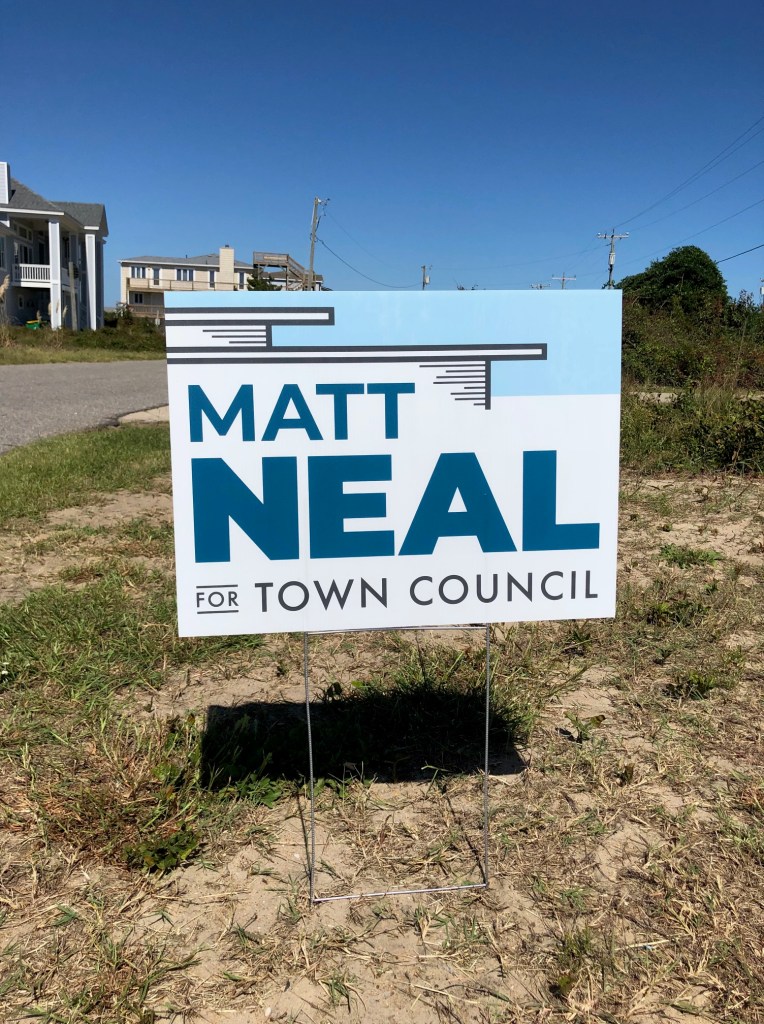
Incumbent Matt Neal is one of four candidates running for three positions on the Southern Shores Town Council.
The Beacon will only be publishing this post this week. We encourage you to view the videotape of Monday night’s Town Council candidates’ forum, hosted by the League of Women Voters of Dare, which you may access at https://www.ywatch?v=mOkCDKGozAgoutube.com/.
There was considerable discussion among the candidates about a controversial housing provision just passed in the N.C. General Assembly’s 2023 appropriations bill that restricts the authority and governance Dare County towns have over State-financed affordable housing projects within their limits.
Most of the candidates’ discussion was not about the provision itself, however, but about who had authored the provision and arranged to insert it in the budget, questions that remain unresolved. We would have liked to have known more about the provision.
The N.C. General Assembly allocated $35 million to Dare County in 2021 to construct “affordable,” aka essential workforce, housing. The Dare County Board of Commissioners thereafter partnered with Coastal Affordable Housing, Inc., a newly created, North Carolina-based consortium, to build workforce housing using these nonrecurring funds.
Dare County also partnered separately with the Ohio-based Woda Cooper Cos. to build other workforce/affordable housing initially just on Roanoke Island; later, Woda Cooper identified a Nags Head site. Dare County has reportedly committed $12 million to Woda Cooper projects.
No State- or Dare County-funded housing project has been greenlighted on Roanoke Island or the beach because of local resistance.
The Outer Banks Voice has done an excellent job of reporting on these developments, and we refer you to their coverage, which includes an article yesterday about the Dare County Board of Commissioners’ decision on Monday night to form an affordable housing task force made up of representatives from the county and all six of its municipalities.
All six towns, including Southern Shores, have officially protested the N.C. legislature’s budgetary provision as an encroachment of their powers and control—i.e., a heavy-handed usurpation of local authority by a State legislature increasingly inclined to usurp such authority.
We were curious about what the provision actually says and looked it up online.
Titled “Dare County Affordable Housing,” it is section 24.8 of the “Current Operations Appropriations Act of 2023” (House Bill 259) and consists of just three subsections. We quote:
“SECTION 24.8(a) The following shall apply to all construction of buildings and infrastructure under the agreement or series of agreements entered into pursuant to Section 24.1 of S.L. [Session Laws] 2022-74 to construct affordable housing units in accordance with Dare County’s longstanding master development plan to increase workforce housing:
“(1) With respect to building permits and inspections of the new construction, the State of North Carolina and any local government with jurisdiction over the new construction shall expedite the issuance of permits and prioritizing the conduct of all necessary inspections.
“(2) With respect to development regulations:
(a) “Articles 6 and 7 of Chapter 160D of the General Statutes shall not apply to the new construction under the agreement or series of agreements.
(b) “Approval under Article 8 of Chapter 160D of the General Statutes shall not be required for the new construction under the agreement or series of agreements; however, a plat of any subdivided land shall be recorded by a selected qualified private partner.
“(3) With respect to utilities, and provided that the local government has sufficient capacity, any local government within a 1-mile radius of the new construction under the agreement or series of agreements shall provide all utilities in the same manner as that local government provides utilities to all other new construction in that jurisdiction.
“SECTION 24.8(b) This section is effective when it becomes law.”
Chapter 160D is the “Local Planning and Development Regulation.” Article 6 pertains to development regulations; Article 7 to zoning regulations, and Article 8 to subdivision regulations.
This is, indeed, a sweeping usurpation of municipal powers by an autocratic legislature whose intentions we will not speculate upon. We do think that the formation of a task force is a positive step, provided its membership is not too unwieldly. Affordable workforce housing is a county-wide issue that should be approached by the towns and county acting in concert. It’s one for all and all for one. We all can benefit.
Four candidates running for three positions on the Southern Shores Town Council will meet for a Q&A forum hosted by the League of Women Voters of Dare County (LWV) tomorrow, from 7 p.m. to 8:30 p.m., in the Pitts Center.
The LWV moderator will pose questions to the candidates submitted by the public on site or in advance in email sent to LWVdare@gmail.com. The LWV asks that you include your name and your town with your emailed question(s).
The four candidates vying for Town Council office are incumbents Matt Neal, who was elected in 2019 and has served as mayor pro tem for two years during his term, and Mark Batenic, who was appointed in January 2022 to fill the vacancy created when then-Councilwoman Elizabeth Morey was elected mayor, and challengers Robert E. Neilson and Michael Guarracino.
We have neither seen nor heard of any door-to-door campaigning occurring in town, which is highly unusual for grass-roots electioneering, nor have we learned of any meet-and-greets being held or scheduled or received any mailers. With just 18 days remaining before the early voting period begins, the candidates have been very subdued.
Please see The Beacon, 9/10/23, for more details about the general municipal election, which will be held Nov. 7 in the Pitts Center, not the Kitty Hawk Elementary School.
TOWN COUNCIL MEETING FEATURES AUDIT and ETJ CHANGE
The Town Council will meet Tuesday at 5:30 p.m. for its regular monthly meeting. Mayor Elizabeth Morey announced at the last Council meeting that the Mayor Pro Tem will preside over the meeting in her absence.
Included on the meeting agenda are an audit report by the Town’s new accounting firm, Carr, Riggs & Ingram, and a public hearing on Town Code Amendment (TCA) 23-02, whose purpose is to relinquish Southern Shores’ Extraterritorial Jurisdiction (ETJ) over commercial properties in Martin’s Point.
If the Town Council votes to adopt TCA 23-02, and relinquishes the Town’s ETJ, Martin’s Point commercial properties will no longer be subject to the Town’s development regulations, including zoning, and will become a part of Dare County’s jurisdiction.
ETJ Representative John Finelli requested the relinquishment in August 2022, and the Planning Board unanimously recommended in December that the relinquishment occur. The Town Council directed Town staff in February to prepare an ordinance to effectuate this action, and the Planning Board unanimously recommended in August that the Council adopt TCA 23-02.
Carr, Riggs & Ingram is a top-25 nationally ranked, Alabama-based accounting firm that serves clients nationwide, according to its website, https://cricpa.com.
Tuesday’s meeting agenda does not note any topics that Town Manager Cliff Ogburn plans to bring up in his staff report. The Council will be taking up in “new business” tasks associated with replacing the culvert at the Trinitie Trail bridge.
PARADE OF HOMES: 2 SOUTHERN SHORES-BASED BUILDERS ON TOUR
Southern Shores-based builders, Sandmark Custom Homes, Inc., and Neal Contracting Co., each have examples of their craftsmanship in this year’s Outer Banks Home Builders Assn.’s Parade of Homes, which starts Thursday and runs through Saturday, from 10 a.m. to 6 p.m.
The OBHBA also will host a Trade Expo for businesses and vendors who support the Outer Banks building industry on Sunday from 10 a.m. to 3 p.m. at the Ramada Plaza Oceanfront in Nags Head.
Neal Contracting built a new seven-bedroom, 2,926-square-foot house in Southern Shores at 8 Fifth Ave., and Sandmark remodeled a five-bedroom, 3,059-square-foot house in Duck at 107 Canvas Bank Drive.
These houses are two of nine featured in the 31st annual Parade of Homes, three of which are only available for viewing online in a “Virtual Parade”—a new twist to this annual showcase of home design and construction.
Croatan Custom Homes of Kitty Hawk built three of the nine featured homes, including two on the Virtual Parade, which according to FAQ on the OBHBA website will remain online for one year.
The six “in-person” homes range in location from Corolla to Salvo and include one in Manteo.
The largest and most expensive “home” on the tour is a wedding venue in Corolla known as “OBX One” that was built by CMI Design Studio, a custom builder based in Washington, D.C.
The $12.5 million, 14,500-square-foot venue has 12 bedrooms, 19 full baths, 3 half-baths, a swimming pool, an elevator, “state-of-the-art technology,” and a boatload of other luxuries, as you can imagine, and is located “semi-oceanfront” at 890 Lighthouse Drive, meaning it is across the street from the beach.
Tickets are $20 per person and include access to the nine houses and the Trade Expo.
For more information about the homes, the Trade Expo, and advance ticket sales, see https://www.obhomebuilders org/2023-homes/.
Tickets also may be purchased at the entrance to one of the “in-person” homes.
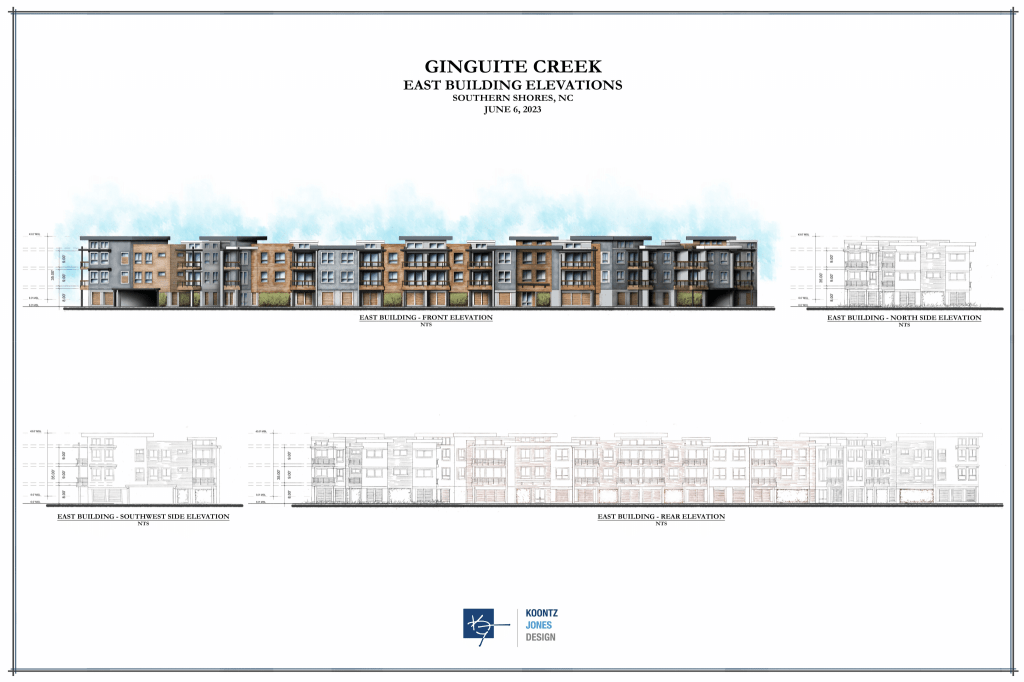
This design drawing of the 30-unit residential building was included in Ginguite, LLC’s SUP application.
Ginguite, LLC, has proposed constructing a “mixed-use group development” consisting of 36 “multifamily” dwellings and space for retail, offices, and restaurants in two buildings on 4.55 acres of vacant property on Ginguite Creek at 6195 N. Croatan Hwy. (U.S. Hwy. 158).
One building would be strictly residential and contain 30 dwellings with ground-floor parking, according to Ginguite, while the other building would house a mix of six dwellings and the various commercial uses.
In order to proceed, Ginguite must receive a special use permit from the Town of Southern Shores because its development is not one that is permitted “as of right” in the Town’s C General Commercial District.
According to Ginguite LLC, which is a subsidiary of SAGA Realty & Construction, the property is predominantly in the Town’s C General Commercial District, but a small portion of land north of the Ginguite Creek basin is in the R-1 (low-density) residential district.
The Town may require SAGA/Ginguite to meet explicit conditions before it approves its permit.
(Zoning districts are defined in Article IX of the Town Code, which begins with section 36-202.)
Before June 7, 2022, when the Town Council unanimously voted to add the “mixed-use” of residential and commercial buildings on one property as a “conditional” or “special” use in the commercial district and specified the requirements for such developments, projects like SAGA’s were prohibited in Southern Shores. (See Town Code 36-207(c)(11) for the mixed-use provisions enacted by Zoning Text Amendment 22-06, a ZTA that was introduced by SAGA/Ginguite.)
The SAGA/Ginguite proposal is the first mixed-use development to be considered by the Town.
This is the basic factual premise that was before the Town Planning Board for its Sept. 18 review of Ginguite’s permit application, known as SUP 23-01. The subsidiary was represented at the Board meeting by Sumit Gupta, Co-Founder, Partner, and Chief Executive Officer of SAGA, and engineer Michael Strader of Quible & Associates.
We went over the salient details of SUP 23-01 in our first part of this meeting report, posted 9/19/23 and titled “After Homeowners’ Objections, Planning Board Painstakingly Begins Review of Special Use Permit for SAGA’s Ginguite Creek Project.”
The Planning Board will make a recommendation about the SUP to the Town Council, which will hold a public hearing and make the final decision.
Today we consider only one significant issue, which was a major sticking point last year between SAGA/Ginguite LLC and the Planning Board, when ZTA 22-06 was being analyzed and revised, and between the Planning Board and the Town Council, which disagreed on it: the maximum allowable lot coverage.
LOT COVERAGE NUMBERS
According to SAGA/Ginguite’s SUP application materials, the Ginguite Creek parcel is 6.96 acres, including the creek basin, which Mr. Strader told Planning Board Chairperson Andy Ward, upon his inquiry, Ginguite LLC owns.
“The owner does have deed to the bottom of Ginguite Creek basin,” the Quible engineer advised a skeptical Mr. Ward.
An acre of land is 43,560 square feet, so the entire parcel area is 303,177.6 square feet (“SF”). SAGA/Ginguite also cited the following other measurements with its application:
The area of the parcel without “surface water” and without the northern portion of R-1 property is 5.19 acres or 226,076.4 SF.
The “net acreage” of the parcel, which Town Code sec. 36-57 defines as “total area to be developed minus any areas covered by waterways, marshes, or wetlands,” is 4.55 acres or 198,177.73 SF, according to SAGA’s calculation .
SAGA further represents that its development would have the following lot coverage:
2,115 SF for existing asphalt
41,158 SF for buildings
7,075.8 SF for permeable pavers (developers who incorporate the use of permeable pavement may be accorded a higher maximum lot coverage, as we explain below)
24,272.3 SF for decking and walks
46,852.2 SF for new asphalt (this includes 200 parking spaces)
5,885.0 SF for concrete
TOTAL = 127,358.3 SF
This total lot coverage covers 64.26 percent of the net area of the parcel (SAGA calls it 64.2 percent); 56.3 percent of the total area without surface water and the R-1 property; and 42 percent of the total 303,177.6-square-foot parcel.
SAGA also represents that the total residential building and parking coverage is 54,313.4 SF, a figure derived by adding 41,158 SF for buildings and 13,155.4 SF for parking. This is important because the Town’s mixed-use ordinance requires a minimum of 25 percent and no more than 40 percent lot coverage of the net parcel area associated with the residential building and parking footprints. See Code section 36-207(c)(11)(e).
SAGA’s proposed residential coverage is 27.4 percent of the net area, well within the range.
A DISCONNECT
In his “Cliff’s Notes” column for the Sept. 25 newsletter, Town Manager Cliff Ogburn appears to respond to comments that we made at the Sept. 18 meeting in the second comment period regarding a disagreement between the Planning Board and the Town Council about the mixed-use ordinance. We address that disagreement here and refer you to The Beacon’s coverage on 5/26/22, 6/10/22, 6/20/22, and 7/19/22.
The Planning Board spent months last year, talking, deliberating, and negotiating with Mr. Gupta over ZTA 22-06. The Beacon took a post-election months-long hiatus and did not create a paper trail documenting these meeting exchanges. We had to catch up in May.
At the Board’s May 19, 2022 meeting, Mr. Ward said it was reviewing the fourth version of the proposed mixed-used ordinance. At that meeting, the Planning Board voted to recommend denial of ZTA 22-06, as it then existed, but to recommend approval of it with additional conditions, the majority of which already were in the Town Code standards for the commercial district and the R-8 (high-density) multifamily residential district.
The Planning Board essentially favored a “blending” of district standards to arrive at a new hybrid commercial district. The rub in its blending was arriving at the maximum allowable lot coverage restriction for the hybrid district: Lot coverage permitted in the commercial district is considerably more than that permitted in any residential district, where there are density concerns associated with occupancy. (See The Beacon, 5/26/22.)
The Board opted to blend the maximums allowed in the RS-8 residential district (40 percent) and the commercial district (60 percent) and recommend a 50 percent maximum lot coverage—a figure that Mr. Ward thought was “a pretty good average.”
Because the maximum 60 percent lot coverage in the commercial district can be increased to 67 percent with the use of permeable pavers in excess of 5 percent of the total lot coverage, the Board also recommended an increase in the mixed-use property zone from 50 percent to 55 percent with pavers at 5 percent. (See Code sec. 207(d)(5)).
The Planning Board further recommended calculating all mixed-use lot coverage according to the “net” parcel area, the standard used in the RS-8 residential district, in contrast with the “total” parcel area standard applied in the commercial district.
Not surprisingly, Mr. Gupta opposed a lot-coverage limitation of 50 percent, viewing it as a penalty for including residential uses in any development it might propose.
Mayor Elizabeth Morey and Mayor Pro Tem Mattew Neal agreed at the Town Council’s June 7, 2022 meeting with Mr. Gupta. They thought that mixed-use lot coverage should be calculated just as it is on other commercial property, as 60 to 67 percent, depending on pavers, and on the basis of the total parcel area, and that is what the Council unanimously decided to do.
Mayor Morey led off the Council’s discussion about ZTA 22-06 with the pronouncement: “This is a commercial development, and we’re pulling in dense residential into it.” There would be no blending.
She then framed, and limited, the choices before the Town Council by saying either it should vote to 1) impose the 60 percent maximum lot coverage standard applied in the commercial district or 2) use total parcel area in calculating a maximum lot coverage below 60 percent.
The Town Council accepted the Planning Board’s recommendation that a minimum lot coverage of 25 percent should be established for the residential area of a mixed-use development.
Mr. Ward spoke in the public hearing for ZTA 22-06 against the lot-coverage provisions that the Town Council adopted. He later sent an email to the Mayor and Town Council, which he read at the Planning Board’s July 19, 2022 meeting, expressing his extreme disappointment with the Council’s decision.
In his June 8 email, Mr. Ward said that the mixed-use maximum lot coverage that the Council approved allows SAGA/Ginguite, whose property includes “more than an acre of marsh and wetlands,” an additional 27,182 square feet of “hard structure lot coverage” than the Planning Board recommended and Mr. Gupta was “amenable to accepting.”
“Given the fragility of this particular parcel and the gateway into our town,” he wrote, “I feel we have strayed from our founders’ original vision of Southern Shores which speaks to ‘land use that naturally protects environmental resources and fragile areas by limiting development and growth.’”
He concluded his letter by saying that “Allowing 27,182 sq. feet of lot coverage over-and-beyond what the applicant stated he would accept, is a giveaway I find hard to reckon with. Sometimes, less is more.”
(See The Beacon, July 19, 2022.)
A public workshop that Mr. Ward said the Mayor proposed to discuss the “disconnect” between the two governing bodies was never held, and no other public followup occurred.
HOW MUCH DIFFERENCE DOES IT MAKE?
OK, let’s crunch the numbers, as SAGA/Ginguite represented them to be, and, we presume, the Southern Shores Planning Department verified. Mr. Ward arrived at his 27,182 SF by using the 5.2-acre total parcel area in the Dare County GIS listing for 6195 N. Croatan Hwy.
As noted above, SAGA/Ginguite derived a net parcel area of 4.55 acres and proposed a 64.26 percent lot coverage, covering 127,358.3 SF of 198,177.73 SF.
If the Town Council had accepted the Planning Board’s recommendation of a 50 percent maximum lot coverage, with a possible increase to 55 percent with pavers, SAGA/Ginguite would only be able to build on 108,997.75 SF, a deduction of 18,360.55, or a little less than a half-acre.
Mr. Ward’s point is best made by comparing 55 percent and 67 percent of the total area figures of 5.19 acres (226,076.4 SF) and 6.96 acres (303,177.6 SF): They would be 124,342 SF versus 151,471.2 SF and 166,747.7 SF versus 203,129 SF, respectively.
SAGA’s proposed coverage is well shy of 67 percent of either total, but it runs afoul of the 55 percent maximum that the Planning Board recommended when applied to the 5.19-acre total, for a difference of about 2,939 SF.
Bottom line: The Ginguite Creek project could cover much more ground than has been proposed.
If there is a different way to calculate the total area of this property, it was not presented at the Sept. 18 meeting. Planning Board member Ed Lawler asked about the Army Corps of Engineers’ assessment of the wetlands on the site and requested proof that the Corps “has signed off” on the parcel.
Mr. Strader referred to local environmental scientist George Wood as having “worked things out” with the Corps some years ago, but he did not specify what may have occurred officially.
He further said that “There are no proposed wetland impacts associated with the development,” a comment that drew a stir from the audience.
“We want to build [the project] so that it meets all rules and is environmentally sensitive,” Mr. Gupta said, while also acknowledging that there will undoubtedly be “some impact on the environment.”
Until Sept. 18, Mr. Gupta spoke openly in public meetings about aspiring to build high-end condos or “luxury multifamily” dwellings, similar to the Run Hill Luxury Apartment Villas owned by SAGA in Kill Devil Hills.
“Affordable, workforce housing,” he said at the May 19, 2022 Planning Board meeting, “is not [our] focus.” (See The Beacon, May 26, 2022.) He said the same at the Town Council’s June 7, 2022 public hearing.
Mr. Gupta was considerably less adamant last week about his desire for a luxury-condominium community, although he did say that he wanted to “condominize” all dwelling units.
The SAGA project is limited to a maximum of eight dwelling units per net acre, which is the standard in the R-8 residential district, and allegedly has 7.91 units per net acre.
Mr. Gupta said the 30 units in the residential building will have two or three bedrooms, and the six units in the residential/commercial building will have three or four bedrooms. He did not provide a unit size or sales price.
RECOMMENDED CONDITIONAL APPROVAL
Deputy Town Manager/Planning Director Wes Haskett has recommended that the Planning Board recommend to the Town Council conditional approval of SUP 23-01. In his staff report, he enumerates eight conditions, the most important of which to neighbors and other members of the public are probably the following:
The elimination of a proposed marina, dock/picnic area/kayak storage, and proposed dock extending into Ginguite Creek, because the Town Code does not permit such structures in the commercial district.
The maintenance of a 50-foot setback from the eastern property line shared with the Southern Shores Landing to any buildings, parking spaces, incinerators, trash collection areas, etc., on the SAGA property and the preservation of the existing vegetative buffer.
The maintenance of a 50-foot setback from the northern property line shared with All Saints’ Episcopal Church to buildings, parking spaces, etc., on the SAGA property, and the preservation of the existing vegetative buffer.
The italicized language above is from the Town Code section that regulates the C General Commercial district. A 50-foot setback is required in the commercial district from boundaries of “residential districts.” See sec. 36-207(d)(7).
Mr. Gupta said last week that he has no issue with the SUP approval conditions suggested by Mr. Haskett, except for the 50-foot setback with the Landing. He said he had arranged for a 34-foot setback from this shared boundary and is only required by the Town Code to observe a 15-foot setback because the Landing is in a commercial district, not a residential district.
In support of this contention, the SAGA CEO said that the Landing is a Planned Unit Development (PUD), which is only “allowed under a commercial designation.”
Indeed, the Town Code specifies that PUDs are permitted uses in the commercial district. (See sec. 36-207(b)(6)). The zoning status of the Landing has been a matter of much confusion and dispute: Mr. Ogburn has said that it is commercial.
“We submitted something [a site plan] that we thought had some consideration for the neighbors,” Mr. Gupta observed. “We did increase setbacks,” but he said he was “having heartburn about” the Landing setback.
***
Folks, we apologize for writing so much in this post, but editing time has not been afforded to us this week. We may post a Part Three to this report, but it will not be before the week of Oct. 9.
The Planning Board will continue its review of SUP 23-01 on Monday, Oct. 16, at 5 p.m. in the Pitts Center.
The autumn Southern Shores bulk-waste collection will be Friday, Oct. 13, the Town announced in an online notice today.
Each year, the Town schedules two roadside bulk-waste collections, one in April, and the other in October.
The Town requests that residents not place approved items for pickup in the street rights-of-way until Friday, Oct. 6, and have all items on the roadside no later than Thursday, Oct. 12.
Some of the large items approved for collection are furniture, including sofas, chairs, mattresses, and dressers, etc.; exercise equipment; refrigerators, provided the Freon has been removed and the item is so marked; and yard waste or vegetative debris bagged in clear or brown paper bags.
Some of the many unapproved large items include televisions, hot tubs, water heaters, basketball goal posts, hazardous materials (such as paints, solvents, and chemicals), tires, and building materials. Windows, roofing, doors, screens, carpets, rugs, toilets, cabinets, and demolition debris are prohibited.
Any item that is rejected by the contractor will be marked with an X.
The townside collection will take place all day on Oct. 13 and possibly go late into the evening. The Town asks residents not to call Town Hall about missed pick-up inquiries until the business day after the collection, which would be Monday, Oct. 16.
CORRECTIONre PROPOSED GINGUITE CREEK CONDOS
In preparing for Part Two of our report on the Planning Board’s consideration of a special use permit application submitted by SAGA/Ginguite LLC for its proposed two-building residential-commercial development at 6195 N. Croatan Hwy., we discovered that we erred in representing the number and size of the “multifamily” dwelling units in the creekfront project. (See The Beacon, 9/19/23.)
The proposed project calls for 36 total multifamily residences, according to Sumit Gupta, Chief Executive Officer of SAGA Realty & Construction, 30 of them in the eastern residential building, which will have ground-floor parking, and six in the western residential-office-retail-restaurant building.
The 30 eastern building units will have two, three, or four bedrooms, Mr. Gupta said, and the six western building units will have three or four bedrooms.
We regret any confusion we may have caused.
We will be posting Part Two of our report later this week without the pressure of a deadline.
AND A REMINDER . . . OCT. 2 CANDIDATES’ FORUM
The Southern Shores Town Council candidates’ forum, hosted by the League of Women Voters (LWV) of Dare County, will be held on Monday, Oct. 2, from 7 p.m. to 8:30 p.m., in the Pitts Center.
The four candidates vying for three positions on the Town Council are incumbents Matt Neal and Mark Batenic and challengers Robert E. Neilson and Michael Guarracino.
If you would like to submit a question for the forum, email it to LWVdare@gmail.com. The LWV asks that you include your name and your town with your question(s).
Crews from Ripple Fiber will begin necessary installation work soon in the public rights-of-way of Southern Shores roads to enable residents to receive high-speed fiber Internet, according to a notice posted yesterday on the Town website.
The construction is expected to take several months, according to a release by the Charlotte-based Ripple Fiber linked to the Town’s notice. The work includes a “restoration phase” after the construction is finished—more details of which appear in the FAQ listed in the release.
Ripple Fiber warns in its release that its “installation process” may present “inconveniences [and that the fiber Internet provider] is committed to restoration of all damage resulting from the construction.”
Ripple Fiber promises to “restore the affected areas to pre-construction conditions” after it finishes its construction. The company may temporarily place seed and straw, for example, on property owners’ lawns.
We strongly urge you to read the FAQ included in the release, which advises, in part, that the Town of Southern Shores cannot deny access to a cable/Internet franchise looking to do business here, as a matter of federal law; that Fiber Ripple will only be conducting work in public easements, which also may include utility easements in property owners’ yards; and that the installation fee for the high-speed fiber Internet service is $200 per customer, a fee that may be waived for “preorders,” defined as orders received before construction restoration.
You may learn about Ripple Fiber, including its product pricing, at ripplefiber.com and send inquiries to the company about construction issues (once it’s under way) and sales and service at ripplefiber.com/contact. Its telephone numbers are (252) 862-3407; and (800) 359-5767.
As a public service, we include a link to an August 2023 article on highspeedinternet.com that compares fiber Internet with 5G home Internet: See https://www.highspeedinternet.com/resources/fiber-vs-5g-home-internet. We make no representations about the content of the information provided.
This aerial photograph of the Southern Shores Marketplace was provided by Klein Enterprises. The parking lot in front of the Food Lion was still undergoing re-pavement at the time it was taken.
Klein Enterprises, a diversified real estate developer, investor, and operator, has acquired the Southern Shores Marketplace, the Baltimore-based company announced yesterday.
According to a company release, an affiliate of Klein Enterprises purchased the 140,000-square foot shopping center on North Croatan Highway from the Charlotte-based Aston Properties, which recently undertook a significant redevelopment there, bringing in Marshalls, Rack Room Shoes, and Five Below leases.
The Marketplace Food Lion, which anchors the shopping center, is considered “high-performing” and was further incentive for Klein to “establish our footprint in the rapidly growing North Carolina market,” the release said.
Said Sean Garland, Klein’s chief investment officer: “The acquisition of Southern Shores Marketplace achieves several important goals, including delivering stable cash flow with long-term leases from a blend of national and local tenants, along with manageable geographic expansion.”
According to the company’s release, the purchase deal was structured as an off-market transaction and facilitated by Berkeley Capital Advisors, with financing provided by TD Bank.
The acquisition represents Klein’s first asset in North Carolina and serves as the 1031 exchange replacement property for the company’s sale earlier this year of Deer Park Business Center, a nearly 170,000-square-foot office/flex center property in Randallstown, Md., outside of Baltimore.
Broadly stated, a 1031 exchange is the swap of one real estate investment property for another that allows capital gains taxes to be deferred. The properties must be considered “like-kind” in order for the Internal Revenue Service to recognize a tax deferral. The exchange derives its name from Section 1031 of the Internal Revenue Code.
According to The Daily Record, a Baltimore-based business and legal journal, commercial real estate owner/operator Fernau LeBlanc Investment Partners of Bethesda, Md., purchased Deer Park in April for an undisclosed amount.
The Marketplace acquisition is Klein’s 13th retail acquisition in the past two years, as the 75-year-old, fourth-generation company continues an active transaction and development period. The company currently has nearly 60 assets “comprised of over 6 million square feet including 3.5 million square feet of commercial properties and approximately 3,000 Class A multifamily units owned or in development,” the release said.
For more information about Klein Enterprises’ portfolio holdings and investment strategy, see www.kleinenterprises.com.
Aerial view of the SAGA/Ginguite property, outlined in red, as it appears in Dare County GIS.
A standing-room-only crowd of Southern Shores property owners turned out yesterday evening at the Planning Board meeting to oppose the Board’s approval of a SAGA investor group’s proposal/site plan to develop a large tract on U.S. Hwy. 158 that fronts on Ginguite Creek into a “mixed-use” development of condominiums, offices, retail shops, restaurants, and a marina.
Common among the sentiments expressed by the 20 property owners who spoke against the project at 6195 N. Croatan Hwy., which is located next to the Southern Shores Landing, were those of Dixie Kirby of North Dogwood Trail who said she was “appalled” by its “size and extent” and called it “against the spirit of Southern Shores.”
Although the Planning Board did not meet yesterday to approve or disapprove the proposed development—that boat already has sailed (see below)—it did begin a painstaking review of the special use permit application (SUP 23-01) that must be approved by the Town Council before property owner Ginguite LLC can apply for a building permit.
Deputy Town Manager/Planning Director Wes Haskett has recommended that the SUP be approved, subject to a number of conditions–ranging from the procurement of mandatory State permits to the conduct of an updated fire hydrant flow test–to which the Planning Board may add more.
The Planning Board will make a recommendation about Ginguite’s application to the Town Council, and the Council will make the final decision.
According to SUP 23-01, Ginguite LLC, which was represented at the Board meeting by Sumit Gupta, Co-Founder and Chief Executive Officer of SAGA Realty & Construction, and engineer Michael Strader of Quible & Associates, proposes to build two three-story wood-framed buildings, 200 parking spaces, a marina, and associated infrastructure on what it claims is about 4.55 acres (net acreage) of a 6.96-acre property that is zoned predominantly commercial, with a small section of R-1 low-density residential in the northern end. (The “net acreage” does not include any areas covered by “waterways, wetlands, or marshes.”)
The easternmost building would house 30 residences, which Mr. Gupta heretofore has referred to as “luxury condominiums,” and the western building would house six residences, about 9,255 square feet of office space, and 6,985 square feet of combined retail and restaurant space.
Upon questioning by Planning Board member Robert McClendon, Mr. Gupta revealed that the “multi-family” residences he intends to build in the eastern building would have two or three bedrooms, and the residences in the western building would have three or four bedrooms.
He waffled on whether they would be rentals or sales, expressed a clear preference for condos, not apartments, and declined to mention a sales price. He told Board Chairperson Andy Ward that he envisions a total of 140 bedrooms.
None of the lot being developed includes areas covered by “waterways, wetlands, or marshes,” according to Ginguite’s application, although it is difficult to argue that the development will not have, as homeowner Elizabeth Ryan said in public comments, a “detrimental effect” on the “unique and natural beauty” of the Ginguite Creek area.
In its review of Ginguite’s SUP, the Planning Board is analyzing the impact of the proposed development on adjacent properties, transportation and transportation systems, stormwater, utilities and telecommunications, vegetation and other elements of the natural environment, and noise, among other factors, and ensuring Ginguite’s compliance with regulations and requirements imposed by the Town Code.
Questions posed by the Planning Board were so detailed and wide-ranging that Mr. Strader remarked in frustration that the “types of questions” being asked “should have been ironed out before tonight, quite frankly.” (We will delve into some of the questions, especially those pertaining to lot coverage, in Part Two of our report.)
Mr. Strader’s comment came after an extended exchange over a wastewater utility easement and the use of a lift station in a common area of the Landing development. (We struggled to follow Board members’ train of thought.)
Mr. Ward replied that “We intend to question everything” on Ginguite’s “site narrative,” which was submitted with its site plan and other materials.
“It’s our right,” he emphasized, adding “Just as long as we can make reasonable progress, we can move forward.”
Earlier, the Board Chairperson informed the audience that last night’s meeting was “just the starting point in our process” of a “complex review” that was “likely to take at least two meetings.”
CONDITIONS FOR APPROVAL OF SUP
Among the many conditions that Mr. Haskett recommended in his staff report were two that dealt with mandatory 50-foot setbacks from the property lines of the adjacent Southern Shores Landing and All Saints’ Episcopal Church, as well as the preservation of existing natural vegetative buffers between them.
Lynn Usher of Ocean Boulevard, who described himself as a member of the vestry of All Saints’, spoke beautifully about how the Ginguite development “will inevitably intrude on our outdoor sanctuary,” where people “contemplate their lives and remember those who have passed.”
Equally poignant were remarks by Arline Arnold of Holly Trail about the detrimental impact of the development on the children’s playground at All Saints’ that she dedicated “in memory of our granddaughter who was killed at Sandy Hook [Elementary School].”
Mr. Haskett further pointed out that marinas, which he defined as a “series of docks and piers,” are not permitted in the C General Commercial District. He cited an unattributed “interpretation letter” dated Aug. 14, 2023, for this opinion, which we have learned was written by him to the named SUP applicant, Quible engineer Cathleen M. Saunders.
Although the Town did not recommend that Ginguite do a traffic impact assessment or traffic study to evaluate how the mixed-use development will affect traffic in this well-traveled area of U.S. 158—a significant concern for most of the property owners who spoke—it did condition Ginguite’s submission of its Building Permit application on completion of such a study, if the N.C. Dept. of Transportation requires one.
There are two accesses in and out of the proposed development, one of which fronts on the highway and is already being used, and the other of which is Landing Trail, an access easement that Ginguite shares with the Southern Shores Landing. Mr. Strader said Ginguite has in mind preventing a left turn from its development into the Landing and would be “open to further changes” so that “no unchecked through traffic” occurs in the Landing.
Jim Baker, president of the Martin’s Point Homeowners Assn., predicted that it will be “impossible to make a left-hand turn” on to U.S. Hwy. 158 from the Ginguite development, so residents and visitors will turn right on the highway and then use the Martin’s Point service road to turn around.
After a lengthy discussion with Mr. Strader and Mr. Gupta, the Planning Board adjourned without taking a vote on whether to recommend the SUP’s conditional approval.
It will resume its review of what Mr. Ward referred to as Ginguite’s “grandiose proposal” at its next meeting, Oct. 16, at 5 p.m. in the Pitts Center.
WATER UNDER THE BRIDGE: THE MIXED-USE ORDINANCE
It was clear from property owners’ comments that many had just learned yesterday about this controversial creekfront project, even though the Town’s discussion about it dates back to February 2022, when Ginguite, LLC sought to amend the Southern Shores Town Code to authorize and define mixed-use developments in the General C Commercial District. The SAGA investor group introduced a Zoning Text Amendment (ZTA) to make that change.
Until the Town Council unanimously voted on June 7, 2022 to amend Town Code sec. 36-207(c) to add “mixed-use” as a conditional use in the Town’s commercial district, and specified the requirements for such developments, with the Ginguite project specifically in mind, such developments were prohibited in Southern Shores. (See the amendment at Town Code 36-207(c)(11))
The Planning Board negotiated for months with Mr. Gupta on the wording of the ZTA that it eventually recommended for approval to the Town Council. As we previously reported, the SAGA CEO met personally with Mayor Elizabeth Morey, Mayor Pro Tem Matt Neal, and Town Manager Cliff Ogburn on the morning of the meeting in which the Council passed a mixed-used ordinance (ZTA 22-06) that was more generous in terms of maximum allowable lot coverage than the one the Planning Board recommended.
Mr. Neal attended yesterday’s meeting. He was the only one of the four candidates running in November for three seats on the Town Council who did.
We have been writing on the social media site, Next Door, today to try to catch homeowners up with the events last year that led to enactment of Southern Shores’ mixed-use ordinance, which makes “mixed use group development of commercial and residential buildings” a conditional use in the general commercial district. (Because of a change in nomenclature by the N.C. General Assembly, conditional uses are now being called special uses.)
After listening to homeowners’ negative comments about his project, Mr. Gupta informed the Board and the audience yesterday, “We studied the rules. There’s an ordinance in Southern Shores, and we followed it to a T.”
The mixed-use ordinance specifies such matters as minimum building size (2,500 square feet); residential density (limited to RS-8 “high-density” district allowances); minimum front, side, and rear setbacks; maximum building height (35 feet); the minimum and maximum lot coverage of the net parcel area that can be associated with the residential-use footprint (25 and 40 percent, respectively), and more.
“We met all dimensional requirements,” Mr. Gupta said yesterday. “. . . We don’t ask [the Town] for anything.”
He further noted that “We purchased a sewage system to develop this property.”
Mr. Gupta said he has no issue with the SUP approval conditions suggested by Mr. Haskett, except for the 50-foot setback imposed from his property’s eastern boundary line to buildings, parking spaces, incinerators, and other structures on it.
Saying that the Landing is a commercial property—which, because of a Town zoning map error and the type of development it is, appears to be true (more troubled water under the bridge)—Mr. Gupta argued that it was not entitled to such a lengthy setback. Only residential properties receive a 50-foot side setback from commercial developments under the Town Code.
Nonetheless, the SAGA developer said he had arranged for a 34-foot setback, which is more than twice the 15 feet that the mixed-use ordinance requires for side-yard setbacks.
We will stop here and pick up with our report of the Planning Board’s review of Ginguite’s SUP and the history of the mixed-use ordinance in Southern Shores either later this week or next week.
Please let us know if we have misspelled anyone’s name. We did not take the time to verify spelling with the Town Clerk.
A new eastside sidewalk is planned for N.C. Hwy. 12, starting at Triangle Park/the Duck Road split (above) and running to the East Dogwood Trail intersection.
The Town Council directed Town Manager Cliff Ogburn at its Sept. 5 meeting to submit an application to the Dare County Tourism Board for a grant to help with construction costs for a westside sidewalk on N.C. Hwy. 12/Duck Road from East Dogwood Trail to Hickory Trail.
The application for a Dare County Tourism Impact grant must be filed by the end of this month, a deadline that was the impetus for the town hall/public forum on potential new sidewalks that was held on Aug. 29.
More than 60 residents and property owners attended the town hall: Nearly all of the people who spoke opposed sidewalk segments proposed in a “priority” list prepared by the Town Council that was circulated before the meeting. Most of the opponents addressed potential sidewalks on streets along the cut-thru route, however, and did not single out Duck Road.
(See The Beacon, 8/30/23. See also The Beacon, 8/24/23 and 9/3/23.)
Also last week, the Council authorized survey work to be done for 1) a possible extension of the new Duck Road westside sidewalk from Hickory Trail to Hillcrest Drive; 2) a future sidewalk on the north side of Skyline Road, from the asphalt path that is by vacationers in Chicahauk to cut over from Spindrift Trail to Skyline, to Ocean Boulevard; and 3) a possible extension of the existing Juniper Trail sidewalk to U.S. Hwy. 158.
Council members debated the need for a sidewalk on Skyline Road, with Mayor Pro Tem Matt Neal expressing doubt, but did not reach consensus.
The suggested extension on Juniper Trail would run along the east side of the street, from where the current sidewalk ends to the U.S. Hwy. 158 intersection.
The Town previously committed to construction of an eastside sidewalk on Duck Road from Triangle Park, where the cell tower is, to East Dogwood Trail. (See photo above.)
The Town Council next meets on Oct. 3, at 5:30 p.m., in the Pitts Center. Mayor Elizabeth Morey announced that the Mayor Pro Tem will chair the meeting in her absence.
PLANNING BOARD TO CONSIDER SAGA INVESTOR GROUP’S SPECIAL USE PERMIT FOR MULTI-USE PROJECT AT GINGUITE CREEK
The Planning Board will consider at its Monday meeting a special use permit (SUP) application submitted by Ginguite, LLC/SAGA for a mixed-use group development of residential and commercial buildings at 6195 N. Croatan Hwy. (U.S. 158), next to the Southern Shores Landing.
The meeting will be held at 5 p.m. in the Pitts Center. The Beacon plans to cover it.
Quible & Associates, P.C., prepared the site plans for the project, which consists of luxury condominiums mixed with commercial businesses on what the applicant represents as a 300,000+ square-foot parcel of creekfront land. Cathleen M. Saunders, an engineer with Quible, will represent Ginguite LLC before the Planning Board, according to the permit application.