10/19/24: DISPUTE: VARIANCE HEARING SCHEDULED MONDAY FOR NEW PROPERTY OWNERS WHOSE SUBDIVISION PLANS WERE DENIED BY TOWN.

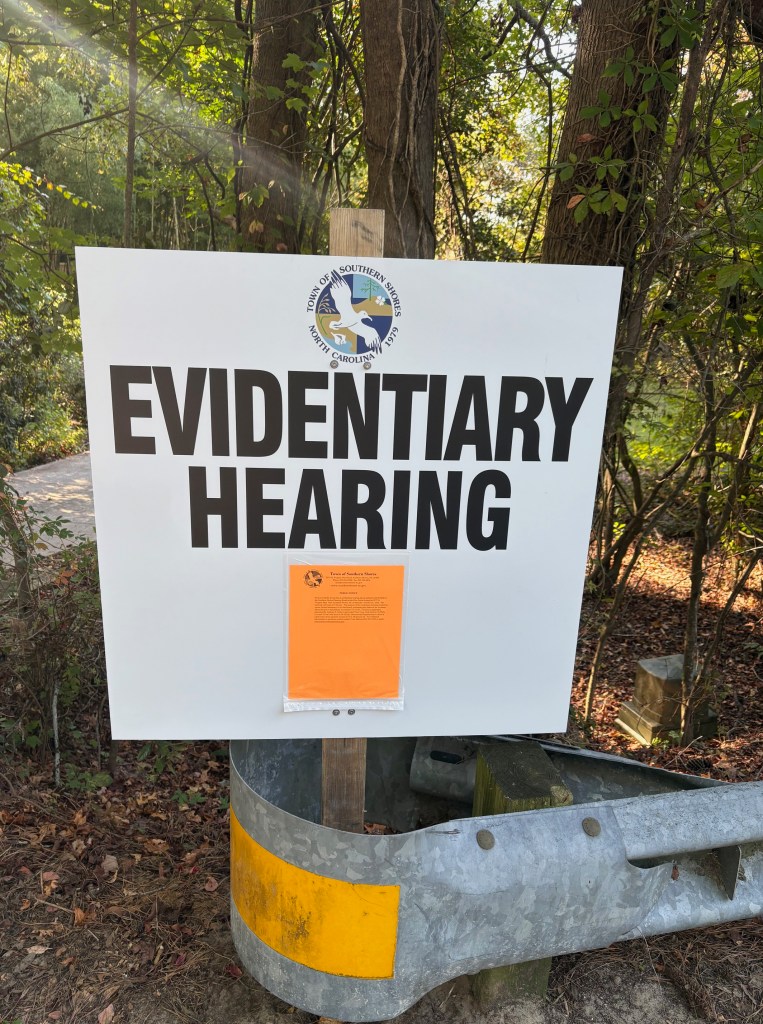
The evidentiary hearing you might have seen promoted on a large roadside sign at 75 E. Dogwood Trail, near the Dick White Bridge (see above photo), announces a hearing Monday before the Town Board of Adjustment (BOA) about a requested variance.

When you peruse the voluminous documentation in the Town file for this variance application, however, you quickly discover this is not your garden-variety variance request. In fact, it is unprecedented in Southern Shores.

The homeowners at 75 E. Dogwood Trail are asking for a variance that would allow them to subdivide their 46,500-square-foot property into two lots. We explain below why they believe they are entitled to that variance.

The BOA’s hearing, which is quasi-judicial in nature, will be held Monday in the Pitts Center at 5 p.m. The five-member Town Planning Board will sit as the Town’s BOA. The Planning Board Chairperson—or someone serving in his place, if he must recuse himself for any reason—will conduct the hearing much like a trial in a courtroom, only less formally.

Members of the public may not give their opinions as they may in legislative hearings.   

For information about Monday’s hearing, including the ground rules (“order” of hearing), see https://www.southernshores-nc.gov/bc-pb/page/planning-board-will-meet-october-21-2024.

HOMEOWNERS HAVE ALREADY SUED THE TOWN, 11 OTHERS

The same zoning matter that brings homeowners Anthony Mina and Jennifer Franz before the BOA also induced them to file suit in federal court in August against the Town of Southern Shores, Deputy Town Manager/Planning Director Wes Haskett, and 10 other defendants whom Mr. Mina and Ms. Franz have dubbed the “Dare County Real Estate Scam Defendants.”

The couple—Mr. Mina describes Ms. Franz in the file as his fiancee—are representing themselves before the BOA and in court. When parties represent themselves in court, they are said to proceed “pro se,” a Latin phrase meaning “in one’s own behalf.”

Inasmuch as Mr. Mina, a former Pennsylvania resident who is described in a 2020 opinion by the U.S. Court of Appeals for the Third Circuit as a “prolific pro se litigant,” authored all of the documentation in the Town’s case file, we will refer to the couple collectively as Mr. Mina.

(Most of the documents in the case file are irrelevant, including the 55 pages that consist of the complaint Mr. Mina filed in the Eastern District of the U.S. District Court of North Carolina. The case number is 2:24-CV-00042.)

(For the opinion of the Court of Appeals for the Third Circuit, see https://digitalcommons.law.villanova.edu/cgi/viewcontent.cgi?article=1479&context=thirdcircuit_2020.)

The nub of Mr. Mina’s dispute with the 12 defendants he names in his complaint and the reason for his variance request concerns the legal circumstances surrounding his and Ms. Franz’s joint purchase of 75 E. Dogwood Trail from its former owner, Linda Lauby. He contends that the Town of Southern Shores illegally amended the Town Zoning Code to prevent their subdivision of the property.  

Dare County records show that Ms. Lauby sold 75 E. Dogwood Trail to the couple on July 5, 2023 for $625,000. A wooden two-story house built in 1970 was on the property then and still is.  

The 46,500-square-foot, rectangular-shaped lot has frontage on East Dogwood Trail on its northern side and abuts a developed adjacent property on its eastern side. The property’s western and southern sides front on canals.   

Mr. Mina claims that he was led to believe by both the Town and the real estate listing agent, James Monroe of Outer Banks Realty Group, that the property possibly could be subdivided such that one lot would be situated behind another lot. The rear lot would abut the southern end of the front lot and not have any public road frontage.

Mr. Mina includes in his variance application a transcript of an email correspondence between Ms. Lauby and Mr. Haskett in which Mr. Haskett writes on April 30, 2021 (not 2023) that “Based on [Mr. Monroe’s] description [of the 75 E. Dogwood Trail property] it sounded possible to subdivide the property but further review would help.”

Indeed, Mr. Monroe notes on the listing document, which is dated Feb. 24, 2023, that the property is “potentially capable of being subdivided.”

After Aug. 3, 2021, however–as we explain below–such a representation would be false.

There is no evidence in the file to establish that Mr. Haskett tentatively approved a subdivision plan by Mr. Mina prior to his purchase of the lot.  

ZONING CHANGE AFTER PROPOSED SUBDIVISION ON HILLCREST

Subsequent to Mr. Haskett’s email exchange with Ms. Lauby, a preliminary subdivision plat for 279 Hillcrest Drive came before the Town Planning Board (May 17, 2021) and the Town Council (June 1, 2021) for approval.

Homeowner Lauren Van Riper sought to subdivide her 100,000+-square-foot lot into two lots, in the same manner as Mr. Mina proposes, with one lot in front of the other, and only the front lot having public-road frontage.

The Planning Board recommended conditional approval of Ms. Van Riper’s plat. The Town Council did the same, advising Ms. Van Riper that, under the Town Code subdivision ordinances then in effect, she would have to create a public-access easement from Hillcrest Drive to the back lot and that this easement would have to have a minimum pavement width of 16 feet and a minimum turnaround area of 20 feet.

She was also advised that, pursuant to the subdivision regulations, the back lot would have to have 30 feet of frontage on that access easement.

We recall the public hearing on Ms. Van Riper’s application very well. We were dismayed by what she proposed and spoke in opposition to it. We have no recollection, however, of a public hearing held on Aug. 3, 2021, the upshot of which was that the Town Council unanimously passed a Town Code Amendment (TCA 21-06), not a Zoning Text Amendment, to require that all lots in a subdivision must front on a public road.

TCA 21-06 eliminated the option of a subdivided lot having frontage on an access easement, instead of a public road, which had been permissible under Town Code sections 36-95 and 30-96(f) before the amendment.

Mr. Mina alleges that the Town failed to give requisite notice to the public of its hearing on TCA 21-06 and, therefore, illegally enacted the zoning ordinance change and violated his due-process rights. (His lawsuit is based on a violation of his constitutional rights.)

We are not going to analyze the merits of his argument. We will say this, however: Immediately after the hearing on Ms. Van Riper’s application, Town Councilman Matt Neal, who is now the Mayor Pro Tem, made a motion that Mr. Haskett work with the Planning Board to amend the language of the Town Code subdivision ordinances to remove the easement option. (See Minutes from the Town Council’s June 1, 2021 meeting, p. 10.)

Mr. Neal’s idea was to write a Zoning Text Amendment—not a Town Code Amendment, which originates with the Town Council—that would be subject to public notice and hearing in the Planning Board and the Town Council.

According to Mr. Haskett’s Staff Report for the Aug. 3, 2021 public hearing on TCA 21-06, Town Staff did draft a new Zoning Text Amendment, ZTA 21-07, to address the road/easement access concerns, and the Planning Board recommended its approval in June. But the ZTA was withdrawn, Mr. Haskett writes, when “further review . . . determined that the ZTA would render existing lots with frontage on an easement nonconforming.”

The further review was done either by the Town Attorney or members of the Town Council, or both. Mr. Haskett does not specify. When Mr. Haskett brought up the zoning change at the Planning Board’s July 2021 meeting, it was in the form of a Town Code Amendment, not a ZTA, so no hearing was ever held before the Board.

The Beacon mentions the Aug. 3, 2021 hearing on TCA 21-06 in a July 29, 2021 blog we wrote in which we previewed the Town Council’s agenda for Aug. 3, 2021. We did not cover the hearing. Instead, we filled August 2021 blog posts with news of Covid, cut-through traffic, the Marketplace proposal, and beach nourishment.

THE LOT-WIDTH “QUAGMIRE”

Mr. Mina also challenges as illegal the Town Council’s enactment on June 6, 2023 of ZTA 23-03, which altered the wording of Town Code sec. 36-202(d)(2) concerning the mandatory minimum width of a lot. He again cites deficient notice for the hearing.

He further states in his variance application that Mr. Haskett “illegally adopted” this ZTA—Mr. Haskett has no power or authority to pass ordinances—and that he “secretly planned without my knowledge to intentionally prevent lot subdivision. . . . All evidence indicates [that] Wes Haskett was helping a real estate scam.”

We are very familiar with what we now call the lot-width “quagmire.” ZTA 23-03 was enacted by the Town Council as a stop-gap measure to bring clarity to an ambiguous area of the Town Code, to wit, how to measure minimum lot width.

ZTA 23-03 replaced confusing language that relied for this measurement upon the “building setback line” from the front of a property. Unfortunately, the new language is rigid. The width of all lots created since June 6, 2023 is now measured from the front lot line at right angles to the rear lot line. In other words, in the RS-1 single family dwelling residential district, all lots created since June 6, 2023 through subdivision or recombination, must be 100 feet wide throughout.

A ZTA designed to replace this definition, and to allow for pie-shaped and other irregularly shaped lots, was tabled by the Town Council in May of this year. The stop-gap remains in force.

Mr. Mina consulted with Mr. Haskett in the months before his July 5, 2023 purchase of 75 E. Dogwood Trail and states in his application his belief that the Town Planning Director deliberately withheld from him “pertinent information” about the soon-to-be-changed lot-width ordinance. Mr. Mina says he relied upon the lot-width ordinance that was in effect before June 6, 2023, in buying the property and planning his proposed subdivision, and Mr. Haskett knew this.

We don’t see Mr. Mina even reaching the issue of lot width because he can’t hurdle the road frontage requirement for a subdivision. TCA 21-06 became law nearly two years before he bought Ms. Lauby’s lot.

Mr. Mina submitted to the Town in July two applications for a subdivision of 75 East Dogwood, and Mr. Haskett denied both.

Mr. Haskett denied what he calls Application 1 in a letter to the homeowners on the grounds that the two proposed lots do not front upon a public road. He denied Application 2 because the two proposed lots do not meet the Town’s lot-width requirement. Mr. Mina did not appeal either of these rulings to the Dare County Superior Court.

At the Town Council’s Oct. 1 meeting, Town Attorney Phillip Hornthal read a statement by Mr. Mina into the record, prefacing it by saying that Mr. Mina was “currently banned from Town property for 30 days.”

Mr. Mina sought in the statement to alert “Town property owners” to the Town actions that he now disputes and described the effect of the subdivision ordinance amendment as “down-zoning.”

It is clear from the case file and Mr. Mina’s statement that he has been hostile toward Town employees.

By Ann G. Sjoerdsma, The Southern Shores Beacon

Revised, 10/20/24

10/16/24: TOWN COUNCIL APPOINTS SEVEN TO “ENTRY CORRIDOR ENHANCEMENT” COMMITTEE; ALSO TAKES UP ACCESSORY DWELLING UNITS.

The Town of Duck uses utility poles in its “entry corridor” on Duck Road (N.C. Hwy. 12) to hang banners welcoming visitors. Though scarce now, the banners are in abundance during the summertime.

Earlier this month the Southern Shores Town Council appointed seven people to what is currently being called the Southern Shores Entry Corridor Enhancement Committee.

The idea for the “entry corridor” committee flows from Mayor Pro Tem Matt Neal’s long-held desire, as he explained at the Council’s Aug. 6 meeting, “to build a blue-sky vision” of Southern Shores, which would be, essentially, a future plan for the town that might extend up to 30 years.

Mr. Neal, a local builder, has described his goal as designing the commercial district—into which the “entry corridor,” or main entry route into Southern Shores, leads—as well as beautifying and improving the remainder of the town.

Mr. Neal nominated the following residents as committee members, all of whom were unanimously approved by the Council at its Oct. 1 meeting:

*Mayor Elizabeth Morey

*Mr. Neal himself

*Matt Savage Price, a partner in Savage Land LLC, a real estate holding company

*Wes Haskett, Deputy Town Manager/Town Planning Director

*Michael Zehner, an Alternate on the Town Planning Board and a professional planning consultant

*Jim Gould, Community Planner for the Town of Duck

*Linda Lauby, an independent publisher and writer

Mr. Neal said at the October meeting that he “canvassed our community” for members of the committee, but we submit that he didn’t conduct a very wide canvass. We know all of these people, and they do not represent what we would consider a cross-section of the community. Also, none of them is a commercial property owner in Southern Shores or likely to become one.

Further, it seems redundant to us to have three professional planners on the committee, even if Mr. Haskett serves exclusively as staff.

Mr. Zehner is the Director of Planning and Community Development for Berkley Group, a private consulting firm operating in Virginia and North Carolina that specializes in municipal planning. Since his appointment to the Planning Board as its Second Alternate—he is now the First Alternate—Mr. Zehner has functioned largely as a full member of the Planning Board, without voting power.

A former planning director for the Town of Nags Head, Mr. Zehner took a very prominent role in the Planning Board’s hearings during September-November 2023 on SAGA’s special use permit application for its Ginguite Creek project. He also has actively promoted affordable housing with the Board and the Town Council.   

Mr. Zehner would seem to be a better choice for an adviser to the “entry corridor” committee, rather than a voting member.

Why not appoint one of the five regular members of the Town Planning Board to the committee? They have their fingers on the pulse of Southern Shores residents and know the Town Zoning Ordinance.

In Mr. Neal’s selection of committee members, we do not see the “citizen input” that the Town Council spoke of seeking when it considered committee membership in September.

In response to a request by the Town Council at its August meeting that Town Staff make recommendations to the Council about developing a vision for the Town’s 38-acre commercial district, Town Manager Cliff Ogburn suggested at the September meeting that the working committee charged with this task consist of:

*The Mayor or another Council member

*The Mayor Pro Tem or another Council member

*Two commercial property owners

*Three at-large members

*The Deputy Town Manager/Planning Director

Mr. Haskett would serve as staff to the other seven people.

The Town Council—in particular, Council Members Mark Batenic and Rob Neilson—responded favorably to the inclusion of commercial property owners, as obvious “stakeholders,” and stressed “input” from the community. Either one could serve in lieu of the Mayor and bring a fresh perspective.  

Mr. Neal clearly has ideas for this endeavor, which he has called his “baby,” and spoke at the October meeting about “enhancing the commercial district” and “designing a small area plan.” He mentioned the interest that some residents have in a town square or a central gathering place in town.  

He also said that developing a “mission statement” and “goals” would be the first action items for the “entry corridor” committee.  

*******

In his presentation to the Council in September, Mr. Ogburn recommended that the “entry corridor” committee consider the following in developing a vision for the commercial district:

*Current Town ordinances

*Enhancements for pedestrians and bicyclists

*Connectivity

*Architectural standards

*Economic vitality

*Potential stressors, such as burdens on adjacent property owners

*A Process for continuous review for compliance and success

*Maintenance of the Town’s identity

To be honest, we’re not that keen on thinking of our small neighborly beach town/community as having an entry corridor, like a billboard-marked or banner-decorated roadway into a city, but if this is the direction that Southern Shores homeowners would like to go, we would not vigorously object. We also appreciate the concept of a “blue-sky vision” for Southern Shores, especially for the commercial district.

Regardless of what may emerge from the committee about the appearance of the entry corridor, Kitty Hawk, which shares that corridor, would have to be consulted.

We would like to point out, however, that Southern Shores is not Duck. (We note Mr. Gould’s participation.) Duck is a tourist village, a happy vacation playground with only 746 year-round residents, as of the 2020 U.S. Census. Duck was designed to cater to vacationers’ amusement, not year-rounders’ needs. Southern Shores is a year-round town with a population of 3,107 people.

Since Southern Shores’ 1979 incorporation, it has had a “small” commercial district located on “the southern edge of town” that has been focused on “convenience shopping and services” for residents, according to the vision statements of all of the Land Use Plans of the past 45 years.   

The recently approved Land Use Plan update, which is now being reviewed by the N.C. Division of Coastal Management, encourages the sort of planning that Mr. Neal proposes with his committee. We would just ask that the viewpoints of people in the larger community be considered, not just those of the relatively small sampling of committee members who have been handpicked to participate in the discussion.

One final thought: As a committee officially appointed by the Town Council, the Southern Shores Entry Corridor Enhancement Committee should hold all of its meetings in public, and minutes of its meetings should be recorded and readily available to the public.

The Council did not address the workings of the committee when it approved its membership.

A WORD ABOUT ACCESSORY DWELLING UNITS

Also at the October meeting, the Town Council expressed an interest in getting out in front of the N.C. General Assembly in legislating the legalities of accessory dwelling units in Southern Shores.

A pair of House and Senate bills introduced in the 2023-24 N.C. General Assembly session would have required local governments to allow at least one ADU per single-family dwelling.

The House Bill (409) passed; the Senate Bill (374) did not. Had it been enacted, the legislation would not have affected Chicahauk because it has private covenants among property owners relating to dwelling type restrictions.

See the text of the bill here: https://webservices.ncleg.gov/ViewBillDocument/2023/2431/0/DRS55034-MQ-72A.

Currently, the Southern Shores Town Code permits accessory dwelling units on residential property, as long as they are not used for “living space.” Living space has typically been evaluated by whether there are cooking facilities in the ADU.   

Viewing ADUs as a means by which affordable housing may be created, the Town Council decided at its October meeting to engage in pertinent information gathering before deciding what, if any, Zoning Code amendments it might recommend.

Mayor Pro Tem Neal suggested that all existing covenants that run with deeds to Southern Shores properties be ascertained to determine how many landowners already have the right to build an ADU.

It was fairly common for the original Southern Shores developers to create lots that would accommodate both a primary residence and a guest house. You still can see evidence of this trend on the oceanfront.

Mayor Elizabeth Morey also suggested that a count of the lots that still have coverage space for building be ascertained. New homeowners who have developed vacant lots or torn down existing structures in order to build have tended to max out the allowable 30-percent lot coverage.

Council members said they would try to enlist the help of the Southern Shores Civic Assn., the Chicahauk Property Owners Assn., and the Town staff in collecting this data—although Mr. Neal offered to do some searches himself and tried to draft his Council colleagues into doing the same.

The next Town Council meeting will be Tuesday, Nov. 12, at 5:30 p.m. in the Pitts Center.

By Ann G. Sjoerdsma, The Southern Shores Beacon  

10/10/24: TOWN COUNCIL APPROVES AWARD OF $1.667 MILLION CONTRACT FOR TRINITIE TRAIL BRIDGE CONSTRUCTION.

The Trinitie/Juniper trails culvert bridge as it appears today.

The Southern Shores Town Council unanimously voted this morning to accept a bid of $1,667,178.70 by Smith-Rowe LLC for what is now being called the Trinitie Trail Bridge Construction Project and to authorize the Town Manager to execute a contract on behalf of the Town with the Mt. Airy, N.C. construction company.

Town Councilman Mark Batenic did not attend this morning’s meeting, described by the Town as a “reconvening” of the Council’s Oct. 1 regular meeting. The vote, therefore, was 4-0.

According to Town Manager Cliff Ogburn, the Town received four bids for the proposed bridge reconstruction project, ranging from Smith-Rowe’s low bid of nearly $1.7 million to the highest bid, which, he said, was $900,000 more.

Because the project involved a public construction contract financed by more than $500,000 in public money, the Town was required by State statute to award it to the “lowest responsible bidder,” after taking into consideration the quality, performance, and time specified in the bidder’s proposal. (See N.C. General Statutes sec. 143-129.)  

Smith-Rowe’s bid qualified it as both the lowest responsible and lowest “responsive” bidder, Mr. Ogburn said, explaining that a responsive bid meets all of the requirements of the bid submission process, as well as all applicable legal requirements.

North Carolina courts have interpreted “responsible” to imply “skill, judgment, and integrity, necessary to the faithful performance of the contract, as well as sufficient financial resources and ability.” (Kinsey Contracting Co. v. The City of Fayetteville, a 1992 N.C. Court of Appeals decision.)

To see a photo gallery of bridges that Smith-Rowe has built in North Carolina, see https://www.smithrowe.com/bridge- construction-services/.

The 32-year-old company claims on its website to have built more than 400 bridges in its service area, which includes Virginia, Tennessee, South Carolina, and Georgia, as well as the heart of North Carolina.

Mr. Ogburn said that Smith-Rowe will have 210 days, or about seven months, to complete the construction project after it receives a “notice to proceed” from the Town, which he said should happen soon. The Town Attorney will have to sign off on the contract first.

The Town Manager has previously said that the construction of the new cored slab bridge on Juniper/Trinitie trails would start in November and be finished by “summer 2025,” with the bridge being closed for up to six months. (See The Beacon, 3/8/24.)

Both Town Councilman Robert Neilson and Town Councilwoman Paula Sherlock expressed some concerns at today’s meeting about the design and “aesthetics” of the new bridge, saying they would like it to blend in with the surrounding neighborhood.

The Town has been engaged with engineering/planning/design consultant Kimley-Horn on this project for nearly two years. There has been ample time to explore aesthetics and to confer in public session with Kimley-Horn about design elements.

If members of the Town Council were unresolved about the replacement bridge’s appearance and suitability in Southern Shores, we are of the mind that they should have expressed their concerns long before the contract went out for bid in September.

Indeed, a special town hall meeting for the public to weigh in on Kimley-Horn’s design plans might have been beneficial for Council members and residents, alike.  

By Ann G. Sjoerdsma, The Southern Shores Beacon

10/7/24: PARADE OF HOMES STARTS THURSDAY, FEATURES THREE SOUTHERN SHORES PROPERTIES; EARLY VOTING OPENS OCT. 17; BULK TRASH PICKUP SCHEDULED OCT. 18.

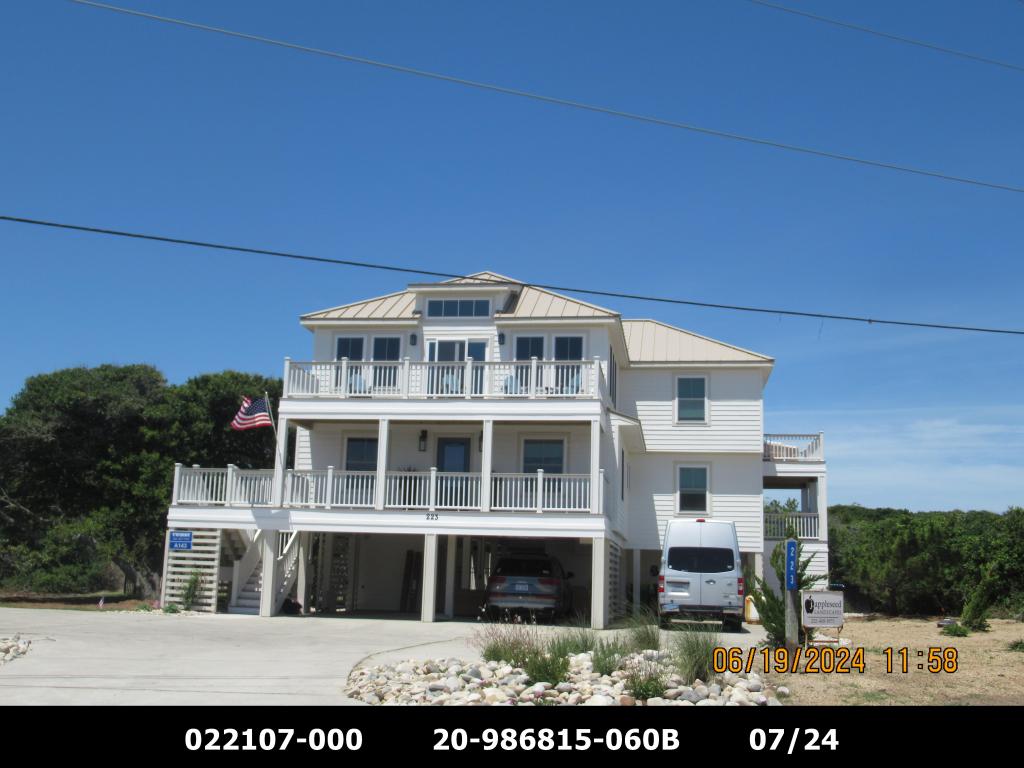
Sandmark Custom Homes’ renovation of the beach cottage at 223 Ocean Blvd. in Southern Shores is featured in the 2024 Parade of Homes. (Photo credit: Dare County GIS)

The four-day 2024 Outer Banks Parade of Homes starts Thursday and features three properties in Southern Shores, one of which is a space renovation in the Southern Shores Crossing for the long-awaited coffee shop.

The homes in the 32nd annual Parade of Homes will be open Thursday through Saturday, from 10 a.m. to 6 p.m. A trade expo and builder awards ceremony will be held Sunday, from 10 a.m. to 2:30 p.m., at Jennette’s Pier in Nags Head.

Tickets are $20 each and may be purchased online with a credit card or for cash at one of the participating homes. For ticket information, see https://www.obhomebuilders.org/2024-tickets/.

Sixteen of the properties on display are located in the beach zone, from Corolla to Nags Head, and the remaining two are on the mainland, one in Currituck County and the other in Manteo.

The Manteo entry is actually a remodel by SAGA Realty and Construction of the Firetender Restaurant, which is past the Manteo Hotel on Hwy. 64/264. The other commercial remodel in the parade is Neal Contracting Co.’s renovation in the Southern Shores Crossing, at 1 Ocean Blvd., for Shore Coffee Roasters

A list of the 18 homes, with detailed descriptions of each, may be found at https://www.obhomebuilders.org/2024-homes/.

Unfortunately, the Outer Banks Home Builders Assn. (OBHA), which hosts the parade, did not include the addresses of the homes on its listing page. You have to click on the individual home links to uncover them.

An interactive parade map is available on the OBHA’s website, but we did not find it particularly helpful. Perhaps a free Parade of Homes magazine available for pickup at the properties will have an easy-to-use list of addresses.

The other two parade homes in Southern Shores are a renovation by Sandmark Custom Homes, Inc., of a beach cottage at 223 Ocean Blvd. (see photo above), and the construction of a new home by Maso Design Build at 97 Ocean Blvd., which is on the west side of Ocean Boulevard at its intersection with Chicahauk Trail. You may park in the town parking lot on Chicahauk Trail to tour 97 Ocean Blvd.

All three of the builders represented in Southern Shores are husband-and-wife teams who live in the town. Sandmark Custom Homes also has a home in Harbinger, at 204 Cynthia Ct., in the parade.

The 18 properties will be available for viewing online after the parade, according to FAQs on the OBHA website. Virtual tours will remain active for at least one year, it says.

See FAQ at https://www.obhomebuilders.org/2024-poh-faq/?fl_builder.

The Outer Banks Tourism Bureau is a parade partnership sponsor with the OBHA.

COMING UP: EARLY VOTING; BULK TRASH PICKUP

*You no doubt have heard that early voting for the Nov. 5 general election starts Oct. 17 and continues until Nov. 2. If you are a Dare County resident, you may vote at any one of the three voting sites, listed below. On Election Day, you may only vote at your assigned polling place.

Early voting polls are:

Kill Devil Hills Town Hall, 102 Town Hall Drive, KDH

Dare County Administrative Bldg., 954 Marshall C. Collins Drive, Manteo

Fessenden Center Annex, 47017 Buxton Back Road, Buxton

Voting hours are:

Thurs., Oct. 17, and Fri. Oct. 18: 8 a.m. to 7:30 p.m.

Mon., Oct. 21 through Fri., Nov. 1: 8 a.m. to 7:30 p.m.

Sat., Nov. 2: 8 a.m. to 3 p.m.

A list of all of the candidates on your ballot may be obtained on the Dare County Board of Elections website at https://www.darenc.gov/home/showpublisheddocument/12400/638398691853670000.

The ballot also includes an important proposed amendment to the N.C. Constitution that would restrict voting in state elections to U.S. citizens only. You are being asked to vote “for” or “against” citizens-only voting in North Carolina.

BULK TRASH PICKUP IS OCT. 18

The town-wide autumn bulk trash pickup will be held Fri., Oct. 18. You may begin putting approved items—a list of which is available through the website link below—on the roadside a week before. (No TVs, no building supplies, no rugs!)

See https://www.southernshores-nc.gov/community/page/bulk-waste-collection-semi-annual for details.

The Town has already scheduled the spring bulk trash pickup on April 4, 2025.

By Ann G. Sjoerdsma, The Beacon

7/16/24: TOWN COUNCIL SPLITS ON COMMERCIAL DESIGN STANDARDS, BUT AGREES TO FORM COMMUNITY TASK FORCE TO DEVELOP VISION FOR COMMERCIAL DISTRICT, ALSO APPROVES UPDATED LAND USE PLAN.

Is the yellow paint color used on this building in the Southern Shores Crossing subtle, neutral and earth tone?

The Southern Shores Town Council met on July 2 for its regular monthly business meeting. The following are highlights from the meeting:

COMMERCIAL DESIGN STANDARDS: In a rare display of disagreement, Town Council members split on some of the new commercial design standards recommended by the Planning Board and included in a Zoning Text Amendment that the Council first took up at its June meeting and then tabled for further consideration at the July meeting.

Expediency won out, as if often does, with three of the five members voting July 2 to approve the language before them in ZTA 24-03, and only change one word. The ZTA, which was subject to public hearing in June, sets forth 11 design standards with which “new construction and substantial improvements” must comply. It also defines what a substantial improvement is.

To see the latest version of ZTA 24-03, see pages 2-8 of the July 2 meeting packet, which you will find at https://mccmeetings.blob.core.usgovcloudapi.net/soshoresnc-pubu/MEET-Packet-b9c1afc388cb479a858efdfa994cef50.pdf 

After the 3-2 vote, the Town Council coalesced around an idea promoted by Mayor Pro Tem Matt Neal, who was in the minority, of involving the “larger community” in a task force- or committee-led effort to create a “real vision” of Southern Shores’ small commercial district at the southern end of town.

Mr. Neal spoke of formulating a “small-area plan” for the “enhancement of our commercial district”—which would apply for 10 years, 20 years, even 50 years “down the line”—and referred to the vision statement and land-use recommendations in the newly updated Southern Shores Comprehensive CAMA Land Use Plan (LUP) for guidance and support.

The Council left the “framework” for such a task force up to the Town staff, which is expected to make a proposal at an upcoming meeting.

(For further information, see our recap of the Council’s discussion below.)

NEW LAND USE PLAN: After a public hearing, during which no one spoke, the Town Council unanimously approved the updated Comprehensive CAMA Land Use Plan (LUP), which was drafted with Town support by consultant Stewart, Inc.—provided the plan receives a final edit.

Councilwoman Paula Sherlock drew attention to some typographical and syntactic errors in the text, after which Councilman Mark Batenic insisted that the plan be thoroughly reviewed.

(Having been in touch with the consultant about the many errors present in an earlier draft, we would recommend hiring a professional proofreader to bring “fresh eyes” to the document.)

You will find the final draft of the new LUP here: https://www.southernshores-nc.gov/sites/default/files/fileattachments/planning/page/2509/2-13-24_draft_comprehensive_land_use_plan.pdf

After the final edit is done, Mr. Haskett will submit the plan to the N.C. Division of Coastal Management (DCM) for review. The DCM acts as staff for the N.C. Coastal Resources Commission, which must certify the LUP for it to take effect. The DCM will notify Mr. Haskett of any questions it may have about the LUP.

AFFORDABLE HOUSING INITIATIVE: Michael Zehner, a professional planner and alternate member on the Town Planning Board, spoke to the Town Council, on behalf of the Board, asking the Council to “take some initiative” on addressing affordable housing, aka workforce housing, in Southern Shores.

Mr. Zehner used the official definition promulgated by the U.S. Dept. of Housing and Urban Development to define “affordable” housing as housing that costs 30 percent or less of a household’s gross income, including utilities. The term is often used in a different sense to refer to specific housing assistance programs, such as those that reserve a number of units in a residential complex for low-income renters or owners.  

Mr. Zehner, who led a discussion about affordable housing in the Planning Board at its May meeting, said he was conveying the Board’s recommendation that the Town engage the public to find out, first of all, if residents believe affordable housing is/is not a “problem” in Southern Shores, and, secondly, if it is, how residents would like to address/resolve it.

He suggested that a public study could be done. The survey done just two years ago for the update of the LUP did not include affordable housing as a topic, per se.    

In advocating for a community task force to develop a plan for the commercial district, Mr. Neal suggested incorporating affordable housing options.

He also expressed, during his closing comments, an interest in talking about accessory dwelling units in Southern Shores, which, under current Town Code ordinance, are not permitted. The Code allows for separate living space that is accessory to a principal residence, but the space cannot constitute a dwelling unit.

The Mayor Pro Tem again turned to the newly approved LUP for support, quoting a land-use recommendation on p. 100 that suggests evaluating “the Town’s current policy on separate living spaces and [considering] revisions to allowances and standards for accessory dwelling units by zoning district.”

(The Chicahauk Property Owners Assn. has a covenant that prohibits accessory dwelling units in Chicahauk and supersedes the Town Code.)

Mr. Neal said he would like to “elevate” the issue of accessory dwelling units, which have been suggested as a means to provide affordable housing, and move toward taking action.

MILFOIL SURVEY: Town Manager Cliff Ogburn reported that the N.C. Dept. of Environmental Quality will be conducting a survey of the presence of Eurasian milfoil in the Southern Shores canals during the “second half of July.” Mr. Ogburn anticipates having DEQ’s results to present to the Town Council at its September meeting.  

JUNIPER TRAIL/CHICAHAUK TRAIL BRIDGE/CULVERT: Mr. Ogburn also reported that the construction contract for the renovation of the Juniper Trail/Chicahauk Trail bridge and culvert will be out for bid on Sept. 9 and remain open until Oct. 4. The Town Manager hopes to receive at least three bids and to be able to present them to the Town Council at its November meeting.

SOUTHERN SHORES CEMETERY: Councilwoman Sherlock is heading up an effort to beautify and enhance the Southern Shores Cemetery, which is located at 64 S. Dogwood Trail and has substantial funding for maintenance. Ms. Sherlock reported that she met at the cemetery with 15 people who have family members buried in, and/or own plots in, the cemetery, and with arborist Andy McConaghy, who lives in Southern Shores, to discuss improvements.

Apparently, some people have suggested removing some of the trees that make the cemetery such a desirable resting ground. According to Ms. Sherlock, Mr. McConaghy advised her that there are dogwoods in the cemetery that are more than 100 years old and live oaks that are older than 200 years old.

Ms. Sherlock also reported that she, the Town Manager, Public Works Director David Bradley, and a community volunteer spent a couple of hours the morning of July 2, picking up litter, including beer bottles, “dead plants and faded flowers,” at the cemetery. A volunteer-led litter patrol would seem to be in order.

BONUS COVERAGE: ELABORATING ON COMMERCIAL DESIGN STANDARDS

Mayor Pro Tem Neal, who is an experienced builder, initiated the Town Council’s discussion of ZTA 24-03, which adds a new section (36-179), titled “Commercial design standards,” to the Town Code of Ordinances. He also led the Council’s discussion on the measure at the June meeting. (See The Beacon, 6/14/24.)

Mr. Neal made the case for deleting three of the 11 proposed design standards in ZTA 24-03 and received support from Councilman Batenic.

The standard that primarily divided Mr. Neal and Mr. Batenic from the other three Council members was one requiring “exterior building paint colors” to be “subtle, neutral and earth tone colors.”

“That level of detail needs to be more of a community-led decision, rather than a Council [decision],” Mr. Neal said, noting that many of the town’s flat tops wouldn’t meet this requirement.

Councilwoman Sherlock, who was the most vocal in opposing the Mayor Pro Tem’s suggestions, responded: “I think that’s what our community wants in the commercial area. They don’t want some glaring . . . [trickle off inaudibly] I don’t think they want the big, bright-colored buildings. They don’t want the yellow building.”

Mr. Neal replied that he knows “some who wouldn’t care,” and that Ms. Sherlock would be surprised by opinions in town outside of the Council’s “limited circles.”

[We represent such an opinion and prefer a colorful and beachy look in the Town’s commercial buildings to the “neutral,” cookie-cutter façades we currently see at The Marketplace. Not every colorful building is garish.]

Mr. Neal also commented upon the lack of specificity in the adjectives, “neutral” and “subtle,” which may be evaluated differently depending on the eye of the beholder. We note that even the description, “earth tone,” is subject to interpretation, and every effort should be made in legislation to enact unambiguous, precise terms that make clear the intent of the Council.   

Mr. Neal quoted from the newly updated Land Use Plan—which the Town Council unanimously approved later in the meeting—to support his position.

“When creating building design standards,” he read from p. 102 of the LUP, “the community should be involved in the process.”

Saying that they “don’t do anything” or “add anything” to the new ordinance, Mr. Neal also argued in favor of deleting the following two design standards:

“Architectural embellishments with a coastal design that add visual interest are encouraged.” (No. 8)

“Low impact development techniques utilized to mitigate potential stormwater impacts are encouraged.” (No. 9)

Clearly, to “encourage” commercial property owners to do something is not the same as to hold them to an enforceable standard, which all Council members recognized. We would have deleted this language for that reason. Mr. Neal noted that the concept of a “coastal architectural style” is very broad, and, again, Mr. Batenic supported him.

Mayor Elizabeth Morey, Councilman Rob Neilson, and Councilwoman Sherlock all said they “like” these two “standards,” and Ms. Sherlock observed that, despite the lack of enforceability, they are a “message about what we want businesses to aspire to.”

Mr. Batenic took issue with another standard that reads: “Building elements that resemble animals, lighthouses, castles or pirate ships are prohibited.” (No. 11)

The Councilman noted that “you could have lollipops” or other elements not singled out in the standards, and said he thought “the whole idea was not to have anything on the outside.”

“You could make a prohibited emblems list a mile long,” Mr. Neal said.

Ms. Sherlock recalled that she asked Mr. Haskett at the June meeting about this standard and posed the hypothetical of having a slice of pizza on the outside: Would that be permissible?

Mr. Haskett distinguished “building elements” from signs and said he thought the pizza slice would be interpreted as a sign, which would be regulated by the Town’s sign ordinance.

The word “element” was not defined in ZTA 24-03.

No one suggested deleting this standard or rewriting it so that the intent behind the prohibition would be effectuated without listing specific “elements.”

Finished vs. Floor Area Ratio

Mr. Neal again brought up the ZTA’s use of the term, “finished area,” which it defines by referring to the definition in the Town Code for “living space.”

At the June meeting, Mr. Neal said that he was not familiar with the ZTA’s terms of “finished area” and “finished area ratio” and explained that professional builders use the standards of “floor area” and “floor area ratio.”  

Mr. Neal said that “floor area,” which he defined as “all square footage within the exterior walls” of a building, is typically used to control density on a commercial property. The floor area ratio is derived by dividing the floor area by the building lot area.     

Under the new ordinance, the square footage of the “finished area,” which as “living space” is essentially the area usable for human habitation, is divided by the land area to arrive at a required “finished area ratio” for buildings in the commercial district. This ratio is limited to 0.35 in one of the new design standards. (No. 10)

Mr. Neal noted at the July meeting that “finished area” is “subject to change” because some of the square footage considered uninhabitable could be converted to “living space” and vice versa.

“I’d like it to be more immutable, personally,” he said, but he eventually withdrew his objection to the new term, provided Deputy Town Manager/Planning Director Wes Haskett redefines it so that it has a separate definition, apart from “living space.”

The new definition was not made part of the motion that resulted in the ZTA being adopted nor did the Council provide a definition.

We believe the issue of density and what building area to consider is of more relevance in a mixed-use development, than in a traditional commercial development where there is no residential space.

If SAGA Realty & Construction had been limited to a finished area ratio of 0.35 in the buildings it proposed for its Ginguite Creek property, one Planning Board member informed us, the living space in its buildings would have been reduced.  

According to the new LUP, Southern Shores’ commercial district is 38 acres, or 2 percent of the town’s land area.

According to the current Land Use Plan, which was certified by the N.C. Coastal Resources Commission in 2012, the commercial district is 56 acres, or 2.6 percent of the town’s total land area of 2,175 acres.

We wonder why there is this discrepancy.

As noted above, ZTA 24-03 eventually passed, by a 3-2 vote, with just a one-word change. Although the one word is a significant one—changing “shall” to “may”—in a section pertaining to the submission of a site plan review of a proposed development for new construction or substantial improvements in the general commercial district, we exercise our prerogative not to probe this esoterica further. The new ordinance does not change the fact that the Planning Board will scrutinize all sketch plan reviews.

ZTA 24-03 also changes the off-street parking requirements in the Town Code (Sec. 36-163) by allowing a business to reduce its required parking by one space for every 20 parking spaces, if it plants a shade tree instead. The Town Council unanimously supported this amendment.

The Council’s discussion about the design standards ended with Mr. Neal saying, “This document doesn’t get us there,” and Councilwoman Sherlock responding, “But it’s a step in the right direction.”

By Ann G. Sjoerdsma, 7/16/24

7/12/24: MAYOR’S CHAT TO BE HELD WEDNESDAY, AT 4:30 P.M.; PLANNING BOARD TO TAKE UP TREE REMOVAL, ADUs MONDAY.

Southern Shores Mayor Elizabeth Morey

Mayor Elizabeth Morey will host a Mayor’s chat on Wednesday, at 4:30 p.m., in the Pitts Center—the first such chat this year and in quite some time. Mayor Morey has said that she discontinued her informal gatherings with Southern Shores residents, which she began during the first year of her tenure, because they were poorly attended.

Town staff members, including Town Manager Cliff Ogburn, also will attend the Mayor’s chat.

Also next week, the Southern Shores Planning Board will meet Monday at 5 p.m. in the Pitts Center for its regular monthly meeting. Board members will take up a new Zoning Text Amendment (ZTA 24-04) that proposes establishing planned unit developments as a special use in the general commercial district and prohibiting bitcoin mining in all zoning districts. The Town Code currently permits PUDs as of right.

ZTA 24-04 also revisits an issue that first arose in ZTA 24-02. It proposes requiring property owners to obtain a lot disturbance/stormwater management permit in order to remove trees greater than 6 inches in diameter and at least 4.5 feet tall from a front, side, or rear yard setback on any unimproved lot in all zoning districts. The earlier proposed provision applied only in the general commercial district, not in the residential and government-institutional districts, as well. The Board directed the Town staff to revise the proposed provision so that it applies throughout town.  

The Planning Board will continue its discussion about accessory dwelling units in town. The N.C. General Assembly, which ends its 2023-24 session on July 31, has proposed a bill that would require municipalities to permit accessory dwelling units in single-family housing residential districts. The bill has passed the House, but not the Senate.

For information about the Board’s meeting, see https://www.southernshores-nc.gov/bc-pb/page/planning-board-meeting-july-15-2024. You may live-stream the meeting on the Town’s You Tube website.

We note that when the cut-through weekend traffic was still considered a talking point in town, the Mayor drew a vocal group of residents to a summertime chat. Perhaps residents can target pedestrians in town roadways with more success.

Too often pedestrians walking on roads without sidewalks walk in the direction of the traffic rather than against oncoming traffic, as North Carolina law (N.C. General Statutes sec. 20-174(d)), the National Highway Safety Administration, and common-sense safety dictate. Perhaps the Town could post some “Walk Facing Traffic” signs on heavily traveled roads. (We note that the law requires bicyclists traveling in roadways to go with the traffic.)    

We regret that we have been unable to attend or keep up with Town meetings in recent months. We will strive to have a report of the July 2 Town Council meeting posted on our blog before the Mayor’s chat on Wednesday.

THE SOUTHERN SHORES BEACON   

7/2/24: WATER SERVICE TO BE DISRUPTED TODAY ON SECTION OF SOUTH DOGWOOD TRAIL FOR HYDRANT REPAIR.

Water service to residents of South Dogwood Trail who live between Osprey Lane and Fairway Drive will be disrupted today starting at 9 a.m., so the Dare County Water Dept. can do maintenance to a fire hydrant, according to an announcement on the Town website.

Residents on this section of South Dogwood Trail will be without water from 9 a.m. until service is restored, which is expected to be by 5 p.m.

If you do not live on South Dogwood Trail, and you are without water, the Water Dept. asks that you call its office at (252) 475-5990.

THE SOUTHERN SHORES BEACON

6/30/24: PUBLIC HEARING ON UPDATED TOWN LAND USE PLAN SCHEDULED ON TUESDAY; TOWN COUNCIL WILL VOTE ON ITS ADOPTION. More Discussion About Commercial Design Standards, Report on Affordable Housing in Southern Shores Also on Council Meeting Agenda.

A public hearing will be held at the Town Council’s meeting Tuesday, at 5:30 p.m., on the newly revised Southern Shores Comprehensive CAMA Land Use Plan (LUP), after which the Council will vote on the plan’s adoption and submission to the State for certification. The N.C. Division of Coastal Management must review and approve the LUP before it can take effect. 

Also on the Town Council’s agenda are further discussion of Zoning Text Amendment 24-03 concerning newly drafted design standards for the commercial district; an update from Town Manager Cliff Ogburn about the N.C. Dept. of Environmental Quality’s survey of milfoil in the Southern Shores canals, which the Council approved June 4; and a report on affordable housing options in Southern Shores by Planning Board Alternate Member Michael Zehner, which was postponed from the Council’s June 4 meeting because of Mr. Zehner’s unavailability.

Tuesday’s meeting will take place, as usual, in the Kern Pitts Center behind Town Hall.

For the meeting agenda and meeting packet, see: https://mccmeetings.blob.core.usgovcloudapi.net/soshoresnc-pubu/MEET-Packet-b9c1afc388cb479a858efdfa994cef50.pdf

To review the proposed Comprehensive CAMA Land Use Plan, see https://www.southernshores-nc.gov/sites/default/files/fileattachments/planning/page/2509/2-13-24_draft_comprehensive_land_use_plan.pdf

A representative from Stewart, Inc., the Raleigh-based consultant whom the Town hired to manage the update and revision of the current Town LUP, will present the final draft of the new LUP to the Town Council and be available virtually to answer questions, according to the meeting agenda.

The revised LUP represents the culmination of nearly two years of work. To see an overview of the update process, go to https://www.southernshores-nc.gov/planning/page/2022-land-use-plan-update-project

COMMERCIAL DESIGN STANDARDS, ZTA 24-03: ZTA 24-03 was subject to a public hearing on June 4, but no one spoke other than Deputy Town Manager/Planning Director Wes Haskett, who sought to withdraw the proposed ordinance to work on it further. After some discussion the Town Council unanimously voted to table ZTA 24-03 until Tuesday’s meeting. See The Beacon, 6/14/24, for a report.

The latest version of ZTA 24-03 is included in the meeting packet (see link above) on pages 2-8.

One of the stumbling points for the Town Council, in particular, Mayor Pro Tem Matt Neal, was the Planning Board’s inclusion in the proposed ZTA of a “maximum finished area ratio” for all buildings in the general commercial district. The ZTA defines finished area ratio as the “living space” in buildings divided by the “net acreage of a lot.”

According to the Southern Shores Town Code, “living space” includes only the enclosed, conditioned area within a structure that is designed or constructed for “human habitation,” and “net acreage” is the total land area to be developed after the acreage covered by waterways, marshes, or wetlands is subtracted. (Town Code sec. 36-57.)     

ZTA 24-03 proposes that the finished area ratio for all buildings in the commercial district not exceed 0.35. According to Mr. Haskett’s staff report on ZTA 24-03 for the Council’s June 4 meeting, the Southern Shores Marketplace has a finished area ratio of 0.20; the Southern Shores Crossing has an FA ratio of 0.14; and TowneBank’s FA ratio is 0.12.

Another common ratio used in urban planning and real estate development, we have learned, is the floor area ratio or “FAR.” It is derived by dividing the total floor area of buildings by the total lot area.  

The purpose of both ratios is to determine, and limit, the density of construction in an area.

We have not caught up on the Planning Board meetings to be able to analyze ZTA 24-03 in detail for you, but we will attempt to do so after Tuesday’s meeting. We believe it would facilitate the Council’s discussion of the measure if a member of the Planning Board were present at the meeting to answer questions and to elaborate upon the Board’s intentions.

REPORT ON AFFORDABLE HOUSING: The Beacon previewed Mr. Zehner’s presentation to the Town Council on affordable housing options in Southern Shores on 6/2/24. Please see that article for background. No description of Mr. Zehner’s postponed talk has been provided in the meeting agenda or packet for Tuesday.

During the Planning Board’s May meeting, Mr. Zehner, who is the Board’s First Alternate, proposed holding “educational sessions” in town about affordable housing and encouraging people to “air their concerns” about its availability in Southern Shores.

A planning professional, he said the cheapest house then for sale in Southern Shores was listed at $525,000 and defined affordability as costing “no more than 30 percent of household income.”

In a presentation June 25 to the Dare County Housing Task Force, Tyler Mulligan, a professor of public law and government in the University of North Carolina School of Government, defined affordable as “not cost-burdened” and “cost-burdened” as spending more than 30 percent of one’s gross income on housing.

(Today, according to realtor.com, there are a fixer-upper on Duck Road, built in 1976, listed for sale at $339,000 and a 672-square-foot cottage, built in 1955 and renovated, on South Dogwood Trail, listed for $399,000 and under contract for an undisclosed amount. All other listings exceed $525,000.)

Mr. Zehner suggested in May that a starting point for a conversation among Town residents would be an examination of the problem, specifically addressing whether people believe a problem in affordable housing exists in Southern Shores and “agreeing what the problem is.”    

Mr. Zehner expressed an interest in being “proactive,” in taking a leadership role, and in embarking on a study of both the problem of, and strategies for increasing, affordable housing in Southern Shores.

At the suggestion of Planning Board chairman Andy Ward, the Board agreed to have Mr. Zehner speak to the Town Council about the issue.

PUBLIC HEARING ON TCA 24-02: Besides the revised final-draft LUP, the Town Council will hold a public hearing on Town Code Amendment 24-02 at Tuesday’s meeting. TCA 24-02, found at pages 15-19 of the meeting packet, is another in a series of amendments introduced by Town staff to modernize the Town Code, as the Town Council authorized it to do in February.

This time, the focus of changes is on 1) adding definitions for “development” and “developmental approval” to the Town Code that are based on definitions in an N.C. general statute; and 2) amending the Code to allow the submission of a FEMA-approved form, survey, or other documentation prepared by a licensed professional that demonstrates that the natural grade of a parcel exceeds the RFPE [Regulatory Flood Protection Elevation] of eight feet instead of the submission of an under-construction and finished-construction elevation certificate in shaded X and X flood zones.   

We imagine these changes will be approved without objection.

FINAL WORDS ON THE LAND USE PLAN

The N.C. Coastal Area Management Act (CAMA) requires all 20 coastal counties to have a local LUP in accordance with guidelines established by the Coastal Resources Commission (CRC), which consists of 13 members appointed by various public officials, including the Governor, the Speaker of the N.C. House, and the Senate President Pro Tempore.

(You may know from recent concerns about the status of Jockey’s Ridge that the CRC is responsible for designating areas of environmental concern within the coastal region and for adopting rules and policies for development within those areas.)

Towns are not required to have land use plans, but all of the towns in Dare County do. These plans serve as blueprints for growth and include policies and guidance for such growth-related topics as resources protection, economic development, and storm hazard reduction. The N.C. Division of Coastal Management, which serves as staff to the CRC, is supposed to use local land plans in making its CAMA permit decisions.

An important element in all local land use plans is the municipality’s vision statement. The community vision statement in the updated Southern Shores LUP is as follows:

“The Town of Southern Shores is a quiet coastal community comprised primarily of low-density single-family homes interspersed with passive and active recreational facilities, navigable waterways, forests, and open space. The Town’s identity is intimately tied to its natural resources, history, and residential nature. We strive to protect Southern Shores’ environment, enhance the small commercial district located on the southern edge of town, and preserve the Town’s unique qualities by maintaining the existing community appearance and form.”

All ordinances enacted by the Southern Shores Town Council must be in compliance with the Town LUP, especially the vision statement.

Upon approval by the Town Council, the updated LUP will be sent to the Division of Coastal Management for review. The Division must approve the plan before submitting it to the CRC for certification.

The LUP currently in effect in Southern Shores dates to 2008. It was finally certified by the CRC in 2012, after the Town belatedly responded to questions asked by the Division of Coastal Management. Such delay is not expected to occur this time.

****

Happy Fourth of July, everyone.

The Town of Southern Shores prohibits fireworks, but you can watch fireworks displays in Avon, Nags Head, Manteo, Kill Devil Hills, Duck, and Corolla.

The Outer Banks Voice published a roundup of firework displays, parades, and other Fourth of July celebrations on the OBX. Check it out at https://www.outerbanksvoice.com/2024/06/22/4th- of-july-celebrations-on-the-outer-banks/

PLEASE NOTE: THE FOURTH OF JULY HOLIDAY WILL HAVE NO IMPACT ON FRIDAY’S COLLECTION OF GARBAGE AND RECYCLING. PUT YOUR CANS OUT AT THE USUAL TIMES.

Have fun and stay safe.

**

By Ann G. Sjoerdsma, 6/30/24

6/14/24: TOWN COUNCIL AGREES TO SURVEY MILFOIL IN CANALS, APPROVES $12.8 MILLION FY 2024-25 BUDGET, AND TACKLES PROPOSED CHANGES TO COMMERCIAL DISTRICT IN BUSY JUNE 4 SESSION.  

Eurasian milfoil

The Southern Shores Town Council had one of its busier meetings last week:

  • Approving a Town budget of $12,795,709 for fiscal year 2024-25, which starts July 1;
  • Learning from a N.C. State professor a multitude of facts about Eurasian milfoil, before authorizing the N.C. Dept. of Environmental Quality to survey Southern Shores canals for presence of the invasive weed;
  • Discussing proposed changes to the Town Zoning Ordinance that would establish design standards for the commercial district; and
  • Re-appointing two full members and two alternate members of the Planning Board to new three-year terms.

The one agenda topic the Town Council did not reach June 4 was affordable housing because Planning Board Alternate Michael Zehner, a professional planner who was going to initiate a Town “conversation,” could not attend the meeting. Mr. Zehner’s presentation was rescheduled to the Council’s July 2 meeting.

Police Chief David Kole also reported that a background check was then in process for a new officer and that Senior Patrol Officer Christopher L. Simpson had been promoted to sergeant.

The next Town Council meeting will be July 2, 5:30 p.m., in the Pitts Center. Mayor Elizabeth Morey announced that she will hold a Mayor’s chat on Wed., July 17, from 4:30 to 5:30 p.m., in the Pitts Center.

For background on the June 4 meeting agenda topics, see The Beacon, 6/2/24. For the meeting agenda and background materials, see:

https://mccmeetings.blob.core.usgovcloudapi.net/soshoresnc-pubu/MEET- Packet-db4132f33646488b9d04fe19680873c3.pdf.

EURASIAN MILFOIL 101

At the invitation of Town Manager Cliff Ogburn, Professor Rob Richardson, the Dept. of Crop Science at N.C. State University, appeared via Zoom, to give a thorough and comprehensive presentation about Eurasian milfoil, an invasive weed that typically grows in shallow waterways.

It was all you would ever want to know—and then some.

Dr. Richardson, who is the Aquatic and Non-Cropland Weed Scientist at N.C. State, covered what Eurasian milfoil is and where it is found in the United States; how to control milfoil, which grows from seeds in sediment into matted infestations, so it does not block the use of waterways; and how to eradicate milfoil, if that is a goal.

The Professor characterized Eurasian milfoil, which is typically found in the Northeast and Midwest and not as far south as North Carolina, as a “weak submersed aquatic perennial.”

During an excellent question-and-answer session with the Town Council after his talk, Dr. Richardson said the presence of the noxious invasive weed in a waterway varies from year-to-year—depending on such factors as water salinity and temperature, rainfall amounts, the effects of storms, waterway shading, and plant disease.

Dr. Richardson explained that there are 15 herbicides available to treat milfoil, and they come in either a granular (pellets) or liquid form. They all use a chemical known as 2,4-D (2,4-dichlorophenoxyacetic acid), which was an ingredient in Agent Orange, an herbicide and defoliant used by the U.S. military during the Vietnam War that caused harm to human beings.

It was not the 2,4-D in Agent Orange that caused the herbicide’s toxicity, Dr. Richardson said in response to a question from the Council. It was the combination of 2,4-D with 2,4,5-T (Trichlorophenoxyacetic acid), whose synthesis produces dioxin, which is highly toxic to animals and humans.

2,4,5-T is no longer used in U.S. herbicides.  

At its May meeting, the Town Council considered signing a Memorandum of Understanding (MOU) with the N.C. Dept. of Environmental Quality to enter into a 50-50 cost-sharing milfoil eradication treatment partnership. (See The Beacon, 5/4/24.)

Only three Town Council members attended the May meeting, and they voted not to take any action on milfoil eradication until NCDEQ conducts a territorial survey of the weed in Southern Shores waterways. (See The Beacon, 6/10/24.)

After Dr. Richardon’s presentation last week, the full Council unanimously approved signing a revised MOU with NCDEQ for a $2,000 aquatic vegetation survey to be conducted between June 3 and Aug. 30, when the weed is reproducing. The survey will determine the distribution and extent of Eurasian milfoil in the canals, and the Town will pay $1,000 toward its cost.

Dr. Richardson said a 2,4-D herbicide presents a “very low risk to animals and humans,” but it can damage other plants and, thus, the aquatic habitat. He also said its effects on milfoil last from 18 months to four years.   

COMMERCIAL DESIGN STANDARDS

The Town Council spent a considerable amount of time reviewing Zoning Text Amendment (ZTA) 24-03, which adds a new section to the Zoning Ordinance on “commercial design standards” (Sec. 36-179) and also new definitions intended to limit the “building area,” i.e., the footprint, in the commercial district.

The ZTA introduces the concept of a “finished area ratio,” which it defines as the “finished area divided by the land area,” where “finished area” is the same as heated “living space” (Town Code sec. 36-57) and “land area” means “the net acreage of a lot.” A proposed commercial design standard in ZTA 24-03 limits the “finished area ratio” for all buildings to 0.35.    

Because of time constraints, we did not attend the Planning Board’s May 20 meeting, during which members discussed ZTA 24-03, or listen to the meeting videotape. We understand from Deputy Town Manager/Planning Director Wes Haskett’s agenda item summary that the Planning Board, by a 3-2 vote, recommended approval of ZTA 24-03 at that meeting, but also “noted,” Mr. Haskett writes, “that the ZTA is for informational purposes, a first pass.” The Board encouraged the Town Council to “consider a larger evaluation or study of the Town’s commercial properties in the commercial corridor.”

You will find ZTA 24-03 on pp. 22-27 in the June 4 meeting packet. It also has a proposed change to the off-street parking requirements in the Town Code (Sec. 36-163) that would allow a business to reduce its required parking by one space for every 20 parking spaces, if it plants a shade tree instead. The idea is to reduce the formation of asphalt deserts.

We will not delve too deeply into Council members’ discussion of ZTA 24-03, which was principally led by Mayor Pro Tem Matt Neal, who is a professional builder.

The Council held a public hearing on the ZTA, but no one from the public spoke.

Mr. Neal questioned the new terminology, in particular, the concept of “maximum finished area ratio,” asking where it came from and commenting that “the term is not taught in school.” Floor area ratio is the term he uses and knows and would prefer to continue using.

Mr. Haskett’s response implied that the term came from Mr. Zehner, who previously served as planning director of Nags Head for about 2 1/2 years.

“I like where [the ZTA is] headed,” Mr. Neal said, “I just don’t think it’s a complete document.”    

Councilwoman Paula Sherlock called it an “excellent start.” Councilman Mark Batenic thought the ZTA contained ambiguities and “needs further review” before he could pass it.

Observing that “there’s a lot that needs to be amended” in the ZTA, Mr. Neal suggested forming a consulting group to “blue sky this thing and think about what we want our commercial district to look like.”

Ultimately, the Council unanimously voted to table ZTA 24-03 until its July 2 meeting, at which time we would expect the measure to have been revised to address some of the Council’s concerns.

IN OTHER ACTION:

  • The Town Council unanimously approved Mr. Ogburn’s Recommended Fiscal Year 2024-25 Budget of $12,795,709, after it held the State-mandated public hearing. No one from the public spoke.
  • The Council unanimously approved designation of the flat top cottage at 13 Skyline Road, which the Town owns and partially renovated, as a historic landmark. No one spoke during the public hearing on the historic landmark designation application except Mr. Haskett.
  • The Council unanimously approved a FY 2023-24 budget amendment of $264,789, the funds to come from the Town’s Unassigned Fund Balance and to be applied to street improvements at the end of the third year (June 30, 2024) of the Town’s 10-year street improvement plan. The advance will reduce the amount of work funded in the fourth year, which begins July 1.   
  • The Council unanimously approved reappointing regular Planning Board Members Andy Ward and Robert McClendon and Alternates Michael Zehner and Charles Ries to new three-year terms, beginning July 1, 2024 and expiring June 30, 2027.

In her comments at the end of the meeting, Mayor Morey said the Juniper Trail Culvert Replacement Project will start construction “after the first of the year,” rather than at the end of 2024, as the Town Manager had previously announced.

THE PLANNING BOARD will meet on Monday, June 17, at 5 p.m. in the Pitts Center. An agenda has not been posted on the Town website, as of this writing.

By Ann G. Sjoerdsma, 6/14/24