9/18/18: MAYOR “ADOPTS” COASTAL TOWN OF SWANSBORO FOR RELIEF EFFORT: DONATIONS SOUGHT; PLANNING BOARD CONTINUES TALKS ABOUT NEW LAW REGULATING NONCONFORMING LOTS: Should There Be Exceptions?

swansborofloods
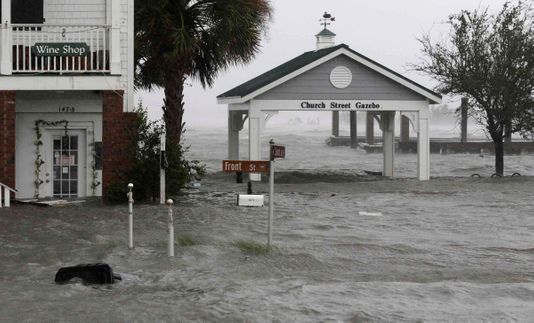
Flooding overtakes a section of downtown Swansboro, N.C., on Sept. 14. (Photo courtesy of the Associated Press)

In a good will gesture, Mayor Tom Bennett has reached out to the mayor of Swansboro, N.C., a coastal town about the size of Southern Shores, and offered to send supplies to help its residents recover from flooding caused by Hurricane/Tropical Storm Florence. The small town in Onslow County, near Camp Lejeune Marine Corps Base, has experienced a total rainfall since last Thursday of more than 35 inches, much of it falling during the storm’s first two days.

At last night’s Planning Board meeting, Mayor Bennett described how he asked town staff to identify some hard-hit towns in North Carolina that, like Southern Shores, have a population of about 3,000 people. Swansboro qualifies, although Southern Shores is larger in area. The total land and water area of Swansboro, which is on the Intracoastal Waterway about 80 miles northeast of Wilmington, is about 1.3 square miles.

According to Mayor Bennett, Swansboro has been “hammered” by Florence, and flooding there has been “devastating.” Many residents are without electricity. The Mayor recommended donations of tarps, plastic storage boxes, and plastic containers, but any nonperishable items, such as canned foods, bottled water, soft drinks, toilet paper and other paper products, pet foods and supplies, and cleaning products, are in demand. You may bring your donations to Town Hall today and in the ensuing days. (Update 9/21: Mayor Bennett reports that trailer- and truck-loads of donations will be delivered to Swansboro today.)

Tiny Swansboro topped the National Weather Service’s preliminary rainfall totals for North Carolina towns as of noon Saturday, Sept. 15 with a record 30.58 inches. By Sunday night, the National Oceanic and Atmospheric Admin. was reporting an unofficial total rainfall for Swansboro of 33.89 inches. Rain is still in Swansboro’s forecast today, but it is predicted to end by tomorrow.

“We broke the state record for rain at one time,” Swansboro Mayor John Davis told USA Today, “but considering the strength of the storm and how long it has stayed, we did pretty well.”

Rainfall totals from Hurricane Florence have eclipsed those from Hurricane Floyd, which wreaked havoc in eastern North Carolina in 1999. Floyd dumped a record 24.06 inches on Wilmington, which sits on the Cape Fear River and is currently coping with the aftermath of Florence’s rain and storm surge. Besides Floyd, Wilmington was hammered, to use the Mayor’s verb, in 1996 by Hurricane Fran.

Swansboro, which is in Onslow County across the waterway from Hammonds Beach State Park, is a former plantation that was incorporated as a town in 1783. The town’s motto is “The Friendly City by the Sea.” Its historic district made the National Register of Historic Places in 1990.

Thanks to Florence’s strong winds, Mayor Davis said in his USA Today interview, “[W]e had 10 roofs peel off like the tops of cans” in the historic district.

I would like to thank Mayor Bennett for his thoughtful and gracious offer to Mayor Davis and encourage Southern Shores residents to donate what they can. When I asked Mr. Bennett after the Planning Board meeting if Southern Shores suffered any storm-related damage, he replied: “Nothing.”

“Just pine needles,” he said, smiling. “A few downed tree limbs, but no trees.”

Other northern Outer Banks towns fared similarly. There will be no storm-debris pickup anywhere in Dare County. Just a reminder, however: If you own property on one of the town’s canals, and a tree fell in the canal during the storm, you are responsible for removing it.

PLANNING BOARD TAKES UP NEW NONCONFORMING LOTS LAW: Exceptions?

It appeared from the Planning Board’s online agenda that much of last night’s meeting would be devoted to considering the Southern Shores Volunteer Fire Dept.’s Conditional Use Permit application to build a new fire station at its current site. But because of the storm, the SSVFD’s engineer, Joseph C. Avolis of New Bern-based Avolis Engineering, P.A., could not attend the meeting. The Board will take up the CUP at its Oct. 15 meeting. (Links to CUP materials are at https://www.southernshores-nc.gov/planning-board-meet-september-17-2018/.)

The Planning Board instead spent more than 90 minutes discussing what, if any, modifications it would recommend that the Town Council make to the newly adopted zoning text amendment, ZTA 18-07, about regulating nonconforming lots. The Board concluded its extremely thorough discussion by agreeing unanimously that it needed more time to evaluate how the new law affects property owners, vis-à-vis protecting the town’s interests, and whether any exceptions to the law are warranted.

“This board will always do due diligence,” Chairperson Glenn Wyder stated. Earlier in the session, he stressed: “We want to do things right.”

On Sept. 5, the Town Council voted 4-1 to replace current Town Code sec. 36-132 with the text of ZTA 18-07, which seeks to curtail development on nonconforming lots, in particular, 50-foot-wide lots that were once part of 100-foot-wide parcels. The new law seeks to “recombine” nonconforming lots into conforming lots so that the resulting parcel is a minimum width of 100 feet, which has been the minimum size for a buildable lot in Southern Shores since enactment of the Town Code.

This “do-over” became necessary, in large part, because the original sec. 36-132, which took effect in 1981 and sought recombination of all nonconforming lots owned by a single owner into conforming lots, was drafted inartfully—so poorly as to not trigger recombination of vacant, adjacent nonconforming lots in single ownership.

At least, that is the opinion of Town Attorney Ben Gallop, who has determined the Planning Department’s approach. Some Southern Shores residents believe that sec. 36-132 was sufficient and that the sales of many 50-foot-wide lots in town should not have been allowed to occur. I believe the intent of the Town Council nearly 40 years ago was to recombine all nonconforming lots that were not single lots. The language it used is debatable and, now, with the new law, moot.

Prior to the town’s 1979 incorporation, single lots of 75 feet were sold and developed, but most of the parcels sold consisted of two or more 50-foot-wide lots. Restrictive covenants that run with these lands require developing them as 100-foot-wide tracts. (Some pre-incorporation exceptions on the oceanfront do exist.)

With an eye toward assessing ZTA 18-07’s effect, new Planning Board member Andy Ward, a local builder, did a comprehensive lot-by-lot analysis of Ocean Boulevard, starting at Pelican Watch and going north, and of nearby streets, including Duck Road, Porpoise Run, Trout Run, and Wax Myrtle Trail. Mr. Ward presented his thorough analysis (he worked on “rainy days,” he joked) to the Board before it started its deliberations. Mr. Wyder called it “a great identifying tool for us as a board and eventually for the town council.”

This analysis allows easy identification of properties and property owners directly affected by the new law. (You may view it at https://www.southernshores-nc.gov/wp-content/uploads/2018/09/8-22-18-Ward-Scenarios.pdf.) In examining Mr. Ward’s scenarios, Board members made clear that they do not wish to unduly burden individual property owners. They spent the bulk of last night’s meeting deliberating over exceptions to the new law.

“We want to try to be fair,” said Elizabeth Morey, the Planning Board vice-chairperson.

“We want to make people whole who are in place,” said Mr. Ward.

One such property owner identified by the Board is Richard M. White of Elizabeth City, who owns 85 Ocean Blvd., two 50-foot-wide lots that he developed in 1999 as a single 100-foot-wide lot. In 2014, Mr. White, who was present at last night’s meeting, bought a former paper street at 85A Ocean Blvd., which is a nonconforming 50-foot-wide lot. He would like to build on this investment property.

On May 21, however, the Planning Board, sitting as the Board of Adjustment, denied Mr. White’s request for a side-yard setback variance on 85A Ocean Blvd. because House Engineering, P.C., of Kitty Hawk, who represented him, sought a setback reduction from 15 feet to 10 feet, not 12 feet. All of the side-yard setback variances that the Board approved on 50-foot-wide lots, before adoption of ZTA 18-07, were for 12 feet.

The new law specifies that owners of single 50-foot-wide lots—meaning they do not own any adjacent property—may use a side-yard setback of 12 feet. Mr. White cannot avail himself of this variance, however, because the new law requires him to recombine 85 and 85A Ocean Blvd. into one 150-foot-wide parcel.

To remedy Mr. White’s situation, the Board eventually arrived at a possible exception that Mr. Haskett framed. If I understood it correctly, the exception would apply to a single owner who has a vacant nonconforming lot adjacent to two nonconforming lots that have a structure on them (e.g., Mr. White’s rental house). Under this exception, Mr. White would have to recombine the two lots that make up 85 Ocean Blvd., but not the lot at 85A Ocean Blvd.

Upon hearing this proposal, I immediately began brainstorming ways to use the exception to get around the recombination mandate of the new law. I’m sure other property owners and their lawyers would do the same. I think it would be more efficient to except former paper streets from the definition of nonconforming lots. Mr. White’s case is unique.

OPINION:

I found Board members’ discussions last night among themselves and with Mr. Gallop and Deputy Town Manager/Planning Director Wes Haskett to be thoughtful, creative, and wide-ranging. They coalesced into the excellent suggestion that Mr. Wyder meet with Mr. Gallop and Mr. Haskett to focus these discussions.

In Mr. Gallop’s exchanges with the Planning Board, the Town Attorney repeatedly returned to the questions of the Board’s objectives—“What are the problems you’ve trying to solve?”—and its policies, apart from individual property owners’ circumstances. In my opinion, the Planning Board has to ensure that any exceptions it recommends to the Town Council reflect sound policy that benefits the town, at large. Exceptions should be policy-driven, not property-owner-driven, and, thus, neutral and non-discriminatory.

In stating the Board’s objective, Mr. Wyder said: “The idea is to maximize the number of conforming lots and minimize the number of nonconforming lots.”

While true, I believe this statement is too broad. I believe it needs to be broken down into a more practical analysis that rests on policy considerations.

The only other observation I would make is that sometimes the Planning Board members refer to, and fear, legal repercussions from their actions, without articulating or knowing what the legal cause of action would be. The Town Council does this, as well. I understand that all of these town representatives take their responsibilities very seriously and do not wish to harm the town in any way. I commend them for their conscientiousness. I also know that we live in a very litigious society. But you cannot sue on the air you breathe or just because you feel like it. You have to state a legally actionable claim.

Last night, one member brought up the concern that a recombination of nonconforming lots might be an unconstitutional taking of property. Lawyers know it is not, and I was most gratified when Mr. Gallop put that fear to rest, citing the U.S. Supreme Court as authority. I wish he would speak up more often and address Planning Board and Town Council members’ legal concerns when they arise. In my experience and opinion, they are often unfounded.

Ann G. Sjoerdsma, 9/18/18
9/14/18: ALL SOUTHERN SHORES RESIDENTS, PROPERTY OWNERS ALLOWED REENTRY TOMORROW, AT 7 A.M.; VISITORS PERMITTED SUNDAY; Florence Stays South of Outer Banks, Making Landfall at Wrightsville Beach, as Category One Hurricane

reentry

All permanent residents, non-resident property owners, and all other Priority Two and Three personnel will be allowed reentry to the Outer Banks, north of Oregon Inlet, tomorrow, starting at 7 a.m., according to Dare County Emergency Management. All visitors will be permitted into the northern Outer Banks starting 7 a.m. Sunday.

Priority One or “essential” personnel are currently allowed on the Outer Banks north of Oregon Inlet.

These county orders are based on the latest reports from the National Weather Service and the National Hurricane Center and could change if weather conditions change. But I think it’s safe to say that Hurricane Flo is a no-show, and, except for some minor beach road overwash in Kitty Hawk and Nags Head, the northern Outer Banks escaped unscathed.

According to The Weather Channel, Hurricane Florence made landfall at Wrightsville Beach, near Wilmington, at 7:15 a.m. today. As of this writing (about 12:30 p.m. Friday), it is heading south toward Myrtle Beach, S.C.

There currently is no access to Hatteras Island because of ocean overwash on N.C. Hwy. 12, which has been closed. According to Emergency Management, the N.C. Dept. of Transportation must clear the roads and bridges of debris, inspect them for structural damage, and do necessary repairs before access to the island will be permitted.

Priority Two personnel include permanent residents and essential personnel for critical businesses. For reentry, such personnel must have a valid N.C. driver’s license with a local address or a current Dare County property tax bill or parcel data sheet. Non-resident essential personnel of critical businesses, such as food service/supply, pharmacies, banks, gas stations, property management, building supply, and hotels will be allowed reentry only with a permit, according to the county website.

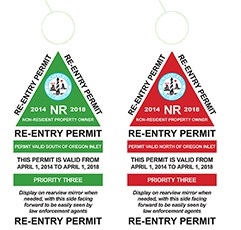
Priority Three encompasses non-resident property owners and non-resident employees of non-critical businesses. Non-resident property owners must display a reentry permit (see photo above) or have a current tax bill or parcel data sheet with matching government-issued identification, such as a driver’s license.

Reentry permits from previous years will not be accepted. However, those with an April 1, 2018 expiration date remain valid until Dec. 30, 2018.

For more details about reentry, see:

https://www.darenc.com/departments/emergency-management/hurricanes/reentry.

I will provide information specific to Southern Shores when it is available.

Ann G. Sjoerdsma, 9/14/18

9/10/18: 20 YEARS AGO, BONNIE LAY OVER THE OCEAN, AND WE ALL WAITED AND WAITED AND WAITED

hurricanes
The Weather Channel is enjoying a bonanza in its ratings.
Bonnie2
Hurricane Bonnie nears Wilmington, N.C., on Aug. 26, 1998. It made landfall at Cape Fear. (photo credit, Wikipedia)

In light of the weather news this week, I thought you might enjoy reading a column I wrote 20 years ago for The Virginian-Pilot when I was an editorial columnist. It appeared Aug. 29, 1998 and was headlined “OUTER BANKS HURRICANE WATCH: Bonnie Moved Slowly, as I Waited.” You’ll note that I refer in the article to Hurricane Felix, a 1995 storm. Unfortunately, I cannot locate a copy of the Aug. 27, 1995 column that I wrote about Felix. In that piece, I stopped and interviewed people in Kitty Hawk, KDH, and Nags Head who, in general, were taking the storm in stride. Here’s my report on Bonnie:

WHILE OUTER BANKS VACATIONERS panic at the words “mandatory evacuation” and rush to sit for hours in traffic gridlock, we barrier-island locals know just how long the wait for a hurricane can be. Too many times, I’ve kept an anxious eye on one of these anthropomorphic forces of nature only to have it fail to show up or be a shadow of its former self when it did.

Of course, tourists have to be ushered off the beaches early to minimize later potential disaster, though it’s a shame they leave on the lovely sunny day (last Tuesday) before the hunkering-down begins. Realistically confronting a hurricane, not simply fleeing from its possibility, is largely a matter of mathematics. And unpredictability. A hurricane’s slow course cannot be confidently plotted. This much I’ve learned.

Am I better off waiting in Elizabeth City or Norfolk? And when a hurricane’s as big as Texas—Bonnie’s girth—is there any hiding place? There will be ample time to tell.

At 9 a.m. last Wednesday, Bonnie was 100 miles south of Wilmington, N.C., and moving at 14 miles per hour. Slower than the previous night. It doesn’t take a calculator to figure that if Bonnie, which was packing 115-mph winds, continued at this speed and on its north-northwest path, it wouldn’t reach Wilmington for seven hours; and since Wilmington is a fair bit south of my inland Outer Banks residence, I had hours to while before deciding whether to hightail it out. What to do?

Hit the town. What else?

Theoretically, everyone should leave during a countywide mandatory evacuation; and certainly, if you’re a tourist, the hotels and cottage rental companies can oust you. But the police don’t go door-to-door, forcibly removing people. And until a curfew is issued, the roads are fair game.

Three years ago, when I waited out Felix—which traveled at 6 godawful slow miles an hour before it stalled off the coast and went out to sea—I felt as if I had returned to 1975, so wide-open were the roads. But today, with the increase in the number of Outer Banks year-rounders, the tempestuous Bonnie had much more company.

At 10:30 a.m., there was traffic. No wind, no rain. But traffic. The 7-Eleven in Kitty Hawk was a happening place. “Welcome, Bonnie,” the message on its window boards teased. “Come on in . . . OPEN.” And people did, buying milk, bread, toilet paper, gas. The mood was festive, but the wait had just begun.

Down the road in Kill Devil Hills, 40 cars were parked at Kmart, as signs there promised batteries and water and announced that the usually jam-packed store was “being run by all volunteer staff.” “Volunteer” is code for bored locals going nuts at home.

A couple in cutoff jeans emerged carrying two big boxes of detergent: Bonnie had forced them to confront laundry day.

Open supermarkets and combo service station-convenience stores were doing a brisk business, as was Ace hardware. Two men fished in the pond next to the Nags Head movie Cineplex. I wondered if there actually were fish in it, but didn’t stop to ask. Only one police car passed by. On the Nags Head oceanfront, a construction crew banged nails on a partially built cottage.

“My Bonnie Lies Over the Ocean—Stay There” was the hands-down favorite message spray-painted on boarded-up windows. With an ungrammatical variant having Bonnie laying over the same.

A young man sat in front of Las Trancas restaurant in Nags Head, playing an accordion. All of the hotels were closed, except the Ramada Inn and Holiday Inn in Kill Devil Hills, where droves of newspeople were staying. These unlucky folks start out thinking a hurricane watch is exciting, then end up hyping ocean surge far weaker than the typical nor’easter produces.

By noon, Bonnie had slowed to 12 mph. Still no rain. In the woods of Southern Shores, a man watered his lawn.

Seeing people at the Exxon convenience store near the old Trading Post in Kill Devils Hills reminded me of the waterspout that came in there in 1978. The black wind tunnel damaged the pink Wilbur Wright Hotel beyond repair and caused a refrigerator to move in a house across the street, crushing a woman to death. I stood watching it from two miles away, transfixed.

Up in Kitty Hawk, Miles Davis, owner of Winks grocery store, which is closing on Labor Day after 45 years,* greeted customers in search of eggs, bacon, bread, batteries, bottled water and ice. Auto mechanic Kevin Bradshaw popped in. He was enjoying a “free day” at work—no phone interruptions. The popular Kitty Hawk pier restaurant was packing ’em in.

To the north, upscale Duck and Corolla were deserted.

By 3 p.m., Bonnie, which had hit land at Cape Fear, was 40 miles south of Wilmington and moving at 10 miles per hour. Simple math: The wait lengthened.

At 5 p.m., I looked out at the same gray sky, the same still trees in the same still air. Bonnie had slowed to 8 mph; it was 21 miles south of Wilmington, heading inland and weakening.

By 9 p.m., the Texas-size hurricane had stalled. Still no wind or rain. Ditto at 11 p.m.

Hundreds of people were rescued from the ocean at the Outer Banks during the first two weeks of August when a storm system whipped up the surf and created dangerous rip currents. Four people drowned. Maybe it’s because I know that the Outer Banks is never without danger that I can wait for new danger to arrive.

By 9 a.m. Thursday, the wind had finally picked up. A light rain fell. Bonnie, now blowing 75-mph winds, was near New Bern, N.C., moving northeast at 6 mph. People were talking about a new girl named Danielle. It was going to be a long day.

***

In an online report on Hurricane Bonnie, Wikipedia says it was “the most observed hurricane in history.” See https://en.wikipedia.org/wiki/Hurricane_Bonnie_(1998).

*Mr. Davis did sell Winks in Kitty Hawk, but the new owner retained the name.

MY BOTTOM-LINE ADVICE: If you find yourself panicked by all of the hurricane-watch hype—and it is both extensive and relentless—take a deep, deep breath; turn off the Weather Channel; and seek out someone who you know is unflappable in an emergency. Prevail upon a cooler head to help you restore your equilibrium. You will have plenty of time to engage in reasoned decision-making, based on facts, not fear.

Ann G. Sjoerdsma, 9/10/18

9/6/18: TOWN COUNCIL PASSES MODIFIED LOT COVERAGE ZTA AND ORIGINAL VERSION OF NONCONFORMING LOTS ZTA, ACCEPTING RECOMMENDATIONS OF PLANNING BOARD; SSVFD’s Architect Provides Cost Range for Proposed New Fire Station, Timetable for Bids

swimmingpoolwchair
Swimming pools count toward lot coverage . . .
gravelwalkway
. . . but now gravel walkways do not.

The Southern Shores Town Council last night passed a modified version of the lot coverage zoning text amendment (ZTA) and the original version of the nonconforming lots ZTA, endorsing recommendations made by the Town Planning Board and involving that board in anticipated “tweaking” of the latter. Both votes were 4-1. (See The Beacon’s Aug. 21, 2018 report about the Planning Board’s action.)

Said Town Councilman Jim Conners in making the motion to adopt ZTA 18-07, the original proposal to amend the current flawed Town Code ordinance on nonconforming lots (sec. 36-132): “It’s very important that we adopt something to stop what’s going on.”

(The Beacon has written extensively about the recent trend toward constructing houses on nonconforming lots that once made up a single combined conforming parcel. In the usual case, a 100-foot-wide parcel is sold off and developed as two 50-foot-wide lots.)

Agreeing with a majority view that ZTA 18-07 has some problems, Mr. Conners encouraged a “joint effort” among the Town Council, the Planning Board, the Town Attorney, the Town Planning Director, and other staff on “tweaking” the Code amendment, so that “outlier issues” are resolved. The Town Council previously has expressed concern about the adverse impact the ZTA appears to have on some property owners.

New Planning Board Chairperson Glenn Wyder favorably responded to Mr. Conners’s suggestion, saying, “We’re at a place where we can finally nail things down and do it the right way. . . . We are willing to finalize this.”

ZTA 18-07, which became Town law as soon as Mayor Tom Bennett signed it into effect, will return to the Planning Board for what the Mayor characterized as “refinements.” Only Councilman Chris Nason voted against its adoption and subsequent fine-tuning, saying that the stopgap ZTA takes a sledgehammer approach to the development problems it addresses.

In presenting his Board’s actions on both ZTAs, Mr. Wyder cited the great importance the amendments have on land use in Southern Shores and on preservation of the vision that Town founders had. Noting that ZTA 18-04, the lot-coverage amendment, has a history dating back to Aug. 7, 2017, Mr. Wyder described the “systematic approach” that he and his Planning Board colleagues applied to analyzing every provision of the ZTA.

The Chairperson aptly characterized their discussion as “vigorous” and their research as “significant.” Having witnessed their discussion, I can attest to its vigor, preparedness, and thoroughness. I am very impressed with Mr. Wyder’s leadership and the Planning Board’s teamwork. Mr. Wyder was spot-on in his initial remarks when he said that the Board “went above and beyond” in exercising “due diligence.”

The Planning Board approved three of ZTA 18-04’s provisions, which amend the Town Code law on maximum allowable lot coverage (sec. 36-202(d)(6), and rejected three other proposed changes, including exemptions for 500 square feet of the water area of swimming pools and certain types of driveways and parking areas.

The Town Council agreed with the Planning Board’s analysis and passed the recommended changes into law. Only Councilman Gary McDonald dissented, saying he was concerned about neighborhood density and stormwater runoff and would like to leave the current ordinance “as is.”

Pursuant to the new law, gravel walkways will no longer be counted toward the 30-percent maximum allowable lot coverage, nor will “open-slatted decks that allow water to penetrate through to pervious material, not exceeding a total of 25 percent of the total footprint area of the attached single-family dwelling.”

To take advantage of these exemptions, the new law requires an applicant for a building or zoning permit to present a survey that meets the Town’s requirements for a Lot Disturbance and Stormwater Management Permit.

OPINION: The Town Council and Planning Board worked well together on both of these measures. Collaboration between these two bodies, which are independent decision-makers, is essential to carrying out what the Southern Shores Town Code (sec. 24-27) states is the prime objective of the Planning Board: “to bring about a coordinated and harmonious development” of the town. Sec. 24-27 enumerates the Planning Board’s broad powers and duties, the reading of which confirms that it serves the Town, not the Town Council, and is expected to be proactive. One of the Planning Board’s powers is: “To make any other recommendations which it sees fit for improving the development of the area.” It seems to me that if either of the ZTAs enacted last night has an untoward effect, such as increasing stormwater runoff in the roads or in adjacent properties, or too much “sledgehammering,” the Planning Board can step in and propose remedies.

NEW FIRE STATION

Many members of the Southern Shores Volunteer Fire Dept. turned out last night to hear and support architect Kenneth C. Newell’s latest briefing to the Town Council on the proposed new fire station.

For two hours yesterday afternoon, Mr. Newell, who is a partner in the Gastonia, N.C.-based firm of Stewart, Cooper, Newell, PA, also was available to the public in an information meeting at the Pitts Center. Unfortunately, I was one of only two people who attended that event, and the other person has a potential financial interest in the station’s construction.

Mr. Newell informed the Town Council that the station construction project will be out for bids in about two to three weeks and will remain open for four weeks after that. The architect assured Councilman Conners, when he inquired about local contractors, that the project bidding period will be “publicly advertised” and that local contractors will have an opportunity to compete.

When asked by Councilman Fred Newberry what the anticipated cost of the project is, Mr. Newell cited the volatility of market prices and gave a range of between $325 and $425 per square foot. He told Mr. Newberry that the proposed station size is “just over 13,000 square foot.” Earlier, he told me that it is 14,000 square feet. Applying all of these figures, the potential cost for a 13,000-square-foot station, therefore, would be between $4.2 million and $5.5 million; and for a 14,000-square-foot station, it would be between $4.6 million and $6 million (rounding up).

(In his report to Council earlier in the evening, SSVFD Chief Ed Limbacher responded to a question asked last month about compensation for the SSVFD’s services in 2019-20: “We don’t anticipate asking for any more money in the next budget cycle,” he said.)

I plan to write a blog about the proposed new fire station, based on my interview yesterday with Mr. Newell and further research. The Town Council is expected to vote on whether or not Southern Shores will financially participate in the station’s construction at its Nov. 7 meeting.

The new fire station, which is single level and equipped with four “double-loaded drive-through bays,” according to Mr. Newell, would be built on the existing site of the current station at South Dogwood Trail and Pintail Trail.

“We worked with the department to meet its minimum needs” and to be “cost-effective” on a site that poses constraints, he said. “There’s not a lot of fluff in the building.”

Mr. Newell, who has designed 400 fire stations across the country, in 26 different states, also had to meet certain legal requirements, which I’ll explore later.

I refer you to the SSVFD’s website for more details: www.ssvfd.net.

CAPITAL IMPROVEMENTS UPDATE

Also last night, Town Manager Peter Rascoe gave an update on three major capital improvement projects, saying:

*RPC Contracting, Inc. has already started working on the east end of the East Dogwood Trail walking path. The construction is to be completed by Jan. 23, 2019.

*RPC Contracting, which also was low bidder on the Yaupon Trail rebuilding project, will start working there on Oct. 15. Completion date is May 15, 2019.

*The “specs” are out on the Juniper Trail project, and bids are due to be opened Sept. 25.

As The Beacon reported yesterday, RPC’s winning bid on the East Dogwood walking path was $167,550, which, according to an internal memo to the Town Council from Mr. Rascoe, “includes three bid alternates for construction of feeder crosswalks across East Dogwood Trail and its medial to the new walking path—at Hillcrest Drive, Sea Oats Trail, and Wax Myrtle Trail.” (This memo was included in yesterday’s meeting packet.) Barnhill Contracting Co. and Hatchell Concrete Inc. also submitted bids.

RPC’s bid on Yaupon Trail was $377,320. The only other bidder, Barnhill Contracting Co., submitted a bid of $538,400. I would like to know what accounts for the wide discrepancy in these bids, but I did not raise the question last night.

RECONSTRUCTION TASK FORCE

The Southern Shores Town Code provides that in the event of a “damaging storm and enactment of a building moratorium”—when “no building permits shall be issued”—a special reconstruction task force “will oversee the recovery and reconstruction process and serve as an advisory body to the town council on recovery/reconstruction issues.”

You may read about damaging storms, building moratoriums, and the reconstruction task force in the emergency management chapter of the Town Code at sec. 12-66 et seq. Sec. 12-68(b) specifies the conditions under which an “initial post-storm reconstruction moratorium shall be declared.” Mayor Bennett summarized them well when he said: “This is Hurricane Katrina in Southern Shores.”

The 12-member reconstruction task force only becomes an acting committee upon the declaration of the initial building moratorium. Sec. 12-69(c) specifies the composition of the task force by office or by representation. Last night, the Town Council appointed the people who will serve on the task force, as follows:

1)      Two elected officials: Mayor Tom Bennett and Mayor Pro Tem Chris Nason

2)      Town manager

3)      Two Planning Board members: Chairperson Glenn Wyder and Vice-Chairperson Elizabeth Morey

4)      One Board of Adjustment member: Andy Ward

5)      One representative each from the Southern Shores Civic Assn. and the Chicahauk Civic Assn.: to be determined (TBD)

6)      Building inspector

7)      Police Chief or his representative: TBD

8)      Fire chief of his representative: TBD

9)      One representative from either the realty or the construction community: Matt Neal of Neal Contracting, who is 2018 president of the Outer Banks Home Builders Assn.

OVERALL, last night’s meeting was very successful. I should probably end this lengthy report on a positive note, but instead, I feel compelled to mention . . .

THINGS THAT TROUBLED ME . . .

Town Council’s October Meeting Canceled

Mayor Bennett made a motion last night to cancel the Town Council’s regular meeting of Oct. 2 due to a “lack of agenda items.” Councilman Conners quickly seconded this motion, and it passed, 3-2, over dissents by Councilmen Newberry and McDonald.

Council Resolution 2017-12-01 was cited as authority for this motion. That resolution lists all of dates for regular and special meetings in 2018 and states that “any meeting may be cancelled for lack of agenda items.”

The problem that I have with this cancellation is that the reason offered by the Mayor was disingenuous, at best. Deceitful, as worst. I asked Town Manager Rascoe last month why the October meeting was being canceled, and this is what he wrote to me in an Aug. 8 email:

“The cancellation has been previously noted to the Council at meetings on three separate meetings since January and is due to the Town Manager being unable to attend due to a family commitment.”

It is actions like this motion and meeting cancellation that give those of us committed to transparency and open government pause. It’s not a matter of politics or personalities, it’s a matter of trust and playing by the rules. The fact that Mr. Rascoe is taking a vacation should have no bearing on next month’s Town Council meeting.

Besides the agenda items of the usual five staff reports, I can identify the following others in October: the Planning Board’s report from its Sept. 17 meeting, which includes action on the conditional use permit for the proposed fire station and, possibly, suggestions on ZTA 18-07; the Southern Shores Historic Landmarks Commission’s report on its latest application; public comments—I personally have a problem with construction noise that I’d like to bring up; and any other items that Town Council members would like to put on the agenda, such as followup on the cut-through traffic problem, the local Outer Banks “housing crisis,” as presented last night in public comments by Mr. Neal and representatives from the Outer Banks Chamber of Commerce and the Outer Banks Restaurants Assn..; the planning/opening of a branch library in Southern Shores, an interesting idea brought up by Mr. Conners in his final comments; and any other issues that may arise in the MONTH between now and Oct. 2.

After the Town Council adjourned, it met in closed session to discuss a matter pertaining to the fitness of an employee. Mr. McDonald suggested that this matter, too, could be an agenda item in October.

Meetings are canceled for a lack of agenda items mere days before the event, not a whole month out.

Historic Landmarks Meeting Postponed

Also disconcerting for me was to learn, through Deputy Town Manager/Planning Director Wes Haskett’s report, that the Historic Landmarks Commn.’s Aug. 28 hearing on an application for 170 Ocean Blvd. was postponed because the Commission did not yield a quorum. That means that three of the five Commission members couldn’t or didn’t show, for whatever reason. I only hope that the out-of-town applicant was informed well ahead of time.

It’s time to do what’s necessary to appoint alternates to the Commission. Its rescheduled meeting is Sept. 25, 9 a.m., in the Pitts Center.

Ann G. Sjoerdsma, 9/6/18

9/5/18: VIEW DESIGN PLANS FOR NEW FIRE STATION, 3-5 p.m.; ATTEND TOWN COUNCIL MEETING, starting at 5:30 p.m.: Lot coverage & nonconforming lots ZTAs on Council agenda again

firetruck
You also may see architectural drawings of the proposed new fire station at the SSVFD’s website, http://www.ssvfd.net.

Today you will have an opportunity to see the design plans for the proposed new fire station, which would be located at the same South Dogwood Trail-Pintail Trail site as the current station is, and ask questions of architect Ken Newell in an “information meeting” from 3 p.m. to 5 p.m. in the Pitts Center.

Later during the Town Council’s meeting, which starts at 5:30 p.m., Mr. Newell, of Stewart Copper-Newell Architects, PA, will brief the Mayor and the four councilmen on those plans. Although the Town of Southern Shores has paid for the architect’s services, it has yet to commit to participating financially in the fire station’s construction. That vote is expected to be taken at the Town Council’s Nov. 7 meeting.

Although billed as “new business” on tonight’s meeting agenda, the Town Council will hold another public hearing on ZTA 18-04, a proposed amendment to change calculation of the maximum allowable lot coverage (30 percent), as set forth in Town Code Sec. 36-202(d)(6). This amendment effort dates back more than a year and has come before both the Town Planning Board and the Town Council multiple times. (See The Beacon’s archives.)

The Town Council will also revisit the subject of development on nonconforming lots, specifically, building on lots that are smaller than the Town Code-required 20,000 square feet and 100-feet width. This issue is a can that the Town Council has kicked down the road, in large part because—in my humble opinion—Council members have not been adequately prepared to discuss the applicable zoning text amendment, ZTA 18-07, which passed 3-2 on a first reading June 5.

In July, rather than hold a second reading on ZTA 18-07, the Town Council unanimously approved a motion directing Town Attorney Ben Gallop to gut it. “Gut it” is my view of what the new nonconforming lots ZTA, 18-07A, does to the original amendment of Town Code sec. 36-132. Others might say, less stridently, “limit” it or “restrict” it.

The Town Planning Board took decisive action at its Aug. 20 meeting on ZTA 18-04, 18-07, and 18-07A, unanimously approving a scaled-back version of the lot-coverage amendment (allowing gravel walkways and some open-slatted decks to be exempted from the 30-percent calculation); rejecting the “gutted” nonconforming lots ZTA 18-07A, principally because it would allow owners of vacant land, of which there is still a considerable amount in the Southern Shores beach zone, to sell their land as separate 50-foot-wide lots; and endorsing the comprehensive ZTA 18-07, which would protect the Town from higher-density development similar to what we see south of us.

New Planning Board Chairperson Glenn Wyder will present his five-member Board’s recommendations to the Town Council tonight. It is The Beacon’s fervent wish that the Town’s elected officials will see the wisdom of this dedicated and informed volunteer Board’s decisions and endorse them. (See The Beacon’s report, Aug. 21, 2018.)

The Town Council will hold a public hearing on the revised ZTA 18-07A and may consider a second reading of ZTA 18-07. A super majority of four Council members is required to pass ZTA 18-07A. ZTA 18-07 may be passed with a simple majority of three.

Other business of note in tonight’s meeting agenda (see below for a link to the agenda and the meeting packet) includes Town Manager Peter Rascoe’s report of awarding two capital-improvement-project contracts to RPC Contracting, Inc.

RPC received the contract for the construction of the East Dogwood walking path with a bid of $167,550, which, according to an internal memo from Mr. Rascoe in the meeting packet, “includes three bid alternates for construction of feeder crosswalks across East Dogwood Trail and its medial to the new walking path—at Hillcrest Drive, Sea Oats Trail, and Wax Myrtle Trail.” RPC will have 150 days from the date of the contract to complete this project. Barnhill Contracting Co. and Hatchell Concrete Inc. also submitted bids.

RPC’s bid of $377,320 for the Yaupon Trail rebuilding project earned the company that contract, as well. The only other bidder, Barnhill Contracting Co., submitted a bid of $538,400. I would like to know what accounts for the wide discrepancy in these bids.

Remember the Traffic?

CONSPICIOUSLY ABSENT from the agenda for tonight’s meeting, as well as from the agenda for last month’s meeting, is any followup on the No-Left-Turn weekend in June and management/curtailment of cut-through traffic next summer. Unfortunately, this is par for the course that I’ve observed in the past four years.

I recently received the following email from a homeowner on Hillcrest Drive, whose name I will withhold because she was not writing publicly:

“My husband and I recently moved to the Southern Shores community. We love it here and actually his family has owned a house on Hillcrest Drive for about 30 years. We have moved into the home and are overwhelmed by the amount of traffic on our road Saturdays and Sundays during the summer. It is so bad we cannot even leave our home due to the amount of traffic on our street. This also occurs on Sea Oats just as bad if not worse. Hillcrest Drive and Sea Oats are basically a parking lot beginning at 8 a.m. until 6 p.m. every Saturday/Sunday.

“I am certain you are not the person who can do anything regarding this [Heaven knows, I’ve tried.], but maybe you can direct us on what if anything can be done about this. We literally feel like prisoners in our own home on the weekends during the summer.”

As do many of us. I heard from many of your fellow prisoners this summer on The Beacon’s Facebook page.

I wrote to the homeowner that she and others in her situation need to raise their voices with the Mayor and the Town Council—at Town Hall meetings, in emails, telephone calls, all methods of communication. “Grin and bear it” doesn’t result in change. “Grin and bear it” just results in another cliché: “Swept under the rug.” And one more: The “squeaky wheel” gets greased.

I hope to see all of you at the meeting tonight.

Ann G. Sjoerdsma, 9/5/18

Agenda:

Click to access Agendas_2018-09-05.pdf

Meeting packet:

Click to access Meeting-Packet_2018-09-05.pdf

8/31/18: ALPHA-GAL SYNDROME: A Little-Known Red-Meat Allergy Triggered by a Lone Star Tick Bite; Most Prevalent in Southeastern USA

Lonestartick
The lone star tick. Only the females transmit alpha-gal sugar.

“I just laid down on the bathroom floor and called for my husband . . . A minute or two later, I felt the itching on my hands and then on my feet, and I looked around, and it was everywhere—hives, just intense itching. We decided it was time to go to the emergency room.”—JOANNE, alpha-gal allergy sufferer

Have you ever heard of alpha-gal syndrome?

I hadn’t, until I met with a friend earlier this month in Chapel Hill, and she told me she had been diagnosed with this unusual syndrome. Alpha-gal syndrome is an allergy to red meat that a person develops after a lone star tick bites him/her and transmits a sugar molecule called alpha-gal. I’m serious! The sugar is the allergen.

Joanne, whom I quote above, had a full-blown allergic reaction in October 2016 after eating “two very small ribs.” First, she had severe gastrointestinal distress; then the hives came. She was 65.

Alpha-gal is not a tick-borne disease; it’s a tick-borne allergy. If you’ve never heard of it, either, it may be because alpha-gal syndrome, which is characterized by a delayed allergic reaction after eating red meat, has only recently been identified. Also, many people who have the allergy don’t know they have it.

Just eating a hamburger or a few spare ribs can bring on a full-body case of intense hives or a severe bout of nausea, vomiting, and diarrhea, or even life-threatening anaphylaxis in people who, like Joanne, have been eating hamburgers and spare ribs all of their lives without incident.

I told my friend Linda I always knew she was an alpha gal. This alpha-gal, however, is short for galactose-alpha-1,3-galactose, which allergist and immunologist Dr. Scott Commins, of the University of North Carolina Dept. of Medicine, described in a Sept. 12, 2017 UNC podcast as “a carbohydrate or sugar that has two galactose sugars linked in an alpha-1-3 linkage.”

Dr. Commins is an associate professor in UNC’s Division of Rheumatology, Allergy, and Immunology and Thurston Arthritis Research Center. He is also a nationally recognized expert in alpha-gal syndrome. The UNC allergist trained as an allergy and immunology fellow in the University of Virginia lab where, and when, the first alpha-gal allergy cases were identified and studied.

Although scientists in Georgia reported in the late 1980s upon what were most likely 10 cases of alpha-gal allergies caused by tick bites, they did not publish their findings, nor did the Georgia Allergy Society or the U.S. Centers for Disease Control and Prevention follow them up. It was not until 2009, when the U.Va. research team, led by Thomas A.E. Platts-Mills, M.D., Ph.D.,  published a report of 24 cases of “delayed anaphylaxis to red meat,” occurring after tick bites, that alpha-gal syndrome gained research traction.

Interestingly, before they made the tick bite-red meat-allergic reaction connection, Dr. Platts-Mills and his colleagues grappled with what Dr. Commins calls in the “Alpha-Gal Allergy—with Dr. Scott Commins” podcast the “cancer side of alpha-gal.”

Starting in 2004, more than 20 percent of the patients who were receiving intravenous infusions of the cancer drug, cetuximab, in clinical trials developed sudden-onset alpha-gal syndrome and experienced anaphylactic-type reactions. A few fatalities occurred. Most of the affected patients lived in the southeastern United States, which, it turned out, not coincidentally, is a hotbed region for ticks.

I published this blog first on my medical information website. Because the Outer Banks is a hotbed within that hotbed region for ticks, I thought I’d share it on the Beacon blog. The alpha-gal story is fascinating.

ALPHA-GAL SUGAR AND TICKS

Chemists and those inclined toward chemistry will understand what Dr. Commins means by an alpha configuration. The rest of us need know only that alpha-gal sugar, which coats some proteins, is present in non-primate mammals, such as cows, sheep, pigs, and even dogs and cats, but we humans don’t have it. We can make an immune response to alpha-gal sugar, however—producing what are known as IgE (immunoglobin E) antibodies— if we eat foods that are derived from species that have it.

While most of us who are non-immuno-compromised eat these kinds of animal products without becoming reactive to the alpha-gal sugars in them, some of us become reactive, i.e., allergic. Those who do react produce a novel IgE response that is different from typical IgE responses directed toward protein allergens. (Allergies are caused by exposure to substances called allergens or, more generally, antigens. Most food allergies are caused by protein allergens, such as peanuts, not by sugars.)

Much of Dr. Commins’s research is focused on why some people react to alpha-gal, while others don’t.

My friend Linda, who lives in the woods (as I do), became potentially allergic after she was bitten by a lone star tick, which carries alpha-gal molecules from the blood of the animals it commonly bites.

Linda is outdoorsy and tick-savvy. She covers her arms and legs and wears boots when she’s out in her woods, and she checks herself for ticks regularly. She knew that she had been bitten by a lone star tick, which also transmits unwelcome diseases, and told her primary-care physician about it during a subsequent checkup. Her doctor did a screening blood test and diagnosed her with alpha-gal, before Linda, who is largely a vegetarian, had experienced any symptoms. She had never heard of it.

Since her diagnosis, my friend has avoided eating beef, pork, and lamb—“anything essentially that has hooves and walks on four legs,” Dr. Commins says, adding venison, bison, and buffalo to the list—or anything that may be cooked in a stock with these meats and has felt fine. Dr. Commins also discourages ice cream consumption.

According to the UNC medical professor, only a “small fraction” of people who test positive on an alpha-gal blood test actually develop allergic responses after eating red meat. That’s good news.

Contrary to what you may assume, lone star ticks do not come from Texas. They are named for the white, star-shaped spots on their backs (see above) and primarily live in the southeastern United States. Only the females transmit alpha-gal sugar and disease. With warmer winters prolonging tick seasons, lone-star-tick populations are starting to spread farther north and west. Like many of their tick “cousins,” they travel on deer, which we have in abundance on the Outer Banks.

In the podcast, Dr. Commins cautions that lone star ticks should not be assumed to be the only cause of alpha-gal syndrome. The allergy exists in Australia, Europe, and parts of Asia where the lone star tick does not.

Most people with alpha-gal syndrome do not know they have alpha-gal until they become ill, which typically does not occur, according to Dr. Commins, until four to six weeks after a tick bite, at which point the patient may have forgotten about the bite, if he/she even noticed it.

Besides the lapse in time between a tick bite and allergic symptoms, there is a two- to six-hour delay between the eating of red meat and the development of an alpha-gal reaction. These delays make alpha-gal easy to overlook.

To diagnose alpha-gal, Dr. Commins says, a physician relies on two-fold proof: 1) a clinical history; and 2) a positive blood test.

CLINICAL HISTORY: SYMPTOMS

Because the red-meat allergic reaction doesn’t start until an average of three or four hours after eating a hamburger or a steak, most alpha-gal allergy sufferers are stricken during the night when they are asleep. One explanation for the hours-long delay, Dr. Commins says, is that the digestive process for fat takes that long. In contrast, most allergic responses to food, such as peanuts or eggs, are immediate.

The alpha-gal allergic reaction often begins with intense itching, particularly on the palms and soles of the feet. It then spreads to the rest of the skin.

“We have patients tell us repeatedly that their hands begin to itch and turn red,” Dr. Commins explains. “Then they often get systemic hives all over their skin. [The process usually] starts with skin and itching and hives and redness, perhaps swelling, then [patients] often tell us that they feel light-headed, so we think their blood sugar is dropping. Often there is a gastrointestinal component to this as well—so really severe abdominal cramping, diarrhea, nausea, vomiting—all the hallmarks of an anaphylactic allergy reaction.”

In a Sept. 19, 2017 University of North Carolina Dept. of Medicine podcast that Dr. Commins did with Joanne, one of his alpha-gal allergy patients, the allergist says that he worries when two organ systems—the skin being one—are involved in the reaction.

If a patient just has hives, then he or she can probably manage the reaction with an antihistamine, such as Benadryl®. It there is a second organ system involved—typically, the gastrointestinal system and/or the cardiovascular system (blood-pressure changes)—then Dr. Commins advises the patient to call 911 or go immediately to the emergency department of a local hospital. The reaction can be life-threatening.

Joanne, who is a Duke University professor, describes waking up around 2 a.m., feeling nauseated and having extreme and sudden “gastrointestinal distress.” Her face was flushed and very hot. After having severe diarrhea, she started feeling itching on her hands and feet, “and I looked around,” she says, “and it was everywhere—hives, just intense itching.”

She went to an emergency room with her husband and was treated for anaphylaxis: “They gave me some fluids. They gave me maybe two Benadryl tables, and then just observed me, and after a while I was fine.”

The emergency physicians did not diagnose Joanne with alpha-gal. Instead, they referred her to her primary-care physician, who happened to be at UNC. She did some computer research and came up with the possible alpha-gal diagnosis, which the physician herself had never made. Armed with the tentative alpha-gal diagnosis and with the knowledge that, as a gardener, she received many tick bites, Joanne pretty much diagnosed herself, through Internet research, before she saw Dr. Commins.

Joanne had eaten red meat her whole life, without any difficulties. She had even eaten meat every night for several consecutive nights before the consumption of those “two very small ribs” that induced her allergic distress and brought her to the bathroom floor.

HYPERSENSITIVITY & CETUXIMAB

Judging from her symptoms, Joanne probably did not experience anaphylaxis.

According to the online Mayo Clinic, anaphylaxis, which is a severe hypersensitivity induced by exposure to an allergen, is characterized by:

*Difficulty breathing

*Rapid, weak pulse

*Dizziness or lightheadedness

*Drooling and inability to swallow

*Full-body redness and warmth (flushing)

Anaphylactic “shock” occurs when there is a sharp drop in blood pressure, along with breathing difficulties, hives, and itching. Such shock can be fatal.

“Hypersensitivity reactions are a classic side effect of cetuximab,” write French researchers in a 2014 oncology journal article in which they report upon three cancer patients in Normandy, France, who developed life-threatening symptoms with cetuximab treatment, one of whom died. (See https://www.ncbi.nlm.nih.gov/pmc/articles/PMC4116358/.)

Elsewhere, they write that “Hypersensitivity reactions are a classic side effect of monoclonal antibodies.”

In 2004, when ImClone and Bristol Meyers Squibb were investigating the monoclonal antibody, cetuximab, in clinical trials for treatment of metastatic colorectal cancer, they did not know about this “classic side effect.” Early in their studies, however, it became clear that the antibody was causing hypersensitivity reactions, primarily in patients in a group of southern U.S. states. (Very roughly speaking, monoclonal antibodies are one type of substitute antibodies formed in a lab and used in cancer immunotherapy.)

Cetuximab was produced in a mouse cell line, not from human cells. According to Dr. Commins, patients who received this intravenous medication reacted “on the order of one in five or one in four on first infusion.”

“These reactions . . . developed rapidly and symptoms often peaked within 20 minutes following or during the first infusion of the antibody and occasionally proved fatal,” write Drs. Commins, Platt-Mills, and John W. Steinke in a 2015 article, “The Alpha Gal Story: Lessons Learned From Connecting the Dots.” Because of marketing delays, it was not until 2006 that the true severity of the reactions became obvious.

Eventually, the U.Va. researchers deduced that the mouse cells—mice being one of the species that make alpha-gal—were “decorating” the cancer drug with alpha-gal sugar, so that when the medication was given to people who were alpha-gal allergic, they reacted.

At the same time, Dr. Commins says in a podcast, Dr. Platt-Mills and he were seeing patients in the U.Va. Asthma and Allergic Disease Center who were not on cancer drugs, but were telling us, “Hey, doc, I think I’m allergic to beef (or pork, or lamb) but it doesn’t happen every time, and it happens in a delayed way.”

Dr. Platt-Mills had developed a blood-screening test for alpha-gal allergy to use in the cancer-drug context. He and Dr. Commins applied it to clinic patients with a meat allergy, and “that opened the Pandora’s box,” Dr. Commins says. A CDC map of the incidence of Rocky Mountain Spotted Fever in the United States and, ironically, Dr. Platts-Mills’s own experience with a tick bite and a meat-eating allergic reaction helped the researchers to make the eventual causative connection.

Both the clinical-trial cancer patients and the walk-in clinic patients who experienced allergic reactions had been bitten by lone star ticks. Amazing.

THE GOOD NEWS

The best news about alpha-gal syndrome is that it appears to be a transient allergy, not a life-long immune response. Besides taking Benadryl upon the appearance of symptoms, Dr. Commins recommends using EpiPen or epinephrine auto-injector, which is used for other allergies. Epinephrine is the same as adrenaline.

In an excellent July 2018 New York Times Magazine article about alpha-gal, Dr. Commins suggests that an enzyme in the tick’s saliva may work as an immunological adjuvant, essentially telling the bite victim’s immune system to see alpha-gal as a threat that warrants an allergic reaction.

If he is correct about the enzyme being “what it is about the tick that creates this risk,” then the development of an allergy shot that uses this salivary component may not be that far off. An allergy shot would desensitize people with alpha-gal and prevent future allergic reactions.

In the meantime, you know the tick drill: Cover up and tuck in; use insect repellant on your exposed skin, clothing, and gear; keep your dog on a leash; tick-proof your yard by clearing brush and leaves; and check yourself, your children, and your pets for ticks.

Ticks are rarely higher than knee-high–despite the myth about them falling from trees– but they have an unnerving habit of crawling up your skin, once they’re aboard.

Ann, 8/31/18

UNC podcast with Dr. Scott Commins, Sept. 12, 2017:

https://www.med.unc.edu/medicine/news/chairs-corner/podcast/alpha-gal

UNC podcast with Dr. Commins and Joanne, Sept. 19, 2017:

https://www.med.unc.edu/medicine/news/chairs-corner/podcast/alpha-gal-patient

commins
Dr. Scott Commins 

8/21/18: A CHANGING OF THE GUARD: THE ‘NEW’ PLANNING BOARD REJECTS REVISED ZTA ON NONCONFORMING LOTS AS INADEQUATE PROTECTION FOR TOWN; APPROVES 2 OF 5 PROPOSED EXEMPTIONS FROM 30-PERCENT LOT-COVERAGE CALCULATION: Chairperson Glenn Wyder Takes Charge

planningboardplanningboard

In a meeting last night that served notice that the new Planning Board, chaired by Glenn Wyder, will be well-prepared, proactive, and highly protective of Southern Shores, the five volunteer Board members unanimously rejected a scaled-back version of the nonconforming lots zoning text amendment (ZTA 18-07A)—which Mr. Wyder said “you could drive a truck through”—and recommended removing from the lot-coverage ZTA most of the proposed exemptions, including those for swimming pools and driveways.

The Board threw its support behind the previous comprehensive nonconforming lots ZTA (18-07), which the Mayor and Town Council directed Town Attorney Ben Gallop to revise, after they postponed action on the ZTA’s second reading at their July 10 meeting.

Although the Board rejected three exemptions proposed by ZTA 18-04, which seeks to change the calculation of 30-percent residential lot coverage, it approved the exemptions of gravel walkways and open-slatted decks that allow water to penetrate through to pervious material. (See below.)

During the hearing on ZTA 18-04, Planning Board member David Neal, a local builder, pointed out that the amendment would enlarge the buildable footprint for a house, a fact that has prompted many property owners to oppose it. Mr. Neal and newly appointed member Andy Ward, another local builder, voted only in favoring of exempting gravel walkways from the lot-coverage calculation.

(The Beacon has written extensively about these two zoning text amendments. Please refer to blogs posted in May, June, July, and earlier this month for background and analysis.)

Before deciding these weighty matters, the Planning Board, sitting in its capacity as the Board of Adjustment (BOA), granted a special variance to the owners of the Pink Perfection, a classic flat top built on the oceanfront in 1954, so that they may build a roof atop a new dune deck, in the same style as the roof on a historic dune deck that will be demolished. The Board stressed the “special and historic nature of the property” in approving a variance from Town Code sec. 36-99, which prohibits roofs on dune decks.

Mr. Wyder signaled a changing of the guard early in the meeting when he announced that speakers making public comments—outside of those given during a BOA hearing—henceforth will be limited to three minutes and that there will be no informal dialogues among Board members and members of the audience or any calling out from audience members. Mr. Wyder’s formalized procedural rules are designed to move meetings along and to keep discussions focused and on point.

IMO, last night’s meeting proceeded at a fairly brisk clip, with two welcome breaks taken at opportune times. Whenever Mr. Wyder thought that the robust and thorough discussion among the Board members, chiefly involving Mr. Ward, Mr. Neal, and the Chairperson, was becoming redundant or “circular,” as Mr. Wyder described it, he intervened. That these Board members clearly had done substantial research in preparation for the meeting gave their discussions both depth and momentum.

OPINION: From both a procedural and a substantive standpoint, this Planning Board meeting was the best I have ever attended, hands down. All of the members are independent-minded and thoughtful. They each have their own way of processing information and communicating, but they are united in their concern for Southern Shores. The three builders on the panel—Joe McGraw is the third—each have decades of experience and history with Southern Shores, and the fifth member, Elizabeth Morey, a political-campaign consultant, has a background in government regulatory work.

MORE OPINION: When Mr. Neal spoke during the “Pink Perfection” variance hearing about “thinking outside of the box” and “getting away from cookie-cutting this town,” I was overjoyed.

“I’m here to represent what I think is good for the Town of Southern Shores,” he said, citing the 40 years in which he has lived and worked here and the unfortunate changes he has seen. In Mr. Wyder, who claimed a 25-year Southern Shores history, I believe we have a strong leader who is equally committed to serving the Town.

NONCONFORMING LOTS, ZTA 18-07A

Speaking of unfortunate changes . . . the recent trend toward developing 50-foot-wide lots that were once part of a larger parcel of two or more 50-foot-wide lots is one of the worst that I’ve seen in my decades of Southern Shores life. It’s ruinous.

I may be misquoting Mr. Wyder in his truck analogy. He may have driven a “Mack” truck through ZTA 18-07A. I know the New Jersey native referred to the Lincoln Tunnel, too, in describing the “loopholes” of ZTA 18-07A.

The first reading of the original nonconforming lots ZTA, 18-07, garnered 3-2 support from the Council, with Mayor Tom Bennett and Councilman Chris Nason dissenting. Councilman Jim Conners was especially enthusiastic about the amendment, saying it was about “stopping runaway development so [Southern Shores] doesn’t look like Kitty Hawk or Kill Devil Hills.”

Mr. Conners then exhorted his Council colleagues: “Let’s move forward.”

By July 10, the date of the ZTA’s second reading, the newest Town Councilman clearly had changed his mind. After the Town Council returned from a closed session during the July meeting to discuss ZTA 18-07, Mr. Conners made a motion (which all supported) to send the ZTA back to Town staff for revision so that it achieved the limited purpose of preventing a property owner who has a single structure on a double-lot or larger parcel (at least two 50-foot-wide lots) from:

1. Razing that structure and building two structures on his/her property; or

2. Selling his/her property so that someone else can raze the structure and rebuild on the smaller lots.

The Town Council deliberately omitted from the regulation the sale of vacant land that consists of two or more 50-foot-wide (or otherwise nonconforming) lots. That omission is the primary loophole that Mr. Wyder could drive his truck through.

“Did Council want to leave out vacant lots?” Mr. Neal asked Mr. Gallop.

“Yes,” the Town Attorney answered.

The key paragraph of ZTA 18-07A reads:

“Prior to the demolition of an existing principal building, redevelopment exceeding 50% of an existing principal building’s value, or construction of a new principal building when such existing or proposed principal building is located or proposed to be located on two or more lots any of which are non-conforming, all lots underlying the existing or proposed principal building shall be recombined into a single lot.”

It quickly became clear in last night’s meeting that the Planning Board, which unanimously approved ZTA 18-07 on May 21, recommending that the Town Council adopt it, was not going to permit the exclusion of undeveloped parcels. (In this case, “parcel” means a tract of land that consists of more than one nonconforming lot.)

Both Mr. Wyder and Mr. Ward came prepared with examples of vacant parcels in Town, which, if they were sold as separate 50-foot-wide lots, would result in a proliferation of development that would seriously compromise the low-density nature of Southern Shores–its character, appeal, and habitability–and otherwise cause irreparable damage. Southern Shores would indeed look more like Kitty Hawk or KDH.

Mr. Wyder said he had identified six vacant parcels of 100 or 200 feet in width, between the Southern Shores Crossing and the Ocean Boulevard-Chicahauk Trail intersection, a distance of about 8/10 mile. If each of these parcels were sold in 50-foot-wide lot increments and developed as such, he said, 13 new houses could be built. “I have a problem with this,” he said, stressing that he had looked at only one short stretch of the beach.

Mr. Ward identified a section of the oceanfront—at 76A, 76B, and 76C Ocean Blvd., formerly known as 76 Ocean Blvd.—in which such lot sales have already occurred. These three were sold Dec. 28, 2017, ahead of anticipated lawmaking to prevent such transactions. (As I have written, restrictive covenants that run with the land might prevent the construction of houses on these small nonconforming lots, but someone has to be legally qualified and otherwise willing to enforce them. That’s a topic for another blog.)

“I think the tear-down is a slam dunk,” Mr. Ward said, meaning everyone wants to stop the demolition and redevelopment that ZTA 18-07A seeks to stop. But it doesn’t go far enough.

“We need to stop” sales like the one at 76 Ocean Blvd., he continued. “It’s plain and simple. . . . People don’t want to see a bunch of 50-foot lots developed.”

“I think the Council got in the weeds” at the July meeting, Mr. Neal suggested, citing considerable confusion about ZTA 18-07.

Earlier in the meeting, Mr. Ward suggested that “an easy fix” could be made to ZTA 18-07 to except lots owned by the same owner that are adjacent, but not parallel to each other. At the July Town Council meeting, a property owner expressed concern about her ability to build on a 50-foot-wide lot that she owns that backs up to another parcel that she co-owns in an L-shaped configuration. The parcels are adjacent, but perpendicular to each other.

After the Planning Board members discussed whether they should draft new language for ZTA 18-07A “on the fly,” ensuring it covers vacant land and making other crucial changes, and after Mr. Gallop told them that “You can change 07A to 07—that could be your recommendation,” Chairperson Wyder took decisive action. He moved to reject ZTA 18-07A in its entirety and to recommend to the Town Council that it adopt 18-07. Mr. Ward seconded the motion, and it passed unanimously.

Mr. Wyder will present the Board’s action to the Town Council at its Sept. 5 meeting. Mayor Bennett and Councilmen Conners, Fred Newberry, and Gary McDonald all attended last night’s meeting.

LOT COVERAGE ZTA 18-04

I have been writing about the zoning text amendment to change the calculation of residential lot coverage since the Beacon premiered in April. By then, it or an earlier version of the ZTA had already been around at least eight months.

The ZTA effort dates to an Aug. 11, 2017 memorandum from former Planning Board Chairperson Sam Williams to Mayor Bennett in which Mr. Williams advised that the Board, which had been painstakingly reviewing the proposed Town Code rewrite submitted by consultant Codewright, would be making recommendations to the Council for possible Code changes on a piecemeal basis, before its full review was finished.

Mr. Williams zeroed in on two zoning changes that the then-Board decided to take up: 1) the manner in which building height is calculated; and 2) the manner in which lot coverage is calculated.

In its report, Codewright did not advise the Town to change its lot-coverage ordinance, which is codified at Town Code sec. 36-202(d)(6). Instead, it gave the Town options to consider, one of which was to do nothing to the ordinance. ZTA 17-03, the lot-coverage amendment that the Planning Board approved last August and recommended to the Town Council in September, represented another option.

The Town Council defeated ZTA 17-03, Sept. 5, by a 3-2 vote, but the measure was resurrected as a slightly altered ZTA 18-04 in February 2018, after the newly elected Mr. Conners joined Mayor Bennett and Councilman Nason in a motion to do so.

ZTA 18-04 would eliminate from the building footprint, and, therefore, from the lot-coverage calculation the following:

*50 percent of the area consumed by pervious materials and turfstone/pavers for driveways and parking areas

*Gravel walkways

*The outermost 4 feet of [roof] eaves

*Up to 500 square feet of the water area of a swimming pool

*Open-slatted decks that allow water to penetrate through to pervious material (not to exceed a total of 25 percent of the total footprint area)

Lot coverage is the ratio of the total footprint area of all structures on a lot to the net lot area. The footprint typically includes principal (your house) and accessory structures, such as garages, carports, covered patios and roofed porches, decks, swimming pools, driveways, and parking pads.

The chief objectives of lot-coverage laws are 1) to ensure stormwater retention in the ground, so that runoff into streets and adjacent lots doesn’t occur; and 2) to protect open space, which is a critical element of Southern Shores’ land-use plan.

Last night, as it did April 16, when it previously considered ZTA 18-04, the Town Planning Board largely focused on the stormwater issue. Only Mr. Ward and Mr. Neal expressed appreciation for the environmental “aesthetics” affected by lot coverage.

I’m not going to belabor the Board’s discussions. Chairperson Wyder quickly moved into deliberations of each exemption listed above, and the members voted on whether they supported the exemption or not. They recommended removal of any exemption that they did not support, to wit:

*50 percent of the area consumed by pervious materials and turfstone/pavers for driveways and parking areas: REMOVE, 5-0 vote

*Gravel walkways: SUPPORT, 5-0 vote

*The outermost 4 feet of [roof] eaves: REMOVE, 5-0 vote

*Up to 500 square feet of the water area of a swimming pool: REMOVE, 5-0 vote

*Open-slatted decks that allow water to penetrate through to pervious material (not to exceed a total of 25 percent of the total footprint area): SUPPORT, 3-2 (Mr. Ward and Mr. Neal dissenting)

The Board then unanimously approved a motion that included all of the above decisions, which Mr. Wyder will relay to the Town Council at its Sept. 5 meeting.

The Planning Board’s next meeting is Sept. 17. I will pass along agenda items as soon as I learn about them.

76aocean.png
76A Ocean Blvd., one of three adjacent nonconforming lots on the Southern Shores oceanfront that once were a part of a larger vacant combined parcel on the site. (Photo courtesy of Dare County GIS)

Ann G. Sjoerdsma, 8/21/18

8/20/18: PLANNING BOARD PREVIEW: LOT COVERAGE AND NONCONFORMING LOTS ZTAs TO BE CONSIDERED TONIGHT; Reservations about ZTA 18-07A, the Rewrite

144oceanblvd

The Southern Shores Planning Board meets today, 5:30 p.m., in the Pitts Center, to consider two zoning text amendments of consequence to property owners and the future of the town’s development: one concerning how the 30-percent lot coverage limitation is calculated, and the other addressing “nonconforming” lots, in particular, lots that do not meet the Town’s minimum requirements for width and size.

For the first time since July 2009, someone other than Sam Williams will be chairing the meeting. Newly elected board chairperson Glenn Wyder will be presiding, and newly appointed board member Andy Ward will be sitting in the seat held by Mr. Williams, who chose not to seek another term.

The Beacon has written extensively about ZTA 18-04, the proposed lot coverage change, which dates to August 2017 and has been the subject of multiple public hearings in the Planning Board and the Town Council. Resident property owners have been vocal in opposition to the ZTA, which they believe will lead to larger houses, denser development, and less open space in Southern Shores.

The original text of ZTA 18-04, styled as ZTA 17-03, was recommended by the Planning Board and defeated in the Town Council, 3-2, last September. The zoning text amendment resurfaced as ZTA 18-04, by motion of the Town Council, 3-2, which had changed by one member, and was approved by the Planning Board, with amendments. The Town Council’s hearing on ZTA 18-04 in July resulted in the measure being tabled and sent back to the Planning Board for further consideration.

I no doubt will delve more into the history of ZTA 18-04 in my report on the Planning Board’s action tonight. My primary purpose in writing this blog, belatedly, however, is to give you a closer look at the proposed nonconforming lots regulation, ZTA 18-07A, which is a revision of an earlier, more comprehensive ZTA, known as ZTA 18-07.

Although a majority of the Town Council was enthusiastic about ZTA 18-07 at its first reading, it did not garner the super majority needed to pass it. Subsequently, it became clear that Councilman Jim Conners, who usually votes with Mayor Tom Bennett and Councilman Chris Nason, but had aligned with Councilmen Fred Newberry and Gary McDonald in this instance, had withdrawn his support for the measure; and the Town Council voted to send the ZTA back to the Town Attorney and Town Planning Director for revision.  Upon receipt of the revision, styled as ZTA 18-07A, the Council voted to refer it to the Planning Board for consideration.

If approved by the Town Council, ZTA 18-07A would replace current Town Code sec. 36-132(a). It pertains only to single-family residential districts.

Earlier, I wrote that I would not analyze the merits of ZTA 18-07A. I since have decided to engage in a little analysis of the language of the Town Code change and to invite you to comment.

ZTA 18-07A consists of two significant paragraphs:

1. The first paragraph seeks to permit construction of a single-family dwelling and customary accessory buildings on:

“any single lot which met all legal requirements at the time of its creation and recording in the Dare County public registry.”

It further states that “All applicable dimensional requirements other than lot area and lot width shall be met . . . except that a lot having a lot width of fifty (50) feet or less may use a side yard setback of twelve (12) feet.” [Otherwise, the Town requires 15-yard setbacks.]

I have decided that without a definition of “single lot,” I am uncomfortable with the wording of what might appear to be a fairly straightforward provision.

More troublesome to me is the second paragraph of the amendment. I insert in the text of the paragraph (below) bracketed letters [a], [b], and [c], so you may more easily read it.

2. The second paragraph seeks to prevent the division of 100-foot-wide lots that have been developed as single lots into two 50-foot-wide lots for purposes of new development. This is how the key provision reads:

“Prior to [a] demolition of an existing principal building, [b] redevelopment exceeding 50% of an existing principal building’s value, or [c] construction of a new principal building when such existing or proposed principal building is located or proposed to be located on two or more lots any of which are non-conforming, all lots underlying the existing or proposed principal building shall be recombined into a single lot.”

Would anyone care to take a crack at what this provision means? It is too much legalese for me, and I am a former lawyer. (Actually, my law license is active in Maryland, which doesn’t require continuing legal education, and inactive in North Carolina and the District of Columbia, which do. So, you could say that I’m a Maryland lawyer.)

More problematic for me than its meaning is what it permits. I ask you: Does option [c] above permit my siblings and me to sell a VACANT 100-foot-wide oceanfront piece of property that we own, separately, as the two underlying 50-foot-wide lots that are on record? I think it does.

I was certain that predecessor ZTA 18-07 precluded such a division, sale, and development, which I believe is as it should be. Low-density development on the oceanfront is essential to the preservation of Southern Shores’ character, look, charm, and commercial appeal.

I also believe that each of the 50-foot-wide lots comprising the oceanfront property that my family owns is arguably a “single lot.”

I am one of four siblings, and we are not unanimous in our views on what to do with the Southern Shores property that our parents gave us. We’re not all similarly situated financially. There’s also another generation behind us that does not have the affection for and attachment to Southern Shores that my siblings and I have

I trust the Planning Board, under Mr. Wyder’s direction, will thoroughly explore what the language of ZTA 18-07A prohibits and what it permits, and whether this language serves the Town’s land-use plan and objectives. A majority on the Town Council may not wish to engage in “what-if?” analysis, which ZTA 18-07 sought to do, but I believe the Planning Board has an obligation to do so. Southern Shores’ future depends on its careful deliberation.

Please let me know what you think.

Ann G. Sjoerdsma, 8/20/18

8/14/18: BUSINESS AS USUAL: CATCHING UP WITH NONCONFORMING LOTS, THE DRAFT SSVFD CONTRACT, THE EAST DOGWOOD TRAIL WALKWAY PROJECT, POTHOLES, & MORE: The Aug. 7 Meeting

beachscene

In the shadow of Councilman Gary McDonald’s censure, the Southern Shores Town Council still managed to conduct business as usual at its Aug. 7 meeting, considering topics that ranged from the draft of a new fire services contract, to bids on the East Dogwood Trail walkway project, to the designation of a 1950s-era oceanfront house as a historic landmark, to pothole repairs and unsightly recycling cans. (See The Beacon, Aug. 9, for a report on the censure.)

Mayor Tom Bennett and the Town Council also honored Sam Williams for his nine years of service on the Town Planning Board and Planning Board alternate Carlos Gomez for his two years. (Mr. Williams actually served 10 years on the board, nine of them as chairperson.) Here are some of the other meeting highlights:

NONCONFORMING LOTS ZTA: BACK TO THE PLANNING BOARD

The Town Council voted unanimously to send the revised nonconforming-lot zoning text amendment, known as ZTA 18-07A, to the Town Planning Board, which will hold a hearing on the measure at its Aug. 20 meeting. The Council scheduled its own public hearing on ZTA 18-07A on Wednesday, Sept. 5, which is the date for its next regular meeting. PLEASE NOTE THE MEETING DAY CHANGE.

The Council declined to reconsider ZTA 18-07, the original Town Code amendment proposed to end the trend in town toward the development of nonconforming 50-foot-wide lots. The Planning Board unanimously approved ZTA 18-07. (For more about ZTA 18-07A, see The Beacon, Aug. 2.)

DRAFT FIRE SERVICES CONTRACT: CONCESSIONS MADE

The Town’s current 10-year contract with the Southern Shores Volunteer Fire Dept. expires June 30, 2019. Town Manager Peter Rascoe reported that he has been meeting with SSVFD Fire Chief Ed Limbacher for months to negotiate a new contract, a draft of which he presented to the Town Council. (See the Aug. 7 meeting packet, available on the Town website.)

According to Mr. Rascoe, the draft contract contains two “major concessions” from the SSVFD, including:

  1. The SSVFD agrees to submit an annual budget to the Town Council for its review and approval. In the current contract, the SSVFD’s compensation is calculated as a portion of Town property taxes. The base budget for future SSVFD operations will be set in the first year of the contract.
  2. In the event of a “default and termination of the contract” by the SSVFD because of an inability to provide fire services, the SSVFD agrees to be contractually obligated to “convey over to the Town all real and personal property.” Mr. Rascoe described this concession in a follow-up email as a “refinement and uncomplication” of the SSVFD’s legal obligation.

The Town Manager said that the draft contract does not obligate the Town to fund any “debt service” for the new fire station, upon which the Council has not yet voted.

The Town Council unanimously passed a motion stating that it agrees in concept with the draft fire services contract and looks forward to working with the SSVFD.

PLANS FOR THE NEW FIRE STATION: COUNCIL & PUBLIC REVIEW

Mr. Rascoe announced that the architect for the new SSVFD fire station, who is being funded by the Town, will present the potential building plans and site plan to the Town Council at its Sept. 5 meeting, in order to obtain feedback before the design is final. The architect’s drawings will be on display at the Pitts Center from 3 to 5 p.m. that day for the public to review. Bids on the project will be received in October, according to Mr. Rascoe.

The Town Council will take up both the final plans for the proposed new station and the SSVFD’s financing package at its November meeting. The Council has not yet approved funding of the $5-$6 million-plus fire station.

EAST DOGWOOD TRAIL WALKWAY

Mr. Rascoe announced that a pre-bid conference had been held with all potential contractors on the East Dogwood Trail walkway project and that bids are due today. In response to a follow-up inquiry by The Beacon, he said that four companies had attended the conference: Barnhill Contracting Co., RPC Contracting Co., Hatchell Concrete Inc., and Millstone Marine Construction. The Town Manager will officially inform the Town Council at its Sept. 5 meeting which contractor received the contract.

[UPDATE, 8/14/18: The Beacon has learned that Mr. Rascoe awarded RPC Contracting the contract. More details to come.]

The East Dogwood Trail walkway will start at the intersection of North, South, and East Dogwood Trails, and run along the south side of East Dogwood Trail to its intersection with N.C. Hwy. 12 (Duck Road). It will be a 5-foot-wide concrete path.

Mr. Rascoe previously announced that the Outer Banks Visitors Bureau will be contributing a matching grant for one-half of the project’s cost, up to $119,000.

Mr. Rascoe also gave updates on the Yaupon Trail improvements project and the Juniper Trail project. He said informal bids on the Yaupon Trail project will be reviewed Aug. 23 and a contract award made before the Town Council’s September meeting. The Yaupon Trail construction had to be delayed because of an environmental concern; construction activities in the water there cannot begin until October. The Juniper Trail project was not out for bid, as of last week’s meeting, according to Mr. Rascoe.

“SMALL WORLD” DESIGNATED HISTORIC LANDMARK

The Town Council voted unanimously to approve 116 Ocean Blvd., a small frame house with a gable roof known as “Small World,” as a historic landmark. Formerly known as the Small Cottage, the oceanfront house was built in 1954—the work product of Southern Shores founder and developer Frank Stick’s architect, Harry Lawrence, and his builder, Curtis Gray.

Lee Whitley, chairperson of the Southern Shores Historic Landmarks Commission, formally presented to the Council the historic-landmark application for Small World, which the five-person Commission unanimously approved.

Mayor Bennett told Ms. Whitley that he was concerned about the “upkeep and maintenance” of the Small cottage, which has experienced considerable deterioration. Ms. Whitley replied that the Commission has “no impact” on such issues, and that once the house is designated a historic landmark, the owners “can’t dramatically alter it.” Town Planning Director Wes Haskett noted that maintenance is not among the criteria that the Commission is required by the Town Code to apply in evaluating a property.

After describing the house, which has neither heat nor air conditioning, as “weathered,” but “structurally sound,” Councilman Jim Conners made a motion to approve its historic designation, and the Mayor seconded the motion. Clayton Small, one of the three grandsons of the original owners who now own the house, told the Town Council that he and his brothers intend to make improvements with the money they will be saving in real estate taxes.

THE BEST FOR LAST? POTHOLES & RECYCLING PICKUP

As I previously reported on The Beacon’s Facebook page, Town Manager Rascoe said that most of the calls received at Town Hall from residents during the three weeks before the Aug. 7 meeting were about potholes on Town-maintained streets. The potholes, Mr. Rascoe said, are being “triaged” based on safety, with the most hazardous potholes being repaired first.

You should be seeing both pothole repair crews and Town mowers out and about, attending to the streets and the grass in the public rights-of-way.

The rains this summer have certainly contributed to the creation and enlargement of potholes, as well as served as a deterrent for their repair. The irony of fixing potholes now, shortly before hurricane season begins, has not been lost on Town employees.

The Town has a hotline for reporting potholes. You may call 261-2394, option 5, or email info@ southernshores-nc.gov. See https://www.southernshores-nc.gov/pothole/.

The Town Council ended its business meeting with an extensive discussion about how the change in the recycling day pickup, from Monday to Wednesday, has aggravated the problems of roadway obstruction and littering posed by recycling and trash cans. In my opinion, none of the Town Council members seemed pleased with the pickup day change, upon which The Beacon has previously reported, and all were concerned.

Rather than renew the Town’s recycling-pickup contract with Waste Management of Virginia (WMV), which ended June 30, 2018, the Town Manager awarded the new recycling contract to Bay Disposal, which also handles trash removal. In so doing, Mr. Rascoe said, the Town saved $30,000 over what it was paying WMV, but Bay Disposal cannot pick up both trash and recycling on the same day. The move to Wednesday means cans sit out on the roadside longer than they did before, and more litter occurs.

The only solutions offered by the Town Council were to ask Bay Disposal to pick up both recycling and trash on Monday, which it reportedly cannot do, or to terminate the recycling contract, which the Town Manager just awarded, and give it to another company. Mr. Rascoe said that Bay Disposal has indicated a willingness to consider changing its operations next year.

When asked by the Town Council what other towns do with recycling, Mr. Rascoe replied that:

Two towns recycle by subscription only. (I learned after the meeting that they are Kitty Hawk and Kill Devil Hills.)

One town handles the recycling itself, except for pickup in areas east of the 158 bypass, such as the beach road. (Nags Head)

One town handles recycling and trash pickup like Southern Shores does, contracting with waste-management services. (Duck)

 The discussion ended with Mr. Rascoe saying, “I hear you. I’ll see what we can do.”

AND FINALLY, A QUESTION:

Mr. Rascoe reminded the Town Council that there will not be a meeting in October because he will not be available. In a follow-up email, the Town Manager confirmed that he has a “family commitment” in early October and that the Town Council has been informed of the cancellation at three previous meetings.

My question is why is Mr. Rascoe’s absence considered sufficient reason to deny property owners their right of access to the Town Council for one month and the Town Council members their monthly opportunity to confer over business in front of the public?

As The Beacon’s reports of today, last week, and in recent months attest, the Town is juggling a lot of balls. The September meeting is going to be chock-full of business items, concerns, and decisions. The Town and the public need more opportunities for dialogue, rather than fewer—especially before the November meeting, when the SSVFD and its new station will be headlining the agenda.

Mr. Haskett is now deputy town manager. Surely, Mr. Haskett can substitute for Mr. Rascoe, who can submit a written report, if he’d like. Finance Officer Bonnie Swain attends all Town Council meetings, as do other Town employees. Ms. Swain can report on financial matters. They’re both astute and experienced professionals.

If the Town Council believes it absolutely cannot do without Mr. Rascoe, then it should postpone its October meeting so that the Town Manager can attend. It’s ridiculous to me that Mr. Rascoe’s absence is viewed as just cause for canceling a monthly meeting.

Ann G. Sjoerdsma, 8/14/18


8/9/18: THE SOUTHERN SHORES TOWN COUNCIL VOTES, 3-1, TO CENSURE COUNCILMAN GARY MCDONALD; We Are Troubled by Behind-the-Scenes Maneuvering, Exclusion of Council Member, and Revival of Motion Defeated in July


disapprovedcensure

In a reversal of action taken at its July 10 meeting, the Southern Shores Town Council voted, 3-1, at Tuesday night’s meeting to censure Councilman Gary McDonald for remarks he made to Councilman Chris Nason during a heated debate last month about a proposed zoning text amendment. The Town Council majority voted for the censure after Mayor Tom Bennett first gave Mr. McDonald several opportunities to apologize to Mr. Nason, which Mr. McDonald declined to do.

According to a lengthy resolution that they approved, Mayor Bennett, Mr. Nason, and Councilman Jim Conners censured Mr. McDonald for his “improper behavior” as a Council member. Town Manager Peter Rascoe confirmed that he had prepared the resolution at the Mayor’s request. The document sets forth in detail why the three Council members thought it was necessary to invoke an “official expression of pronounced condemnation and disapproval” of Mr. McDonald.

It became clear during early remarks Tuesday that the Mayor and Councilmen Nason and Conners had conferred with each other, legal counsel, and Mr. Rascoe, about the censure before the meeting, deliberately excluding Councilman Newberry from their discussions and raising the question of whether they had violated the North Carolina’s open-meetings law. (I discuss the open-meeting question below.)

In my opinion, Mayor Bennett, who bears ultimate responsibility for the censure, has no excuse for intentionally excluding Councilman Newberry from the behind-the-scenes maneuverings, and the other two Council members showed a lack of good conscience in going along. I don’t believe Mr. McDonald should have been blindsided, either, but not conferring with him can be justified.

The Mayor has dealt a major blow to public trust.

Of that point, I am certain. Otherwise, I have struggled with how to report upon what occurred. I decided not to write a blog yesterday because I wanted to give myself time to process events, to think, and to consult with the Beacon editorial board, only a few of whom actually attended the meeting.

I am not a detached observer. I know and empathize with both Mr. Nason and Mr. McDonald and have been vocal about my opinions, including in public comments on Tuesday. (In fact, I am quoted in a meeting-excerpt transcript attached to the resolution, calling out from the audience, for which I apologize. I should show more restraint.)

Not only was I shocked that Mayor Bennett and Councilmen Nason and Conners felt compelled to take such an extreme and divisive action—a “do-over,” essentially, of the failed motion in July—but their action has left me with despair over our Town’s well-being and its leadership.

How does this censure possibly serve the Town of Southern Shores?

In the month since Mr. McDonald asked Mr. Nason, a local architect, during an argument about proposed changes in lot-coverage computation, “How much money do you need to make?”, neither mediation nor reconciliation occurred. Instead, it would appear that anger and hurt feelings festered and escalated. Having been a mediator in legal disputes, I know how important an apology is to an aggrieved party, but I also know that an apology cannot be coerced from someone. Demanding an apology from someone in a public forum, at the risk of censure, is likely to make a person more intransigent, not contrite.

I wish that the Mayor had consulted a counselor/mediator, rather than the Town attorney, in deciding how to move forward with what the resolution calls Mr. McDonald’s “breach of decorum.” Instead, the resolution inflates Mr. McDonald’s remarks, exaggerating their significance and, in my opinion, distorting their meaning—at least, the meaning that many of us who attended the July meeting inferred—although Mr. Nason is certainly entitled to his feelings.

The censure resolution does not end the conflicts among the Town Council members. It only inflames them.

There also now are the added questions of what effect, if any, the defeated July motion to censure had or should have had—who’s minding the rules?— and the propriety of the activities engaged in by the three elected officials who invoked censure.

SURPRISE ATTACK

The censure motion was not on the Aug. 7 meeting agenda posted on the Town website, so the public had no notice. It was a surprise “attack,” if you will. Mayor Bennett opened the business portion of the meeting by announcing that he was going to move to amend the agenda to add the censure item, unless Mr. McDonald apologized to Mr. Nason for his comments. After Mr. McDonald declined to apologize, the Town Council voted, 3-2, to amend the agenda, with Mr. Newberry and Mr. McDonald dissenting.

The open-meetings law, which is codified at N.C. General Statutes sec. 143-318.10, provides that when a majority of a governing board’s members meet or gather to discuss public business, the public must be given notice and access to the meeting or informal gathering. The meeting need not take place in person. Any simultaneous communication by electronic means or by telephone by a majority of the board constitutes an official meeting that must be open.

The three Council members, who constitute a majority and a quorum, denied that simultaneous conferencing occurred. I am nonetheless troubled by the fact that they clearly conspired together, in secret, to pull off what Beacon editorial board member Geri Sullivan called in public comments a “coup.”

Even if the three Council members did not technically violate law, they certainly violated its spirit. The open-meeting laws, also known as sunshine laws, are designed to foster public trust and confidence in government and to ensure transparency in local government decision-making. In my opinion, their secretive behavior rises to the level of an “appearance of impropriety,” which a Council member is ethically bound to avoid.

Every Southern Shores Town Council member must acknowledge in writing a Town Code of Ethics that governs them. Here is a copy of Mr. McDonald’s acknowledgment: https://www.southernshores-nc.gov/wp-content/uploads/2014/12/McDonald.pdf. The Code of Ethics does not address “improper” conduct, per se. It speaks about avoiding impropriety.  A lack of civility or rudeness is not what is customarily meant by impropriety, which is more on the order of wrongfulness, dishonesty, or an ethical breach. A “breach of decorum” generally does not rise to the level of impropriety.

Robert Hobbs Jr., a partner in the local law firm of Hornthal, Riley, Ellis & Maland, substituted for Town Attorney Ben Gallop at Tuesday’s meeting. He read into the record another N.C. statute, 160A-75, pertaining to voting by municipal government officials and when an official should be excused. This statute served as the basis for a motion by Councilman Conners to excuse Councilman McDonald from voting on the censure motion because it was a matter “involving the consideration of . . . [his] official conduct.”

Seconded by Mr. Nason, the motion to excuse Mr. McDonald passed, 3-2, with Councilmen Newberry and McDonald dissenting.

Frankly, I don’t understand why Councilman McDonald’s excusal was subject to motion and vote. The statute clearly states that a municipal board member “shall” be excused when matters of a certain nature, which constitute a conflict of interest for the member, are being voted upon. It seems to me that Mr. Hobbs (or the Mayor) should have excused Mr. McDonald without a motion.

I believe the same is true of the motion to censure Mr. McDonald that was made and defeated, 3-2, at the July 10 meeting. Mr. Gallop should have excused Mr. McDonald from voting. If he had, the vote presumably would have been 2-2, with the Mayor and Councilman Newberry voting not to censure, and Councilmen Conners and Nason voting for censure. Mr. Bennett showed good judgment then.

If the vote had been 2-2, would the motion have been defeated? What is the rule? There are no rules of procedure for Town Council meetings in the Town Code. Do Robert’s Rules of Order apply? If so, then the motion failed. Is it proper to ignore the July vote because the Town Attorney erred and to allow a “do-over”? It certainly doesn’t seem right to me.

MEANING OF THE WORDS

I also believe that Mr. McDonald’s remarks to Mr. Nason on July 10, albeit rude and inappropriate, have been distorted and overblown. If I were he, I would have apologized for speaking thoughtlessly and rashly. In my opinion, however, his words did not constitute an accusation that Mr. Nason was promoting the changes in lot-coverage calculation in order to directly benefit financially.

At the July meeting, Mr. McDonald was clearly frustrated by the fact that the lot-coverage ZTA, which had been defeated in September 2017, was again before the Town Council, in a slightly modified form, as the result of a motion by Mr. Nason, which the Mayor and Mr. Conners supported. After listening to Mr. Nason explain, at length, why the ZTA should be adopted, Mr. McDonald said, according to the transcript:

“[A] majority of our community is against this. I don’t know why it came back up . . . well, I . . . [turning toward and addressing Councilman Nason directly] How much money do you need to make?”

My interpretation of this remark was not that Mr. McDonald was accusing Mr. Nason of acting in furtherance of his own direct financial interests, but rather that, as an architect who works with Southern Shores builders, he would benefit, as all professionals involved in the construction industry would, if the ZTA passed. Many property owners, including myself, believe the proposed lot-coverage changes would allow larger houses to be built and would stimulate remodeling projects. (The Beacon has extensively covered ZTA 18-03. The Planning Board will take it up again at its Aug. 20 meeting.)

After refusing to retract what he said or to apologize, Mr. McDonald then said: “The truth sometimes hurts.”

I honestly don’t know what that means. What truth? That as an architect, Mr. Nason stands to gain from more construction work in Southern Shores? That’s how I interpreted what Mr. McDonald said, in the heat of a passionate argument.

Somehow these two statements became, in the language of the censure motion, “unsubstantiated statements.” Of what, exactly? Mr. McDonald never accused Mr. Nason of dishonesty or any other unethical behavior. And yet, the resolution states:

“NOW THEREFORE BE IT RESOLVED, based on Councilman McDonald’s unsubstantiated statements made publicly and personally to Councilman Nason, and his refusal to publicly retract them and publicly apologize to Councilman Nason and the citizens of the Town of Southern Shores, the Southern Shores Town Council does hereby CENSURE Councilman McDonald for his improper and unsubstantiated statements made to Councilman Nason, thereby constituting improper behavior as a member of the Town Council.” (Made personally? How are alleged personal comments relevant?)

It seems to me that Mr. McDonald is being censured for what Mayor Bennett, Mr. Nason, and Mr. Conners believe he was insinuating.

CONTENTIOUSNESS

Before the censure vote was taken, Councilman Newberry asked Mr. Hobbs what censure is, legally, and what constitutes misconduct. The lawyer replied that there is “no precise definition” of censure and characterized it as a “statement of displeasure,” of disapproval. It has no legal effect, but, in my opinion, it does have a shaming effect. In this case, it also may have a chilling effect on what Town Council members say to each other—to the detriment of the public’s interest.

In explaining his about-face on the censure motion, Mayor Bennett characterized Mr. McDonald’s comments as having “jeopardized” Mr. Nason’s livelihood, which was something he could not permit. Stressing that an apology could have ended the matter, he said he approached Mr. Nason and asked him: “What do you want to do, Chris?”

After Tuesday’s meeting, I spoke at length with Mr. Nason, who was visibly upset. He told me about how distressing the past month has been for him with the media coverage about Mr. McDonald’s remarks and the inquiries he has received. As I said before, I empathize with him. I’ve been in the fish bowl, too, and it’s no fun. You don’t want press; you just want your privacy.

Nonetheless, I think Mr. Nason, Mayor Bennett, and Mr. Conners came up with a poor solution that has set a poor precedent.

On the one hand, Councilman Conners argued Tuesday that the three were not “ganging up” on Mr. McDonald—although they clearly kept Mr. Newberry, who often sides with Mr. McDonald on Council matters, out of their confidences.

“We’re ganging up on that kind of [improper] behavior,” he said. On a lack of civility.

On the other hand, Mr. McDonald argued, “I didn’t know I didn’t have the right to free speech,” and pointed out that “Transparency is still an issue” in Southern Shores.

After a rift like this one, where does the Town Council go from here?

I’ll be back soon with news about potholes, recycling cans, the draft fire services contract, and other routine Town business. In the meantime, I welcome your comments.

Ann G. Sjoerdsma, 8/9/18