Replacement of the culvert at the Juniper/Chicahauk trail bridge is estimated to cost $1.6 million.
The Town Council will hold its regular business meeting on Tuesday at 5:30 p.m. in the Pitts Center. The Dare County Board of Commissioners (Dare BOC) will meet earlier that day at 9 a.m. in Manteo for a special public meeting concerning efforts to create essential workforce housing in Dare.
The Board of Commissioners will make a decision Tuesday on “where we go from here,” Board Chairman Robert Woodard promised in a press release about the special meeting.
“We’ll open it up and have everything on the table with respects to three and a half years ago when we started,” he elaborated, “what’s been done, what hasn’t been done and what the future might look like.
“This board needs to make a decision on what direction we’re going to go from moving forward with respects to essential housing . . .,” he concluded.
The meeting will be held in the Dare BOC meeting room at the Dare County Administration Bldg., 954 Marshall C. Collins Drive, Manteo.
The Dare County Housing Task Force will next meet on April 16, 9 a.m., in Room 168 of the Dare County Administration Bldg.
TOWN’S ANTICIPATED FY 2024-25 BUDGET HAS NEW MAJOR EXPENDITURES
The Town of Southern Shores is into its budget season, and we would like to catch you up on the planning for the Town’s fiscal year 2024-25 budget, which must be adopted by June 30.
At the March 12 Town Council meeting, Town Manager Cliff Ogburn presented the FY 2024-25 budget calendar and a list of estimated “big-ticket” capital-improvement costs. The calendar is as follows:
March 7: The heads of the Town’s various departments, such as public works, police, and fire, submitted their projected FY 2024-25 budgets to the Town Manager. Mr. Ogburn anticipated meeting with them in March to discuss their numbers and possible pare-downs.
April 16: Mr. Ogburn will present a preliminary budget to the Town Council at a 9 a.m. workshop in the Pitts Center and seek the Council’s “input and priorities,” he said. The public may comment at this meeting.
May 7: Mr. Ogburn will present his recommended FY 2024-25 budget to the Town Council at its regular first-Tuesday monthly meeting. The Council may or may not discuss the budget then. The public will have its customary two comment periods.
May 21: The Council has the option to hold a 9 a.m. workshop on this Tuesday for further discussions about the Town Manager’s recommended budget.
June 4: A public hearing will be held on the recommended FY 2024-25 budget at the Town Council’s regular monthly meeting, after which the Council may adopt the budget, as it has tended to do in recent years. Alternatively, it may decide to have another 9 a.m. budget workshop on June 18.
The “big-ticket” items, and their cost estimates, that “we need to approach,” Mr. Ogburn told the Town Council at its last meeting are:
The Duck Road (N.C. Hwy. 12) path extension would be on the west side and run for about a half-mile from East Dogwood Trail to Hickory Trail.
The document scanning project came about during Town staff-Town Council discussions about physically expanding the space for the Planning and Code Enforcement Department’s file room, where documents about individual properties are stored.
A 101-square-foot addition to the file room, whose “floor’s about to cave in,” Mr. Ogburn said, has been proposed.
The room currently holds 3,240 individual files, each of which represents a different property address, according to the Town Manager.
Sentiment expressed by Town Council members and the public has been to digitize these documents so that they may be accessed electronically, as well as to retain paper copies of them.
To “purge” the paper documents—i.e., physically remove them from the files—going back 20 or so years, Mr. Ogburn told the Town Council, “would just take forever.” Scanning every document could be done “much more efficiently,” he said.
(Of course, you could scan everything and purge at the same time, but we like our visits to Town Hall to peruse paper documents, some of which are quite large.)
The Town already owns the software required to make the scanned documents electronically available, Mr. Ogburn said.
The cost of building the file room addition and making some improvements and security upgrades to the Town Hall complex is included in “building renovations.” The Town Council has had such upgrades on its radar for years.
Mr. Ogburn reported that revenue from land-transfer taxes during FY 2023-24 is down 12 percent from the previous fiscal year, and revenue from occupancy and sales taxes is up only about 3-4 percent. The combined total of revenue from these taxes in FY 2022-23 was $3,876,770.
The Town’s unassigned fund balance, he said, is a healthy $7.8 million, as of the last audit, but $3.5 million of that is reserved and cannot be used for budget expenses.
The Town Manager advised the Council that the Town may need either to cut services or increase taxes to balance the budget, which is expected to be well over $10 million.
Mayor Elizabeth Morey encouraged residents to make their views known about line items in the budget.
TOWN COUNCIL MEETING AGENDA HIGHLIGHTS
Speaking of cost—and returning to Tuesday’s meeting, the Town Council will discuss a $34,882 proposal submitted by Coastal Protection Engineering of North Carolina for services associated with its 2024 annual beach profile monitoring. CPE’s cost is broken down into two tasks: 2024 annual beach profile data acquisition ($19,217) and 2024 annual beach profile data analysis and report ($15,665).
As previously reported, the public hearing on ZTA 24-02, the tree-removal permit provision for commercial property owners, which we analyzed 4/5/24, will be held Tuesday.
In other meeting highlights, Town Manager Ogburn will address the excessive rate increase proposed by GWWTP, LLC, a subsidiary of SAGA Realty & Construction, for the use of its [Ginguite Woods] Wastewater Treatment Plant by residents of Southern Shores Landing; and the Town Council will consider whether it would like to follow the Town of Duck’s lead and adopt a Town Code ordinance that would ban the release of balloons in Southern Shores.
The Town Council unanimously approved at its March 12 meeting a resolution to oppose the release of balloons in town because of the hazards they pose for wildlife and the environment. It also asked Town staff for examples of ordinances enacted in other N.C. coastal communities.
The Duck Town Council considered both a resolution and an ordinance at its April 3 meeting and opted for a legally enforceable prohibition. The text of Duck’s new ordinance, which exempts balloons used for scientific or meteorological purposes, is in the meeting packet for Tuesday’s Council meeting.
Debbie Swick of Chicahauk has spearheaded the campaign on the Outer Banks to ban the release of balloons into the coastal environment. Duck’s ordinance is the first of its kind in our region. The Town Council meeting packet includes balloon-ban ordinances from Wrightsville Beach, Swansboro, Topsail Beach, and Surf City, N.C.
By a 4-1 vote, the Southern Shores Planning Board recommended approval March 18 of a zoning change that would require all commercial property owners to apply for a lot disturbance-stormwater management (“LDSM”) permit before removing trees that are at least six inches in diameter and stand at least 4 ½ feet tall from the setback yards on any unimproved lot.
Zoning Text Amendment 24-02 adds this permit requirement to Town Code section 36-171 and makes removal of such trees without an SDSM permit an offense punishable by civil penalty, if the offender does not abate the violation within 30 days after receiving a warning citation. (See The Beacon, 4/3/24, for background.)
The Town Council will hold a public hearing on ZTA 24-02 at its next regular meeting, which is Tuesday, 5:30 p.m. in the Pitts Center. You will find the text of the amendment here:
What is the point of this zoning change, you may ask?
Originally, it appeared to be a corrective measure designed to address stormwater runoff caused by the removal of trees on a lot being prepared for development—or perhaps even an anti-clear-cutting measure for the same purpose.
Simply put, trees play a crucial role in stormwater management. Their leaves and bark intercept rain, and their roots absorb water.
During the Board’s discussion, Regular Member Ed Lawler spoke about the importance of the “stormwater function” trees play “below ground,” and characterized trees as “infrastructure” that “must be protected.”
The zoning text amendment approved by the Planning Board, however, covers only those trees on commercial property that are located within “a front, side or rear yard (setback)” and may no longer contribute much, if at all, to stormwater management.
What happened to the inclusion of residential property that was in the original wording of the ZTA?
Board Chairperson Andy Ward repeatedly asked Deputy Town Manager/Planning Director Wes Haskett this question, never being satisfied with the response he gave.
Because he was “not good to go” with exempting residential property owners from obtaining an LDSM permit for tree removal, Mr. Ward cast the sole dissenting vote against ZTA 24-02.
THE HISTORY OF ZTA 24-02
When it was first drafted, ZTA 24-02 was part of the lengthy, wide-ranging ZTA 24-01, which the Town Council approved, 4-0, after a public hearing March 12, with a number of revisions. (Councilman Mark Batenic was absent.)
The original ZTA applied the LDSM permit requirement “in all town zoning districts” and covered all trees measuring at least six inches in diameter and 4 ½ feet in height anywhere on an unimproved lot, not just such larger, older trees in the setback yards.
(See The Beacon, 2/18, 2/23, and 3/16/24, for background on ZTA 24-01.)
Mr. Haskett announced at the Planning Board’s February meeting that “the Town” was withdrawing the earlier version and redrafting it in a separate zoning text amendment, which became ZTA 24-02. He gave no reason for the revision.
In response to Mr. Ward’s queries at the March 18 meeting, Mr. Haskett said that “we” decided it was “quite a burden to have a surveyor cover all the trees” on a lot, but he did not explain the logical distinction between commercial and residential property and the decision to limit the permit requirement to what he called the “buffer” areas of a lot.
He also did not mention that the Town Code already requires protective buffers and 50-foot setbacks between commercial property and adjacent residential property.
We wonder, when “we” revised the ZTA, were “we” aware that surveyors would be covering trees in 50-foot setbacks, front, side, and rear?
Town Code Section 36-207, which is about the commercial district, already requires 20-foot buffers of “dense vegetative planting or natural vegetation” between a mixed-used development or commercial use, on the one hand, and abutting residential uses, on the other.
The section also specifies that the buffer area shall consist of a minimum of “two rows of planting material placed 10 feet on center that are a minimum of five feet in height when installed that expect to achieve a height of eight feet within three years.”
This language was altered by the recently passed ZTA 24-01 to replace “zone” and “use” with “district” and to extend buffer protection to planned unit developments, such as the Southern Shores Landing.
Section 36-207 of the Code also already requires that a 50-foot setback exist between a mixed-use or commercial development and an abutting residential district. ZTA 24-01 extended this setback protection to planned unit developments, as well.
In light of the Code-mandated 20-foot buffers of “dense vegetative planting or natural vegetation,” AND the 50-foot setbacks, ZTA 24-02 would seem to be superfluous.
Isn’t the Town enforcing the current buffer requirements imposed on commercial property owners? We would certainly assume so.
LOT DISTURBANCE AND STORMWATER MANAGEMENT PERMITS
Town Code sec. 36-171, which ZTA 24-02 augments, is titled “Lot disturbance and stormwater management” and already provides that, in all zoning districts, “no grading, filling, or other alteration of the topography or elevation of any unimproved lot, or demolition and clearing of improved property, nor any manmade change to any improved real estate resulting in the discharge of stormwater onto adjacent property and requiring a building permit” shall be undertaken without a LDSM permit.
It then spells out what is required in an LDSM permit application and how the Zoning Administrator (Mr. Haskett) should review and evaluate an application and the authority he has in issuing a permit.
All ZTA 24-02 does is add to these provisions that, “in the general commercial district,” no tree removal may occur, as discussed. If these five words were deleted from the ZTA, then the tree removal permit requirement would apply to all zoning districts.
Mr. Haskett actually pointed this out during the March 18 meeting, but he was not emphatic, even though Mr. Ward said several times that he wanted to see the residential districts covered by the ZTA, and a majority of the Board appeared to agree with him.
The Board lost focus during its discussion by venturing into the question of clear-cutting in the residential districts and by taking up factual scenarios that were not raised by ZTA 24-02.
No one made a motion to amend ZTA 24-02 by deleting those five words and, thereby, including residential “infrastructure.”
Board members seemed to believe either that they could not recommend the ZTA with a proposed amendment—they certainly can; they have done this many times—or that if they were to do that, they would deprive the public of “notice.”
We find this hesitation perplexing.
PUBLIC ‘NOTICE’REQUIRED
Certainly, when the Planning Board takes up a zoning text amendment, it must hold a public meeting with standard notice, but this is not the same as holding a public hearing on a proposed ZTA. Only the Town Council holds public hearings on proposed legislative changes; the Planning Board’s function is to review the measure and advise the Council.
(See Town Code sec. 36-415(a); N.C. General Statutes 160D-301.)
The Planning Board’s March 18 meeting was noticed by the Town, and the public could access ZTA 24-02 on the Town website. That was enough. The Planning Board could have recommended the ZTA with any amendment it voted to include.
As we noted on 4/3/24, after recommending approval of ZTA 24-02, the Board, by consensus, recommended to the Town Council that it authorize the draft of another ZTA that would include residential districts. This was Mr. Haskett’s suggestion.
Only Mr. Ward seemed disturbed by the delay, if indeed the Council agrees with the Board, saying that he did not want the tree-removal permit requirement for residential property owners, “just [to] die on the vine.”
UPCOMING PLANNING BOARD BUSINESS
In their comments at the end of the March 18 meeting, First Alternate Michael Zehner, who substituted for absent Regular Member Jan Collins, asked that affordable housing be added to the Planning Board’s May meeting agenda. He suggested that the Board look at the possibilities in Southern Shores for creating housing that would be affordable for working people.
Both Chairperson Ward and Vice-Chairperson Tony DiBernardo stressed that the Board needs to get back to drafting commercial design standards, and Mr. Ward said he would like to discuss the possible regulation of accessory dwelling units. At previous meetings, the Board has considered the imposition of distance requirements on ADUs, such that they would have to be built in close proximity to the primary residence on a lot.
The next Planning Board meeting will be April 15, 5 p.m., in the Pitts Center.
**We will publish a preview of the Town Council meeting agenda before Tuesday.
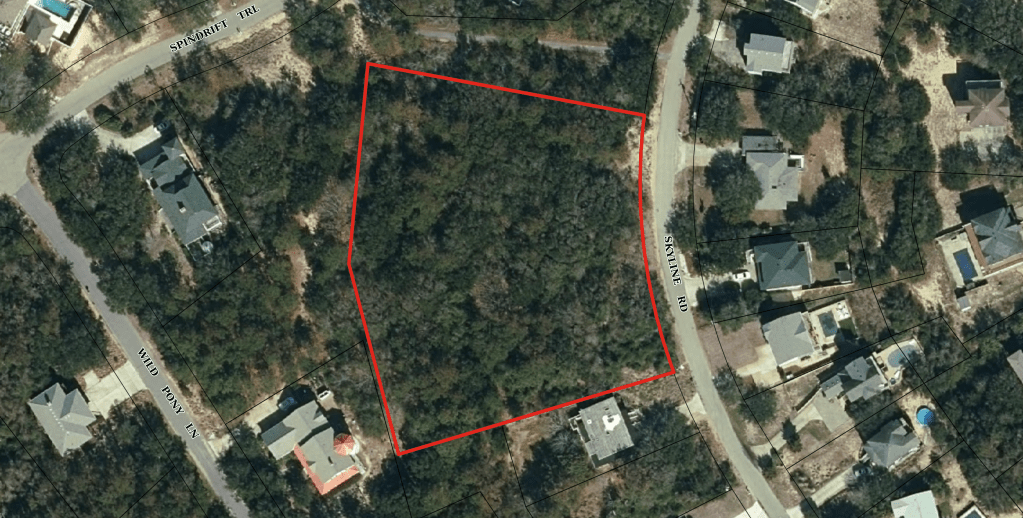
A 2022 Town decision regarding the division into four smaller parcels of the large outlined land tract (above) on Skyline Road prompted the Town Council to ask for a rewrite of Town Code lot-width ordinances, which has yet to be successful.
The Southern Shores Planning Board is stymied.
After nearly a year of trying—albeit with months of interruptions spent on other pressing business (think SAGA)—the Board cannot decide how to measure a lot to determine its width.
Question:Where on a lot do you take a width measurement?
At its most recent meeting March 18, the Board discussed yet again this seemingly simple calculation. And yet again, the Board failed to resolve it, sending the latest Zoning Text Amendment (ZTA) on lot width back to the Town staff for another go-round.
This makes four times, by our count, that the Board has shrugged its collective shoulders.
The hour-and-twenty-minutes consumed two weeks ago by the Planning Board in another discussion about minimum lot width can best be described as bogged down and digressive, albeit earnestly so. Its struggle in reaching a solution seems sincere. Its failure to do so, nonetheless, is perplexing.
(Regular Board member Jan Collins did not attend the meeting; First Alternate Michael Zehner sat in for her, joining the four other regular members.)
How would you measure lot width?
‘A MOVING TARGET’
The Board first took up a lot-width ZTA, designated ZTA 23-01, on April 17, 2023. The ZTA it most recently critiqued is ZTA 23-05. The Board sent a version of a lot-width ZTA back to staff for more work on April 17, May 15, and Dec. 18, 2023, and now March 18, 2024.
On June 6, 2023, the Town Council enacted, by a 3-2 vote, a “stopgap” ZTA 23-03, mandating that all lots created in the residential and government/institutional districts after June 6, must have the required minimum width uniformly from front to back. This Town Code amendment essentially mandated rectangular lots.
Minimum lot widths, which are set forth in the Town Code, vary according to zoning district. In the RS-1 residential district, where most people live, the minimum lot width is 100 feet, the presumption being that most lots are 100 feet-by-200 feet and measure 20,000 square feet in size, another Town Code minimum requirement.
Some Planning Board members brought up eliminating minimum lot width—at least, in the RS-1 district— and trusting that the minimum lot size of 20,000 square feet would preserve the low-density character of Southern Shores neighborhoods.
It is only on newly platted lots—created through recombination or subdivision—that the width measurement is relevant. Many lots exist in Southern Shores now that are not 100 feet wide at any point; they are considered legally permitted nonconformities. The concern is with new lots.
Planning Board Chairperson Andy Ward colorfully described lot width at the meeting as “a moving target.”
“You’ve got to hit 100 feet somewhere on [a] lot, moving front to back,” said Mr. Ward, who argued strongly in favor of maintaining the minimum 100-foot width, which “has always been there.” We believe most longtime homeowners in Southern Shores would agree.
“You’ve got to hit 100 feet at some point on a newly subdivided lot,” he continued, without, unfortunately, suggesting where. How about in the middle?
Perhaps, Deputy Town Manager/Planning Director Wes Haskett offered, you could require a lot “to maintain 100 feet after it gets to that point,” going from front to back—whatever that point may be. This would account for cul-de-sac lots that are shaped like pieces of a pie and have concerned the Board quite a bit in its deliberations.
By the time Mr. Haskett polled the Board on a few questions relevant to his path forward in drafting another revised Zoning Text Amendment (23-06?)—including whether a lot must be 100 feet wide “at some point”—two members were asking what the “objective” and “goal” of the ZTA currently before them was.
Have they forgotten the context? Or has the context become obscure and/or irrelevant with all of the revisions?
We will refresh their memories, and yours, and risk getting bogged down, too.
CONTEXT: THE RECOMBINATION THAT EXPOSED AMBIGUITY
On April 20, 2023, we laid out the original context in a report of the Planning Board’s April 17, 2023 meeting that was headlined “Planning Board Grapples With Proposed Revision of Lot Width Requirement; Town Seeks to Eliminate Ambiguity.”
As we explained then, the Town Council requested a ZTA amending the Town Code’s lot-width ordinances after it reversed an October 2022 decision by the Board of Adjustment against property owners who sought to recombine an 80,000-square-foot tract land at 55 Skyline Road into four smaller buildable parcels. (See photo above.)
Operating as Skyline Oaks Properties LC (“Skyline Oaks”), the property owners wanted to situate two of their proposed new smaller lots behind the other two, so that the rear two would not front on Skyline Road. Mr. Haskett turned them down.
Although each of the new lots would measure 100 feet in width, their configuration persuaded Mr. Haskett, serving in his capacity as Zoning Administrator, to deny approval of Skyline Oaks’ recombination plat because it would create nonconforming lots in violation of the lot-width requirement in the RS-1 residential district.
(See The Beacon, 10/1/22, for even more background.)
In reaching his decision, Mr. Haskett applied the then-current language in sec. 36-57 of the Town Code, defining “lot width” as “the width of a lot at a required building setback line measured at right angles to depth” and “building setback line” as a line that is “parallel to or concentric with the street right-of-way establishing the minimum allowable distance between such right of way and the nearest portion of any building.”
Then-Town Code sec. 36-202(d)(2) specified that the 100-foot minimum lot width in the RS-1 district was to be “measured at the building setback line.”
(We appreciate the difficulty in interpreting the Code, but for reasons we do not understand, the word “minimum” was read differently by BOA members and by the Town and the property owners.)
In a written decision, Mr. Haskett explained how he interpreted the applicable ordinances and calculated the 100-foot width: “[A]ll of the proposed lots,” he wrote, “should have a minimum width of 100 feet measured at a line that is parallel to and 25 feet from the current right-of-way, Skyline Rd.”
He essentially equated the “building setback line” with the front setback line, which is 25 feet from the street. The building setback line, therefore, was the same as the lot-width line, or the “point” that Mr. Ward was trying to identify at the Board’s latest meeting.
The Board of Adjustment is a quasi-judicial body comprised of the same five members who sit on the Planning Board. Among its functions, the BOA hears appeals by property owners from administrative decisions by the Town, such as the denial of Skyline Oaks’ recombination.
After a hearing on the merits, the Board agreed, 3-2, with Mr. Haskett’s interpretation of the ordinances, and the property owners appealed the decision to the Superior Court of Dare County.
The Town Council subsequently (and quickly) intervened to enter into a consent decree with Skyline Oaks, resolving the matter in the property owners’ favor. The Council overruled Mr. Haskett’s interpretation and tasked him with clearing up the ambiguities in the Town Code ordinances pertaining to lot width.
FIRST ATTEMPT AT ELIMINATING AMBIGUITY
In the Town-submitted first proposed draft of ZTA 23-03, the meaning/definition of lot width was changed to “minimum horizontal distance between the side lot lines of a lot measured from the front lot line at right angles to the rear lot” and the RS-1 requirement was changed to “100 feet (measured from the front lot line at right angles to the rear lot line).”
(The new language used for the RS-1 minimum width was repeated in the other relevant Code sections on residential districts RS-8, RS-10, and R-1 and the GI district. This has been the case all along.)
We understand why the Planning Board rejected this language on April 17, 2023 and asked Mr. Haskett to revisit it. It is cumbersome and does not allow for irregularities, such as the cul-de-sac example. We were disappointed, however, that the Board did not propose alternate language, although it was aware of and considered other definitions.
This is not a wheel that needs reinventing. The American Legal Publishing, e.g., whose attorneys and editors have been assisting municipalities with ordinance codification for nearly 90 years, has posted a serviceable definition of lot width online. We quote it below.
SECOND ATTEMPT AT ELIMINATING AMBIGUITY
In the second proposed draft of ZTA 23-03, the definition of lot width was changed to “horizontal distance between the side lot lines of a lot,” and the RS-1 requirement was changed to “100 feet (measured at the front lot line).”
Needless to say, the Planning Board asked for another do-over, expressing a continued concern for cul-de-sac lots and other irregular-shaped lots.
THIRD ATTEMPT: A STOPGAP WRITTEN BY THE TOWN ATTORNEY
The draft of ZTA 23-03 approved by the Town Council on June 6, 2023, returned to the earlier language, specifying that “lot width means minimum horizontal distance between the side lot lines of a lot measured from the front lot line at right angles to the rear lot line,” and the calculation of width “for all lots created after June 6, 2023,” in the RS-1 district would be100 feet “measured from the front lot line at right angles to the rear lot line.”
Rectangles are in; irregular lots are out.
LATEST ATTEMPT, ZTA 23-05
Two weeks ago, the Planning Board considered this language:
“Lot width” means the “width of a lot at the required building setback line measured at right angles to the rear lot line.”
“Building setback line” means “a line parallel to or concentric with the front lot line establishing the allowable distance between the front lot line and the nearest portion of any building … [etc.]”
The word “minimum,” modifying “allowable distance,” was deleted.
ZTA 23-05’s language about minimum lot width in RS-1 reverts to the pre-June 6, 2023 language, specifying 100 feet “(measured at the building setback line).”
The new proposed language also states that for “lots that front a cul-de-sac, the building setback line shall be established 25 feet from the front lot line, or the point where the lot is 100 feet wide, whichever distance is closer to the front lot line,” and “for all other lots, the building setback line shall be established 25 feet from the front lot line.”
Before reaching this revision, Mr. Haskett proposed in an earlier draft, considered Dec. 18, 2023 by the Planning Board, that the building setback line on a lot that fronts a cul-de-sac could be established up to 80 feet from the front lot line. The Board rejected this suggestion.
Have you/we bogged down yet? No?
What about ambiguity? Has it been eliminated, as the Town Council requested?
It’s not surprising that the Planning Board bogged down with this new emphasis on “building setback line,” spending too much time on the difference between the building setback line and the “lot-width line,” a term that Mr. Haskett suggested invoking, but which has not been created yet.
The building setback line relates to where on a lot a structure may be built in relation to the front lot line. As Board members pointed out, repeatedly, it should not be used in defining lot width.
GOING FORWARD WITH ANOTHER ZTA
The American Legal Publishing offers the following definitions:
LOT WIDTH: “is the horizontal distance between the side lot lines, measured at right angles to the lot depth at a point midway between the front and rear lot lines.”
LOT DEPTH: “is measured along an imaginary straight line drawn from the midpoint of the front property line of the front property line of the lot to the midpoint of the rear property line.”
If depth runs vertically and width runs horizontally, a right angle can be achieved and measured.
What these definitions do is put the lot width measurement at the midway depth point between the front and rear lot lines.
Whatever the Planning Board—and the Town Council, in time—decide to do about defining lot width, we strongly recommend that they streamline the applicable ordinances so that lot width is only defined in sec. 36-57, and the width requirements in the ordinances for each zoning district refer only to the minimum number of feet.
Thus, if you consulted Code sec. 36-202(d)(2), you would learn that the minimum lot width is 100 feet, but you would have to read the definition of lot width in sec. 36-57 to learn how the 100 feet are measured. A referral to sec. 36-57 could be inserted next to the lot width requirement for each zoning district.
All the Planning Board has to do is pick its point or points on a lot for measuring horizontal distance—stop its targets from moving—and be fair about its choices.
We are of the mind that the minimum lot widths in the various districts should be maintained.
To be continued.
AND A WORD ABOUT ZTA 24-02 AND TREE REMOVAL
After the Planning Board voted unanimously not to approve ZTA 23-03, it shifted into a discussion about ZTA 24-02, which requires a commercial property owner to get a lot disturbance-stormwater management permit from the Town before removing from an unimproved lot any trees that are greater than 6 inches in diameter, 4.5 feet above the ground, and within a front, side, or rear yard setback area.
The proposed ZTA, which amends Code section 36-171, makes such tree removal without a permit an offense that is punishable by a civil penalty.
The rub with this ZTA, as we noted in our 3/16/24 preview of the Planning Board’s meeting, is that it is what we termed a “watered-down” version of an earlier version of the measure that imposed this permit requirement on property owners in all zoning districts. We viewed the original ZTA as a tool to prevent stormwater runoff in town, which is a major problem.
The earlier version also did not restrict the location of the trees to what Mr. Haskett referred to as “buffer” areas. It applied to trees throughout an unimproved lot.
Mr. Haskett announced at the Board’s February meeting that “the Town” was withdrawing the earlier version, which was part of ZTA 24-01, and redrafting it in a separate zoning text amendment. He gave no reason for the revision.
The Town Council reportedly passed ZTA 24-01, with a few revisions, at its March 12 meeting. One of its parts amends the Town Code to mandate 20-foot buffers between mixed-use group developments and commercial zoning, whenever they abut a residential district or a planned unit development, such as the Southern Shores Landing.
So what exactly does the new ZTA 24-02 do that the newly enacted ZTA 24-01 has not already done?
Chairperson Ward asked Mr. Haskett several times why “residential tree removal [was] pulled out” of the ZTA and never received a satisfactory response. He also said several times that he wanted to see the residential districts covered by the ZTA, and a majority of the Board appeared to agree with him.
Here’s our rub: Neither Mr. Ward nor any other Planning Board member made a motion to amend ZTA 24-02 by changing the text to include residential districts. It would have been a simple matter of deleting five words. Members seemed to believe either that they couldn’t do that—which they can—or that if they were to do that, they would deprive the public of “notice.”
In our next blog, we will explore the Board’s decision to put the residential districts on “the backburner,” as Mr. Ward said.
After spending an hour criticizing the ZTA, as presented, the Board recommended its approval, by a 4-1 vote, with the Chairperson casting the only dissenting vote.
Upon suggestion by Mr. Haskett, the Board also recommended to the Town Council, by consensus, that it authorize the draft of another ZTA that would include residential districts.
The Town Council will hold a public hearing on ZTA 24-02 at its April 9 meeting.
Town offices will be closed tomorrow in observance of Good Friday, which is a holiday in North Carolina and nine other states, but not a federal holiday.
Recycling will be picked up in Southern Shores tomorrow, and banks, which observe a federal holiday schedule, generally will be open, but Dare County schools, offices, and other facilities, and State offices, such as those serving the N.C. Dept. of Motor Vehicles, will be closed.
U.S. mail service will not be affected by the State holiday.
(According to our online research, Connecticut, Delaware, Hawaii, Indiana, Kentucky, Louisiana, New Jersey, North Dakota, and Tennessee are the other nine states that observe Good Friday as a state holiday. Texas has designated the day as an “optional” holiday.)
**
REMINDER: THE SPRING LARGE-ITEM COLLECTION IS FRIDAY, APRIL 12. Approved items should be placed on the roadside by April 11, but not before April 5.
Among the excluded items that we often see out for pickup are televisions, building materials, roofing, doors, screens, windows, toilets, carpets, rugs, and basketball goals.
Furniture, mattresses, exercise equipment, appliances that do not contain freon, and properly bagged vegetative debris are acceptable. See the link above for a list of do’s and don’ts.
The Town has already announced that the fall large-item pickup will be Friday, Oct. 18.
**
THE TOWN COUNCIL NEXT MEETS ON TUESDAY, APRIL 9, NOT ON THE FIRST TUESDAY OF THE MONTH. The Beacon will publicize its agenda when it is posted online.
**
Be on the lookout for increased traffic this weekend. We can expect a sunny weekend with mild temperatures after today’s storm system exits our area.
In our blog post of March 21 about the Chicahauk Property Owners Assn.’s enforcement of a covenant violation, we misstated the law vis-à-vis town ordinance. Local laws generally supersede homeowners association rules, but HOA rules may be more restrictive.
We regret any confusion this misstatement may have created.
We also should have elaborated upon the House Bill in the N.C. General Assembly that seeks to require municipalities to allow one accessory dwelling unit per single-family residence.
H.B. 409, which was overwhelmingly passed last year in the N.C. House of Representatives, but has stalled in a Senate committee, has exceptions for homeowners associations’ restrictive covenants and historic properties. It seemingly would not affect Chicahauk.
We have edited the March 21 blog to reflect these updates. Our haste to publish during a busy time last week created errors for which we apologize.
We trust the CPOA Board of Directors will make an effort to resolve covenant violations involving accessory dwelling units without holding adversarial hearings and imposing fines. Accessory dwellings have been allowed to be built and to be rented in Chicahauk, and homeowners have come to rely upon the income that their rental provides. We hope that fairness prevails for all parties, in light of the circumstances, and that all divisiveness can be resolved.
The annual meeting of the Board of Directors of the Chicahauk Property Owners Assn. (CPOA) will be held tomorrow (Saturday) at 10 a.m. in the Pitts Center.
In light of recent legal action taken by the Board to enforce a CPOA covenant that prohibits both the building of guest houses and other accessory dwelling units on lots and their rental, we note that Town Manager Cliff Ogburn will be attending this meeting. Chicahauk residents may wish to invite Mayor Elizabeth Morey to attend, as well.
A recent letter to Chicahauk residents from an attorney representing the Chicahauk Property Owners Assn. (CPOA) informing them that CPOA will be levying stiff fines against owners who use their property for other than “single-family residential purposes” has the social media site Next Door abuzz today with confusion, anger, suspicion, and a lot of concern.
The March 13 letter, written by attorney Louis J. “John” Hallow, III of Hornthal, Riley, Ellis & Maland—the same law firm that represents the Town of Southern Shores—puts CPOA members on notice that after March 31, CPOA will begin imposing fines of $100 per day for violations of a protective covenant that prohibits the erection or placement of “guest houses and/or suites or ancillary or accessory structures” on a lot in the subdivision, without prior written approval.
The letter, a copy of which The Beacon obtained, quotes from Article III, Section 1, “Residential Use,” of the CPOA’s Amended Declaration and Restatement of Protective Covenants and Conditions, for the restriction that:
“Only one single family residence may be placed on and [sic] lot, and duplexes or multiple family houses are expressly prohibited. No guest house and/or suites ancillary or accessory structures may be leased, rented or sold separately from the main residence.”
So Chicahauk homeowners can neither build guest houses, suites, or accessory structures, nor rent such structures—if they do indeed build them. The current version of these restrictions dates back to 2010, which is the last time the CPOA covenants were revised.
Although in this age of Airbnb rentals, homeowners are increasingly renting out rooms, suites, and other accommodations in their primary residences, the language of the CPOA covenant clearly applies to what are customarily called accessory dwelling units (ADU), not to rental spaces within homes.
ADUs are commonly understood to include guest houses, granny flats, in-law units, cottages, apartments above detached garages, and other secondary dwellings that share the same building lot as a larger, primary home, but not the same structure. They may be attached to a house or garage or stand alone. They may be rented by the homeowner, but they cannot be bought or sold separately.
To put the CPOA covenant into a larger context:
**The Town of Southern Shores does not permit accessory dwelling units, except those that are temporary family health care structures, which, e.g., an elderly parent or his/her caregiver may occupy (See Town Code sec. 36-168(5).)
The Town, however, does allow “accessory structures with living space” in all of the zoning districts except for the RS-10 residential district, Deputy Town Manager/Planning Director Wes Haskett confirmed with us today. RS-10 is the high-density residential district, such as where Pelican Watch is located.
We have always found this distinction between ADUs and “accessory structures with living space” to be confusing.
“From a zoning perspective,” Mr. Haskett explains, “someone can live in an accessory structure with living space, and they can be rented, but it can’t have all of the elements that make up a dwelling unit.”
This has meant in the past that accessory structures in Southern Shores cannot have ovens and other cooking appliances. A hot plate is all right, but we think microwaves are forbidden. (To be verified later.)
**TheNorth Carolina State Legislature may be on the verge of passing a bill that would require all local governments to allow the development of at least one accessory dwelling unit for each single-family detached dwelling. The N.C. House passed the bill, H.B. 409, last year. The Senate equivalent, S.B. 374, passed a first reading in the N.C. Senate in 2023, but it has stalled in committee. (The General Assembly’s sessions last two years; the 2023-24 session ends July 31.)
This pro-builder state legislation has bipartisan sponsorship and is touted politically as a means to provide affordable housing. The Town of Southern Shores Planning Board and Town staff are well aware of H.B. 409/S.B. 374, but Mr. Haskett could not tell us more than we already know.
H.B. 409, which critics claim would undesirably increase real estate density and congestion, has exceptions for HOA restrictive covenants and historic properties.
Southern Shores Town Code section 36-94 provides that only one “principal building” and its “customary accessory building” may be erected on a lot in town, except as otherwise authorized, such as with the temporary family health care structure.
A “customary accessory building,” according to Code section 36-202(b)(2), which applies to the RS-1 single-family residential district where most homeowners live, includes, but is not limited to, swimming pools, tennis courts, and garages, “provided no dwelling unit is located in the accessory structure.”
Got it? We honestly don’t. How many violations regarding accessory structures do you think exist now—or have occurred—in Southern Shores, outside of Chicahauk? Guest houses, sometimes used as quarters for domestic employees, were once common on the oceanfront lots that front on Ocean Blvd. How many exist today?
LONG-STANDING TENSION AMONG HOMEOWNERS
The Beacon is aware that there has been tension between individual homeowners, including some CPOA Board of Directors members, about ADU rentals in Chicahauk, as well as Airbnb rentals in people’s homes. We do not know the specifics, but we do know that such tension is not exclusive within the town to just the Chicahauk subdivision.
We have heard the Town Planning Board grapple with how to regulate ADUs, assuming that the N.C. legislature will open the floodgates, and can attest that members generally do not view them favorably.
According to Mr. Hallow’s letter, the CPOA Board of Directors notified Association members last September by letter that it would begin imposing fines for violations of the “Residential Use” covenant. Unaware of this, we wrote on Dec. 11-12 about a CPOA meeting to discuss a review of the covenants and bylaws and the drafting of a membership survey.
We spoke then to CPOA president, David Stager, who told us that the purpose of the meeting was to “gather” questions for a survey to be sent to CPOA members regarding whether to “change or adjust” Association covenants.
Judging by the comments on Next Door today, we conclude that no such survey was done.
“A board operating from less of a dictatorship, one who genuinely wants to have a FAIR CONVERSATION would benefit us all,” Kiirsten Farr of Chicahauk Trail writes in a lengthy Next Door post that summarizes many of the objections to the new enforcement action taken by the CPOA Board of Directors.
“The drama and unnecessary tension amongst community members this is causing when we’ve had such a dream sense of community for decades,” she continues, “is incomprehensible.”
Writes Dan Lester of Trinitie Trail: “My problem here is that one person had an issue and now it has consumed money and a lot of stress for people. Before making it a legal problem, the process should have been to evaluate whether it was time to make an adjustment to the covenants.”
Judd Snapp of Spindrift Trail acknowledges on Next Door that “our property unfortunately started all of this.” He describes how he and his wife went to “great lengths” to save trees on their lot and to design a house that they believed captures the “Outer Banks look and feel.”
Mr. Snapp’s objection to clear-cutting is not shared by all in Chicahauk, however, as he describes in his Next Door post being told by the “current Chicahauk ARB” (Architectural Review Board head) at a meeting that “he has no right to tell new construction owners that they can’t cut down all the trees on [their] lot.”
In fact, section 9 of Article III of the CPOA’s covenants is designed to do just that. It prohibits property owners from disturbing, removing, or destroying existing “vegetation” during construction without first getting express written consent from the CPOA, which can deny them permission.
CPOA’S PROPOSED FINES ARE EXCESSIVE
But the CPOA Board of Directors is not interested in preventing clear-cutting or in preventing other covenant violations. It is focused on rental ADUs and has brought out the heavy fire.
Per Mr. Hallow’s letter, CPOA will begin enforcing violations of this “Residential Use” covenant after March 31: The Board of Directors, the attorney writes, “will properly notice and call a special meeting . . . to hold a hearing to determine whether a violation . . . has occurred, and if so, whether a lot owner should be fined or if planned community privileges or services should be suspended.”
Mr. Hallow cites N.C. statute for the Association’s authority to take this punitive action.
The allegedly “violating lot owner,” he explains, will be given notice and an opportunity to present evidence at the hearing, at the conclusion of which the Board will either announce a decision or defer decision-making to a later date.
Per a decision make by the Board on March 7, Mr. Hallow writes, fines will be $100 per day, for each day the violation continues. This penalty is comparable to what the Town of Southern Shores levies for zoning violations. According to the State statute cited by Mr. Hallow, $100 is the most severe fine the CPOA could impose.
N.C. General Statutes sec. 47F-3-107.1, which is part of the N.C. Planned Community Act, actually states that a homeowners association may impose a fine of up to $100 for “each day more than five days after the decision that the violation occurs.” Mr. Hallow does not qualify the potential fine imposed by the CPOA, and, therefore, it exceeds the penalty authorized by the State act.
The CPOA’s declaration of covenants also does not give notice to members that they may be subject to stiff fines and the suspension of community privileges if they are found to have violated a covenant. It also does not prohibit the CPOA from imposing them.
We agree with those homeowners who believe that the CPOA Board of Directors has gone too far. The CPOA should have made an effort to discuss the underlying issues of its enforcement action and to hire a professional mediator, rather than a lawyer, to resolve community conflicts. Cooler heads should have prevailed with reasoned problem-solving. Pitting neighbor against neighbor is never a good approach.
The most recent version of the CPOA covenants is nearly 15 years old now and reflects rule-making decisions made decades ago. Radical changes in technology, in market value of Outer Banks property, in the U.S. and the local economies, and in contemporary lifestyles and personal needs, to name just a few variables, have occurred since 2010, and homeowners associations’ governing rules have to keep pace. In updating covenants, CPOA leaders must listen to the many voices in the community, not just to the voices that they want to hear.
Where was the CPOA Board when accessory dwellings were built many years ago? Why has it allowed these dwellings to be built and rented and failed to enforce the covenant?
We also question why one of the Town’s attorneys is involved in this community dispute. The CPOA and the Town are separate entities, with differing interests. If, in fact, Chicahauk homeowners are paying Dare County occupancy taxes on their accessory rentals, the Town of Southern Shores is benefiting.
It is well-established law that local laws supersede homeowners associations’ rules and regulations, but HOA rules may be more restrictive. As noted above, the Town Code allows accessory structures with living space as long as they are not dwelling units. They also may be rented.
We trust the conversation that began on Next Door today will continue and will grow to include the entire community of Southern Shores.
Residents of Southern Shores Landing spoke in opposition yesterday to a doubling of their monthly sewage costs, as requested by the SAGA Realty & Construction subsidiary that operates their wastewater treatment plant, at a consumers’ hearing held in Manteo before an examiner for the N.C. Utilities Commission (NCUC).
The Outer Banks Voice covered the hearing, which it reports was held at the Dare County Courthouse before NCUC examiner Anne Winstead, identified as a public utilities regulatory analyst on the Commission’s website. We refer you to a news article by Kip Tapp about the hearing in today’s Voice and thank him for his coverage.
A full hearing on the rate increase requested by subsidiary GWWTP, LLC, whose acronym stands for Ginguite Woods Wastewater Treatment Plant, will be held in Raleigh on May 7, according to The Voice.
A GWWTP representative reportedly testified before Ms. Winstead in a hearing on March 11.
GWWTP, which was appointed in January as the emergency operator of the Ginguite Woods treatment plant, has proposed a rate increase of $90 per month—from $90 to $180 per month—according to an order by the Commission that approves the increase on a provisional basis.
The rate requested is based on a “single family equivalent” (SFE) usage of 360 gallons per day.
In the same order, the NCUC grants a motion by GWWTP to serve as the Ginguite wastewater treatment plant’s emergency operator and discharges Enviro-Tech of N.C., which had been serving that role.
The N.C. Utilities Commission is a state agency that regulates the rates and services of public utilities in North Carolina. The consumer public is represented in rate hearings by a member of the Commission’s Public Staff. Attorney Davia Newell, of the Public Staff, will be representing Southern Shores Landing residents as their public advocate.
Ms. Newell reportedly attended yesterday’s hearing and visited the Ginguite Woods site.
****
JUST ANNOUNCED: The Town of Southern Shores’ springtime large-item collection will be Friday, April 12.
The Southern Shores Planning Board will take up a strikingly altered version of a tree-removal ordinance that was proposed, then withdrawn and redrafted, by the Town, and consider the Town’s latest wording about minimum lot-width measurements for all residential districts, at its regular meeting Monday, to be held at 5 p.m. in the Pitts Center.
The meeting will be live-streamed on the Town’s You Tube website.
Originally included in ZTA 24-01, which, according to Deputy Town Manager/Planning Director Wes Haskett’s meeting report to the Planning Board, was approved, with revisions, by the Town Council at its March 12 meeting, ZTA 24-02 now applies only to the commercial district and not to any Southern Shores residential districts. It also applies only to trees in setback zones.
(Regretfully, we have not had an opportunity yet to review the March 12 meeting videotape, except for its end, which we checked to learn who was appointed to the Planning Board. See below.)
The now independent and revised ZTA 24-02 proposes amending Town Code sec. 36-171, which concerns lot disturbance and stormwater management (“LDSM”), to require a landowner to obtain an LDSM permit in order to remove trees greater than 6 inches in diameter that are measured at 4.5 feet above the ground and are within a front-, side-, or rear-yard setback “on any unimproved lot in the general commercial zoning district.”
These are significant changes from ZTA 24-01, which required permits for such tree removal on “any” unimproved lot, not just commercial lots, and covered tree removals from any location on a lot.
(See The Beacon, 2/18/24, for our reporting on the original ordinance.)
Question: Who is responsible for watering down a proposed change that we viewed as good stewardship and community protection by the Town?
Answer: Clearly someone who has authority over the Town staff.
If the point of the newly required permit is to guard against stormwater runoff into adjacent properties and roadways caused by the removal of old-growth trees, then ZTA 24-02 should address all unimproved lots, not just those in the commercial district. We urge the Planning Board to take that position under consideration.
The Beacon would go a step further and impose a permit requirement for such tree removal on all lots, regardless of whether they are improved or not.
Increasingly, we see new homeowners taking down large trees soon after they move in.
Stormwater runoff is a major hazard in Southern Shores, and causing it is not an “individual property right.” The Town owes it to the community to guard against runoff, when it has the means to do so.
ZTA 24-02 provides civil penalties for a commercial property owner’s failure to obtain a permit to remove trees greater than 6 inches in diameter measured at 4.5 feet above ground in a yard- setback space. It proposes that each tree removed in violation be viewed as a separate offense and requires the Town to issue a warning citation to an offender before taking enforcement action.
The offender has 30 days after receiving the warning to “abate” the violation by replacing the removed tree with a tree “similar in size.” If this is not done, the ZTA proposes that the Town may fine the offender, as outlined in Town Code sec. 1-6(d), which imposes a civil penalty of up to $500 for each violation, and establishes that each day that a violation exists is another violation.
LOT WIDTH ZTA
The minimum lot width required by the Town Code varies according to the zoning district. It is 100 feet in the RS-1 single family residential district and the R-1 low-density residential district; 75 feet in the RS-8 multifamily residential district and the RS-10 residential district; and 50 feet in the government and institutional district.
Question: At what point—i.e., where—on a lot is width measured?
The Town staff tried a year ago to make the answer to this question less ambiguous in the Town Code than it was. This turned out to be a difficult task that was not achieved.
On June 6, 2023, the Town Council voted 3-2 to enact a stopgap ordinance on minimum lot width that had the effect of requiring all lots created after June 6 to be rectangular, i.e., uniform in width throughout, while the staff continued to work on a revision. The stopgap meant that a conforming lot on a cul-de-sac could not be created.
The two dissenting Council members were Mayor Pro Team Matt Neal, who wanted to resolve definitional difficulties last year and not delay, and Councilwoman Paula Sherlock, who supported him.
ZTA 23-05 proposes new definitions for “building setback line,” a demarcation that has been used to determine the point at which width is to be measured on a lot, and “lot width,” amending Town Code section 36-57.
The proposed definition in ZTA 23-05 for building setback line is the “line parallel to or concentric with the front lot line establishing the allowable distance between the front lot line and the nearest portion of any building, [etc.].”
In the RS-1 district, where most of us live, for example, the Code provides that the minimum width of all lots is 100 feet “measured at the building setback line.”
For those lots that front on a cul-de-sac, ZTA 23-05 proposes that the building setback line is “25 feet from the front lot line, or the point where the lot is 100 feet wide, whichever distance is closer to the front lot line.”
For all other lots, ZTA 23-05 proposes that the building setback line is “25 feet from the front lot line.”
This same language is repeated in the width requirements for the other districts mentioned above.
Is it unambiguous? Is it reasonable?
Does it help to know that the Town Code defines the front lot line as “the line separating said lot from that street which is designated as the front street on the building permit, certificate of occupancy, or subdivision plat”?
We leave it to the Planning Board to sort out the ZTA and decide.
Regretfully, again, we are unable to cover the Planning Board’s deliberations at its Monday meeting. We will try to catch up with zoning issues before the Town Council’s April meeting, which is April 9.
CHARLIE RIES JOINS PLANNING BOARD
The Town Council unanimously approved Charlie Ries’s appointment to the Planning Board as the Board’s Second Alternate.
Current Second Alternate Michael Zehner will move up to the First Alternate position, from which Dan Fink recently resigned, thereby creating the vacancy.
Mr. Fink’s appointment was set to expire June 30, 2024.
The Town had two applicants for the alternate position: Mr. Ries and Richard W. Filling.
Before nominating Mr. Ries for the appointment, Mayor Elizabeth Morey, who said she met with both applicants, borrowed a phrase from Planning Board Chairperson Andy Ward in describing them both as “totally over-qualified.”
According to his application, Mr. Ries spent three decades in U.S. diplomatic service, concentrating on economic affairs and Europe. After leaving the State Department, he joined RAND Corporation as a Senior Fellow and went on to serve eight years as Vice President, International, overseeing the non-profit global research organization’s three international offices.
Mr. Ries’s appointment takes effect immediately and runs through June 30, 2027. He lives on South Dogwood Trail.
Mr. Filling is an engineer who had a 30-year career with Baltimore Gas & Electric, during which he acquired extensive experience in land development and zoning projects, according to his application. He had a second career as a home improvement contractor and finish carpenter. Mr. Filling has been active with Better Beaches, N.E.S.T., and the SSVFD. He lives in Chicahauk.
Contractor Kimley-Horn will formally present the design for the structure that will replace the Juniper Trinitie Culvert Bridge to the Southern Shores Town Council at its regular meeting next Tuesday, at 5:30 p.m. in the Pitts Center.
Town Manager Cliff Ogburn, who has kept the Town Council up to date on Kimley-Horn’s progress, previously announced at a Council meeting that construction of the bridge replacement will likely start in November.
Also featured on the Town Council’s meeting agenda are:
A public hearing on, and the Council’s consideration of, Zoning Text Amendment 24-01, which received unanimous approval from the Planning Board last month, subject to wording changes it suggested (See The Beacon, 2/18/24, 2/23/24);
The Council’s consideration of a Town resolution to oppose the release of “helium or lighter-than-air balloons into the atmosphere” within the limits of Southern Shores, an environmental concern that has been championed by Chicahauk homeowner Debbie Swick;
The appointment of one of two highly qualified candidates to fill the vacancy on the Planning Board for a second Alternate, and the reappointment of Wanda Brett-Jordan as an Alternate on the Southern Shores Historic Landmarks Commission;
An update on the previously approved 101-square-foot addition to the Town Planning and Code Enforcement Dept.’s file room and the possible scanning of documents stored in the file room for digital preservation;
A planning discussion led by Town Manager Ogburn about the Town’s FY 2024-25 budget;
February reports by the Deputy Town Manager/Planning Director, the Police Chief, and the Fire Chief; and
Recognition of Eagle Scout Austin Bellinger for the Town Hall Little Free Library.
As usual, there will be two public-comment periods during the meeting.
You may live-stream the meeting at https://www.youtube.com/@SouthernShores/streams. If you choose to view the meeting on You Tube video, after it is over, be sure to click the “Live” link in the menu at the top of the page.
The Town has received the approval of the U.S. Coast Guard to lower the culvert bridge on Juniper/Trinitie trail when it is replaced by a cored slab bridge—thus, reducing the opening of the structure—in order to improve the lines of sight of drivers who cross it.
Kimley-Horn has signed two contracts with the Town, one of which covers project tasks that were not dependent on the Coast Guard’s response and the other of which covers tasks that were. The Raleigh-based engineering firm has been working on the pre-Coast Guard tasks. The total cost of the bridge replacement is expected to be about $434,500, according to Mr. Ogburn.
Mr. Ogburn has given a tentative starting date of November for construction of the replacement bridge and a completion date of Summer 2025. He also has said that the bridge potentially could be closed for six months.
We would like to thank Ms. Swick for her dedicated efforts to rid the coastal environment of contamination by Mylar and latex balloons, which, when deflated, pollute the land and waters and pose a serious hazard to the lives and health of animals, birds, and fish.
Proposed Town Resolution 2024-03-02 states that such balloons “represent the most common form of floating garbage and flotsam within 200 miles of the shore” and that their effect on “marine life is incalculable at the present time,” although research indicates that marine life and animals ingest the balloons when they appear on the surface of waters.
We also would like to thank Ms. Brett-Jordan for serving as an Alternate on the Historic Landmarks Commission for the past three years and for volunteering to serve another three-year term in that position, and Charlie Ries of South Dogwood Trail and Richard W. Filling of Crooked Back Loop for volunteering to serve on the Town Planning Board.
Although the position open on the Planning Board is that of First Alternate, Planning Director Wes Haskett has suggested in a report to the Council that it name the new appointee to be Second Alternate and promote the current Second Alternate, Michael Zehner, to the First Alternate’s position.
The Town Council usually observes seniority in its alternate appointments, such that the promotion of Mr. Zehner should be pro forma.
The Beacon will be unable to cover Tuesday’s meeting. We will watch Kimley-Horn’s presentation as soon as we can and report on those details that we believe would be of most benefit and use to residents, especially those residents who live in Chicahauk.
Don’t forget: Daylight Savings Time starts this weekend. We’re springing forward again.






 The Southern Shores Beacon