Current Town Council members Matt Neal and Mark Batenic, whose terms expire in December, filed their notices of candidacy yesterday, the first day of the Dare County municipal elections’ two-week candidate filing period. Election Day is Nov. 7.
Southern Shores voters will be electing three people to serve new four-year terms on the Town Council. Besides the seats held by Mr. Batenic and Mr. Neal, who also serves as mayor pro tem, the seat currently held by Councilman Leo Holland will be turning over.
Mr. Neal won his term on the Town Council in the contested 2019 municipal election. Mr. Holland was elected at the same time.
The Town Council appointed Mr. Batenic in January 2022 to serve out the two years remaining on Elizabeth Morey’s Town Council term, after she was elected mayor in November 2021. (Hence, the parentheses in our headline: Only Mr. Neal is seeking re-election.)
To run for town office, a candidate must have lived in the municipality for at least 30 days, be registered to vote in that municipality, and be at least 21 years old by the date of the election.
We hope that Southern Shores voters will have multiple candidates from whom to choose, and that the election results in a diversity of opinion on the Town Council that we have not had in the past two years.
The Town Council will meet Tuesday at 5:30 p.m. in the Pitts Center for what appears from the agenda to be a short business session. You may access the agenda and the meeting packet here:
The cut-thru traffic last weekend was heavy, and the traffic already today seems to be just as oppressive, but there is no indication from the Council’s meeting agenda that it will revisit the problem.
Please feel free to comment here on the traffic, if you’d like.
And as a final note: You may have noticed that speed bumps, not humps, have been installed in front of the Food Lion at the Southern Shores Marketplace. Bumps are designed to slow traffic down to 5 mph or less—which should be the speed in a parking lot—and, as we noted on 6/29/23, are not appropriate for residential streets.
A speed hump on a residential street. (Photo courtesy of the FHWA.)
(As promised on 6/21/23.)
Police Chief David Kole admitted at the beginning of his talk on speed bumps/humps at the Town Council’s June 20 morning workshop meeting that he is “not a big fan” of such traffic-calming devices, and he expected to face an “uphill battle” in his research about their use on residential streets in Southern Shores. To his surprise, however, he discovered that “the majority of the data that I found discourages speed bumps.”
It was at this point, about 20 seconds into the Chief’s talk, that we believe he went wrong, and not just because he admitted to a bias that should have disqualified him from doing the Google research on bumps and humps that he did.
No, he went wrong because he focused on speed bumps, not humps, and he obscured the significant differences between the two throughout his talk. We now know this because we’ve done our Google research.
If the Town Council, which took no action last week, truly wants to respond to residents’ concerns about speeding—concerns that prompted the Chief’s “research”—it needs to focus on the use of speed humps on certain blocks of certain streets and talk to a traffic engineering expert like the one it previously hired to study the town’s traffic. Speed bumps are not appropriate.
To her credit, Mayor Elizabeth Morey consistently referred during the Council’s half-hour discussion with the Chief to speed humps as the option to consider in Southern Shores, but she was alone in doing so, and she didn’t correct her colleagues, who expressly rejected bumps! Going just by what Chief Kole told them, the other Council members could not know the difference.
Present for the meeting were Councilwoman Paula Sherlock and Councilmen Leo Holland and Mark Batenic, none of whom lives on a street in the soundside woods or dunes on which residents regularly see speeding vehicles throughout the week/year, as well as on cut-thru summer weekends, which was the Council’s focus.
Mayor Pro Tem Matt Neal, who did not attend, lives at the uncongested southern end of a cut-thru street and has attested publicly many times to the speeding he has witnessed. His participation was greatly missed.
BUMPS VS. HUMPS; ABRUPT VS. GRADUAL . . . IT’S IN THE DESIGN
We begin our critique of Chief Kole’s presentation by quoting from an e-primer lesson plan on traffic calming offered by the U.S. Dept. of Transportation’s Federal Highway Admin. (FHWA), about “bumps, humps, and other raised pavement areas.” According to the FHWA, which was one of Chief Kole’s primary sources:
“Although people often gripe about the inconvenience of having to slow down for these devices, they don’t have much choice [when they are present]. Their effectiveness at slowing traffic cannot be disputed. They are sometimes referred to as Silent Policemen.”
The FHWA says that bumps are raised areas “extending transversely across the travel way, generally with a height of three to six inches and a length of one to three feet.”
In contrast, humps “normally have a minimum height of three to four inches and a travel length of approximately 12 feet, although these dimensions may vary.”
Transversely means the bumps and humps extend from one side to the other side of a roadway. Length refers to the width of the bump or hump that a vehicle drives over.
Elsewhere online, we found the FHWA describing speed bumps as more “aggressive” and “abrupt” than speed humps and “generally located in private driveways or parking lots,” not on residential streets.
Speed humps, it notes, are “more gradual, larger in profile [i.e., width], and lower” than speed bumps and typically found on “low-speed roadways,” such as “residential or local streets.”
According to the National Association of City Transportation Officials (NACTO), humps typically reduce speeds to 15 to 20 mph. Speed bumps, it says, generally result in vehicles slowing to 5 mph or less at each bump.
Although Chief Kole acknowledged that humps are a “popular traffic-calming technique,” he only differentiated between humps and bumps by the “raised reflective bar that’s put across the street.” That doesn’t begin to probe how these devices are designed and used, the pros and cons that each presents, and how and whether the preferred hump could be appropriately authorized and installed on speed-happy blocks of Sea Oats Trail, Wax Myrtle Trail, East Dogwood Trail, South Dogwood Trail, Hickory Trail, or another residential road.
The Chief said that these devices must be placed at one-mile intervals in order to be effective. According to the FHWA, the recommended spacing for bumps is 300 to 500 feet; for humps, it’s 300 to 600 feet.
Besides defining the two devices, the FHWA also provides design considerations for each, instructing, for example, that bumps are not conducive to bicycle travel and should be used only in apartment complexes, parking lots, and on private streets and driveways. As for humps, they should be visible at night, adequately marked and alerted with signage for drivers, and not located near driveways—just for starters. A traffic engineer can design and place a speed hump to minimize noise to neighbors.
Many of the “cons” that Chief Kole cited generally to discourage the use of bumps or humps on Southern Shores streets simply don’t hold up to scrutiny when design is considered.
For example, he said that all such raised bars can result in injuries to motorcyclists and bicyclists, and cause damage to vehicles, ruining brakes, shock absorbers, and suspension. This might be true if a cyclist or driver were to speed excessively over an abrupt bump, but the gradual slope of a hump protects against such damage.
According to the NACTO, “Speed humps have evolved from extensive research and testing and have been designed to achieve a specific result on vehicle operations without imposing unreasonable or unacceptable safety risks.” Bumps, however, have been installed “without the benefit of proper engineering study regarding their design and placement,” it says.
Chief Kole also said humps and bumps slow the response time of emergency vehicles, such as fire trucks and ambulances. He cited a study out of Miami (of all places!) that suggested they (again, lumped together, not differentiated) slow such vehicles by 10 seconds.
We have seen three to five seconds cited in NHWA articles as the decline in emergency-vehicle response time in urban settings and think a traffic engineer would be better able to evaluate how the placement of a hump or two on little Wax Myrtle Trail, for example, would affect this time.
Obviously, as the NACTO points out, speed humps should not be used on primary emergency vehicle routes. It is also obvious in Southern Shores that response time varies considerably depending on whether the emergency occurs on a summer weekend or another time of the year.
At a Town Council morning workshop last June, Chief Kole disputed residents’ contentions about speeding on South Dogwood Trail, using language and data similar to what he used last week. (See The Beacon, 6/23/22.)
It is unfortunate that, just like a year ago, the information that the Chief displayed on overhead projection at the June 20 meeting could not be viewed on You Tube because there was no videographer present to zoom in on them. The camera remained stationary throughout the meeting. We live-streamed the meeting; we did not attend it.
We would like to see a written report from the Chief, with citations, posted on the Town website.
PEOPLE’S PERCEPTION OF SPEED IS FLAWED
Putting aside the bump-hump bungle, we turn to what Chief Kole said after he presented his biased research on traffic-calming devices. In short, he said he doesn’t believe speeding is occurring to the extent that residents claim it is. He essentially insulted his public.
“I’m not going to stand here and tell you that cars don’t speed, but . . . they don’t speed like people think they do,” the town’s top law enforcement officer told the Town Council. “The same people who are complaining about the speeds are the same ones who will call the next week and go, ‘What are you going to do? I can’t even get out of my driveway. The cars are bumper-to-bumper.’
“Well, they’re either bumper-to-bumper, or they’re speeding. They can’t be both.”
The Chief said this same thing a year ago, and we wrote then: “We see no inconsistencies in these reports. Clearly, motorists can’t speed when the traffic is at a standstill, but they can, and they do, when the traffic opens up during non-peak hours on the weekends.”
We daresay there’s not a resident on the summer cut-thru route who hasn’t witnessed both speeding and bumper-to-bumper traffic on the same day. Mayor Morey surely knows this. She’s been door-to-door campaigning for two elections and has heard these complaints, just like we have. It happens. Speeding on Southern Shores residential roads is rampant, and it doesn’t matter whether locals or vacationers are doing it.
For the Chief to say, again last week, that “a lot of people’s perception of speed is a lot different than reality” is offensive. Motorists may not be traveling at 50 mph on Wax Myrtle Trail, as the Chief claims a “few squeaky wheels” who contact the police department seem to think, but they are speeding at 35 or 40 mph. It doesn’t take radar to figure that out.
When asked by Mayor Morey what the Chief would recommend, in lieu of speed humps, to curb speeding on Sea Oats Trail or Wax Myrtle Trail on what she called summer “change-out days,” the Chief responded by criticizing pedestrians and bicyclists on the road.
PEOPLE SHOULD GET OFF THE ROAD
“A lot of people don’t even know what side of the road to walk on any more . . .,” he replied, “let alone the bikes, [which don’t observe the rules of the road].”
His suggestion, he continued, was “On a Saturday or Sunday changeover, don’t be riding your bike in the road and be walking with your kids in the road on a Friday or Saturday in the summer.
“In North Carolina, the pedestrian is supposed to, when able,” he continued, “to yield the right of way to the oncoming vehicle, but when we can’t even get people to walk on the right side of the road, they don’t even know the vehicle is coming until it’s too late.”
The Chief is referring to N.C. General Statutes section 20-174, which applies to pedestrians crossing roadways at places other than crosswalks (they must yield to all traffic in the road) and to pedestrians walking on roadways where sidewalks are or are not provided.
He has referred to this right-of-way issue before. We now detail it.
Where sidewalks are provided, it is unlawful in North Carolina for pedestrians to “walk along and upon an adjacent roadway.” They must use the sidewalk. However, where sidewalks are not provided, any pedestrian “walking along and upon a highway shall, when practicable, walk only on the extreme left of the roadway or its shoulder facing traffic which may approach from the opposite direction. Such pedestrian shall yield the right-of-way to approaching traffic.” (NCGS 20-174(d))
“Practicable” is one of those legal words that is subject to differing interpretations, depending on who is spinning the facts.
Notwithstanding this provision, the statute also states that “every driver shall exercise due care to avoid colliding with any pedestrian upon any roadway, and shall give warning by sounding the horn when necessary, and shall exercise proper precaution upon observing any child or any confused or incapacitated person upon a roadway.” (NCGS 20-174(d))
It’s not open season on pedestrians, regardless of whether they walk with or against the traffic.
“I think,” the Chief continued, “a lot of the frustration is not necessarily the speeding. They [i.e., residents] use that because that’s the ‘I got your attention’ word, but I think the biggest complaint is the volume of traffic and I get it. It’s a lot, but I also knew that when I moved to the beach 15 or 16 years ago . . . [This is the ‘What did you expect?’ rationale for police inaction.]
“I would just recommend that if they’re going to walk in the road, they need to yield the right-of-way to the vehicles, and I wouldn’t be out riding my bike” on the road.
‘THERE’S NOT A SPEEDING PROBLEM’
The Mayor tried again to get Chief Kole to address slowing vehicles down, asking “What’s our next best choice” to speed humps?
At last, the Chief mentioned “enforcement,” but quickly observed that “we don’t have enough manpower.”
It is unclear how many officers the Town has available because the Chief, when asked later about the strength of his force, only replied “We’re still down three.” The Mayor and Town Council may know what that “down three” number is, but the public doesn’t. He also mentioned a fourth position that will be vacant another two months because of an employee’s maternity leave.
But even if he had the resources, the Chief wouldn’t need to use them because, he maintained, “The data I have shows there’s not a speeding problem. I’m sorry.”
What data, you ask?
Chief Kole cited “average speed” data “starting Memorial Day weekend,” which, as you may recall, was very congested on the cut-thru route. We don’t believe the data to which he referred last week included subsequent weekends in June, but they may have. He was unclear about that.
In any case, the Chief’s average speeds were: 21 mph, on Hillcrest Drive; 12 mph, on Sea Oats Trail; and 19 mph, in the 200 block of Wax Myrtle Trail. He said that 85 percent of the motorists on Hillcrest Drive during the time frame he was using averaged a speed of 25 mph. On Sea Oats, the 85th percentile was 18 mph, and on Wax Myrtle, it was 25 mph.
We don’t believe average speeds tell the tale: There is no way to know with an average whether a northbound motorist travels on Wax Myrtle or Sea Oats at between 35 mph to 50 mph at noon on a Saturday and a late-arriving motorist travels the same roadway, now congested, at just 5 or 10 mph at 4 p.m. We also would like to know how these averages are computed.
Even the Chief admitted: “I’m not saying that cars aren’t speeding, but I can tell you that the majority of the vehicles aren’t speeding.”
We don’t believe any “squeaky wheel” suggested that the majority of motorists who travel the cut-thru route are speeding. We also don’t believe the speeding problem is just on weekends.
Councilman Holland, who did not attend the June 2022 workshop meeting, asked the Chief to post his average-speed data on the Town website. We haven’t seen anything yet. But it doesn’t matter if all he has to offer are data from one day, or one weekend, out of one year.
USE A LITTLE COMMON SENSE: CHA-CHING!
Having dismissed the speeding issue, the Chief concluded by admonishing residents to “know the rules of the road, walk on the correct side,” and “just use a little common sense.”
He played a variation of the blame-the-victim game, we think.
Councilwoman Sherlock quite reasonably asked the Chief about the use of speed cameras instead of speed bumps or humps. His reply: “Cha-ching!”
Cha-ching! That’s all he had on the subject, except the observation that some states have banned such cameras.
According to our research, North Carolina is not one of them.
How much exactly, Chief Kole, is cha-ching? A dollar figure would be helpful. Certainly, a camera would be simpler to install than a hump.
The cost of speed cameras, and the revenue they might bring in, would be interesting data points to research. Maybe the Town Manager can look into it.
A Five Below store may occupy the space in the Southern Shores Marketplace vacated by the Dollar Tree, Planning Director/Deputy Town Manager Wes Haskett revealed at Monday’s Planning Board meeting when he announced that the potential new business is seeking a variance from the Town’s sign requirements.
Five Below, Inc. is a large U.S. chain of “specialty discount stores that sells products that are less than $5, plus a small assortment of products from $6 to $25,” according to Wikipedia.
Founded in Philadelphia, Five Below sells a wide variety of merchandise—from room décor to toys and games to tech and beauty products to clothes, shoes, and fashion accessories, arts and crafts supplies, and more—that “is aimed at tweens and teens,” according to Wikipedia. (See also www.fivebelow.com.)
As of May 23, 2023, there were 1,385 Five Below stores in the United States, across 44 states, with the most being located in Texas (141) and Florida (138), according to ScrapeHero, a web data provider. The states without stores are Alaska, Hawaii, Idaho, Montana, Oregon, Washington, and Wyoming, according to ScrapeHero.
Mr. Haskett said the Town Planning Board will be considering Five Below’s sign variance application, submitted by a sign company, at its July 17 meeting, which will held at 5 p.m. in the Pitts Center.
The Board also may have before it the special-use permit application submitted by the SAGA investor group, Ginguite LLC, on June 6 for its proposed mixed-use development of retail, office, and restaurant space and 36 luxury condominiums at 6195 N. Croatan Hwy. (U.S. 158), next to the Southern Shores Landing; a new zoning text amendment on the calculation of lot width (presumably, ZTA 23-05); and a proposed ordinance relinquishing Southern Shores’ extraterritorial jurisdiction over the commercial district of Martin’s Point.
Mr. Haskett said the Board will be taking up “the variance, for sure, the others, possibly.”
TOWN COUNCIL WORKSHOP
The good news from the Town Council’s morning workshop meeting yesterday is that the Council unanimously approved renewing Town Manager Cliff Ogburn’s employment contract for another three years.
The bad news is that Police Chief David Kole’s excessively negative report on the use of speed bumps/humps and his disparagement of residents’ ability to accurately assess speeds of vehicles on their streets again torpedoed any effort by the Town Council to address residents’ legitimate concerns about speeding that those of us who live near the affected streets know is prevalent.
We say again torpedoed because Chief Kole disputed claims by homeowners on South Dogwood Trail about speeding on that road in a June 21, 2022 Town Council workshop, using some of the same language he used yesterday. (See The Beacon, 6/23/22.)
Homeowners’ “perception of speed is different from reality,” the Chief said yesterday, once again relying on meaningless “average speed” statistics on implicated roads to conclude that “The data I have shows [sic] there’s not a speeding issue. I’m sorry.”
Chief Kole told the Town Council at the outset of his presentation that he was “not a big fan” of speed bumps and humps, and he proved that well-known fact yesterday.
As we stated earlier, he was a poor choice for a research assignment on the use of speed bumps/humps in Southern Shores. (The minimal use of such calming devices, not every half-mile on Wax Myrtle Trail or Sea Oats Trail.) A neutral person whose department is not responsible for enforcing speed limits in town should have handled it.
The Town Council tabled any further discussion on speed bumps. We will write more about the Chief’s report and the Town Council’s response when we can bring ourselves to listen to the videotape again. The Chief’s report begins at the 44th minute of the You Tube meeting video. Check it out.
Before cut-thru traffic hits gridlock like this at the intersection of Hillcrest Drive with Sea Oats Trail on Memorial Day weekend, many residents say drivers excessively speed on the open stretches of residential roads.
The Town Planning Board will discuss proposed revisions to the draft Land Use Plan update—including a welcome rewrite of the all-important “Community Vision Statement”—at its 5 p.m. meeting Monday, and the Town Council will meet the next day at 9 a.m. to consider speed bumps on residential streets and other business left over from its June 6 meeting.
Although the Council agenda does not specify that Police Chief David Kole is to present the report on speed bumps and their use in Southern Shores, we assume that he will, as he was prepared to do so on June 6. There is no preview of Chief Kole’s report in the Council’s meeting packet.
There is only one public-comment period on the Town Council’s agenda, and it occurs before any business is discussed.
PLANNING BOARD: DRAFT LAND USE PLAN
Property owners who objected to the new Community Vision Statement presented by consultant, Stewart, in its April 21 draft Land Use Plan, which was discussed at a public workshop on April 26 and open for public comments until May 17, will be pleased to learn that the statement has been substantially revised. It now resembles LUP vision statements of the past that better capture the essence of Southern Shores and is as follows:
“The Town of Southern Shores is a quiet coastal community comprised primarily of low-density single-family homes interspersed with passive and active recreational facilities, maritime forests, and open space. The Town’s identity is intimately tied to its natural resources, history, and residential nature. We strive to protect Southern Shores’ environment, enhance the small commercial district located on the southern edge of town, and preserve the Town’s unique character by maintaining the existing community appearance and form.”
For comparison purposes, we print below the current Community Vision Statement, which is in the 2008 Land Use Plan, which was not approved by the State of North Carolina until 2012:
“The Town of Southern Shores (TOSS) is a quiet seaside residential community comprised primarily of small low density neighborhoods consisting of single family homes primarily on large lots (i.e., at least 20,000 sq ft) interspersed with recreational facilities (e.g., marinas, tennis facilities, athletic fields, and parks), beach accesses, walkways and open spaces. These neighborhoods are served by picturesque local roads (rather than wide through streets) along the beach, in the dunes, or in the sound-side maritime forest. The scale and architecture of new development and re-development is compatible with existing homes. The community is served by a small commercial district, located on the southern edge of town, which focuses on convenience shopping and services. The desired plan for the future is to maintain the existing community appearance and form.”
The Planning Board also will be considering revised policies in the draft Land Use Plan prepared by Stewart. You will find these polices, highlighted in red type, in this file:
The public is welcome to comment at the Planning Board meeting about the Community Vision Statement and the revised policies.
REQUIRED MINIMUM LOT WIDTH
According to the public notice of the Planning Board meeting, which was published on the Town website just yesterday, the Board also may consider Zoning Text Amendment 23-05 to amend the applicable sections of the Town Code on lot-width requirements that were just amended, by a Town Council vote of 3-2, on June 6.
The ZTA approved 11 days ago was numbered 23-03 and was represented as a “stopgap” measure by Planning Director/Deputy Town Manager Wes Haskett. A quick fix, if you will, of a perceived ambiguity in the current Code. The “fix” mandates that all lots created after June 6, through recombination or subdivision, are to be rectangular, the expectation being, Mr. Haskett said at the Council meeting, that the Town would revisit the issue later and “figure out how to address irregularly shaped lots,” including pie-shaped lots.
We would like to tell you how ZTA 23-05 differs from ZTA 23-03, and how the width of “irregularly shaped lots” is to be measured, but ZTA 23-05 is not on the Town website for us to peruse.
In our 6/13/23 writeup of the Council’s June 6 meeting, we briefly gave an overview of how the “stopgap” lot-width changes in ZTA 23-03 alter the current regulations in the Town Code (we previously delved into ZTA 23-03 on 4/20/23 and 6/4/23), but stopped short of a full examination, concluding:
“We will resume our analysis of ZTA 23-03 and the Council’s discussion and vote in a separate blog post. We believe it is both instructive and illuminating of the Town’s legislative process, as well as the process by which zoning becomes ‘gummy,’ a term used by [Mayor Pro Tem Matt] Neal, who argued for a ‘cleaner’ bill [in voting against ZTA 23-03].”
Now that we know there is a proposed ZTA to amend what the Town Council just approved, we will hold off on that “separate blog post.”
TOWN COUNCIL: ANOTHER CLOSED SESSION
As has become a common practice at its meetings, the Town Council will hold a closed session with a Town Attorney—the Town is represented by the firm of Hornthal, Riley, Ellis & Maland—after the June 20 workshop business agenda is finished. When members return from that session, according to the agenda, they will consider the renewal of Town Manager Cliff Ogburn’s contract—an item they presumably will discuss in the closed session.
Unstated in the agenda is that it is time for Mr. Ogburn’s annual evaluation, which is permitted by N.C. statute to be performed in a closed session.
Mr. Ogburn became Southern Shores town manager in 2020 during the Covid-19 shutdown.
Judging from the statutory reasons cited for having Tuesday’s closed session, however, the Council will be talking about more than just Mr. Ogburn’s contract. (The “permitted purposes” for public bodies to hold closed sessions are enumerated in N.C. Gen. Stat. section 143.318-11.)
The agenda cites permitted purpose 143-318.11(a)(3), the attorney-client privilege purpose, which is to be used when the Council considers and gives “instructions to an attorney concerning the handling or settlement of a claim, judicial action, mediation, arbitration, or administrative procedure.” The Council may not avail itself of this purpose simply to discuss general policy matters with an attorney.
In other local news, the Network for Endangered Sea Turtles (N.E.S.T.) reported the first sea turtle nest of the season this month in Kitty Hawk. The eggs were laid June 6. A second nest was laid June 12 in Carova. (The photo above is representational, only.)
The Town Council approved all of the staff recommendations on three zoning text amendments that came before it for public hearing last Tuesday—enacting a new method of calculating lot width of newly created lots and rejecting a ZTA permitting “shared space occupancy dwellings” in the commercial district and a ZTA proposing to protect planning unit developments (PUDs) from adjacent commercial development.
It also postponed until its June 20 workshop meeting Police Chief David Kole’s report on speed bumps and their potential use in Southern Shores.
(The Beacon previewed all of the zoning text amendments on 6/4/23.)
Noteworthy in the Council’s discussion were 1) a split in the vote on the lot-width ZTA, with Mayor Pro Tem Matt Neal and Councilwoman Paula Sherlock dissenting, for the first-ever 3-2 vote on a proposed zoning change in Mayor Elizabeth Morey’s tenure, and 2) confusion over what a “special use” is in the C general commercial district and how the permit process for one is conducted.
Planning Director/Deputy Managing Editor Wes Haskett recommended using the special use process to address the concerns of the two applicants who filed the ZTAs on shared space occupancy dwellings and on setback protections for PUDs, which the Southern Shores Landing is. The westernmost housing in the Landing is in a commercial zone and, therefore, not entitled by right to setbacks that the Town Code mandates for residential districts next to commercial development. (Originally permitted in a residential district, PUDs are now permitted only in the town’s commercial district.)
We will look in more detail at both of these ZTAs below.
ZTA 23-03, the lot-width change, retains the minimum number of feet currently required in all residential districts and in the government and institutional district (GI), but changes the method of calculating that width. Mr. Haskett described it as a “stopgap” ordinance.
Until such time as the Council “fine-tunes” what the ZTA achieved, all lots created after June 6—through recombination or subdivision—in these districts must have a uniform width from side-lot line to side-lot line of 50 feet (in GI), 75 feet (in the RS-8 and RS-10 districts), and 100 feet (in RS-1 and R-1), thus making them rectangular. No irregularly shaped lots will be allowed, nor will lots be permitted to have even a slight variance in the width—say a rear width of 95 feet in a lot in the RS-1 district where a 100-foot width is required.
(RS-1 is the single family residential districts, where most homeowners live.)
The language of ZTA 23-03 was written by the Town Attorney, Mr. Haskett explained at the two meetings (April and May) during which the Planning Board considered the measure, and was designed to fix an ambiguity in the current Town Code language on width.
“There’s a lot of edits” of the Town Code mandated by ZTA 23-03, Mayor Pro Tem Matt Neal said, in opposing the measure’s approval, “and the ambiguity was where the front setback is. Wouldn’t it be simpler to fix the front setback at one static location?”
The simple answer to that question is yes, but that is not the route that the Town Attorney took.
For years, Mr. Haskett has interpreted the current Code language that specifies lot width is to be measured “at the building setback line,” as being the width at the 25-foot front building setback from the public right of way (the street). He has interpreted it as a static location.
Planning Board Chairperson Andy Ward, who initially opposed ZTA 23-03 until the Town brought it back to the Board a month later with the understanding, he said, that the Town Attorney was concerned about liability, indicated a similar view in considering the measure. In litigation with the Town last year, however, property owners on Skyline Road argued that the Code language was susceptible of a different interpretation.
We will resume our analysis of ZTA 23-03 and the Council’s discussion and vote in a separate blog post. We believe it is both instructive and illuminating of the Town’s legislative process, as well as the process by which zoning becomes “gummy,” a term used by Mr. Neal, who argued for a “cleaner” bill.
Tuesday’s Council agenda was unusually time-consuming because of the ZTA public hearings. A fourth hearing, held for citizen comment on the Town Manager’s recommended fiscal year 2023-24, proved to be perfunctory. No one spoke, and the Town Council unanimously approved the budget, as well as a $500,00 increase in the minimum amount that must be maintained in the town’s Unassigned (aka Undesignated) Fund Balance, from $3 million to $3.5 million.
The UFB typically has over $6 million in it.
Mayor Morey initiated the delay of Chief Kole’s report on speed bumps—scheduled as the last item on the agenda—and another item of new business at 7:45 p.m., after the Council had been in session for more than two hours. Citing the “the [late] hour and the darkness approaching” for the delay, she later observed that the Council had a closed session scheduled after the meeting, which would further lengthen the Council’s time.
Closed sessions with legal counsel infrequently occurred in the previous mayoral administration, but now are held almost as a matter of course. Tuesday’s session involved two Hornthal, Riley, Ellis & Maland (HREM) attorneys: Lauren Arizaga-Womble, who joined the firm in January and handled Tuesday’s meeting and public hearings, and Robert B. Hobbs Jr., a Nags-Head based HREM partner and longtime Town Attorney for Duck who arrived just for the closed session.
Also postponed until the June 20 workshop, which will be held at 9 a.m. in the Pitts Center, was the Council’s consideration of a building maintenance contract that would cover repairs and upgrades to Town Hall, the police station, and the Pitts Center.
THE ZONING TEXT AMENDMENTS
In unanimously disapproving ZTA 23-04, which was submitted by Matt Huband, a property owner in Southern Shores Landing, the Town Council accepted the recommendation by Mr. Haskett that the setback, buffer, and stormwater protections the ZTA would give planned unit developments, such as the Landing, could and should be more specifically addressed through special use permits when a special use, such as a restaurant, drive-through facility, or mixed-use group development, is proposed by an adjacent commercial property owner.
A special use—formerly known in North Carolina as a conditional use—is a use of property in a zoning district that is NOT permitted “by right.” They are uses of property that must be approved by town government.
Many common uses of property in Southern Shores’ commercial district are special uses. Enumerated in Town Code sec. 36-207(c), they include restaurants, with or without drive-through facilities; child day care centers; veterinary clinics; garden centers/nurseries; group developments of commercial buildings, and mixed-use developments of residential and commercial buildings.
The Town has considerable leeway in imposing conditions on special use permits and takes into consideration the effects of a proposed new development on adjacent properties. The Landing, which is roughly situated at the corner of South Dogwood Trail and U.S. Hwy. 158, is next to the SAGA investor-owned commercial property at 6195 N. Croatan Hwy (158).
It would have been helpful, we believe, for Mr. Haskett or Ms. Arizaga-Womble, to have elaborated upon the nature of special uses and to have explained how decisions on their permits are made. Questions asked by Town Council members suggested a lack of familiarity.
Matthew Huband, a homeowner in the Southern Shores Landing, submitted ZTA 23-04 to establish minimum 50-foot setbacks between PUDs and restaurants, drive-through businesses, and mixed-use developments (all of which are special uses that require Town permission). The ZTA also extended to PUDs other protections that Code sec. 36-207 gives residential districts from abutting commercial development.
Because of mistakes made by the Town, the western third of the Landing is zoned commercial, while the remainder of the development is zoned RS-10 (high density) residential.
During his presentation of ZTA 23-04, Mr. Huband, who lives in the commercial third, meticulously laid out actions taken since January by both the Town and Landing homeowners to rectify the Town’s “unprecedented” split-zoning mistake. He also disclosed that the SAGA investors, known collectively as Ginguite LLC, who own the adjacent commercial property, “beat the clock” that afternoon by filing “an application” with the Town Planning Dept. for a proposed special-use development.
Had the Town Council enacted ZTA 23-04, it would not have applied to that development, but it certainly would have applied to a different proposed development plan, if Ginguite LLC were to withdraw the proposal it filed June 6 and substituted it with another. It also would apply throughout the commercial district, which concerned Council members.
The Planning Board unanimously recommended approval of ZTA 23-04 at its May 15 meeting. Planning Board Chairperson Andy Ward spoke Tuesday in support of Southern Shores Landing homeowners, pointing out that Sumit Gupta, who represented Ginguite, LLC, before the Board multiple times last year in negotiating a mixed-use commercial/residential development ZTA, said he was “amenable” to a 50-foot residential setback. At the time, however, both the Town and Mr. Gupta, who is a co-founder and CEO of SAGA Realty & Construction, assumed the Landing was exclusively zoned RS-10 residential.
“The residents of Southern Shores Landing have had the rug pulled out from under them,” Mr. Ward said.
This messy conflict is not going away. We will undoubtedly write about it in the future.
All Council members seemed inclined to help Landing property owners, but they were restrained by Ms. Arizaga-Womble from talking about their options. If Ginguite LLC’s application goes forward in the Planning Board and arrives at the Town Council for a quasi-judicial hearing, they will be ruling on a permit that has conditions attached to it, some of which may benefit Landing property owners.
In unanimously disapproving ZTA 22-08, submitted by attorney Casey Varnell on behalf of Pledger Palace, CDEC, the Town Council rejected a new permitted use in the Town’s C general commercial zoning district of “Shared-Space Occupancy Dwellings,” a form of affordable rental housing that the applicant proposed offering to J-1 work-visa students and other single persons in a boarding-house type of arrangement.
Although, if approved, the ZTA would apply to all property in Southern Shores’ commercial district, Patricia Pledger, the president of Pledger Palace, focused in her application on how she would convert a child-care center she owns at 6325 N. Croatan Hwy., which is in the Martin’s Point commercial district, into a shared-space occupancy dwelling that could house up to 95 people.
The Town of Southern Shores currently has extraterritorial jurisdiction over Martin’s Point commercial district, but it soon may vote to transfer jurisdiction to Dare County.
Mr. Neal and Ms. Sherlock led the Town Council’s discussion of Ms. Pledger’s application, focusing principally on the population density of such a shared-space dwelling. Mr. Neal pointed out that the maximum number of people that the State of North Carolina permits in apartments in a building the size of Ms. Pledger’s—7400 square feet—is 35. (We assume he was referring to a State requirement. He did not cite his source.)
The Mayor Pro Tem also keyed in on space requirements for the “shared space” or room, where people would sleep, and for a kitchen and common areas, and on the number of toilets and showers per person that Ms. Pledger planned. Her ZTA did not include these figures.
Ms. Pledger explained that she had used as a square-footage guide a requirement from the N.C. Building Code that each adult have 50 square feet of space per bedroom.
Said Ms. Sherlock: “I’ve known jails that offer larger accommodations than 50-square feet . . . That’s a tiny space.” (We made the same analogy!)
Ms. Pledger explained that she was referring to 50 square feet between beds. Her model proposes 10 bunk units per shared space, which can accommodate 20 people, an arrangement we would compare to a barracks or a youth hostel, rather than a group home.
In public comments before the hearing, Tim Baker, who identified himself as president of the Martin’s Point Homeowners Assn., called the proposed density “frightening,” and fraught with “public-health risks,” such as the spread of communicable diseases. Ms. Pledger responded during the hearing by citing her high standards for cleanliness and her commitment to “doing things right.”
Mr. Neal elicited from Ms. Pledger that she had used Dare County health department standards for determining the required number of toilets, sinks, and showers in her dwelling. The health code mandates one each per 10 people, she said.
Mr. Neal also probed the parking requirement of one space per seven people, which is in Ms. Pledger’s ZTA, and learned that Mr. Varnell based this requirement on the number of spaces currently at the building and the 95-person maximum occupancy. Both Mr. Varnell and Ms. Pledger commented on the propensity for students to ride bicycles, not drive cars.
Councilman Leo Holland asked Ms. Pledger what her “break-even number” of occupants was, a question to which she replied, “Can he ask that?,” before telling him it was 65.
One question that the Council did not ask was what Ms. Pledger planned to charge renters, i.e., what amount she considered “affordable,” a word she used in defining a shared-space occupancy dwelling. Most local ordinances nationwide define rent in affordable housing by providing a mathematical equation that takes into account the prevailing rental market. It is not a subjective standard.
Councilwoman Sherlock, who was complimentary of Ms. Pledger’s aspirations and business acumen, and supportive of affordable housing, seemed to speak for everyone on the Council when she said, “A ZTA is the wrong way to go here.” She suggested pursuit of a special use, and Mr. Neal noted that any such use should have a lower maximum occupancy than 95; square-footage standards; parking requirements, and the like.
The Planning Board also endorsed the concept of affordable housing, but recommended denial of ZTA 22-08, by a 4-1 vote.
CUT-THRU TRAFFIC
The only time that the problem of cut-thru traffic came up at the meeting was during the question period after Police Chief Kole presented his department’s calls/incidents/arrests statistics for May. He reported that four motor vehicle accidents had occurred during the month.
“Were the motor vehicle accidents related to . . . cut-thru traffic or were they other accidents?” Councilwoman Sherlocked asked the Chief.
“Honestly, I’d have to check,” he answered, having no knowledge.
He was equally uninformed about a drug charge about which Ms. Sherlock inquired.
This is not the first time that a Town Council member has asked Chief Kole to elaborate upon the facts of motor vehicle accidents and arrests and been informed that he doesn’t know them.
The Councilwoman, who is a retired family court judge, was also spot-on in her “two cents” about the increase in the hourly legal fees being charged by Hornthal, Riley, Ellis & Maland, which the Town Council unanimously approved.
Noting that while $235 per hour for an attorney’s time is reasonable, Ms. Sherlock also pointedly observed that an increase of 15 percent, from $205 to $235, which is what the firm requested, is “a bit steep.” Indeed.
She further confirmed that attorneys’ travel time is billed at the same hourly rate.
As we reported 6/4/23, the Town’s contract with HREM, which may be terminated at will by the Town, requires the payment of a non-refundable monthly retainer of $3,000, from which all fees for services must be debited first.
Ms. Sherlock confirmed with Town Manager Cliff Ogburn that the retainer monies are “lost,” not carried over, if they are not used. Mr. Ogburn commented that only twice in the past five years has the Town consumed less than $3,000 worth of legal services in a month.
Four public hearings, including one for citizen comment on the Town Manager’s recommended fiscal year 2023-24 budget of nearly $10 million—the largest budget ever requested in Town history—distinguish a busy agenda for the Town Council’s regular monthly meeting tomorrow.
The Council will meet at 5:30 p.m. in the Pitts Center.
FY 2023-24 BUDGET: We are disappointed with both Town Manager Cliff Ogburn’s written presentation of the FY2023-24 budget, which is thinner on detail and less readable and standardized per department than budget presentations of recent years, and with the Town Council’s decision not to hold any budget workshops this year. Mayor Elizabeth Morey eschewed the need for a workshop at the April 4 Council meeting, saying, “We have had significant budget discussions since the first of the year, periodically”—just not in public.
While not required, the presentation of budget requests by the different department heads at a public workshop has always been a valuable service for citizens. It gives a view into the inner workings of the town government and important budgetary decision-making and adds a layer of accountability. We would have liked the Town Council to have accepted Mr. Ogburn’s offer on April 4 to present “Cliff’s notes” about his recommended FY 2023-24 budget, with highlights brought to the forefront, at an April or May workshop.
The Town Manager’s requested budget for FY 2023-24 is $9,731,450, about 11 percent higher than the $8,790,776 budget that the Town Council adopted last year at this time for FY 2022-23.
As so often happens during fiscal years, last year’s approved budget grew with amendments that the Council approved for additional unbudgeted expenses. The $8,790,776 FY 2022-23 budget ballooned to $10,937,428, an increase of more than $2 million, or about 24 percent.
According to Mr. Ogburn’s budget report, revenues exceeded expenses last year, so the Town did not have to dip into its Undesignated or Unreserved Fund Balance (UFB) to cover unanticipated expenses. As we understand his report, the Town Manager expects to use UFB funds in 2023-24 for construction of the new Trinitie/Juniper Trail culvert.
Town policy dictates that the UFB have a minimum balance of $3 million—an amount the UFB usually eclipses by millions—to ensure coverage of extraordinary expenses, such as those incurred in guarding against the effects of natural or other disasters, providing for unanticipated capital expenditures, or protecting the Town in an economic downturn.
According to Mr. Ogburn, projected Town revenues in FY 2023-24 remain strong, with sales, occupancy, and land-transfer tax revenue estimated at $3,876,770, and revenues from all ad valorem taxes, including those assessed for the beach nourishment project, estimated at $4,325,237.
Although Mr. Ogburn suggested last year that ad valorem taxes might need to be increased this year, he is not recommending a tax hike.
Personnel account for much of the Town’s cost of doing business.
All Town employees are receiving a 6.5 percent COLA raise in FY 2023-24, for an expense of $122,022, according to the budget report. The Town contributes 7.65 percent in FICA benefits per employee. Mandatory Town contributions to the State Retirement System are expected to increase from 12.13 percent to 12.88 percent for general employees, and from 13.04 percent to 14.10 percent for law enforcement officers. And medical insurance premiums for employees are expected to increase 5 percent over last fiscal year.
The requested budget for the Police Department in FY 2023-24 is $2,334,697, or about 24 percent of the total budget. Of this amount, $1,229,744 is earmarked for salaries.
The requested budget for the Administration Department is $1,337,842 (14 percent), of which $409,244 goes to salaries. An additional $114,113 is budgeted for merit funds and bonus pay.
The Town Council’s compensation, which is a separate item in the Administration budget, is $18,600: $4200 for the Mayor, and $3600 for each Council member. (We thought you might be interested.)
The requested budget for “Streets, Bridges, Beaches and Canals” is, at $2,690,329, by far the largest allocation (28 percent of the total), but considerably less, so far, than the $4,021,216 spent in the 2022-23 fiscal year for infrastructure repairs and capital improvements. This budget is administered by the Public Works Dept. and includes in FY 2023-24, $1,182,088 in payment of debt service (third year) for the 2022 beach nourishment project and $1 million for infrastructure.
This year, the Town staff is asking the Council to increase the minimum required UFB balance to $3.5 million, as a hedge against the possibility that the Town will have to assume “ownership of the assets and responsibility to provide fire services,” should its contract with the Southern Shores Volunteer Fire Dept. become void.
Mr. Ogburn has allocated $1,073,539 in FY 2023-24 for fire services, $734,519 of which goes toward contractual obligations with the SSVFD, which are not detailed, and another $314,020 of which is the annual payment for the debt the Town incurred to construct the new fire station.
ZTAs: The other three public hearings concern the following zoning text amendments:
1) MINIMUM LOT WIDTH/ZTA 23-03, submitted by the Town to amend ordinances in the Southern Shores Town Code pertaining to the definition of lot width and the minimum lot width requirements in all residential districts and in the government and institutional district, in order to make the method by which lot width is calculated less ambiguous than it currently is in the Code.
We wrote about this ZTA on 4/20/23 after the Town Planning Board took a first crack at it and will not delve here into all of the new proposed Town Code language vis-a-vis the current Code language. If the Town Council approves the changes, we will discuss them in a later blog.
The Planning Board revisited ZTA 23-03 on May 15. Thanks to the quick thinking of newly appointed Planning Board second alternate Michael Zehner, who is a professional planner, the new definition/measurement of lot width will apply only to lots created by recombination or otherwise after the Council’s adoption of the ZTA. If the new language had applied to all existing lots in town, many properties—especially those irregularly shaped or non-rectangular—would have been rendered nonconforming.
The current definition of “lot width” in Town Code sec. 36-57 is “the width of a lot at the required building setback line measured at right angles to depth.” (This necessitates looking up the definition of “building setback line,” which is subject to more than one interpretation, and the definition of depth.)
ZTA 23-03 would change this definition to “the minimum horizontal distance between the side lot lines of a lot measured from the front lot line at right angles to the rear lot line.”
In the RS-1 residential district, where most people live, the minimum lot width for lots created after June 6, 2023, if that is the adoption date, would be “100 feet from the front lot line at right angles to the rear lot line,” rather than 100 feet “measured at the building setback line.” (Town Code sec. 36-202(d)(2).)
What do you think? Does this language compute for you?
How would you measure the 100-foot width that is required for a residential lot in the RS-1 district to be buildable?
Planning Board Director Wes Haskett informed the Board on May 15 that ZTA 23-03 is a “stopgap” measure to prevent problems with recombinations of lots, such as occurred when property owners sought last year to recombine an 80,000-square-foot tract land at 55 Skyline Road into four smaller buildable parcels. Mr. Haskett denied their recombination request on the grounds that two of the four proposed lots, which were situated behind two streetfront lots, did not meet the 100-foot minimum width requirement, even though they actually measured 100 feet in width. Mr. Haskett based his ruling on his interpretation of the building setback line as essentially the front building setback of 25 feet from the public right of way. (See The Beacon, 10/1/22 and 4/20/23, for more details.)
The Town Board of Adjustment upheld Mr. Haskett’s decision, 3-2, on appeal, and the property owners appealed its ruling to the Superior Court of Dare County. The Town Council intervened in the litigation and approved a Consent Order in favor of the Skyline Road property owners.
The new ZTA language, if adopted, could be fine-tuned later, Mr. Haskett said.
Mr. Zehner is director of planning and community development for Berkley Group of Kitty Hawk and a former planning director for the Town of Nags Head. He is a huge asset to the Town Planning Board. We would prefer that he, rather than the Town Attorney, draft the Town’s new lot-width ordinances.
2) SHORES SHORES LANDING/ZTA 23-04, submitted by Matthew Huband, a homeowner in the Southern Shores Landing, to amend the Town Code to establish minimum 50-foot setbacks between restaurants, drive-through businesses, other commercial buildings/facilities, and mixed-use developments AND planned unit developments (PUDs), which the Landing purportedly is, so that Landing homeowners will have protection from any commercial or mixed-use construction on the SAGA investor-owned adjacent property at 6195 N. Croatan Hwy.
This ZTA is the result of a mess. As best as we understand it, the Town approved the Southern Shores Landing as a PUD in 2005, when PUDs were a permitted use in the RS-10 (high-density) residential district. Subsequently, the Town changed the ordinance on PUDs, allowing them only as a permitted use within the C, General Commercial District. It also rezoned the Landing development from 100 percent RS-10 to two-thirds RS-10 and one-third General Commercial.
ZTA 23-04 is an attempt to give PUDs setback, stormwater, and buffer protections from adjacent commercial and mixed-use developments, which they do not have if they are zoned commercial.
Although the Town Planning Board unanimously recommended approval on May 15 of ZTA 23-04, Mr. Haskett has taken the position that these protections can be more specifically addressed through Special Use Permits when a Special Use, such as a restaurant, drive-through facility, or mixed-use group development, is proposed. He is recommending that the ZTA be denied. We agree with the Planning Board.
3) SHARED SPACE HOUSING/ZTA 22-08, submitted by attorney Casey Varnell on behalf of Pledger Palace, CDEC, to create a new permitted use in the Town’s C, General Commercial zoning district of “Shared-Space Occupancy Dwellings,” a form of affordable rental housing that the applicant proposes offering to students and other single persons in a boarding-house type of arrangement.
Pledger Palace once operated a child education center at 6325 N. Croatan Hwy., which is located in the Martin’s Point commercial district, over which the Town of Southern Shores currently has extraterritorial jurisdiction, although it has indicated an interest in allowing Dare County to take over jurisdiction.
Although, if approved, the ZTA would apply to all property in Southern Shores’ commercial district, Patricia Pledger, the president of Pledger Palace, focused in her application on how she would convert her child-care center into a shared-space occupancy dwelling that could house 95 students, in four-walled “shared spaces” that could accommodate up to 10 bunk units for a maximum of 20 occupants.
The Planning Board endorsed the concept of affordable housing, but recommended denial of ZTA 22-08, by a 4-1 vote. John Finelli, who represents Martin’s Point on the Board, adamantly argued that the ZTA lacks fundamental standards (pertaining to square footage needs per occupant, and sanitation requirements for group housing, for example) that must be established before such housing can be considered.
CONTRACTS: In addition to consideration of the FY 2023-24 budget and the three ZTAs, the Town Council will decide upon contract matters, including:
1) Awarding contracts for two street improvement projects, each of which the Town staff recommends should be awarded to Fred Smith Co. Construction, the lowest bidder and the company that has been in charge of all of the rehabilitation projects since the Town’s 10-year street-improvement plan started. Fred Smith Co.’s combined bids total $1,072,799.95, about $72,800 more than the $1 million budgeted this fiscal year for street improvements.
2) Considering the two bids received for performing repairs and building upgrades at the Town Hall, the Pitts Center, and the Southern Shores Police station and possibly awarding a contract to one of the bidders, either C&T Contracting ($98,450.00), which the Town staff recommends, or Cynergy Home Solutions LLC ($122,725.00).
3) Considering a request by the Town’s legal representative, Hornthal, Riley, Ellis and Maland (“HREM”), to amend its contract with the firm to increase the hourly rate it pays for legal services from $205 to $235 for attorneys and from $140 to $160 for paralegals, effective July 1. The Town’s current contract with HREM took effect July 1, 2019, with then-rates of $195/hour for attorneys and $140/hour for paralegals. HREM’s attorney rates increased, pursuant to the contract, to $200/hour on June 1, 2020, and to $205/hour on June 1, 2021.
The contract, which may be terminated at will by the Town, requires the Town to pay a non-refundable monthly retainer of $3,000, from which all fees for services must be debited first.
Mr. Ogburn has budgeted $60,000 for legal services in FY 2023-24 and believes this amount will cover the increased hourly rates.
4) Approving a proposal by Coastal Protection Engineering of N.C., the Town’s beach nourishment agent, to conduct annual beach profile monitoring in 2023. CPE conducted such monitoring of the Southern Shores shoreline in 2017, 2019, 2020, and 2021. The cost of CPE’s services for 2023, which involve gathering profile data and analyzing it for sand-volume and shoreline changes, and preparing a report, is $33,471.25, according to CPE Senior Program Manager Ken Willson.
After all of this business is conducted, Police Chief David Kole will present “staff” findings—as the Town Council requested at its May 2 meeting—on the use of speed bumps on residential streets, according to the agenda. (See The Beacon, 6/3/23) Nowhere else on the agenda is a discussion of traffic problems indicated.
A frustrated west-bound driver in a Land Rover used this right-of-way corner of Wax Myrtle Trail at Hillcrest Drive last Saturday as his means around a gridlocked Hillcrest Drive, then continued along the right-of-way until he could re-enter the roadway.
As some of you have heard, a pedestrian was struck last Saturday afternoon by a vehicle at the congested intersection of Hillcrest Drive and Wax Myrtle Trail and attended to by emergency personnel. While we have not read the police report of the incident—which we trust Chief David Kole will share at the Town Council meeting Tuesday evening (5:30 p.m., Pitts Center)—we have learned from neighbors, who prefer to remain anonymous, what occurred.
By mid-afternoon last Saturday, one homeowner told us, the cut-thru traffic near the Wax Myrtle-Hillcrest intersection had become “so congested that people were driving down both sides of Hillcrest toward the intersection with Duck Road. [Once there,] only a few cars at a time were getting to turn left on to Duck Road, and on some light cycles, none, pushing everyone along Hillcrest toward madness.”
The intersections of Hillcrest Drive with Wax Myrtle Trail and Sea Oats Trail “became scenes of tension and conflict,” the homeowner said, “because the people on Hillcrest wouldn’t let” motorists turning off of the other two streets into the flow of traffic.
A conflict apparently arose between a pedestrian who was trying to cross the Hillcrest-Wax Myrtle intersection and “started to get cut off by a minivan trying to force its way [from Wax Myrtle] on to Hillcrest,” another resident reported. The pedestrian “stood his ground,” and the minivan struck him, and he fell to the ground.
After police, EMS, and fire department personnel responded to the incident, another dangerous situation apparently occurred, according to the homeowner. A driver in a Land Rover, who was trying to drive up the blocked Hillcrest Drive in the opposite direction from arriving vacationers, drove on to rights of way and people’s yards in order to get around the gridlock in the street.
According to an eyewitness, the Land Rover driver got “exasperated, throwing up his hands, hitting the steering wheel,” and exiting Hillcrest Drive by driving onto someone’s yard, over rocks and behind emergency vehicles, then crossing Wax Myrtle Trail, and continuing “up Hillcrest along the right of way until he was out of sight.”
The eyewitness described the Land Rover driver as “volatile” and was shocked that the police did nothing to stop his progress.
We do not know the identity of the pedestrian who was hit or the extent of his injury. The eyewitness to the Land Rover driver’s off-road driving thought the driver was probably a local resident.
In explaining at the Town Council’s May 2 meeting why she did not support the use of “Local Traffic Only” barricades along the cut-thru route this summer, Mayor Elizabeth Morey said she thought the “potential for conflict” between and among drivers and residents over their use “outweighs their efficacy,” an opinion she based on her personal observations last summer and one that she has consistently expressed since last June.
The Town Council unanimously rejected the use of the barricades. (See The Beacon, 5/3/23)
It would appear that Mayor Morey and her Town Council colleagues should have given more thought to the “potential for conflict” along the cut-thru route in the absence of barricades, which discourage some drivers from entering roads and certainly slow down the flow of traffic. People are at least warned of the risk they take by using the cut-thru route.
To our knowledge, no two-way Southern Shores streets became one-way at Duck Road last summer, in the direction of the northbound cut-thru traffic, because of vehicle congestion and driver frustration. And no pedestrians were hit by minivans. (We are aware that arriving motorists have made Hillcrest Drive one-way before its intersection with Sea Oats Trail.)
We have long maintained that with barricades closing key access roads and police on the ground controlling traffic at key intersections, the traffic flow on both the cut-thru route and Duck Road can move more smoothly and safely than it currently does on summertime weekends. We frankly do not understand why the police are not involved in moving the traffic through town.
According to its website, the Southern Shores Police Dept. has a complement of 11 police officers, including the Chief, Deputy Chief, and school resource officer, and it is seeking to hire a twelfth. The Town has financial reserves to pay Southern Shores police officers overtime for Saturday afternoon duty, if necessary, and to hire off-duty police from other towns to help during the peak weekend times. (According to its website, the Town of Duck Police Dept. has 12 officers!) Why aren’t we using police officers to do what they’re trained to do?
We hope today’s traffic will be much improved from last Saturday’s. We also hope that the Mayor, the Town Council, and the Police Chief are looking ahead to what they can do differently during the peak season to ensure public safety through better management of the traffic through town.
TOWN COUNCIL MEETS TUESDAY AT 5:30 P.M. IN THE PITTS CENTER
SPEED BUMPS?
The Town Council’s Tuesday (June 6) meeting is top-heavy with four public hearings, three of them on Zoning Text Amendments and the fourth on the Town Manager’s recommended budget for fiscal year 2023-24. We will report briefly on these hearings and the budget either tomorrow or Monday.
Today we mention only that the last item listed on the meeting agenda under “New Business” is a discussion/consideration of speed bumps on residential streets. Homeowners on South Dogwood Trail, Wax Myrtle Trail, and Sea Oats Trail, in particular, have publicly complained about speeding on their streets. After hearing some of these complaints again at its May 2 meeting, the Town Council tasked the Town staff with researching the use of speed bumps.
It is unfortunate that this item was assigned such low priority, with all four hearings, several Town contract matters, and even the reappointment of a Planning Board member for another three-year term being taken up before this discussion. We believe this discussion should come under the “Old Business” agenda and occur before all of the other time-consuming “New Business” agenda items.
We are also dismayed that Police Chief Kole will be presenting the “staff” findings on the use of speed bumps. Chief Kole has not previously supported speed bumps because they are perceived as impediments to first responders. We would have preferred to have heard from the Town Manager on the subject.
Southern Shores homeowner Mark Dailey posted the above photograph on Next Door late yesterday afternoon. It depicts cut-thru traffic at the intersection of Sea Oats Trail and Hillcrest Drive, looking north.
As The Beacon reported 5/3/23, the Town Council unanimously voted earlier this month not to take any action on the street to prevent cut-thru traffic. Mayor Elizabeth Morey and her colleagues on the Council decided, based on anecdotal evidence, that the “No Thru Traffic” barricades employed last summer were not effective.
“Mayor Morey,” we wrote 5/3/23, “said she thought the ‘potential for conflict’ between and among drivers and residents over [the use of the barricades] ‘outweighs their efficacy,’ an opinion she based on her personal observations last summer and one that she has consistently expressed since June, when people acted out angrily over the closure of Hickory Trail at East Dogwood Trail.
“Town Councilmen Matt Neal and Mark Batenic agreed with the Mayor, saying that their informal observations last summer led them to believe that too many cut-thru drivers were ignoring the barricades. Town Councilwoman Paula Sherlock expressed her dislike for the ‘eyesore’ that the barricades created.”
The Beacon has been writing about the scourge of cut-thru traffic since we started this blog in April 2018. We have suggested many problem-solving tactics and reported upon those that were employed. We also have reported on many public meetings about how to address the cut-thru traffic, including those held by the citizens’ Exploratory Committee to Address Cut-Thru Traffic, which was sanctioned by the Town Council, and the traffic engineering consultant hired by the Town to evaluate traffic conditions.
(To read about the findings of the exploratory committee and the outside traffic consultant, J.M. Teague Engineering and Planning of Waynesville, N.C., see The Beacon, 3/29/21 and 2/18/21, respectively. The Town paid $7500 for Teague’s study and report.)
As those of you who have been in the trenches for a while know, action by the Town Council comes slowly. None of the suggestions made by the traffic engineer, which were chiefly physical barriers, was even considered for implementation by then-Mayor Tom Bennett, who served from 2013-21, and the Town Council.
Indeed, it took four years and a radical change in Town Council membership before the left-turn prohibition at U.S. Hwy. 158 and South Dogwood Trail, which emerged as a solution from a 2014 townwide traffic workshop–for which the Town hired a professional mediator–was tried on a trial basis, and then opponents mischaracterized the results, to discourage its continued use. (See The Beacon, 6/25, 6/29, and 7/6/18.)
Police Chief David Kole was one of the primary detractors of the turn prohibition. He did not want to commit resources to enforcing it.
For six years Mayor Bennett consistently voted against prohibiting the left turn at South Dogwood Trail or taking any other actions suggested by property owners to reduce traffic. He repeatedly said in public that he considered the summertime traffic “the burden of living here.”
Mr. Bennett cast the sole dissenting vote against holding three “manned” no-left-turn weekends during the summer of 2020, the first of the Covid-19 summers. “Manned” meant having the Southern Shores police monitor the intersection for violations.
Two weeks later, however, the Mayor abruptly reversed course. The unprecedented traffic jam-up of the first two weekends in June, during which the left turn was not prohibited, was “not a healthy situation,” he said. At the Mayor’s initiative, the Council added two “unmanned” no-left-turn weekends in June.
Is that what it is going to take for Mayor Morey and the current Town Council to take further action this summer, including restoring some barricades? An “unhealthy situation”?
The Town of Kitty Hawk, which has jurisdiction over the left-turn lane at the U.S. 158-South Dogwood Trail intersection, refused to cooperate last summer with a left-turn prohibition on weekends, citing “safety concerns,” according to then-Town Manager Andy Stewart. (See The Beacon, 5/13/22.)
Would Kitty Hawk abruptly change course and support its neighbor if the situation became “unhealthy”?
If so, would the Southern Shores police, with assistance from the Kitty Hawk police, commit the necessary resources to enforcement of the ban to make it effective? “Unmanned,” as experience teaches, doesn’t cut it.
The arriving northbound cut-thru traffic yesterday–judging from our observations–was steady on South Dogwood Trail, not backed up, as it can be during peak season. It is only going to get worse when schools close for the summer.
It has been nearly a year since Mayor Morey held a Mayor’s Chat. We think one is well overdue.
Although Next Door has become the go-to forum for residents’ traffic complaints, and we are publishing less frequently, we still welcome your comments here.
(We apologize for the technical difficulties earlier, which resulted in subscribers receiving notice of this blog post twice.)
When Town Manager Cliff Ogburn asked the Town Council at its May 2 meeting what measures it would like to take this summer to prevent the scourge of cut-thru traffic on residential streets, the four members present were quick to disparage the use of “Local Traffic Only” barricades, as were used last summer, but not to offer any new ideas at the street level.
(Town Councilman Leo Holland was absent. See The Beacon, 5/3/23, for our meeting report.)
We would have liked to have heard the three elected Council members, and one appointed member, engage in a creative problem-solving session, with the objective being to design an enforcible plan to prevent cut-thru traffic and thereby promote public health, safety, and welfare.
The Town has tools available to it now to improve upon traffic conditions on summertime weekends, if it chooses to use them.
In the spirit of creative problem-solving, we offer the following plan that combines street closures, which are legal and can be effected with the barricades that the Council rejected for this summer—on the basis of only one configuration of their use—with police control of key Duck Road intersections:
Part One: Street Closures
We propose 1) Blocking access to Ocean Boulevard at the Triangle cell tower park (the Duck Road split); and
2) Blocking access to all streets off of N.C. Hwy. 12, between the Duck Road split and the East Dogwood Trail intersection, that lead to Wax Myrtle Trail, and blocking access to Eleventh Avenue, which connects Duck Road with Sea Oats Trail. Thus, no motorist driving on Duck Road could jump off of the thoroughfare by turning left on to Porpoise Run, Dolphin Run, or Eleventh Avenue.
Other optional closures include Trout Run (which is a right turn off of Duck Road) and Hickory Trail, where it intersects with Hwy. 12.
Part Two: Police Direction of Traffic
We next propose:
Assigning police officers to direct vehicle flow at the traffic-light-controlled intersections of Hillcrest Drive and Duck Road and Sea Oats Trail and Duck Road, and consider adding a third officer at the Hickory Trail-Duck Road intersection. These officers would move the northbound Hwy. 12 traffic along and allow, at most, two vehicles at a time to join the flow from Hillcrest Drive and Sea Oats Trail and, optionally, Hickory Trail.
Any motorist who elects to circumvent Hwy. 12 by cutting through on the South Dogwood Trail-to-East Dogwood Trail-to-Hickory Trail-to the dunes route should encounter a major delay and be discouraged from ever doing it again.
Police know how to clear congestion through a bottleneck. They know how to keep intersections unblocked and open. We should take advantage of their expertise at least every Saturday afternoon this summer, and perhaps also on Sunday afternoons during the peak season.
With the cooperation of the N.C. Dept. of Transportation, the traffic lights at the key Duck Road intersections could be set so that they are blinking yellow on the thoroughfare and red on the side streets. We do not believe N.C. DOT would object to either local police traffic control or blinking lights on Hwy. 12. The State is very familiar with the summer weekend traffic nightmare.
Part Three: Duck’s Participation
We further propose:
Enlisting at least two officers from Duck’s well-staffed police department to control traffic and pedestrian flow at the most-popular Hwy. 12 crosswalks in its downtown. Their objective would be to keep the traffic moving so that a backup does not undermine the police efforts on Hwy. 12 in Southern Shores. Duck year-rounders, who are also beleaguered by the northbound traffic on summer weekends, would welcome their presence and efforts.
**
What Do You Think?
Southern Shores residents already plan their summer weekends to avoid the traffic congestion in town, especially on Hwy. 12. We do not believe our plan aggravates the inconvenience that residents who rely upon Hwy. 12 to come and go—for example, those who live on or off of Duck Road, such as in Seacrest Village—already experience. It it works, we believe it would improve their weekend road travel considerably.
Please let us know what you think about our proposal for traffic control and share with us any proposals that you may have, keeping in mind the tools that the Town already has and can exercise.
THE TOWN’S AUTHORITY
Lest you wonder, we assure you that the Town of Southern Shores has the authority to close its streets to ALL traffic, when and where it chooses.
According to section 160A-296 of the N.C. General Statutes, a “city [or town] shall have general authority and control over all public streets, sidewalks, alleys, bridges, and other ways of public passage within its corporate limits,” except when authority and control “over certain streets and bridges” are vested in N.C. DOT.
The Town owns all of the streets within its corporate limits, except N.C. Hwy. 12 and U.S. Hwy 158, which are within the jurisdiction of the State, and a few private roads, such as Mallard Cove Loop and a section of Fairway Drive.
Section 160A-296 further states that a municipality’s “authority and control” over its public streets includes “the power to close any street or alley either permanently or temporarily,” and “the power to regulate the use of the public streets, sidewalks, alleys, and bridges.” Sec. 160A-296(a)(4)-(5).
Cities and towns have this regulatory authority because the 10th Amendment of the U.S. Constitution reserves to the states all “rights and powers” that are not delegated elsewhere in the Constitution to the United States (i.e., the federal government.)
Such powers are known as “police powers.” They enable municipalities to act to protect the public health, public morals, public safety, and the general welfare of their communities.
If the Town were to close its streets to non-resident motorists and others who do not have business in Southern Shores, and keep them open to temporary and permanent residents, property owners, and others who do have business in Southern Shores, it could face a legal challenge.
But legal challenges are not the same as court victories.
In any lawsuit based on a constitutional claim, the Town would rely upon its police powers to assert that it has a “rational basis” for taking action, i.e., it is protecting the public health, safety, and welfare and using reasonable means in doing so.
THE TERMS OF THREE COUNCIL MEMBERS EXPIRE THIS YEAR
We conclude our plan by pointing out that the terms of office of three current Town Council members expire in December: They are Mayor Pro Tem Matt Neal, Councilman Mark Batenic, and Councilman Holland. Three people on the Council constitute a majority.
The municipal election for these seats will be held Nov. 7.
Candidates wishing to run for Southern Shores Town Council must submit their applications to the Dare County Board of Elections during a two-week filing period that opens at noon on Friday, July 7, and closes at noon on Friday, July 21.
We encourage residents who are fair, open-minded, and creative people with problem-solving, leadership, and communication skills to consider running for town office. We need fresh perspectives and a diversity of opinion in our government representation. We need brainstormers who will fight to protect the public’s interests.
The Southern Shores Town Council unanimously approved last night adopting the No-Thru Traffic Resolution, no. 2023.05.02, whose purpose, Mayor Elizabeth Morey said, is to “affect navigation applications,” such as WAZE, so that they will not direct motorists to the cut-thru residential streets, and rejected by consensus the placement of any barricades on the cut-thru streets, including on Ocean Boulevard at the Duck Road split or at any other intersections, where anecdotal evidence by residents might have suggested they were effective.
(See The Beacon, 4/28/23, for the text of the resolution and other background.)
The intent of the resolution, as the Mayor made clear, is not to legislate a cut-thru traffic ban, but to provide WAZE, which is owned by Google, with a municipal order that authorizes it to withhold from motorists alternate routes around congestion on U.S. Hwy. 158 and N.C. Hwy. 12.
The Mayor said she, Mayor Pro Tem Matt Neal, and Town Manager Cliff Ogburn had a Zoom conference with WAZE representatives to effect the resolution.
According to Police Chief David Kole, this new traffic-control tactic “can’t hurt,” but “we cannot enforce it.”
It was unclear from comments last night whether the Town would erect “No Thru Traffic” signs on any residential streets.
In dispensing with the “Local Traffic Only” barricades, Mayor Morey said she thought the “potential for conflict” between and among drivers and residents over their use “outweighs their efficacy,” an opinion she based on her personal observations last summer and one that she has consistently expressed since June, when people acted out angrily over the closure of Hickory Trail at East Dogwood Trail. (See The Beacon’s coverage last June.)
Town Councilmen Matt Neal and Mark Batenic agreed with the Mayor, saying that their informal observations last summer led them to believe that too many cut-thru drivers were ignoring the barricades. Town Councilwoman Paula Sherlock expressed her dislike for the “eyesore” that the barricades create.
It is a shame that the Town did not present any objective data about the barricades’ effectiveness or report on the number of hostile incidents (what, when, and where) that could be attributed to their deployment.
The Council also showed by consensus an interest in exploring the implementation of speed bumps or humps on residential streets in response to a Wax Myrtle Trail property owner’s complaint about speeding by weekend cut-thru motorists on his street.
While the idea of installing temporary speed bumps/humps has come up repeatedly during the past eight years, elected officials have declined to act upon it.
“I’d be willing to try [speed bumps],” Mayor Morey said last night, “maybe.”
The other three Town Council members present were equally tepid about their use. Town Councilman Leo Holland did not attend the meeting.
Last summer speeding complaints came from residents on South Dogwood Trail, Sea Oats Trail, and East Dogwood Trail (between Hickory Trail and South Dogwood Trail), in addition to Wax Myrtle Trail. (See The Beacon, 6/23/22, 7/14/22.) Such complaints are long-standing.
As we mentioned in our 4/28/23 post, we were not able to attend last night’s meeting or to live-stream it. We have watched most of the meeting videotape today, but, unfortunately, are not in a position to do more than submit this short report on the Council’s and the public’s discussion of seasonal traffic mitigation efforts.
We are disappointed that the Council adopted an all-or-nothing approach to the use of barricades, rather than examining where their placement might serve as a deterrent to cut-thru traffic (Ocean Boulevard**), and also did not consider any other means that might be employed this summer, such as preventing left turns off of residential streets on to Duck Road during certain hours of the weekend.
Andrew McConaughy, who lives on Wax Myrtle Trail, said in public comments that he thought the barricades “were working well.”
The Mayor heard similar comments from residents at her July 13, 2022 chat, which was held after the Town temporarily removed the barricades. (See The Beacon, 7/14/22.) Robert Green Sr. of Hillcrest Drive told her then: “The barricades were working.”
Even a closure of the Dick White Bridge, which is located on East Dogwood Trail between Hickory Trail and South Dogwood Trail, during certain hours on summer Saturdays merits some discussion. Mr. Ogburn mentioned the bridge closure as an idea that the Town has not tried, but no Council member picked up on it.
If ideas are going to be recycled, the bridge closure is certainly one that should be reconsidered.
The No-Thru-Traffic Resolution was originally prepared in 2014-15, according to Mr. Ogburn, who said he basically did a “cut and paste” job in drafting it. It is a shame it took the Town Council eight years to get back around to it.
We were hoping that the resolution showed more commitment by the Town to protect the community from cut-thru traffic. It is not news to us that the navigation-app companies will respect town ordinances and resolutions regarding use of Town roads. Tommy Karole, the chairperson of the citizens exploratory committee on cut-thru traffic, often referred to this deference and the need for the Town Council to enact a resolution like the one that was adopted.
While we support the resolution, we also call upon the Town Council to do more to prevent the cut-thru traffic this summer.
IN OTHER NEWS . . . Mr. Ogburn presented a recommended budget for fiscal year 2023-24 of $9,731,450, which is 10 percent higher than the FY 2022-23 budget that was approved last June.
Although he suggested last year that a tax-rate increase might be necessary this year, Mr. Ogburn said last night that “A tax increase is not recommended at this time.”
The public hearing on the FY 2023-24 recommended budget will be held during the Town Council’s June 6 meeting, which starts at 5:30 p.m. in the Pitts Center.


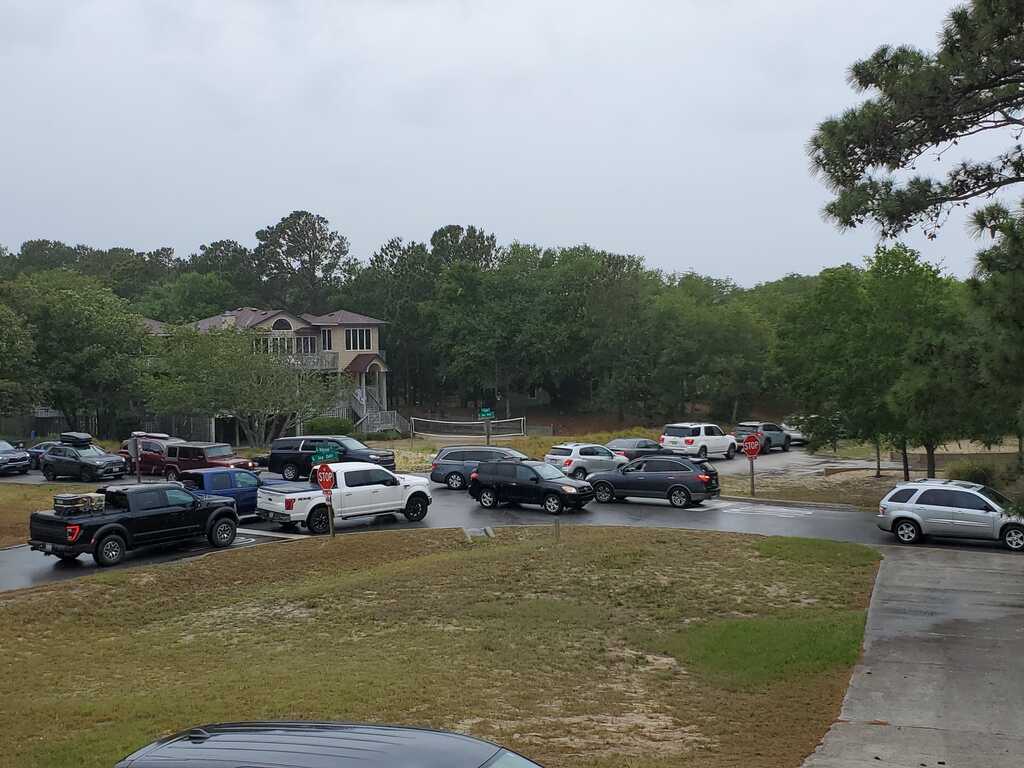


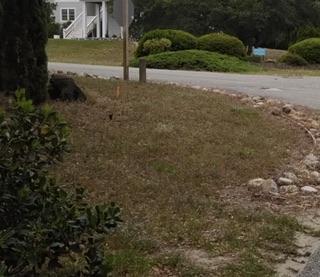
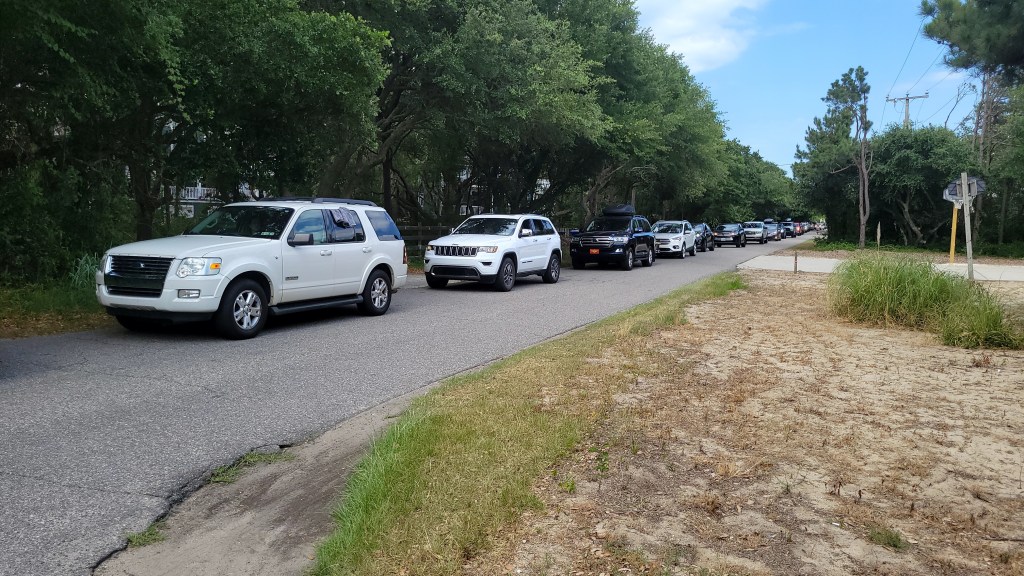

 The Southern Shores Beacon