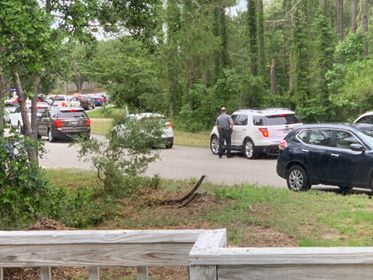
A Southern Shores police officer stops a motorist in the column of northbound traffic headed north on Hillcrest Drive today around 4:20 p.m.
Homeowners on Sea Oats Trail say the northbound traffic backup today on their street started at 3:30 p.m.
Homeowners on Hillcrest Drive near the SSCA tennis courts took the photo above at 4:20 p.m. today.
They assume the traffic stop was for speeding down the hill at what used to be known as Lookout Point and some people now refer rather gauchely to as Harry’s Hump. It is one of the few stretches of road where a police officer can park a vehicle and not impede traffic flow. It is also where frustrated motorists formed two northbound lanes of traffic yesterday.
As of 4:40 p.m., I can report a backup on Hickory Trail that extends to the intersection of East-North-South Dogwood trails and beyond.
It’s déjà vu all over again, as the great Yogi Berra said. Only 24 hours have passed.
Please feel free to post comments on the Facebook page and on The Beacon blog page about traffic conditions.
Your Facebook comments will appear immediately. I have to approve the blog comments, so they may be delayed, depending on when I receive an email informing me about them.
Two more people have tested positive for COVID-19 in Dare County, bringing the total number of cases since the pandemic began to 35, according to today’s Dare County Dept. of Health and Human Services’ dashboard.
The dashboard data show that one of the new cases is a Dare County resident; the other is not. One is female; the other is male. One is between the ages of 18 and 24; and the other is age 65 or older.
The Dare County resident is in home isolation, according to the dashboard report. The non-resident is in isolation in his or her home county.
It is impossible to distinguish in the dashboard data which is which, and Dr. Sheila Davies, director of the DCDHHS, has consistently withheld specific demographic details about the people who have tested positive. She will give a sketchy description of virus transmission about the three cases reported this weekend in her videotaped update on Tuesday. (We will update if any other cases are reported today.)
The DCDHHS dashboard also shows that the non-resident who was in home isolation in Dare County has recovered.
Today’s statewide COVID-19 statistics present another large increase in the number of laboratory-confirmed tests, but a decline in the number of hospitalizations.
Since yesterday’s N.C. Dept. of Health and Human Services’ dashboard report, 1,443 people have tested positive for the virus out of 15,440 completed tests, for a positive test rate of 9.3 percent. Dr. Mandy Cohen, NCDHHS secretary, has said that she would like to see a consistent positive-test rate of 5 percent or lower.
Since May 4—42 days, or six weeks ago—when The Beacon started keeping a daily record of the NCDHHS statistics, the positive-test rate has been 5 percent or lower on only nine days.
Hospitalizations declined today to 798 from yesterday’s single-day record high of 823. Five more people have succumbed to COVID-19, bringing the number of reported deaths in North Carolina to 1,109. Eleven percent of the deaths have been in Mecklenburg County, where Charlotte is located.
For more demographic information about COVID-19 cases in North Carolina, see:
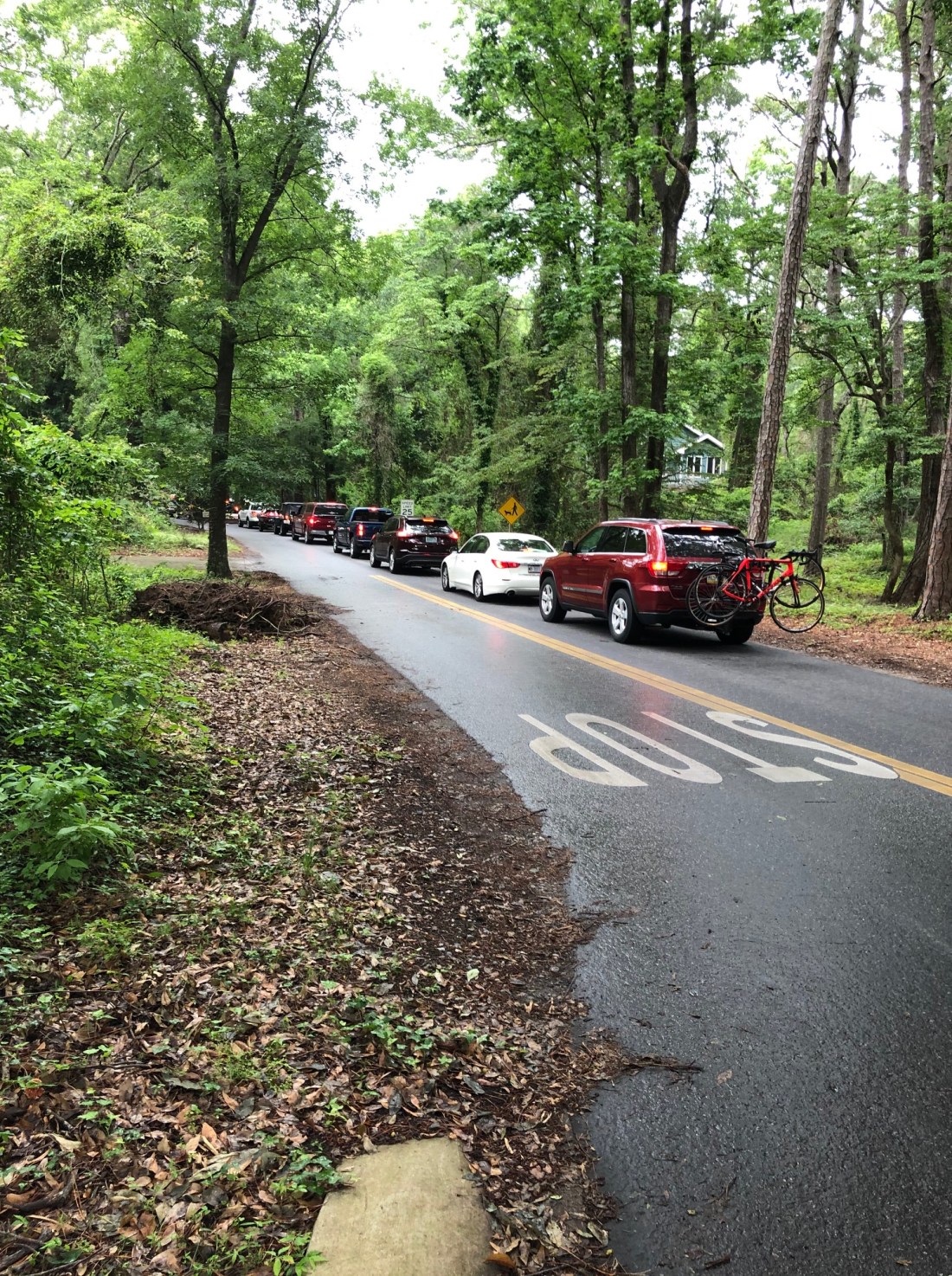
This photo depicts the traffic backup on Hickory Trail yesterday around 4:40 p.m., looking north from the East Dogwood Trail intersection. Passing motorists said the traffic was backed up to the Wright Memorial Bridge. One South Dogwood Trail homeowner reported that the traffic on her street was still backed up at 6 p.m. to the stop signs at Mallard Cove.
We would like to thank everyone who reported on traffic conditions yesterday on the cut-through route in Southern Shores and elsewhere in town. We all see firsthand a segment of the congestion on the cut-through route north, but together, we see the entirety.
Yesterday’s traffic was the worst traffic Southern Shores has ever experienced on a vacation Saturday, without a doubt. It was unprecedented. And it is only mid-June.
Yesterday’s northbound cut-through traffic was backed up at times to the Wright Memorial Bridge, according to drivers we questioned en route, making the previous Saturday’s heavy traffic seem light by comparison.
Several people contacted The Beacon to say that South Dogwood Trail was a “parking lot” until well into the evening.
Residents on Hillcrest Drive near the tennis courts reported that northbound drivers turned that street into a two-lane, one-way street for part of the day—posing the risk of a head-on collision with southbound vehicles.
Homeowners in the 300 block of Sea Oats Trail reported that the backup on their street, which started around 1:30 p.m., did not ease until 8 p.m. I saw a fair amount of northbound traffic on Hickory Trail, near the East Dogwood Trail intersection, still at 9 p.m. when I went out.
An email from a homeowner in the 300 block of Wax Myrtle Trail really brought yesterday’s over-the-top traffic conditions home for us. He wrote that he reached the Wright Memorial Bridge at 5:30 p.m. and did not arrive home until 8:30 p.m.
It took this homeowner three hours to drive less than 10 miles! Traffic moved better on Interstate 95 in Virginia yesterday, he said, than it did in Southern Shores.
It goes without saying that if any resident of Southern Shores had needed emergency service yesterday, or if a fire had occurred in a house on one of the congested roads, access by first responders would have been seriously inhibited by the bumper-to-bumper traffic, some of it in the form of large vehicles, such as the massive recreational vehicle that we saw barreling through.
The Town Council has had more than sufficient notice of the dangers posed by the traffic and of the possibility that a preventable tragedy could occur.
We all can speculate as to why the traffic has increased so markedly this June, but the reason it has ultimately does not matter. It only matters that conditions like yesterday’s cannot be allowed to continue. Public health and safety must come first and be safeguarded by taking preventive measures.
I have been advocating for solutions to cut-through traffic for years now, but the Town Council has consistently declined to take action—with the exception of the no-left-turn weekend in June 2018, which former Councilmen Gary McDonald and Fred Newberry spearheaded.
Mayor Tom Bennett, who took office in December 2013, is on the public record as opposing any measures that would inconvenience northbound vacationers, and he has always managed to have a majority of the Council support him.
Meanwhile, the traffic has only gotten worse.
The Mayor stood alone, however, in voting against the three no-left-turn weekends that the other four Town Council members approved this summer at their June 1 meeting.
“We want to get [the vacationers] here so badly,” Mr. Bennett said then, “. . . [and] we depend on them for pretty much our survival, but we don’t want them to use our streets . …”
Mr. Mayor, we would like to meet the people in Southern Shores who depend on Corolla and Duck vacationers for their “survival.”
As for Southern Shores streets, drivers passing through town are perfectly free to use N.C. Hwy. 12, which is the designated thoroughfare.
Tommy Karole, a Southern Shores homeowner who owns a restaurant in Duck and actually does have a livelihood interest in northern Outer Banks vacationers, is the chairperson of the citizens’ cut-through committee that is trying to get cut-through traffic off of Southern Shores roads.
Mr. Bennett’s concerns about what we call biting-the-hand-that-feeds-us is “the thing I have a hard time with,” he said at the meeting, “but I’ll work that out.” Not soon enough to vote in favor of his constituents’ best interests and welfare, however.
The Mayor should consider that northbound vacationers are not served, either, by an hours-long drive through the Southern Shores residential community. The shortcut their navigational device directed them to take yesterday was hardly that.
If all traffic were restricted to Hwy. 12, it would actually move faster because there would be no blockages at intersections where the cut-through side streets meet the thoroughfare. That is indeed what happened in June 2018 when the left turn on to South Dogwood Trail from U.S.Hwy. 158 was prohibited.
The three no-left-turn weekends that the Town Council approved are beginning to look like the metaphorical equivalent of applying a band-aid to a blood-gushing open head wound. We need them, but we need much more.
In the short term, the police can assist with traffic flow, moving it along on U.S. Hwy 158 and N.C. Hwy. 12 and away from South Dogwood Trail.
A coordinated effort among the Dare County Sheriff’s Office, the N.C. State Highway Patrol, and the police departments of Southern Shores and Kitty Hawk could make a measurable difference in the time it takes drivers to travel through Southern Shores and in the volume of traffic through Southern Shores’ residential areas.
In the long term, it is time to consider gating Southern Shores at every access road on summertime weekends. The Town owns the roads, except for a few private roads, and does not need federal or state money to maintain them.
Until the mythical mid-Currituck County bridge is built, Southern Shores is at risk during post-Memorial Day weekends of becoming what the Wax Myrtle Trail homeowner called “an impassable congested freeway that is a danger both to our residents and to our visiting guests.”
The coronavirus is not going away. To the extent it is a factor in the decisions people are making to vacation in, and even move to the Outer Banks—and we cannot know with a certainty what its influence is—it is going to continue to be a factor for the foreseeable future. The Town Council must protect the people who elected them to office. To do otherwise would be blatant neglect and a dereliction of public duty.
PUBLIC COMMENTS AT TUESDAY’S COUNCIL MEETING: There will be a general public comments period at the Town Council’s workshop meeting Tuesday, which convenes at 9 a.m. in the Pitts Center. If you would like to submit written comments, which would be read into the record at the meeting, please email them to Town Clerk Sheila Kane at skane@southernshores-nc.gov. Please write in the subject line to your email: “Public comment for Town Council’s June 16 meeting.”
You also may address the Town Council in person or via Zoom videoconferencing. The meeting is open to the public, but seating will be limited because of social-distancing requirements.
As you know, a public hearing on a town-wide beach nourishment project in 2022 will be held at Tuesday’s meeting, as well. You may speak during this hearing in the same manner as outlined above: 1) by submitting written comments, with the subject line, “For the June 16 public hearing on beach nourishment”; 2) by presenting comments in person; or 3) by remotely commenting via Zoom.
Comments during a public hearing are not time-limited, like comments during the public-comment period are. The limit for general public comments is three minutes.
The meeting packet for the workshop session has been updated since The Beacon last provided a link to it. It now includes a letter and “scope of professional services” proposal from Ken Wilsson, president of Coastal Protection Engineering of North Carolina, Inc. (“CPE-NC”), which has been selected by the towns of Duck, Southern Shores, Kitty Hawk, and Kill Devil Hills to be the joint project manager, designer, engineer, and permitting services provider for their 2022 projects.
Southern Shores has committed to doing five-year maintenance of its beach nourishment at Pelican Watch, but it has not yet made a commitment to a 3.7-mile-long, $14 to $16.5 million (or, likely, much more) townwide beach nourishment project.
The other three towns plan to do maintenance in 2022 of their 2017 beach nourishment projects.
Mr. Willson, who is the only coastal professional to recommend to Southern Shores that it undertake a town-wide nourishment project—and as a proactive measure, not to redress damage—proposes to receive $437,675.75 for his company’s services, some of which would be shared by the other three towns.
At a recent meeting, the Town Council determined that CPE-NC, formerly known as APTIM, did not place itself in a compromising position by undertaking a beach management plan for Southern Shores, in which it recommended a 2022 nourishment project, and then applying to manage that project. The Town did not perceive a conflict of interest because CPE-NC will not do the actual dredging and sand filling.
Nonetheless, CPE-NC stands to gain financially from directing Southern Shores toward a beach-nourishment project, which Mr. Wilsson did after initially telling the Town Council that the town’s beaches and dune system were stable and “time is on your time” in terms of doing nourishment.
The Town Council did not consider beach-study proposals from multiple coastal engineering firms before it chose APTIM—as Dare County recently did in considering an Avon study—nor did it solicit opinions from other coastal engineers after APTIM filed its reports.
Former Town Manager Peter Rascoe simply delivered Mr. Wilsson and APTIM to the Town Council, and the Council put the Southern Shores beaches in his hands.
The Council also did not confer with oceanographers and other scientists at the U.S. Army Corps of Engineers’ Field Research Facility north of Duck (the “Duck Research Pier”) who offered to consult without charge.
The considerable unchecked control that the Town Council has given Mr. Wilsson and the growing corporate enterprise of which he is a critical part troubles us a lot.
Backup of traffic going north on Hickory Trail around 4:40 p.m. extends to the intersection of Hickory and East Dogwood Trail, then continues . . .. . . on to East Dogwood Trail and beyond to South Dogwood Trail. One man told us that the backup went as far as the Wright Memorial Bridge.
A few years ago we suggested at a Southern Shores Town Council meeting that police officers control the flow of northbound traffic from U.S. Hwy. 158 to N.C. Hwy. 12 to just beyond Duck, with all traffic lights set on blinking yellow. The arriving traffic is similar to the departing traffic from a large stadium event, we said. Police can move it along better than it can move itself. No one on the Council said a word.
Update at 5:45 p.m.: Northbound traffic stopped on Hickory, East Dogwood, and South Dogwood trails.
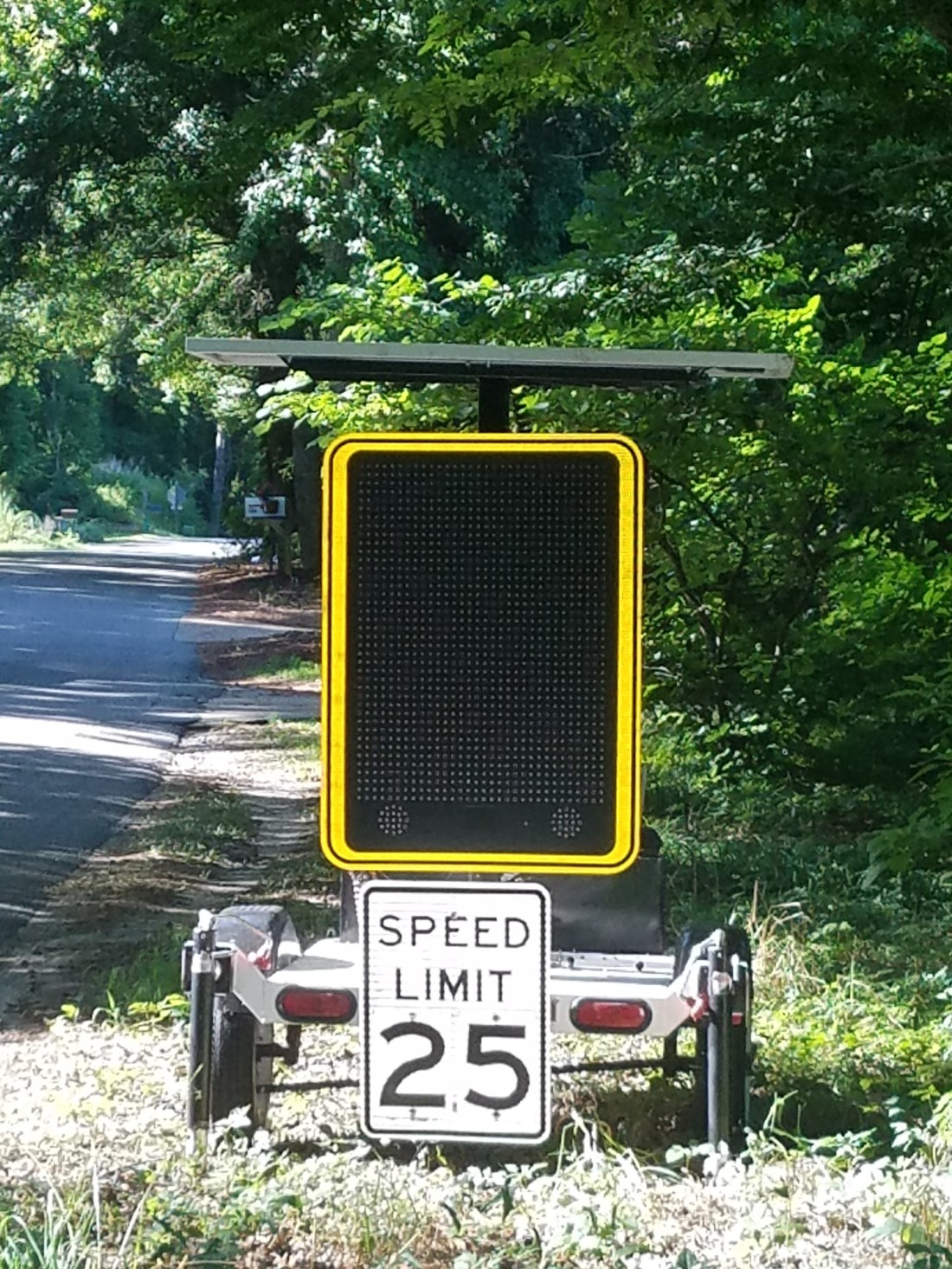
Roadside traffic counters can look like the one pictured above, which was positioned on South Dogwood Trail near the South-North-East Dogwood trails intersection last summer.
Vacationer cut-through traffic on Hickory Trail today has been continuous all afternoon–with most drivers running the stop sign at Hickory and East Dogwood–but not yet what we would call hideous. Potentially hazardous, yes, but not yet hideous.
Please tell us about the traffic flow and backups that you’re seeing on your street today, especially if you live on South Dogwood Trail, Hillcrest Drive, Sea Oats Trail, Wax Myrtle Trail, Eleventh Avenue, and Juniper, Trinitie, and Chicahauk trails.
Another Dare County resident has tested positive for COVID-19, according to today’s Dare County Dept. of Health and Human Services’ dashboard, which updated after The Beacon posted the story about the County Control Group’s refusal to require people to wear face coverings under any circumstances.
The new case is a woman between the ages of 25 and 49 who is in home isolation, the dashboard reports. She represents the 23rd COVID-19 case among Dare County residents; 10 other cases have been recorded of non-residents.
One-third (11) of Dare County’s 33 positive test results have occurred since May 16, when visitors were permitted entry to the Outer Banks.
Phase Two of Governor Roy Cooper’s plan to reopen businesses while still controlling spread of the coronavirus started May 22 and is scheduled to expire June 26, unless the Governor extends it.
There have been N.C. and national press reports that the State’s move into Phase Three could be delayed. A suggested worst-case scenario has the State reverting to Phase One, which would be devastating for many small businesses.
Dr. Mandy Cohen, secretary of the N.C. Dept. of Health and Human Services, told NPR on Thursday that if cases and hospitalizations statewide keep rising, North Carolina could return to a stay-at-home order. The order only lifted with Phase Two.
“The way the numbers look now, I would be surprised if we move fully into Phase Three,” Alma (“Gibbie”) Harris, the public health director for Mecklenburg County, N.C., where Charlotte is located, told reporters yesterday.
“We all prefer not to move backward. We would like to move forward,” said Ms. Harris, who is a registered nurse with a master’s degree in public health.
RECORD-HIGH METRICS
Mecklenburg County, a former virus “hot spot” in the state, hit a new record high yesterday in single-day increases of COVID-19 cases, according to The Charlotte Observer, adding 398 cases to its cumulative total of 6,538.
The State of North Carolina also marked its largest single-day increase yesterday in newly reported COVID-19 cases, adding 1,768.
Today’s statewide single-day total is 1,427, according to the N.C. Dept. of Health and Human Services’ dashboard. Nearly 9 percent of the new single-day completed tests were positive.
The total number of laboratory-confirmed COVID-19 cases reported statewide since the pandemic began is 42,676.
As of today, 823 people are hospitalized in North Carolina for the virus, and 1,104 people have died.
“I grow more concerned every day,” UNC-Chapel Hill epidemiologist and infectious modeling expert Kimberly Powers, Ph.D., told The Observer. “This reopening is looking like a failed experiment, where if things don’t miraculously somehow change really soon, it becomes increasingly frightening.”
THE BIGGER PICTURE
North Carolina is among nine states nationwide that have experienced an upsurge in new COVID-19 cases since Memorial Day, according to The Washington Post.
The others are Arizona, Arkansas, California, Florida, Oregon, South Carolina, Texas, and Utah.
“Our metrics have moved in the wrong direction,” Dr. Cohen told The Washington Post last week. Unlike states such as New York and California, North Carolina never hit a peak. It is still experiencing a first wave of viral infections.
Confirmed COVID-19 cases in North Carolina have tripled during the past month, and hospitalizations are close to doubling.
Dr. Cohen stressed hygiene, mask wearing, and social distancing as means by which people can prevent the spread of COVID-19.
Ms. Harris told The Charlotte Observer that within a few weeks, social-distancing metrics could return in Mecklenburg County to where they were in March, before the local stay-at-home order took effect.
Other N.C. counties that have been hard hit since the reopening, according to Dr. Cohen, are Alamance, Duplin, Durham, Forsyth, Johnston, Lee, and Wake.
Duplin County is in southeastern North Carolina near Jacksonville. Johnston County abuts Wake, and Lee County is nearby. The seat of Forsyth County is Winston-Salem.
Orange County, which is next to Durham and Alamance counties and near Wake County, initiated a face-mask mandate yesterday. Durham County residents have been required to wear masks since late April.
Orange County is home to Chapel Hill and the University of North Carolina; Durham is home to Duke University. Both counties are densely populated as are Wake, Mecklenburg, and Forsyth counties.
A statewide face covering/mask requirement would send one unified, consistent message to North Carolinians about personal protection from the COVID-19 pandemic during the reopening process.
Because COVID-19 can be transmitted by asymptomatic and pre-symptomatic people, those who choose not to wear a face covering or a mask are posing a risk to others, not assuming one for themselves.
The Beacon will update cases reported on the DCDHHS dashboard as they occur.
Requiring a mask is “such a challenging enforcement issue,” Dare County Control Group Chairman Bob Woodard said in yesterday’s message.
The Dare County Control Group decided Thursday against requiring people to wear face coverings “when in close contact with others” . . .
. . . but, in a videotaped message yesterday, Chairman Bob Woodard encouraged business owners to “please require” their employees and customers to wear masks and asked service providers who come into people’s homes to do the same.
Why the Control Group thought it had to require people to wear face coverings—or masks, as Mr. Woodard repeatedly referred to them—in all settings in which members of the public encounter each other is not explained in the video.
Virginia Governor Ralph Northam recently ordered all people statewide to wear face coverings or masks when they are in enclosed places open to the public. It is in enclosed public places, such as supermarkets, that the risk of virus transmission by a stranger is greatest. Few of us worry about passing a mask-less stranger in a parking lot.
The Dare County Control Group met Thursday, a now-bearded Mr. Woodard said in yesterday’s You Tube video, for the 42nd time since the COVID-19 outbreak—“almost a month since the last meeting”—for the purpose of considering a face covering/mask requirement.
Mr. Woodard said he sought “consensus”—not a majority decision—among the group members, who include the six Dare County town mayors, Dare County Sheriff Doug Doughtie, and Dave Hallac, superintendent of the Cape Hatteras National Seashore.
According to Mr. Woodard, who is chairman of the Dare County Board of Commissioners as well as the Dare County Control Group, the Group concluded that masks would be “strongly encouraged, but not mandatory.”
The reason the Group did not act, he said, is because of the “inability to enforce the requirement.”
The Chairman then gave what The Beacon thought were ludicrous reasons to buttress that argument, saying that law enforcement officers would be unable to distinguish household members from non-household members—we think at the Walmart, they could tell—or know who cannot wear a face covering because of “a medical condition.” (Think about that explanation for a while.)
In what was the worst possible reason offered, the Control Group Chairman said that people who newly arrive on the Outer Banks would be unaware of the mask/covering requirement and innocently violate it.
Last we checked, ignorance of “the law” was not a defense, and anyone who travels during this COVID-19 pandemic and does not ascertain the “rules” of their destination is more than just ignorant.
“Business is booming on the Outer Banks,” Mr. Woodard proclaimed, and clearly the Chairman wants to keep it booming.
“Approximately” 150,000 people are on the Outer Banks “this week alone,” he said, “maybe even 200,000.”
“Vacation rentals are seeing record numbers,” he continued, saying that rental property companies are at close to “maximum occupancy.”
Since May 16, 800,000 visitors have come to the Outer Banks,” he said, and only 10 new COVID-19 cases have been reported.
The Chairman did not report on the number of COVID-19 tests that have been administered, however.
We find it disappointing that the Control Group did not back up those business owners who have imposed face covering requirements on their customers by making the requirement county-wide. The Beacon heard recently about two ugly confrontations between a proprietor and customers who refused to observe her mask requirement and were reluctant to leave.
While Mr. Woodard asked home service providers to show “respect for others and their safety” by wearing face coverings, his Control Group did not require our fellow customers to do the same in all enclosed public places where social distancing cannot be maintained.
The Southern Shores Town Council could implement a face-covering requirement to protect public health and safety in our town, if it chose. Any of the beach towns’ governing boards could take action.
But the Dare County Control Group exists in large part so that there is consistency in action among the towns of Southern Shores, Duck, Kitty Hawk, Kill Devil Hills, Nags Head, and Manteo.
Professing that he “personally” wears “my mask everywhere I go,” Mr. Woodard concluded his six-minute message by saying:
A Dare County resident who tested positive recently for COVID-19 and was in home isolation has been hospitalized, according to today’s Dare County Dept. of Health and Human Services’ dashboard.
Meanwhile, two of the non-residents who tested positive recently in Dare County and were transferred to their home counties for isolation have recovered, the dashboard shows.
There have been no changes in total COVID-19 cases diagnosed in Dare County since last Sunday when six cases were reported, bringing the total to 32.
Evidence of a COVID-19 outbreak on a statewide basis continues to accrue as cases and hospitalizations in North Carolina have steadily increased since the Governor authorized Phase One of the economic reopening on May 8.
Phase Two started May 22 and is scheduled to expire June 26, unless the Governor extends it.
“Our metrics have moved in the wrong direction,” Dr. Mandy Cohen, secretary of the N.C. Dept. of Health and Human Services, told The Washington Post Monday.
North Carolina joins Arizona, Arkansas, California, Florida, Oregon, South Carolina, Texas, and Utah, as states that have experienced a “new wave” of cases since Memorial Day, according to The Post.
Confirmed COVID-19 cases in North Carolina have nearly tripled during the past month. The total as of today is 39,481 cases, according to the NCDHHS dashboard.
Total hospitalizations reported today stand at 812. A month ago, the total was 464. The state has recorded 1,064 COVID-19-related deaths since the pandemic started.
Since Phase One started May 8, North Carolina has reported single-day positive-test rates of between 2.3 percent and 12 percent, for an average of 6.7 percent.
Dr. Cohen would prefer to see an average positive test rate of 5 percent or lower.
About 5.4 percent of the State’s 10.5 million people have been tested for the virus.
Tomorrow is the deadline for submitting your comments by email or U.S. mail in the Town Council’s beach nourishment survey. The Town Council will hold a public hearing during its workshop meeting next Tuesday on whether or not to move forward with a beach nourishment project in 2022.
The Tuesday, June 16, meeting will be held at 9 a.m. in the Pitts Center and will be open to attendance by the public, who will be required to comply with social-distancing guidelines for mitigating the potential spread of COVID-19. Seating will be limited.
You also may participate in the meeting via Zoom.
Please send your email comments to info@southernshores-nc.gov or mail them to the Town of Southern Shores, 5375 N. Virginia Dare Trail, Southern Shores, NC 27949. Make sure you include your property address(es) with your written remarks.
According to the Tuesday meeting agenda, emails will be forwarded to Town Council members at the close of business tomorrow:
The Beacon has been reporting on the continuing beach nourishment story for more than 15 months. For background, we refer you to blogs posted 2/28/19, 9/17/19, 9/20/19 (in this report, local oceanographers question the Town’s coastal engineering consultant’s “limited data”), and 1/19/20.
In a notice mailed to all Southern Shores property owners, the Town described a potential 2022 beach nourishment project as being funded possibly “through tax assessments which may include Municipal Service Districts and/or a Town-wide assessment that could potentially range from an additional $100 to around $3,000 to your tax bill depending on the value of your property, the location of your property, and its proximity to the ocean.”
What this means is that the Town is considering paying for its share of the estimated $14-$16.5 million project—Dare County would contribute monies, as well—through a special property tax assessment that imposes different rates on properties according to where they are located. The town would be divided into different designated “municipal service districts” for this assessment.
No formal analysis or report of the Town’s MSDs and tax rates has been done. The financial data upon which the Town is currently relying is strictly preliminary and for “discussion purposes only.” The Town cannot know how much your annual tax bill would increase.
The Beacon does not support the beach nourishment project, as proposed. We do not believe that all—or even most of the—3.7 miles of the Southern Shores coastline need additional sand fill.
We also believe that Southern Shores, which differs substantially from other beach towns because of its strong dune system, its lack of commercial property on the oceanfront, and its layout, should settle the beach nourishment question by referendum and its funding by a general obligation bond.
Much of Southern Shores is “proximate” to the oceanfront. That is a primary reason why people bought land here and built homes.
TRAFFIC COUNT DATA FROM APRIL, MAY, AND LAST WEEKEND
In addition to the public hearing on beach nourishment Tuesday, the Town Council will resume its discussion of the three no-left-turn weekends this summer that it approved, 4-1, at its June 1 regular meeting.
You may find of interest traffic-count data compiled in weekly increments by Police Chief David Kole from March 30 to June 7, and included in the Council’s meeting packet.
Until the week of May 25-31, vehicles on N.C. Hwy. 12 and the South Dogwood Trail cut-through route apparently were being counted at 12 different locations. During the June 1-7 week, a thirteenth location on Juniper Trail was added.
We believe the data, if accurate, speak for themselves. Assumptions as to why traffic may have increased on a given Saturday are not evidence-based and should not be made. There is no way for Chief Kole or anyone else to know why people come to, and leave the Outer Banks when they do. Speculation is inappropriate.
The Chief highlights in red on his data sheets those traffic-count numbers that may be erroneous because of a problem with the counter. While they are not many, they do call into question the reliability of this technology.
You may be interested to know that last Saturday, when the cut-through traffic was hideous, 10,002 vehicles were counted traveling north on N.C. 12 at the Skyline Road counter; 2,121 were counted going north at the South Dogwood Trail counter; and 2,472 were counted, going north on Seat Oats Trail, at 332 Sea Oats Trail, which is just north of the Hillcrest Drive-Sea Oats Trail intersection.
It would appear that Sea Oats Trail is the convergence point for traffic because the count last Saturday at 55 Hickory Trail (going north) was just 1,284, nearly 50 percent fewer vehicles than those counted at 332 Sea Oats Trail. Drivers appear to be jumping off of Wax Myrtle Trail, Hillcrest Drive, and Sea Oats Trail between East Dogwood Trail and Hillcrest Drive.
More counters are necessary to get a full picture of the traffic flow.
The data, as presented, do not distinguish between northbound and southbound traffic on the dunes roads or on Juniper Trail. So we checked the roadside counters themselves, which also register the speed of the passing vehicles. They are all positioned to count northbound traffic.
Of the seven people who tested positive for COVID-19 in Dare County between last Friday and yesterday, six acquired the virus by “direct contact with a family member or household contact,” according to a report by the Dare Co. Dept. of Health and Human Services.
Of these six, “some” of them acquired the virus by direct contact with an “asymptomatic positive case,” Dr. Sheila Davies, DCDHHS director, said in a videotaped message posted yesterday to the health department’s COVID-19 website.
The remaining case is deemed to be “community acquired,” Dr. Davies said, because no cause can be determined. This person is a non-resident who contracted the virus before coming to Dare County, she noted.
Four of the seven people are non-residents, of whom three are asymptomatic and in home isolation outside of Dare County. The fourth is hospitalized outside of the area.
As you may recall, three of the non-residents are young people under age 24, two of them just 17 years old. The fourth non-resident is between the ages of 50 and 64. (See The Beacon’s posts on 6/7/20.)
The three Dare County residents who tested positive for COVID-19 are all symptomatic, Dr. Davies said, and are recovering in home isolation.
Dr. Davies stressed three “takeaways” from a review of the seven positive cases in her message:
Acquisition of the virus by direct contact with an asymptomatic case “reinforces the importance of wearing masks and maintaining social distancing.”
The spread of the virus occurs “quickly among family members and members within the same household.”
The number of direct contacts associated with the latest positive cases is greater than previously seen with positive cases, an increase that Dr. Davies attributes to a relaxation of infection-control restrictions in phases one and two of the economic reopening.
The increase in the number of direct contacts means the the DCDHHS’s job of contact tracing is more time-intensive.
“From family gatherings to social parties and backyard barbecues, the number of direct contacts individuals have is on the rise,” Dr. Davies said. “While this is to be expected, please note this increases your risk of exposure.”
Dr. Davies said she is continuing to work on plans for the “next community testing clinic,” which will involve both diagnostic and antibody testing for COVID-19. An antibody test requires a blood sample to be drawn indoors.
The DCDHHS director will announce details of the testing clinic as soon as they are available. The next COVID-19 update on the website will be Friday.





 The Southern Shores Beacon