Delegates from the 10 counties* represented by the Albemarle Rural Planning Organization (ARPO), which include Dare and Currituck, voted yesterday in Hertford to maintain the “regional priority” status of the Mid-Currituck Bridge project, thereby preserving the State’s committed funding of $173 million for another budgetary year.
The vote was 6-1, according to CBS affiliate WTKR (channel 3), which did not elaborate further.
“We’re asking for one more budget cycle,” Southern Shores Mayor Elizabeth Morey told representatives from the N.C. Dept. of Transportation who attended the Town Council’s special meeting Tuesday, which was more of an information session than the public hearing that the Town had promoted in a news release.
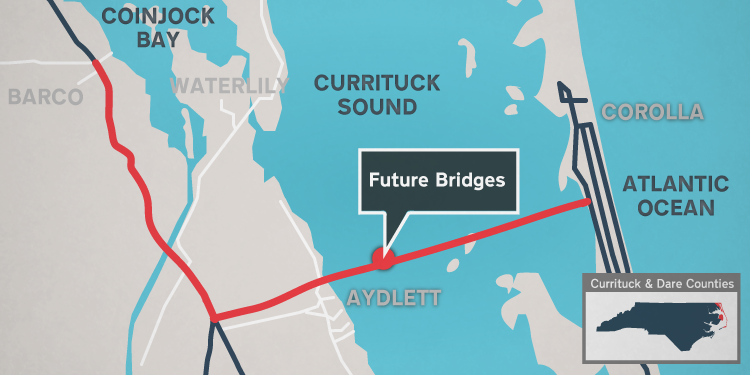
The ARPO gave her the year. But the extension of the priority designation does not come with any more guaranteed State funds for the seven-mile-long, two-lane toll bridge that would connect Aydlett on the Currituck mainland to Corolla.
Tuesday, David Wasserman, Deputy Director of the NCDOT Division of Planning, identified a $832 million shortfall between the current $1.2 billion estimated cost of the Mid-Currituck Bridge and the State’s committed funding ($173 million) plus projected toll revenues.
His calculation factored in $195 million for the net cash flow from tolling operations, which is less than the $238 million in toll revenue that was estimated when the NCDOT approved the Mid-Currituck Bridge in 2014 for funding during the 10-year budget that started in 2016.
Proponents of the Mid-Currituck Bridge have advocated for higher tolls being imposed than NCDOT has calculated, but neither Mr. Wasserman nor his colleague, Ronnie Sawyer, Deputy Division Engineer for NCDOT-Division One, who also attended the meeting, responded to inquiries Tuesday about the bridge’s toll rate.
We have heard suggestions made by local elected officials and Dare residents of $50 to $100 tolls for a one-way trip. NCDOT’s initial discussions about the toll rate focused on $15.
Only two Southern Shores homeowners spoke while the NCDOT representatives were at the meeting. Hand-picked by Mayor Morey, they were Geri Sullivan of 10th Avenue, near Duck Road, and Jim LeBlanc, of South Dogwood Trail. Both addressed safety problems posed by the summer weekend traffic congestion and the inconvenience of coming and going in Southern Shores, not the funding gap.
For organizational purposes, it is helpful to know that the NCDOT has 14 highway divisions statewide, and that Division One is comprised of 14 counties in Northeastern North Carolina, including the 10 served by the ARPO.
An NCDOT “Region” is a broader category that encompasses multiple divisions. Dare and Currituck counties are in Region A, which, Mr. Wasserman said, has 8 percent of the State’s population. There are seven regions: A through G.
****
As we learned Tuesday, the NCDOT operates with 10-year budgets for transportation projects across the state. The funding for the 2026-2035 budget is $32 billion, an amount determined by the N.C. General Assembly that does not begin to meet the need, according to Mr. Wasserman.
During the upcoming additional “status quo” year for the Mid-Currituck Bridge, he said, NCDOT will continue to “work through legal challenges” and seek additional alternative funds, chiefly federal grants.
The time, effort, and money the State has spent on legal challenges already have been significant.
Since NCDOT’s 2014 approval, the bridge project has been beset by litigation initiated by the Southern Environmental Law Center on behalf of Currituck County residents who formed non-profit organizations to qualify for the SELC’s representation.
Litigation, which is still ongoing, has prevented the bridge from going forward. In the interim, the cost of the Mid-Currituck Bridge has skyrocketed.
While the SELC has not won in court on any of its claims, it has succeeded in delaying the bridge construction and “upping the ante” on the bridge.
NCDOT has already spent an estimated $63 million in engineering, litigation, and other costs for the Mid-Currituck Bridge, according to Mr. Wasserman. No one wants this much taxpayer money to go for naught.
The ARPO could have voted to change the bridge’s status from priority, also known as “Scheduled for Delivery,” to “Funded for Preliminary Engineering Only.” Had it done so, the Mid-Currituck Bridge would have had to undergo another ranking process, the result of which would have determined the NCDOT funds for which it might be eligible.
Also, the $173 million in allocated funds would have been available for other selected projects in Division One of NCDOT.
Mr. Wasserman presented a PowerPoint on Tuesday that explained how the State determines which transportation projects get funded and where the funding comes from.
It is for such processes that the word bureaucracy was coined. Not surprisingly, Mr. Wasserman and Mr. Sawyer referred to funding sources as “buckets” rather than by their technical names.
As we understand it, before a transportation project can be considered for funding from one or more of three buckets—Statewide Mobility, Region, or Division Needs—it must be quantitatively evaluated by the State according to criteria such as benefit/cost; safety; accessibility/connectivity; and congestion.
Mr. Wasserman’s PowerPoint data show the Mid-Currituck Bridge having scored high enough for funding in the Division One Needs category, but not in the other two.
It might qualify for Region A funding if both the ARPO and NCDOT Division One each assigned it additional points, but its current funding is only from the Division bucket. It would never qualify for Statewide Mobility funding.
In the 2026-2035 budget for the State Transportation Improvement Program (STIP), Mr. Wasserman’s data show, only about $800 million is available in Region A for all projects. The same is true for Division One: $800 million for all projects.
Available “Regional Impact” funding is apportioned according to the region’s percentage of the State population, and Northeastern North Carolina is sparsely populated compared to other regions where urban areas are located.
We will leave our explanation there and hope that we have not added to the bureaucratic confusion. The bottom line is cost.
* The 10 counties are Camden, Chowan, Currituck, Dare, Gates, Hyde, Pasquotank, Perquimans, Tyrrell, and Washington. The other four counties in Division One are Bertie, Hertford, Martin, and Northampton.
By Ann G. Sjoerdsma, The Southern Shores Beacon, 4/16/26

