Without indisputably and straightforwardly committing the Town of Southern Shores to a beach re-nourishment project in 2027, the Town Council unanimously approved at its July 7 meeting a pre-construction agreement with the coastal engineering consultant who would manage the project and authorized $62,553.75 to cover the firm’s engineering and consulting services.
If the Town Council does not abruptly reverse course by September, Southern Shores will embark on beach nourishment in May-October 2027, when the towns of Duck, Kitty Hawk, and Kill Devil Hills will be re-nourishing their coastlines, and will share the costs of mobilization with them, as it did in 2022.
The Town Council had withheld its approval of a 2027 project, and its scope, until after it could see beach monitoring data for 2026, which Ken Willson, senior program manager for Coastal Protection Engineering of N.C. (“CPE”), presented last week.
CPE monitors Southern Shores’ 3.7 miles of beaches at designated profile points, which are 1,000 feet apart, at roughly the same time each year, usually in June, although the beach is its widest in July and August.
CPE’s data last month show that Southern Shores’ beaches have held up very well in the past year and in the past four years since the 2022 nourishment project.
Mr. Willson showed slides of the data at the meeting; he did not prepare a written report like he has in the past, nor did he give a breakdown of the data by profiles. You may access his presentation at:
To hear his commentary on the slides, you will have to listen to the You Tube stream of his presentation. Go to youtube.com/@ SouthernShores/streams and select “Live” at the top of the page. The July 7 meeting will come up as the first video you can download.
TOSS BEACHES ARE DOING WELL
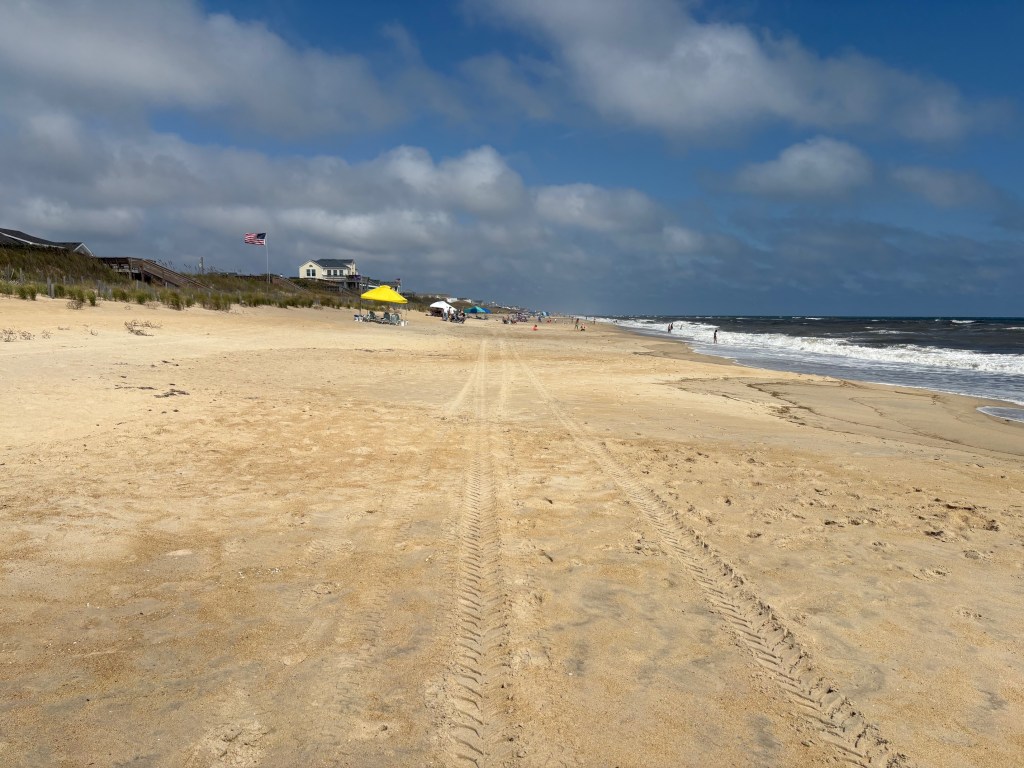
According to the data, the “Northern Section” of the Southern Shores shoreline, which is the area north of Fourth Avenue, has performed exceptionally well, having gained 177,500 cubic yards of sand (this is volume) in the past four years, in addition to the 124,000 cubic yards of sand that the project placed there. The gain is by natural accretion.
The “Southern Section,” which is from about Chicahauk Trail south to the Kitty Hawk town line, also gained sand, adding 49,500 cubic yards on top of the 343,700 cubic yards that were placed there in 2022. Only the “Central Section,” which is the area in between, experienced a loss in sand volume, but it is only about 10 percent (57,900) of the 580,800 cubic yards that were placed there in 2022.
There was little discussion after Mr. Willson’s presentation by the four members of the Town Council at last week’s meeting. Councilman Rob Neilson did not attend.
The exception was when Mayor Elizabeth Morey questioned the manager’s definition of a “trend,” which he based on only five to 10 years of data, as well as the erosion rate he used in his projected erosion trend for Southern Shores’ beaches.
We wish the Mayor had enlightened us more about her thinking.
Mr. Willson referred to losing 3 cubic yards of sand per foot per year overall on the Southern Shores shoreline, but this is a volume loss rate, not a dimensional loss. It means that for every one foot of beach width, the shoreline is losing 3 cubic yards of sand per year.
Ms. Morey instead referred to an erosion rate of one-half foot of beach width per year, which is a linear loss rate, not having to do with sand volume. Mr. Willson did not try to reconcile or relate these two measurements.
Obviously, it is what people see on the dry sand beach that matters to them, not the cubic yards of sand lost.
Mr. Willson has proposed adding 375,000 cubic yards of sand to Southern Shores’ beaches in 2027, in order to achieve the “plan” CPE developed in 2022 for maintenance.
Citing how well the Northern Section has performed, Mayor Pro Tem Matt Neal asked if there was a minimum amount of sand that the Town had to place next year. In a rather wordy response that delved into cost, Mr. Willson essentially replied that the Town could not advantageously deposit less than 375,000 cubic yards.
He said that “to stay ahead of the game,” the “minimum fill” for Southern Shores is 375,000 cubic yards of sand.
According to the schedule that Mr. Willson outlined, the four towns’ project design plans will be done in August-September, and the projects will go out for construction bids in September.
Theoretically, the Town Council could still put the brakes on in September and not go forward next year, he said, but that is hardly likely. We read CPE’s data and graphs as supporting a decision to skip 2027 and do maintenance in 2032, instead, but no official raised that possibility.
TOWN HAS CHOICE OF MAINTENANCE PLANS
Going forward, the Town Council will have to choose from among three 2027 project maintenance plans.
- The first, based on a five-year maintenance interval, will necessitate re-nourishment in 2032 and will cost $6,793,900.
- The second, based on a six-year maintenance interval, will delay re-nourishment until 2033 and will cost $6,734,000.
- The third, based on a seven-year maintenance interval, will require re-nourishment in 2034 and cost $6,679,600.
The cost declines because Southern Shores’ proportionate share of the mobilizations costs, which it splits with the other three towns, declines.
Each town has different needs, and the healthiest beaches are in Southern Shores and Kitty Hawk, Mr. Willson said. Duck has the most severe erosion problems.
According to Mr. Willson, Dare County has estimated cost shares for each town’s project that are based on a five-year maintenance cycle. He did not cite any percentages.
Thanks to Southern Shores homeowner Sean Mulligan’s persistence in drawing the Council’s attention to the adverse effects that beach nourishment has on surfing, fishing, and swimming—because it destroys sandbars—Mr. Neal asked Mr. Willson if the maintenance project could be designed to protect the existing sandbars, which took years to develop after the 2022 project.
Mr. Willson replied that there is no design technology “that exists now” that would “construct bars as they are now.” The bars, he said, “will be smothered” by the dredging. Surfing, fishing, and swimming will suffer again.
OTHER NEWS FROM THE TOWN
Bike and Pedestrian Grant: The N.C. Dept. of Transportation’s Integrated Mobility Division has awarded the Town a grant of between $50,000 and $60,000 to develop a comprehensive bicycle and pedestrian network plan. In order to get the money, the Town must pay 10 percent of the amount as “municipal reimbursement.” By unanimous vote, the Town Council authorized this $5,000-$6,000 payment.
According to Deputy Town Manager/Planning Director Wes Haskett, who filled in for Town Manager Cliff Ogburn at the July 7 meeting, NCDOT will assign a consultant to the Town to manage the project. More details to come.
Planning Board Term Limits: By consensus, the Town Council asked Town staff to draft a policy or Town Code amendment(s) that would impose term limits on members of standing committees, which currently include only the Planning Board and the Historic Landmark Commission. Mr. Neal initiated discussion at the Council’s June meeting about this potential change.
The Town Code section about the Planning Board’s composition and terms of office is section 24-24. The five regular members and two alternate members of the Board serve for three years and are appointed in staggered terms. The Planning Board regularly meets monthly.
Town Code section 17-1 established the Southern Shores Historic Landmarks Commission in 2016. The Commission has five regular members and one alternate member, all of whom serve three-year terms. The Historic Landmarks Commission only meets when it has business.
All board members and alternates are appointed by the Town Council. When a member’s term expires, it has been the Town’s policy to ask him or her if they would like to continue serving for another term. If they do, they are typically reappointed. If they do not, Mr. Haskett consults the voluntary committee member applications he has on file for candidates. The Town has not hitherto advertised vacancies when they occur.
“I served on the Planning Board for eight years,” said Mayor Morey. “That seems like a long time.”
We agree. We think six years would be more appropriate, exclusive of any alternate time.
Unlike his predecessors, Planning Board Chairperson Andy Ward, who has served in his office for years, allows alternate members to participate in Board discussions, even when they are not substituting for an absent member. They do not vote, but they act otherwise as full members.
Councilwoman Paula Sherlock said she would like to know what the current Planning Board members think about imposing term limits before she forms her own opinion.
Setbacks Set Aside Temporarily: The Town Council decided to take up changing rear-yard setbacks at a Mayor’s Chat or other future public hearing so that more residents can weigh in.
The Council made it clear that it is not keen on changing side-yard setbacks, but it may be amenable to reducing rear-yard setbacks for accessory structures, if the public favors this.
In the RS-1 single-family-dwelling residential district, the side-yard setback is 15 feet, and the rear-yard setback is 25 feet.
FLYOVERS AT BIG KITTY HAWK INTERSECTION?
By now, you probably have heard about two design projects proposed for priority status by NCDOT for the U.S. 158-N.C. 12 intersection in Kitty Hawk.
The NCDOT is composing its list of priority projects statewide for the 2027-2038 State Transportation Improvement Plan (STIP), the next 10-year transportation plan, and is soliciting public comment until July 31. Councilwoman Sherlock said she was “horrified” when she saw NCDOT’s two intersection plans.
One of the designs proposes two flyovers to facilitate the flow of traffic through the intersection, with N.C. 12 traffic traveling underneath U.S. 158 traffic. This project would cost at least $36 million, Ms. Sherlock said. The other proposes a reconfiguration of the intersection that we are hard-pressed to figure out based on the illustration provided by NCDOT online.
We are not going to delve into what has become a controversial subject in Southern Shores, as you can imagine. Instead, we are going to refer you to what others have written:
The Town of Southern Shores’ news release: See https://www.southernshores-nc.gov/government/page/help-shape-future-transportation-our-region
An article by The Outer Banks Voice, titled “Southern Shores officials voice opposition to possible NCDOT project at NC 12 & US 158,” at https://www.outerbanksvoice.com/2026/07/14/southern-shores-officials-voice-opposition-to-possible-ncdot-project-at-nc-12-us-158/.
We cannot imagine that NCDOT ever expected flyovers to fly with Outer Bankers.
This same idea surfaced maybe 10 years ago (?) and was quickly snuffed out by locals. There was even talk about a flyover of Duck.
By Ann G. Sjoerdsma, The Southern Shores Beacon, 7/15/26


