Dare County will hold a COVID-19 diagnostic and antibody testing clinic Tuesday, June 30, starting at 10 a.m., at the county’s Parks & Recreations facility in Kill Devil Hills, according to a bulletin posted today on the Dept. of Health and Human Services’ website.
Dare County residents who are age 10 or older and asymptomatic may register for an appointment for either or both tests, the bulletin advises. All registrants will be required to send a photocopy of a government-issued identification card and an insurance card, if they have one, to the county before the event.
You need not have insurance to register for a test.
The telephone number to call for an appointment is (252) 475-5008, starting tomorrow. The call center is open Monday through Friday from 8:30 a.m. to 5 p.m.
Dare County is partnering with Mako Medical Laboratories of Raleigh on this event.
The Parks & Recreation facility is located at 602 Mustian St., down the street from the Thomas A. Baum Senior Center and behind the Brewing Station restaurant parking lot.
Those who register for the nasal-swab diagnostic test will stay in their vehicles and be seen on a drive-thru basis. A registrant for the antibody test must come into the Parks & Rec building and have his/her temperature taken and a blood sample drawn.
A diagnostic test determines if a person currently has a COVID-19 infection, while an antibody test determines if a person has had a COVID-19 infection and recovered.
The DCDHHS further advises that a positive antibody test “does not mean an individual has immunity to future COVID-19 infections.”
The tests are not free, but people with insurance “will not incur any out-of-pocket cost,” according to today’s bulletin, because “the COVID-19 test is completely covered” by all insurance providers, including Medicaid and Medicare.
Mako Medical Labs will cover the costs of people without insurance who seek diagnostic testing by using COVID-19 Relief Fund monies, the bulletin advises. Mako will “work with” uninsured people who would like to undergo antibody testing.
More information will be provided about cost coverage “when individuals call to register for an appointment,” according to today’s release.
The results of both tests will be provided to people within 72 hours.
The DCDHHS also advises participants in the testing event to “understand they are coming to a community-based testing site located in a public location and therefore patient privacy cannot be assured.” But all results, it says, will be confidential.
A female non-resident between the ages of 18 and 24 is the 44th person to test positive in Dare County for COVID-19. The Dare Dept. of Health and Human Services’ dashboard reports today that she is in home isolation in Dare County.
Half of the 44 COVID-19 diagnoses that Dare County has reported were made since June 3. Twenty-seven are Dare County residents, of whom nine still have active cases, including one who is in the hospital.
Seven of the 17 non-residents who have been diagnosed with COVID-19 in Dare have recovered or been symptomatically cleared, according to the dashboard. The remaining 10 are in home isolation, nine of them outside of the local area.
Dr. Sheila Davies, director of the DCDHHS, will post her weekly videotaped message tomorrow. She will address in broad terms the mode of viral transmission of the people who have been diagnosed with COVID-19 since last Friday, June 12, when she gave her last report on transmission and contact tracing.
As of this morning, DCDHHS has reported 12 new cases.
Dr. Davies also will give details about the holding of a local clinic on June 30 for both diagnostic and antibody testing of COVID-19. She has previously announced that the antibody testing, which requires a subject’s blood to be drawn, will take place indoors at the Dare County Parks and Recreation facility in Kill Devil Hills.
The Beacon will continue to update the number of COVID-19 diagnoses in Dare County as they are reported on the DCDHHS dashboard. Our posts may seem excessive to some readers, but we are able to keep track of the sex, age, and residency status of individuals only as the cases are reported. We consider our reporting a documentary record for readers–as well as ourselves–easily to review.
Dare County has reported another positive COVID-19 test, this time of a female non-resident who is between the ages of 25 and 49, according to today’s Dept. of Health and Human Services’ dashboard.
The woman, whose case brings the total number of positive tests in the county to 43, has been transferred to home isolation in her county of residence, the dashboard reports.
Of the 43 COVID-19 cases diagnosed in Dare County, 27 are local residents, and 16 are non-residents. Twenty-four are female, and 19 are male.
The age breakdown of the 43 cases is as follows:
Age 17: three
Ages 18 to 24: six
Ages 25 to 49: 13
Ages 50 to 64: 12
Ages 65+: nine
Diagnosis of the 44th COVID-19 case in Dare County will mark a doubling of the total number of cases reported since the May 16 reentry of visitors to the Outer Banks.
During the past two weeks, North Carolina has reported a rising number of cases, for a daily average of 1,148. It is one of nine states that are experiencing a surge in the number of positive COVID-19 test results.
Hospitalizations statewide have also increased. Today’s reported 846 hospitalizations are a single-day record for North Carolina.
The number of people who have died in North Carolina because of COVID-19 is now 1,168, according to the latest report by the N.C. Dept. of Health and Human Services.
Three more people have tested positive for COVID-19 in Dare County, all of them local residents who are symptomatic and in home isolation, according to the county’s Dept. of Health and Human Services’ dashboard. One person is a teenager.
The total number of COVID-19 cases reported in Dare County since the pandemic began is now 42. Twenty of those cases have been diagnosed in the past month.
The three new cases vary considerably in age: One person is 17; one is between the ages of 25 and 49; and the third is age 65 or older. Two are female, and one is a male.
Since June 12, 10 new COVID-19 cases have been diagnosed in Dare County. Five are residents, and five are non-residents. All of the five residents, including today’s three, are symptomatic and recovering in home isolation, according to a Dare County COVID-19 case update posted online today.
Four of the five resident cases are “connected,” according to the update, “and it is believed one individual acquired the virus by community spread” and spread it to three “family members/close contacts.”
The fifth COVID-19-positive resident is also believed to have acquired the virus through community spread because the DCDHHS has not been able to determine another source.
Of the five non-residents, one is symptomatic, and the other four are asymptomatic. Three of the asymptomatic cases share a “common household and acquired the virus through direct contact,” the update states.
The other two non-resident cases are not connected: One of them “acquired the virus by direct contact outside of the area,” according to the update, and the other “likely acquired the virus by community spread outside of Dare County.”
All of the non-residents have returned to their home counties.
DCDHHS has not found a connection between the residents and the non-residents.
Health department staff has done contact tracing on nine of the cases and notified all of their direct contacts. The 10th individual is not cooperating with “the contact tracers at this point,” according to the update.
“Direct contacts” are people whom the COVID-19-positive person identifies as coming within six feet or less of him or her for 10 minutes or longer.
If a COVID-19-positive person identifies someone associated with a business, restaurant, or other establishment as a “direct contact,” but does not know this contact’s name or how to get in touch with the contact, “DHHS staff works with that place of business to identify the individual and obtain contact information.”
When contact-tracing a non-resident, the update explains, “DHHS staff identifies any contacts the individual had while . . . in Dare County during [a] contagion window.”
The DHHS reportedly monitors all positive cases daily throughout their isolation period.
NEXT TESTING EVENT WILL BE JUNE 30
The DCDHHS is “finalizing” plans with Mako Medical Laboratories of Raleigh for a community testing clinic to do both diagnostic and antibody testing of COVID-19 on June 30.
The antibody testing requires a blood draw, not just a finger stick, and will be held indoors at the Dare County Parks and Recreation facility in Kill Devil Hills.
Details about appointment scheduling and costs will be released at the end of this week.
The unprecedented cut-through traffic backups of the past two weekends received immediate attention from Mayor Tom Bennett, who reached out to Kitty Hawk town officials, state transportation officials, and Town staff to formulate a plan to prohibit the left turn at South Dogwood Trail/U.S. Hwy. 158 during the next two weekends.
The Mayor’s plan to hold so-called “unmanned” no-left-turn weekends on June 20-21 and June 27-28 unanimously passed the Town Council at its workshop meeting this morning.
“Unmanned” means the Southern Shores police will not monitor the intersection for violations, as they will for the three no-left-turn weekends that the Town Council approved two weeks ago.
It was unclear from the Town Council’s discussion today exactly what direct role, if any, Kitty Hawk would play during these weekends. Certainly, Southern Shores needs its northern neighbor’s consent and cooperation because the South Dogwood Trail/U.S. 158 intersection is in Kitty Hawk.
The Council also agreed that it would consider at its July 7 meeting doing the same in July for the weekends that have not been designated for street closure.
The total cost for renting barrels to block the left turn lane at U.S. Hwy. 158 over both remaining June weekends is $7400, an amount that the Council approved spending from the Town’s undesignated fund balance.
The turn will be prohibited from 11 a.m. to 8 p.m. on both days of both weekends.
Mayor Bennett has consistently voted during the past six years against prohibiting the left turn at South Dogwood Trail—an idea that first received resident consensus at a public workshop in October 2014—or taking any other actions suggested by homeowners to reduce traffic.
Indeed, he cast the sole dissenting vote against holding the three “manned” no-left-turn weekends this summer, on July 4-5, July 25-26, and Aug. 1-2.
Today, he said that he had long considered the traffic “the burden of living here.” But, with the traffic crush of the past two weekends, he felt compelled to act. We applaud his show of leadership.
Pointing out that even Circle Drive, a circular road east of N.C. Hwy. 12 (Duck Road) that begins and ends on Hickory Trail, had cut-through traffic on it, the Mayor said, “People are going to find a way on to our streets.”
The traffic jam-up of the past two weekends, he said, is “not a healthy situation.”
“This past weekend was miserable,” agreed Councilman Leo Holland, who lives in Chicahauk and monitors the app, WAZE.
Mr. Holland also referred to the traffic on Circle Drive–resort to which may be the ultimate exercise in futility and desperation.
WAZE gives real-time road condition updates and alerts. It routinely directs motorists to avoid N.C. Hwy. 12 and use roads through Southern Shores’ residential areas.
Action by the Town Council came after 30 minutes of public comments, during which about a dozen property owners addressed the June weekend traffic, by email, Zoom, or in person, calling it “ridiculous,” “horrendous,” and “unprecedented”; offered various solutions, including allowing residents to drive on the beach to get around the traffic; and requested help from the Town.
Because of the public hearing on beach nourishment that took place later, the Pitts Center was standing-room-only–but the standing was outside of the meeting room, in the hallways, because of social-distancing inside.
About a dozen members of the public were able to sit inside the meeting room at any time with the Town Council and Town staff members.
The Beacon thanks the Mayor and Town Council for stepping up now to take immediate action to ameliorate the weekend traffic nightmare. We also found encouraging talk by some Council members of devising a plan this summer to anticipate and deal with weekend cut-through traffic jams next summer.
This response by elected officials represents a big change. In the past six years, a Council majority inclined to take action on the cut-through traffic has not existed.
BEACH NOURISHMENT APPROVED, WITHOUT SPECIFICS
After a public hearing during which the overwhelming majority of the speakers supported a beach nourishment project in Southern Shores and after a lengthy question-and-answer period with the Town’s coastal engineering consultant, who appeared via Zoom, the Town Council voted unanimously “to pursue beach nourishment.”
The motion, made by Town Councilman Matt Neal, did not specify whether the project “pursued”—which the Mayor clarified as meaning that the Council will “proceed”—would be town-wide or only a portion of the beach. It also did not endorse one particular “option” recommended by the consultant, Coastal Protection Engineering of N.C., Inc. (“CPE-NC”), formerly known as APTIM.
In an interview after the meeting, Mr. Neal told The Beacon he was referring to a town-wide project. That appeared to be his implication, but he was not specific.
Mr. Neal’s motion came after an extensive discussion by the Town Council about beach nourishment and its funding, which The Beacon will attempt to cover at a later date.
It also came after Mr. Neal made another motion that he withdrew and reframed in a simpler form.
This much we will say now: The Council sought to delay as much as possible any decision-making on beach nourishment until after new town manager Cliff Ogburn takes office, which will be June 24. As town manager of Nags Head, which has done two sand-fill projects, Mr. Ogburn has been through the beach-nourishment process. Nags Head did not hire CPE-NC to manage its two projects.
Various members of the Town Council reported that more than 300 emails had been received by the Town in response to its mailer requesting comment by June 12. Of these, Mr. Neal calculated, 47 percent were in support of beach nourishment; 45 percent were in opposition; 2 percent were undecided; and 6 percent requested more information.
Essentially, 50-50.
Several of the people who spoke in person at the meeting asked about the tax amounts cited in the survey mailer, which stated that beach nourishment costs per capita “could potentially range from an additional $100 to around $3,000.”
The speakers asked if these amounts were annual tax payments or one-time payments.
The answer is the additional tax will be annually assessed for the five-year term of the project financing.
***
In other business this morning, the Town Council unanimously approved retaining Joe Anlauf and Andy Deel as a town-engineer team for the next two fiscal years, at the end of which Mr. Ogburn will decide whether or not to continue the contractual relationship.
Before voting in favor of the Anlauf/Deel contract renewal, Mr. Neal clarified that he would like to reserve the right for the Town to bid out engineering jobs, if it thought another engineer would be more qualified to do the job.
Town Attorney Ben Gallop stated that there was nothing in the current town engineer’s contract that would prohibit that.
The Town Council also unanimously approved appointing current Planning Board member Ed Lawler to a new three-year term that starts July 1.
COVID-19 CASES CONTINUE TO RISE, TOTAL NOW 42
The Beacon has learned that the number of COVID-19 cases in Dare County has increased by three today, bringing the total to 42. We will publish a report on the latest cases, as well as cover the content of Dr. Sheila Davies’s update today. Please check back with us later.
Four more people have tested positive for COVID-19 in Dare County, according to today’s Dare County Dept. of Health and Human Services’ dashboard.
All four new cases are non-residents who have been transferred to isolation in their home counties. Three of the four are between the ages of 18 and 24, and one is between the ages of 50 and 64. Three are men, and one is a woman.
The total number of COVID-19 cases diagnosed in Dare County is now 39.
Seventeen of the 39 cases have been diagnosed since May 16, when the county lifted the access restriction on visitors. Of those 17, six are Dare County residents, and 11 are non-residents. It is not known how many tests have been completed in the county.
Dr. Sheila Davies, director of the DCDHHS, will provide a few details tomorrow in her weekly update message about how the latest seven people who tested positive for COVID-19 in Dare County contracted the virus. The DCDHHS reported three new cases over the weekend, two of them residents.
The Dare County Control Group decided last Thursday to encourage the use of face masks or face coverings in public, but not to make their use mandatory. (See The Beacon, 6/13/20.)
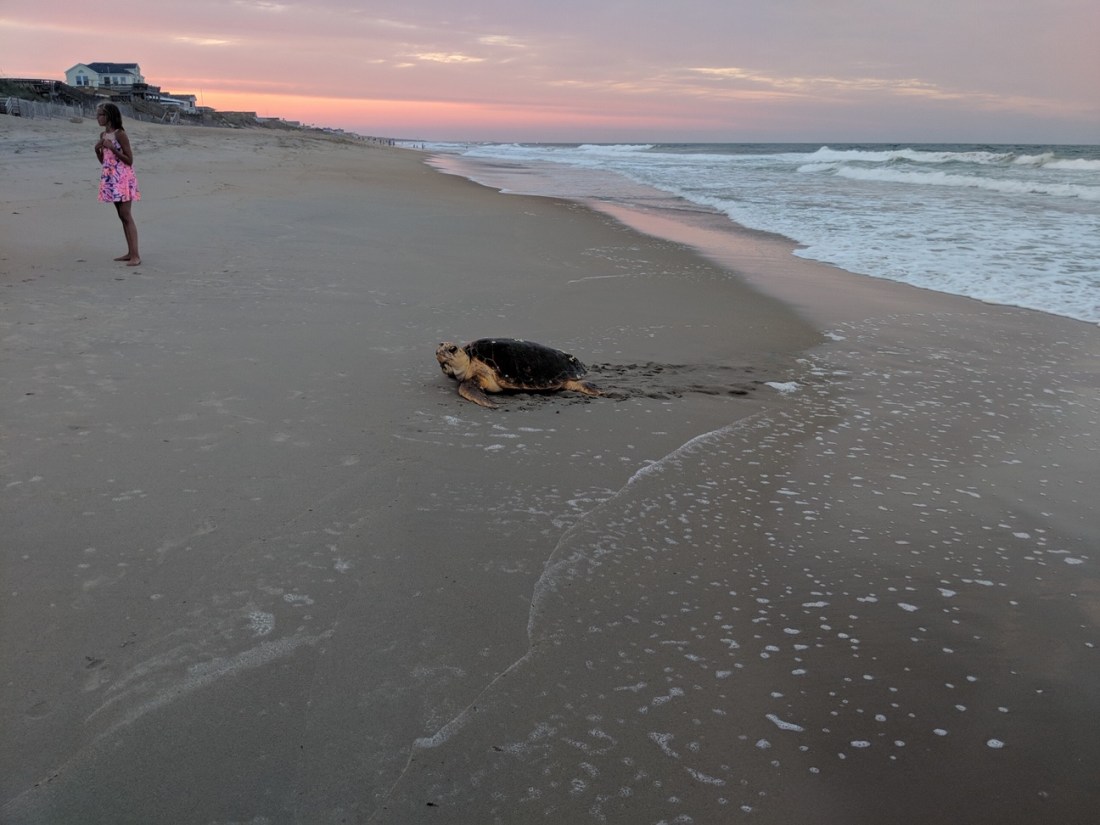
A sea turtle comes ashore to lay her eggs on the wide Southern Shores beach at 174 Ocean Blvd. last July. The beaches oscillate in width from season-to-season and year-to-year and are at their widest in late July and early August.
The main event scheduled at tomorrow’s 9 a.m. Town Council workshop session is the public hearing on the proposed town-wide beach nourishment project for 2022. The Beacon makes one last pitch, below, for delaying approval of a project, for which there is no present need.
Before the hearing, however, the Council will be taking up other important business, including the three no-left-turn weekends that it approved for this summer.
The morning workshop, which will be held in the Pitts Center, is open to the public, but seating will be limited because of social-distancing requirements. You also may view the workshop on Zoom or listen to it by telephone.
After preliminaries, tomorrow’s workshop agenda will progress as follows:
General public comment
If you would like to submit written comments that would be read into the record at the meeting, please email them to Town Clerk Sheila Kane at skane@southernshores-nc.gov. Be sure to write in the email subject line: “Public comment for Town Council’s June 16 meeting.”
You also may address the Town Council in person or via Zoom videoconferencing. If you choose to speak via Zoom, you must click on the “Chat” button once you have joined the meeting and type a message to Ms. Kane, requesting time to speak. She will acknowledge your request and then inform you when your microphone is open.
You are not restricted in the topics that you may bring up in public comments. There is a time limit, however, of three minutes.
Planning Board appointments
The term of current regular Planning Board member Ed Lawler, who was appointed in January 2019 to complete the late Glenn Wyder’s unexpired three-year term, is ending June 30. Mr. Lawler has expressed an interest in being appointed to a new three-year term. No other people have applied for the vacancy.
Continued discussion of town engineer contract
This discussion will pick up with a motion made by Town Councilman Jim Conners at the Town Council’s June 1 meeting to approve hiring the engineering “team” of Joe Anlauf and Andy Deel, although only Mr. Anlauf submitted a Statement of Qualifications in response to the Town’s April 27 Request for Qualifications for a new town engineer. By his own representation, Mr. Anlauf has been the engineer for Southern Shores for the past 20 years. Three other engineering firms have applied for the contract. The Beacon supports one of the other applicants. See The Beacon, 6/9/20, for more details.
Discussion of no-left-turn weekends
The Town Council approved, by a 4-1 vote, with only Mayor Tom Bennett objecting, the scheduling of three no-left-turn weekends this summer. The weekends discussed at the June 1 Council meeting were July 4-5, July 25-26, and Aug. 1-2. We imagine that the crush of traffic during this past weekend, particularly on Saturday, will come up in the Council’s discussion, and we are hopeful that Police Chief David Kole will provide some traffic counts for the weekend.
Public hearing on beach nourishment project for 2022
You may speak during this hearing in the same manner as outlined above: 1) by submitting written comments, with the subject line, “For the June 16 public hearing on beach nourishment”; 2) by presenting comments in person; or 3) by remotely commenting via Zoom.
Comments during a public hearing are not time-limited.
The Beacon has written extensively about the results of Southern Shores shoreline surveys and the possibility of a beach nourishment project. We refer you, in particular, to posts on 2/28/19, 3/31/19, 4/3/19, 9/17/19, 9/20/19, 12/14/19, and 2/1/20.
We do not support beach nourishment in 2022. We support annual beach profiling, but not nourishment.
ABOUT SOUTHERN SHORES’ ‘NEED’ FOR BEACH NOURISHMENT
In 2017, the Wilmington, N.C.-based coastal engineering firm of APTIM Coastal Planning & Engineering of North Carolina conducted a baseline assessment of Southern Shores’ beaches. Emphasis on baseline.
At a March 6, 2018 Town Council meeting, Ken Willson, project manager of APTIM, presented his firm’s survey of the Town’s 3.7-mile coastline, which was based on 22 beach “profiles” or shoreline locations that are spaced 1,000 feet apart from each other.
APTIM determined that 1) the Southern Shores shoreline is “stable,” having lost only 0.4 feet (that’s five inches) between 2006 and 2017; and 2) the volume of sand in the system had actually increased during the same time period.
Mr. Willson told the Council at the March 2018 meeting that “the shoreline is looking fairly stable” and there is “no big rush” to “jump” on beach nourishment.
Nonetheless, he still wanted to do a “vulnerability assessment of the oceanfront structures [i.e., houses]” in Southern Shores and determine the “minimum cross-section of [sand] volume” that should be maintained to protect the shoreline from storm damage.
In other words, he wanted to calculate how much sand would need to be added to the beaches to restore them to their pre-storm condition in the event of a severe hurricane the likes of which may never occur in Southern Shores—and, in fact, has not occurred in Southern Shores since 1962.
To calculate the minimum cross-section of sand–called “volume density”–APTIM ran computer simulations of an “Isabel-like” hurricane, using storm characteristics such as wave heights, wave period, and storm duration, and three different sea-level scenarios.
Those of you who were here for Hurricane Isabel in 2003 may recall that it did not reach Southern Shores. It fizzled out.
You also may know that Southern Shores has not had a major storm since the Ash Wednesday storm of 1962.
The beach-nourishment plan options that APTIM eventually proposed along with its “vulnerability assessment” are based on calculations of sand volume density that would be required to correct theoretical “potential damage” to the Southern Shores beaches caused by a storm that is highly unlikely ever to happen.
This is not beach nourishment based on environmental science or oceanography or any other coastal science. And it’s not beach nourishment based on damage done. This is beach nourishment cooked up by computer storm simulations and engineering to fix “potential damage” that is as unlikely to occur as the hurricane that theoretically caused it.
ABOUT SOUTHERN SHORES’ COASTLINE HISTORY
We quote below an excerpt from an article that we posted 2/1/20, which was titled, “Shoreline History of Southern Shores is One of Low Long-Term Average Erosion Rates, Some Accretion.” Accretion is the accumulation or addition of sand, not the loss of it. We have edited the article for length:
According to coastal engineer and geologist Spencer Rogers, who works with the research/education/outreach program, N.C. Sea Grant, in its Wilmington office, historical erosion rates provide a model for the future.
They are the “best indicator,” Mr. Rogers said in a telephone interview with The Beacon yesterday, of what will happen to a shoreline.
And yet, these rates have not been part of the conversation that Southern Shores has had during the past two years with APTIM. APTIM’s emphasis has been on erosion in the event of a severe storm, whose parameters (e.g., winds, wave action) it modeled after Isabel, the 2003 hurricane that, as Mr. Rogers noted, “pretty much petered out by the time it got to Kitty Hawk.”
As the highly regarded coastal specialist aptly pointed out, Southern Shores has not been directly hit by a severe storm since the Ash Wednesday storm of 1962, an Extreme Nor’easter that took out the old Sea Ranch Hotel at the current site of Pelican Watch, next to the Kitty Hawk Pier.
Since this March 1962 event, no buildings in Southern Shores have been destroyed or threatened by erosion.
When Duck and Kitty Hawk did beach nourishment in 2017, houses in both towns were teetering at the ocean’s edge. Some in Kitty Hawk had already been lost. This has never been the case in Southern Shores.
While APTIM is advising the Town Council how to achieve “storm damage reduction protection” in the event of a monster hurricane, the reality is, as Mr. Rogers observed, that “storm patterns are pretty scattered” in the northern Outer Banks, in contrast to Hatteras Island and the southern Outer Banks.
Another reality—in addition to the town’s known 60-year history since the Ash Wednesday nor’easter—is that no hurricane of the magnitude of Katrina or Michael has ever hit Southern Shores.
Looking at Types of Beach Erosion
As Mr. Rogers explains in his book, “The Dune Book,” there are four types of erosion: 1) seasonal erosion; 2) erosion caused by a severe storm; 3) long-term erosion; and 4) inlet erosion. Beach nourishment projects are designed to address #2, an “extreme storm event” and/or #3, “chronic day-to-day losses,” he said.
Fortunately, we do not have to contend with inlet erosion. Shorelines adjacent to inlets—such as Topsail Beach—experience hazards that shorelines along oceanfront do not.
One such shoreline is along Ocean Isle Beach, which is between Holden and Sunset beaches near the North Carolina-South Carolina line. Beach nourishment done there 20 years ago by the U.S. Army Corps of Engineers “disappeared in a couple of months,” Mr. Rogers said. The town and Corps had to go back to the drawing board.
To compare the Southern Shores’ shoreline with a shoreline where an inlet is the major driver of erosion, as some local property owners have done, is to make the proverbial apples-to-oranges comparison. There are no inlets off of our coast.
(Mr. Rogers also noted that Dare County’s nourishment of unincorporated Buxton and Rodanthe, which had high long-term erosion rates, “disappeared very quickly,” too.)
Seasonal erosion occurs because of a variation in wind and wave energy.
As Mr. Rogers explained: “The beach oscillates in width from season-to-season and from year-to-year.” During the summer, he noted, sand moves north, so Southern Shores should benefit from Kitty Hawk’s 2017 nourishment project.
The beach is at its widest in late July and early August, according to retired longtime USACE Field Research Facility coastal engineer and former Southern Shores homeowner Bill Birkemeir, who also spoke with me by telephone last week. (To calculate beach widths recently, APTIM used measurements from May, not from the summer. See The Beacon’s articles on 9/17/19 and 9/20/19 for background.)
In the “seasonal cycle,” Mr. Birkemeier said, the beach is “narrow and steep in winter” and “comes back in the summer.” Passing hurricanes and other storms push the sand off-shore, but it returns. “It’s really simple,” he noted, and very important to understand.
When Mr. Willson attempted to update in September 2019 what he called erosional and accretional “trends” in Southern Shores on the basis of data obtained between December 2017 and May 2019, oceanographers from the Field Research Facility [also known as the Duck Research Pier] challenged his conclusions.
As The Beacon reported 9/20/19, Dr. Katherine L. Brodie and Dr. Nicholas Cohn, both of whom live in Southern Shores, told the Town Council at its Sept. 19 planning session that APTIM’s conclusions were “based on limited data” and “on short-term trends that are not particularly helpful.”
“It is very challenging to understand what’s really happening to our coastline,” said Dr. Brodie, who characterized the Southern Shores dune system and shoreline as being “stable” over time. (“It is very difficult to eyeball the shoreline,” said Mr. Rogers. There are “radical changes” going on that the eye cannot detect.)
Dr. Brodie also told the Town Council that “there is lots of seasonal variability” in erosion (loss) and accretion (gain) of beaches. The time to measure beach erosion is not in the winter, as APTIM had done.
Because Southern Shores has not been annually profiling its shoreline, we do not have what Mr. Birkemeier called “built-up knowledge” to evaluate short-term data. Some of us thought that APTIM’s 2017 profile would be the first in a series of annual surveys to keep track of the shoreline. But it did not take long for Mr. Willson to shift into recommendations for beach nourishment, with encouragement from the Town.
Southern Shores Has History of Low Long-Term Average Erosion Rates
According to its website, the N.C. Division of Coastal Management (“DCM”) evaluates long-term average erosion rates for North Carolina’s 300-mile ocean coastline every five years. It updates these rates by obtaining new aerial photographs of the shoreline to add to its database and running the data through computer programs that yield “thousands of numbers.” It started this effort in 1979, using photographs that date back to 1940.
In a January 2019 report about the methods it used to update long-term average erosion rates in 2016, the DCM reported that 88 percent of the Southern Shores shoreline had measured erosion, while the remaining 11 percent had measured accretion. The DCM calculated the average long-term erosion rate for our beaches to be 0.5 feet per year.
This does not mean that every year part of the Southern Shores shoreline is losing six inches of width while another part is gaining sand.
The DCM explains the calculation by comparing a 1992 shoreline with a 1942 shoreline. To derive the long-term average erosion (or accretion) rate, you would divide the distance that the shoreline has moved by 50, which represents the 50-year time period. If it has eroded 100 feet, you have a long-term average erosion rate of 2 feet per year, 100 divided by 50.
[It is possible to determine long-term average erosion rates for the Southern Shores beaches through an interactive mapping service offered online by the N.C. Division of Coastal Management. For my article, I researched these rates for different locations along our shoreline, and this is what I discovered:]
[The] DCM has calculated a long-term average accretion rate of 0.2 feet/year over a 76-year period from 1941 to 2017 at the Seventh Avenue oceanfront, which two homeowners have complained is so narrow as to be unusable. (Because of their complaints, the Town Council approved extending any beach nourishment plan that the Town undertakes to the Duck line, even though APTIM did not originally recommend the inclusion of northern Southern Shores beaches.)
A number of spots along the Southern Shores shoreline between Chicahauk Trail and Skyline Road have long-term average accretion rates of 0.1 to 0.2 feet/year. There is long-term accretion on the oceanfront at Third Avenue and Hickory Trail, too.
In my interactive mapping explorations, I discovered that the only areas of the Southern Shores shoreline that have long-term average erosion rates above the state median rate of 1.0 ft./yr. are a section around Trout Run, south to Yellowfin, and the southern part of the beach, from Ocean View Loop to the Kitty Hawk line. These erosion rates are generally 1.0 ft./yr. to 1.1 ft./yr. The 2017 nourishment at Pelican Watch should have made a difference at the southern end.
“You don’t have to put sand everywhere,” Mr. Rogers said, in addressing the perceived “need” for beach nourishment, “or put the same amount everywhere.”
You can distinguish among different sections of the beach, but first, The Beacon believes, you should know your beach.
Both Mr. Rogers and Mr. Birkemeier recommend annual surveys. We do not know where the sand on our beaches is and where it goes. We need to start keeping track.
“It helps a lot to understand what your beach is doing,” Mr. Rogers said, “and to design a project [to suit your beach] when you do” decide that nourishment is warranted.
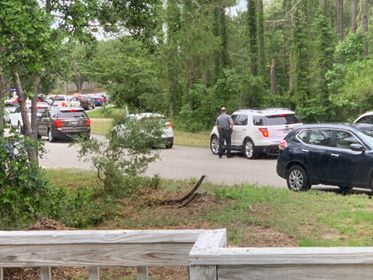
A Southern Shores police officer stops a motorist in the column of northbound traffic headed north on Hillcrest Drive today around 4:20 p.m.
Homeowners on Sea Oats Trail say the northbound traffic backup today on their street started at 3:30 p.m.
Homeowners on Hillcrest Drive near the SSCA tennis courts took the photo above at 4:20 p.m. today.
They assume the traffic stop was for speeding down the hill at what used to be known as Lookout Point and some people now refer rather gauchely to as Harry’s Hump. It is one of the few stretches of road where a police officer can park a vehicle and not impede traffic flow. It is also where frustrated motorists formed two northbound lanes of traffic yesterday.
As of 4:40 p.m., I can report a backup on Hickory Trail that extends to the intersection of East-North-South Dogwood trails and beyond.
It’s déjà vu all over again, as the great Yogi Berra said. Only 24 hours have passed.
Please feel free to post comments on the Facebook page and on The Beacon blog page about traffic conditions.
Your Facebook comments will appear immediately. I have to approve the blog comments, so they may be delayed, depending on when I receive an email informing me about them.
Two more people have tested positive for COVID-19 in Dare County, bringing the total number of cases since the pandemic began to 35, according to today’s Dare County Dept. of Health and Human Services’ dashboard.
The dashboard data show that one of the new cases is a Dare County resident; the other is not. One is female; the other is male. One is between the ages of 18 and 24; and the other is age 65 or older.
The Dare County resident is in home isolation, according to the dashboard report. The non-resident is in isolation in his or her home county.
It is impossible to distinguish in the dashboard data which is which, and Dr. Sheila Davies, director of the DCDHHS, has consistently withheld specific demographic details about the people who have tested positive. She will give a sketchy description of virus transmission about the three cases reported this weekend in her videotaped update on Tuesday. (We will update if any other cases are reported today.)
The DCDHHS dashboard also shows that the non-resident who was in home isolation in Dare County has recovered.
Today’s statewide COVID-19 statistics present another large increase in the number of laboratory-confirmed tests, but a decline in the number of hospitalizations.
Since yesterday’s N.C. Dept. of Health and Human Services’ dashboard report, 1,443 people have tested positive for the virus out of 15,440 completed tests, for a positive test rate of 9.3 percent. Dr. Mandy Cohen, NCDHHS secretary, has said that she would like to see a consistent positive-test rate of 5 percent or lower.
Since May 4—42 days, or six weeks ago—when The Beacon started keeping a daily record of the NCDHHS statistics, the positive-test rate has been 5 percent or lower on only nine days.
Hospitalizations declined today to 798 from yesterday’s single-day record high of 823. Five more people have succumbed to COVID-19, bringing the number of reported deaths in North Carolina to 1,109. Eleven percent of the deaths have been in Mecklenburg County, where Charlotte is located.
For more demographic information about COVID-19 cases in North Carolina, see:
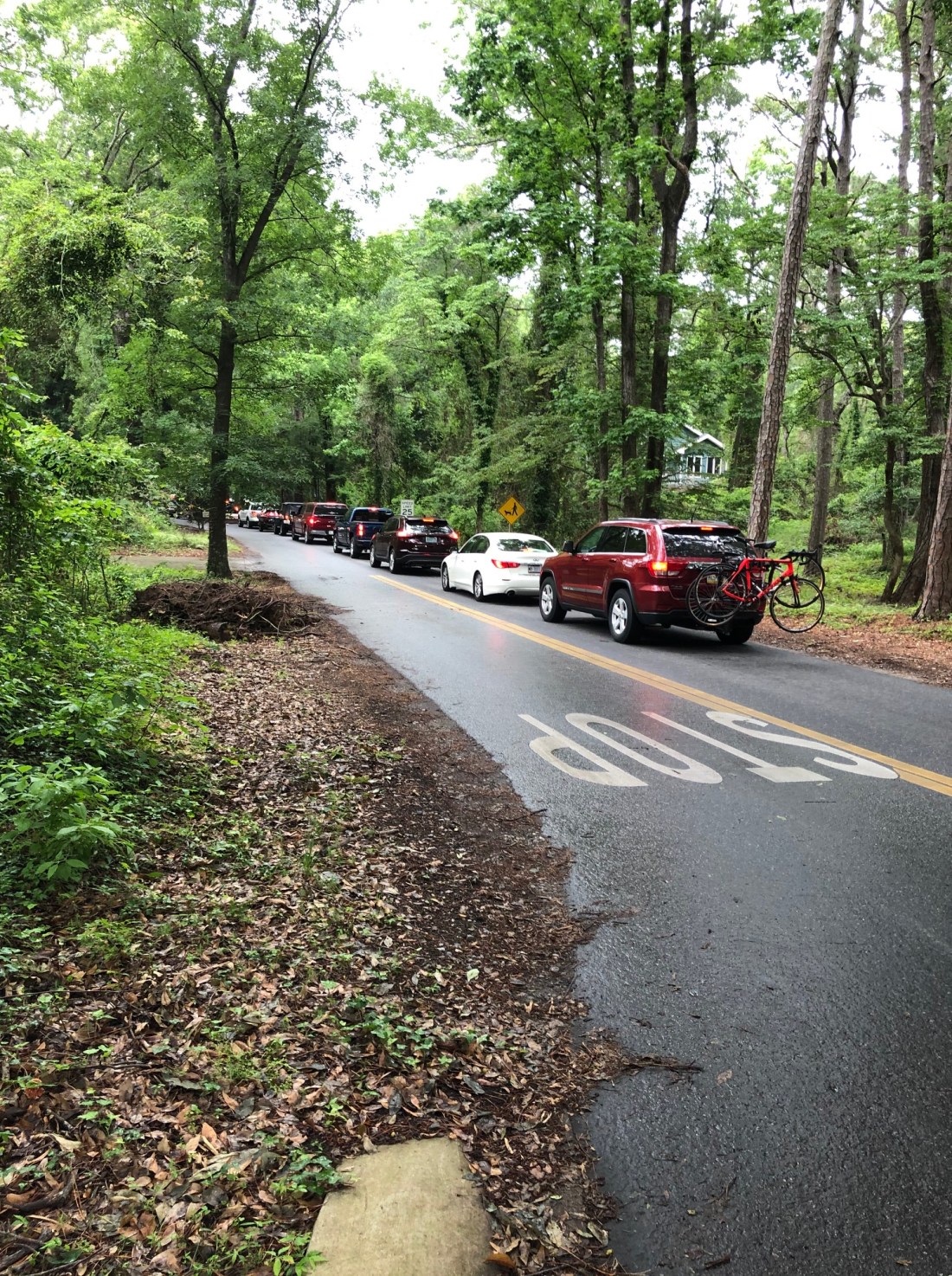
This photo depicts the traffic backup on Hickory Trail yesterday around 4:40 p.m., looking north from the East Dogwood Trail intersection. Passing motorists said the traffic was backed up to the Wright Memorial Bridge. One South Dogwood Trail homeowner reported that the traffic on her street was still backed up at 6 p.m. to the stop signs at Mallard Cove.
We would like to thank everyone who reported on traffic conditions yesterday on the cut-through route in Southern Shores and elsewhere in town. We all see firsthand a segment of the congestion on the cut-through route north, but together, we see the entirety.
Yesterday’s traffic was the worst traffic Southern Shores has ever experienced on a vacation Saturday, without a doubt. It was unprecedented. And it is only mid-June.
Yesterday’s northbound cut-through traffic was backed up at times to the Wright Memorial Bridge, according to drivers we questioned en route, making the previous Saturday’s heavy traffic seem light by comparison.
Several people contacted The Beacon to say that South Dogwood Trail was a “parking lot” until well into the evening.
Residents on Hillcrest Drive near the tennis courts reported that northbound drivers turned that street into a two-lane, one-way street for part of the day—posing the risk of a head-on collision with southbound vehicles.
Homeowners in the 300 block of Sea Oats Trail reported that the backup on their street, which started around 1:30 p.m., did not ease until 8 p.m. I saw a fair amount of northbound traffic on Hickory Trail, near the East Dogwood Trail intersection, still at 9 p.m. when I went out.
An email from a homeowner in the 300 block of Wax Myrtle Trail really brought yesterday’s over-the-top traffic conditions home for us. He wrote that he reached the Wright Memorial Bridge at 5:30 p.m. and did not arrive home until 8:30 p.m.
It took this homeowner three hours to drive less than 10 miles! Traffic moved better on Interstate 95 in Virginia yesterday, he said, than it did in Southern Shores.
It goes without saying that if any resident of Southern Shores had needed emergency service yesterday, or if a fire had occurred in a house on one of the congested roads, access by first responders would have been seriously inhibited by the bumper-to-bumper traffic, some of it in the form of large vehicles, such as the massive recreational vehicle that we saw barreling through.
The Town Council has had more than sufficient notice of the dangers posed by the traffic and of the possibility that a preventable tragedy could occur.
We all can speculate as to why the traffic has increased so markedly this June, but the reason it has ultimately does not matter. It only matters that conditions like yesterday’s cannot be allowed to continue. Public health and safety must come first and be safeguarded by taking preventive measures.
I have been advocating for solutions to cut-through traffic for years now, but the Town Council has consistently declined to take action—with the exception of the no-left-turn weekend in June 2018, which former Councilmen Gary McDonald and Fred Newberry spearheaded.
Mayor Tom Bennett, who took office in December 2013, is on the public record as opposing any measures that would inconvenience northbound vacationers, and he has always managed to have a majority of the Council support him.
Meanwhile, the traffic has only gotten worse.
The Mayor stood alone, however, in voting against the three no-left-turn weekends that the other four Town Council members approved this summer at their June 1 meeting.
“We want to get [the vacationers] here so badly,” Mr. Bennett said then, “. . . [and] we depend on them for pretty much our survival, but we don’t want them to use our streets . …”
Mr. Mayor, we would like to meet the people in Southern Shores who depend on Corolla and Duck vacationers for their “survival.”
As for Southern Shores streets, drivers passing through town are perfectly free to use N.C. Hwy. 12, which is the designated thoroughfare.
Tommy Karole, a Southern Shores homeowner who owns a restaurant in Duck and actually does have a livelihood interest in northern Outer Banks vacationers, is the chairperson of the citizens’ cut-through committee that is trying to get cut-through traffic off of Southern Shores roads.
Mr. Bennett’s concerns about what we call biting-the-hand-that-feeds-us is “the thing I have a hard time with,” he said at the meeting, “but I’ll work that out.” Not soon enough to vote in favor of his constituents’ best interests and welfare, however.
The Mayor should consider that northbound vacationers are not served, either, by an hours-long drive through the Southern Shores residential community. The shortcut their navigational device directed them to take yesterday was hardly that.
If all traffic were restricted to Hwy. 12, it would actually move faster because there would be no blockages at intersections where the cut-through side streets meet the thoroughfare. That is indeed what happened in June 2018 when the left turn on to South Dogwood Trail from U.S.Hwy. 158 was prohibited.
The three no-left-turn weekends that the Town Council approved are beginning to look like the metaphorical equivalent of applying a band-aid to a blood-gushing open head wound. We need them, but we need much more.
In the short term, the police can assist with traffic flow, moving it along on U.S. Hwy 158 and N.C. Hwy. 12 and away from South Dogwood Trail.
A coordinated effort among the Dare County Sheriff’s Office, the N.C. State Highway Patrol, and the police departments of Southern Shores and Kitty Hawk could make a measurable difference in the time it takes drivers to travel through Southern Shores and in the volume of traffic through Southern Shores’ residential areas.
In the long term, it is time to consider gating Southern Shores at every access road on summertime weekends. The Town owns the roads, except for a few private roads, and does not need federal or state money to maintain them.
Until the mythical mid-Currituck County bridge is built, Southern Shores is at risk during post-Memorial Day weekends of becoming what the Wax Myrtle Trail homeowner called “an impassable congested freeway that is a danger both to our residents and to our visiting guests.”
The coronavirus is not going away. To the extent it is a factor in the decisions people are making to vacation in, and even move to the Outer Banks—and we cannot know with a certainty what its influence is—it is going to continue to be a factor for the foreseeable future. The Town Council must protect the people who elected them to office. To do otherwise would be blatant neglect and a dereliction of public duty.
PUBLIC COMMENTS AT TUESDAY’S COUNCIL MEETING: There will be a general public comments period at the Town Council’s workshop meeting Tuesday, which convenes at 9 a.m. in the Pitts Center. If you would like to submit written comments, which would be read into the record at the meeting, please email them to Town Clerk Sheila Kane at skane@southernshores-nc.gov. Please write in the subject line to your email: “Public comment for Town Council’s June 16 meeting.”
You also may address the Town Council in person or via Zoom videoconferencing. The meeting is open to the public, but seating will be limited because of social-distancing requirements.
As you know, a public hearing on a town-wide beach nourishment project in 2022 will be held at Tuesday’s meeting, as well. You may speak during this hearing in the same manner as outlined above: 1) by submitting written comments, with the subject line, “For the June 16 public hearing on beach nourishment”; 2) by presenting comments in person; or 3) by remotely commenting via Zoom.
Comments during a public hearing are not time-limited, like comments during the public-comment period are. The limit for general public comments is three minutes.
The meeting packet for the workshop session has been updated since The Beacon last provided a link to it. It now includes a letter and “scope of professional services” proposal from Ken Wilsson, president of Coastal Protection Engineering of North Carolina, Inc. (“CPE-NC”), which has been selected by the towns of Duck, Southern Shores, Kitty Hawk, and Kill Devil Hills to be the joint project manager, designer, engineer, and permitting services provider for their 2022 projects.
Southern Shores has committed to doing five-year maintenance of its beach nourishment at Pelican Watch, but it has not yet made a commitment to a 3.7-mile-long, $14 to $16.5 million (or, likely, much more) townwide beach nourishment project.
The other three towns plan to do maintenance in 2022 of their 2017 beach nourishment projects.
Mr. Willson, who is the only coastal professional to recommend to Southern Shores that it undertake a town-wide nourishment project—and as a proactive measure, not to redress damage—proposes to receive $437,675.75 for his company’s services, some of which would be shared by the other three towns.
At a recent meeting, the Town Council determined that CPE-NC, formerly known as APTIM, did not place itself in a compromising position by undertaking a beach management plan for Southern Shores, in which it recommended a 2022 nourishment project, and then applying to manage that project. The Town did not perceive a conflict of interest because CPE-NC will not do the actual dredging and sand filling.
Nonetheless, CPE-NC stands to gain financially from directing Southern Shores toward a beach-nourishment project, which Mr. Wilsson did after initially telling the Town Council that the town’s beaches and dune system were stable and “time is on your time” in terms of doing nourishment.
The Town Council did not consider beach-study proposals from multiple coastal engineering firms before it chose APTIM—as Dare County recently did in considering an Avon study—nor did it solicit opinions from other coastal engineers after APTIM filed its reports.
Former Town Manager Peter Rascoe simply delivered Mr. Wilsson and APTIM to the Town Council, and the Council put the Southern Shores beaches in his hands.
The Council also did not confer with oceanographers and other scientists at the U.S. Army Corps of Engineers’ Field Research Facility north of Duck (the “Duck Research Pier”) who offered to consult without charge.
The considerable unchecked control that the Town Council has given Mr. Wilsson and the growing corporate enterprise of which he is a critical part troubles us a lot.