Three more people have tested positive in Dare County for COVID-19, all of them male non-residents, according to today’s Dare County Dept. of Health and Human Services’ dashboard.
The total number of COVID-19 cases reported in the county is now 49, of whom 22 are non-residents.
The three men who tested positive have been transferred to isolation in their home counties, according to the dashboard. All are under the age of 65: One is in the 18-24 age range; one is between ages 25 and 49, and the third is between ages 50 and 64.
Dr. Sheila Davies, director of the DCDHHS, will give details about the latest confirmed COVID-19 cases on Tuesday.
The “appropriate resources” that the Town said in its newsletter last Friday are lacking for next weekend’s approved left-turn prohibition at U.S. Hwy. 158 and South Dogwood Trail are police resources, according to Mayor Pro Tem Elizabeth Morey, who spoke with The Beacon this afternoon.
Until Ms. Morey informed us, we were not aware that Southern Shores police officers had monitored the U.S. 158-South Dogwood Trail intersection this weekend.
The Town announced cancellation of the June 27-28 no-left-turn weekend that had been unanimously approved by the Town Council at its June 16 meeting in a newsletter item called “Updated Schedule for Southern Shores ‘No-Left Turn Events.’”
The item also said that other no-left-turn events that the Town Council has authorized for later in the summer “may . . . be subject to change.”
The Beacon questioned both the reason for the June 27-28 cancellation and the Town’s failure to explain it. We also thought that the item’s wording about change gave rise to doubts about the Town’s commitment to the three no-left-turn weekends that the Council had approved at its June 1 meeting. (See The Beacon, 6/19/20.)
As Ms. Morey explained, the Town of Kitty Hawk, which has jurisdiction over the U.S. Hwy 158-South Dogwood Trail intersection with the N.C. Dept. of Transportation, refused to sign a written memorandum of understanding with Southern Shores on the no-left-turn weekends, absent police presence.
Mayor Tom Bennett thought Kitty Hawk had given its permission, Ms. Morey said—although the Mayor did express some lingering doubt at the June 16 meeting about the neighboring town.
The Mayor had hit on the idea, the Mayor Pro Tem said–after the miserable traffic of the June 13-14 weekend–to put barrels out in the left-turn lane on U.S. Hwy. 158, but not to have a police presence, so there would be “less cost and less strain on officers.”
When the Town of Southern Shores “went to get the agreement from Kitty Hawk,” she said, “[officials there said,] ‘No, we don’t want you to do it without police out there.’”
Southern Shores Police Chief David Kole provided police oversight at the Hwy. 158-South Dogwood Trail intersection this weekend, but he has not agreed to the June 27-28 weekend. Ms. Morey did say, however, that implementing next week’s previously scheduled no-left-turn event is “not out of the question.”
Police availability is key.
If the Council believes that “it all worked pretty well this weekend,” the Mayor Pro Tem said, it may decide “maybe we can do it next week.”
The Town Council has a “commitment to do the three [other no-left-turn weekends] that we voted on,” she said, “unless something horrible happens” that would prevent them from being held. A bad accident or an injury to a police officer on the scene, she said, would be “something horrible.”
The July 4-5 no-left-turn weekend is a definite event. The other two weekends approved by the Town Council are currently scheduled for July 25-26 and Aug. 1-2. Those dates could change, the Ms. Morey said, but the Town’s commitment would not change, absent that “something horrible” or some other occurrence that would compel cancellation.
Ms. Morey also elaborated upon an increased number of vehicle counters on the route from the Wright Memorial Bridge through Duck and the sharing of vehicle-count data among the towns of Kitty Hawk, Duck, and Southern Shores.
Counters will be set up to determine the number of vehicles that enter Duck at its south end and depart Duck at its north end, as well as elsewhere on N.C. Hwy. 12, she said, giving the three towns a better idea of how many vehicles are merely passing through Dare County to vacation on the Currituck beaches.
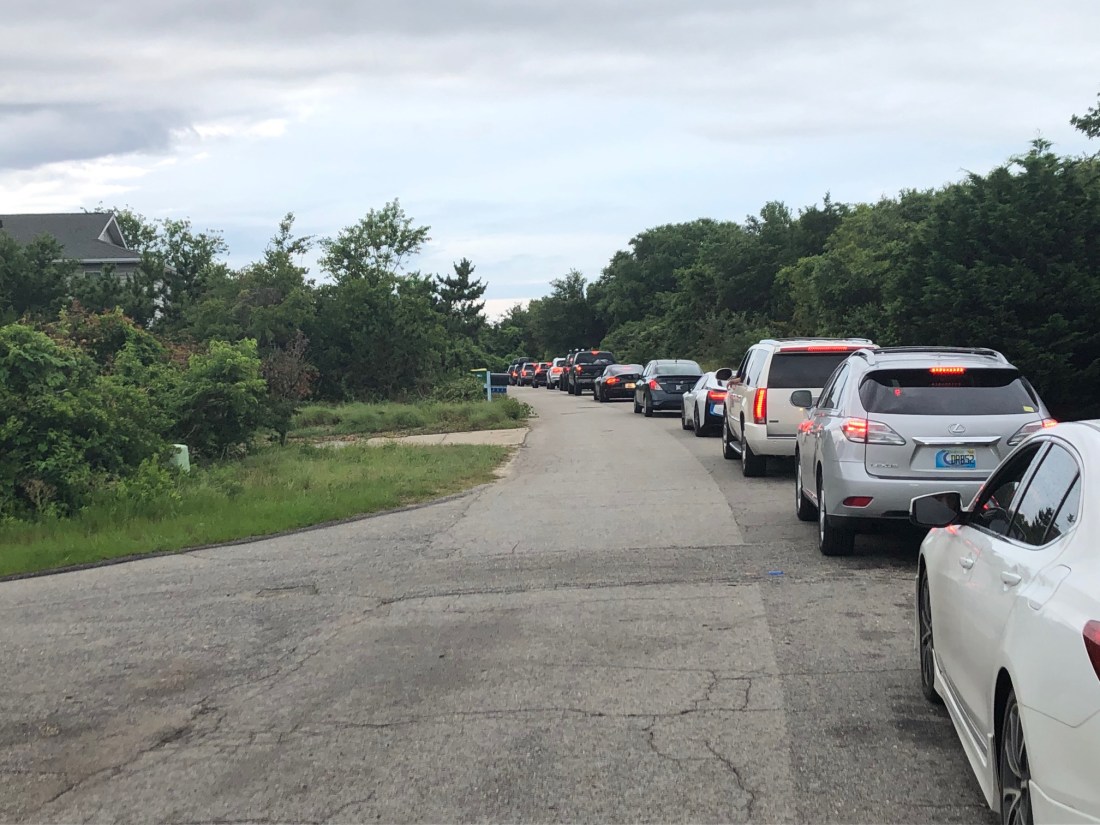
Traffic backup yesterday around 7 p.m. on Sea Oats Trail. (Photo courtesy of a homeowner.)
At noon on Hickory Trail, near the intersection with East Dogwood Trail, there is only an occasional vehicle passing by, and it is quiet.
Please let us know the traffic conditions on your street as the day progresses. You may post comments on the blog website or on the Facebook page. We also will check The Beacon’s email.
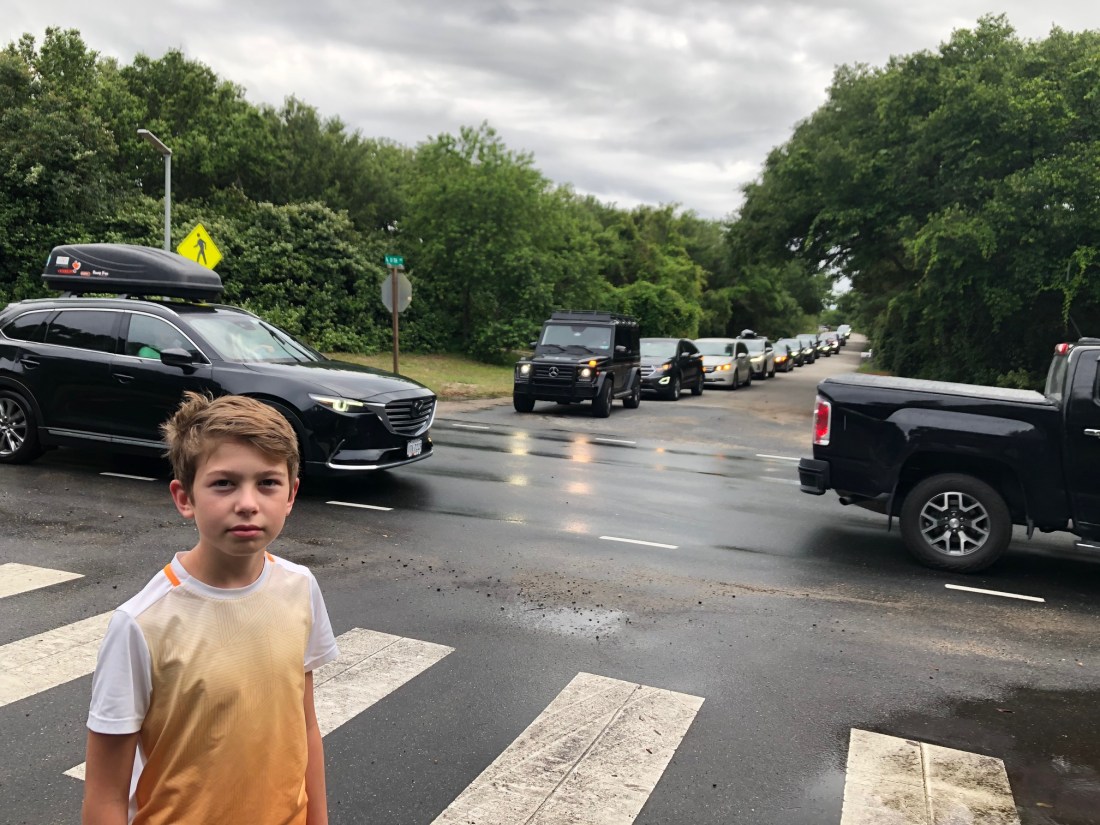
A homeowner’s grandson stands across from a traffic backup on Eleventh Avenue, which is controlled only by a stop sign, at Duck Road yesterday at 6:45 p.m. (Photo submitted by the homeowner.)
The cut-through residential roads in Southern Shores were pleasantly open and quiet yesterday until northbound vacationer traffic started picking up around 4 p.m., causing backups at intersections with N.C. Hwy. 12 (Duck Road), according to reports to The Beacon by a number of homeowners.
Waves of vehicles began running the stop sign at the East Dogwood Trail-Hickory Trail intersection yesterday about 4:30 p.m., but had mostly subsided by 7:15 p.m..
The backup on Sea Oats Trail from the Duck Road traffic light lasted from about 4 p.m. to 8 p.m., according to homeowners on that heavily traveled cut-through road.
The Beacon also heard from homeowners on Wax Myrtle Trail, who live between Hickory Trail and Hillcrest Drive, that traffic moved smoothly, if too quickly, yesterday afternoon until it came to a dead stop around 6:30 p.m.
We did not hear when the backup on Wax Myrtle Trail subsided.
The photograph above shows young Hugh Hoskins across the street yesterday at 6:45 p.m. from traffic backed up on Eleventh Avenue at Duck Road.
All in all, we would say that this hastily arranged no-left-turn weekend, which was not policed, was a success, considering the nightmarish congestion of the past two weekends.
From about 10:45 a.m. until about 4:15 p.m. yesterday, Hickory Trail was a quiet, pleasant street on which to live, walk, jog, and cycle. Homeowners who live north of Hickory Trail enjoyed the peaceful conditions, too—albeit for a shorter time, if they live on Sea Oats Trail.
Adjectives used by homeowners on Hillcrest Drive, Sea Oats Trail, and Wax Myrtle Trail yesterday to describe the traffic until the backups started included: “Fantastic!” “Wonderful!” and “Delightful!”
No one reported any problems on Juniper Trail/Trinitie Trail or Chicahauk Trail, nor did we hear from anyone who lives on South Dogwood Trail.
The Town should consider making modifications for the next no-left-turn weekend, which as of today appears to be July 4-5.
A homeowner on Duck Woods Drive reported that motorists were making U-turns at his street, off of U.S. Hwy. 158, and double-backing to South Dogwood Trail to make legal right turns. This was a problem with the June 2018 no-left-turn weekend and should be addressed. There are ways in which to discourage this “work-around.”
It was not clear to The Beacon how many of the motorists who came through the dune roads accessed them by jumping off of Duck Road. No one reported seeing motorists short-cutting from Duck Road, but it is a safe assumption that some did.
These access points have been discussed at public workshops about the cut-through traffic, which all Town Council members have attended. Preventing access to Wax Myrtle Trail, Sea Oats Trail, and Hillcrest Drive via Duck Road, rather than via South Dogwood Trail, should be addressed by the Town.
The Beacon thanks everyone who participated in yesterday’s monitoring of the traffic. Your firsthand observations are critical to understanding what is happening on our roads and to taking steps to improve conditions. We welcome your comments today.
This photo depicts a backup last weekend on Hillcrest Drive just before the SSCA tennis courts. The backup extended south on the residential cut-through route back to a line on the Wright Memorial Bridge, waiting to turn left at South Dogwood Trail.
Two young non-residents, one female and one male, have tested positive for COVID-19 locally and been transferred to their home counties for isolation, according to today’s Dare County Dept. of Health and Human Services’ dashboard.
The dashboard reports that one of the young people who tested positive is 17 years old, and the other is between the ages of 18 and 24.
Of the 46 COVID-19 cases reported in Dare County, more than half (25) involve people under the age of 50. Forty-one percent (19) are non-residents.
As The Beacon reported in detail yesterday, Dare County is responding to the rising number of confirmed COVID-19 cases both statewide and locally by implementing a mandatory face-covering requirement, effective tomorrow at 9 a.m.
The order requires face coverings on all “customers, employees and other users of restaurants, grocery and retail stores,” when they are indoors, and on all “persons in any other indoor or outdoor setting” in which they cannot maintain six-foot social distancing.
The county’s order further requires people to wear face coverings that cover both their noses and mouths.
Children under age 12 are exempt from the face-covering requirement. Other situational exceptions to the order include while dining in a restaurant and while in the company only of fellow household members. (See The Beacon, 6/19/20, for a list of exceptions.)
Violation of the face-covering requirement is punishable as a Class 2 misdemeanor, which carries a penalty of up to a $1,000 fine and 60 days’ imprisonment.
At a press briefing Thursday, Governor Roy Cooper strongly used North Carolinians to wear face masks or coverings to slow the spread of COVID-19 and said he is considering imposing a statewide face mask/covering requirement.
The Governor also promised to announce a “comprehensive plan” to address COVID-19 conditions in North Carolina next week ahead of the June 26 expiration of Phase Two of the state’s economic reopening.
For the first time Thursday, Dr. Mandy Cohen, secretary of the N.C. Dept. of Health and Human Services, publicly acknowledged that the rising number of COVID-19 cases in North Carolina is not “due to [increased] testing alone.”
“Cases are being driven by younger folks,” she said, especially those between the ages of 25 and 49 who “may be asymptomatic and can spread” the virus.
A WORD ON TRAFFIC TODAY: The prohibition on the left turn from eastbound U.S. Hwy. 158 on to South Dogwood Trail took effect at 11 a.m. today and will continue until 8 p.m. The same hours will be in effect tomorrow.
Please let us know the traffic conditions that you experience on your road and elsewhere in Southern Shores throughout today and tomorrow. We are counting on your firsthand reports to document the effects of the closure of South Dogwood Trail to traffic arriving in Dare County that is headed north.
I can already detect at 11:30 a.m. a difference in the volume of northbound traffic flow and the traffic noise level on Hickory Trail, near the East Dogwood Trail intersection.
Face coverings must be worn in indoor and outdoor public spaces in Dare County in which six-foot social distancing cannot be maintained starting Sunday at 9 a.m., according to an amendment to the county’s emergency declaration for COVID-19 signed today by Dare County Board of Commissioners Chairman Bob Woodard.
Just last Friday, Mr. Woodard announced that the Dare County Control Group, which he also chairs, had met and decided to “strongly encourage” face masks or other face coverings whenever “people are in close contact with others,” but not to make their use mandatory.
The reason the Group did not act, Mr. Woodard said, was because of the “inability to enforce the requirement.” (See The Beacon, 6/13/20.)
Enforcement apparently is no longer an obstacle for the Chairman.
The updated declaration, which covers all areas of Dare County, including the towns of Duck, Southern Shores, Kitty Hawk, Kill Devil Hills, Nags Head, and Manteo, as well as the unincorporated areas on Hatteras Island and the Dare mainland, reportedly came after a discussion held this afternoon by county officials about the current state guidelines that strongly encourage face coverings. [Update: The Chairman clarified later that he met with the county’s mayors.]
(See The Beacon’s story earlier today about the Governor’s press briefing yesterday.)
“Voluntary compliance with face covering recommendations has not been effective within Dare County,” said a 5:41 p.m. emergency alert issued today by the county with news of the requirement, “and local business owners have requested a stronger tool for compliance.”
The face-covering amendment specifically provides that “[W]hile indoors, all customers, employees, and other users of restaurants, grocery and retail stores and all persons in any other indoor or outdoor setting in which people cannot maintain” six-foot physical distancing “shall wear a face covering which covers the nose and the mouth.”
Children who are under the age of 12 are excluded from the order’s reach.
Other exceptions to the requirement include:
“While dining in a restaurant”;
“For reasons related to any individual’s medical condition, behavioral condition, disability or religious beliefs”;
“[While] in private separate offices”;
“[When with] household family members”;
“When complying with directions of law enforcement officers”;
“[While] in settings where it is not practical or feasible to wear face coverings when rendering or obtaining goods or services”; and
“[While] in areas of retail establishments, businesses and restaurants that are not open to the public and recommended distancing is maintained.”
A violation of the face covering order is punishable as a Class 2 misdemeanor, which carries a possible fine of up to $1,000 and imprisonment of up to 60 days.
“Wearing a face covering or mask in public when unable to social distance is crucial to maintaining the health and safety of the Outer Banks community,” the county’s emergency alert concludes.
But it also cautions people to “[k]eep in mind that there may be justifiable reasons some individuals are not wearing a mask or cloth face-covering in public.
“Please be kind, show compassion and wear your mask to protect those who can’t.”
With only the vaguest of explanations, the Town of Southern Shores has canceled implementation of a no-left-turn weekend June 27-28 that the Town Council unanimously approved and budgeted funds for just three days ago.
In announcing the cancellation today, the Town confirmed that prohibition of the left turn on to South Dogwood Trail from eastbound U.S. Hwy. 158 will occur tomorrow and Sunday, from 11 a.m. to 8 p.m., as the Council authorized.
The June 27-28 no-left-turn weekend was canceled, the Town’s release said, “due to not having the appropriate resources.”
The Beacon hopes that when new town manager Cliff Ogburn comes on board next week, he will ensure that Town announcements actually inform Southern Shores property owners and residents, and not just demoralize them.
Perhaps Mr. Ogburn will even have ideas on how to salvage an event by finding “appropriate resources” elsewhere.
Today’s announcement by the Town also casts doubt on the holding of the three no-left-turn weekends that the Town Council approved June 1 to be held in July-August.
It states: “The dates and/or times of the remaining scheduled events may also be subject to change.”
The Town Council discussed at its June 16 workshop meeting possibly scheduling no-left-turn weekends on different July weekends than the ones it has previously approved—which are July 4-5, July 25-26, and Aug. 1-2–as well as on additional July weekends.
By its language, however, the Town’s announcement unnecessarily calls into question the Town Council’s commitment to holding three no-left-turn weekends during July-August, not just the dates of those three weekends.
A limited number of appointments are still available for COVID-19 antibody testing, and “plenty” of diagnostic drive-thru testing appointments remain for the June 30 testing clinic in Kill Devil Hills, according to an update today by the Dare County Dept. of Health and Human Services, which reports that 265 appointments have been booked.
Appointment scheduling just started today.
The clinic will be held at the Parks & Recreation facility at 602 S. Mustian St., in Kill Devil Hills, starting at 10 a.m.
You may call (252) 475-5008 to schedule an appointment, Monday through Friday, from 8:30 a.m. to 5 p.m. (See yesterday’s Beacon for more details.)
The DCDHHS also reported today on the two people who have tested positive in Dare County for COVID-19 since Tuesday, when the County gave details about the 10 people who tested positive between June 12 and Tuesday.
As The Beacon reported earlier this week, both new cases are female non-residents between the ages of 18 and 24.
The one whom we reported is symptomatic and recovering in her county of residence acquired the virus from direct contact with another non-resident who was diagnosed last week, according to today’s bulletin.
The other young woman, who is asymptomatic and isolating in Dare County, acquired the virus from direct contact outside of Dare County, the bulletin reports.
Between June 12-16, 10 new COVID-19 cases were diagnosed in Dare County, five residents and five non-residents. (The Beacon reported on the sex, age, and residency status of each new case as it was reported on the DCDHHS dashboard.)
The five residents are symptomatic and are recovering in home isolation. Four other residents still have active cases, according to the DCDHHS, and four of the five are in home isolation. The fifth is in the hospital.
The five non-residents have returned to their home counties. Only one of them is symptomatic. (See The Beacon, 6/16/20, for more details.)
The DCDHHS defines “direct contacts” as people whom the COVID-19-positive person identifies as coming within six feet or less of him or her for 10 minutes or longer.
The DHHS monitors all positive cases daily throughout their isolation period.
As of 4 p.m. today, the total number of COVID-19 cases diagnosed in Dare County is still 44.
“We do not want to go backward,” Governor Cooper said yesterday about the state’s phased reopening, but North Carolinians, he noted, have to do more to slow the spread of COVID-19 by “wearing face masks and social distancing.”
Yesterday’s press briefing about COVID-19 with Governor Roy Cooper and Secretary of the N.C. Dept. of Health and Human Services Dr. Mandy Cohen was all about wearing face masks or other face coverings to slow the spread of the virus and whether or not to impose a statewide face-mask requirement.
New lab-confirmed cases of COVID-19 in North Carolina continue to increase daily, as do hospitalizations. Today’s reported new case total of 1,652 is the second highest single-day count reported in the state. The previous high was 1,768 on June 12. Hospitalizations have hit a new record-high of 871 statewide. Deaths now number 1,197.
“These numbers continue to concern us,” Governor Cooper said at the top of yesterday afternoon’s briefing in Raleigh, and yesterday’s numbers, which he cited, look good compared to today’s.
For the first time Dr. Cohen publicly acknowledged that the rising number of COVID-19 cases in North Carolina is not “due to [increased] testing alone.”
“Cases are being driven by younger folks,” she said, especially those between the ages of 25 and 49 who “may be asymptomatic and can spread” the virus.
Both the Governor and the Secretary touted the use of facial coverings.
“Wearing a face covering when you’re around other people slows the spread of the virus,” the Governor said emphatically, citing scientific evidence in support of the effectiveness of masks against viral transmission.
“This is a low-cost, low-tech way to protect ourselves and our communities,” he continued. “ . . It’s not the most comfortable thing that you wear, but you get used to it. It’s a piece of protection,” like a glove in cold weather.
“This is the thing that we should do to slow the spread [of COVID-19] and get our economy going,” the Governor stated unequivocally.
The Governor said he is considering imposing a statewide face mask/covering requirement and promised he would announce a “comprehensive plan to slow the spread of the virus in North Carolina” next week ahead of the June 26 expiration of Phase Two of the state’s economic reopening.
To make their point about masks, Dr. Cohen even demonstrated how to put on and take off a face covering, stressing that it must cover both the wearer’s nose and mouth and that wearers must wash their hands after removing it.
The state’s top public-health official advised wearing a face covering “when you’re out at any time” and called it an “incredibly effective tool” to stop the spread of COVID-19.
THE QUESTIONS WE WANT ANSWERED
Governor Cooper’s and Dr. Cohen’s remarks during the briefing lasted only minutes. Most of the 45-minute-long briefing was dedicated to a media Q & A period.
Jonah Kaplan, an investigator reporter with ABC-11 in Raleigh-Durham, asked pointed questions of both the Governor and the Secretary that we all want to ask and hear honestly answered. The responses he received were definitely guarded, but not so political as to be void of meaning.
Of Governor Cooper, who responded to another reporter’s question just before Mr. Kaplan’s inquiry by saying, “We need more people to wear masks. We need to figure out the best way to do that,” he asked:
“What’s holding you back from making this [masks] mandatory this minute?” Why wait until next week?
Of Dr. Cohen, Mr. Kaplan asked:
“Who is getting the virus?”
“What are you learning from the contact tracers?”
“What percentage of the cases are from community transmission?”
And then this zinger: Are “known cases” contracting the virus from “attending mass protests, eating at restaurants, praying at churches, flying on airplanes” or are most people contracting the virus “at workplaces and congregate living settings?”
We will give you the most revealing answer—or perhaps more accurately, the most revealing non-answer—to Mr. Kaplan’s questions first.
Dr. Cohen did not directly respond to the query about who is getting the virus and what the contact tracers are learning because, she said, the “detective work . . . takes a fair amount of time,” and it is still on-going.
But in response to the TV reporter’s zinger about the settings in which viral transmission is occurring, Dr. Cohen replied, “All of the above.”
Restaurants, airplanes, churches, protests, long-term residential facilities, workplaces . . . all of the above.
The Secretary declined to cite a percentage for community transmission, saying only that, “We are having community spread” at all of the settings Mr. Kaplan listed because they present a “higher risk.”
Whenever “folks are closer together for longer periods of time,” Dr. Cohen said, especially in cooler temperatures (think air-conditioning), the risk of community spread transmission is higher.
The Secretary added meat-packing plants to Mr. Kaplan’s list of “hot spots” for COVID-19 transmission.
As for why Governor Cooper is “holding back” on a mandatory face-covering requirement, when, as he earlier stated, “Clearly, we want people to wear masks,” the Governor, who is an attorney, responded: “There are probably more than a dozen ways you could write a law requiring face masks in different kinds of settings for different kinds of people.”
Before he approves one, he wants the law to “be careful . . . be specific . . . [and] based on the best evidence.”
The requirement must be “well thought through,” the Governor explained, and “be effective with the least intrusion that we can have on people.”
Ultimately, he replied to Mr. Kaplan that you “get better results if you can convince the public heart and soul that this is a good thing to do.”
The Governor is looking to “business leaders, preachers, athletes,” and TV celebrities to “come forward” to do some of that convincing in public-service announcements and other public forums.
He clearly would rather cajole people than legally compel them to do what he knows–and any other well-informed person knows–is best for public health. That he is up for reelection in November cannot be ignored.
The Governor said earlier that he wants to “remove the politics out of all of this,” and started doing his own convincing by observing that “strong people wear masks.”
By wearing a mask, he said, “strong” people show compassion; they show that they “actually care about people.”
During the briefing, he also said that “the mandatory nature” of a face mask/covering requirement is “being considered and studied” by his Office.
Asked specifically by another reporter during the media portion about enforcing a face-mask requirement, the Governor said, “You need to have some kind of enforcement.” Enforcement is “one of the issues we would look at.”
The Governor, Dr. Cohen, and every other state official who spoke yesterday entered the briefing room wearing a face covering. Only the sign language interpreters had their faces uncovered, in order for their lips to be visible.
COVID-19 IN DARECOUNTY: The Beacon will report later today on Dr. Sheila Davies’s videotaped message about the two new COVID-19 cases that have been diagnosed locally since her last update Tuesday. Please see our post yesterday for details about a COVID-19 diagnostic and antibody testing clinic on June 30 in Kill Devil Hills.
Dr. Cohen reported yesterday that there are now more than 500 COVID-19 testing locations in North Carolina. They are listed on the NCDHHS website.