10/19/18: SAGA’S 12-BEDROOM, 17-PARKING-SPACE PLAN FOR 134 OCEAN BLVD.; OBJECTIONS TO MAYOR’S SCHEDULING OF MORNING MEETING NOV. 7 ON OCCUPANCY LIMITS; A CHANCE ENCOUNTER


higgins2.jpg
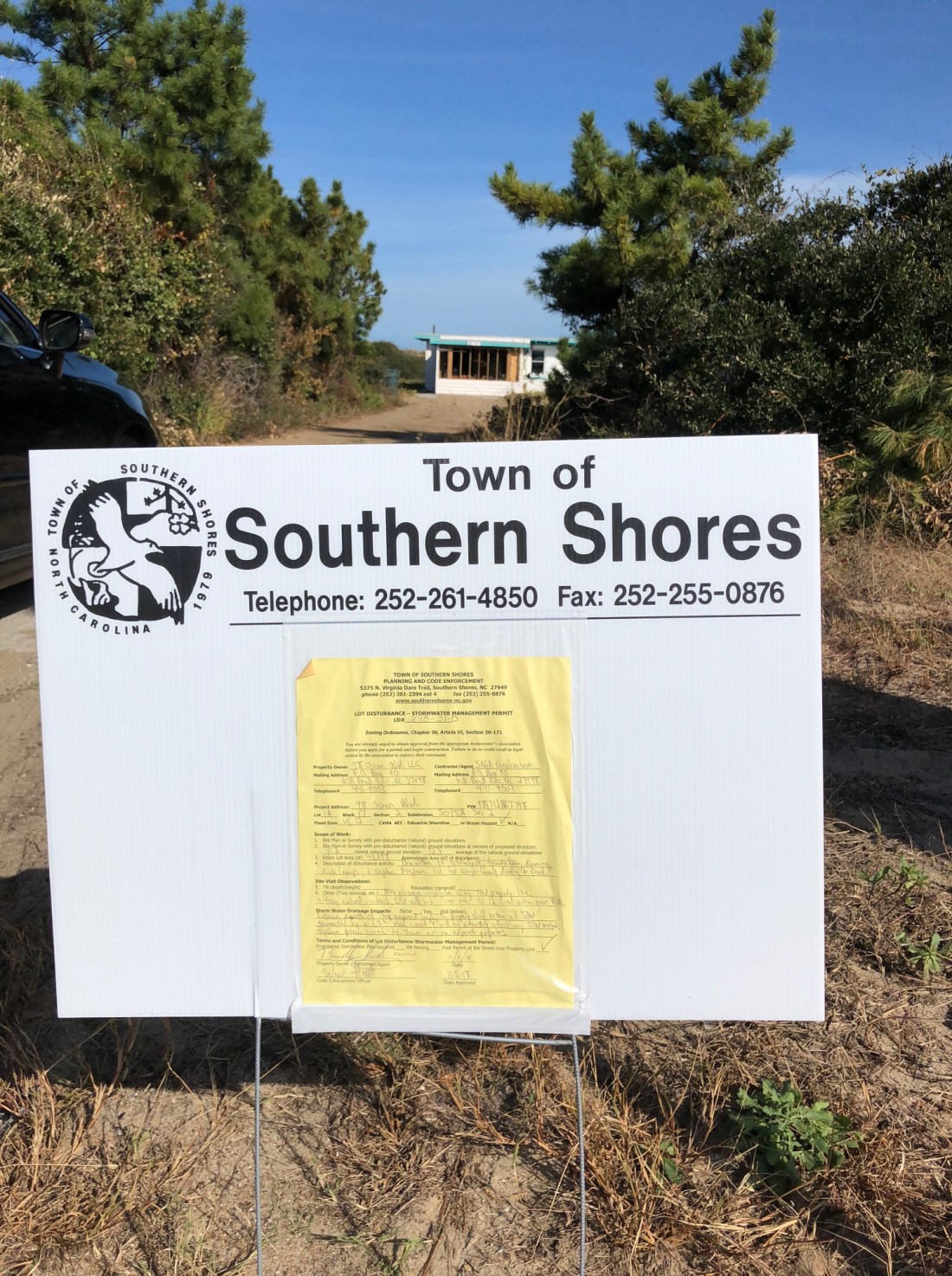
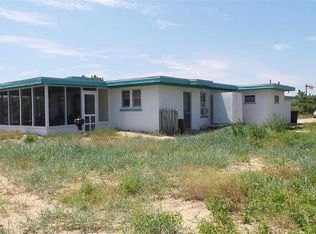
At 134 Ocean Blvd., footprints lead to Higgins’ Haven, a picturesque part of the Southern Shores oceanfront for 60 years, now destined for SAGA’s wrecking crew.


The 5,945-square-foot house that SAGA Construction proposes to build at 134 Ocean Blvd., on the Southern Shores oceanfront, is virtually identical to the 5,981-square-foot house it proposes to construct at 98 Ocean Blvd., after demolishing an original Frank Stick-designed flattop, The Beacon has confirmed. The demolition at 134 would be of “Higgins’ Haven,” a modified flattop that was #014 in Southern Shores Realty’s rental program this year.

According to documents submitted by SAGA for its CAMA minor permit, the house proposed at 134 Ocean Blvd., which is just south of the Duck Road split, would have 12 bedrooms and 12 bathrooms in “suites,” a 14-seat home theater, an elevator, a swimming pool, hot tub, tiki bar, large game/recreation room, and interior bar. It also would have 11 parking spaces on the driveway and six spaces underneath the house and septic capacity for 24 people.

The Dare County Dept. of Public Health Improvement Permit in the Town Planning Dept’s. file for 134, which issued Oct. 4, shows a septic tank size of 2,500 gallons and a per-day capacity of 1,440 gallons. It also shows seller Clay E. Higgins, in his capacity as a trustee, as the property owner, not SAGA.

According to the purchase offer and acceptance on file, settlement on the 134 sale was to occur Sept. 28. Property owners Mr. Higgins and his wife, Franca B. Higgins, also a trustee, live in Harbinger.

Comparable paperwork for 98 Ocean Blvd. shows a 3,500-gallon septic tank and a 1,440-gallon-per-day capacity, and SAGA as the property owner. That permit issued Oct. 2.

Although the parking lot and swimming pool layouts at 134 differ from those at 98, the house designs are essentially the same. The architect for both is Community Planning and Architectural Associates (CPAA) of Kitty Hawk. Judging by CPAA’s plans, the bedrooms appear to be about 13-feet-by-11-feet, and their layout suggests a dormitory.

MY OPINION: This is cookie-cutter construction and development, which is SAGA’s goal. One need only look at the Nags Head oceanfront to see one identical, indistinguishable SAGA mega-house after another on the oceanfront.

For background on SAGA’s proposed projects in Southern Shores, see The Beacon’s blogs on 10/10, 10/11, and 10/16/18.

134 OCEAN BLVD. BY THE NUMBERS

Here are the numbers that SAGA provides in its building plans for lot-coverage purposes:

Proposed residence: 3,900 sq. ft.

Concrete parking and drives: 4,284 sq. ft.

Pool and concrete decks: 2,079 sq. ft.

Wood beach walkway and deck: 344 sq. ft.

The total coverage adds up to 10,607 sq. ft.

SAGA claims a lot area to the first line of stable natural vegetation (FLSNV) of 36,925 sq. ft., and, therefore, lot coverage of 28.7 percent. The Town limits lot coverage to 30 percent.

Elsewhere in its documentation, SAGA reports a lot size of 46,702 sq. ft., or 1.07 acres.

SAGA’s numbers for “enclosed living space” for purposes of calculating house size are as follows:

Ground level: 301 sq. ft.

First floor:  2,822 sq. ft. (enclosed); 865 sq. ft. deck area

Second floor: 2,822 sq. ft. (enclosed): 865 sq. ft. deck area (Notice the identical floors.)

The total enclosed area adds up to 5,945 sq. ft., and the deck area is 1,730 sq. ft.

In addition, SAGA’s plans show an unenclosed area below the enclosed area of 2,517 sq. ft., where six vehicles can be parked.

The maximum house size permitted by ordinance in Southern Shores is 6,000 square feet of enclosed living space, which is further defined as habitable space. In its plans for 98 Ocean Blvd., SAGA exempts from its size calculation a 124-square-foot, “unconditioned” enclosed space that serves as a storage area.

I have to wonder if such an exemption should be allowed by the Town. A 124-square-foot space easily could be converted into a thirteenth bedroom. I am aware of a permitted garage addition to a house on North Dogwood Trail that, despite being done after the 6,000-square-foot maximum went effect, brought the total size of the house to over 6,000 square feet. Why wasn’t this violation prevented?

As previously reported, the adjacent property owners to the north of 134 Ocean Blvd. have objected to SAGA’s project. They live in Emporia, Va. The Southern Shores Civic Assn., which owns a beach access that adjoins the property to the south, filed its written objection yesterday.

The CAMA permit for 98 Ocean Blvd. could issue any day. When it does, the SSCA will receive notification and instructions on the appeal process for the denial of its objection.

MORNING MEETING ON NOV. 7 BURDENSOME AND EXCLUSIONARY

I am hearing from property owners that they object to the timing of the special meeting to consider occupancy limits for single-family dwellings in Southern Shores, scheduled by the Town at 10 a.m. on Wed., Nov. 7, in the Pitts Center. I agree with these property owners’ concerns.

A morning week-day meeting excludes property owners who work daytime hours, both inside and outside the home, residents say. In addition, scheduling the meeting on the same day as the Town Council’s regular evening meeting—which will be unusually agenda-heavy because the Town Council voted, 3-2, to cancel its October meeting—AND on the day after national midterm elections, is unduly burdensome.

How many members of the public will be inclined to attend both meetings? And aren’t public meetings for the benefit of the public? The public is entitled to a realistic opportunity to be heard.

Mayor Tom Bennett is responsible for the scheduling of the Nov. 7 morning meeting. Any objections by Town Council members to this scheduling have not been persuasive. You may reach Mayor Bennett at tbennett@southernshores-nc.gov.

I am also hearing residents criticize the Town Council, which has made no public statement since the SSCA announced SAGA’s 98 Ocean Blvd. plans, at its Oct. 8 meeting, as a “do-nothing” Council. In fact, I heard that term just this morning when I was out walking my dog. This particular resident and fellow dogwalker, whom I do not know personally, said “do nothing” is what she has come to expect of this Town Council in terms of limiting development.

I do not believe it is correct or fair to impute the Mayor’s reasoning and actions to any Town Council members. It is the Mayor who decided the date and time of the special meeting, not the Town Council. And it is the Mayor who could change the date and time, if he chose to do so.

NO DUCK PLANNING BOARD MEETING – MEA CULPA – BUT IT LEADS TO AN UNEXPECTED ENCOUNTER

Contrary to what I reported on Tuesday the Duck Planning Board did not hold a meeting last night. Mea culpa. I misread the Town of Duck’s calendar on its website. In fact, the Duck Planning Board met on Oct. 10 and will next meet on Nov. 14. Duck is also grappling with how to limit occupancy in “single-family” dwellings.

My trip to Duck last evening was not wasted, however, because I met and chatted with a longtime Dare County resident who showed up at the town meeting hall because he had seen my post about a Planning Board meeting. I will not name him because I did not inform him that we were “on the record,” and I have no desire to ambush people!

This gentleman, whom I’ll call Mac, is of the opinion that the Senate Bill 25 amendments to N.C. General Statute 160A-381, which took effect in 2015, prohibit towns from regulating septic capacity. Mac referred to the following language in the law for his argument:

“Regulations prohibited by [160A-381(h)] may not be applied, directly or indirectly, in any zoning district . . . unless voluntarily consented to by the owners of all the property to which those regulations may be applied . . . ”

Mac believes a limit on the septic capacity of single-family dwellings would be an “indirect” application of a regulation on the number of bedrooms. He asserts that this is what the N.C. General Assembly intended.

NCGS 160A-381(h) lists those building-design elements that counties and towns cannot regulate, and one of them is “the number and types of rooms.” Hence, the invalidation of the seven-bedroom restriction in Southern Shores.

When I practiced law in Maryland, I did a fair number of “statutory-construction” cases on appeal, where the question was: What does the state statute mean?

It is not unusual for state legislatures to approve unclear or ambiguous statutory language or language that is subject to multiple interpretations. The overriding legal principle that I applied in my analyses was “the plain meaning of the language.” What does the statute plainly mean, on its face? One shouldn’t have to delve into legislative history in order to discern what words are supposed to mean, although where several meanings are reasonably possible, legislative intent may come into play.

I argued with Mac that the plain meaning of the word “indirectly” did not support his interpretation, and that a court would have to render the definitive judgment in a legal dispute. IMO, it requires a contortion of words to arrive at Mac’s interpretation, despite what legislators might have said in committee hearings or elsewhere.

If the General Assembly wanted to prohibit regulations restricting septic capacity, it should have clearly said so.

EARLY VOTING IN THE NOV. 6 GENERAL ELECTION STARTED YESTERDAY. I will post my analysis of judicial candidates and the proposed constitutional amendments by the weekend, at the latest.

REMEMBER: The Pitts Center is not a polling station for early voting, aka one-stop absentee voting, in this election. The polling stations are as follows:

DARE COUNTY ADMIN. BLDG., 954 Marshall C. Collins Drive, Manteo

KDH TOWN HALL, 102 Town Hall Drive, KDH

FESSENDEN CENTER ANNEX, Buxton

For more election details, see The Beacon’s 9/26/18 post.

Ann G. Sjoerdsma, 10/18/18

10/16/18: 12-BEDROOM, 6,000-SQ. FT. RENTAL HOUSES: SAGA HAS PROPOSED TWO: 98 and 134 OCEAN BLVD.; TOWN SCHEDULES SPECIAL MEETING NOV. 7; PLANNING BOARD POISED TO ACT, ‘CHARACTER OF TOWN’ AT STAKE; SSFVD’s Conditional Use Permit for New Fire Station Granted

higgins
In another Southern Shores project, SAGA Construction proposes to demolish this modified flattop at 134 Ocean Blvd. and build a nearly 6000-square-foot, high-occupancy, “single-family” dwelling.

The Town of Southern Shores announced yesterday that it will hold a special meeting Wed., Nov. 7, 10 a.m., in the Pitts Center to consider all options “to further limit occupancy of single-family dwellings in Southern Shores.” Currently, the Town seeks to preserve its traditional open-space, low-density neighborhoods by restricting single-family house size to 6000 square feet of “enclosed living space.”

The Town’s meeting notice, posted on the front page of its website, cites “alarm” voiced by “some property owners” over the ability of a “party requesting [a] permit . . . to design 12 bedrooms within” the “maximum allowable 6,000 square feet of living space for a single-family dwelling,” as the reason for the meeting.

The notice makes no mention of the SAGA Construction building project at 98 Ocean Blvd. and its various features (e.g., 17 parking spaces) that have aroused “alarm”—and outrage—among “some” property owners—do dozens or hundreds qualify as “some”?—nor does it fairly represent those Town Council members who have expressed their opposition to the SAGA projects in informal discussions. The Beacon is aware that at least one Town Council member wanted to hold a special meeting well before Nov. 7, the same day that the Council meets in the evening for its regular monthly meeting.

And why has the Town scheduled a meeting on a week-day morning when daytime working people cannot attend?

I say SAGA projects, plural, because The Beacon has confirmed that, in addition to the 12-bedroom, 12-bathroom, 5981-square-foot rental house proposed by the Kill Devil Hills-based developer at 98 Ocean Blvd., as reported in this blog 10/10/18, SAGA also proposes to demolish a flattop and build a similar structure at 134 Ocean Blvd. (See photo above.)

According to Town Permit Officer Dabni Shelton, “134 Ocean Blvd., LLC,” whose agent is SAGA Construction, filed a CAMA permit application for that property, which is just south of the Duck Road split, on Oct. 11. In a telephone conversation I had with Ms. Shelton this morning, she characterized the proposed project at 134 Ocean Blvd. as “substantially different in parking and location of the pool,” from the one proposed at 98 Ocean Blvd.

Ms. Shelton said the “layouts” for the two projects differ, and that the “total floor area” claimed by SAGA for the proposed structure at 134 Ocean Blvd. is 5945 square feet, whereas the total floor area at 98 Ocean Blvd. is 6105 square feet. Total floor area is a measurement considered under CAMA. The Town’s calculation for living space is different. (I will review the permit file on 134 Ocean Blvd. at Town Hall as soon as I can. BLOG POST COMING 10/18/18 ABOUT THE PROPOSED STRUCTURE AT 134 OCEAN BLVD., WHICH IS VIRTUALLY IDENTICAL TO 98 OCEAN BLVD.)

The adjacent riparian property owners (homeowners) to the north of 134 Ocean Blvd.—at 136 Ocean Blvd.—have objected in writing to SAGA’s project, according to Ms. Shelton. This SAGA property, like the property at 98 Ocean Blvd., adjoins a beach access owned by the Southern Shores Civic Assn. The SSCA has objected to the proposal for 98 Ocean Blvd. (see The Beacon, 10/10/18), but not yet filed its response for 134 Ocean Blvd. (UPDATE: SSCA OBJECTION FILED 10/17/18.)

Ms. Shelton told me that the SSCA received delivery of the certified-mail notice of SAGA’s proposed project at 134 Ocean Blvd. on Oct. 9, according to U.S. Postal Service records. The civic association has 10 days after receipt of this notice in which to reply.

MY OPINION: The SSCA should wait until the last day of the 10-day period to file its letter of objection. Until this period lapses, and the SSCA either objects or accedes, 134 Ocean Blvd. LLC’s CAMA application is not complete.

Ms. Shelton said she is planning to do site visits at both properties tomorrow. The CAMA permit for 98 Ocean Blvd. could then issue “any time,” she explained, although “typically, there is a window of eight to nine days” after an application is complete before a permit issues. In the case of 98 Ocean Blvd., that window would expire Oct. 19.

I also asked Ms. Shelton how objections from adjacent riparian property owners are handled.

As a Local Permit Officer (LPO), she said, she “takes the nature of the objection” into consideration and has a “conversation with the [Division of Coastal Management] field representative” about it. The field rep will advise her as to whether a “state rule regulation” has been violated and whether the objecting party has standing to challenge the permit applicant over this violation. If both are the case, then a permit will not issue. An objecting property owner receives notification of both the permit and standing decisions.

Standing is a legal requirement, typically considered before a lawsuit is initiated. In order to file a lawsuit or otherwise to legally challenge an action, such as SAGA’s proposed project, a party (person, corporation, or other legal entity) must have legally protected interests at stake and be at risk of suffering, or already have suffered, harm (an “injury”). There are standard factual elements that are taken into consideration in determining whether standing exists. Adjudicators, such as courts, make rulings on standing.

In the event a CAMA permit issues and the SSCA is viewed as lacking standing, Ms. Shelton said, the SSCA will have 20 days in which to appeal the standing decision to the Coastal Resources Commission. I will explore the appellate process if and when this scenario occurs.

PLANNING BOARD’S RESPONSE

With the Town Council’s meeting more than three weeks away, members of the Town Planning Board, which met last night, made it clear in their comments that they would consider holding a special meeting on large-house controls, if they deemed such action desirable and necessary. The question of large houses and occupancy limits was not on the Planning Board’s agenda.

“What’s at stake is the character of the town,” said Planning Board Chairperson Glenn Wyder. “… We will do our due diligence, and our Town Council will do its due diligence. . . . We can get a grip on this.”

Planning Board member David Neal, a longtime Southern Shores resident and builder, described the Town as being at a “crossroads” in terms of its character, quality of life, and development. Mr. Neal said that if SAGA’s proposed 12-bedroom rental house—which, at 98 Ocean Blvd., purportedly would have parking for 17 vehicles and septic capacity for 24 people—were to become the standard in Southern Shores housing, he would move.

As the Beacon explained on 10/11/18, until the N.C. General Assembly passed in 2015 new statutory language that appears to make a bedroom restriction illegal, the Town Code of Southern Shores defined a detached single-family dwelling in the R-1 residential district, which covers 98 and 134 Ocean Blvd., as:

“consisting of no more than seven bedrooms or septic capacity for more than 14 people.” (Sec. 36-205(b)(1).

It further defined a large home dwelling as “any home containing more than seven bedrooms (or rooms that could be considered as bedrooms using the county criteria for determining septic system design) or septic system capacity for more than 14 people.” (Sec. 36-57).

Senate Bill 25, which amended N.C. General Statutes sec. 160A-381, prohibits counties and municipalities from regulating “building design elements” and “aesthetic controls,” most of them having to do with the exterior appearance of a structure. Among the bill’s prohibitions, it bars towns from restricting the “number and type of rooms” in single-family and two-family dwellings. (For the text of the amended statute, see https://www.ncleg.net/Sessions/2015/Bills/Senate/PDF/S25v3.pdf.)

SB 25 became state law on June 19, 2015. Although it appeared to invalidate the Town of Southern Shores’ bedroom limit, it did not prohibit its 14-person occupancy/septic capacity restriction.

On Jan. 22, 2016, when the Town Council held a special meeting in order to enact an ordinance that would limit occupancy in single-family homes and, thereby, prevent SAGA from building a 25-bedroom wedding destination home on the oceanfront, it considered three zoning text amendments: One of them restricted occupancy by septic capacity, and the other two sought to limit occupancy by house size. (See The Beacon, 10/11/18)

“I fought hard to keep the septic capacity in the [Town] ordinance,” said Planning Board member Andy Ward, who spoke during the January 2016 meeting. But, he acknowledged, “people were in favor of smaller house sizes.”

The Town Council’s decision to approve the maximum house size restriction, instead of a 14-person occupancy/septic capacity restriction, left him “with a lump in my throat,” said Mr. Ward, another longtime Southern Shores homeowner and builder.

“I still think,” he said last night, “that [restricting occupancy through septic capacity] is very feasible to do. We just have to figure out how to do it. As a town, we have to figure out how to regulate septic capacity.”

The Beacon has learned that members of the Planning Board have been in touch with members of Duck’s Planning Board, which is also grappling with large houses and occupancy limits. The Duck board meets tomorrow at 6:30 p.m. When it does, the Beacon will be there. [Mea culpa, folks. I erred when I confirmed this meeting on the Town of Duck website calendar. In fact, the Duck Planning Board met Oct. 10 and will next meet on Nov. 14.]

CONDITIONAL USE PERMIT GRANTED FOR NEW FIRE STATION

In other action at last night’s Planning Board meeting, the five-member Board voted unanimously to recommend to the Town Council that a conditional use permit be granted to the Southern Shores Volunteer Fire Dept. to build a new fire station at 15 South Dogwood Trail and Pintail Trail, the site of the current station, subject to two conditions:

  1. Before it submits an application for a Town building permit, SSVFD must have received a) a stormwater general permit, as required by NCDEQ; b) erosion control approval, as required by NCDEQ; and c) an improvement permit and authorization to construct a new wastewater collection, treatment, and disposal system as issued by the DCHD and reviewed and approved by the NCDHHS (if applicable); and
  2. SSVFD must strictly abide by all requirements of the Town Code and must strictly comply with all other applicable local, state, and federal requirements.

Before taking its vote, the Board questioned the SSFVD’s engineer, Joseph C. Avolis of New Bern, N.C., about stormwater management plans. All members were sensitive to the problems of stormwater runoff and flooding. Mr. Avolis said that, “on balance, I think we’ve pretty much covered [stormwater], 100 percent.”

I briefly interviewed Kenneth C. Newell, the SSVFD’s architect, on Sept. 5, when he came to Southern Shores for a public information meeting and a Town Council meeting.

According to Mr. Newell, who is a partner in the Gastonia, N.C.-based firm of Stewart, Cooper, Newell, PA, the N.C. State Building Code requires fire stations to last between 50 and 75 years. Planning Board Vice Chairperson Elizabeth Morey asked last night about the building’s life span.

FEMA requires the station to be designed as an “essential facility,” Mr. Newell also told me, and the National Fire Protection Assn.’s minimum response times for firefighters necessitate “immediate egress” from the station.

“We worked with the department to meet its minimum needs” and to be “cost-effective” on a site that poses constraints, Mr. Newell said. “There’s not a lot of fluff in the building,” which, if built, will be a single-level, 14,000-square-foot station equipped with four “double-loaded drive-through bays.”

The architect also noted that the “look” of the station “must reflect local character and local color. It must blend in and look like a civic building.”

Mr. Newell said he has designed 400 fire stations across the country, in 26 different states.

When asked by Councilman Fred Newberry at the September Town Council meeting what the anticipated cost of the project is, Mr. Newell cited the volatility of market prices and gave a range of between $325 and $425 per square foot. Thus, the cost for a 14,000-square-foot station would be between an estimated $4.6 million and $6 million.

The Town Council is expected to vote on whether or not Southern Shores will financially participate in the station’s construction at its Nov. 7 meeting.

Ms. Morey expressed concern last night about the size of the Town’s capital expenditure and the “green” standards that the architect observed in the station’s design. Mr. Newell did not attend the meeting.

“It’s a missed opportunity if the Town does not require the building to be forward-thinking,” she said, built to the “highest possible standards” for environmental responsibility and resource efficiency.

Mr. Neal concurred, saying, “The firehouse needs to be modern and efficient.”

AND FINALLY . . . The Planning Board unanimously voted to table its consideration of ZTA 18-08, an effort by builder Olin Finch to amend the fill section of the building height ordinance, which pertains to properties in the AE flood zone. (Code sec. 36-202(d)(7)(b).) It boils down to a question of how elevation is measured.

Mr. Finch, who lives in Duck, would like to use and distribute more fill in his lot at 237 Woodland Drive, where he is building a multi-story house, than the Town Code currently would permit him to do. Deputy Town Manager/Planning Director Wes Haskett advised Mr. Finch’s site manager, Marc Murray, who represented him last night, that he had to remove two feet of fill that had been unloaded and distributed. Mr. Murray referred in discussions with the Planning Board to a client, but Mr. Finch owns the property.

The Planning Board revised the building height ordinance in August 2017, and the Town Council passed its recommended rewrite on Sept. 5, 2017. Planning Board member Joe McGraw, a builder, and Ms. Morey, both of whom were on the Board in 2017, acknowledged that they gave short shrift to the provision on the use of fill in the AE flood zone—spending most of their time on changing how building height is measured in the X flood zone—and agreed that it needs revision.     


NO NONCONFORMING LOTS DISCUSSION; RESCHEDULING OF NOV. MEETING

. . . The Board elected not to discuss the new nonconforming lots ordinance last night. Chairperson Wyder said the Board is “still gathering information about nonconforming lots and waiting for recommendations from the Town Attorney and the Town staff.”

The Board also voted, 5-0, to reschedule its regularly scheduled November meeting from Nov. 19 to Nov. 26.

(Believe it or not, whenever I start one of these blogs, I think it’s going to be short! Sorry for the technical difficulties.)

Ann G. Sjoerdsma, 10/16/18


10/11/18: PROPOSED 12-BEDROOM SAGA HOUSE: WHAT HAPPENED TO THE 7-BEDROOM RESTRICTION IN SOUTHERN SHORES? CAN THE TOWN LEGALLY LIMIT OCCUPANCY?

98
The Frank Stick design flattop at 98 Ocean Blvd. is habitable and was in Southern Shores Realty’s vacation-rental program this year.

Since I posted my blog yesterday about SAGA Construction’s proposal to demolish a historic flattop at 98 Ocean Blvd. and build a 12-bedroom, 5981-square foot, three-story house with parking for 17 vehicles on the oceanfront site, people have been asking about the seven-bedroom restriction that Southern Shores used to impose on single-family dwellings.

What happened to it?

The short answer is: It no longer exists.

While I briefly answered this question in yesterday’s blog, I did not detail the history underlying the answer, which is: The bedroom restriction appeared to be illegal after the N.C. General Assembly in 2015 passed Senate Bill 25, which, among many other prohibitions, bars municipalities from restricting the “number and type of rooms” in single-family and two-family dwellings.

SB 25 deals with “building design elements” and “aesthetic controls,” most of them having to do with the exterior appearance of a structure, such as with the design of roofs or garages. The legislation arose in the context of suburban and urban housing developments, not in a coastal development area. (For the text of the bill, see https://www.ncleg.net/Sessions/2015/Bills/Senate/PDF/S25v3.pdf.)

SB 25, which became Session Law 2015-86, also has some exceptions. The prohibitions do not apply to structures that are located in local or national historic districts or that are individually designated historic landmarks. Where municipal regulations are “directly and substantially related” to applicable safety codes adopted under the N.C. State Building Code or where they are adopted as a condition of participation in the National Flood Insurance Program, SB 25 does not apply.

SB 25 became state law on June 19, 2015. At that time, the Town Code of Southern Shores defined a detached single-family dwelling in the R-1 residential district, which covers 98 Ocean Blvd., as:

“consisting of no more than seven bedrooms or septic capacity for more than 14 people.” (Sec. 36-205(b)(1).

It further defined a large home dwelling as “any home containing more than seven bedrooms (or rooms that could be considered as bedrooms using the county criteria for determining septic system design) or septic system capacity for more than 14 people.” (Sec. 36-57).

It is important to note that although SB 25 appears to invalidate the bedroom limit, it did not prohibit the 14-person occupancy/septic capacity restriction.

Sometime after SB 25 took effect, SAGA Construction proposed to build a 25-bedroom “wedding destination” or “event” house at 64 Ocean Blvd, in the middle of what was once visionary founder Frank Stick’s housing compound. SAGA destroyed a historic structure on this oceanfront site, as did the homeowners at 62 Ocean Blvd., but it was prevented from building the event house when the Town Council passed a size limit on single-family dwellings of 6,000 square feet of “enclosed living space.”

The Council’s action occurred seven months after SB 25 took effect. Unfortunately, I recall a long, well-aware delay by the Town before it responded to the new law, about which all Planning Board and Town Council members knew. Although there was considerable buzz surrounding SB 25, and beach towns to the south changed their zoning ordinances, it was not until SAGA’s development proposal for 64 Ocean Blvd. became known that Southern Shores acted. (You may recall that a Town Council election occurred in November 2015, resulting in the arrival of three new Council members. It was the former Council that ignored SB 25.)

PLANNING BOARD AND TOWN COUNCIL RESPONSE TO SB 25

On Jan. 22, 2016, the Town Council considered three zoning text amendments, prepared by Town Attorney Ben Gallop and Town Planner Wes Haskett, to ensure both that the Town Code conformed to SB 25 and that the SAGA 25-bedroom “event house” would not be built. I recall the hearing on these ZTAs as being somewhat confusing and overwhelming. Each ZTA contained a lot of verbiage to process.

The previous evening, the Town Planning Board had met and unanimously recommended approval of ZTA 16-02, which restricted occupancy in large structures, but not maximum building size. The Planning Board did not reject the other ZTAs; it just favored ZTA 16-02 over the others. I detail the ZTAs that the Town Council considered below:

ZTA 16-02: “Large structures, 14-person occupancy limit”

The crux of this ZTA was a new definition for “large-home dwelling” under Code sec. 36-57. Large homes were redefined as “any residential structure designed or constructed to have septic capacity for more than 14 people. Large home dwellings are not a permitted use in any zoning district unless expressly authorized by that district’s regulations.” (I added the italics.)

This ZTA, like all of the proposed ZTAs, elaborated on the definition of “event facility,” which constitutes a restaurant under the Town Code and requires a conditional use permit. Much effort was put into drafting new Code language that would define and control “event facilities.”

ZTA 16-03: “Large structures, maximum square footage”

This amendment established a “maximum size” for a single-family dwelling within the different residential districts of not more than “6,000 sq. ft. of enclosed living space.” Living space is defined in the Town Code as habitable space.

Significantly, ZTA 16-03 also eliminated the 14-person septic system capacity limit on detached single-family dwellings, and, in my opinion, amended the definition of the term “family” in an awkward, unfortunate, and, most likely unintended, manner. I will not get into the “family” point now, but it figures into an analysis of what is a family insofar as a vacation rental house occupancy is concerned.

ZTA 16-04: “Large structures, graduated square feet”

This ZTA sought to define the maximum size of a large-home dwelling according to the zoning district in which it is located. But it also specified that such dwellings “are not a permitted use in any zoning district.”

The way this ZTA worked is that dwelling size was determined by the square footage of the lot on which it was built:

On lots with square footage up to 10,000 square feet, a single-family dwelling could not exceed 2,000 square feet of enclosed living space. If the lot were between 10,0001 and 20,000 square feet, the size limit would be 4,000 square feet; on lots between 20,001 and 35,000 square feet, the limit would be 6,000 square feet; and on lots greater than 35,001 square feet, the maximum house size could not exceed 8,600 square feet of enclosed living space.

Remember, any lot under 20,000 square feet is still nonconforming.

If this ZTA had been passed by the Town Council, instead of ZTA 16-03, SAGA would be able to build an 8,600-square foot house at 98 Ocean Blvd., provided the building did not exceed the 30 percent lot coverage restriction. SAGA claims in its CAMA application that the lot size is 35,262 square feet.

ZTA 16-04 also sought to alter the meaning of “family.”

You will find links to all of the ZTAs at this link: https://www.southernshores-nc.gov/?s=16-03.

I am simplifying the proposed ZTAs as much as possible. I do think it’s important to mention, however, that each one proposed a change to off-street parking requirements for single-family dwellings, which had been based on the number of bedrooms in a dwelling. Instead of using bedrooms, the Town conditioned the minimum number of requisite parking spaces on septic capacity, which is determined by the county health department.

The Jan. 22 meeting minutes reflect, and I recall, that the Town Council zeroed in on ZTAs 16-02 and 16-03. The graduated square-foot scheme and its consequences were difficult to comprehend quickly. It seemed unduly complicated.

According to the minutes, Mr. Gallop stated that he was more confident about defending ZTA 16-03 from legal challenge than he was ZTA 16-02 or 16-04. He also said that ZTA 16-02, which would restrict septic capacity, would be harder to enforce.

See the minutes here: https://www.southernshores-nc.gov/wp-content/uploads/minutes-agendas-newsletters/Minutes_2016-01-22.pdf.

According to the minutes, Councilman Christopher Nason asked Mr. Haskett what was meant by “enclosed living space,” and he replied that it is space that is heated and cooled. Hence, a detached garage would not be included.

Eventually, the Town Council approved the maximum size limit of 6,000 square feet by a 3-2 vote, with Mayor Tom Bennett and Councilman Nason opposing it. Councilman Leo Holland joined Councilmen Fred Newberry and Gary McDonald in supporting ZTA 16-03.

WHAT ABOUT NOW?

An obvious question, in hindsight, is why didn’t the Town Council combine ZTA 16-02 and 16-03, and restrict both maximum building size and maximum occupancy, according to septic capacity? The answer, I believe, is that it could have, but it didn’t because a ZTA incorporating both approaches wasn’t drafted, and it was under the gun with the SAGA development looming.

Could the Town Council seek to limit occupancy now in single-family dwellings by reference to septic capacity? Yes. Could it limit occupancy in single-family rental dwellings without reference to septic capacity? I would like the opinion of an expert land-use attorney on this matter. The definition of family, as it pertains to vacation rentals, would definitely come into play.

Whether or not the Town could enforce an occupancy limit is a different question from whether or not it has the authority to impose a limit. Enforcement is a practical how-to matter. How does the Town enforce maximum building height or maximum lot coverage or other limits now?

I have long  believed that there is can-do government, and there is can’t-do government. The same can be said of attorneys. I stand with those who believe they can and figure out how.

Ann G. Sjoerdsma, 10/11/18; revised, 10/12/18

10/10/18: SAGA PROPOSES TO DEMOLISH ORIGINAL FRANK STICK FLAT TOP, BUILD 12-BEDROOM, 5,981-SQUARE FOOT HOUSE ON SOUTHERN SHORES OCEANFRONT NEAR CHICAHAUK TRAIL BEACH ACCESS; AT&T Cell Tower To Be Expanded By 20 Feet; Planning Board Meets Monday

98
This is the photograph of 98 Ocean Blvd. on the Dare County GIS website. Online photographs of Southern Shores Realty’s rental house #081, at http://www.southernshores.com, do it more justice.

If SAGA Construction secures the CAMA and town permits it needs to develop 98 Ocean Blvd. on the Southern Shores oceanfront, an original Frank Stick design will be destroyed and a 12-bedroom, 12-bathroom, 5981-square foot, three-story house with a claimed septic capacity of up to 24 people and parking for 17 vehicles will be built in its place.

“98 Ocean Blvd. LLC,” the legal identity that SAGA has used as purchaser, reportedly settled on the property, identified as lots 1-2 of block 17, last Friday, buying it from three sisters who live in Virginia and acquired it, in large part, from their parents.

This summer, the flattop at 98 Ocean Blvd., known as the Brooks house, was still in the rental program at Southern Shores Realty. See https://www.southernshores.com/outer-banks-rentals/brooks/081.

According to Town Permit Officer Dabni Shelton, 98 Ocean Blvd. LLC’s application to CAMA (Coastal Area Management Act) for a development permit was filed Oct. 2 and sent to the N.C. Division of Coastal Management the next day. CAMA regulations require a “minor” permit to be issued within 25 days after an application is in hand–therefore, in this case, by Oct. 27. Permits customarily issue well before the 25-day period elapses, Ms. Shelton said. (See below.)

Amit Gupta of SAGA is acting as 98 Ocean Blvd. LLC’s agent.

A SLAP IN THE FACE

SAGA’s plan is a “slap in the face to the vision of Frank Stick, the developer of Southern Shores,” said Sally Gudas, who, with her husband Steve, owns a 1950s-era flat top on Wax Myrtle Trail and has actively sought to preserve flat tops and arrange tours of them.

Building a “12-bedroom structure,” which may be an “event house,” in place of the historic flattop now at 98 Ocean Blvd. (see photo above), Ms. Gudas told me this morning, “is antithetical to the goals of Frank Stick’s original development.”

I will tell you, in full candor, that I agree. It is also antithetical to Southern Shores’ current land-use plan, which endorses a vision of a “quiet seaside residential community comprised primarily of small low density neighborhoods,” not a high-density, congested seaside community with 17 SUVs parked in front of three-story houses.

SAGA’s proposed demolition and construction project at 98 Ocean Blvd. became public Monday when Board member Rod McCaughey announced it at the Southern Shores Civic Assn.’s general membership meeting. Mr. McCaughey called it “bad news.” I have yet to speak to anyone in Southern Shores who feels differently.

Mr. McCaughey reported that the SSCA had received notice last Friday from SAGA of its application for a permit. The CAMA permit system is divided into major and minor permits based on the size and environmental impact of a development project. SAGA’s project is considered minor.

Because the SSCA’s Chicahauk Trail beach access adjoins 98 Ocean Blvd., to the south, the civic association is an adjacent riparian owner entitled to notice and an opportunity to comment or object to SAGA’s application. The Kill Devil Hills-based developer erred in sending certified-mail notice of its application to the landowner on the other side of the beach access, skipping over the SSCA. (An agent for the homeowner at 100 Ocean Blvd. accepted delivery of SAGA’s certified letter notice on Sept. 19. That homeowner did not file comments or objections within the requisite 10-day period after receipt.)

FULL DISCLOSURE: I attended the SSCA meeting and stood up to ask questions of Mr. McCaughey. As I have at other public meetings, I raised the issue of whether the proposed SAGA house qualifies as a “single family dwelling.” Ninety-eight Ocean Blvd. lies within the Southern Shores’ RS-1 residential district, which is zoned for single family dwellings only. I also suggested that the SSCA use some “legal firepower” in opposing this project.

Immediately after the meeting, I circulated among SSCA members who lingered and heard only negative comments about the SAGA project. I spoke with Mayor Tom Bennett that night, as well as two Town Council members. All Town Council members attended the SSCA meeting, except Councilman Christopher Nason. Yesterday, while researching the Town permit file on 98 Ocean Blvd., I spoke further with Mayor Bennett, who happened to stop by Town Hall, and Councilman Jim Conners, with whom he was meeting, as well as at length with Ms. Shelton. Deputy Town Manager/Planning Director Wes Haskett is out of town.

I can confidently say that none of the elected officials with whom I spoke wholeheartedly supports SAGA’s project. But that does not mean that any of them are prepared or eager to fight, through legal means—including via amendments to the Southern Shores Town Code—this project and future projects like it. At least, not yet.

SSCA OBJECTS TO SAGA HOUSE

Yesterday, Mr. McCaughey, who heads the SSCA’s bylaws/long range planning/architectural review board committee, submitted a letter of objection to Mr. Haskett and Ms. Shelton, who are the local permit officers (LPOs), writing, in significant part:

“The characterization/classification of a 12-bedroom structure as a single-family dwelling is improper and misleading. A structure with that number of bedrooms surely seems designed to accommodate large numbers of people along the lines of other event houses built in Dare County. [The SSCA] feels strongly that such a structure is out of character with all of the existing single fairly dwellings in Southern Shores and raises concerns with accommodating large numbers of vehicles associated with use of the structure.”

I thank Mr. McCaughey and the SSCA for their opposition. I believe they are representing a majority view of the civic association’s 1802 members. I only wish the SSCA had withheld its response until the end of the 10-day period. 

According to Ms. Shelton, “The first day to issue [a CAMA permit] is customarily eight to 10 days from the date of a complete application, which in this case was Oct 9th, when the SSCA submitted their Adjacent Riparian Property Owner notice and letter.” [Content in boldface added 10/12/18.]

MY OPINION: To call SAGA’s proposed structure a single family dwelling or “home” is to distort the common meaning of this term. That the new property owner is identified as a corporation, rather than as an individual, further defies application of this description to SAGA’s project. This is a luxurious rental-house machine—each of the 12 bedrooms is conceptualized as a “suite”—being built on speculation, not a dream house being built by a wealthy individual for personal use.

I am reluctant to say more now about the single family dwelling status of this controversial project and how relevant existing law may or may not apply to it. I have more research that I would like to do, and the project is early in the permitting process.

Ms. Shelton said that the Town is “reviewing” SAGA’s CAMA application. She has not received any applications from SAGA for local permits. A building-permit application requires proof of ownership, and, so far, only SAGA’s purchase offer, accepted by the three sisters in March 2018, is on file.

Rather than talk about legalities, I would like to share with you SAGA’s numbers.

LOT COVERAGE, HOUSE SQUARE FOOTAGE

I asked Ms. Shelton about the proposed SAGA house’s lot coverage, and she said that, when assessing an oceanfront building, it is calculated from the first line of stable natural vegetation (FLSNV). CAMA will make its determination of FLSNV, she explained, and then she will visit the property and make her own independent determination.

According to SAGA’s building plans on file, the developer calculated square-foot coverage of the project as follows:

Proposed residence: 4,435 square feet, a calculation that excludes a 165-square-foot interior garden that is open to the sky.

Proposed concrete parking and driveways: 3,732 square feet. (The plans indicate that six parking spaces will be under the house; 11 will be on the driveway.)

Proposed swimming pool and concrete decking: 1,724 square feet (The project also has a hot tub and tiki bar.)

Proposed wood beach walkway and deck: 416 square feet

The total of these measurements is 10,307 square feet.

SAGA has calculated the lot area to FLSNV as 35,262 square feet, or .81 acres. By SAGA’s calculations, its project would cover 29.2 percent of the lot.

Ms. Shelton pointed out that when determining the size of a structure, CAMA calculates “total floor area,” whereas the Town, in deciding whether a house exceeds the 6,000-square-foot cap imposed by zoning ordinance, takes account only of “enclosed living space.” The Town Code requires living space to be habitable.

According to SAGA’s CAMA application, the “total floor area” for its proposed house is 6105 square feet, whereas the total enclosed living space is 5981 square feet. The developer’s  building plans show the following square-footage calculations:

GROUND FLOOR LEVEL

Enclosed area: 265

Storage (non-conditioned): 124

Covered area (non-conditioned): 3443

FIRST FLOOR

Enclosed area: 2958

Deck area: 1261

SECOND FLOOR

Enclosed area: 2758

Deck area: 888

To arrive at 5981 square feet, SAGA added the enclosed areas of 265, 2958, and 2758 square feet.

As many of you know, the Town enacted the 6,000-square-foot size limit on single family houses when Senate Bill 25 became law in 2015, and it lost the authority to restrict the number and type of rooms. Before then, Southern Shores imposed a seven-bedroom limit on single family dwellings.

SB 25 dealt with many “building design elements” and “aesthetic controls,” most of them having to do with the exterior appearance of a structure. It arose in the context of suburban and urban housing developments. (See https://www.ncleg.net/Sessions/2015/Bills/Senate/PDF/S25v3.pdf.)

It may be advantageous to revisit this law after the November election with General Assembly members from Dare County. In the meantime, it is worth noting that the 2015 law allows municipalities to enact zoning regulations pertaining to “the use of buffering or screening to minimize visual impacts, to mitigate the impacts of light and noise, or to protect the privacy of neighbors.”

A PERSONAL NOTE

I join Ms. Gudas in believing, as she told me, that the demolition of the flat top at 98 Ocean Blvd. “will be a huge loss to the essence of Southern Shores.” It will be a loss of history. That such demolition may be an inevitability does not lessen the loss.

I also agree with her that “even more troubling” is the size, scope, and commercial intent of the proposed structure that will replace it. That it is proposed to be located next to the main beach access used by Chicahauk residents and vacationers is also troubling.

On a personal note, I would like to say that I am one of three sisters—I also have a brother—who acquired an oceanfront house in Southern Shores that my parents built. My family’s cottage is historic only in the sense that it was the first house built on pilings, and the flat top contingent wasn’t happy about it. Now it is a dwarf among giants.

The cottage that I own with my siblings sits between two flat tops and always has. This year the flat top to the north of our rental home was for sale, and I couldn’t convince my siblings to buy the property in order to protect our home and the town. Too much money, too much hassle, etc., etc.

I was greatly relieved when an Ohio couple bought the property, not SAGA or another developer of event “homes.” I was then, and am still, prepared to litigate if I have to. I hope the SSCA is, as well.

CELL TOWER EXPANSION

Speaking of money . . . It was also announced at the SSCA meeting that American Tower Corp. will be extending the cell tower at the Duck Road/Ocean Blvd. fork by 20 feet in order to accommodate Verizon Wireless, which is not now on the tower, and to expand AT&T’s cellular capacity.

The current “straight pole-like structure,” American Tower representative Mark Landers explained to the SSCA audience, “will look exactly the same on the outside.” He also said that the expansion is being done to “accommodate” the explosion in cell-phone traffic, which he described as a 40-percent annual increase in data. Too many people are trying to use the network at the same time.

The expansion will take about five months and bring in $5400 more in rent for the SSCA, bringing the total income from the cell tower to just under $40,000. The cell tower will be 150 feet high when it is done.

***PLEASE NOTE***

THE NEXT PLANNING BOARD MEETING IS 5:30 p.m., OCT. 15, in the Pitts Center. On the agenda are consideration of the Southern Shores Volunteer Fire Dept.’s application for a conditional use permit to construct the new fire station at 15 S. Dogwood Trail and a hearing on proposed ZTA 18-08, concerning a change in the maximum building height ordinance, sec. 36-202(d) of the Town Code.

Before the SSCA’s meeting Monday, I thought I would be writing a blog this week about the SSVFD’s new station and ZTA 18-08, which arose, literally, from a situation in my back yard.

Duck-based builder Olin Finch bought the lot behind my residence at 237 Woodland Drive, a once-forested irregular lot in an AE flood zone. I have met on-site with manager Marc Murray, who will be representing Mr. Finch at the Planning Board hearing, and have monitored the development. I had setback concerns.

I was not in town, however, when a convoy of dump trucks traveled down South Dogwood Trail, arriving before 7 one morning, and unloaded fill in the Woodland lot, which Mr. Haskett has aptly described as a “bowl.” I subsequently learned from a neighbor and Mr. Haskett that the added fill exceeded the amount permitted by the Town Code by two feet and had to be removed. Hence, ZTA 18-08.

Section 36-202(d)(7)(b) currently permits “the use of fill or redistribution of fill” for properties in the AE flood zone up to “7 feet above mean sea level.” The amendment would delete that phrase and replace it with up to “the regulatory flood protection elevation.” That brings FEMA into the definition.

I have been advised by informed sources that this is a good change, one that will bring consistency to Code sections and protect homes in the AE flood zone. My own house sits on a ridge, not in a bowl. I will listen carefully to what Mr. Haskett and Mr. Murray say. But what I mostly would like is for Finch and Co. to fill in the trench–a three-foot-high dropoff–that was created between our lots when the trucks brought in the fill.

The Planning Board may or not take up the new nonconforming lots law again. It also may take up the SAGA project. Certainly, property owners and others are free to bring up the project to the Board in public comments.

I encourage the Planning Board and the Town Council to fight the SAGA project. This is not a time for “What can we do?” shoulder-shrugging and delay. This is a time for swift, preventive action.

Ann G. Sjoerdsma, 10/10/18; revised slightly 10/11/18

9/26/18: GENERAL ELECTION PREVIEW: SOME WHO, WHAT, WHEN, & WHERE DETAILS; LWV CANDIDATES FORUM, EARLY VOTING, & VOTER REGISTRATION; A LOOK AT SIX CONSTITUTIONAL AMENDMENTS ON BALLOT

votencelectionday

The election season in Dare County is in full swing now with candidates’ signs dotting front yards and street rights-of-way, invitations to fundraising meet-’n’-greets arriving in the mail, and absentee voters receiving their ballots.

If you have not yet registered to vote in Dare County, and qualify by age and residency to do so, you have until Oct. 12—25 days before the election—to sign up. Early voting for the Nov. 6 general election starts Oct. 17. (More about “one-stop” absentee voting, at the end of this blog. Note: There will be no early voting at the Pitts Center.)

Each of the 120 N.C. House of Representatives seats and 50 N.C. Senate seats is up for grabs in November. Members of the N.C. General Assembly, which is the collective name for the House and Senate, serve two-year terms. Dare County has one of each.

North Carolina has been and continues to be a red-hot political battleground because of the “supermajority” in the General Assembly that enables Republicans to override Democratic Gov. Roy Cooper’s vetoes and because of racial gerrymandering of U.S. congressional districts.

STATE LEGISLATURE

If Democrats gain either four House seats or six Senate seats, they will break the supermajority that Republicans currently have. I oppose a supermajority in a state legislature by any party—unless it truly represents party affiliation statewide, and then I’m moving—but The Beacon is not going to evaluate the candidates’ qualifications or make political endorsements. I simply urge voters to become informed.

In Senate district one, which includes Dare County, Democrat D. Cole Phelps is running against Republican Bob Steinburg to succeed Republican Bill Cook, who decided not to run for re-election. Mr. Steinburg currently represents House district one in the General Assembly. Dare County is in House district six.*

Running to succeed Representative Beverly Boswell in House district six are Democrat Tess Judge and Republican Bobby Hanig. Ms. Boswell was defeated earlier this year in the Republican primary. She ran against Ms. Judge’s late husband, Warren, a longtime Dare County commissioner, in 2016. Mr. Judge died three days before the election.

U.S. CONGRESS

In late August, a federal district court ruled that North Carolina had unconstitutionally gerrymandered by race two of the state’s 13 U.S. congressional districts. This decision had nothing to do with state legislative districts, only federal districts, and will have no effect on the November election. (This is not the first time the N.C. General Assembly has engaged in unlawful racial gerrymandering.)

Dare County is in U.S. congressional district three, where, unfortunately, incumbent Congressman Walter B. Jones, who was first elected in 1994, is running unopposed. I say unfortunately because I believe the voters of northeastern North Carolina are ill-served by a one-party system. We deserve a choice, even if Mr. Jones, who faced a tough challenge in the Republican primary, wins in a landslide, as he usually has.

Ten of North Carolina’s 13 U.S. Congressional representatives are Republicans. Both of its U.S. senators, Richard Burr and Thom Tillis—neither of whom is up for re-election—are Republicans.

LWV’S CANDIDATES FORUM

Mark your calendars for Sunday, Oct. 14, when the Dare County League of Women Voters will host an afternoon of candidate forums at Jennette’s Pier in Nags Head. In detailing below the LWV’s itinerary that day, I provide the party affiliations of the candidates because they are printed on the ballot, which I have seen, not because the candidates are necessarily seeking partisan offices.

According to the LWV’s online calendar, the itinerary for this free educational event will be:

From 1 p.m. to 2:30 p.m.:  Candidates for Dare County Board of Commissioners   

There are two contested races for seats on the seven-member Dare County Board of Commissioners: Republican Anne P. Petera is running against Democrat Ervin Bateman for the at-large seat held by retiring Commissioner Jack Shea, a Repubican and Southern Shores resident; and Democrat Rosemarie Doshier is challenging incumbent Commissioner Jim Tobin, a Republican, for the district one seat. District one covers Roanoke Island and the Dare County mainland.

Incumbent Commissioner Rob Ross, a Republican, is running unopposed in district two, which includes Nags Head, Colington, and Kill Devil Hills. Southern Shores is in district three with Kitty Hawk and Duck. Steve House, a Republican elected in 2016, represents our district.

Each of the commissioners’ terms is for four years.

From 2:30 p.m. to 3 p.m.: Candidates for N.C. Senate and House

The candidates for the N.C. General Assembly will reportedly “make presentations and be available to the audience.” They will not be participating in a traditional question-and-answer forum. All of the other candidates on the League’s program will respond to audience questions.

From 3 p.m. to 4:15 p.m.: Candidates for the Dare County Board of Education

Democrat Jen Alexander is challenging Republican incumbent Joe Tauber in BOE district two (NH, Colington, KDH), and Democrat Margaret Lawler, a Southern Shores resident, is running unopposed in district three (TOSS, KH, Duck). Ms. Lawler is vice-chairperson of the Board.

From 4:15 p.m. to 5 p.m.: Other Dare County Candidates

Current Register of Deeds Vanzolla McMurran, a Democrat, faces a challenge from Republican Cheryl House; and Republicans Dean Martin Tolson and J.D. (Doug) Doughtie are running unopposed for their respective offices of Clerk of the Dare County Superior Court and Dare County Sheriff.

All of the Dare County Superior and District Court judges whose four-year terms are expiring are running unopposed. They include:

Superior Court: J.C. Cole, Democrat; and Jerry R. Tillett, Republican

District Court: Robert Parks Trivette, Democrat; Eula E. Reid, Democrat; and Meader Harriss, Republican.

Incumbent District Attorney R. Andrew Womble, a Republican, is also running unopposed.

If you have any interest in becoming a soil and water conservation district supervisor, you may well win office by asking your family and friends to write in your name on the ballot. Two such supervisor positions are up for election, and each will be decided by write-in voting.

Voters also will be electing a N.C. Supreme Court justice and three justices on the N.C. Court of Appeals, which is the intermediate appellate court in the state. (The superior and district courts that I mention above are trial courts.) Because most voters don’t know anything about these candidates when they cast their ballots, I will give you a rundown about all of them in a separate blog.

CONSTITUTIONAL AMENDMENTS

Listed at the end of the election ballot, after the candidates’ names, are six proposed amendments to the N.C. Constitution, which you are asked to vote “for” or “against.” These referenda include the following:

INCOME TAX CAP: An amendment to reduce the income tax rate in North Carolina to a maximum allowable rate of seven percent (7%). The current rate is 10 percent (10%).

VOTER PHOTO ID: An amendment to require voters to provide photo identification before voting in person.

RIGHT TO HUNT: An amendment to protect the right of the people to hunt, fish, and harvest wildlife.

VICTIMS’ RIGHTS: An amendment to strengthen protections for victims of crime; to establish certain basic rights for victims; and to ensure the enforcement of these rights.

JUDICIAL VACANCIES: An amendment to change the process for filling judicial vacancies that occur between judicial elections from a process in which the Governor has sole appointment power to a process in which the people of North Carolina nominate individuals to fill vacancies by way of a commission comprised of appointees made by the judicial, executive, and legislative branches charged with making recommendations to the legislature as to which nominees are deemed qualified; then the legislature will recommend at least two nominees to the Governor via legislative action, not subject to gubernatorial veto; and the Governor will appoint judges from among these nominees.

(I will take up this amendment and the photo ID amendment when I look at the candidates for the N.C. Supreme Court and Court of Appeals.)

BOARD OF ETHICS: An amendment to establish an eight-member Bipartisan Board of Ethics and Elections Enforcement in the Constitution to administer ethics and elections law.

You may read about the League of Women Voters’ positions on the six amendments here: http://www.lwvdarenc.org/files/LWVNC-2018-Amendments-Positions2.pdf.

EARLY VOTING

And finally . . . early, aka one-stop, voting begins Wed., Oct. 17, and will continue through Sat., Nov. 3, except for Oct. 20-21 and Oct. 27, when the polls will be closed. With the exception of Sun., Oct. 28 (noon to 4 p.m.) and Sat., Nov. 3 (8 a.m. to 1 p.m.), the polls will be open from 7 a.m. to 7 p.m.

THERE WILL BE NO EARLY VOTING AT THE PITTS CENTER IN SOUTHERN SHORES OR AT THE BAUM CENTER IN KILL DEVIL HILLS.

Polling stations are as follows:

DARE COUNTY ADMIN. BLDG., 954 Marshall C. Collins Drive, Manteo

KDH TOWN HALL, 102 Town Hall Drive, KDH

FESSENDEN CENTER ANNEX, Buxton

***

*Explaining my asterisk above: District one in the N.C. Senate includes Dare, Beaufort, Camden, Currituck, Gates, Hyde, Pasquotank, and Perquimans counties. District six in the N.C. House of Representatives encompasses Dare, Beaufort, Hyde, and Washington counties. Camden, Currituck, Pasquotank, and Perquimans counties are in House district one, which Mr. Steinburg currently represents, along with Chowan and Tyrell counties.

I undoubtedly will repeat some of the information in this blog before the Nov. 6 election, especially with the Southern Shores Town Council taking a hiatus in October. Please check back for new and repeated details.

Ann G. Sjoerdsma, 9/26/18

9/18/18: MAYOR “ADOPTS” COASTAL TOWN OF SWANSBORO FOR RELIEF EFFORT: DONATIONS SOUGHT; PLANNING BOARD CONTINUES TALKS ABOUT NEW LAW REGULATING NONCONFORMING LOTS: Should There Be Exceptions?

swansborofloods
Flooding overtakes a section of downtown Swansboro, N.C., on Sept. 14. (Photo courtesy of the Associated Press)

In a good will gesture, Mayor Tom Bennett has reached out to the mayor of Swansboro, N.C., a coastal town about the size of Southern Shores, and offered to send supplies to help its residents recover from flooding caused by Hurricane/Tropical Storm Florence. The small town in Onslow County, near Camp Lejeune Marine Corps Base, has experienced a total rainfall since last Thursday of more than 35 inches, much of it falling during the storm’s first two days.

At last night’s Planning Board meeting, Mayor Bennett described how he asked town staff to identify some hard-hit towns in North Carolina that, like Southern Shores, have a population of about 3,000 people. Swansboro qualifies, although Southern Shores is larger in area. The total land and water area of Swansboro, which is on the Intracoastal Waterway about 80 miles northeast of Wilmington, is about 1.3 square miles.

According to Mayor Bennett, Swansboro has been “hammered” by Florence, and flooding there has been “devastating.” Many residents are without electricity. The Mayor recommended donations of tarps, plastic storage boxes, and plastic containers, but any nonperishable items, such as canned foods, bottled water, soft drinks, toilet paper and other paper products, pet foods and supplies, and cleaning products, are in demand. You may bring your donations to Town Hall today and in the ensuing days. (Update 9/21: Mayor Bennett reports that trailer- and truck-loads of donations will be delivered to Swansboro today.)

Tiny Swansboro topped the National Weather Service’s preliminary rainfall totals for North Carolina towns as of noon Saturday, Sept. 15 with a record 30.58 inches. By Sunday night, the National Oceanic and Atmospheric Admin. was reporting an unofficial total rainfall for Swansboro of 33.89 inches. Rain is still in Swansboro’s forecast today, but it is predicted to end by tomorrow.

“We broke the state record for rain at one time,” Swansboro Mayor John Davis told USA Today, “but considering the strength of the storm and how long it has stayed, we did pretty well.”

Rainfall totals from Hurricane Florence have eclipsed those from Hurricane Floyd, which wreaked havoc in eastern North Carolina in 1999. Floyd dumped a record 24.06 inches on Wilmington, which sits on the Cape Fear River and is currently coping with the aftermath of Florence’s rain and storm surge. Besides Floyd, Wilmington was hammered, to use the Mayor’s verb, in 1996 by Hurricane Fran.

Swansboro, which is in Onslow County across the waterway from Hammonds Beach State Park, is a former plantation that was incorporated as a town in 1783. The town’s motto is “The Friendly City by the Sea.” Its historic district made the National Register of Historic Places in 1990.

Thanks to Florence’s strong winds, Mayor Davis said in his USA Today interview, “[W]e had 10 roofs peel off like the tops of cans” in the historic district.

I would like to thank Mayor Bennett for his thoughtful and gracious offer to Mayor Davis and encourage Southern Shores residents to donate what they can. When I asked Mr. Bennett after the Planning Board meeting if Southern Shores suffered any storm-related damage, he replied: “Nothing.”

“Just pine needles,” he said, smiling. “A few downed tree limbs, but no trees.”

Other northern Outer Banks towns fared similarly. There will be no storm-debris pickup anywhere in Dare County. Just a reminder, however: If you own property on one of the town’s canals, and a tree fell in the canal during the storm, you are responsible for removing it.

PLANNING BOARD TAKES UP NEW NONCONFORMING LOTS LAW: Exceptions?

It appeared from the Planning Board’s online agenda that much of last night’s meeting would be devoted to considering the Southern Shores Volunteer Fire Dept.’s Conditional Use Permit application to build a new fire station at its current site. But because of the storm, the SSVFD’s engineer, Joseph C. Avolis of New Bern-based Avolis Engineering, P.A., could not attend the meeting. The Board will take up the CUP at its Oct. 15 meeting. (Links to CUP materials are at https://www.southernshores-nc.gov/planning-board-meet-september-17-2018/.)

The Planning Board instead spent more than 90 minutes discussing what, if any, modifications it would recommend that the Town Council make to the newly adopted zoning text amendment, ZTA 18-07, about regulating nonconforming lots. The Board concluded its extremely thorough discussion by agreeing unanimously that it needed more time to evaluate how the new law affects property owners, vis-à-vis protecting the town’s interests, and whether any exceptions to the law are warranted.

“This board will always do due diligence,” Chairperson Glenn Wyder stated. Earlier in the session, he stressed: “We want to do things right.”

On Sept. 5, the Town Council voted 4-1 to replace current Town Code sec. 36-132 with the text of ZTA 18-07, which seeks to curtail development on nonconforming lots, in particular, 50-foot-wide lots that were once part of 100-foot-wide parcels. The new law seeks to “recombine” nonconforming lots into conforming lots so that the resulting parcel is a minimum width of 100 feet, which has been the minimum size for a buildable lot in Southern Shores since enactment of the Town Code.

This “do-over” became necessary, in large part, because the original sec. 36-132, which took effect in 1981 and sought recombination of all nonconforming lots owned by a single owner into conforming lots, was drafted inartfully—so poorly as to not trigger recombination of vacant, adjacent nonconforming lots in single ownership.

At least, that is the opinion of Town Attorney Ben Gallop, who has determined the Planning Department’s approach. Some Southern Shores residents believe that sec. 36-132 was sufficient and that the sales of many 50-foot-wide lots in town should not have been allowed to occur. I believe the intent of the Town Council nearly 40 years ago was to recombine all nonconforming lots that were not single lots. The language it used is debatable and, now, with the new law, moot.

Prior to the town’s 1979 incorporation, single lots of 75 feet were sold and developed, but most of the parcels sold consisted of two or more 50-foot-wide lots. Restrictive covenants that run with these lands require developing them as 100-foot-wide tracts. (Some pre-incorporation exceptions on the oceanfront do exist.)

With an eye toward assessing ZTA 18-07’s effect, new Planning Board member Andy Ward, a local builder, did a comprehensive lot-by-lot analysis of Ocean Boulevard, starting at Pelican Watch and going north, and of nearby streets, including Duck Road, Porpoise Run, Trout Run, and Wax Myrtle Trail. Mr. Ward presented his thorough analysis (he worked on “rainy days,” he joked) to the Board before it started its deliberations. Mr. Wyder called it “a great identifying tool for us as a board and eventually for the town council.”

This analysis allows easy identification of properties and property owners directly affected by the new law. (You may view it at https://www.southernshores-nc.gov/wp-content/uploads/2018/09/8-22-18-Ward-Scenarios.pdf.) In examining Mr. Ward’s scenarios, Board members made clear that they do not wish to unduly burden individual property owners. They spent the bulk of last night’s meeting deliberating over exceptions to the new law.

“We want to try to be fair,” said Elizabeth Morey, the Planning Board vice-chairperson.

“We want to make people whole who are in place,” said Mr. Ward.

One such property owner identified by the Board is Richard M. White of Elizabeth City, who owns 85 Ocean Blvd., two 50-foot-wide lots that he developed in 1999 as a single 100-foot-wide lot. In 2014, Mr. White, who was present at last night’s meeting, bought a former paper street at 85A Ocean Blvd., which is a nonconforming 50-foot-wide lot. He would like to build on this investment property.

On May 21, however, the Planning Board, sitting as the Board of Adjustment, denied Mr. White’s request for a side-yard setback variance on 85A Ocean Blvd. because House Engineering, P.C., of Kitty Hawk, who represented him, sought a setback reduction from 15 feet to 10 feet, not 12 feet. All of the side-yard setback variances that the Board approved on 50-foot-wide lots, before adoption of ZTA 18-07, were for 12 feet.

The new law specifies that owners of single 50-foot-wide lots—meaning they do not own any adjacent property—may use a side-yard setback of 12 feet. Mr. White cannot avail himself of this variance, however, because the new law requires him to recombine 85 and 85A Ocean Blvd. into one 150-foot-wide parcel.

To remedy Mr. White’s situation, the Board eventually arrived at a possible exception that Mr. Haskett framed. If I understood it correctly, the exception would apply to a single owner who has a vacant nonconforming lot adjacent to two nonconforming lots that have a structure on them (e.g., Mr. White’s rental house). Under this exception, Mr. White would have to recombine the two lots that make up 85 Ocean Blvd., but not the lot at 85A Ocean Blvd.

Upon hearing this proposal, I immediately began brainstorming ways to use the exception to get around the recombination mandate of the new law. I’m sure other property owners and their lawyers would do the same. I think it would be more efficient to except former paper streets from the definition of nonconforming lots. Mr. White’s case is unique.

OPINION:

I found Board members’ discussions last night among themselves and with Mr. Gallop and Deputy Town Manager/Planning Director Wes Haskett to be thoughtful, creative, and wide-ranging. They coalesced into the excellent suggestion that Mr. Wyder meet with Mr. Gallop and Mr. Haskett to focus these discussions.

In Mr. Gallop’s exchanges with the Planning Board, the Town Attorney repeatedly returned to the questions of the Board’s objectives—“What are the problems you’ve trying to solve?”—and its policies, apart from individual property owners’ circumstances. In my opinion, the Planning Board has to ensure that any exceptions it recommends to the Town Council reflect sound policy that benefits the town, at large. Exceptions should be policy-driven, not property-owner-driven, and, thus, neutral and non-discriminatory.

In stating the Board’s objective, Mr. Wyder said: “The idea is to maximize the number of conforming lots and minimize the number of nonconforming lots.”

While true, I believe this statement is too broad. I believe it needs to be broken down into a more practical analysis that rests on policy considerations.

The only other observation I would make is that sometimes the Planning Board members refer to, and fear, legal repercussions from their actions, without articulating or knowing what the legal cause of action would be. The Town Council does this, as well. I understand that all of these town representatives take their responsibilities very seriously and do not wish to harm the town in any way. I commend them for their conscientiousness. I also know that we live in a very litigious society. But you cannot sue on the air you breathe or just because you feel like it. You have to state a legally actionable claim.

Last night, one member brought up the concern that a recombination of nonconforming lots might be an unconstitutional taking of property. Lawyers know it is not, and I was most gratified when Mr. Gallop put that fear to rest, citing the U.S. Supreme Court as authority. I wish he would speak up more often and address Planning Board and Town Council members’ legal concerns when they arise. In my experience and opinion, they are often unfounded.

Ann G. Sjoerdsma, 9/18/18

9/14/18: ALL SOUTHERN SHORES RESIDENTS, PROPERTY OWNERS ALLOWED REENTRY TOMORROW, AT 7 A.M.; VISITORS PERMITTED SUNDAY; Florence Stays South of Outer Banks, Making Landfall at Wrightsville Beach, as Category One Hurricane

reentry

All permanent residents, non-resident property owners, and all other Priority Two and Three personnel will be allowed reentry to the Outer Banks, north of Oregon Inlet, tomorrow, starting at 7 a.m., according to Dare County Emergency Management. All visitors will be permitted into the northern Outer Banks starting 7 a.m. Sunday.

Priority One or “essential” personnel are currently allowed on the Outer Banks north of Oregon Inlet.

These county orders are based on the latest reports from the National Weather Service and the National Hurricane Center and could change if weather conditions change. But I think it’s safe to say that Hurricane Flo is a no-show, and, except for some minor beach road overwash in Kitty Hawk and Nags Head, the northern Outer Banks escaped unscathed.

According to The Weather Channel, Hurricane Florence made landfall at Wrightsville Beach, near Wilmington, at 7:15 a.m. today. As of this writing (about 12:30 p.m. Friday), it is heading south toward Myrtle Beach, S.C.

There currently is no access to Hatteras Island because of ocean overwash on N.C. Hwy. 12, which has been closed. According to Emergency Management, the N.C. Dept. of Transportation must clear the roads and bridges of debris, inspect them for structural damage, and do necessary repairs before access to the island will be permitted.

Priority Two personnel include permanent residents and essential personnel for critical businesses. For reentry, such personnel must have a valid N.C. driver’s license with a local address or a current Dare County property tax bill or parcel data sheet. Non-resident essential personnel of critical businesses, such as food service/supply, pharmacies, banks, gas stations, property management, building supply, and hotels will be allowed reentry only with a permit, according to the county website.

Priority Three encompasses non-resident property owners and non-resident employees of non-critical businesses. Non-resident property owners must display a reentry permit (see photo above) or have a current tax bill or parcel data sheet with matching government-issued identification, such as a driver’s license.

Reentry permits from previous years will not be accepted. However, those with an April 1, 2018 expiration date remain valid until Dec. 30, 2018.

For more details about reentry, see:

https://www.darenc.com/departments/emergency-management/hurricanes/reentry.

I will provide information specific to Southern Shores when it is available.

Ann G. Sjoerdsma, 9/14/18

9/10/18: 20 YEARS AGO, BONNIE LAY OVER THE OCEAN, AND WE ALL WAITED AND WAITED AND WAITED

hurricanes
The Weather Channel is enjoying a bonanza in its ratings.
Bonnie2
Hurricane Bonnie nears Wilmington, N.C., on Aug. 26, 1998. It made landfall at Cape Fear. (photo credit, Wikipedia)

In light of the weather news this week, I thought you might enjoy reading a column I wrote 20 years ago for The Virginian-Pilot when I was an editorial columnist. It appeared Aug. 29, 1998 and was headlined “OUTER BANKS HURRICANE WATCH: Bonnie Moved Slowly, as I Waited.” You’ll note that I refer in the article to Hurricane Felix, a 1995 storm. Unfortunately, I cannot locate a copy of the Aug. 27, 1995 column that I wrote about Felix. In that piece, I stopped and interviewed people in Kitty Hawk, KDH, and Nags Head who, in general, were taking the storm in stride. Here’s my report on Bonnie:

WHILE OUTER BANKS VACATIONERS panic at the words “mandatory evacuation” and rush to sit for hours in traffic gridlock, we barrier-island locals know just how long the wait for a hurricane can be. Too many times, I’ve kept an anxious eye on one of these anthropomorphic forces of nature only to have it fail to show up or be a shadow of its former self when it did.

Of course, tourists have to be ushered off the beaches early to minimize later potential disaster, though it’s a shame they leave on the lovely sunny day (last Tuesday) before the hunkering-down begins. Realistically confronting a hurricane, not simply fleeing from its possibility, is largely a matter of mathematics. And unpredictability. A hurricane’s slow course cannot be confidently plotted. This much I’ve learned.

Am I better off waiting in Elizabeth City or Norfolk? And when a hurricane’s as big as Texas—Bonnie’s girth—is there any hiding place? There will be ample time to tell.

At 9 a.m. last Wednesday, Bonnie was 100 miles south of Wilmington, N.C., and moving at 14 miles per hour. Slower than the previous night. It doesn’t take a calculator to figure that if Bonnie, which was packing 115-mph winds, continued at this speed and on its north-northwest path, it wouldn’t reach Wilmington for seven hours; and since Wilmington is a fair bit south of my inland Outer Banks residence, I had hours to while before deciding whether to hightail it out. What to do?

Hit the town. What else?

Theoretically, everyone should leave during a countywide mandatory evacuation; and certainly, if you’re a tourist, the hotels and cottage rental companies can oust you. But the police don’t go door-to-door, forcibly removing people. And until a curfew is issued, the roads are fair game.

Three years ago, when I waited out Felix—which traveled at 6 godawful slow miles an hour before it stalled off the coast and went out to sea—I felt as if I had returned to 1975, so wide-open were the roads. But today, with the increase in the number of Outer Banks year-rounders, the tempestuous Bonnie had much more company.

At 10:30 a.m., there was traffic. No wind, no rain. But traffic. The 7-Eleven in Kitty Hawk was a happening place. “Welcome, Bonnie,” the message on its window boards teased. “Come on in . . . OPEN.” And people did, buying milk, bread, toilet paper, gas. The mood was festive, but the wait had just begun.

Down the road in Kill Devil Hills, 40 cars were parked at Kmart, as signs there promised batteries and water and announced that the usually jam-packed store was “being run by all volunteer staff.” “Volunteer” is code for bored locals going nuts at home.

A couple in cutoff jeans emerged carrying two big boxes of detergent: Bonnie had forced them to confront laundry day.

Open supermarkets and combo service station-convenience stores were doing a brisk business, as was Ace hardware. Two men fished in the pond next to the Nags Head movie Cineplex. I wondered if there actually were fish in it, but didn’t stop to ask. Only one police car passed by. On the Nags Head oceanfront, a construction crew banged nails on a partially built cottage.

“My Bonnie Lies Over the Ocean—Stay There” was the hands-down favorite message spray-painted on boarded-up windows. With an ungrammatical variant having Bonnie laying over the same.

A young man sat in front of Las Trancas restaurant in Nags Head, playing an accordion. All of the hotels were closed, except the Ramada Inn and Holiday Inn in Kill Devil Hills, where droves of newspeople were staying. These unlucky folks start out thinking a hurricane watch is exciting, then end up hyping ocean surge far weaker than the typical nor’easter produces.

By noon, Bonnie had slowed to 12 mph. Still no rain. In the woods of Southern Shores, a man watered his lawn.

Seeing people at the Exxon convenience store near the old Trading Post in Kill Devils Hills reminded me of the waterspout that came in there in 1978. The black wind tunnel damaged the pink Wilbur Wright Hotel beyond repair and caused a refrigerator to move in a house across the street, crushing a woman to death. I stood watching it from two miles away, transfixed.

Up in Kitty Hawk, Miles Davis, owner of Winks grocery store, which is closing on Labor Day after 45 years,* greeted customers in search of eggs, bacon, bread, batteries, bottled water and ice. Auto mechanic Kevin Bradshaw popped in. He was enjoying a “free day” at work—no phone interruptions. The popular Kitty Hawk pier restaurant was packing ’em in.

To the north, upscale Duck and Corolla were deserted.

By 3 p.m., Bonnie, which had hit land at Cape Fear, was 40 miles south of Wilmington and moving at 10 miles per hour. Simple math: The wait lengthened.

At 5 p.m., I looked out at the same gray sky, the same still trees in the same still air. Bonnie had slowed to 8 mph; it was 21 miles south of Wilmington, heading inland and weakening.

By 9 p.m., the Texas-size hurricane had stalled. Still no wind or rain. Ditto at 11 p.m.

Hundreds of people were rescued from the ocean at the Outer Banks during the first two weeks of August when a storm system whipped up the surf and created dangerous rip currents. Four people drowned. Maybe it’s because I know that the Outer Banks is never without danger that I can wait for new danger to arrive.

By 9 a.m. Thursday, the wind had finally picked up. A light rain fell. Bonnie, now blowing 75-mph winds, was near New Bern, N.C., moving northeast at 6 mph. People were talking about a new girl named Danielle. It was going to be a long day.

***

In an online report on Hurricane Bonnie, Wikipedia says it was “the most observed hurricane in history.” See https://en.wikipedia.org/wiki/Hurricane_Bonnie_(1998).

*Mr. Davis did sell Winks in Kitty Hawk, but the new owner retained the name.

MY BOTTOM-LINE ADVICE: If you find yourself panicked by all of the hurricane-watch hype—and it is both extensive and relentless—take a deep, deep breath; turn off the Weather Channel; and seek out someone who you know is unflappable in an emergency. Prevail upon a cooler head to help you restore your equilibrium. You will have plenty of time to engage in reasoned decision-making, based on facts, not fear.

Ann G. Sjoerdsma, 9/10/18

9/6/18: TOWN COUNCIL PASSES MODIFIED LOT COVERAGE ZTA AND ORIGINAL VERSION OF NONCONFORMING LOTS ZTA, ACCEPTING RECOMMENDATIONS OF PLANNING BOARD; SSVFD’s Architect Provides Cost Range for Proposed New Fire Station, Timetable for Bids

swimmingpoolwchair
Swimming pools count toward lot coverage . . .
gravelwalkway
. . . but now gravel walkways do not.

The Southern Shores Town Council last night passed a modified version of the lot coverage zoning text amendment (ZTA) and the original version of the nonconforming lots ZTA, endorsing recommendations made by the Town Planning Board and involving that board in anticipated “tweaking” of the latter. Both votes were 4-1. (See The Beacon’s Aug. 21, 2018 report about the Planning Board’s action.)

Said Town Councilman Jim Conners in making the motion to adopt ZTA 18-07, the original proposal to amend the current flawed Town Code ordinance on nonconforming lots (sec. 36-132): “It’s very important that we adopt something to stop what’s going on.”

(The Beacon has written extensively about the recent trend toward constructing houses on nonconforming lots that once made up a single combined conforming parcel. In the usual case, a 100-foot-wide parcel is sold off and developed as two 50-foot-wide lots.)

Agreeing with a majority view that ZTA 18-07 has some problems, Mr. Conners encouraged a “joint effort” among the Town Council, the Planning Board, the Town Attorney, the Town Planning Director, and other staff on “tweaking” the Code amendment, so that “outlier issues” are resolved. The Town Council previously has expressed concern about the adverse impact the ZTA appears to have on some property owners.

New Planning Board Chairperson Glenn Wyder favorably responded to Mr. Conners’s suggestion, saying, “We’re at a place where we can finally nail things down and do it the right way. . . . We are willing to finalize this.”

ZTA 18-07, which became Town law as soon as Mayor Tom Bennett signed it into effect, will return to the Planning Board for what the Mayor characterized as “refinements.” Only Councilman Chris Nason voted against its adoption and subsequent fine-tuning, saying that the stopgap ZTA takes a sledgehammer approach to the development problems it addresses.

In presenting his Board’s actions on both ZTAs, Mr. Wyder cited the great importance the amendments have on land use in Southern Shores and on preservation of the vision that Town founders had. Noting that ZTA 18-04, the lot-coverage amendment, has a history dating back to Aug. 7, 2017, Mr. Wyder described the “systematic approach” that he and his Planning Board colleagues applied to analyzing every provision of the ZTA.

The Chairperson aptly characterized their discussion as “vigorous” and their research as “significant.” Having witnessed their discussion, I can attest to its vigor, preparedness, and thoroughness. I am very impressed with Mr. Wyder’s leadership and the Planning Board’s teamwork. Mr. Wyder was spot-on in his initial remarks when he said that the Board “went above and beyond” in exercising “due diligence.”

The Planning Board approved three of ZTA 18-04’s provisions, which amend the Town Code law on maximum allowable lot coverage (sec. 36-202(d)(6), and rejected three other proposed changes, including exemptions for 500 square feet of the water area of swimming pools and certain types of driveways and parking areas.

The Town Council agreed with the Planning Board’s analysis and passed the recommended changes into law. Only Councilman Gary McDonald dissented, saying he was concerned about neighborhood density and stormwater runoff and would like to leave the current ordinance “as is.”

Pursuant to the new law, gravel walkways will no longer be counted toward the 30-percent maximum allowable lot coverage, nor will “open-slatted decks that allow water to penetrate through to pervious material, not exceeding a total of 25 percent of the total footprint area of the attached single-family dwelling.”

To take advantage of these exemptions, the new law requires an applicant for a building or zoning permit to present a survey that meets the Town’s requirements for a Lot Disturbance and Stormwater Management Permit.

OPINION: The Town Council and Planning Board worked well together on both of these measures. Collaboration between these two bodies, which are independent decision-makers, is essential to carrying out what the Southern Shores Town Code (sec. 24-27) states is the prime objective of the Planning Board: “to bring about a coordinated and harmonious development” of the town. Sec. 24-27 enumerates the Planning Board’s broad powers and duties, the reading of which confirms that it serves the Town, not the Town Council, and is expected to be proactive. One of the Planning Board’s powers is: “To make any other recommendations which it sees fit for improving the development of the area.” It seems to me that if either of the ZTAs enacted last night has an untoward effect, such as increasing stormwater runoff in the roads or in adjacent properties, or too much “sledgehammering,” the Planning Board can step in and propose remedies.

NEW FIRE STATION

Many members of the Southern Shores Volunteer Fire Dept. turned out last night to hear and support architect Kenneth C. Newell’s latest briefing to the Town Council on the proposed new fire station.

For two hours yesterday afternoon, Mr. Newell, who is a partner in the Gastonia, N.C.-based firm of Stewart, Cooper, Newell, PA, also was available to the public in an information meeting at the Pitts Center. Unfortunately, I was one of only two people who attended that event, and the other person has a potential financial interest in the station’s construction.

Mr. Newell informed the Town Council that the station construction project will be out for bids in about two to three weeks and will remain open for four weeks after that. The architect assured Councilman Conners, when he inquired about local contractors, that the project bidding period will be “publicly advertised” and that local contractors will have an opportunity to compete.

When asked by Councilman Fred Newberry what the anticipated cost of the project is, Mr. Newell cited the volatility of market prices and gave a range of between $325 and $425 per square foot. He told Mr. Newberry that the proposed station size is “just over 13,000 square foot.” Earlier, he told me that it is 14,000 square feet. Applying all of these figures, the potential cost for a 13,000-square-foot station, therefore, would be between $4.2 million and $5.5 million; and for a 14,000-square-foot station, it would be between $4.6 million and $6 million (rounding up).

(In his report to Council earlier in the evening, SSVFD Chief Ed Limbacher responded to a question asked last month about compensation for the SSVFD’s services in 2019-20: “We don’t anticipate asking for any more money in the next budget cycle,” he said.)

I plan to write a blog about the proposed new fire station, based on my interview yesterday with Mr. Newell and further research. The Town Council is expected to vote on whether or not Southern Shores will financially participate in the station’s construction at its Nov. 7 meeting.

The new fire station, which is single level and equipped with four “double-loaded drive-through bays,” according to Mr. Newell, would be built on the existing site of the current station at South Dogwood Trail and Pintail Trail.

“We worked with the department to meet its minimum needs” and to be “cost-effective” on a site that poses constraints, he said. “There’s not a lot of fluff in the building.”

Mr. Newell, who has designed 400 fire stations across the country, in 26 different states, also had to meet certain legal requirements, which I’ll explore later.

I refer you to the SSVFD’s website for more details: www.ssvfd.net.

CAPITAL IMPROVEMENTS UPDATE

Also last night, Town Manager Peter Rascoe gave an update on three major capital improvement projects, saying:

*RPC Contracting, Inc. has already started working on the east end of the East Dogwood Trail walking path. The construction is to be completed by Jan. 23, 2019.

*RPC Contracting, which also was low bidder on the Yaupon Trail rebuilding project, will start working there on Oct. 15. Completion date is May 15, 2019.

*The “specs” are out on the Juniper Trail project, and bids are due to be opened Sept. 25.

As The Beacon reported yesterday, RPC’s winning bid on the East Dogwood walking path was $167,550, which, according to an internal memo to the Town Council from Mr. Rascoe, “includes three bid alternates for construction of feeder crosswalks across East Dogwood Trail and its medial to the new walking path—at Hillcrest Drive, Sea Oats Trail, and Wax Myrtle Trail.” (This memo was included in yesterday’s meeting packet.) Barnhill Contracting Co. and Hatchell Concrete Inc. also submitted bids.

RPC’s bid on Yaupon Trail was $377,320. The only other bidder, Barnhill Contracting Co., submitted a bid of $538,400. I would like to know what accounts for the wide discrepancy in these bids, but I did not raise the question last night.

RECONSTRUCTION TASK FORCE

The Southern Shores Town Code provides that in the event of a “damaging storm and enactment of a building moratorium”—when “no building permits shall be issued”—a special reconstruction task force “will oversee the recovery and reconstruction process and serve as an advisory body to the town council on recovery/reconstruction issues.”

You may read about damaging storms, building moratoriums, and the reconstruction task force in the emergency management chapter of the Town Code at sec. 12-66 et seq. Sec. 12-68(b) specifies the conditions under which an “initial post-storm reconstruction moratorium shall be declared.” Mayor Bennett summarized them well when he said: “This is Hurricane Katrina in Southern Shores.”

The 12-member reconstruction task force only becomes an acting committee upon the declaration of the initial building moratorium. Sec. 12-69(c) specifies the composition of the task force by office or by representation. Last night, the Town Council appointed the people who will serve on the task force, as follows:

1)      Two elected officials: Mayor Tom Bennett and Mayor Pro Tem Chris Nason

2)      Town manager

3)      Two Planning Board members: Chairperson Glenn Wyder and Vice-Chairperson Elizabeth Morey

4)      One Board of Adjustment member: Andy Ward

5)      One representative each from the Southern Shores Civic Assn. and the Chicahauk Civic Assn.: to be determined (TBD)

6)      Building inspector

7)      Police Chief or his representative: TBD

8)      Fire chief of his representative: TBD

9)      One representative from either the realty or the construction community: Matt Neal of Neal Contracting, who is 2018 president of the Outer Banks Home Builders Assn.

OVERALL, last night’s meeting was very successful. I should probably end this lengthy report on a positive note, but instead, I feel compelled to mention . . .

THINGS THAT TROUBLED ME . . .

Town Council’s October Meeting Canceled

Mayor Bennett made a motion last night to cancel the Town Council’s regular meeting of Oct. 2 due to a “lack of agenda items.” Councilman Conners quickly seconded this motion, and it passed, 3-2, over dissents by Councilmen Newberry and McDonald.

Council Resolution 2017-12-01 was cited as authority for this motion. That resolution lists all of dates for regular and special meetings in 2018 and states that “any meeting may be cancelled for lack of agenda items.”

The problem that I have with this cancellation is that the reason offered by the Mayor was disingenuous, at best. Deceitful, as worst. I asked Town Manager Rascoe last month why the October meeting was being canceled, and this is what he wrote to me in an Aug. 8 email:

“The cancellation has been previously noted to the Council at meetings on three separate meetings since January and is due to the Town Manager being unable to attend due to a family commitment.”

It is actions like this motion and meeting cancellation that give those of us committed to transparency and open government pause. It’s not a matter of politics or personalities, it’s a matter of trust and playing by the rules. The fact that Mr. Rascoe is taking a vacation should have no bearing on next month’s Town Council meeting.

Besides the agenda items of the usual five staff reports, I can identify the following others in October: the Planning Board’s report from its Sept. 17 meeting, which includes action on the conditional use permit for the proposed fire station and, possibly, suggestions on ZTA 18-07; the Southern Shores Historic Landmarks Commission’s report on its latest application; public comments—I personally have a problem with construction noise that I’d like to bring up; and any other items that Town Council members would like to put on the agenda, such as followup on the cut-through traffic problem, the local Outer Banks “housing crisis,” as presented last night in public comments by Mr. Neal and representatives from the Outer Banks Chamber of Commerce and the Outer Banks Restaurants Assn..; the planning/opening of a branch library in Southern Shores, an interesting idea brought up by Mr. Conners in his final comments; and any other issues that may arise in the MONTH between now and Oct. 2.

After the Town Council adjourned, it met in closed session to discuss a matter pertaining to the fitness of an employee. Mr. McDonald suggested that this matter, too, could be an agenda item in October.

Meetings are canceled for a lack of agenda items mere days before the event, not a whole month out.

Historic Landmarks Meeting Postponed

Also disconcerting for me was to learn, through Deputy Town Manager/Planning Director Wes Haskett’s report, that the Historic Landmarks Commn.’s Aug. 28 hearing on an application for 170 Ocean Blvd. was postponed because the Commission did not yield a quorum. That means that three of the five Commission members couldn’t or didn’t show, for whatever reason. I only hope that the out-of-town applicant was informed well ahead of time.

It’s time to do what’s necessary to appoint alternates to the Commission. Its rescheduled meeting is Sept. 25, 9 a.m., in the Pitts Center.

Ann G. Sjoerdsma, 9/6/18

9/5/18: VIEW DESIGN PLANS FOR NEW FIRE STATION, 3-5 p.m.; ATTEND TOWN COUNCIL MEETING, starting at 5:30 p.m.: Lot coverage & nonconforming lots ZTAs on Council agenda again

firetruck
You also may see architectural drawings of the proposed new fire station at the SSVFD’s website, http://www.ssvfd.net.

Today you will have an opportunity to see the design plans for the proposed new fire station, which would be located at the same South Dogwood Trail-Pintail Trail site as the current station is, and ask questions of architect Ken Newell in an “information meeting” from 3 p.m. to 5 p.m. in the Pitts Center.

Later during the Town Council’s meeting, which starts at 5:30 p.m., Mr. Newell, of Stewart Copper-Newell Architects, PA, will brief the Mayor and the four councilmen on those plans. Although the Town of Southern Shores has paid for the architect’s services, it has yet to commit to participating financially in the fire station’s construction. That vote is expected to be taken at the Town Council’s Nov. 7 meeting.

Although billed as “new business” on tonight’s meeting agenda, the Town Council will hold another public hearing on ZTA 18-04, a proposed amendment to change calculation of the maximum allowable lot coverage (30 percent), as set forth in Town Code Sec. 36-202(d)(6). This amendment effort dates back more than a year and has come before both the Town Planning Board and the Town Council multiple times. (See The Beacon’s archives.)

The Town Council will also revisit the subject of development on nonconforming lots, specifically, building on lots that are smaller than the Town Code-required 20,000 square feet and 100-feet width. This issue is a can that the Town Council has kicked down the road, in large part because—in my humble opinion—Council members have not been adequately prepared to discuss the applicable zoning text amendment, ZTA 18-07, which passed 3-2 on a first reading June 5.

In July, rather than hold a second reading on ZTA 18-07, the Town Council unanimously approved a motion directing Town Attorney Ben Gallop to gut it. “Gut it” is my view of what the new nonconforming lots ZTA, 18-07A, does to the original amendment of Town Code sec. 36-132. Others might say, less stridently, “limit” it or “restrict” it.

The Town Planning Board took decisive action at its Aug. 20 meeting on ZTA 18-04, 18-07, and 18-07A, unanimously approving a scaled-back version of the lot-coverage amendment (allowing gravel walkways and some open-slatted decks to be exempted from the 30-percent calculation); rejecting the “gutted” nonconforming lots ZTA 18-07A, principally because it would allow owners of vacant land, of which there is still a considerable amount in the Southern Shores beach zone, to sell their land as separate 50-foot-wide lots; and endorsing the comprehensive ZTA 18-07, which would protect the Town from higher-density development similar to what we see south of us.

New Planning Board Chairperson Glenn Wyder will present his five-member Board’s recommendations to the Town Council tonight. It is The Beacon’s fervent wish that the Town’s elected officials will see the wisdom of this dedicated and informed volunteer Board’s decisions and endorse them. (See The Beacon’s report, Aug. 21, 2018.)

The Town Council will hold a public hearing on the revised ZTA 18-07A and may consider a second reading of ZTA 18-07. A super majority of four Council members is required to pass ZTA 18-07A. ZTA 18-07 may be passed with a simple majority of three.

Other business of note in tonight’s meeting agenda (see below for a link to the agenda and the meeting packet) includes Town Manager Peter Rascoe’s report of awarding two capital-improvement-project contracts to RPC Contracting, Inc.

RPC received the contract for the construction of the East Dogwood walking path with a bid of $167,550, which, according to an internal memo from Mr. Rascoe in the meeting packet, “includes three bid alternates for construction of feeder crosswalks across East Dogwood Trail and its medial to the new walking path—at Hillcrest Drive, Sea Oats Trail, and Wax Myrtle Trail.” RPC will have 150 days from the date of the contract to complete this project. Barnhill Contracting Co. and Hatchell Concrete Inc. also submitted bids.

RPC’s bid of $377,320 for the Yaupon Trail rebuilding project earned the company that contract, as well. The only other bidder, Barnhill Contracting Co., submitted a bid of $538,400. I would like to know what accounts for the wide discrepancy in these bids.

Remember the Traffic?

CONSPICIOUSLY ABSENT from the agenda for tonight’s meeting, as well as from the agenda for last month’s meeting, is any followup on the No-Left-Turn weekend in June and management/curtailment of cut-through traffic next summer. Unfortunately, this is par for the course that I’ve observed in the past four years.

I recently received the following email from a homeowner on Hillcrest Drive, whose name I will withhold because she was not writing publicly:

“My husband and I recently moved to the Southern Shores community. We love it here and actually his family has owned a house on Hillcrest Drive for about 30 years. We have moved into the home and are overwhelmed by the amount of traffic on our road Saturdays and Sundays during the summer. It is so bad we cannot even leave our home due to the amount of traffic on our street. This also occurs on Sea Oats just as bad if not worse. Hillcrest Drive and Sea Oats are basically a parking lot beginning at 8 a.m. until 6 p.m. every Saturday/Sunday.

“I am certain you are not the person who can do anything regarding this [Heaven knows, I’ve tried.], but maybe you can direct us on what if anything can be done about this. We literally feel like prisoners in our own home on the weekends during the summer.”

As do many of us. I heard from many of your fellow prisoners this summer on The Beacon’s Facebook page.

I wrote to the homeowner that she and others in her situation need to raise their voices with the Mayor and the Town Council—at Town Hall meetings, in emails, telephone calls, all methods of communication. “Grin and bear it” doesn’t result in change. “Grin and bear it” just results in another cliché: “Swept under the rug.” And one more: The “squeaky wheel” gets greased.

I hope to see all of you at the meeting tonight.

Ann G. Sjoerdsma, 9/5/18

Agenda:

Click to access Agendas_2018-09-05.pdf

Meeting packet:

Click to access Meeting-Packet_2018-09-05.pdf