2/18/21: TRAFFIC ENGINEER RECOMMENDS ERECTING PHYSICAL BARRIERS TO PREVENT CUT-THROUGH TRAFFIC ON RESIDENTIAL ROADS. Citizens’ Committee Needs to File Its Report; Plus More on Road Conditions and the Proposed New Town Code of Ordinances.

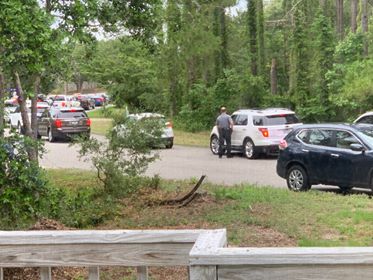
Cut-through traffic backs up on Sea Oats Trail at its intersection with Duck Road on a summertime Saturday afternoon.

The only way to prevent cut-through traffic on Southern Shores’ residential streets during summertime weekends is to erect physical barriers and/or diverters, the Town’s traffic engineering consultant concludes in a report filed Feb. 12.

Chief among the barrier recommendations made by J.M. Teague Engineering and Planning of Waynesville, N.C. is the placement of a gate on South Dogwood Trail that would operate both north- and southbound and be closed on peak-season Saturdays unless the Town decides to enable access by local traffic and emergency vehicles.

At The Beacon’s request, Town Manager Cliff Ogburn sent us Monday a link to Teague’s “Town of Southern Shores Congestion and Cut-Through Traffic Analysis,” which consists of about 18 pages of text and 450 pages of data-filled appendices.

He further informed us that the traffic analysis will be online for the public to access as soon as Teague makes some corrections that the Town Manager has identified. We will let you know when this occurs.

After considerable thought, The Beacon has decided not to report on Teague’s report—not to critique the whole of it—but to let you read it and draw your own conclusions.

We will say, however, that we endorse the use of gates as mitigation devices, but we are mindful that there must be sufficient turn-around space before them and there must be no possibility of an alternate route that allows drivers to work around them.

A gate on South Dogwood Trail, for example, is ineffective if a driver can turn left on Pintail Lane, then turn right on Ginguite Trail, and connect up again with South Dogwood at the cemetery.

Further, the impact that a gate on South Dogwood Trail would have on the volume of traffic that diverts on to Juniper Trail or off of Duck Road on to Porpoise Run, Dolphin Run, East Dogwood Trail, Hickory Trail, and other intersecting residential roads must be considered. Moving the cut-through traffic entrance farther up the road is not a solution.

According to Mr. Ogburn, a date for the J.M. Teague study to be presented to the Town Council has not been set yet, but he is “working on it.” The presentation will not be as soon as the Council’s March 2 meeting, he said.

Mr. Ogburn also said it is his understanding that the Town Council would like to get the recommendations of the citizens’ Exploratory Cut-Through Traffic Committee soon, so that it may discuss all recommendations at the same meeting.

Mayor Pro Tem Elizabeth Morey, who is one of the committee’s Town Council sponsors, expressed this desire at the Council’s Feb. 2 meeting. (See The Beacon, 2/4/21, 2/2/21.)

The Beacon was supportive of the traffic committee’s request, made Dec. 10, to have an information session with J.M Teague engineers before either the committee or the consultant prepared its conclusions. We were discouraged by the Town’s cancellation of the information session apparently because the Town Council thought it might compromise the consultant’s independence.

Having read J.M. Teague’s analysis, we believe that such a session would have helped the consultant to better understand the Town’s residential road network and to better tailor its recommendations to the community’s way of life.

While a fresh pair of eyes and independent thinking are of value in a problem-solving analysis, “outsiderness” can introduce new problems.

We were supportive of the information session, but we are not supportive of any further delay in the traffic committee’s issuance of a report.

Authorized by the Town Council in the summer of 2019, the Exploratory Cut-Through Traffic Committee has been dormant throughout the pandemic, failing to hold any public meetings, remotely or otherwise. It also never posted on the Town website minutes of the meetings that it did hold.

The Beacon appreciates how difficult it has been to conduct business during the pandemic, as well as the personal hardships that some people have experienced, but we also recognize the obligation that a government-sanctioned committee has to fulfill its purpose within a reasonable time. We’re sticklers for good government.

The committee must produce a formal written report of its conclusions now. An extemporaneously delivered speech to the Town Council will not suffice.

With the Council’s first fiscal year 2021-22 budget workshop expected to be held in April, time is of the essence.

FOLLOWUP ON THE PAVEMENT CONDITION SURVEY: The Beacon would like to commend the Town Council, especially Councilman Matt Neal, and Town Manager Cliff Ogburn for moving forward with a new pavement condition survey of the Town’s roads and a capital improvement plan that will allow for an adequate annual budget to perform necessary road repairs and maintenance. (See The Beacon, 2/17/21.)

After the civil engineering firm conducts the road pavement survey, the Town will have a 20-year history of its roads, Mr. Ogburn explained at Tuesday’s Council workshop. The Town will know the condition that roads and segments of roads are in; what has been done to them in the past; what needs to be done to them in the future, and when it needs to be done, Mr. Ogburn said. Street improvements will be based predominantly on need and proper timing, not on anyone’s personal preference.   

There will be data informing the Town how roads were built and how they need to maintained or rebuilt. This is progress.

PLANNING BOARD REVIEW OF CODEWRIGHT’S ‘ADOPTION DRAFT’ OF NEW TOWN CODE: The Town Planning Board completed at its Tuesday meeting a review of the definition section, chapter 4, of the November 2020 “Adoption Draft” of the rewritten Town Code of Ordinances submitted by consultant CodeWright Planners.

The Board will take up the revised and all-important zoning chapter, which is chapter 22, on Tuesday, March 15, at 5 p.m. in the Pitts Center.

Thanks to Mr. Ogburn and Planning Director/Deputy Town Manager Wes Haskett, the Planning Board’s review sessions are being live-streamed on You Tube.

We are not sure yet how to cover either the Planning Board’s review sessions, which, in addition to chapters 4 and 22, will address chapter 26, subdivisions; and chapter 28, flood damage prevention, or how to critique the Adoption Draft. 

You may access the November 2020 Adoption Draft here: https://www.southernshores-nc.gov/wp-content/uploads/2020/12/11-24-2020-Adoption-Draft.pdf.

A redline version of this draft, which shows how it differs from the previous final draft, may be accessed here: https://www.southernshores-nc.gov/wp-content/uploads/2021/02/TOSS-Town-Code-Adoption-Draft-11-24-20-REDLINE.pdf. 

At the Board’s Tuesday meeting, Mr. Haskett—who is the chief coordinator and chief copy and substantive editor on this massive project—announced that CodeWright principal Chad Meadows will virtually attend the March 2 Town Council meeting to discuss the chapters of the Town Code that the Planning Board is not reviewing.

We followed up this reference with Mr. Ogburn, who explained in an email: “The thinking is that the Council can go ahead and start their review of those other chapters while waiting on the Planning Board to do their work.  The entire code will likely have to be adopted at the same time though.  But the Council can get some of their review behind them.”

Mr. Meadows, Mr. Ogburn said, will “do a project refresh to jog [Council members’] memory and then focus on the key changes between current and proposed chapters” of the Town Code. 

As for jogging memories, Mayor Tom Bennett and Councilman Leo Holland were on the Town Council in 2015 when Mr. Meadows started the Town Code update/revision, but Ms. Morey, Mr. Neal, and Councilman Jim Conners were not.

Ms. Morey, however, was a member of the Planning Board when it spent more than a year, from April 2017 to May 2018, reviewing revised Town Code sections within its purview in an earlier draft submitted by CodeWright.

(In hindsight, we realize that this delay served the legislative process well, enabling zoning changes to be made democratically via the Planning Board and Town Council, rather than via suggestions by a hired outside planner.)

(The Beacon erred in stating in an earlier blog that the Planning Board reviewed the entire Town Code revision. It did not. It reviewed only selected chapters, just as the current Board is doing. We apologize for the error.)

Mr. Haskett asked the Planning Board members Tuesday whether they wanted to have Mr. Meadows meet virtually with them, and they declined.

While we understand why the Board may view Mr. Meadows’s presence as intrusive or as a hindrance to their progress, we urge the members to reconsider. An overview by Mr. Meadows of the “before” and “after” of Code sections within the chapters they are reviewing could save the members time and help them to focus.

They can see how effective this intervention could be for them by tuning into the Town Council’s March 2 interaction with Mr. Meadows.

Planning Board Chairman Andy Ward, Vice Chairman Tony DiBernardo, regular member Lynda Burek, and alternates Robert McClendon and Jan Collins served on the Board Tuesday.

We mean no disrespect to the alternates when we say that we hope regular members David Neal, who is the only current member of the Planning Board who participated in the previous CodeWright review, and Ed Lawler attend the review sessions on chapter 22.

Mr. Neal participated in every important zoning chapter change that was made by the Town Council, with the Planning Board’s recommendation, in the past five years and can ensure that CodeWright’s Adoption Draft faithfully records them.

Mr. Lawler arrived on the Board in January 2019 in time to deliberate upon zoning text amendments pertaining to nonconforming lots and high-occupancy houses, as well as to hear arguments for and against regulating special events in residences.

Both bring the necessary institutional memory to the task at hand.  

Ann G. Sjoerdsma, 2/18/21

2/17/21: CURIOSITIES ABOUND IN COUNCIL’S 19-MINUTE WORKSHOP; HOMEOWNER QUESTIONS WHY SHE RECEIVED EASEMENT REQUEST, BUT NEIGHBORING OCEANFRONT PROPERTY OWNER DID NOT.

Tasked with choosing a civil engineering firm to conduct a pavement condition survey of the town’s 37.6 miles of roads, the Town Council yesterday gave Town Manager Cliff Ogburn all of the authority he needs to negotiate and contract with a firm, without actually choosing one of the firms he recommended.

The Beacon found this odd. The oversight occurred because Mayor Tom Bennett said, after Mr. Ogburn’s report on the pavement study and the firms who applied for the job, “We need a motion,” and then explained the motion that was needed without actually making a motion.

We consider what the Mayor did a procedural irregularity. And it is not the first time he has done this.

The Mayor phrased the “needed” motion as “to authorize the Town Manager to enter negotiations for a scope of work and costs to perform a pavement condition study and capital improvement plan.” But he omitted the name of the civil engineering firm with which Mr. Ogburn would negotiate.

He then asked at the end of this non-motion: “Do we need to add any more to that?”

By the time the Council finished adding language about money to fund the pavement study and capital improvement plan, the Mayor was referring to his non-motion as a motion, and Councilman Jim Conners had seconded it. 

Mr. Ogburn, in consultation with a Town staff committee, recommended two engineering firms from among nine that applied to a Request for Qualifications proposal: SEPI Engineering & Construction, Inc. (“SEPI”) of Raleigh, which the committee ranked No. 1, and LaBella Associates, a Charlotte firm. (See The Beacon, 2/13/21, for background.)

Yesterday’s workshop was clearly held for the purpose of selecting an engineering firm.

We have blanched before when Mayor Bennett has said “We need a motion” and then read prepared language, telling the Town Council the content of the “needed” motion, instead of allowing a Council member to make a motion of his or her choosing.

This is simply not proper procedure. The Mayor’s request should be open-ended in the form of “Is there a motion?” He should not be telling the Council what motion to make. If he chooses to make his own motion, he can do so.   

Had Councilman Matt Neal, who said during discussion about Mr. Ogburn’s report that “I’m happy with staff’s recommendation”—meaning, with the selection of SEPI—made the motion, we believe he would have specified the firm.

Mr. Neal also pointed out after the Mayor’s non-motion that money for the survey could be taken out of the FY 2020-21 budget’s “line item for streets improvement.”

Eventually, the Mayor rephrased his non-motion—with help from his colleagues—as a motion, with all of the necessary instructions, except the name of the engineering firm, and Mr. Conners seconded it.

No one addressed the obvious gap, and the motion passed unanimously.

Presumably, Mr. Ogburn will contract with SEPI and report back to the Town Council. He was instructed by the Council not to exceed $35,000 in cost, a figure that he himself offered as a ceiling.

While we appreciate that Mayor Bennett may be experiencing memory difficulties, we urge him to leave complicated motions to the rest of the Town Council and to refrain from telling his colleagues what motion is “needed.” To do otherwise suggests undue influence, which we do not believe he intends.

UNEASE ABOUT EASEMENTS AND MUNICIPAL SERVICE DISTRICTS

This needed-motion “curiosity” was one of several that transpired yesterday during the Council’s 19-minute-long workshop session. 

In another, oceanfront property owner Lisa Emig, of 1 Mockingbird Lane, spoke during what amounted to a delayed public-comment period about the voluntary easement request that she had received from the Town for access during the 2022 beach-nourishment project and perpetually thereafter.

Ms. Emig started by saying that “It seems that my neighbor next to me did not receive an easement agreement, and I’m questioning why I was the only one within my area.”

Mayor Bennett responded by deferring to Mr. Ogburn and saying—unsatisfactorily, we believe—that he had nothing to do with the easement mailings. 

Are we to believe that the Mayor of Southern Shores does not know how beach-nourishment easements are being handled? How can that be? Why isn’t he informed?

Mr. Neal and Mayor Pro Tem Elizabeth Morey, who are the strongest proponents of townwide beach nourishment in 2022, quickly sought to discourage Ms. Emig from continuing with her questions, both of them asking whether she was going to make comments—which is a proper use of the public-comment period—or ask questions, which is an improper use.

Ms. Morey advised Ms. Emig firmly, but courteously, that she should direct any questions to Mr. Ogburn after the meeting.

Ms. Emig continued by saying that she had “concerns” about the wording of the easement, including the use of the word “perpetual”; about whether her grant of the easement entitles “access to my property by anybody”; and “if the construction will involve removal of my property line.”

The Mayor picked up on what the Mayor Pro Tem said and steered Ms. Emig to the Town Manager. He also referenced the March 16 public hearing on the proposed municipal service districts (“MSDs”), with which Ms. Emig indicated she was familiar.

The only Council member who showed any empathy for Ms. Emig—at least publicly during the meeting—was Councilman Conners, and we thank him for that.

Here was a confused, obviously worried, but respectful and well-intended Southern Shores property owner who had made a special effort to attend a 9 a.m. meeting, only to receive a cool reception from the elected board. The Dare County GIS listing for her property suggests that she also is likely a nonresident.

To his credit, Councilman Conners reached out to her, but what he said was curious.

“The whole MSD district is undergoing a legal process right now,” he said. “We’ve gotten emails on this . . . The whole thing, it could change.”

Seeking to communicate further with Ms. Emig, Mr. Conners continued: “I’m very hesitant to address too much your concerns right now because [of the MSD “legal process”]. Everything could change.

If there appears now to be a three-person majority on the Town Council that would vote to significantly change the scope of the 2022 beach nourishment project and/or alter the boundaries of the MSDs, then we strongly urge that majority to take that vote March 2.

Property owners should not have to be burdened by the stress and distress, inconvenience, time demands, and travel expenses involved in preparing for and attending the March 16 hearing, which is a major hearing with significant financial consequences for many.  

It may be easy for the Town Council to show up and listen to public speakers, but we can assure Council members that it is not easy for those of us who will speak. It is a hardship.

We also would speculate that it was a hardship for Ms. Emig to appear at the Council workshop and raise the questions she did. Confrontation is not easy for most people.

Speaking as a former attorney—my law license is active in Maryland, but no longer in North Carolina—I would advise all Southern Shores property owners that they should not sign a document that has language in it that makes them uncomfortable. The easements that the Town seeks—whether from selected oceanfront property owners or not—are strictly voluntary, not mandatory.

The Beacon found much to dislike in the draft perpetual easement that Town Attorney Ben Gallop prepared by culling language, he said, from easements used in other Dare County towns, as well as in Atlantic Beach, Emerald Isle, and Topsail Beach. (See The Beacon, 10/2/20; 7/26/20.)

The Town Council unanimously approved Mr. Gallop’s draft easement, with some modifications, on Oct. 6, 2020, but it did not sign off on a rewrite, and it never reviewed a rewrite at a subsequent meeting—presumably because it also unanimously gave Mr. Ogburn the authority to proceed with trying to procure easements from oceanfront property owners. (See The Beacon, 10/15/20.)

At the Council’s Feb. 2, 2021 meeting, Mr. Ogburn reported that 45 of the 185 easements required of oceanfront property owners for the Town’s 2022 beach-nourishment project had been mailed. (See The Beacon, 2/5/21.)

At no time has the Town Manager publicly explained that some oceanfront property owners will be receiving easement requests and others will not. If this is true, he should inform the public.

I also would advise property owners that the fact that other people in other Dare County towns have signed similar easements—a point brought up yesterday by Councilman Neal—is irrelevant. Their property situations are different—no town is like Southern Shores—and they may have been negligent in protecting their own interests or received poor advice.

We also wonder if there is a town in Dare County that Mr. Gallop and his legal colleagues at Hornthal, Riley, Ellis & Maland do not represent.

Property owners in other towns may perceive more benefit in granting an irrevocable and perpetual easement than a Southern Shores oceanfront property owner would. The beaches in Nags Head, for example, have experienced extensive erosion, unlike the beaches in Southern Shores, which are stable except at the southern end.

An easement conveys a legal right to use the property of another as specified in the granting document.  A property owner should understand the terms of the use before agreeing to such a conveyance; and a town governing board should want the constituent-owners it represents to have that understanding.

Ann G. Sjoerdsma, 2/17/21

2/16/21: TODAY’S 5 P.M. PLANNING BOARD MEETING TO BE LIVE-STREAMED.

The cover page of the “final” assessment submitted by CodeWright in 2019. The Planning Board will be reviewing an amended version of its earlier draft, known as the November 2020 Adoption Draft, which is available on the Town website.

Today’s 5 p.m. Town Planning Board meeting, which is being held to start the Board’s review of sections of consultant CodeWright Planners’ proposed draft of a new Town Code of Ordinances, will be live-streamed, according to Town Manager Cliff Ogburn.

You may watch the livestream on the Town of Southern Shores You Tube website at https://www.youtube.com/user/TownofSouthernShores.

Mr. Ogburn had already been discussing the possibility of live-streaming today’s Planning Board meeting with Wes Haskett, Town Planning Director and Deputy Town Manager, when The Beacon contacted him yesterday. We thank them both for enabling this convenience.

Traditionally, Planning Board meetings are neither live-streamed nor videotaped. The only way to determine what occurred at a Board meeting, if one cannot attend it, has been to read the meeting minutes, which are posted on the Town website.

All You Tube livestreams of public meetings are videotapes that may be viewed later on the same website. This is a far superior record of the proceedings than minutes of the meeting.    

As The Beacon reported yesterday, the Planning Board will take up first the revised definitions section of the Town Code, which is chapter 4. It plans to review three other chapters that fall within its purview at subsequent meetings: chapter 22, zoning; chapter 26, subdivisions; and chapter 28, flood damage prevention.

The Town Code draft the Planning Board will be reviewing is dated Nov. 24, 2020, and it known as the “adoption draft.” You will find it on the Town website.

The meeting will be held in the Pitts Center subject to COVID-19 safety protocols.

The Beacon, 2/16/21

2/15/21: TWO TOWN MEETINGS SCHEDULED TOMORROW; PLANNING BOARD TO TACKLE (AGAIN) THE TOWN CODE REWRITE, A 14-MONTH PROJECT THAT HAS TAKEN 5 ½ YEARS SO FAR. Plus, ‘Town Hall’ Is Bothered By Signs Again.

The display of yard signs, such as this one in the Southern Shores woods, is governed by Town Code sec. 36-165. CodeWright’s final rewrite of the Town Code will rework the ordinance, if it conforms to language in an earlier draft.

The Southern Shores Planning Board will meet tomorrow at 5 p.m. to begin its substantive review of consultant CodeWright Planners’ final draft of the Town Code of Ordinances update and revision.

The Planning Board will take up first the revised definitions section of the Town Code, which is chapter 4. It plans to review three other chapters that fall within its purview at subsequent meetings: chapter 22, zoning; chapter 26, subdivisions; and chapter 28, flood damage prevention.

As previewed by The Beacon 2/13/21, the Southern Shores Town Council also will meet tomorrow at 9 a.m. for a workshop session, which will focus on the hiring of a civil engineering firm to perform a pavement condition survey of the town’s roads. The last such survey was done in 2004.

Both meetings will be held in the Pitts Center, with COVID-19 safety protocols in effect.

The Town Council’s meeting will be live-streamed on the Town’s You Tube website and videotaped for later viewing there. You may email public comments to info@southernshores-nc.gov before the meeting or appear in person to present them.

Planning Board meetings are not customarily live-streamed or videotaped, but we are hopeful that the Town will make an exception for the Board’s review of CodeWright’s Town Code final draft, especially when it takes up the zoning chapter.

A project launched in 2015 and outlined by the consultant to take 14 months, CodeWright’s update/revision of the Southern Shores Town Code has been in the works for nearly 5 ½ years. The Town signed a contract with CodeWright Planners, a Durham-based company operated by principal Chad Meadows, in early September 2015.

A once-highly engaged Southern Shores public, which was particularly invested in potential zoning changes, has fallen by the wayside in the past five years, either frustrated by an inordinate amount of delay in the revision process, much of it engendered by the Planning Board, in its first review of CodeWright’s product, and by the Town Attorney; or else satisfied that the Town Council has addressed many of its concerns by amending or enacting new zoning ordinances in the interim.

(Since the project began, the Code ordinances on nonconforming lots, building height restrictions, allowable lot coverage, setbacks, and other zoning issues have been taken up and revised by the Town Council. The Council also has enacted restrictions on maximum overnight occupancy in vacation homes.)

In fairness to both the Planning Board and Town Attorney Ben Gallop, CodeWright submitted an inferior product that needed a thorough going-over.

Mayor Pro Tem Elizabeth Morey, who was on the Planning Board when it spent more than a year critiquing the  “final” Town Code assessment that CodeWright submitted in October 2016, called it “an unacceptable work product” in an interview with The Beacon and said that the Town Council “dumped” it on the Planning Board, which was tasked with reviewing the entire draft.

We agree with Ms. Morey. Her familiarity with the CodeWright product should help to inform the Council’s eventual decision-making on its approval, however.

If the long delay were not enough of a damper, the interested public that remains now must contend with the COVID-19 pandemic. Few people are currently motivated to attend Planning Board meetings, which once commanded healthy (no pun intended) audiences whenever zoning issues were being discussed.

In December 2015-January 2016, when the CodeWright project was fresh and new, an Internet-based citizens’ survey consisting of 23 questions, many of them zoning-related, drew 932 responses, 137 of which were disallowed because the respondents did not provide street addresses. Subsequently, a well-attended public forum was held by Mr. Meadows on March 7, 2016 to discuss the survey results and the current Town Code.

It was then nearly three years before Mr. Meadows held another public meeting about the Code rewrite. Far fewer property owners attended this meeting—held Jan. 31, 2019—than did the March 2016 forum, but those that did had strong opinions about amending certain sections of the Town Code and about CodeWright’s failure to do so sufficiently.

We recall in particular much discussion about Town Code sec. 22-3, which addresses prohibited noise, and sec. 36-166, about outdoor lighting. Property owners were concerned that CodeWright’s revised sections were not written precisely enough and would not protect residents from noise and light pollution.

The Planning Board will be examining sec. 22-3 in its final review, but not sec. 36-166.

The public will have an opportunity to be heard on CodeWright’s final draft before the Town Council considers approving its enactment. Before that hearing occurs, it would be helpful if residents and property owners could hear the Planning Board’s deliberations either as they take place or on videotape.

SELECTIVE CODE ENFORCEMENT: TOWN NEWSLETTER HAS ANOTHER ‘REMINDER’ ABOUT REMOVING SIGNS IN THE RIGHT OF WAY

The Feb. 12, 2021 Southern Shores Town newsletter contained a “friendly reminder” to property owners that signs are not permitted in town right-of-ways, pursuant to Code sec. 36-165, and should be removed.

The Town has an ordinance that prohibits “obstructions” in the right-of-ways, such as the large stones and rocks that you see in front of property owners’ houses (including Mayor Tom Bennett’s) and/or lining their driveways—as well as fences, yard decorations, posts, poles, etc., etc.—but “Town Hall” has never “reminded” residents that these nuisances, which are numerous in number, need to be removed. (This is Code sec. 28-2.)

This is not the first time that “Town Hall” has been bothered by signage. When the “No! Mini-Hotels” campaign was in its early stages, and more than 100 such signs adorned Southern Shores, “Town Hall” targeted these signs for removal, in a less-than-friendly manner. We had a different town manager then. With a new manager, we thought we were done with such nonsense.

(The litigation against SAGA for its construction of the mini-hotels at 98 Ocean Blvd. and 134 Ocean Blvd. is pending, and so some No! Mini-Hotels signs remain.)

We are discouraged by the “friendly reminder” in the newsletter singling out signs, which clearly convey messages and thus raise a First Amendment issue, which the large bed of rocks in the right of way in front of the Mayor’s house does not. It, like all nuisances, raises a health and safety issue.

The newsletter reminder smacks of selective enforcement of the Town Code and, therefore, of personal bias.

The Beacon supports Town Code enforcement, but not discriminatory Town Code enforcement. With the recent hiring of a full-time building inspector/code enforcement officer, perhaps Town Hall will finally move away from “complaint-driven” code enforcement to objective and consistently applied code-enforcement-department oversight of the town.

Town Hall should be questioning whether the 30-percent lot coverage ordinance or the 15-foot-side-setback ordinance is being violated by new house construction, not expecting residents (neighbors!) to bring such potential violations to its attention. On-site compliance visits by the code enforcement department during new house construction and major renovations should be mandatory. Inspections after the work is done occur far too late.  

Ann G. Sjoerdsma, 2/15/21

2/13/21: TOWN COUNCIL TO CONSIDER CIVIL ENGINEERING FIRM FOR ROAD PAVEMENT SURVEY, CAPITAL IMPROVEMENT PLAN. Plus Some Streets Committee History.

The north end of Sea Oats Trail, pictured above at its intersection with Duck Road in September 2019, after Hurricane Dorian passed by the coast, is slated for rebuilding this year.

The Southern Shores Town Council will consider at its upcoming Tuesday morning workshop a recommendation by Town staff to hire a Raleigh civil engineering firm to perform a town-wide pavement condition survey and to develop an associated capital improvement plan for maintenance and repair of the roads.

The firm, SEPI Engineering & Construction, Inc. (“SEPI”), is one of nine that responded to a Request for Qualifications (“RFQ”) for Professional Engineering Services issued by the Town on Dec. 15, after the Town Council voted unanimously to put out an RFQ for an engineering survey of the town’s 37.6 miles of roads.

The last pavement condition survey was conducted in 2004 by the N.C. Institute for Transportation Research and Education, according to minutes from the Oct. 4, 2017,  inaugural meeting of the Capital Infrastructure Improvement Planning (CIIP) Committee, now known as the Streets Committee. (For committee history, see below.)

The Town Council’s workshop will be held at 9 a.m. in the Pitts Center, with the usual COVID-19-safety protocols in effect. You may view a livestream of the meeting on the Town’s You Tube website. There will be one public-comment period.

An RFQ proposal evaluation/selection committee consisting of Town Manager Cliff Ogburn, Deputy Town Manager Wes Haskett, Public Works Director David Bradley, and Town Engineer Joe Anlauf ranked SEPI No. 1 among all RFQ applicants, according to the packet for Tuesday’s meeting.

LaBella Associates, a Charlotte firm, came in second in the committee’s ranking, which was based on a quantitative scoring of four criteria that included company and personnel experience and qualifications. The committee also reportedly contacted and verified applicants’ references.

You may read about the committee’s evaluation and ranking process and review the RFQ proposals from SEPI and LaBella in the meeting packet: https://www.southernshores-nc.gov/wp-content/uploads/minutes-agendas-newsletters/Meeting-Packet_2021-02-16.pdf.

The Council’s consideration of the RFQ committee’s recommendations, which also address negotiations with SEPI (or another firm, if the Council chooses one) about the scope of the survey work and its cost, is the sole item of business on Tuesday’s agenda.

The selection of SEPI to serve as the road-survey engineer would appear to be a rubberstamp for the Town Council. According to its impressive RFQ proposal, SEPI provided engineering services to the Town of Nags Head in 2019, when Mr. Ogburn was town manager there, in order to develop its capital improvement plan. (See p. 12 of meeting packet.)

Founded in 2001, SEPI is a woman-owned business that has been recognized by the State of North Carolina as a Historically Underutilized Business (HUB), a designation that signifies its ownership by certain minorities, including women, is at least 51 percent.

The results of the pavement condition survey “will serve to better assist the Town in prioritizing street improvements based on a rational and consistent method of allocating limited resources,” Mr. Ogburn concludes in his agenda item summary, which is in the meeting packet.

We can’t argue with that. In fact, we welcome such an approach, after years of discretionary—and some would argue, biased—decision-making.

Reason, consistency, and objectivity need to be integrated into the Town’s decision-making about which street improvements will be done, why, and when.

We trust the Town Manager is aware of the 2004 survey and will have it to use for a comparative analysis, as well as for an assessment of how streets rebuilt during the past 17 years have held up.

A WORD ON THE HISTORY OF CAPITAL IMPROVEMENT PLANNING

After reading Mr. Ogburn’s agenda item summary for Tuesday’s meeting, we feel compelled to recall some town history on The Beacon record.

Before the formation in 2017 of the CIIP Committee, the town had a “Capital Improvement Plan Committee,” which was controlled by Mayor Tom Bennett with input from Town Manager Peter Rascoe, Town Engineer Joe Anlauf, former Public Works Director Rachel Patrick, another Council member selected by the Mayor, and two citizen representatives selected by the Mayor.

The other four members of the Town Council had no say in who served on this committee, as they did with the former CIIP Committee and do now with the Streets Committee. This committee’s meetings, several of which we observed, were essentially Town staff meetings, presided over by Mayor Bennett and attended by non-staff members whom he hand-picked.

The 2015-16 minutes from the Capital Improvement Plan Committee are on the Town website. In 2015, current Mayor Pro Tem Elizabeth Morey served on it, at the Mayor’s invitation, as did current Town Councilman Jim Conners.

Ms. Morey eventually resigned; Mr. Conners has served on every capital improvements committee since 2015, first as a citizen representative selected by the Mayor and later, since his November 2017 election to the Council, as a co-chairman. 

The Capital Improvement Plan Committee of 2015-17 identified the streets that needed improvement, purportedly based on first-hand observations—but residents’ personal requests also held sway, the minutes make clear—and then prioritized them. Streets that showed tree root upheaval and cracking and had stormwater drainage problems reportedly received the committee’s attention.

The process was decidedly informal and subjective. The Town Council as a whole did little more than approve the committee’s recommendations.

When this discretionary process resulted in a 2015 decision to destroy dozens of large trees lining the west end of Fairway Drive, which is a dead-end street off of South Dogwood Trail that the committee identified for rebuilding, the public became involved in it. Intense public protest also greeted the committee/staff/Council decision to re-do the intersection of South, North, and East Dogwood trails, a project that destroyed more large, old trees.    

Three Town Council members who allowed these “improvements” to occur, despite considerable public opposition, lost their bids for re-election in November 2015.

It took another two years, however, before the Mayor’s Capital Improvement Plan Committee was replaced by the CIIP Committee, which has five citizen-members on it, each appointed by a Council member, in addition to two Council co-chairs.

Until the CIIP Committee appointments of January 2020, Mayor Bennett controlled this committee as a co-chairman, and selected the co-chair who would serve with him.

The CIIP Committee inherited a priority list of the target street projects identified by the previous committee.

Former Town Manager Peter Rascoe and/or Town Engineer Anlauf typically ran the CIIP meetings for Mr. Bennett, and Mr. Rascoe recorded the meeting minutes.

The CIIP committee has been re-conceptualized by the new Town Council as an entity referred to variously as the Streets Committee or the Streets Improvement Committee. It is co-chaired by Councilman Conners and Councilman Matt Neal.

It is unclear to The Beacon what the Streets Committee’s purpose and value are. The committee’s decision at its Jan. 21 meeting not to move forward in the current fiscal year with the postponed Sea Oats Trail improvement project was ignored by a unanimous Town Council at its Feb. 2 meeting. 

Further, no minutes of the committee’s meetings are being reported, even though it is an official committee of the Town Council. This has to change. There is no excuse for the Town failing to keep and post minutes from this committee. It is ignoring the public record—something no government should ever do. 

The Budget for Capital Improvements

Since the Town’s fiscal year 2018-19 budget, the annual capital improvements budget has been determined by a set-aside of five cents of the Town property tax rate, which in FY 2018-19 and FY 2019-20 was 22 cents on every $100 of assessed property value.

The Town Council unanimously approved the five-cent policy at a Feb. 20, 2018 strategic planning workshop, upon motion by then-Councilman Gary McDonald, who observed that the Town always had insufficient funds budgeted for capital projects.

In FY 2018-19, the five-cent, set-aside revenue came to $654,870; in FY 2019-20, it was $662,340.

The Town Council eliminated capital improvements in the FY 2020-21 budget because of concerns over a revenue shortfall during the COVID-19 pandemic.

In voting recently to proceed with the Sea Oats Trail rebuild—from Eleventh Avenue to Duck Road—the Town Council approved funding the project with monies from the Town’s Unassigned Fund Balance, not from a capital budget.

Before the five-cent policy took effect, the annual capital improvement budget was determined by Town staff, including the Public Works Director, the Finance Director, and the Town Manager, and then approved by the Town Council upon its recommendation.

In FY 17-18, the budget appropriation for capital projects was $575,000. In FY 2016-17 and 2015-16, it was $516,000. (We believe these figures were derived from a set-aside of four cents from the then-current tax rate, but we can only confirm through capital improvement committee minutes that the FY 2016-17 budget appropriation was.)

Mr. McDonald told The Beacon in an email yesterday that he regretted not choosing a higher set-aside than five cents.

The former Councilman, whose term expired in 2019, sought to increase the annual budgetary amount for improvements a year later by using a different formula, but a 3-2 Council majority did not agree with what he proposed and did not deem it necessary to increase the tax set-aside.

Ann G. Sjoerdsma, 2/13/21

2/8/21: ANOTHER DARE COUNTY RESIDENT DIES OF COVID-19, THE FIFTH PERSON IN A WEEK.

Another Dare County resident has died of COVID-19, according to the Dare County Dept. of Health and Human Services, which reported the death today, but did not update the number of fatalities and new cases on its COVID-19 numbers dashboard.

Today’s COVID-19 dashboard still shows yesterday’s numbers.

(UPDATE 2/9: We are still seeing yesterday’s numbers on the dashboard on all of our computers, but The OBX Today reported updated numbers this morning. Apparently, the person who died had been hospitalized.)

Five Dare County residents have died of COVID-19 in the past week. The DCDHHS described one of the people in a report as having been hospitalized and recorded a reduction in the number of hospitalizations on its dashboard to suggest that three others were hospitalized, too.

The DCDHHS has given no details about the individuals’ ages or sex.

We strongly suspect that all five people were residents of Peak Resources, the nursing home and rehabilitation center in Nags Head where a COVID-19 outbreak recently occurred. We await confirmation and/or clarification from Dr. Sheila Davies, DCDHHS director, as to whether this is true.

There is no privacy interest that would prevent Dr. Davies from confirming (or not) that the five people who have died were residents of Peak Resources. It is in the interest of the Dare County public, and public health generally, to know why the number of local residents who have died from COVID-19 has nearly doubled in a week.

Twelve Dare County residents have died as a result of an infection with SARS-CoV-2 since last March.

The DCDHHS also reported that, as of yesterday, it had administered 7,197 first doses of the Moderna vaccine and 662 second doses of the vaccine.

The DCDHHS has 600 first doses of vaccine scheduled to be administered between now and Feb. 18, and 2,821 people on its waiting list, to be contacted when vaccine becomes available, according to the DCDHHS vaccine dashboard.

Last week the DCDHHS reported that it would have only 300 first doses of vaccine this week and next week and would be informed later by the N.C. Dept. of Health and Human Services how many first doses it will receive after the week of Feb. 15.

(Please note: We did not expect to write today, but we feel obligated to recognize publicly the death of a member of our community from COVID-19.)

Ann G. Sjoerdsma, 2/8/21

2/7/21: LOOKING AHEAD ON SUPER SUNDAY.

The Beacon is switching gears for the week.

The Beacon will not be publishing or responding to email during most of the upcoming week. Duty calls elsewhere. We expect to resume blogging on Friday or Saturday.

Looking ahead, the Town Council will be holding a workshop session on Tuesday, Feb. 16, at 9 a.m., and the Town Planning Board will be meeting on Feb. 16, at 5 p.m. Both meetings will be held in the Pitts Center, subject to COVID-19-safety protocols.

The Planning Board will be reviewing the revised Chapter 4, which is the Town Code’s definitions section, that consultant CodeWright Planners submitted as part of the final draft of its Code update and rewrite.

According to a member of the Planning Board with whom The Beacon consulted, the Board will take up at separate meetings the Town Code sections over which it has final-review authority, starting with Chapter 4.

The other chapters are Chapter 22, zoning; Chapter 26, subdivisions; and Chapter 28, flood damage prevention.

For more information about the Town Code update/rewrite, contact Town Planning Director/Deputy Managing Editor Wes Haskett at whaskett@southrnshores-nc.gov.

Planning Board meetings are not videotaped or live-streamed, but minutes are taken and are expected to be posted on the Town website.

Unfortunately, no minutes have been posted online since Feb. 18, 2020. This is an oversight that needs immediate correction.

The Town Council meeting will be live-streamed and videotaped. The meeting agenda will be posted on the Town website by this Tuesday.

Happy Super Bowl, Puppy Bowl, and Super Sunday, everyone. We are pulling for “the old guy,” of course. Any time an ageist (or sexist or racist or any other kind of) stereotype can be shattered, we are all in.

Have a great week and stay safe.

Ann G. Sjoerdsma, 2/7/21

2/5/21: ANOTHER DARE COUNTY RESIDENT DIES OF COVID-19.

The DCDHHS had administered 6399 first doses and 232 second doses of COVID-19 vaccine as of last Sunday.

Another Dare County resident has died from COVID-19, the Dare County Dept. of Health and Human Services reported today.

The person is described on the DCDHHS’s COVID-19 dashboard only as having been hospitalized at the time of his or her death.

Since last March, 11 Dare County residents have died as a result of COVID-19–four of them just this week. (See The Beacon, 2/3/21.)

The DCDHHS’s next COVID-19 update should be next Tuesday. Perhaps then we will learn if the four latest deaths were of residents at the Peak Resources nursing home and rehabilitation center in Nags Head, where DCDHHS Director Dr. Sheila Davies recently confirmed a COVID-19 outbreak.

THE BEACON, 2/5/21

2/5/21: MAYOR QUESTIONS SCOPE OF 2022 BEACH NOURISHMENT PROJECT, SUGGESTS LIMITING IT TO ‘CRITICAL’-NEED AREAS. MSD PUBLIC HEARING SCHEDULED MARCH 16.

A surprising announcement by Mayor Tom Bennett at Tuesday’s Town Council meeting that he was reconsidering the “scope” of the town’s estimated $14 to $16 million 2022 beach nourishment project and the means for funding it led to a half-hour discussion about the actual need for sand fill along the entire 3.7-mile-long Southern Shores shoreline.

Although the Town Council unanimously voted last June to “proceed” with beach nourishment, it never defined how and to what extent it would proceed. The assumption has been that the project would be townwide, but no formal vote was ever taken.

“If we reduce the scope of the project to those things that are really critical now,” the Mayor said, “we could probably pay for it in a different way” than by levying higher taxes on property owners in specially established municipal service districts (MSDs).

“We could probably pay for it with an even tax for the whole town of so many cents,” he said, except perhaps for the Pelican Watch homeowners whose properties are in the hot-spot southern section of the shoreline.

The Mayor’s supposition clearly caught his Council colleagues and Town Manager Cliff Ogburn off-guard. He prefaced it by explaining that he had been “trying to agonize over how we’ll handle this project” for “a couple of months.”

The five Town Council members did not reach a consensus about the project’s scope, but they nonetheless unanimously approved holding a public hearing March 16 to receive comments about the two MSDs that Mr. Ogburn has proposed establishing in a report that he presented Tuesday.

(You may access the Town’s notice about the hearing at https://www.southernshores-nc.gov/notice-public-hearing-proposed-beach-nourishment-municipal-service-districts/. The MSD Report has both a written explanation, as well as a map, of the proposed boundaries of the districts, which are subject to change by the Council.

(Property owners whose properties fall within one of the MSDs are required by statute to receive four weeks’ written notice of the public hearing.)

The Mayor’s remarks came after Mr. Ogburn outlined the MSDs he has proposed in order to raise enough revenue by taxing property owners on the oceanfront, the oceanside, the west side of Ocean Boulevard, and the east side of Duck Road more than other Southern Shores property owners would be taxed to pay for the project.

In support of a reduction in project scope—and, possibly, an elimination of MSDs—Mayor Bennett summarized the advice that he said the Town’s coastal engineer, Ken Willson of Coastal Protection & Engineering of North Carolina (CPE), had given him about the three shoreline sections that CPE has identified and is monitoring.

The Northern Section, which is from around Third Avenue north to the Southern Shores/Duck line, “has gained sand,” the Mayor said, and is “not as vulnerable as far as the dunes and the properties behind” them.

Cognizant of homeowners’ complaints last year about the width of the northern beach, he said, the beach “is definitely wider this year than it was last year.”

Later in the meeting, the Mayor noted: “I don’t see the north beach in trouble.”

The Central Section, from Third Avenue south to about 450 feet south of Chicahauk Trail, has “held up pretty steady,” the Mayor said. It “hasn’t gained or lost a lot.” While the dunes “are not as sturdy as they could be” in the Central Section, he continued, “it’s not in extremis.”

Mayor Bennett characterized the decision to do anything in the Central Section as a coin toss.

The Southern Section, from 450 feet south of Chicahauk Trail south to the Southern Shores/Kitty Hawk line, is in extremis. This section, which is the site of the 2017 beach nourishment project, has “lost a lot of sand,” the Mayor said, and “needs work.”

(See The Beacon, 1/26/21, for an exhaustive analysis of the latest shoreline change data in these three sections; and The Beacon, 1/31/21, for a report of erosion and accretion measured from September 2019 to September 2020 along the Duck shoreline.) 

“The way [the project] is structured right now,” the Mayor concluded, “we’re taking on a major project that might not be required.”

Instead, he suggested, “we might be OK for two or three years,” at which time he said he had heard Nags Head might be doing a project, and Southern Shores possibly could share mobilization costs with that town.

IS THE MSD STRUCTURE APPROPRIATE FOR SOUTHERN SHORES?

As The Beacon has previously explained, the rationale and procedure for establishing MSDs is governed by N.C. statute. In order to define an MSD, a city council must find that “a proposed district is in need of [beach erosion control and flood and hurricane protection works] . . . to a demonstrably greater extent than the remainder of the city.” (NCGS sec. 160A-537(a)).

It seemed to us that Mr. Ogburn sought to respond Tuesday to some of our criticisms of his report, but we continue to read the statutory language differently from the Town Manager. (We were just kidding about taxing homeowners who live on an improved street more for the street improvements.)

The emphasis in the MSD statute is on need. If an MSD definition were not need-based, too much subjectivity and caprice would enter into elected officials’ decision-making.

Property owners, who can request exclusion from a proposed MSD at the March 16 public meeting or in writing up to five days after it, also would be more inclined to object. (See The Beacon, 1/31/21.)

In the public comment period of Tuesday’s meeting, Rod McCaughey, who is president of the Southern Shores Civic Assn. and a resident of Eleventh Avenue, questioned the use of MSDs in Southern Shores, saying, “It just seems like there are a lot of inequities.”

He further explained: “It’s not my way of thinking of Southern Shores, that someone on one side of Duck Road will be paying, someone on the other side won’t be paying . . .  someone on North Dogwood Trail,” just as an example, “could get into their car and drive to Eleventh Avenue” and use the beach there, and “what did they pay?”

The SSCA president also challenged the idea that beachfront owners in Southern Shores “will be getting a golden opportunity” as a result of the beach nourishment, that because of it, their properties will go “up in value.”

Mr. McCaughey, who was speaking for himself, not the SSCA, said he was not convinced this would be true in Southern Shores, which has an ordinance restricting maximum occupancy in rental homes. Rental property owners will not be able “to rent to more people,” he suggested, simply because the beaches are wider.

In a Jan. 29 email, Mr. McCaughey informed SSCA members that the civic association, which owns the oceanfront from Hickory Trail north to the Duck town line, as well as 32 beach accesses, had granted easements to the Town for it to perform the 2022 project.

But he stopped short in his email of giving the project the organization’s blessing, saying: “I want to be perfectly clear that granting the easement does not constitute an endorsement of any particular beach replenishment plan or project.”

Earlier in the meeting, Mr. Ogburn reported that N.C. House Representative Bobby Hanig had introduced the necessary legislation (H.B. 30) to add Southern Shores to the list of towns that may “condemn property for beach nourishment.”

If the N.C. State Legislature passes, and the Governor signs, the legislation, the Town will be able to “quick take” privately owned property, such as easements, for beach nourishment without going through a formal eminent domain proceeding.

Mr. Ogburn said that 45 of the 185 easements required of oceanfront property owners for the Town’s 2022 project have been mailed. The Town is asking that these property owners voluntarily grant perpetual and irrevocable easements, without any compensation.

(For background on quick-take condemnation and the easements, see The Beacon, 7/26/20 and 10/2/20.) 

The Town Council voted unanimously at its Oct. 6, 2020 meeting to give Mr. Ogburn authority to proceed with trying to procure the voluntary easements from oceanfront property owners. We have heard nothing about these easements since then.

The Council also unanimously approved, with some modifications, a draft perpetual easement prepared by Town Attorney Ben Gallop, which Mr. Gallop said Oct. 6 was a compilation of language taken from easements applied in other Dare County towns, as well as in Atlantic Beach, Emerald Isle, and Topsail Beach.

The Beacon did not support the granting of a perpetual and irrevocable easement and objected to some of the draft language. The draft easement never returned to the Town Council for approval in its final form.

A DIVIDED TOWN COUNCIL

Mr. McCaughey’s comments seemed to give Mayor Bennett a transition into his analysis of the 2022 project’s scope, but he claimed his remarks had not been “triggered by” what the SSCA president said.

The discussion that the Mayor triggered revealed a divided Town Council, with young Councilman Matt Neal clearly taking a long view of any beach nourishment in Southern Shores, calling the 2022 project part of “long-term, 30-year protection for our shoreline,” and Mayor Pro Tem Elizabeth Morey supporting his thinking.

Both premised their views on what The Beacon considers speculation as to the future damage that future storms may cause and the future effects of future sea-level rise.

While sea-level rise may be inevitable, mitigation efforts also will occur–electric cars, for example–and we are not comfortable with merely taking CPE’s computer models and projecting the future, as Mr. Neal seems to be.

Mr. Neal even mentioned managing a “shoreline retreat” during his lifetime, which would mean moving oceanfront homes to protect them from sea-level rise.

To a great extent, we believe the issue of scope is a matter of timing.

Mayor Bennett and Town Councilman Leo Holland were more inclined to look at today’s conditions, including—thank you, Mr. Holland—the fact that property owners may be coping with financial difficulties during the COVID-19 pandemic. At the very least, the health climate is poor for a major public hearing like the one scheduled March 16, even with a Zoom option, which Mr. Ogburn said there will be.

Mr. Holland brought up “selectively” nourishing the beach, starting with the Southern Section, and then figuring out later “how we can do the rest.”

The Mayor confirmed that Mr. Willson had advised him that selective nourishment could be done, and that a different amount of cubic yardage of sand could be placed at different locations along the shoreline.

The fifth Council member, Jim Conners, advocated for defining the scope of the project at the meeting, but did not express his opinion.

“Now’s the time,” he said.

That turned out not to be the case.

THE RELATIVE MERITS OF THE AVON PROJECT, COUNTY FUNDING

The Beacon also appreciated Councilman Holland’s recognition of the seriousness of the proposed Avon beach nourishment project, which will be the subject of a virtual public meeting before the Dare County Board of Commissioners on Feb. 24, at 6 p.m. See Virtual meeting on proposed Avon beach nourishment project set for Feb. 24 – OBX Today.

“That project is so important to keeping Highway 12 open,” Mr. Holland said, further observing that it has a greater “economic impact” on Dare County than the proposed Southern Shores project, which “doesn’t have a real economic impact to the county.”

With Dare County contributing monies to each project from its Beach Nourishment Fund, Southern Shores and Avon, which is an unincorporated community of the county, are essentially competing with each other.

According to Mr. Ogburn, the Dare County Board of Commissioners has not yet approved the funding that County Manager Bobby Outten said Southern Shores would receive.

Mr. Outten’s commitment of $7 million up-front for Southern Shores’ project costs and another $4 million for its debt service is not yet “firm,” the Town Manager said.

According to an overview of the Avon project prepared by Dare County, the “rate of erosion along the beaches of Avon [which is on Hatteras Island] has accelerated dramatically. The sand dunes along much of the beach have been washed away, allowing the ocean to wash over and flood Highway 12, as well as the properties on the ocean side of Highway 12. This occurs not only in named storms but also in common nor’easters and hard blows.”

Beachfront houses in Avon literally teeter above the ocean during storms—they never do in Southern Shores—and ocean overwash on Hwy. 12, which is the only access roadway, often causes major disruptions in the local economy and everyday life.   

To fund a project estimated to cost $11 to $14 million, Dare County is proposing to tax properties in Avon east of Hwy. 12 at a rate of 40 cents per $100 of real estate value and all remaining parcels at a rate of 10 cents per $100.

The Beacon has problems with Southern Shores taking $11 million from Dare County for what would be a non-emergency, proactive nourishment project—except for the Southern Section—while our neighbors in Avon, who are in dire straits, pay such shocking tax-rate increases.

Commissioners in Nags Head and Duck also expressed concern at public meetings when Mr. Outten told them how much “skin in the game” Avon property owners would be contributing.

In advocating for his long-view position, Councilman Neal said that the Town Council should view beach nourishment “as a county issue,” but he made no mention of Avon’s plight.

All members of the Town Council agreed that if the Dare County commissioners were to deny Southern Shores county funding, or to reduce that funding, they would be compelled to address just the “emergency areas” on the town’s shoreline.

“The County’s participation,” Mr. Neal said, “has been the driving force.”

Ann G. Sjoerdsma, 2/5/21

2/4/21: CITIZENS’ CUT-THROUGH TRAFFIC COMMITTEE TO HOLD OFF ON ISSUING REPORT UNTIL IT REVIEWS CONSULTANT’S REPORT; CHAIRMAN DISAGREES WITH ‘TENTATIVE’ SPECIAL MEETING PROPOSED BY MAYOR PRO TEM; Sea Oats Trail Repaving Project Goes to Bid; Mayor Surprises With New Take on Beach Nourishment.

A Southern Shores homeowner’s grandson stands last summer across from a weekend traffic backup on Sea Oats Trail at its intersection with Duck Road.

A special cut-through traffic meeting proposed by Mayor Pro Tem Elizabeth Morey at Tuesday’s Town Council meeting–during which, she said, recommendations from the Town’s traffic-engineering study consultant and the citizens’ cut-through traffic committee would be discussed–has not been agreed to by committee chairman, Tommy Karole, The Beacon has learned.

Mr. Karole told The Beacon today that “The committee would like to wait to see the traffic engineer’s report and use all of the information [that it makes] available before we issue our report.” He said that the committee, known formally as the Exploratory Committee to Address Cut-Through Traffic, “would like to be thorough.”

Ms. Morey, who is a Town Council co-sponsor with Councilman Matt Neal of the citizens’ committee, proposed the special meeting in comments that she made at the end of the Council’s regular monthly meeting on Tuesday. (You may view a videotape of the meeting on the Town’s You Tube site.)

Without speaking first to Mr. Karole, Ms. Morey said that his committee would be filing its report within the next two to three weeks and that the Council would “discuss all of the potential recommendations” for the problem of seasonal cut-through traffic at the special meeting.

Mr. Karole said his committee would not be prepared to do this. He also said that he was just informed Jan. 25 by Town Manager Cliff Ogburn that a Zoom information meeting he had believed for more than six weeks the Town would set up between his committee and traffic consultant J.M. Teague Engineering and Planning of Waynesville, N.C. would not take place. (See The Beacon, 2/2/21, for background.)

As The Beacon reported 12/14/20, Mr. Karole, who lives on East Dogwood Trail near its intersection with South Dogwood Trail, suggested an exchange of information at a Dec. 10 “progress report” meeting that the Town held for members of his committee and the two Teague engineers who were studying the cut-through traffic problems.

Both of the engineers, who appeared at the December meeting via Zoom, said they would welcome hearing from locals “on the ground”—“in the trenches,” as Mr. Karole described his committee members—and Mr. Ogburn said he would coordinate this session.

Mr. Karole sought scheduling followup with Mr. Ogburn, he told The Beacon today, until he learned from the Town Manager last week that his committee would not be given an opportunity to meet with the Teague engineers.

Ms. Morey attended the Town’s Dec. 10 progress report meeting via Zoom. Mayor Tom Bennett and Councilmen Leo Holland and Jim Conners appeared in person, but Mr. Neal did not participate.

Without specifically mentioning the cancellation of the meeting between the committee and the consultant, Ms. Morey explained Tuesday: “We as a Council decided to allow the consultant to put together his findings and to make his recommendations without influence” from members of the Town Council, the Town staff, or “members of the community.”

She did not say when the Town Council had decided this.

The Beacon recalls, and reported upon, the FY 2020-21 budget workshop last spring during which the Town Council agreed to commission the $7500 traffic study. The Town Council made clear then that it wanted to “keep the emotion out” of the study—as two Council members phrased it—and to ensure an objective, independent report. Objectivity, however, should not be compromised by the sharing of factual information.

Surely traffic engineers with decades of experience know how to receive, process, and evaluate information received from stakeholders in a project without being unduly influenced by any bias that may emerge.   

During her comments Tuesday, Ms. Morey confirmed that J.M. Teague would file its traffic study report on Feb. 12 (a date the Town Manager gave her) and said that a special meeting had been “tentatively” planned for both the consultant and the committee to present their separate reports.

Ms. Morey reported having spoken earlier Tuesday to a member of the six-member citizens’ Exploratory Committee to Address Cut-Through Traffic, whom she did not name, about the proposed special meeting and said that this member was “completely OK with that.” She also reported that she had left a voice message on Mr. Karole’s phone.

According to Mr. Karole, Ms. Morey’s message was left at 4:10 p.m. Tuesday—an hour and 20 minutes before the Town Council’s meeting.

Mr. Karole expressed disappointment that the Town Council did not allow his committee to “get together [with the consultants] in the interest of sharing information.”

SEA OATS TRAIL CONSTRUCTION PROJECT MOVES AHEAD

In other roadway news, the Town Council unanimously approved Tuesday putting out for bids the repaving project on Sea Oats Trail from Eleventh Avenue to Duck Road.

This project, which already has been designed by the Town’s engineer, was ready to move forward last year, but the Town Council postponed it because it was concerned about a revenue shortfall during the COVID-19 crisis

The Council also considered soliciting contractors’ bids for the much larger Hillcrest Drive project, which also was postponed, but it decided not to go forward. Surveying and design work remain to be done on this project, according to Mr. Ogburn.

Councilman Neal reported that the Town’s Streets Committee, which met Jan. 21, did not recommend moving ahead with either project.

Mr. Neal, who co-chairs the Streets Committee—formerly known as the Capital Infrastructure Improvement Planning Committee—with Councilman Conners, further said that the committee discussed at some length the implementation of a 10-year capital improvement plan.

It would have been more informative if Mr. Neal and Mr. Conners had explained why the Streets Committee–which is another committee comprised of “members of the community”–did not support either project. Minutes for the committee’s meetings are no longer being posted on the Town website, even though the committee is a Town Council-appointed and -sponsored committee.

The Beacon considers this lapse a significant failing, especially in the light of the fact that the committee’s meetings are not videotaped.

The Sea Oats Trail project has been estimated to cost $484,609, while the Hillcrest Drive project, which extends from the street’s intersection with Hickory Trail north to the SSCA tennis courts and is 3,700 linear feet long, has been estimated to cost $937,493.

The funding for the Sea Oats Trail project will come from the Town’s unassigned fund balance, which must maintain a $3 million balance as a hedge against emergency expenses, according to Mr. Ogburn.  

SURPRISING BEACH NOURISHMENT AND MSD UPDATE

Tuesday’s meeting went in an unexpected and interesting new direction when Mayor Bennett suggested that the Town Council consider reducing “the scope” of the anticipated 2022 beach nourishment project along the entire Southern Shores shoreline and funding the scaled-down project in “a different way” than through levying increased tax rates on properties in municipal service districts.

The Beacon welcomes the Mayor’s new perspective and approach, but we need time to process what he said and the response he received from his colleagues on the Council, as well as from the Town Manager, before we report on what we heard. We need to percolate, if you will. We will get back to you as soon as possible.

In the meantime, we urge you to listen to the meeting videotape, which you may access via You Tube.

Despite this unexpected new direction, the Town Council unanimously approved scheduling a public hearing March 16 at 5:30 p.m. in the Pitts Center about the two proposed municipal service districts and their boundaries.

We will discuss this hearing, for which Mr. Ogburn said “a Zoom option” would be offered, in an upcoming blog post.

Ann G. Sjoerdsma, 2/4/21; revised, 2/5/21