After three days of relatively modest case numbers, Dare County reported a surge today of 21 new COVID-19 cases, including a local man age 65 or older who was hospitalized.
There are now seven Dare County residents hospitalized outside of the area.
Fifteen of the 21 new cases are Dare County residents, according to the Dare County Dept. of Health and Human Services dashboard, and of those, an astonishing nine are in the 50-to-64 age group; four are in the 25-to-49 age group; and two are age 65 or older.
The five nonresidents who tested positive for COVID-19 are generally younger: Three are ages 18 to 24; one is age 17 or younger; and one is in the 25-to-49 age group.
In her Tuesday update today, Dr. Sheila Davies, director of the DCDHHS, looked at 27 new cases since Friday. The dashboard, however, only recorded 26 cases during this time.
Dr. Davies said the county had a COVID-19 positivity rate of 5.4 percent during the week of Nov. 16-Nov. 22.
The DCDHHS Director’s rundown of the 27 cases shows that they generally adhere to the pattern that has emerged locally of the disease’s transmission being caused by close contact with a known infected person.
Dr. Davies again asks that people observe the three Ws, in order to prevent the spread of COVID-19. She does not mention the Governor’s stricter face-covering mandate, which takes effect tomorrow at 5 p.m. (See The Beacon’s post earlier today.)
LONG COVID IN A YOUNG DOCTOR WITH NO PREEXISTING CONDITIONS
In our continuing effort to inform people about post-[acute] COVID syndrome or chronic COVID-19 symptoms, we refer you to a compelling column in “The Journal of the American Medical Assn.” written by a young physician who is a COVID-19 “long-hauler.”
Dr. Jeffrey N. Siegelman, an assistant professor of emergency medicine at the Emory University School of Medicine in Atlanta, writes in “Reflections of a COVID-19 Long Hauler,” that he awoke on a Monday morning with a headache, “and I am not a headache person.
“Fever followed,” he continues, “and the next morning my blueberry yogurt tasted of nothing. Thick emptiness. I knew I had it. Now, after more than three months of living with coronavirus disease 2019 and the fatigue that has kept me couch-bound, I have had ample time to reflect on what it means to be a patient . . .”
Dr. Siegelman graduated in 2007 from the Albert Einstein College of Medicine at Yeshiva University in New York and did his post-graduate training at Harvard. He is probably about 40 years old, although he does not give his age.
One important point the young emergency physician makes is that a “mild” case of COVID-19 can have “dramatic effects,” of long duration.
According to Dr. Siegelman, he had “no preexisting conditions, was never hospitalized, had minimal respiratory symptoms, and even managed to do limited office work throughout the acute illness.
“. . . And yet, living with this has been anything but mild. I quarantined in the basement for 40 days, staying isolated from my family because low-grade fevers continued, and the Centers for Disease Control and Prevention guidance was unclear for people like me.”
Another important point he makes is that “The lack of objective data does not preclude illness.”
Based on the known objective data, Dr. Siegelman recovered from his bout with COVID-19. His body was clear of the virus, as he writes:
“My test results were normal: nasopharyngeal swabs for severe acute respiratory syndrome coronavirus 2 (SARS-CoV-2), imaging, laboratory results, oxygen saturation were all fine. But I did not feel fine, and still do not.
“I have had a rotating constellation of symptoms, different each day and worse each evening: fever, headache, dizziness, palpitations, tachycardia, and others.”
Dr. Siegelman is fortunate that he can isolate safely from his family in a well-equipped basement and can afford to miss days from work. His supportive colleagues have covered his shifts. He also has long-term disability insurance that will give him financial security if his three-month-long illness extends beyond six months.
“With each negative test,” he writes, “my worry increased that my employer would ask me to go back to work too soon or my primary care physician would rule out COVID-19 despite strong clinical evidence.”
How many PCPs would simply dismiss a long COVID patient as having symptoms that are only “in his head” or attribute them to severe anxiety?
“[M]any physicians are not aware of long COVID,” writes retired scientist Debra Krummel, Ph.D., in a comment at the end of Dr. Siegelman’s article, who says she has been in the same “boat” for more than four months.
Finally, Dr. Krummel says, “research into this chronic condition is now happening.” COVID-19 morbidity, as well as mortality, is being discussed.
Dr. Siegelman says that he “doubted myself multiple times—thinking if I just pushed myself harder maybe I could go back to work and to my regular life, to move on.
“Then,” he explains, “I would eat something without taste, would feel my heart pounding uncontrollably for hours, or would get so dizzy that I could not even write a simple letter.
“Each evening as my symptoms peaked, I was reminded that my diagnosis was not in question.”
Dr. Mandy Cohen asked people yesterday to “consider celebrating Thanksgiving differently this year.” She advised them to “avoid traveling and getting together in person, especially indoors.”
All people in North Carolina will be required to wear a face covering when they are indoors in any public place outside of their homes that is also occupied by a non-member of their household and outdoors when they cannot maintain six feet of distance from non-household members, starting tomorrow at 5 p.m., according to a new executive order announced at a 2 p.m. briefing yesterday by Governor Roy Cooper.
The order also requires businesses to take more responsibility for ensuring that “masks are worn by everyone” in their indoor space, at the risk of criminal sanctions, and extends Phase Three until 5 p.m. on Dec. 11. The last executive order had extended the phase until Dec. 4.
“I have a stark warning for North Carolinians today,” the Governor said before introducing new Executive Order 180 and after citing the State’s “record-high” number of new COVID-19 cases and hospitalizations and its reach of the “grim benchmark of 5,000 deaths.” (See The Beacon, 11/22/20.)
“We are in danger,” the Governor said. “This is a pivotal moment in our fight against the coronavirus. Our actions now will determine the fate of many.”
(Today’s statewide numbers are even worse than yesterday’s: 3,100 new COVID-19 cases and 1724 hospitalizations, according to the N.C. Dept. of Health and Human Services’ dashboard.)
Although not mentioned directly by Governor Cooper, Executive Order 180 specifically authorizes state and local law enforcement to enforce what he called a “strengthened” Face Covering Mandate against individuals who fail to wear a covering. A violation of the mandate is a Class 2 misdemeanor, which carries a maximum penalty of 60 days in jail and a $1,000 fine.
Law enforcement also may cite a business or organization that fails to enforce the face-covering requirements, as they are ordered to do.
The offense charged would be a violation of N.C. General Statutes section 14-288.20A, which pertains to emergency prohibitions and restrictions.
That Governor Cooper, who has long sought to persuade, not force people to wear protective face coverings, is finally calling for criminal sanctions against those who do not wear them outside of their homes, and, therefore, violate his new executive order, is a testament to how “dire” and “deadly serious”—in his words—the situation is statewide.
Ten more N.C. counties are now in the “critical” red tier on the COVID-19 County Alert System map, according to the Governor, thus, bringing the total red counties to 20. This escalation is based on COVID-19 metrics received from county health departments for the period from Nov. 6 to No. 19.
(See The Beacon, 11/18/20 for an explanation of this system, which was introduced just last week. Dare County remains in the “substantial” orange tier; we will discuss its status below.)
The Governor said that the State’s plan had been to update the county alert map every four weeks, but with the next seven to 14 days in the fight to stop the spread of COVID-19 being so “critical,” he decided to give North Carolinians a “snapshot” of where the state is now.
“We are on very shaky ground,” said Dr. Mandy Cohen, Secretary of the NCDHHS, concurring with the Governor and elaborating upon the State’s “worsening” COVID-19 metrics.
“I do not want to see the bottom fall out,” she said grimly. “I’m particularly concerned about our record number of people in the hospital.”
The number of hospitalizations statewide topped 1,600 yesterday, according to the NCDHHS dashboard. Today, it is over 1,700. On Saturday, a record-high 4,514 new COVID-19 cases were reported, for a positivity rate of 8.5 percent.
Although hospitals still have capacity for COVID-19 patients, Dr. Cohen said that some of them “are starting to feel the strain.”
The NCDHHS Secretary put the situation in easy-to-understand terms when she said, “The coming weeks will be a true test of our resolve—to do what it takes to keep people from getting sick, to save lives, and to make sure you have hospital care for whether it’s a heart attack, a car accident, or COVID-19, when you need it.”
“This virus is deadly,” Governor Cooper emphasized. “It’s spreading too fast, and it’s up to each one of us to slow it down.”
RESTAURANT GUESTS MUST WEAR MASKS WHEN TALKING TO EACH OTHER
Executive Order 180 requires face coverings to be worn in all “public indoor settings” and specifically elaborates upon these settings: for example, child care facilities; fitness and physical activity facilities; government operations; museums and aquariums; restaurants, breweries, distilleries, and wineries; retail businesses, etc.
A new restriction not singled out at yesterday’s briefing requires all guests at restaurants to wear face coverings—including at their tables—when they are “not actively drinking or eating.”
There is no exception in the Executive Order for “actively conversing.” The letter of the EO clearly requires guests to mask up when they are simply talking among themselves.
Restaurant employees must wear face coverings at all times.
The new order also requires retail businesses to ensure that all “guests” wear face coverings when they are inside their establishments. Further, any retail business that has more than 15,000 square feet of interior space must post at each public entrance a worker who “is responsible for [enforcing] the Face Covering and Emergency Maximum Occupancy requirements established by Executive Orders.”
While both the Governor and Secretary Cohen referred to “partnering” with businesses to “stem the tide” of COVID-19, the new order clearly puts a burden on businesses to ensure compliance person-by-person, at the risk of sanctions. You might analogize the employee at the entrance to a large retail store to a bouncer at a bar or nightclub.
Executive Order 180 also makes a noteworthy exception for professional or collegiate athletes who are operating “under a COVID-19 health and safety protocol.”
Such athletes are to be “encouraged,” but not required, to wear face coverings when they are “strenuously exercising or recovering from exercise,” the order states, and when they are training for, or participating in, a sport that is under the oversight of a league or other organizer that has a COVID-19 protocol in place.
When such athletes are on the sidelines and in practice, or at any other time that “they are not strenuously exercising or recovering from recent exercise,” the Executive Order requires them to wear face coverings.
We will soon see how college football teams playing in North Carolina, as well as the Carolina Panthers, respond to these demands.
The face covering mandate applies to all people at least 5 years old and is recommended for those everyone over age 2.
MASKS WORK: WHAT WILL IT TAKE?
“The [Three Ws] actions are simple and the effects are profound,” Dr. Cohen stressed yesterday yet again. “Masks work.”
And yet, people refuse to wear them. What will it take to change this behavior? Throwing people in jail?
And if people are arrested for not wearing masks, what will the public/community ramifications of such arrests be?
The preamble to the new Executive Order—the “whereas” portion—cites five studies that purportedly show the effectiveness of face coverings.
The evidence is there, the order virtually screams, if people care to read it and to give it due weight–much in the same objective manner that scientists apply in arriving at their decisions.
Dr. Cohen repeated yet again yesterday that the virus is transmitted through respiratory droplets in the air emitted by an infected person when he/she sneezes, coughs, talks, sings, or just breathes.
The mask “is a barrier,” she stressed. “Studies show masks reduce the spray of respiratory droplets. . . . The more people who wear a mask, the more the community is protected, and, therefore, the more you individually benefit.”
While we appreciate that Governor Cooper and Secretary Cohen are at their wits’ end, frustrated that millions of North Carolinians refuse to do something as simple—and as effective—as wear a face covering, we believe that the Secretary’s “get behind the mask” reiterations are ineffective, and the Governor’s soft-pedaling of the criminal sanctions he has authorized is a mistake.
The Governor should have said directly and honestly that people who refuse to wear a face covering as ordered are now subject to criminal charge and conviction. Local police may refuse or be reluctant to take action, but that is beside the point. Leaders who are not bold face criticism from their detractors.
Instead, in response to a question from a reporter about enforcement, North Carolina’s Chief Executive said: “The enforcement of the Executive Order can be done by local and state law enforcement, local health departments, the state Department of Health and Human Services—all of those enforcement tools are available.”
That does not cut it, as far as we are concerned. He should be up-front about the possibility of an arrest and explain why such enforcement would be constitutional. We can already hear the grumbling among the maskless about the United States being a “free country.”
Instead of repeatedly urging people to wear a face covering for the sake of the public’s health, he should explain to those who refuse to do so—especially because of a “civil liberty” claim—why their thinking is wrong-headed. Engage them. Don’t just issue a “call to arms.” They are hearing a different call.
We also believe that Secretary Cohen should have said more about the option of filing a complaint with a local health department about a violation of the new Executive Order. Dr. Sheila Davies, the director of the Dare County Dept. of Health and Human Services, should step up and do the same.
In our reporting 11/22/20 about post-COVID syndrome in “long-haulers,” also known as long COVID, we sought to discuss the risks presented by this virus in a way that no one in the public eye is discussing.
It is well known in informed medical circles that some people–including young people–who have “recovered” from COVID-19, both mild and severe cases, still suffer from lingering or “chronic” symptoms. If someone thought he or she would experience cognitive impairment for months, if not longer, after acquiring COVID-19, would he/she reevaluate a decision not to wear a mask?
This is a new virus, a pathogen that has no long-term clinical history. It is not the same as influenza or the coronavirus 1 that causes severe acute respiratory syndrome (SARS). It is not possible to know yet how this virus, which invades so many organ systems, may affect people who contract it and then recover. Cases vary by the individual. There is a big risk of the unknown here.
People should understand that, or at least be told that.
We believe that if both Secretary Cohen and Dr. Davies put on their scientist caps and communicated with the public about what is known about COVID-19 and its risks to the health of all people, they might connect with some noncompliant North Carolinians. While they both stand behind the “science,” they never discuss it apart from the COVID-19 metrics, and the metrics don’t involve much informative scientific data. They are quantifications that people can find ways to minimize and deny.
The Governor said yesterday that “We don’t want to go backward, but we will if it’s necessary.” He will “rachet up” restrictions even more, he said, in order to protect the health and safety of North Carolinians.
He also concluded that he and Dr. Cohen believe “that with these [new] rules in place, that if we get more compliance and better enforcement, that we can stem the tide without having to go backward with more restrictions.”
More compliance, better enforcement . . . Why would they get either? So far, what the Governor and the Secretary are doing has not worked.
Maybe they will get the cooperation of some local officials in stopping the spread and make inroads on the grass-roots level. The Mayor of Greensboro spoke eloquently yesterday about the safeguards she is requiring in her city, but Greensboro ain’t Mayberry, or Dare County, for that matter.
We think the State officials should consider taking a different approach with the public and speak to the noncompliant in a manner that would be meaningful to them.
DARE COUNTY’S ORANGENESS
As stated above, Dare County remains in the orange tier in the State’s COVID-19 alert system, with a “substantial” risk of transmission of the disease. Currituck County is in the yellow tier, with a “significant” risk.
Interestingly, the data accompanying the map now show the number of COVID-19 cases all 100 N.C. counties had in a 14-day period per 100,000 people. Dare’s is a whopping 413.4 cases during the Nov. 6-19 period.
Last week, in response to a reader’s inquiry, we did calculations of Dare’s recent cases over a 14-day period and determined that it should be in the red tier, with far more than 200 new cases per 100,000 people. (See The Beacon, 11/19/20.) As this new data show, we were correct.
Dare County does not qualify for the critical red tier, however, as we surmised, because its positivity rate was less than 10 percent, and the impact of COVID-19 on its hospital is only “moderate,” not “high.”
To be classified as “red,” a county either has to have a positivity rate of at least 10 percent or a “high” COVID-19 impact on its hospital(s).
If Dare County COVID-19 patients were actually hospitalized locally, the impact on the Outer Banks Hospital might be considered high. Instead, they are transported outside of the area, a fact that diminishes the usefulness of the new mapping tool.
Dare County’s new single-day case numbers have been five or fewer since last Friday, according to the DCDHHS dashboard. We do not know yet, however, how many tests were performed locally the weekend before Thanksgiving.
For a news report on post-COVID syndrome, tune into ’60 Minutes’ tonight at 7 on CBS.
Single-day COVID-19 cases statewide hit a record-high 4,514 today, according to the N.C. Dept. of Health and Human Services’ dashboard, while current hospitalizations declined in number, but remained high at 1,571.
The NCDHHS also reported a positivity rate of 8.5 percent.
Thus far this weekend, the Dare County Dept. of Health and Human Services has reported only five new COVID-19 cases—three among locals—but one of them is a Dare County woman age 65 or older who has been hospitalized.
The number of hospitalizations of Dare County residents jumped from four to six on the DCDHHS dashboard yesterday, with no explanation for the other case. Either an error was made, or someone in isolation has regressed and needs hospitalization—a “status change” that went unreported by the DCDHHS.
Dare County’s new-case count for today will likely be posted after 5 p.m., if the DCDHHS conforms to its recent timing for updating the dashboard. (UPDATE: The DCDHSS reported four new cases at 5:30 p.m., two residents and two nonresidents. One resident is a man age 65 or older. The other three cases are people in the 18-to-24 age group. All are in isolation.)
Even though the U.S. Centers for Disease Control and Prevention recommended last Thursday that people stay home and not travel for Thanksgiving, The Washington Post and other news organizations reported yesterday that more than 1 million people passed through the nation’s airports on Friday, as counted by the Transportation Security Admin. (TSA).
CNN reported today that the number of TSA screenings yesterday brought the total number of people traveling by air Friday and Saturday to more than 2 million.
These numbers are 42 percent of the total screenings performed on the Friday and Saturday before Thanksgiving last year, CNN said, but they are also the second and third-busiest U.S. air travel days since mid-March. (For some reason, 1.03 million passengers were screened on Oct. 18, the news network reported.)
The CDC reached its recommendation after being alarmed to see 1 million new COVID-19 cases reported across the county during the immediately preceding week.
Earlier, the CDC had reported that more than 50 percent of COVID-19 transmission is caused by infected people who are asymptomatic or presymptomatic and do not feel ill.
We appreciate that, whether people travel or stay home, dine alone or with a large party, they are doing their own risk-benefit assessments, and we do not intend to second-guess them—provided they take precautions to protect other people from possible contagion.
But we do wonder how many people have given any thought to contracting the virus and never recovering from some of its vexing effects or spreading it to someone else who becomes a “long hauler”?
WHAT IS LONG-HAUL COVID-19 SYNDROME?
We have been reading for months about post-COVID syndrome, aka long-haul COVID-19, long-hauler syndrome, or, as it is known in the United Kingdom, long COVID, and wondering when the nation’s and the state’s public-health experts would start talking about it.
Dr. Anthony Fauci, director of the National Institute of Allergy and Infectious Diseases, first brought it to our attention in June or July when he spoke about a post-COVID 19 syndrome characterized by “profound fatigue” and “brain fog.”
We previously had read about severe long-term damage to the lungs, hearts, and brains of COVID-19 patients, but this was not what Dr. Fauci called post-COVID.
People are post-COVID—they have “recovered”—when tests no longer detect the virus in their bodies. According to published studies and surveys conducted by patient groups, Dr. Anthony Komaroff of Harvard writes, 50 to 80 percent of patients continue to suffer from symptoms.
Post-COVID syndrome is somewhat analogous to surviving the horrors of war only to experience a lifetime of post-traumatic stress. With COVID-19, however, there is insufficient clinical history to know how long symptoms might last or even to predict their duration.
But post-viral symptoms, such as those that occur in patients who formerly had Epstein-Barr, Ebola, or severe acute respiratory syndrome (SARS), are a well-known phenomenon. One condition manifested by these patients is myalgic encephalomyelitis, sometimes called chronic fatigue syndrome, ME or ME/CFS.
(I knew someone who had post-polio syndrome. She recovered from polio as a child, only to be stricken decades later by debilitating symptoms that affected her leg muscles, causing them to atrophy and disabling her mobility.)
Coincidentally, CBS’s “60 Minutes” will be featuring a segment on post-COVID syndrome tonight at 7 on channel 10. We only found out about this report during the Washington Football Team’s game this afternoon, after we started writing this post.
A distressed young woman, in the 25-to-49 age group, appeared on one “60 Minutes” promotion talking about a “viral tornado.”
It is long past time to bring this syndrome to the public’s attention.
LINGERING SYMPTOMS
The CDC alerted physicians in May to a life-threatening COVID-19 “multisystem inflammatory syndrome” in children—remember the Kawasaki-like syndrome?—but it has been slow to respond to the gathering clinical evidence about post-COVID in adults.
The most common symptoms suffered by post-COVID long haulers are fatigue, body aches, shortness of breath, difficult concentrating (“brain fog”), headaches, inability to exercise, and trouble sleeping, according to our research sources.
The full constellation of symptoms also includes chills, sweats, pain, fever, difficulty regulating blood pressure and heart rate, and a variety of others, depending on which organ systems the virus attacked.
There is no definitive set of symptoms to define long-haul COVID-19, nor is there yet a defined duration.
Harvard’s Dr. Komaroff divides long-haulers into two groups:
Those who experience some permanent damage to their lungs, heart, kidneys, or brains that may affect their ability to function; and
Those who continue to experience debilitating symptoms like those described above despite there being no detectable damage to organs.
Myalgic encephalomyelitis, aka chronic fatigue, is associated with the second group.
Clinical research that we read online shows that both people only mildly affected by COVID-19 as well as those who were severely ill can have post-COVID syndrome.
Typically, it takes less than two weeks to recover from a mild case, and about four to six weeks to recover from a severe case.
Dr. Komaroff says that lingering symptoms are “more likely to occur in people over age 50, people with two or three chronic illnesses, and people who became very ill with COVID-19,” but we view this as a tentative assessment.
He also does not define the “chronic illnesses.” Obvious illnesses are hypertension and diabetes, but a vitamin D deficiency, according to one report we read, also could be a chronic illness.
One COVID-19 news website cites asthma as the most common co-morbidity in long-haulers, even though people with asthma are less likely to contract COVID-19 than non-asthmatics.
Various hypotheses about the cause of post-COVID have been proposed: They include a severe inflammatory response, venous blood clotting, and oxygen deprivation.
Dr. William Petri, a medical professor at the University of Virginia, reportedly hypothesized that the virus remains in “immune privileged cells” of post-COVID sufferers and cannot be cleared or detected. Some of these so-called IPCs are in hair follicles, which could explain why long-haulers are reporting hair loss!
We will not cite any firm conclusions here. Science is often uncertain. Clearly, further clinical studies and information about long-term recoveries are needed.
Here are some other articles for your edification:
Wikipedia even has an entry under “Long Covid,” in which more symptoms are reported.
We plan to watch “60 Minutes” tonight. Stay tuned.
UPDATE: The “60 Minutes” segment featured patients and their treatment at the Center for Post-Covid Care at Mount Sinai Hospital in New York. It was very sketchy. Long-haulers at Mount Sinai were characterized as young people in their 20s to their 40s who had mild cases of COVID-19 and were never hospitalized, but months later have debilitating symptoms.
The lingering symptoms described by the profiled patients included profound fatigue, severe headaches, hand tremors, tachycardia (rapid heat beat), heavy limbs, ataxia (a lack of muscular movement coordination), and peripheral pins-and-needles pain. They were all women.
One cause offered by a physician for the post-COVID syndrome was the severe inflammatory response that we mentioned. For some reason, the immune system goes into overdrive and continues to fight the virus even after the virus has been vanquished, killing healthy cells.
This same physician called the syndrome a mystery.
Two days after the Governor introduced a COVID-19 county risk mapping tool to try to persuade North Carolinians resistant to masks and social distancing to take precautions against viral transmission, the State topped 4,000 new COVID-19 cases in one day and set a new record-high number of hospitalizations.
Today’s N.C. Dept. of Health and Human Services dashboard reports 4,296 new COVID-19 cases in the past 24 hours and 1,538 COVID-19-related hospitalizations.
According to the NCDHHS, 38 more North Carolinians have died because of COVID-19, a number that brings the total number of deaths in the state to 4,936.
The 4,296 new COVID-19 cases are 1,000 more than were reported by the NCDHHS on Tuesday, when Governor Roy Cooper said at a briefing that, although the State’s daily case numbers are “too high,” they are only “increasing, not surging.”
The Governor has sought to distinguish North Carolina from other states currently experiencing COVID-19 outbreaks, such as the Dakotas, Iowa, Nebraska, and other heartland states, as not having a “surge” in cases. He also said that North Carolina never experienced a “spike” in cases, but rather a steady increase.
We wonder what would have to occur statewide for the Governor to consider the fast-rising number of new COVID-19 cases each day in North Carolina a surge and whether that characterization would compel him to change his strategy.
CALCULATING THE RISK OF COVID-19 IN DARE
Thanks to an astute reader’s inquiry, we went back over our recent posts regarding the Harvard Global Health Institute’s mapping of COVID-19 risk by state and county and discovered that we omitted two key words in describing the measure: per day.
The Harvard risk system calculates the number of new COVID-19 cases in a county PER DAY per 100,000 people. In contrast, the new N.C. COVID-19 County Alert System calculates the number of new COVID-19 cases in a given 14-day period per 100,000 people.
In explaining the new mapping tool Tuesday, Dr. Mandy Cohen, the Secretary of NCDHHS, cited the White House Coronavirus Task Force as the source for the metrics methodology that her department used.
Is it possible for Dare County to be in Harvard’s critical red zone for reporting 30.5 new COVID-19 cases per day per 100,000 people and also in the State’s orange zone for reporting 100 to 200 new cases per 100,000 people from Nov. 1-Nov. 14, 2020?
You do the math.
Between Nov. 1-14, 2020, according to the Dare County Dept. of Health and Human Services’ dashboard, the county reported 181 new COVID-19 cases, of which 141 were local residents.
The Harvard researchers use a moving seven-day average to calculate their per-day case increase. Thus, you need to know that between Nov. 1-7, the DCDHHS dashboard reported 77 new COVID-19 cases, of which 53 were locals, and between Nov. 8-14, the numbers were 104 new COVID-19 cases, of which 88 were locals.
(Of course, the Harvard team could have used another recent seven-day period, as well.)
You also need to know that, unless there has been a radical population explosion this year, Dare County has about 40,000 year-round residents. Roughly speaking, you would have to adjust any average number of cases by multiplying by 2.5, to arrive at a per-100,000 people figure.
In the first week of November, the daily case average for the Harvard researchers is either 11, if you take into account all of the cases, or eight, if you only use the Dare County resident cases. In the next week, the numbers are 15 and 13, respectively.
Regardless of which figure you use between eight and 15 for an average, you can easily see how Harvard derived its quantification of risk of 30.5 cases per day per 100,000.
But how did the State of North Carolina calculate that Dare County had 100 to 200 new cases per 100,000 people from Nov. 1-Nov. 14, 2020?
Between those dates, as stated above, the DCDHHS reported 181 new COVID-19 cases, of which 141 were local residents. If you multiply either of those figures by 2.5, to adjust for population, you get numbers that clearly put Dare County in the red tier, which is defined as more than 200 COVID-19 cases per 100,000 people.
But here’s the rub: In order for a county to be assigned to the red tier, it also must meet one of two other thresholds, according to the NCDHHS explanation that accompanies the map. Either the county has a positivity rate of 10 percent, which Dare does not, or the impact that COVID-19 has had on the county’s hospital is “high,” which it is not.
Dare would appear to be over-qualified for the orange tier, and under-qualified for the red tier.
Obvious questions include: What population figure did the NCDHHS use for Dare County? And did it adjust for a seasonal increase of nonresidents?
This is the best we can do in deciphering the State’s determination that Dare County is in the orange tier for COVID-19 risk.
We regret any confusion that we caused by omitting the critical words “per day” in our earlier post and any confusion we may cause today with our rough figuring.
Whatever methods the NCDHHS used, we agree with Governor Cooper who said on Tuesday about the state’s COVID-19 cases: “These are numbers we cannot ignore.”
Dare County reported 15 new COVID-19-positive tests today on its Dept. of Health and Human Services dashboard, 14 of them of local residents.
Of the COVID-19-positive residents, seven–or one-half of them–are between the ages of 25 and 49, the demographic that is driving the pandemic nationwide, and four are children age 17 or younger. Only one is age 65 or older, and all are in isolation.
As has been the case since the pandemic began, females continue to be diagnosed with COVID-19 more often than males.
The total number of COVID-19 cases reported in Dare County since March is 929: 584 Dare County residents and 345 nonresidents.
Faced with rising COVID-19 cases and hospitalizations statewide and a positivity rate fast approaching 10 percent, Governor Roy Cooper introduced yesterday a “county alert system” that shows on a map where the “viral hot spots” are in North Carolina and offers “specific recommendations” to local government officials, business owners, county organizations, and the public about what they can to “help prevent the spread of the virus.”
This new tool, which employs a map for dramatic visual effect and suggests what the Governor called “strong” recommendations for action by local leaders and the public is as tough as the Governor is willing to be now. He remains very mindful of not going “backward” and re-imposing restrictions, such as a statewide stay-at-home order.
Nonetheless, he alluded yesterday to the possibility of having to impose stricter measures if improvement in COVID-19 metrics does not occur.
“If our metrics keep moving in the wrong direction,” Mr. Cooper said, “the State could impose additional orders, either at the local or statewide level.” He declined to specify what those orders might be, but he did say they would “force” changes in hot-spot areas.
The Governor remains hopeful that county and town officials, businesspeople, and other community leaders who have neither stepped up previously to enforce the COVID-19 restrictions that he has ordered nor taken tougher measures on their own to stop the virus’s spread will step up now as their counties and towns experience COVID-19 outbreaks.
He is giving people at the local level every opportunity to safeguard their communities by working with the State to bring about change. He is looking to “bridge the gap and stop the spread” until vaccines are available on a widespread basis.
There is nothing in the recommendations that the Governor has not advised before at earlier press briefings. What has changed are the COVID-19 metrics statewide.
Today, the N.C. Dept. of Health and Human Services reported 3,367 new cases; a record-high 1,537 COVID-related hospitalizations; an additional 46 COVID-19 deaths for a total of 4,898; and a positivity rate of 9.2 percent. (The positivity rate is the percentage of COVID-19-positive tests among the total tests performed.)
***
Like the Harvard Global Institute’s mapping of COVID-19 risk by state and county, which The Beacon reported yesterday put Dare County in the “red zone,” the North Carolina county alert system is color-coded. It is not nearly as exacting as its Harvard counterpart, however. It employs three tiers denoting the threat of transmission of COVID-19, rather than four zones of risk, and has higher cases-per-100,000-population thresholds.
Also, the Harvard mapping system calculates an average number of new cases per day per 100,000 people in a county.
According to the N.C. system, Dare County is in the middle orange tier for the Nov. 1-14, 2020 period, which means it is experiencing “substantial” transmission of COVID-19, defined as 100 to 200 new cases per 100,000 people in the past 14 days, 8 percent to 10 percent positivity, and a moderate impact on the county hospital(s).
The Harvard researchers define the red zone, its top “tier,” as 25 or more new cases per day per 100,000 people within the past seven days, and they say unequivocally that counties in this zone should have stay-at-home orders in effect.
Counties do not hit the top red tier in the N.C. system, meaning the transmission of COVID-19 is “critical,” until they have more than 200 new COVID-19 cases per 100,000 people in 14 days, a positivity rate higher than 10 percent, and a “high” impact on the county hospitals.
The map shows 10 N.C. counties in the red tier, including Alexander, Avery, Columbus, Davie, Gaston, Hoke, Mitchell, Sampson, Wilkes, and Wilson counties. They are in the western and south-central regions of North Carolina.
The lowest tier in the N.C. system is yellow, denoting a “significant” transmission of COVID-19. All of the counties in the Raleigh-Durham-Chapel Hill and the Greensboro-Winston-Salem areas, as well as Mecklenburg County, where Charlotte is located, are in the yellow tier.
We leave to you the task of reading the recommendations for stop-the-spread action, all of which have been reported by The Beacon before as part of our coverage of the Governor’s briefings.
If we sound skeptical that these recommendations will get more than a passing nod from the people to whom they are directed, it is because we are.
Since September, the Governor has said repeatedly, as he did yesterday, that “We cannot let weariness win,” and “We have to treat the virus like the deadly threat it is,” without producing an effect. Behavior does not change, and the cases keep climbing.
“Letting the virus win now with vaccines coming so soon,” the Governor said in his most passionate moment yesterday, “is like punting at the 10-yard line. That’s foolish. We need to reach this goal line together.”
Perhaps a football analogy will bring the urgency closer to home.
“Now is not the time to give up and to let more people get sick and die,” he implored. “Now is the time to recommit to taking this virus seriously and that means changing our holiday plans to be smaller and safer.
“Let’s stick with what we know works.”
We have heard this plea, which starts with the three Ws, at every COVID-19 briefing given by the Governor for months now. We have heard the same, albeit in a videotaped, rather than live, message from Dare County’s Dr. Sheila Davies for months, too. We will be curious to see how North Carolinians respond to their latest calls for action, especially at Thanksgiving.
Dare County Health Director Dr. Sheila Davies urges all residents to “get behind the mask.” A face shield is added protection.
The local person whose death from COVID-19 was reported last weekend by the Dare County Dept. of Health and Human Services was in his 40s, according to an update today by DCDHHS Director Dr. Sheila Davies.
Dr. Davies gave no further details about the deceased person, but The Beacon believes he is quite likely the man said to be between ages 25 and 49 who the DCDHHS reported last Thursday was hospitalized.
We extend our heartfelt condolences to the family and friends who lost a loved one.
Dr. Davies’s analysis today of the latest 39 cases, as described in The Beacon’s COVID-19 post this morning, continued to show that 78 percent of the cases are Dare County residents; 85 percent are symptomatic; and 73 percent are transmissions by direct contact.
She also said that the positivity rate this past week of 9.44 percent was “the highest we have seen in Dare County thus far during the pandemic.”
As she has in recent reports, Dr. Davies again attributed “the recent spread” of COVID-19 locally “to gatherings of friends, co-workers, and family members at birthday parties, dinner parties, church services, youth group meetings, weddings, and in office break areas.”
In other news, the DCDHHS reported 10 new COVID-19 cases today, 70 percent of them Dare County residents. For the first time in a week, none of the people who tested positive was a child. All 10 are in isolation.
Two Dare County residents in the highest-risk age group were reported yesterday to be hospitalized with COVID-19 by the Dare County Dept. of Health and Human Services, which has added 39 new COVID-19-positive cases to its dashboard during the past three days.
Also yesterday, Dare County reported a seven-day moving average of 30.5 new COVID-19 cases per day per 100,000 people, according to today’s The Raleigh News & Observer, a figure that puts it in the “red zone” of risk defined by the Harvard Global Health Institute.
Dare joins 41 other N.C. counties in the red zone, The N&O reports, which means they have reached a “tipping point” with 25 or more cases per day per 100,000 people. According to the Harvard researchers, stay-at-home orders are necessary in red-zone areas. Dare is reportedly among the top 20 counties on the red-zone list.
The other lesser zones of risk defined by Harvard and its public-health expert consultants are orange (10 to 24 cases per day per 100,000); yellow (one to nine cases); and green (less than one case). The orange zone shows an “accelerated spread” of COVID-19, a situation that prompts the researchers to advise imposing stay-at-home orders.
When the Harvard tool for mapping the COVID-19 risk by state and county was first released in July, only four of North Carolina’s 100 counties were in the red zone.
The two newly hospitalized Dare County residents are among 10 new COVID-19 cases reported yesterday by the DCDHHS, 80 percent of whom are locals.
They are identified on the dashboard only as a man and a woman age 65 or older. The other eight people who tested positive for the disease caused by the coronavirus range in age from 17 and under to 65 or older.
The cases reported in Dare County on Sunday reflect similar demographics: Of 10 new COVID-19 cases, seven, or 70 percent, were locals. Most noteworthy in this group of 10 is that three of the COVID-19-positive people are age 17 or younger, and three are age 65 or older. All are in isolation.
The Beacon previously reported that the DCDHHS added 19 cases to its dashboard on Saturday, 17, or 85 percent, of whom are Dare County residents. We announced in the same post that another Dare County resident had died of COVID-19. (See The Beacon, 11/14/20.)
We expect Dr. Sheila Davies, Director of the DCDHHS, to post her Tuesday update, analyzing the 39 COVID-19 cases reported since Friday, later this afternoon. We will report only the cases added to the dashboard today and any information that Dr. Davies may provide about the recent fatality. We do not imagine that the Dare Public-Health Director will have anything new to add to the “call to action” videotaped message that she issued on Friday.
***
THE N.C. DEPT. OF HEALTH AND HUMAN RESOURCES is reporting today 3,288 new COVID-19 cases in the past 24 hours and 1,501 COVID-related hospitalizations, as the surge continues statewide. The positivity rate has risen to 8.6 percent, a figure reminiscent of rates in the springtime. These are alarming numbers that may compel Governor Cooper to impose further restrictive measures on businesses and community and social gatherings.
New COVID-19 cases statewide have increased from a seven-day average of roughly 1,200 in mid-September to 2,700 as of Sunday, according to the NCDHHS. Dr. Mandy Cohen, Secretary of the NCDHHS, has said that case counts in rural counties, which were largely spared earlier in the year, are driving the surge.
EVENT RISK ASSESSMENT: How Safe Is Your Thanksgiving Dinner?
Not to be outdone by Harvard, the Georgia Institute of Technology has released a map that enables people to determine what the risk is in their locality of at least one guest at their Thanksgiving gathering being COVID-19-positive.
Our manipulations of the map show that if you host a Thanksgiving gathering of 50 people in Dare County, you run a 49 percent risk that at least one COVID-19-positive person will attend. If you have just 10 people at your dinner, the risk falls to 12 percent. You can roughly calculate what GIT believes your risk would be for Thanksgiving parties with differing numbers of people.
The bottom line is you cannot assume you are safe from the virus if you invite people to dine with you who are not in your everyday household bubble.
The piebald deer often seen in the Southern Shores woods near Hickory Trail was reported dead yesterday by a couple who saw the animal’s remains on the side of a canal while they were out boating.
The Beacon received word of the rare animal’s death from Rod McCaughey, president of the Southern Shores Civic Assn., who was notified by the couple.
Mr. McCaughey sent us a photograph of the deer lying in shallow water on the side of a canal reportedly near the Dick White Bridge that crosses East Dogwood Trail. Visible in the photograph next to her remains is a broken wooden walkway.
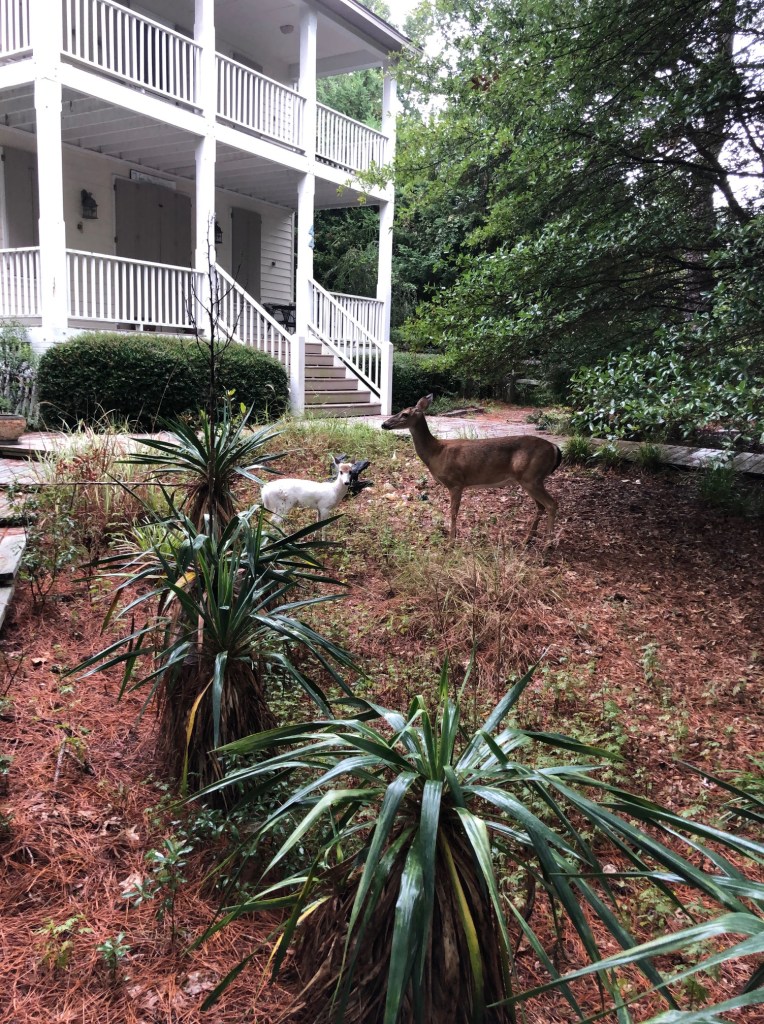
We have chosen not to publish this photograph. Instead, we share a photo that we took in September 2019 of a piebald fawn and her (or his) mother in front of a house on East Dogwood Trail.
Since this sighting, we have believed that Southern Shores may have two piebald deer residents, but we have been unable to confirm that fact. Because of their genetic makeup, piebald deer have difficulty surviving until adulthood.
Piebaldism—which is characterized by white patches or spots on the animal’s coat—is a genetic abnormality that is present in less than 2 percent of the whitetail deer population. The skin underneath the patches lacks pigmentation or coloration, but the animal has pigmentation wherever the brown hair appears.
The word piebald combines “pie,” which is short for magpie, a black-and-white bird, with “bald,” which can mean marked with white, according to the Merriam-Webster dictionary. Besides an adjective for coloring, piebald can be used to describe a composition of incongruous parts.
Piebaldism is often confused with albinism, which is the congenital absence of any pigmentation. Albino deer, which are exclusively white, have pink eyes, pink noses, and pink-hued hooves, whereas piebald deer have brown eyes, brown noses, and black hooves.
Unfortunately, the gene that causes piebaldism also regulates other traits and is associated with skeletal or internal deformities. Piebald deer are likely to have bowed snouts, curved spines (scoliosis), short legs, overbites, and short lower mandibles, as well as what online wildlife resources call “internal organ deformities.”
We are very saddened by the loss of our neighborhood unicorn, who charmed everyone who came upon her and often stopped traffic. She grazed in our yard–but we had not seen her in some time.
We hope the deer’s death was natural and that homeowners who have seen her remains—which we could not locate yesterday—have called Town Hall, the SSVFD, or a wildlife organization to inquire about their removal.
Another Dare County resident has died from COVID-19, according to yesterday’s Dare County Dept. of Health and Human Services dashboard, which gave no details about the deceased person.
It appears from the dashboard, which also records COVID-19-related hospitalizations, that the person had been hospitalized.
The DCDHHS reported 19 new COVID-19 cases yesterday, 16 of them Dare County residents. The 19 people fall in all age groups, from children age 17 and under to elders age 65 and older.
Four Dare County residents have now died from COVID-19, and four remain hospitalized with the disease.







 The Southern Shores Beacon