
12/8/20: GOVERNOR ORDERS PEOPLE TO STAY HOME, SOME BUSINESSES TO CLOSE, BETWEEN 10 p.m. AND 5 a.m.; ON-SITE ALCOHOL SALES TO END AT 9 p.m. Plus Dare County Deceptively Improves to Yellow Tier of COVID-19 Risk.

“Dig deep and keep tapping into that North Carolina spirit to keep each other safe,” Governor Cooper urged.

Starting 5 p.m. Friday, North Carolinians must stay home and certain businesses and facilities must close from 10 p.m. to 5 a.m., pursuant to Governor Roy Cooper’s latest COVID-19-related executive order, which imposes “new actions to slow the rapid spread of the virus,” he said today at a briefing

New Executive Order 181 also further restricts alcohol sales for on-site consumption, requiring them to end at 9 p.m., two hours earlier than the current alcohol-sales “curfew” in effect. Resumption of such sales remains at 7 a.m.

The new restrictions, described as a “modified” Stay-at-Home order for citizens and a “night-time public closure period” for businesses and other venues, are being taken in order to curtail social gatherings, the Governor said, which are driving the recent spike in new COVID-19 cases and hospitalizations statewide.

“The later in the evening you go,” Governor Cooper explained in response to a reporter’s question about the rationale for what she called a curfew, “the larger these gatherings can be.” Further, with the drinking of alcohol and late-night socializing, “people get uninhibited,” he said, and less inclined to observe COVID-19 precautions. 

“[We are trying] to chip away at those times” of close and crowded social gatherings, the Governor said, by ordering people to stay home.

Workplace social events and functions, such as office holiday parties, are obvious targets of the night-time public closure period. In fact, the order specifically states that “events or convenings outside the home must end or pause no later than 10 p.m.”

“You should limit going out to just essential activities,” said Dr. Mandy Cohen, Secretary of the N.C. Dept. of Health and Human Services, who shared the podium.

The Governor cited Massachusetts and Ohio as having had “some success” with similar measures.

But he also cautioned that “We have other things that we can do. We have more tools . . . to fight the spread of the virus,” if these actions do not result in a reduction of the key COVID-19 metrics, all of which have “significantly increased,” according to Dr. Cohen.

Businesses that must close during the night-time public closure period include restaurants; bars and lounges; fitness centers; movie theaters; and entertainment venues, among others.

Capacity limits for restaurants, retail establishments, and other businesses, however, remain the same, as do the limits on permissible social gatherings indoors (10 people) and outdoors (50).

The executive order, which has a number of exceptions to the new rules, will expire at 5 p.m. on Friday, Jan. 8, 2021, unless it is rescinded, modified, or extended.

Chief among the exceptions is one that exempts retail businesses that sell groceries, medications, health-care supplies, and fuel. Restaurants, breweries, distilleries, and wineries also may continue take-out and delivery service after 10 p.m.

We refer you to the FAQs for Executive Order 181 for answers to any questions you may have: EO 181 FAQ (nc.gov)

The exceptions to the modified Stay-at-Home order include leaving during overnight hours to:

*Travel to or from a place of work;

*Perform work at a workplace when the worker’s presence is required by the worker’s employer;

*Travel for work purposes;

*Obtain food, medical care, fuel, or social services;

*Travel from a business that closed at or after 10 p.m.’

*Travel to a business that will open at 5 a.m.’

*Travel to take care of a family member, friend, or pet in another household;

*Travel to or from a religious service;

*Travel necessary for personal safety; and

*Travel into or out of the state.

You may view the entire Executive Order 181 at EO181-Modified-Stay-at-Home-Early-Closure-Order.pdf (nc.gov). It is quite unwieldy because it incorporates many sections from previous executive orders that remain in effect. 

‘I AM VERY WORRIED’

“I am very worried,” Secretary Cohen said again today about COVID-19 conditions statewide, reiterating her comments in a statement issued Saturday and during another a briefing she held alone last week. “This virus is highly contagious and dangerous.”

The number of new COVID-19 cases and hospitalizations statewide on a single day has doubled in a month, she noted, and record highs have been set for both metrics. Not only are COVID-19 hospitalizations at an all-time high, record numbers of people are in the state’s intensive care units for treatment, Dr. Cohen said.

“Hospitals are feeling the strain,” she said, “and this is worrisome.”

According to data cited by a reporter at the briefing, researchers at Duke University and the University of North Carolina at Chapel Hill have concluded that the state’s “hospitals are six weeks away from being at [full patient] capacity.”

Last Saturday, 6,018 cases were reported in a 24-hour period by the NCDHHS; on Sunday, the number climbed to 6,438.

As of today, 2,373 people are hospitalized for COVID-19, a new record high, and 5,605 people have died as a result of the virus.

According to Dr. Cohen, the metrics are only going to get worse next week.  

“We have yet to see the impact of Thanksgiving gatherings,” she said. So far, the only Thanksgiving-related COVID-19 transmission numbers we are seeing, she said, are of “people who went to Thanksgiving already sick” and then infected others.

The Secretary strongly urged people to “avoid traveling and gathering this holiday season” and to keep their celebrations small and indoors.

“Do not wait until it’s you or your loved one” who is sick, she warned. “Act now. Do those three Ws now.”

DARE COUNTY NOW IN THE YELLOW, NOT THE ORANGE OR RED

Dr. Cohen also presented an updated COVID-19 county alert map of North Carolina, saying it “presents a sobering picture.” Unfortunately, the State’s picture of Dare County, which formerly was in the middle orange tier, is deceptive.

See COVID-19-County-Alert-System-Report.pdf (nc.gov)

Forty-right of the state’s 100 counties are now in the red tier, which signifies “critical” community spread of COVID-19—up from just 20 a month ago—and 34 are in the orange tier, a designation for “substantial” spread.

The remaining 18 counties, which now include Dare County, are in the yellow tier, which signifies “significant” community spread.

Based on COVID-19 data from Nov. 21 to Dec. 4, Dare County has a calculated 14-day case rate of 337.8 per 100,000 people and a 14-day positive rate of 7.5 percent.

COVID-19 continues to have a “low impact” on Dare County’s only hospital because COVID-19 patients in need of hospitalization are transported outside of the area.

The Outer Banks Hospital does not have an intensive care unit.

Any county that has more than 200 new COVID-19 cases in 14 days qualifies as a “red” or “critical” county, provided it also has a positive rate of more than 10 percent OR the impact of COVID-19 on its hospitals is “high.”

COVID-19 will never have an impact on the Outer Banks Hospital other than a low impact.

You cannot be intubated at a hospital that does not have a ventilator.

We also question the positivity rate. 

By our count, the DCDHHS reported 176 new cases from Nov. 21 to Dec. 4. We would like to know what population figure the State used to calculate Dare’s 14-day case rate. Regardless, the rate of 337.8 cases per 100,000 people puts the county in the red, but for its absence of adequate health care.

Since last Friday, the DCDHHS has reported 53 new COVID-19 cases, according to Director Sheila Davies’s update today. That includes 20 new cases reported today, 16 of whom are Dare County residents.

Five locals are currently being hospitalized for COVID-19, according to Dr. Davies—just  not in Dare.   

Ann G. Sjoerdsma, 12/8/20

12/8/20: GOVERNOR TO HOLD COVID-19 BRIEFING TODAY AT 3 p.m.

Governor Roy Cooper will hold a COVID-19 update briefing today at 3 p.m., in advance of the expiration of his latest executive order on Friday.

You may watch the Governor’s briefing on UNC-TV, channel 3, or live-stream it at:

Emergency Management Press Conferences | UNC-TV

North Carolina is experiencing a surge in COVID-19 cases, with the number of new cases reported last Saturday and Sunday exceeding 6,000. Yesterday’s new case count dropped to 4,372, but case counts usually decline on Monday.

COVID-19-related hospitalizations statewide also have increased dramatically this month, topping 2,000 for the past seven days. The daily positivity rate, which reflects the percentage of positive COVID-19 test results among the tests administered during a 24-hour period, has been consistently above 10 percent for the past week.

Five percent is the target goal for this metric, according to Dr. Mandy Cohen, Secretary of the N.C. Dept. of Health and Human Services.

The Governor is expected today to extend the “pause” in Phase Three of North Carolina’s reopening, known as “safer-at-home,” for at least another two weeks and to discuss tightening restrictions on businesses and public gatherings. He has repeatedly said that he does not wish to “go backward” and to reimpose stay-at-home restrictions that were imposed in the springtime, but he has not ruled out doing so.  

The Governor and Dr. Cohen typically speak at their COVID-19 update briefings for about 10 to 15 minutes and then take questions from the media for about 30 minutes.

Ann G. Sjoerdsma, 12/8/20

12/7/20: YOU MAY LIVE-STREAM MEETING OF CUT-THROUGH TRAFFIC COMMITTEE. Plus A Followup on the Town Council Meeting.

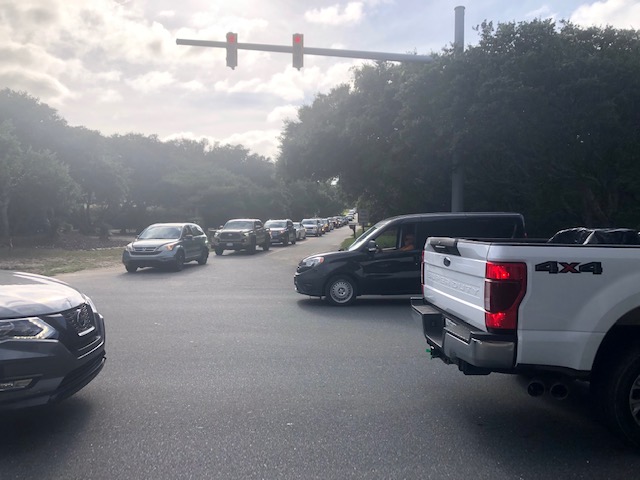
Summertime weekend traffic at the intersection of Sea Oats Trail with Duck Road, looking west

You will be able to live-stream Thursday’s meeting of the citizens’ Exploratory Committee to Address Cut-Through Traffic with the Town’s traffic study consultant on You Tube, according to Town Manager Cliff Ogburn, who spoke with The Beacon today.

The cut-through traffic committee will meet at 3 p.m. Thursday in the Pitts Center to receive a progress report from J.M. Teague Engineering and Planning, which has been hired to conduct a traffic study of Southern Shores that is based largely on police data of vehicle counts. The consultant will appear by Zoom, Mr. Ogburn said.

This meeting will be an informational session designed to include the committee in the study process. There will be no public-comment period.

J.M. Teague’s final report is expected to be submitted in mid-February, Mr. Ogburn said.

You may access the real-time live-stream feed of the meeting at (57) Southern Shores – YouTube.

Anyone who attends the meeting must observe COVID-19 safety protocol, including wearing a mask or other protective face covering.

(For background, see The Beacon, 12/4/20 and 10/14/20.)

FOLLOWUP ON TOWN COUNCIL MEETING

Upon speaking with Mr. Ogburn, we were able to clear up some of the confusion that confounded us when we viewed the Dec. 1 Town Council meeting videotape. Some of the problems had to do with not being able to hear people, especially staff members who spoke off-microphone and out of sight of the camera.

While we thank all Council and staff attendees for wearing protective masks at all times during the meeting, these COVID-19 precautions also interfered with their audibility.

When staff members do not speak into a microphone at the lectern, they cannot be heard on the You Tube videotape, and it becomes imperative for members of the Town Council, who always have microphones, to repeat what they said for the public record.

We also shared with Mr. Ogburn our concern that the Nov. 17 meeting of the Streets Committee—formerly known as the Capital Infrastructure Improvement Committee–was not properly reported at the Council meeting. We are hopeful that minutes of the meeting will be published on the Town website soon. 

Thanks to Mr. Ogburn, we now understand why Wood Duck Court, a cul de sac off of South Dogwood Trail, was selected for an asphalt-overlay project, and an estimate from RPC Contracting, Inc. for the job was solicited and in the Dec. 1 meeting packet.  

This project arose with a complaint by two homeowners to the Town’s Public Works Dept., according to Mr. Ogburn, who said that he could have authorized it without formal approval by the Town Council, but because he is still fairly new to his position, he decided to bring it to the Council’s attention.

RPC submitted a proposal for the overlay job of $18,430 to the Town’s engineering contractor, Joseph Anlauf, on Oct. 30, 2020. RPC also handled the recent resurfacing of U.S. Highway 158.

The PW Dept. has been keeping Wood Duck Court in “decent condition,” Mr. Ogburn said, especially the road’s shoulders. The pavement has been “torn up” and “rutted,” he said, by construction vehicles and trash and recycling trucks traveling upon it.

“We’ve been putting a Band-Aid on it,” Mr. Ogburn explained. “This should be a fix.” 

The Town Council also unanimously approved last week directing the Town Manager to prepare an RFQ (Request for Qualifications) for the purpose of identifying a professional engineering firm with “the knowledge, skill, and ability,” according to Mr. Ogburn, to perform a street paving study of the Town’s 37 miles of roadway.

Councilman and Streets Committee Co-Chairperson Matt Neal, with whom we also spoke today, brought up the idea of commissioning a paving study at last Tuesday’s meeting.

He said then that “It would behoove us to move forward with a street study” that would enable “objective” decision-making on the street projects that the Town undertakes and the funding it allocates to them. Today, he spoke about having an expert collect “scientific data”

At the meeting, Mr. Ogburn said he thought that a study, designed to assess pertinent factors, such as alligator cracking, raveling, patchwork, or rideability, would be “valuable” and “worthwhile.” It would lead to a more efficient and effective way of determining how the Town will allocate capital expenses.

“We may be able to capture more projects with less money over a longer period of time,” Mr. Ogburn suggested, adding that the Town has projected the expenditure of $40 million over 30 years for capital improvements.

Both Mr. Neal and Mr. Ogburn are looking toward financial planning to cover road improvements and repairs for the next 10 to 20 years. (Mr. Neal said 10 to 15 years; Mr. Ogburn said 20.)

As long as the Town Council and Town staff keep the public informed of their discussions and intentions, we will not be confused.

NO WORKSHOP MEETING: The Town made official today the cancellation of the Council’s Dec. 15 workshop session. The Town Council will meet next at 5:30 p.m. on Jan. 5, 2021.

Ann G. Sjoerdsma, 12/7/20

12/5/20: ‘TAKE PERSONAL RESPONSIBILITY,’ DR. COHEN IMPLORES, AS N.C. COVID-19 CASES, HOSPITALIZATIONS RISE PRECIPITOUSLY. More Than 6,000 New Cases Reported Today. Plus News on the Vaccines.

“You need to take precautions as if everyone around you has it,” Dr. Mandy Cohen said Thursday about the coronavirus. There is “a lot of virus” in North Carolina.

North Carolina’s top public-health official is appealing to people across the state to “take personal responsibility for their actions and [for] slowing the spread” of COVID-19, in light of today’s report of 6,018 new cases statewide of the disease.

“Always wear a mask when with people you don’t live with,” implores Dr. Mandy Cohen, Secretary of the N.C. Dept. of Health and Human Services, in a statement today on the NCDHHS COVID-19 dashboard, “keep your distance from other people and wash your hands often.”

Dr. Cohen issued a similar urgent message at a briefing Thursday during which she cited the “devastating milestone” of more than 5,000 new COVID-19 cases being reported in one day and North Carolina’s “highest positive rate yet” of 11.4 percent on Wednesday.

“In less than a week,” Dr. Mandy Cohen says today, “we went from exceeding 5,000 new cases reported in one day to exceeding 6,000. This is very worrisome.”

North Carolina’s new COVID-19 case total yesterday was 5,303; on Thursday, it was 5,637.

“We are seeing our highest rates of tests that come back positive despite the fact we are doing a lot of testing,” the Secretary continues in her statement. “This indicates we have even more viral spread across our state now.  We have record numbers of hospitalizations and people in the ICU.”

Today’s NCDHHS dashboard reports a record-high 2,171 hospitalizations statewide—a COVID-19 metric that keeps climbing with each passing day.

The positivity rate for the past 24 hours of testing was 10.7 percent, marking the fifth consecutive day that the percentage of positive tests among the total number of tests performed has exceeded 10 percent.

“I am asking each North Carolinian to take personal responsibility for their actions and [for] slowing the spread of this virus,” the Secretary implores.

At her Thursday briefing, Dr. Cohen also asked people to “show our care” for others by limiting social activities as much as possible and always wearing a mask when in the company of those with whom we do not live.

This past week the U.S. Centers for Disease Control and Prevention revised its COVID-19 guidelines to recommend “universal mask use” indoors.

Although the agency exempted the general wearing of masks at home, it recommended that people wear a mask at home when a member of their household has been infected or has potentially been exposed to the virus, such as through his or her employment.

In its Dec. 4, 2020 Morbidity and Mortality report, which was released early, the CDC warned that the United States has entered a “phase of high-level transmission” of the virus, with the colder weather and the holiday season driving people indoors for social gatherings with extended family, friends, and other people outside of their household.

Roughly 50 percent of all transmission of COVID-19 is by people who are asymptomatic, the CDC report notes.

To drive home her warning, Dr. Cohen offered Thursday a sobering comparison between the death toll in North Carolina in just 10 months from COVID-19 and the death toll in the State over a 10-year period from influenza.

As of today, the NCDHHS is reporting 5,516 deaths from COVID-19. That compares with 1,500 influenza-related deaths in North Carolina in a decade, Dr. Cohen said, or 150 deaths per year.

“You need to take precautions,” the Secretary concluded Thursday, “as if everyone around you has [the virus]. There’s just a lot of virus here in North Carolina.”

While she declined two days ago to respond specifically to a reporter’s question about possible restrictions that the State may impose if people continue to disregard the mask mandate and hospitalizations continue to rise and threaten the level of health care, Dr. Cohen said today: “We are looking at what further actions we can take as a state to protect North Carolinians and save lives.”

VACCINATION PLAN UPDATE

While Dr. Cohen expressed how “very worried” she is about the number of new COVID-19 cases statewide and the increasing spread of the coronavirus, she spoke chiefly at the Thursday briefing about the two vaccines that are in the pipeline for possible distribution to states this month.

Dr. Sheila Davies, director of the Dare County Dept. of Health and Human Services, reproduced yesterday most of what Dr. Cohen said in her remarks in her own COVID-19 update.

Please see “COVID-19 Vaccine” in Dr. Davies’s report at DCDHHS’ COVID-19 Update #66 | Friday, December 4, 2020 | Coronavirus | Dare County, NC (darenc.com).

The scientific data on Pfizer’s and Moderna’s vaccines are wending their way through the U.S. Food and Drug Administration’s approval process and are expected to be considered by the FDA’s Vaccine Advisory Board on Thursday, Dec. 10, according to Dr. Cohen.

If the FDA grants Emergency Use Authorization approval to the vaccines—specifying exactly how the vaccines may be used on an emergency basis and by whom—North Carolina could receive 85,000 doses of Pfizer’s vaccine “as early as mid-December,” Dr. Cohen said.

A week later, North Carolina may have Moderna’s vaccine, as well, she added. (See The Beacon, 12/2/20, for specifics about the vaccines.)

Dr. Cohen reiterated the prioritization she discussed at the Governor’s briefing last Monday for vaccine distribution. The vaccines, which are administered in two injections separated by weeks, will be given first to:

  1. Health-care workers at a “limited number” of hospitals who have a “higher risk of exposure” to the virus. Such workers need not necessarily be clinical staff.
  2. Long-term care workers and residents.
  3. Adults with two or more chronic conditions that make them more susceptible to severe COVID-19.

The vaccine distribution to hospitals will be based on the size of the hospital, with the larger ones having priority, Dr. Cohen explained. Hospitals will do their own prioritizing of staff for the vaccine.

The federal government will determine how much vaccine to send to the states, the Secretary further explained, and the states will tell the feds where to send the supply.

The vaccine manufacturers will ship directly to the vaccine provider, whether it is a hospital, in the early weeks, or a local health department, as distribution increases.

Children will not be eligible for vaccination, Dr. Cohen said. They have not been studied in clinical trials to determine the vaccines’ safety and effectiveness.

Dr. Davies reports that the Dare County health department will likely receive its first shipment of vaccine in January. Please see her update yesterday for more details about vaccinations locally.

The DCDHHS reported 20 new COVID-19 cases on Thursday and nine yesterday, after shocking us with a record-high 37 new cases on Wednesday. Ten Dare County residents are currently in a hospital outside of the area being treated for COVID-19.

[UPDATE: The DCDHHS reported 20 more COVID-19 cases this afternoon, six (30 percent) of whom are children age 17 or younger. Thirteen are Dare County residents.]

We also find significant in Dr. Davies’s report the following commentary about the followup of COVID-19 patients:

“While the majority of individuals experience only mild to moderate symptoms,” the DCDHHS Director says, “the number of individuals requiring medical attention related to COVID-19 complications has been increasing.

“On our dashboard we report hospitalizations. We also remain in close communication with the Outer Banks Hospital regarding individuals presenting to the emergency department with COVID-like symptoms as well as individuals who go to the emergency department because of worsening symptoms related to COVID-19. Both of these numbers have been increasing over the past few weeks.

“The hospital reported that this past week they saw the highest number of COVID-related returns and admit/transfers since tracking started.”

As we have said before: This is an emerging infectious disease. Its full impact is not yet known.

***

Among the articles we have read recently in medical journals, we thought that this one, titled “Younger Adults Caught in COVID-19 Crosshairs as Demographics Shift,” published Nov. 11 by The Journal of the American Medical Assn., may be of interest to a general audience:

Younger Adults Caught in COVID-19 Crosshairs as Demographics Shift | Infectious Diseases | JAMA | JAMA Network

The pandemic’s age distribution has shifted with time. Of the almost 7 million COVID-19 cases included in the CDC’s “COVID Data Tracker,” about 76 percent have occurred among adults younger than age 65, with 18- to 29-year-olds making up what the article calls “the largest chunk.”

Ann G. Sjoerdsma, 12/5/20

12/4/20: CUT-THROUGH TRAFFIC COMMITTEE TO MEET DEC. 10 FOR PROGRESS REPORT ON STUDY. Plus MSDs, Streets, and More News and Views from the Town Council’s Meeting.

This photo depicts a typical scene on Hillcrest Drive, as vehicles travel north near the SSCA tennis courts, on a summertime Saturday.

The citizens’ Exploratory Committee to Address Cut-Through Traffic will hold a meeting Thursday, Dec. 10, at 3 p.m. in the Pitts Center to receive a progress report from J.M. Teague Engineering and Planning about the traffic study it is conducting for the Town of Southern Shores.

For background on J. M. Teague, a company located in Waynesville, N.C., which is outside of Asheville, and the $7,500 study authorized by the Town Council, please see The Beacon on 10/14/20.

According to a notice released today by the Town, the consultant was hired “to examine previously collected traffic data and to perform a review of roadways affected by cut-through traffic to determine recommended mitigation strategies.”

The consultant will describe the approach it is taking to its examination and analysis of the Town’s traffic data at next Thursday’s meeting, the notice states. It will not present any findings or recommendations, nor will public comment be taken.

J.M. Teague’s final report, which Town Manager Cliff Ogburn said in October would be delivered to the Town in January, is now expected to be completed in mid-February, the notice announces.

Mr. Ogburn advised the Town Council at its Oct. 6 meeting that the consultant would have 90 business days in which to “complete the project.”

J.M. Teague visited Southern Shores on Oct. 9 for the  purpose of “gathering geometric data, taking current turning movement percentages, and conducting observations of the current vehicular volumes and movement that can be translated into seasonal numbers,” according to the Town’s Oct. 9 newsletter.

The Town’s notice today does not indicate that the Dec. 10 meeting will be live-streamed. If we find out that a live stream will be available, we will advise you of that fact.

COVID-19 safety protocol will be observed at the meeting. Please wear a protective facial covering if you attend.

TOWN COUNCIL’S DEC. 1 MEETING: NEWS AND VIEWS

We had pre-existing work commitments this week and could not attend the Town Council’s meeting or view it in real time on the live-stream feed. We are belatedly catching up and will write a fuller meeting report as soon as possible.

If you see Warren Davis of Hillcrest Drive in the next two weeks, wish him a happy birthday.

Mr. Davis, an Outer Banks resident and active volunteer for 37 years, observes his 100th birthday on Dec. 16. The Town of Southern Shores paid tribute to Mr. Davis, who was a chief economist with Gulf Oil Co. when he retired in 1983, at Tuesday’s meeting. Mr. Davis attended, wearing a mask.

Happy Birthday, Mr. Davis, and thank you for all you’ve done for Southern Shores and the greater Outer Banks.

And now, a few snippets of news from the meeting, including:

MUNICIPAL SERVICE DISTRICTS: Mr. Ogburn said the Town Council will begin its consideration of what the “boundaries” of the municipal service districts “are going to look like” at its Jan. 19 workshop meeting. He also stated that the amount of money the Town can expect Dare County to contribute to its 2022 beach nourishment project is a “big unknown,” because the County is “weighing the need for a project in Avon”—a fact that County Manager Bobby Outten informed the Council in November 2019.

Mr. Ogburn said he expects to know the County’s funding of the Southern Shores project by Jan. 19.

The Town Manager also projected March 16 as the date for the public hearing on the MSD designations.

TWO NEW TOWN EMPLOYEES: Deputy Town Manager/Planning Director Wes Haskett introduced two new Town employees: Marcy Baum, who is the new Permit Officer, and Kevin Clark, the new Building Inspector/Code Enforcement Officer.

You may read the biographies that Mr. Haskett presented at the meeting for each employee on the Town website at Planning & Code Enforcement | Town of Southern Shores, NC (southernshores-nc.gov).

Ms. Baum, who purportedly has worked for 26 years in the customer service industry, has no permitting experience. Mr. Clark, who is a licensed electrical contractor, has been a building inspector since 2017.

Ms. Baum started work on Nov. 16, and Mr. Clark started on Dec. 1.

Mr. Haskett has previously announced that Buddy Shelton, the Town’s current part-time Building Inspector, would continue in his job to train his replacement and retire by February, at the latest.   

CODEWRIGHT PROJECT: Mr. Haskett also announced that the Town Planning Board will start working on the “public hearing draft” of CodeWright’s Town Code rewrite at its Jan. 19, 2021 meeting. The Planning Board typically meets on the third Monday of the month, but Jan. 18 is Martin Luther King Jr. Day. 

And some of the Beacon’s views, including

CONFUSION/LACK OF TRANSPARENCY: There were times during the meeting Tuesday that it seemed to us like the Town Council was unraveling.

Mayor Tom Bennett’s holiday greetings to his colleagues at the end of the meeting, made after he said that the Council would not meet again in December, even though it has a meeting scheduled Dec. 15 that has not been properly canceled yet, was the icing on the upside-down cake.   

Unless we missed Mr. Ogburn’s protestation that he had no report to make—the sound quality on the live stream was poor when people spoke without a microphone up-close—the Mayor earlier skipped over the Town Manager’s report, which we consider the most important portion of the Council’s monthly meeting. We have emailed Mr. Ogburn to clarify what happened.

[UPDATE: Mr. Ogburn informs us: “I didn’t give a report on Tuesday, but I don’t plan for that to be the norm.”]

As he has at previous meetings, the Mayor had difficulty Tuesday keeping his place in the agenda. He also struggled with restating motions.

[UPDATE: In retrospect, some of the “unraveling,” as we termed it, occurred because the Mayor was not mindful of informing the viewing public and preserving a public record. When Mr. Ogburn said, inaudibly off-mike, that he had no report, we would have appreciated the Mayor stating for the record: “The Town Manager has just stated that he will not be making a report tonight.” Then: “Town Attorney Ben Gallop also has stated that he does not have a report for tonight.”]

We had expected to hear from Mr. Ogburn about J.M. Teague’s progress and were surprised to see the notice today about next week’s committee meeting. This is something that the Town Manager surely would have mentioned in his report.

Mr. Ogburn is obviously the glue that holds the Town’s operations together, and, if the public is going to be informed, we need to hear from him.

It was clear during the Council’s discussion about MSDs that individual members of the Council are meeting with Mr. Ogburn and that those members are not making their views known in public.

Mayor Bennett actually initiated the topic of MSDs, which was on the agenda as “Old Business,” by saying: “Most of us have seen the paperwork and talked with our manager on this,” and asking if any of the other four want to “share with the rest of us or/and with the manager” what they think now, at the meeting.

He was trying to move the agenda forward. The idea of the people’s representatives actually sharing views with the public at a public meeting did not come up.

Mayor Pro Tem Elizabeth Morey gently reminded the Mayor that the Town Manager had a presentation to make. Mr. Ogburn then gave a thorough report about MSDs, elaborating upon the statutory process for establishing them.

Earlier, the Mayor had said, “I’m keeping track of my mistakes tonight, and I’ve already lost count.”

To which Councilman Leo Holland replied: “Don’t be too hard on yourself.”

With the MSD designation and dramatic take-rate changes taking place next year, decision makers must be clear-headed and competent. The public deserves no less.

STREETS COMMITTEE/WOOD DUCK COURT: An extended discussion occurred among Council members about the value of having a town-wide street paving study done, after Councilman Matt Neal brought up the subject. Before this discussion, the Town Council unanimously approved spending $18,430 to make improvements to Wood Duck Court, which is a cul de sac off of South Dogwood Trail.

The former Capital Infrastructure Improvement Planning Committee, now known as the Streets Committee, met on Nov. 17 and apparently discussed a town-wide roads study, as well as funding a project on Wood Duck Court. Because neither Streets Committee co-chair gave a report Tuesday on the Nov. 17 meeting—which is customary in Town Council business—and no committee meeting minutes have been posted yet on the Town website, we were left to guess who on the committee did or suggested what and why.

Mr. Neal actually said he cannot “speak for the committee,” but, of course, he can, and he should.

The impression we received from the explanation given Tuesday by Streets Committee co-chairperson, Councilman Jim Conners, for why funds should be allocated to Wood Duck Court, and not another cul de sac or section of roadway that is in disrepair, is that two homeowners on the cul de sac met with him privately and convinced him of the need.

We have not inspected the court, but we have no doubt that it could use improvement, as can so many other town roadways. We saw the construction vehicles coming and going from that cul de sac this year—as yet another lot was clear-cut and another house was built—pounding the road surface.

But need alone should not, and cannot, determine how and when the Town Council allocates precious capital-improvement funds.

We found it very curious that Mr. Neal brought up the need for “objective” analysis and “objective” criteria to guide the prioritization of street improvements after the Council subjectively had favored Wood Duck Court.

We look forward to seeing the Streets Committee’s minutes online soon. Former Town Manager Peter Rascoe took the minutes at the CIIP Committee’s meeting and posted them within a day or two. Although they often seemed skewed to us, at least they were there.

More on Tuesday’s meeting soon.

Ann G. Sjoerdsma, 12/4/20; updated 12/7/20

12/2/20: DARE REPORTS 37 NEW COVID-19 CASES. YES, 37.

We wanted to call it a day, but then we checked the Dare County Dept. of Health and Human Services dashboard just one more time and, curses . . . At 5:30 p.m., it reported 37–yes, 37–new COVID-19 cases, 28 of them Dare County residents, including one man age 65 or older, who was hospitalized.

We have a sneaking suspicion that tomorrow’s post-Thanksgiving weekend report will surpass today’s. After all, COVID-19 has an average incubation period of four to five days.

Here is the age breakdown of the 37 people who tested positive in Dare County for the coronavirus disease:

Age 17 and younger: two

Age 18 to 24: two

Age 25 to 49: 15

Age 50 to 64: 13

Age 65 and older: five

Have a good night.

THE BEACON, 12/2/20

12/2/20: GOVERNOR TOUTS STATE’S VACCINE PREPARATION, OFFERS HOPE FOR RELIEF FROM COVID-19.

Delivering a hopeful, rather than a dire message, for a change, Governor Roy Cooper held a briefing yesterday to tout North Carolina’s readiness to handle the distribution of a COVID-19 vaccine that may start on a limited basis as early as later this month.

Citing “newfound hope,” the Governor spoke of the “remarkable early results” achieved in the clinical trials of two COVID-19 vaccines—those of Pfizer/BioNTech and Moderna—saying that the results were “better than health experts ever hoped for.”

Both vaccines, whose manufacturers reported effectiveness in trial subjects of 90 to 95 percent, are currently being evaluated for approval on an Emergency Use Authorization basis by the U.S. Food and Administration. That approval is expected to come soon. 

“North Carolina is working hard to hit the ground running when these vaccines are approved and shipped,” the Governor avowed. “For months our Department of Health and Human Services has been developing a plan to distribute the vaccines so that we can get past this pandemic. . . .

“But,” he continued, “there is still a lot of work to do to get the vaccines from the manufacturers to our healthcare providers, like hospitals and health departments, and then ultimately to each of us.”

Distribution in such a “big state,” with “rural areas that stretch for hundreds of miles,” the Governor said, poses many “challenges of geography,” all of which the State’s chief executive seemed confident would be met.

North Carolina is preparing for Pfizer’s vaccine, not Moderna’s, he said.

The Pfizer vaccine is administered in two injections, 21 days apart, and must be stored long-term at a “super-cold” minus-94 degrees Fahrenheit, according to the latest media reports.

The Moderna vaccine, developed by a Cambridge, Mass.-based biotechnology company, also requires two doses for maximum effectiveness, which must be administered 28 days apart. It, too, needs to be frozen at below-zero temperatures if it is stored for a long time, but it reportedly can be refrigerated for up to 30 days before use.

Scientific data about Pfizer vaccine’s safety and effectiveness in clinical trials are expected to be available for independent scrutiny in the next few days, according to Dr. Cohen, who said that the “preliminary data look very strong.” Scientists nationwide have been waiting to read more than optimistic press releases from the manufacturer.

Both vaccines, as well as a third manufactured by AstraZeneca in collaboration with Oxford University, are mRNA (messenger ribonucleic acid) vaccines made with new technology. The Pfizer vaccine works, Dr. Cohen explained, by triggering the body’s immune system to make the antibodies it needs to combat the SARS-CoV-2 virus, which causes COVID-19. The RNA molecule, as we understand it, encodes a protein in the cell to which the immune system reacts.

The vaccine is “not a quick fix,” Dr. Cohen cautioned, adding that it will “take several months” for the vaccine to be available to anyone who would like it.

North Carolina submitted a draft vaccine distribution plan to the federal government in October that consists of phases. Said Dr. Cohen: “We’ve been hard at work preparing for this moment.”

The first to receive North Carolina’s “limited supply” of COVID-19 vaccine will be high-risk health-care workers in hospital settings, according to the NCDHHS Secretary. Vaccine priority will then progress to residents of long-term care facilities, such as nursing homes, and people with at least two at-risk chronic conditions.

The vaccine will be free to everyone who receives it, Governor Cooper stressed, regardless of an individual’s insurance.

The Beacon will give more attention to vaccination in North Carolina when it becomes a reality. In the meantime, we note that COVID-19 cases and hospitalizations are steadily increasing daily in the state, as is the positivity rate.

As of today, 5,366 North Carolinians have died as a result of the coronavirus-2.

Today’s NCDHHS dashboard reported 4,199 new cases and a record-high 2,039 hospitalizations, along with an 11.4 percent positivity rate.

Dr. Cohen cited the “worrisome” number of emergency department visits being made by people with COVID-19 symptoms and said, “Too many people are becoming seriously ill with COVID.”

We should expect to see the numbers go even higher as the Thanksgiving effect becomes evident. That trend should hold true in Dare County, too.

We will publish a Dare County COVID-19 roundup at the end of the week. In her update yesterday, Dr. Sheila Davies, Director of the Dare County Dept. of Health and Human Services, identified the Dare County resident whose COVID-19-related death was reported Monday as a person in “their” 70s.

Ann G. Sjoerdsma, 12/2/20

11/30/20: FIFTH DARE COUNTY RESIDENT DIES OF COVID-19; NINE LOCALS ARE NOW IN THE HOSPITAL.

A fifth Dare County resident has died of COVID-19, according to the Dare County Dept. of Health and Human Services, which also reported today that a Dare County woman, age 65-or-older, has been hospitalized for treatment of the disease.

The DCDHHS gave no personal details about the deceased person, but its dashboard accounting indicates that he or she was not in the hospital when death occurred.

Nine local residents with COVID-19 are currently hospitalized, according to today’s dashboard report.

Eighteen new COVID-19 cases were reported in Dare County over the weekend, 15 of them on Sunday. Of those 15, five were age 17 or younger, including four local children. Eight of the others were between the ages of 18 and 49, and the remaining two were non-resident men, age 65 or older, one of whom was hospitalized.

COVID-19 metrics statewide continue to “move in the wrong direction,” as both Governor Roy Cooper and NCDHHS Secretary Dr. Mandy Cohen have said. Today’s positivity rate was 9.5 percent, the highest it has been since July.

We will provide a more detailed COVID-19 update later in the week.

THE BEACON, 11/30/20

11/30/20: NUMBER-CRUNCHING, NOT NEED, DEFINES TOWN’S PROPOSED MUNICIPAL SERVICE DISTRICTS: AN ANALYSIS OF MSDs AND THEIR CREATION, AND HOW WE BELIEVE SOUTHERN SHORES HAS ERRED.

Homeowners on Seventh Avenue were very vocal in public meetings about needing beach nourishment. If nourishment would benefit Seventh Avenue “to a demonstrably greater extent” than other other areas in town, then Seventh Avenue, arguably, should be an MSD.

Before establishing a municipal service district for a beach erosion-control project, a town’s governing board must determine that the proposed district is in need of the project “to a demonstrably greater extent” than other areas in the municipality.

North Carolina law permits MSDs to be created—and towns to levy an additional tax on properties within them that would otherwise be unconstitutional—because it assumes that the property owners in the MSDs benefit more from the projects (e.g., beach nourishment) or extra services provided by the municipality than other town property owners do.

The most common MSDs, according to the University of North Carolina School of Government, are established for downtown or urban area revitalization and are often referred to as business improvement districts or BIDs.    

You can see easily how the overhaul of a blighted section of a downtown area would directly benefit businesses located there.

But who benefits to a “demonstrably greater extent” from beach nourishment in a resort town where every property owner benefits from maintaining the beaches so that they continue to attract vacationers, who bring revenue to the town; enhance the value and desirability of all homes and properties; and offer exceptional recreational opportunities?

Who benefits to a “demonstrably greater extent” when everyone in town benefits and the beaches, themselves, are not privately owned?

The “demonstrably greater extent” standard for defining municipal service districts was established by North Carolina state law and is fundamental to the designation of such districts. You will find it presented in plain English in N.C. General Statutes sec. 160A-537(a).

We can say unequivocally that at no time during the Town Council meetings held in the six months before the June 16 beach nourishment public hearing was NCGS sec. 160A-537(a) referenced or the “demonstrably greater extent” standard mentioned.

At no time did Town Attorney Ben Gallop or any other attorney explain the standard and the process of creating MSDs to the Council or the general public.

Instead, the Town Council approved hiring DEC Associates, Inc., of Charlotte to work with Town staff to prepare “beach nourishment funding [financial] models,” based on the Town securing special obligation bonds, which would be financed in part by increased special taxes on property owners in newly designated MSDs.

In other words, the Town created proposed municipal service districts in order to start crunching numbers to figure out how much property owners’ real estate taxes would have to increase—and how many properties would have to be included in an MSD—if it approved a 2022 beach nourishment project.

The Town Council expressly authorized Interim Town Manager Wes Haskett to obtain the real-estate value assessments for all properties within Southern Shores in order to work with DEC Associates to calculate how much more tax MSD property owners would have to pay to meet expenses estimated for three possible beach nourishment projects.

Surely you remember the preliminary MSD maps and number-crunching prepared and circulated by the Town that showed three districts, defined solely by proximity to the oceanfront, and suggested tax rates, don’t you? If not, you can refresh your memories by looking at the meeting packet to the Council’s May 19 workshop meeting.

See “Beach Nourishment Funding Models”: Meeting-Packet_2020-05-19.pdf (southernshores-nc.gov)

Unfortunately, it is not possible to search Municipal Service Districts on the Town’s inadequate website and be directed to any useful information. You have to search Council meeting minutes and packets, or go through the archives of The Beacon, to glean the facts.

On April 15, we wrote in The Beacon that:

“The Town has preliminarily proposed three ‘municipal service districts’ to fund the [beach nourishment special-obligation bond] debt through varied tax increases—oceanfront property owners would pay the highest tax rate increase—but it has yet to prepare a report that demonstrates and justifies the proposed district boundaries. All it has done is provide financial data, not a coherent report.”

Town Councilman Matt Neal, who is a wiz with numbers and mathematical calculations, spearheaded this effort. Mr. Neal could, and did, tell property owners at the June public hearing how much additional tax they could expect to pay, based on the location of their property and the tax rate that had been preliminarily calculated.

We have a lot of respect for Mr. Neal’s intellectual abilities and his character. Indeed, we consider him a friend. But we disagreed with his—and the Council’s—modus operandi in this instance. We considered it slipshod and arbitary, if not invalid.

On May 19, we wrote to Councilman Neal that we seriously questioned “the legal justification of the districts that the Town has carved out from the ‘townwide’ tax base, as well as those it has omitted (i.e., the commercial area). They are based solely on proximity to the oceanfront, not on the ‘demonstrably greater extent’ standard.”

We concluded in our letter that: “[A]n analysis based on the statutory standard—not just on simple real-property tax-value number-crunching—is required before MSDs can be created.”

When the Town Council convenes tomorrow at 5:30 p.m. in the Pitts Center, it will have before it two proposed MSDs. They are MSD1, consisting of oceanfront and oceanside properties; and MSD2, which generally consists of properties on the west side of Ocean Boulevard.

As illustrations in the Dec. 1 meeting packet show, MSD2 may or may not include properties between Ocean Boulevard and Duck Road and those on the side streets in Seacrest Village east of Duck Road.

See the meeting packet: https://www.southernshores-nc.gov/wp-content/uploads/minutes-agendas-newsletters/Meeting-Packet_2020-12-01.pdf.

According to a report by Town Manager Cliff Ogburn in the packet, all that the Town Council has to do tomorrow  is consider the “size and makeup” of these two MSDs. The legal question of benefit is still not considered germane. It will be worked into a report after the Council decides which property owners it wants to tax.

BACKTRACKING TO CONFORM WITH N.C. LAW

The Town needs to generate $1,224,775 per year for the next five years to pay for what is estimated to be its portion of the estimated $16 million beach-nourishment project, according to Mr. Ogburn.

That assumes, he says, that Dare County will pay for 50 percent of the project’s costs from its beach nourishment fund, which is made up of monies from the county’s occupancy taxes (2 percent of the 6-percent levy); but that funding is “uncertain.”  Still.

It is still uncertain more than a year after County Manager/Attorney Bobby Outten spoke to the Town Council at length about the County’s funding capability, and The Beacon extensively covered what he said.  (See The Beacon, 11/8 and 11/9/19.)

“Current planning,” Mr. Ogburn writes, calls for a property tax to be levied through a town-wide tax, so that all property owners contribute to the project, with owners of properties in “one or more municipal service districts” paying a higher tax rate.

The increased taxes will be levied July 1, 2021.

The N.C. law on MSDs requires a town council to hold a public hearing on proposed new MSDs before it votes to adopt an ordinance defining them. (NCGS sec. 160A-537(b))

Before a public hearing can be held, the town council must prepare a report containing:

  1. A map of the proposed district, showing its proposed boundaries;
  2. A statement showing that the proposed district meets the “demonstrably greater extent” standard; and
  3. A plan for providing in the district one or more of the services listed in G.S. sec. 160A-536, among which is “beach erosion control and flood and hurricane protection works.”

We argued to Mr. Neal in our letter that this report should have preceded the June 19 public hearing, when a number of speakers addressed the preliminary MSDs and their possible tax rates, but to no avail. Again, we consider the statutory process to have been abused and the analysis done to have been arbitrary and results-oriented.

According to a hypothetical “Beach Nourishment MSD Creation” timeline drafted by Mr. Oburn, MSD property owners will be notified of proposed districts by the end of January, and a public hearing will be held on their designation in March.

State law requires this notice to be sent at least four weeks before the hearing date.

State law also permits property owners to request exclusion from the MSD at the hearing or to submit a written request of exclusion to the Town Council no later than five days after the hearing.

To be excluded, an owner must “state with particularity the reasons why the tract or parcel is not in need of the services . . . of the proposed [MSD] to a demonstrably greater extent than the remainder of the [town], and provide any other additional information the owner deems relevant.” NCGS sec. 160A-537(c1).

We know that an exclusion request is not likely to be granted by a town council that has already made up its collective mind, but this is the redress provided by the statute. There is no statutory right to appeal the Council’s denial of exclusion, but we are not prepared to say that legal action may not be possible subsequent to a denial. 

For the MSD ordinance to be adopted, a majority of the Town Council must approve it at two separate meetings.

Final adoption of the MSDs must be made in April, during the FY 2021-22 budget process, according to Mr. Ogburn’s timeline. The Town Manager notes that the “Dare County Tax Collector” has requested that the MSDs be established no later than May 4, the date of the Council’s May 2020 meeting.

Inasmuch as the timeline shows the Town proceeding “full steam ahead” with presumed votes of approval, and in accordance with the Tax Collector’s deadline, we view the whole process as a farce. If the Town Council truly cared about the application of the statutory standard and about what property owners think, it would have proceeded with a report and a hearing about MSDs immediately after the June 19 hearing. It is clearly just going through the motions here. 

We also wonder, will the notification to MSD property owners come at the same time as those on the oceanfront are being asked to grant perpetual and irrevocable easements to the Town for erosion control activities, which when described in draft form Oct. 6 were grossly overbroad and poorly defined?

A revision of the easement draft has not yet surfaced. Property owners should not have to make multiple trips to their lawyers to sort out what the Town of Southern Shores is doing to them.

FULL DISCLOSURE OF FINANCIAL INTEREST

Many of you know that I am a co-owner of oceanfront property. My siblings and I co-own two of the few remaining undeveloped oceanfront lots in Southern Shores, as well as an oceanfront beach box that we rent out each summer.

My parents arrived in Southern Shores in the 1960s and purchased property when it was plentiful and housing tastes were still very modest. Southern Shores became my family’s home away from home before it became my home now decades ago.

As I said above, North Carolina beaches are public beaches. More precisely, the dry-sand portion of the beaches is held in trust by the State of North Carolina for the public’s use and benefit. I cannot walk out to the beach in front of my family’s oceanfront cottage and tell members of a yoga class that has assembled there to get lost because they are trespassing. They are not. They have a right to use that beach.

And yet, Southern Shores proposes to tax me more for nourishing beaches that I do not own simply because I own land next to them. And the Town Council does not care what use I make, or do not make, of that land.

I will not make an argument today about why I do not think my family and I benefit “to a demonstrably greater extent” from beach nourishment than a property owner elsewhere in town, far removed from the oceanfront. I conclude not with a summation, but with a word about history.

Dare County first started talking about putting sand on its beaches in 1965, as I recall from press reports in the 1990s, but the real push began in 1991 when the county and the U.S. Army Corps of Engineers launched a study. Subsequently, however, federal money dropped out of the equation, and the N.C. General Assembly did not obligate the State to finance nourishment along its coastline of public beaches. Such projects became the responsibility of local governments, of town-county commitments.

I’m glossing over a lot of history here, most of it featuring the Town of Nags Head, which was the town in most need of beach nourishment.

Some of you may recall that, after gaining the General Assembly’s approval, the Dare County Board of Commissioners imposed in 2005 a 1 percent increase in the general sales tax to bolster funds for beach nourishment.

At the time, people still thought that the federal government would pay for 70 percent of a large-scale nourishment project from southern Kitty Hawk to South Nags Head, and that the state and county would kick in the remaining 30 percent. They opposed the so-called “sand tax.”

A local group known informally as the Beach Huggers gathered enough signatures on petitions to force a referendum on repealing the sand tax, which was to remain in place for eight years. Seventy percent of Dare County voters voted to repeal the tax in 2006.

Big mistake. Had the tax remained in force for its projected eight-year life and then been renewed for another eight years, it, in combination with the occupancy taxes dedicated to beach nourishment, might have paid for all of the projects on the Outer Banks’ public beaches.   

Instead, federal and state money (except grants) for beach nourishment disappeared, and now we have municipal service districts, a mechanism that enables towns to stick it to property owners who already pay increased taxes because of their properties’ location and arguably would derive no more benefit than a property owner elsewhere in town.

Ann G. Sjoerdsma, 11/30/20

11/29/20: MSDs CAN WAIT; TOWN COUNCIL TO REDUCE PUBLIC MEETINGS IN 2021.

We love the cleverness of this sign on South Dogwood Trail. We wonder: Will beach nourishment encourage more yard-sign opinions?

Dear Beacon Readers:

We have decided not to diminish our Sunday pleasure by writing extensively about the Town Council’s understanding and handling—past, present, and future—of municipal service districts (MSDs) for the purpose of unequally taxing town property owners to finance the nourishment of Southern Shores’ public beaches. Nor do we intend to write about COVID-19. 

Such work is what Mondays are for, and tomorrow will come soon enough.

We will say that the Southern Shores Town Council is scheduled to consider at its Tuesday meeting its previous handiwork in creating possible MSDs—the district maps are in the meeting packet—which it did without reference to (or concern for) the N.C. statutory standard that governs their creation and, no doubt, with a majority of the Council members not having bothered to read the relevant statute .

You may recall seeing these district maps in the springtime before the last public hearing on beach nourishment, and you may have wondered what became of them. Well, they’re back for the Council’s predictably perfunctory input—which will be predictably approved unanimously—on Tuesday when it meets at 5:30 p.m. in the Pitts Center.

You may access the Council’s agenda here: https://www.southernshores-nc.gov/wp-content/uploads/minutes-agendas-newsletters/Agendas_2020-12-01.pdf.

The meeting packet is available here: https://www.southernshores-nc.gov/wp-content/uploads/minutes-agendas-newsletters/Meeting-Packet_2020-12-01.pdf.

The meeting is open to the public, with COVID-19 safety protocol in place. Everyone must wear a mask and observe six-foot physical distancing.

The meeting also will be available to view by live stream on the Town’s You Tube website: https://www.youtube.com/user/TownofSouthernShores.

There will be two public-comment periods during the meeting. If you will not be attending the meeting and would like to submit a comment, you are directed in new instructions posted on the Town website to email “public comment” to info@southernshores-nc.gov, not to send comments to Town Clerk Sheila Kane. 

COUNCIL TO REDUCE ITS PUBLIC MEETINGS IN HALF

We note that, pursuant to a resolution included in the meeting packet, the Town Council has decided to eliminate its second workshop meeting of the month in 2021, reverting to the 2018-2019 calendar schemes of holding a meeting on the third Tuesday of the month “as needed.”

The Town Council has been inconsistent in its scheduling of third-Tuesday meetings during Mayor Tom Bennett’s two terms in office.

We see this move as an opportunity lost for the public to know what the Council is doing and thinking, in more detail—if it would cooperate in enlightening us—and for the public to bring up problems and concerns, as well as to voice opinions, to elected officials.

That the curtailment has occurred just as the Town Council is moving into the potentially contentious financial phase of the 2022 beach nourishment project is disappointing, and, we hope, coincidental.

The cost of the 2022 project, the details of which the Town Council has never specifically approved, is estimated to be about $16 million, of which Dare County presumably will pay a sizeable portion. According to a statement by Town Manager Cliff Ogburn in the meeting packet, the Town has not yet secured a commitment from the County for a sum certain.

The reduction in the number of meetings also suggests to us a refusal by the Town Council to engage in long-range planning, which requires workshop-type meetings, over time, to discuss.

The regular first-Tuesday meetings are chock-full of staff reports and other housekeeping matters and leave little time for the thoughtful and unrushed discussion of other issues facing the Town that require analysis and planning.

Indeed, we note further that the proposed 2021 calendar contains no designated dates for budget or planning workshop sessions. This is highly unusual. The Town Council has not held a strategic planning retreat since Feb. 16, 2016, but it has held planning sessions. With a brand-new fire station, it has an ideal location to hold a retreat.

Perhaps the next mayor will be inclined to engage in this highly valuable planning tool, which allows for the expression and consideration of public opinion in an informal setting.

(Revision of the Town Land-Use Plan, which is to be budgeted for fiscal year 2021-22, should involve a community meeting/retreat, if history is any guide. Although the current Land-Use Plan is dated 2012, it is based on community opinion data collected in 2005. The plan was so lacking when it was submitted in 2008 that the N.C. Division of Coastal Management sent it back to the Town for corrections and revisions, thus delaying its finalization for years.)    

We remind you that next year is a municipal election year. The four-year terms of Mayor Bennett and Town Councilman Jim Conners will be expiring in 2021, and their successors will be elected in November.

The other three Council members mark their first anniversary of Town elected service this week.

Ann G. Sjoerdsma, 11/29/20