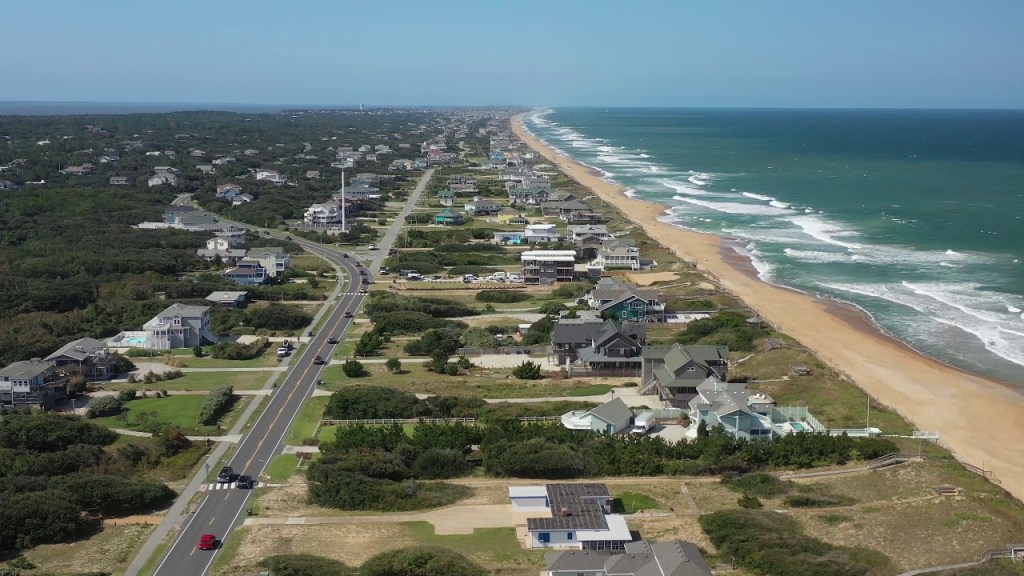
Weeks Marine, the Town’s beach nourishment contractor, will begin delivering construction equipment to the Trout Run beach access tomorrow, and plans to have its crews set the pipe for pumping sand onshore at 60 Ocean Blvd. as early as Thursday or Friday, the Town of Southern Shores announced this afternoon.
Project sand pumping could start at 60 Ocean Blvd. as early as Saturday and head south to the Southern Shores-Kitty Hawk town limit, the announcement said.
The Trout Run beach access, which is next to 168 Ocean Blvd., will remain open unless Weeks Marines crews are actively using it to load and unload equipment, the Town said.
Town Manager Cliff Ogburn has previously reported that there will be three dredging “sub-lines” in Southern Shores, two in addition to the 60 Ocean Blvd. sub-line.
At the Sept. 6 Town Council meeting, Mr. Ogburn said that Weeks Marine was going to try to move a crew up from Kitty Hawk to this area in mid-September to start the project. Sand pumping will occur elsewhere in town when crews are available.
Weekend barricades on the residential cut-through routes will no longer be used this year.
The Town Council unanimously approved dance and group fitness establishments as permissible businesses in the Town’s general commercial district and the installation of a crosswalk at 10th Avenue and N.C. Hwy. 12 (Duck Road) in a meeting last night that lasted about an hour.
The Council also unanimously approved a preliminary subdivision plat submitted by the property owners of 267 Hillcrest Drive to divide their 122,376 square-foot lot into two lots, both of which would meet Town zoning requirements.
(See The Beacon, 9/2/22, for background on the meeting agenda.)
All of these actions were expected and, in the case of the dance/fitness studio addition to the permissible uses of property in the commercial district (Zoning Text Amendment 22-09) and the subdivision plat, were recommended unanimously by the Town Planning Board. (See The Beacon, 8/11/22 and 8/16/22.) The N.C. Dept. of Transportation recommended the 10th Avenue crosswalk.
The only “wrinkle” in the approval process occurred when Mila Smith, the owner/operator of Atlantic Dance in Kill Devil Hills, informed the Council during remarks she made in the public hearing for ZTA 22-09, that she would not be moving her studio to Southern Shores after all. When questioned by Councilwoman Paula Sherlock about the change in her plans, Ms. Smith, who submitted the application for ZTA 22-09, revealed that the commercial space “we had our hearts set on” had been leased.
Although Ms. Smith never identified the prospective location for Atlantic Dance, Deputy Town Manager/Planning Director Wes Haskett told The Beacon at the Aug. 15 Planning Board meeting that it was a space in the Southern Shores Crossing. He said the same last night in response to a query from the Council.
The ZTA, which the Town Council enthusiastically approved, adds “group fitness, aerobics, dance, karate, yoga, gym, and/or weight training” to the list of permissible service establishments in the commercial district. (See Town Code 36-207(b)(3).)
Also yesterday, Town Manager Cliff Ogburn announced that the probable starting date for the Town’s beach nourishment project, which is expected to take 43 days, is now Oct. 2 and that the street paving work that was slated for the first year of the Town’s new 10-year paving maintenance plan is done.
Although some of the street work may look like “a patchwork quilt,” Mr. Ogburn explained–as he has previously–that all streets will eventually have a smooth overlay on them.
Mr. Ogburn referred the Council and residents, many of whom apparently have complained to him about how some of the streets look, to Hickory Trail, east of Duck Road; Soundview Trail; and Chicahauk Trail as examples of how all the streets will look when the overlays are complete.
The Town Manager also reported that last weekend was the last time this year that the road barricades will be used on the residential cut-through routes.
In his update, Mr. Haskett reported that since May, when the changes in the Town’s solid waste ordinance took effect, the Town has issued 63 warning citations to property owners of ordinance violations, the majority of them on Ocean Boulevard and Duck Road. He did not detail the nature of the warnings.
PUBLIC COMMENTS OF NOTE
In public comments last night, Tony DiBernardo, who lives on Ninth Avenue, which NCDOT also considered for a crosswalk on Duck Road, complained about the condition of the walkway on the east side of the thoroughfare, calling it “atrocious.”
Mr. DiBernardo, who also serves as vice chair on the Planning Board, said he has been writing to Town Council members for the past six years about repairing and improving the walkway, but has received little response. He exhorted the current Council to put some budgetary dollars into maintaining the walkway—before it authorizes the construction of a walkway on the west side.
In other comments, homeowner Len Schmitz, of Wax Myrtle Trail, addressed the Town Council’s recent decision to ask NCDOT to lower the speed limit on N.C. Hwy. 12 to 35 mph, year-round. Citing the potential use of the road by “golf carts,” Mr. Schmitz noted safety concerns with such vehicles and expressed a preference for a 40 mph speed limit on the thoroughfare.
Currently, the speed limit on N.C. 12 is 45 mph, except from May 15 through Sept. 15 when the speed limit drops to 35 mph from the Kitty Hawk town line north to Trout Run.
As The Beacon reported 8/3/22, the Town Council’s unanimous approval of a year-round 35 mph speed limit on N.C. 12 cleared the way for low-speed vehicle (LSV) drivers to use the thoroughfare at all times, a consequence that elected officials did not discuss during their deliberations.
No one on the Town Council responded to Mr. Schmitz.
LSVs are motorized electric or gasoline-powered four-wheeled vehicles that generally do not travel at more than 25 mph. Regular golf carts are not LSVs, but there are LSV golf carts.
LSVs must meet State of North Carolina requirements and be licensed in order for them to be street legal.
According to N.C. General Statutes sec. 20-121.1(1) low-speed vehicles may be operated only on roads with a posted speed limit of 35 mph or lower.
Mr. Schmitz clarified with The Beacon today through Facebook that he would maintain the higher speed on Duck Road year-round and support the lower 35 mph limit only for the section of Ocean Boulevard between the Kitty Hawk town line and the cell tower/Duck Road split. (We hope we got that right!)
We agree in part with Mr. Schmitz. We support a 40 mph speed limit on N.C. 12, except from May 15 through Sept. 15, when we favor a 35 mph limit on the entire stretch of the road, not just in the Ocean Boulevard area.
OCTOBER MAYOR’S CHAT: Mayor Elizabeth Morey announced that she will hold another Mayor’s Chat on Wed., Oct. 19, at 4 p.m.
The Planning Board next meets on Sept. 19 at 5 p.m.; and the Town Council will hold a morning session on Sept. 20 at 9 a.m., to discuss budgetary issues and the next phase in the street paving maintenance plan. The Beacon will preview the agenda for each of these meetings.
All of the meetings will be held in the Pitts Center.
The Town Council will consider at its regular meeting Tuesday approving the installation of a crosswalk on Duck Road (N.C. Hwy. 12) at 10th Avenue, an action endorsed by the N.C. Dept. of Transportation after a traffic safety study recommended one.
The NCDOT would pay for the crosswalk installation, while the Town of Southern Shores would cover the cost for overhead solar lights up to $4,000, according to an agenda item prepared by Town Manager Cliff Ogburn for the meeting.
The Council will meet Tuesday at 5:30 p.m. in the Pitts Center behind Town Hall.
The Council’s meeting agenda is remarkably light for its first post-summer session. Besides a discussion of the 10th Avenue crosswalk, the Council will hold public hearings on two matters that The Beacon covered last month in Planning Board reports:
1) a preliminary subdivision plat submitted by the property owners of 267 Hillcrest Drive, which is a 122,376 square-foot lot that they propose to divide into two lots; and
2) a Zoning Text Amendment (ZTA 22-09) to amend the applicable Town Code sections to allow dance and assorted fitness establishments in the Town’s commercial district.
For background on the subdivision plat, which the Planning Board unanimously approved, and ZTA 22-09, which was introduced by Mila Smith, the owner of Atlantic Dance in Kill Devil Hills, and unanimously recommended for approval by the Board with amended language that would allow establishments for “fitness, aerobics, dance, karate, yoga, gym, and/or weight training,” see The Beacon, 8/16/22 and 8/11/22.
Lest there be any confusion—which we have heard expressed—we would like to emphasize that ZTA 22-09 applies only to the commercial district and not to any residential districts. If the zoning change is approved, Ms. Smith will not be able to operate her dance studio or a gym or any other fitness business next door to your home or on your residential block.
The Town currently permits residents to operate “small-scale” home-based businesses, but it strictly controls them to ensure that their conduct is “subordinate” to neighbors’ “property right of quiet enjoyment.” (See Town Code secs. 36-239 to -42.)
Also Tuesday, Mr. Ogburn will give updates on the beach nourishment project and the street paving maintenance schedule. At the Council’s August meeting, Mr. Ogburn reported a projected start for beach dredging of mid- to late-September. We expect that timing to be delayed.
POTENTIAL 10th AVENUE CROSSWALK
The proposed new crosswalk has come about because residents who live on the west side of the northern end of Duck Road approached the Town Manager about the installation of an additional crosswalk. He responded to their request.
According to Mr. Ogburn’s agenda item, the State Traffic Safety Engineer and a consultant from VNB Engineering evaluated the Town’s crosswalks in a “cursory review” and recommended that one be installed at Duck Road and 10th Avenue on the southern leg. Crosswalks at Duck Road and west-side 9th and 12th avenues, which, like 10th Avenue, dead-end into cul de sacs, were also considered.
There is already a crosswalk at Duck Road and 11th Avenue, which intersects with Sea Oats Trail on its west end, although there is no traffic light control at this intersection. Traffic light-controlled intersections exist at Hillcrest Trail, which is just south of 9th Avenue, and at Sea Oats Trail, which becomes 13th Avenue on the east side. The Duck town line is just north of 13th Avenue.
It would appear from meeting agenda materials that the reason 10th Avenue was selected for a crosswalk instead of 9th Avenue or 12th Avenue is because of its distance from the traffic-controlled intersections. A 12th Avenue crosswalk, according to remarks in the materials, is of “lesser priority” because of the avenue’s “proximity” to the 13th Avenue crosswalk, from which it is 448 feet away.
Ninth Avenue is reportedly just 415 feet from the Hillcrest Trail intersection, whereas 10th Avenue is 883 feet from the Hillcrest intersection and 1393 feet from the Sea Oats intersection. It is 485 feet from the 11th Avenue crosswalk, but this crossing, as stated, is not traffic-controlled.
It seems to us that all residents on the west side of these avenues are deserving of crosswalks, especially in light of the fact that there is no sidewalk on their side of Duck Road. The approved reduction of the speed limit on all of N.C. Hwy 12 from 45 mph to 35 mph, year-round, will help make all pedestrian crossings on Duck Road easier and safer.
DIGGING DEEP BEACH HOLES
We conclude our preview of the Town Council’s upcoming meeting with mention of a rather unusual document that appears in the Town Council’s consent agenda.
The consent agenda is rarely discussed by Council members, who typically approve it perfunctorily at the beginning of their meeting.
The unusual document in next week’s consent agenda is titled “Town of Southern Shores Resolution in Support of Legislation Concerning Digging Dangerous Holes on the Beach,” and it “expresses” support of “state legislation [that] would increase our capacity to address the incredibly dangerous issue of holes on the beach.”
The whereas clauses of the resolution outline the dangers of “large beach holes,” including the possibility of their collapse resulting in the deaths of people and “marine life” (sea turtles are very vulnerable) trapped in them, as well as damage to vehicles driven on the beach by people who cannot see them, and conclude with a request that the State of North Carolina enact legislation that would “provide stronger enforcement mechanisms” than are available in local ordinances for their prevention.
In May, the Town of Kill Devil Hills issued a public plea to beachgoers about the dangers of digging deep holes on the oceanfront, just hours before an 18-year-old man was reported to have died when he became trapped in a hole he and his sister were digging on a New Jersey beach.
At that time KDH released a photograph of an Ocean Rescue supervisor standing in an abandoned deep beach hole, with his arms outstretched and a look of frustration on his face, and characterized such holes as a common hazard.
The proposed resolution mentions the N.J. fatality as well as data from a Harvard medical professor who studied sand-hole collapses and reported 52 cases in the United States from 1997 to 2007. We recall the death of a man in Salvo in 2014 who was trapped when sand collapsed on him while he was reportedly tunneling between two six-foot-deep holes he had dug.
The Town of Southern Shores makes “unlawful” the “excessive digging or mounding of sand” that “presents a present, dangerous condition [or is] left for any period of time . . .” Town Code sec. 35-55(b)(3). We would be curious to know the history of this ordinance’s enforcement and why the Town believes it needs State involvement to prevent this danger from occurring on its beaches.
GARBAGE WILL BE PICKED UP ON LABOR DAY: Town-wide trash collection will occur Monday, as usual, but please note that today is the last day for a trash pickup on Friday. The recycling collection day will not change: It will continue to be Friday.
We don’t have any artwork to illustrate this blog post, so we thought you might like to see some other local youngsters who participated in the Southern Shores Boat Club’s crabbing tournament earlier this month. (Photo by Deidre Howard)
The Planning Board unanimously voted to recommend the addition of various group fitness and dance establishments as permitted uses in the Town’s general commercial district and approved a preliminary subdivision plat submitted by the owners of an oversized lot at 267 Hillcrest Drive at its regular monthly meeting yesterday.
The Board also received an overview from attorney Jay Wheless, who represents the Town’s Board of Adjustment (BOA), about the BOA’s hearing procedure in anticipation of an upcoming appeal by an aggrieved property owner of a Town zoning decision.
The Planning Board also sits as the Board of Adjustment, which is a quasi-judicial body that decides issues of fact and makes legal decisions in certain zoning matters, but only two of the Board’s current five regular members have participated in a hearing. Neither of the Board’s two alternates has taken part in one.
(For background on the Board’s business agenda yesterday, see The Beacon, 8/11/22.)
The Planning Board actually recommended approval of an edited and expanded version of Zoning Text Amendment 22-09, which was submitted by Mila Smith, the owner and operator of Atlantic Dance, and proposed to add “group fitness-aerobics/dance/karate/yoga” to the permitted “service establishments” in the commercial district.
The language the Board recommended replaces hyphens with commas and adds two more fitness examples so that the use now reads “group fitness, aerobics, dance, karate, yoga, gym, and/or weight training.”
Deputy Town Manager/Planning Director Wes Haskett clarified that “similar uses not specifically listed” also would be considered permissible under this language. He told The Beacon that the original language of the ZTA was based on a Nags Head ordinance.
Ms. Smith, whose business is currently located in the Dare Centre in Kill Devil Hills, submitted ZTA 22-09 as a required first step to moving into Southern Shores. In remarks she made to the Planning Board yesterday during the ZTA’s hearing, Ms. Smith said she was “looking to move to a safer unit that functions properly.”
She also mentioned that the majority of her students, who are girls who come for lessons after-school, live in Southern Shores and Kitty Hawk. (See The Beacon, 8/11/22, for more details about Ms. Smith’s application.)
Mr. Haskett confirmed with The Beacon that Ms. Smith is looking at a location in the Southern Shores Crossing.
(Some of you may remember, as we do, that a small fitness facility once operated in the Crossing. Mr. Haskett did not know its history. It ceased operation some time ago.)
Planning Board members said very little about the preliminary subdivision plat submitted by Matthew and Allison Cassella, Chicahauk homeowners who purchased the large, irregularly shaped property at 267 Hillcrest Drive in May and now seek to subdivide it into two lots.
The Hillcrest property, which already has a single-family dwelling and other improvements on it, consists of 122,376 square feet, well in excess of the Town’s minimum lot size requirement of 20,000 square feet. The two lots that the Cassellas propose creating through what Mr. Cassella called in brief remarks before the Board a “conservative subdivision” also would be well in excess of 20,000 square feet each. Each would be at least 100 feet wide and have at least 30 feet of frontage on the public right of way, as required by Town ordinance.
Mr. Cassella said that he and his wife are dividing the lot into two for their children, so that each will have a home in Southern Shores.
UPCOMING BOA APPEAL
The appeal that the Board of Adjustment expects to hear, and for which Mr. Wheless was preparing members, is of the Town’s denial of a recombination plat that the owners of 55 Skyline Road submitted, according to Mr. Haskett, who spoke with The Beacon after the meeting.
According to the Dare County gis, the Skyline Road property is vacant and consists of 80,000 square feet or 1.8365 acres. The owner of record is Skyline Oaks Properties LLC, which formed in July 2021 and purchased the property on Aug. 19, 2021. According to public records, Planning Board member Robert McClendon is an owner and the registered agent of the LLC, which uses his home address as its business address.
During yesterday’s meeting, Mr. McClendon asked his fellow Planning Board members if any of them were “aware of the appeal that’s coming up.” Board chairperson Andy Ward quickly acknowledged that he was, and member Ed Lawler said he was, as well, in “a rough way.”
Impartiality by members of the joint Planning Board-Board of Adjustment is a huge problem, we believe, when the BOA hears appeals of Town zoning decisions, which is why The Beacon has long championed the re-establishment of a BOA separate from the Planning Board. The decision being appealed to the BOA by an aggrieved property owner is always one made by Mr. Haskett, with whom the Planning Board works hand-in-glove. The Planning Board represents the Town, and it is the Town that opposes a property owner in a BOA appeal.
Before April 1, 2014, Southern Shores had two boards, with no overlapping members. In the interest of fairness, it should restore that status. All other towns on the Outer Banks have separate planning boards and boards of adjustment.
As Mr. Wheless explained yesterday, any decision that the BOA makes on an appeal must be supported by three of the five members. Mr. McClendon obviously will have to recuse himself. That already two other Planning Board members know about the appeal and, therefore, have talked about it, most likely with Mr. Haskett, is a red flag.
The Beacon will delve into the facts and law pertaining to the appeal at a date closer to the hearing, which has not yet been scheduled, but will not occur before Sept. 19, according to Mr. Haskett.
THE TOWN COUNCIL REACHES OUT
Town Councilman Leo Holland spoke during public comments yesterday to “get into the record” how he responded to two emails that he received from Chairperson Ward regarding the Council’s approval of a significantly different version of a Zoning Text Amendment establishing mixed-use developments in the commercial district than the one recommended by the Planning Board.
We refer you to The Beacon’s 7/19/22 article for details about these emails, which Mr. Ward read into the record at the Planning Board’s July 18 meeting. In short, he described the gap between the two town bodies as a “bit of a disconnect” and expressed strong opposition to the lot coverage that the Council approved for mixed-use, saying it had “strayed from our founders’ original vision of Southern Shores which speaks to land use that naturally protects environmental resources and fragile areas by limiting development and growth.”
According to Mr. Ward, neither the Mayor nor any other members of the Town Council acknowledged his first email, which was dated June 8, so he sent a second one a week later with the subject, “Reply?” In this email, he questioned Council members’ lack of a response and wrote: “Respect should not get in the way of different viewpoints.”
Mr. Holland said yesterday that he “interpreted” the June 8 email “as not requiring a comment” and mentioned that, in fact, an unnamed Council member had responded.
He further explained that he responded to Mr. Ward’s second email within two hours of receiving it. Since then, Mr. Holland said, “he and I have had some discussion.”
It was not “the intent” of the Town Council to “ignore” the Planning Board, the Councilman concluded.
Henley Totten (left) and Hayes Russell display their $30 cash prizes for catching the most crabs and the largest crab, respectively, among pre-teen participants in the SSCA Boat Club’s first annual crabbing tournament for young people held last Saturday. Teenagers Penelope and Addison Greene won prizes in the older age group. Also pictured are SSBC members Eric Howard (blue shirt) and George Kirby. (Photo by Deidre Howard)
The Town Planning Board will consider adding various fitness and dance studios to the permitted uses of property in the commercial district and allowing Hillcrest Drive property owners to subdivide their oversized lot into two buildable lots at its meeting Monday at 5 p.m. in the Pitts Center.
The Board also is expected to discuss the procedure for appeals before the Town Board of Adjustment, which is a quasi-judicial body that hears requests for zoning variances and appeals of zoning decisions by Town administrative officials.
Since April 1, 2014, the Planning Board also has served as the Board of Adjustment.
Mila Smith, the owner and operator of Atlantic Dance in Kill Devil Hills, has submitted a Zoning Text Amendment (ZTA) to add “group fitness-aerobics/dance/karate/yoga” to the list of permitted “service establishments” in the Town’s C general commercial district. The change would appear as new Town Code sec. 36-207(b)(3)(g).
Ms. Smith’s ZTA 22-09 also would establish a minimum parking requirement for off-street parking for “group fitness-aerobics/dance/karate/yoga” service establishments of “one parking space for each 250 square feet of gross floor space.” This change would create a new Town Code sec. 36-163(4)(b)(7).
In a letter sent to the Town, Ms. Smith says she has operated Atlantic Dance in the Dare Centre in Kill Devil Hills for the past 27 years and is looking to move to “a new location that is better suited for our needs.”
She does not identify a commercial space in Southern Shores for her business’s relocation, but she does mention the “opportunity to dance and grow in a beautiful new space.”
According to Ms. Smith, the “majority of our 175 dance families live in the Southern Shores, Kitty Hawk area.”
No explanation is given in the Planning Board meeting materials for why Ms. Smith is seeking an addition to the permitted service establishments that includes “group fitness-aerobics,” “karate,” and “yoga,” as well as dance. While we do not object to the inclusions, we do think the language could be tidier.
Deputy Town Manager/Planning Director Wes Haskett has recommended that the Planning Board recommend approval of ZTA 22-09 to the Town Council.
HILLCREST DRIVE SUBDIVISION
Matthew and Allison Cassella, who are Chicahauk homeowners, have submitted for Planning Board review and approval a preliminary subdivision plat for their property at 267 Hillcrest Drive, which they purchased in May.
According to Mr. Haskett’s analysis, the property, which already has a single-family dwelling and other improvements on it, consists of 122,376 square feet, well in excess of the Town’s minimum lot size requirement of 20,000 square feet.
The lot is on the west side of Hillcrest Drive, close to the intersection of Hillcrest Drive and Hickory Trail. It is one of the large, irregularly shaped lots on Hillcrest that has canal frontage at the end of a flag-pole section of the property.
The Cassellas propose to subdivide the property into two lots, one of which would be 70,360 square feet in area (Lot 1-B) and contain the house and other improvements, and the other of which would be vacant and 52,016 square feet in area (Lot 1-A), including the flag-pole section.
Both proposed lots would meet the Town’s minimum lot width of 100 feet—except in the narrow flag-pole section—as well as the Town’s requirement that they each have at least 30 feet of frontage that abuts a public right-of-way or private street.
Mr. Haskett has recommended that the preliminary subdivision plat be approved.
BOARD OF ADJUSTMENT
It is unclear from the Planning Board meeting materials what the context of the Board’s discussion about Board of Adjustment (BOA) appeals will be.
Included in the materials are the following Town Code sections pertaining to the BOA: sec. 36-364, “Voting,” which specifies the majority required for the board to grant a variance; sec. 36-366, “Appeals of administrative decisions,” which defines what an administrative decision is and details the appeal process; and sec, 36-369, “Impartiality of board of adjustment members,” which explains when a board member should recuse himself or herself for bias or other interest that would compromise his/her impartiality.
We strongly believe that the Town should return to its pre-April 1, 2014 status and have an independent Planning Board and Board of Adjustment, separate and apart from each other, with no overlapping members.
Appeals to the Board of Adjustment, albeit infrequent, are of decisions (issuances/denials of building and zoning permits, e.g.) made by the Zoning Administrator, currently Mr. Haskett, with whom the Planning Board has a close working relationship.
The Planning Board regularly consults with, and defers to the judgment of, Planning Director Haskett and the Town Attorney, who represents the Town in a property owner’s appeal to the Board of Adjustment.
(The Town is now represented by L. Phillip Hornthal, III, of Hornthal, Riley, Ellis & Maland, after years of being represented by Benjamin M. Gallop, of the same firm. Mr. Hornthal made his first Town Council meeting appearance on Aug. 2.)
We also believe it is improper for the Planning Board, which is an advisory board, not a legal decision-maker, to determine whether existing zoning requirements, which it may have had a hand in creating, cause the unnecessary hardship required for a variance to be granted.
Before April 1, 2014, when the Town Council consolidated the two boards, upon the recommendation of both Mr. Haskett and Mr. Gallop, the Board of Adjustment was an independent body that never consulted or collaborated with Town staff. In fact, it rarely met, which was one reason why the consolidation occurred. But that’s a poor reason, as we learned in 2018-19 when BOA rulings led to development on nonconforming, 50-foot-wide lots.
Southern Shores is the only town on the Outer Banks that does not have a board of adjustment separate from its planning board. Even the Town of Duck, which has just one-quarter of the year-round population that Southern Shores has, has two boards with different members.
Southern Shores has many smart, talented people who would be willing and qualified to serve on the Board of Adjustment. As the town continues to grow, so will the need for an independent administrative board to adjudicate variances and zoning appeals.
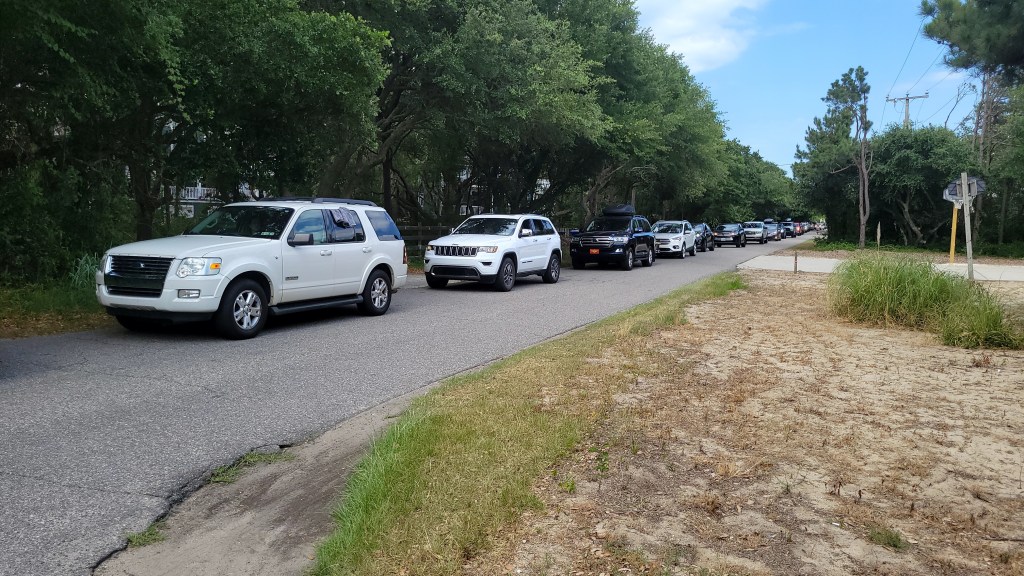
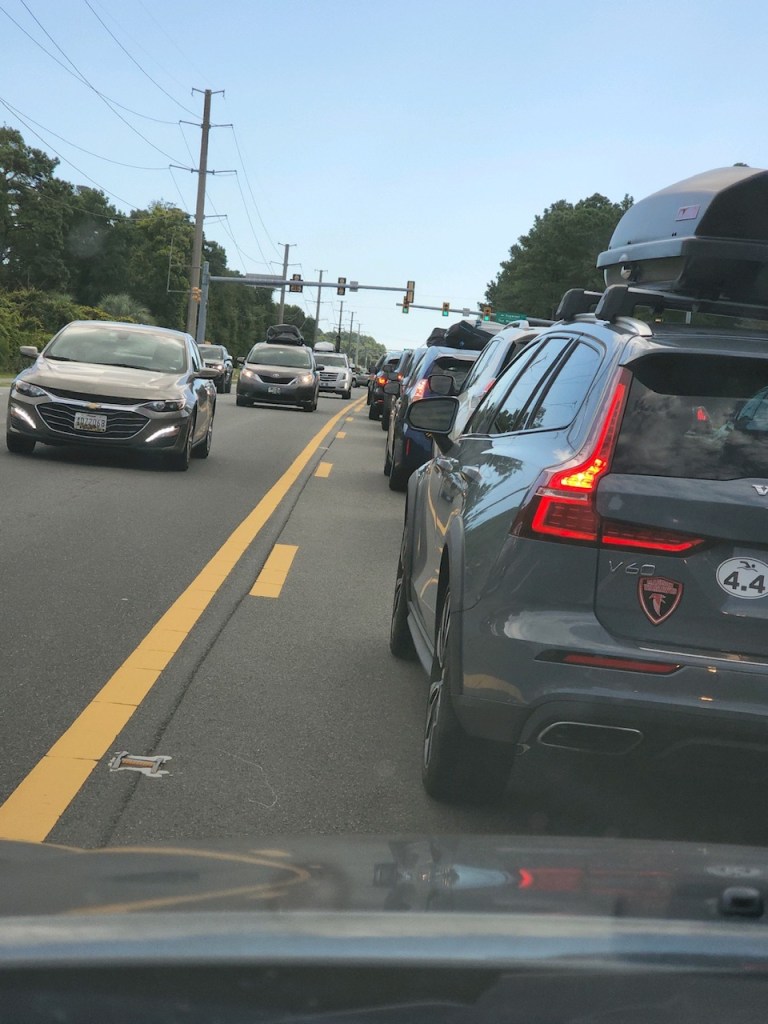
A Beacon reader sent in this photo of the traffic backup at 10 a.m. today in the left-turn lane of U.S. 158-east for South Dogwood Trail. She estimated that there were 20 vehicles in the line when she pulled into it.
Dear Readers: Please feel free to comment on traffic conditions in the residential areas this weekend on The Beacon blog and Facebook page. We hope the “Local Traffic Only” barricades that are in place at street intersections reduce the cut-through traffic in the dunes, in Chicahauk, and on Ocean Boulevard north of the Duck Road split.
The Town is asking people to avoid driving on South Dogwood Trail tomorrow and Friday, if they can, while construction crews work on the pavement along “a very narrow stretch of road” between Fairway Drive and East Dogwood Trail.
According to a special Town announcement released this afternoon, trucks and trailers will have a difficult time passing in this stretch, and all vehicles traveling on South Dogwood Trail will have “longer wait periods before being waived through the construction area.”
If you’ve driven on South Dogwood Trail this week, you already know to avoid it, if possible. The road has been reduced to one lane in areas under construction, and drivers are already experiencing long waits before they can pass through.
Town Manager Cliff Ogburn said Tuesday at the Town Council meeting that contractor Fred Smith Co. started its pavement maintenance work this week on South Dogwood Trail, instead of Twelfth Avenue, as was planned, because of “confusion.” The work on South Dogwood Trail was scheduled to be done Sept. 13-16 and Sept. 26–after the summer tourist season.
The “Local Traffic Only” barricades will be in use this weekend.
The Town will place the “local traffic only” barricades at street intersections along the South Dogwood-East Dogwood trails cut-through route this weekend, Town Manager Cliff Ogburn announced at yesterday’s Town Council meeting.
Although last weekend’s northbound cut-through traffic was “just as bad, if not worse” than the traffic over the July 4 weekend, Mr. Ogburn said, he is hopeful that “we’ve seen the worst of it” this summer, and the cut-through traffic in Town residential areas will be more manageable.
In related news, Mr. Ogburn reported that 7,000 vehicles, including over-sized commercial trucks that would normally be prohibited by Town ordinance from passing through, traveled on South Dogwood Trail on July 21 when a section of N.C. Hwy. 12 was closed because of a water main break. On a typical summer Saturday, between 3,000 and 4,000 vehicles use the road.
“It just showed us how vulnerable we are,” Mr. Ogburn said.
The Town installed the orange, water-filled barricades over the Memorial Day weekend, but suspended their use after the June 25-26 weekend because it believed they caused unacceptably lengthy traffic backups on South Dogwood Trail that went past the Duck Woods Country Club—even to the Wright Memorial Bridge, Mr. Ogburn said.
Conflicts also arose between “drivers and residents, residents and residents, and drivers and drivers,” over the barricades, as tempers flared, Mayor Elizabeth Morey said at the July 13 Mayor’s Chat. The Town removed the barricades to eliminate the potential for angry confrontations.
The barricades will be in place from Friday evening through Monday morning, Mr. Ogburn said.
The Town Manager also reported yesterday that:
The beach nourishment project is now expected to start in mid- to late-September and last 35 to 40 days.
The decision to start town-wide pavement improvements this week with South Dogwood Trail, instead of Twelfth Avenue and Hillcrest Drive, as announced Friday in the Town newsletter, was the result of confusion, not deliberate rescheduling. As soon as contractor Fred Smith Co. updates the road work schedule, “we’ll share it,” Mr. Ogburn said.
The repair to the damage caused by the July 21 water main break near 132 Ocean Boulevard, was done quickly, and will need to be completed in the fall. The water pipe cracked as the result of the impact of a lightning strike in the area, as The Beacon confirmed in a report July 24.
In other news from the Town Council meeting:
REDUCING SPEED LIMIT ON N.C. 12: The Town Council unanimously approved asking the N.C. Dept. of Transportation to set the speed limit on the State-owned N.C. Hwy. 12 in Southern Shores to 35 mph year-round. (See The Beacon, 8/1/22, for background.)
Currently, the speed limit on N.C. 12 is 45 mph, except from May 15 through Sept. 15 when the speed limit drops to 35 mph from the Kitty Hawk town line north to Trout Run.
Although Mayor Pro Tem Matt Neal said initially that he did not see the need to have a 35 mph speed limit on the thoroughfare year-round, just in the summer, he did not argue the point, joining his four colleagues to form a consensus.
The Town has authority under the N.C. General Statutes to set speed limits on State-owned roads in its jurisdiction, provided its request is supported by an engineering and traffic investigation. NCDOT completed a yearlong investigation of the Southern Shores section of N.C. 12 in June and recommended that the speed limit on it be 35 mph year-round. Town staff agreed with that recommendation.
Mr. Neal cited accident data from the NCDOT traffic study that clearly showed speed is not a factor in the overwhelming majority of accidents on the road. He said that, according to the report, most crashes occur at low speed, around 5 mph—they are predominantly rear-end collisions—and he had not seen any in the report above 30 mph.
Although we did not read all of the accident detail in NCDOT’s report, we tend to agree with Mr. Neal, but, like him, we recognize that public opinion runs in favor of a consistent 35-mph speed limit year-round on the thoroughfare.
One consequence of the speed limit reduction that the Town Council did not address is that low-speed vehicle (LSV) drivers will now be permitted to use all of N.C. 12 year-round. LSVs are only permitted on roads that have speed limits of 35 mph or lower.
Low-speed vehicles are motorized electric or gasoline-powered four-wheeled vehicles that generally do not travel at more than 25 mph. Regular golf carts are not LSVs, but there are LSV golf carts. LSVs must meet State of North Carolina requirements and be licensed in order for them to be street legal.
During the Town Council’s discussion about the speed limit change, Town Councilman Mark Batenic brought up what he considers the dangerous behavior of people riding electric bicycles (eBikes). He cited their excessive speed and disregard of traffic signage. Town Councilman Leo Holland said he has been approached from behind when he was walking on a multi-use pathway by eBicyclists who do not announce that they are passing him.
We think it’s safe to say that in Southern Shores, especially during the summer, one has to drive and walk defensively and be on the lookout for human beings operating all manner of two- and four-wheeled modes of transportation. The behavior of many is unpredictable.
CHOOSING A CONSULTANT FOR THE LAND-USE PLAN UPDATE: The Town Council unanimously approved the hiring of Stewart, an engineering, design, and planning firm based in Raleigh, to handle the Town’s update of its CAMA Land-Use Plan. As Mr. Ogburn explained, the update, which is expected to take from 12 to 15 months, will go beyond what the Coastal Area Management Act, a N.C. statute, requires. It will also incorporate a comprehensive Land-Use Plan (LUP) of growth and development for the Town of Southern Shores.
The Town received two proposals from N.C. planning firms in response to a Request for Proposal that it issued July 1 for a “qualified firm” to conduct the LUP update. The other firm was N-Focus Inc., of Kannapolis.
Although N-Focus’s proposed fee for service was lower than Stewart’s proposed fee—$67,750 as opposed to $80,000—both Deputy Town Manager/Planning Director Wes Haskett, who was unable to attend yesterday’s meeting, and Mr. Ogburn recommended Stewart, which recently assisted the towns of Duck and Manteo with updating their land-use plans.
Mr. Ogburn said yesterday that the Town will “get a better product” from Stewart than it would from N-Focus. Town Council members agreed, based on their review of the proposals.
The Town budgeted $80,000 in fiscal year 2022-23 for the LUP update—a fact apparently known to Stewart.
Although the last Town Land-Use Plan was not certified by the N.C. Coastal Resources Commission until Aug. 30, 2012, the LUP clearly states on its first page that it is to be considered a 2008 update. (The procedure and other requirements for a land-use plan update are governed by State law and regulations.)
The Town submitted its last LUP, as it is required by N.C. law to do, to the N.C. Dept. of Coastal Management, in August 2008. The document was returned to the Town, however, in December 2008 with comments and questions by the State. The Town did not adequately respond to those inquiries for nearly four years, for reasons unknown, hence the discrepancy in the dates.
Although Mr. Ogburn consistently refers to the current Town LUP as a 2012 plan, it is, in fact, a 2008 plan. The public workshop and survey upon which some of the plan is based were conducted in 2005.
REQUESTING GRANT MONEY FOR A SIDEWALK ON DUCK ROAD: The Town Council unanimously approved seeking grant money from the Dare County Tourism Bureau to help finance the construction of a 5-foot-wide sidewalk on the east side of Duck Road (N.C. 12) that would run from an area near the Duck Road split to East Dogwood Trail. According to Mr. Ogburn, the sidewalk is estimated to cost $164,256, and the Tourism Bureau could finance up to 50 percent of the cost.
AND FINALLY, THE CHICKENS COME TO ROOST: Jerrica Rea of Sea Oats Trail, who identified herself at the July 13 Mayor’s Chat as “the chicken lady,” made a pitch to the Town Council, during late public comments at yesterday’s meeting, for it to consider repealing the current prohibition on the keeping of chickens in Southern Shores.
Ms. Rea outlined advantages to keeping chickens (i.e., hens)—promoting them for their consumption of ticks, for example, as well as their egg-laying—and disputed common objections to them, having to do with noise, smell, and waste. Two other Town residents spoke in support of Ms. Rea’s request.
The “keeping and having of livestock and fowl” in town is prohibited by Southern Shores Town Code sec. 4-24. The Code defines “fowl” as “edible birds commonly found on farms, such as chickens, turkeys, ducks, guinea fowl and geese.” (Sec. 4-21)
No one on the Town Council responded to Ms. Rea’s or the other residents’ comments. Mayor Morey said at the July 13 chat that the keeping of chickens in town would be an appropriate topic for discussion during the Land-Use Plan update process.
South Dogwood Trail will be undergoing pavement improvements this week, rather than in mid-September, as previously announced, according to a notice released by the Town of Southern Shores this morning.
Contractor Fred Smith Co. was to begin its town-wide pavement work today on Twelfth Avenue and then proceed to Hillcrest Drive, between Sea Oats Trail and East Dogwood Trail, on Aug. 3-5, according to the schedule posted online by the Town.
Town Manager Cliff Ogburn will update the now-revised schedule for pavement work, which currently runs through mid-October, at tomorrow’s Town Council meeting, which will be held at 5:30 p.m. in the Pitts Center.
This week’s work launches an ambitious 10-year road-maintenance plan that will cost more than $1 million per year.
CHANGE IN SPEED LIMIT ON N.C. 12?
We had not planned to return from our summer break until Wednesday, but we thought it was important for residents to know about the construction on South Dogwood Trail, in order to avoid it. Also, residents on the street will not have received much notice from the Town about its commencement.
Now that we’re online, we’ll tell you that the Town Council will be considering at tomorrow’s meeting a change in the speed limit on N.C. Hwy. 12 to 35 mph year-round, a reduction that both the N.C. Dept. of Transportation and the Town staff have recommended.
Currently, the speed limit on N.C. 12 is 45 mph, except from May 15 through Sept. 15 when the speed limit drops to 35 mph from the Kitty Hawk town line north to Trout Run.
In May 2021 the Town asked NCDOT to conduct a traffic study of N.C. 12 in order to provide an informed evaluation of the road’s appropriate speed limit(s).
The Town has authority through the N.C. General Statutes to set the speed limits on a state road, which N.C. 12 is, provided it certifies to the NCDOT that its determination is supported by an engineering and traffic investigation, like the one NCDOT conducted.
We have only skimmed through this material, but think you will find the data on accidents on N.C. 12 from 2017 to 2022 of interest. According to the NCDOT, there were 154 accidents on N.C. 12 in Southern Shores during these six years, of which 97, or 63 percent, were rear-end collisions.
The data reveal that last year was far and away the most hazardous on N.C. 12, with 45 (29 percent) of the 154 accidents.
The one traffic-related fatality on the thoroughfare occurred in 2021 when, many of you will remember, a pedestrian crossing at the Chicahauk Trail traffic light was struck and killed by a vehicle proceeding north on N.C. 12. The pedestrian dashed across the road as the light was changing.
According to NCDOT, 32 of the 154 accidents have involved injuries to people. More than 50 percent of them were in the lowest class of injury (Class C), but we could not find a description of this class or other injury classes included in the report.
This year’s data are incomplete, showing only five accidents on N.C. 12.
IN OTHER BUSINESS AT TOMORROW’S COUNCIL MEETING . . .
*Mr. Ogburn also will update the Town’s beach nourishment project—which, at last report, was expected to start in September—and give a followup on the July 21 water main break at 132 Ocean Boulevard.
*The Town Council is expected to choose a planning consultant to manage the Town’s CAMA Land-Use Plan (LUP) update between two companies that submitted proposals for the contract in response to a Town-issued Request for Proposal. The companies are N-Focus Inc., of Kannapolis and Stewart of Raleigh, which recently assisted the towns of Duck and Manteo with updating their Land-Use Plans.
Although N-Focus’s proposed fee for service is lower than Stewart’s proposed fee—$67,750 as opposed to $80,000—Deputy Town Manager/Planning Director Wes Haskett has recommended that the Council accept Stewart’s proposal because it is “the most qualified and responsible.” The companies’ proposals are included in the meeting agenda packet.
The Town budgeted $80,000 in fiscal year 2022-23 for the LUP update.
As always, we encourage you to attend tomorrow’s Town Council meeting (5:30 p.m., Pitts Center) or watch it on You Tube at https://www.youtube.com/user/TownofSouthernShores. We expect to post an article on Wednesday.
Part of the 10-foot split in the main water line that broke Thursday is visible in this photograph, which Town Manager Cliff Ogburn provided. According to Mr. Ogburn, the water was turned off when this photo was taken. You can see that water has seeped out of a crack on the bottom side, to the right.
Just to follow up with last Thursday’s pandemonium . . . Town Manager Cliff Ogburn confirmed that a lightning strike “in the area” likely caused the main water line break near 132-134 Ocean Boulevard at the pedestrian crosswalk.
According to the Dare County Water Dept., Mr. Ogburn said, the 10-foot split in the pipe that broke (above) was the type of break that a lightning strike causes. It was not the result of a direct lightning hit. Most likely, the impact of the strike on the water in the pipe caused the break.
We thank Mr. Ogburn for keeping people informed after business hours Thursday about the progress of the repairs to the road and its reopening and for immediately responding to us about the cause of the damage and sending a photograph
LOWER YOUR SPEED
No doubt you have read elsewhere about the speed limit on U.S. 158 in Currituck County, from the Wright Memorial Bridge to the H2OBX Water Park, being reduced from 55 mph to 45 mph starting some time this week.
The N.C. Dept. of Transportation announced the speed limit reduction on July 21, explaining that more than 150 crashes, involving four fatalities, have occurred on this 3.4-mile stretch of highway during the past five years.
TIME OFF . . . COUNCIL MEETING
The Beacon is taking a vacation this week and will return in early August.
The next Town Council meeting will be Tues., Aug. 2, at 5:30 p.m. in the Pitts Center. The Town always posts the Council’s meeting agenda and agenda packet on its website the Thursday before each meeting.