Will there be a Halloween spike in new COVID-19 cases this week?
Dare County reported 12 new COVID-19 cases over the weekend, including a local man age 65-or-older who has been hospitalized. The other 11 people are in home isolation.
Of the 12 cases, 10 are Dare County residents. All 12 of the people who tested positive for COVID-19 are at least 25 years old.
The total number of COVID-19 cases reported in Dare County since March is now 709: 411 Dare County residents, and 298 nonresidents.
Southern Shores “is not Mayberry” and needs two police officers on duty “with supervision” 24/7, Police Chief David Kole argued to the Town Council at its Oct. 20 workshop in support of hiring at least one new officer during the current fiscal year.
The additional employee will bring the Southern Shores police complement to 13 officers, according to the Chief, who, although he alluded during his workshop presentation to a study supporting the addition of two officers, limited his request to just one, for now.
“It’s not Mayberry,” the Chief said. “. . . Bad things can happen to police, and things have gotten worse over the last two to three years.”
There are “a lot of arrests, a lot of drug work,” the Chief explained, but he offered no evidence of physical threats being made to, or violence committed upon, Southern Shores police officers.
Although the Chief emphasized the safety of police officers, he presented data at the workshop to suggest that the number of service calls the police handle justify the new hires. We would have liked to have seen better analytics in support of this contention. (See the next section, below.)
With 14 officers on the payroll, there would be 24/7 coverage of the Town by two duty officers and a third person supervising, a goal that Chief Kole said he has had since he first started working for Southern Shores 14 years ago.
Contrary to Town Manager Cliff Ogburn’s assertion that the Town Council had already “agreed to” a new police officer hire at its FY 2020-21 budget workshop, the Council did not consider expansion of the force in April because of concern over lost Town revenue due to the COVID-19 pandemic. The Council asked all Town departments to tighten their budgetary belts, and Chief Kole did not bring up the proposed new hires.
The Oct. 20 workshop was, in part, a forum for considering FY 2020-21 expenses that were tabled by departments. The Town Council, notably, did not vote on any of these measures. Mayor Tom Bennett either unilaterally directed Mr. Ogburn to follow up or advised him that “consensus” existed.
Despite there being no critical discussion about the need for police force expansion and no formal vote, Mayor Bennett told Chief Kole that a “consensus” exists among Town Council members “that we need another police officer.”
Indeed, Councilman Matt Neal, an active participant in most Council business, was conspicuously silent on the issue, and Mayor Pro Tem Elizabeth Morey only asked the Chief after his presentation how long it would take for him to hire someone.
Nonetheless, the Chief’s request will be formally voted upon by the Council at its Nov. 4 meeting as one of a number of FY 2020-21 budget amendments before the town’s governing body. The Council will not take up each amendment separately, as it usually does, unless a member singles one out. Instead, a vote in favor of the “consent agenda” will result in approval of all four of the proposed budget amendments. (See the others below.)
Funding a new police officer for the remaining six months of the fiscal year will cost $43,521, according to the budget amendment prepared by Mr. Ogburn.
The money will come from the Town’s Unassigned Fund Balance, which the Council decided at its workshop—upon Mr. Ogburn’s suggestion—must maintain a minimum $3 million balance, an increase of $1.25 million over the balance it currently must maintain.
The Council also will take up Wednesday an amendment to the Unreserved Fund Balance Policy that increases the minimum balance of the fund and includes language to expand upon the use of the fund. It specifies, for example, that the fund be used to “guard against the effects of an economic downtown, [or] natural or other disasters.”
Councilman Neal suggested at the workshop that the policy be amended to specify that the fund is to be used for “hurricane relief.” He even endorsed setting aside $1 million for such relief, but neither of these suggestions translated to the written word. (The draft revised policy is on p. 27 of the meeting packet.)
The Town Council will meet at 5:30 p.m. in the Pitts Center. The meeting will be open to the public, subject to attendees wearing face coverings and observing social distancing. The meeting also may be live-streamed at https://www.youtube.com/user/TownofSouthernShores.
As usual, there will be two public-comment periods during the meeting. If you would like to submit comments, but not attend the meeting, you may email your comments to Town Clerk Sheila Kane at skane@southernshore-nc.gov. Comments must be limited to three minutes and be submitted to Ms. Kane by 5 p.m. Tuesday.
We were disappointed by both the data presented by Chief Kole to buttress his argument for a new officer and by the Town’s technological display of the data. We were left with many questions—none of which was raised by Council members—and would like to see the data that the Chief offered available on the Town website.
Because of technological gaffes, we did not see the Southern Shores Police Dept.’s “mission statement” or “vision statement,” and the Chief did not read them aloud. He referred to “community policing,” as part of the vision, but he did not define it.
In 2018, the Chief said, the police department received 17,330 calls for service, of which 15,670 were “self-initiated,” and 1,660 were the result of 911 calls. In 2019, he said, the numbers were “very similar,” although 911 calls were “up a little bit.”
Unfortunately, the computer graphics that Chief Kole shared with the Town Council showing these numbers and whatever breakdowns accompanied them were not shown to the You Tube live-stream meeting audience. The same was true of a graphic that the Chief said broke down, on a weekly basis, the nature of the approximately 1,500 service calls that the police handle each month.
We were able to see “missing persons” and “noise complaints” on this screen, but nothing else. We would like very much to see the reasons for the calls and the number of calls received for each reason, as well as the amount of time spent on each call.
The Chief also did not define a “self-initiated” call. How does it occur? What law enforcement is involved in such a call? Are these primarily traffic-control problems? Motor-vehicle accidents? Overnight checks of vacant businesses? How much time is consumed, on average, by a “self-initiated” call vis-à-vis a 911 call?
The technology improved when Chief Kole reached his graphics on the “total hours” that Southern Shores police officers “spent alone on a shift” in 2018 and 2019. Finally, we could see for ourselves in pie charts that the Chief displayed that in 2018, 54 percent of the duty hours were calculated to have been covered by two officers, while 46 percent were handled by one officer; and in 2019, the numbers were 56 percent and 44 percent, respectively.
There was no indication, unfortunately, of which hours of the day were covered by one officer, vis-a- vis two, and whether or not the “supply” of one or two officers met the “demand.” Being alone does not prove anything except that there was no backup. It does not establish that backup was necessary.
According to Chief Kole, the police department has three duty shifts: one from noon to midnight; another from midnight to noon; and a third “power shift” in the summer from 3 p.m. to 3 a.m. The power shift, he said, always has a supervisor on duty.
What happens during all of this time? What are the police doing? This is what the Chief did not adequately document or convey. We especially would like to know what they’re doing from midnight to 6 a.m. and how successful they are at closing cases with arrests, particularly, in burglaries.
We do not take for granted the protection and peace of mind that the Southern Shores police department gives Town residents. We need and depend upon a well-trained and adequately staffed police department. We would never advocate cutting corners to save a few nickels and dimes.
We also know that police work is potentially dangerous, and we would like to be informed about the dangers in our town that prompt Chief Kole to say, as he has on other public occasions, that “It’s a different world out there right now.”
Southern Shores may not be Mayberry anymore, but it’s not Manteo, which has a more diverse year-round population, or Nags Head, which is a much larger and more commercialized beach town, either.
What is so different and threatening in Southern Shores now? The drug scene? In a community policing model, shouldn’t residents know what that scene is?
Bottom line, for our money—and it is our money, both now and later when the police retire, courtesy of the Town of Southern Shores—the Town Council owes us responsible fiscal oversight of all Town departments, all of which must be held fully accountable, regardless of the role they play.
We are not satisfied that full accountability occurred in the consideration of the decision to hire another police officer. We know transparency did not.
ALSO ON THE AGENDA ARE THE FOLLOWING PROPOSED FY 2020-21 BUDGET AMENDMENTS:
*$5800 for redesign and modernization of the Town website: Mr. Ogburn said at the workshop that the current website design dates to 2011, but we can tell you that until former Councilmen Fred Newberry and Gary McDonald lobbied for a search engine on the site (some time in 2016-17), it did not have one. The site was ridiculously difficult to navigate. Mr. Ogburn described the relatively new search feature on the website now as “narrow” in its reach and not providing a very “thorough list.” It has been inadequate from its implementation. Many features on the website are deficient. It needs an overhaul.
*$250,000 as an initial deposit into a Town “Beach Fund” to finance beach nourishment: Approval of this fund, which is being set up at the suggestion of financial people to underwrite future beach nourishment projects, will transfer $250,000 from the Town’s Unassigned Fund Balance to its Capital Reserve Fund to establish a line item for beach nourishment-related expenses.
*$8,000 from the Town Cemetery Fund: The Town Public Works Dept. has requested $8,000 to pay for cemetery maintenance, including replacing the stone in the existing driveway, repairing markers, and grinding tree stumps, according to the Town Manager’s summary. (Speaking as someone who visits a grave in the cemetery, I see no reason to replace the existing driveway or to grind stumps, a process that leaves behind tree roots, which would seem to pose the most interference. This seems like unnecessary “make work” to me.)
IN OTHER BUSINESS . . .
BEACH NOURISHMENT, WHAT ELSE?
The Town Council will vote Wednesday on a resolution to reimburse itself for “capital expenditures incurred in connection with a beach nourishment project from the proceeds of tax-exempt obligation.”
According to Mr. Ogburn’s item summary, the 2022 beach nourishment project is estimated to cost $16,196,500, and to date, the Town has spent $537,000 for permitting and design ($435,000), legal work ($32,000), and financial planning ($70,000).
The resolution states that the Town will not pay anything for the project, despite its flush general fund. Increased taxes will finance the Southern Shores project exclusively, it would seem. We have to make assumptions because the Town Council has yet to take a vote in regard to beach nourishment and its financing except general ones to “pursue” the former and consult with a consultant, who is biased in favor of special obligation bonds, about the latter. (The Town of Duck contributed monies from its general fund to pay for its 2017 beach nourishment.)
Although not yet announced, the Town Council previously discussed dedicating its Nov. 17 workshop to municipal service districts, which must be designated for purposes of levying taxes to pay for beach-nourishment special obligation bonds.
PLANNING BOARD APPOINTMENT
Planning Director and Deputy Town Manager Wes Haskett is expected to recommend that Janis Collins of Chicahauk be appointed to the Town Planning Board as the second alternate and that current second alternate, Robert McClendon, be appointed to the first alternate’s spot. Former First Alternate Lynda Burek was appointed on Aug. 18 to serve out the term of Board Member Don Sowder, who resigned Aug.1. Both Ms. Collins’s and Mr. McClendon’s terms will expire June 30, 2021.
AND FINALLY . . .
The live-stream videotape of the Oct. 20 workshop clearly showed two Town staff members not wearing protective masks. One of them never put on a face covering. The other intermittently wore one.
A Town Council member also removed a face covering during a break in the meeting and stood very near Police Chief Kole, whose back was to the camera, during a conversation with him.
These lapses are unacceptable.
We also are compelled to point out that during the break, Town Council members and the Police Chief continued to converse, but the sound on the live-stream feed was muted. Their postures suggested they were still talking Town business.
Regardless of what they were saying to each other, we see no reason for the video or audio of a live-streamed open governmental meeting ever to be turned off.
Somewhere on Hickory Trail. You gotta love neighbors like these.
Happy Halloween, everyone.
Tonight’s full moon is the first full moon to fall on Halloween in 19 years. It is also a full blue moon because it is the second full moon of October, the first one occurring on Oct. 1.
The Halloween full moon reportedly rose at 10:49 a.m. ET today.
A blue moon, we have learned in research this morning, is also known as a blue hunter’s moon because hunters once used the moonlight to hunt and prepare for the winter. The moon does not actually appear blue.
As far as we can discern from our research, there have been times when the moon appeared blue in regions worldwide because of dust and smoke particles from nearby erupting volcanoes or forest fires. But the adjective blue now refers in this context to a rarity, an unlikely occurrence.
The first recorded appearance of the phrase “blue moon,” according to a Canadian folklorist/professor we met online, was in 16th century writings by Cardinal Thomas Wolsey—one of King Henry VIII’s closest advisers until he fell into disfavor—who wrote that his enemies “would have you believe the moon is blue.” Hence, a blue moon was considered an absurdity.
By the 1700s, the prof says, the phrase had evolved to mean “never.”
Hundreds of years later, however, James Hugh Pruett, a journalist, educator, and amateur astronomer from Oregon, mucked up the definition.
In a 1946 article in “Sky and Telescope Magazine” titled “Once in a Blue Moon,” Mr. Pruett incorrectly stated that a blue moon is the second full moon in any given calendar month, and his confused definition stuck.
Historically, a full moon was considered blue when it was the third of four full moons in a season, a season being defined as the time between an equinox and a solstice. (Some sources say the blue moon was the fourth in four seasonal moons.) This definition still has relevance as an alternate one.
There are 12 lunar cycles in a calendar year, hence 12 full moons, but “once in a blue moon,” there are 13.
A blue moon reportedly occurs once every 2.7 years.
The full moon on Oct. 1 was a harvest moon, which is the full moon that occurs nearest to the autumnal equinox on Sept. 22, which we observe as the first day of autumn. The last time a harvest moon happened in October was 2009.
Just what effects does the increased light during a full moon have on animals and human beings, alike? We leave that to you to research and conjecture. (If you have not seen the fabulous horror film, “An American Werewolf in London” (1981), we highly recommend viewing it on Halloween.)
Today is also the last day of Daylight Saving Time in 2020, so remember to give yourself an extra hour by “falling back” at 2 a.m. tomorrow. Chances are, your technology will beat you to it.
May your Halloween be safe and over the moon. We hear the howling in the distance.
Dare County reported eight new COVID-19 cases today, seven of them local residents, of whom three are women age 65-or-older.
The other four Dare County residents who tested positive for the coronavirus disease are two women and one man between the ages of 25 and 49 and one woman between the ages of 18 and 23. The sole nonresident is a woman between the ages of 50 and 64.
Women outnumber men in the total number of people who have tested positive for COVID-19 in Dare County, 361 to 332, according to the Dare County Dept. of Health and Human Services dashboard.
All eight newly diagnosed individuals are in home isolation.
One of the three Dare residents who has been hospitalized with complications of COVID-19 has been upgraded to home isolation, according to the dashboard update today.
The Beacon reported this afternoon that North Carolina hit a record high today in single-day COVID-19 cases of 2,885. See that report for comments from Dr. Anthony Fauci, director of the National Institutes for Allergies and Infectious Diseases, about the rash of COVID-19 outbreaks nationwide.
N.C. TOPS 4 MILLION IN VOTES CAST: 55 PERCENT OF ELECTORATE
On a more encouraging note, North Carolinians passed the 4-million-vote mark today, according to CNN, which reported that as of 5:30 p.m., state data show 4,022,865 ballots have been cast in the 2020 general election.
The total is roughly 55 percent of all currently registered voters in North Carolina and about 85 percent of the number of N.C. voters who cast ballots in the 2016 election.
North Carolina, the tenth most populous state, has 15 electoral votes. (As you know, there are 538 total electoral votes among the 50 states—hence, the magic number of 270 for an election victory. California and Texas have the most votes, at 55 and 38, respectively.)
According to data from the N.C. State Board of Elections, CNN reported, roughly 852,500 of the 1.36 million North Carolina voters who requested mail-in ballots had successfully returned them, and 233,000 others had decided to vote in-person during the early voting period instead. Roughly 273,000 voters who requested absentee ballots have yet to vote.
Early voting continues tomorrow from 8 a.m. until 7:30 p.m. and Saturday from 8 a.m. until 3 p.m., at the Kill Devil Hills Town Hall. Polls will be closed Sunday and Monday.
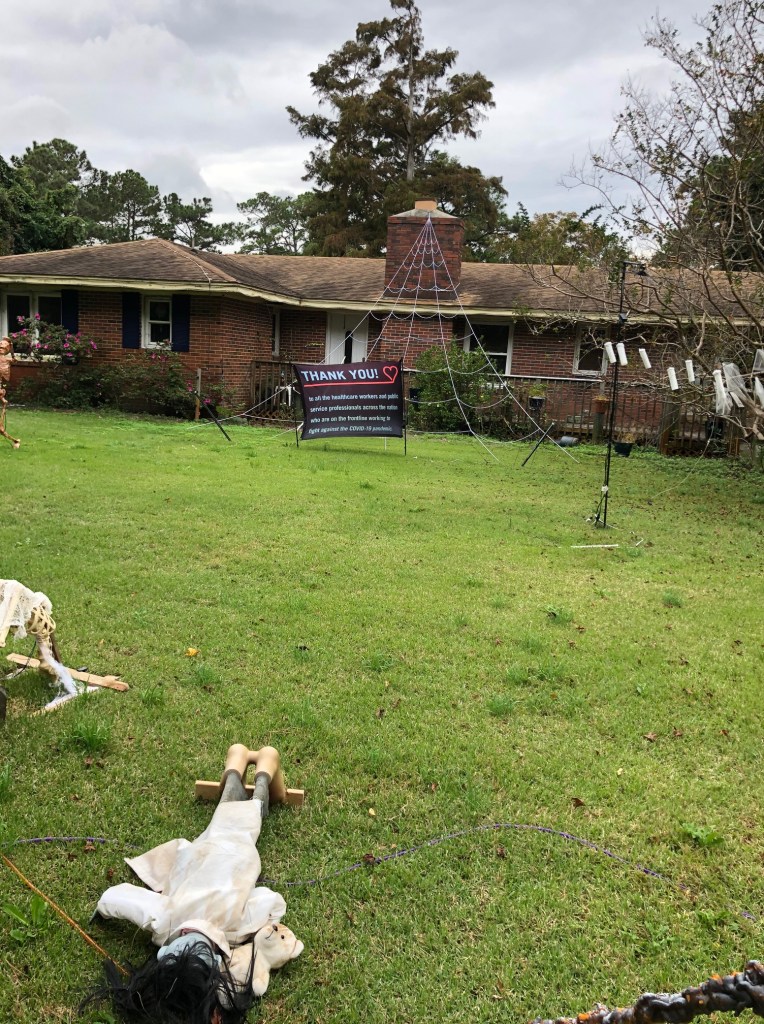
The Ewerlings of South Dogwood Trail combine a banner-size message of gratitude to front-line workers in the COVID-19 pandemic with their usual impressive yard display of Halloween spooks, ghouls, and creepy crawlers. You can’t miss the spider on the roof and the bat (below) by the road.
North Carolina hit a single-day record high today in COVID-19 case reports of 2,885, a number that well eclipses the previous single-day record of 2,716 cases, set just six days ago. Nationwide, daily new cases reportedly are averaging about 70,000.
The COVID-19 death toll in North Carolina has reached 4,283, and 1,181 people are currently hospitalized with the disease, according to the N.C. Dept. of Health and Human Services dashboard.
Small indoor gatherings with family and friends are driving COVID-19 outbreaks throughout the country, Dr. Anthony Fauci said yesterday in a live-stream interview with Dr. Howard Bauchner, the editor of “The Journal of the American Medical Assn.”
Dr. Mandy Cohen, secretary of the NCDHHS, and Dr. Sheila Davies, director of the Dare County Dept. of Health and Human Services, also have implicated social gatherings as a significant cause of rising cases statewide and locally, respectively, but neither has been as forthcoming as Dr. Fauci.
“You get one person who’s asymptomatic and infected, and then all of a sudden, four or five people in that gathering are infected,” the Director of the National Institutes of Allergies and Infectious Diseases explained, a “precarious” scenario that is likely to occur, he said, during upcoming Thanksgiving get-togethers, if people do not exercise caution.
The combination of indoor holiday festivities and people of various age groups from different households socializing in close proximity to each other, he said, is “a bad recipe for a tough time ahead.”
The infectious diseases expert suggested protecting those people who are most vulnerable to severe illness from a coronavirus infection, such as older adults and people with underlying health conditions, by keeping them safe at home.
You “want to take a couple of steps back,” he said, “and say, ‘Is it worth it [this year] to bring those people together when you don’t know what the status of everybody [in the newly created holiday pod] is?”
Dr. Fauci has given other interviews recently—for example, to CBS Evening News anchor Norah O’Donnell—in which he has suggested canceling Thanksgiving gatherings, concerned that they could provoke spikes in COVID-19 cases.
“[Y]ou may have to bite the bullet and sacrifice that social gathering unless you’re pretty certain that the people you are dealing with are not infected,” he told Ms. O’Donnell.
The 79-year-old Fauci said he and his wife are not gathering for Thanksgiving with their three children, who live in three separate states, because of the infection risks associated with air travel and other public transportation and their own vulnerability because of age-related immune deficiency.
The U.S. Centers for Disease Control and Prevention has released guidelines for Thanksgiving and other holiday celebrations, identifying activities that are lower-risk, moderate-risk, and higher-risk.
Mingling among a crowd in a pumpkin patch, for example—even when people are using hand sanitizer, wearing masks, and keeping socially distant—is rated as a moderate-risk activity. Shopping in a crowded department store for holiday gifts, needless to say, is among the higher-risk activities.
Dr. Fauci also expressed support in an interview yesterday with CNBC for a national mask mandate, as well as state and local mask mandates, if a national one is not imposed—which he is not anticipating from the Trump White House.
Face coverings are currently the best option available for slowing the spread of the virus, he said.
The NIAID Director used the same language in describing current U.S. trends in coronavirus infections as Dr. Davies and Dr. Cohen have recently in describing the local and state situations: U.S. trends, he said, are “moving in the wrong direction.”
TOWN COUNCIL MEETING, NOV. 4, 5:30 p.m., IN THE PITTS CENTER
New COVID-19 cases in Dare County have been “trending in the wrong direction for the past few weeks,” Dr. Sheila Davies said today in an update in which she implicated for the first time the means by which some people likely became infected with the virus.
While cases caused by direct contact with a known COVID-19-positive person continue to predominate, the director of the Dare County Dept. of Health and Human Services said that other recently infected people “most likely acquired the virus by either traveling or attending” a wedding or other social gathering.
At least four people who tested positive recently for COVID-19 had traveled by air, she said, and nine others had attended a wedding or other social gathering. All thirteen believed that they contracted the virus through their participation in either the air travel or the social gathering, ruling out for themselves other situational possibilities.
“We know interacting with others outside of your household increases your risk of exposure,” Dr. Davies said. “That is why it is so critically important that if you are going to engage in activities with people outside of your immediate household that you strictly follow the 3 Ws.” (And you know what they are.)
Can we, therefore, safely assume that these newly infected people came into contact with people who were not wearing protective face coverings and/or maintaining a safe distance? If so, then she should flatly state this, instead of encouraging people to “strictly follow the 3 Ws.” People are not doing that.
Nonetheless, The Beacon is delighted that Dr. Davies is adding more details about virus transmission to her updates, however belatedly. She notably did not cite restaurant dining, shopping in retail establishments, or participating in other publicly conducted activities in which strangers encounter each other as activities where “unconnected” cases—those not known to have had direct contact with a COVID-19-positive person—likely acquired the virus.
Since March, 680 people have tested positive for COVID-19 in Dare County, 387 residents and 292 nonresidents. Currently, three Dare County residents are hospitalized with COVID-19 “complications,” and 29 others are in home isolation. Four residents have died, one of them from a non-COVID-19 cause after testing positive for the disease.
Since last Friday, 13 new COVID-19 cases have been reported, including six today.
Traditional Halloween activities, including going trick-or-treating door-to-door, “can be high risk for spreading viruses,” Dr. Davies also said in her update, encouraging people to “consider safer, alternative ways to participate” in the holiday.
She suggested distributing candy in individually wrapped “goodie bags . . . lined up for families to grab and go.”
“The key,” she said, “is to maintain at least six feet from non-household members.” People should wear face coverings and frequently wash their hands, too.
[UPDATE 10/29/20: Small indoor gatherings with family and friends are currently driving COVID-19 outbreaks throughout the country, Dr. Anthony Fauci said Thursday in a live-stream interview with the editor of “The Journal of the American Medical Assn.” The Director of the National Institutes of Allergies and Infectious Diseases expressed concern about upcoming Thanksgiving and other holiday get-togethers
[Dr. Fauci also supported a national mask mandate, as well as state and local mask mandates, in the absence of a national mandate. Face coverings are currently the best option to slow the spread of the virus, he said.
[Like Dr. Davies and NCDHHS Secretary Mandy Cohen, Dr. Fauci described U.S. trends in coronavirus infections as “moving in the wrong direction.”]
Much of the business listed on the agenda, such as amendments to the FY 2020-21 budget for newly approved expenses, follows up decisions made by the Council at its budget and planning workshop last week. In addition to budget amendments, the Council will formally vote on a policy change that will increase the minimum balance that must be maintained in the Town’s Unassigned Fund Balance from $1.75 million to $3 million. As of June 30, the UFB had nearly $6 million in it.
HALLOWEEN IN CHICAHAUK: Homeowners off of Chicahauk Trail offer many options on their lawn for bones that need resting. Their Halloween display is an annual treat.
*SAT., OCT. 31: Early voting ends at 3 p.m. From tomorrow through Friday, you may vote at the Kill Devil Hills Town Hall from 8 a.m. until 7:30 p.m. The polling place will open at 8 a.m. on the 31st, but close early.
Sat., Oct. 31, is also HALLOWEEN, of course. N.C. Dept. of Health and Human Services Secretary Mandy Cohen recommends that everyone wear a face mask during their celebrations, even if they’re wearing a costume mask, and social distance.
*SUN., NOV. 1: Daylight Saving Time ends and Eastern Standard Time returns at 2 a.m., as we “fall back” and gain an hour on the clock. Halloween night owls should appreciate the extra hour of sleep.
*TUES., NOV. 3: General Election Day. Southern Shores voters may cast their ballots at the new Kitty Hawk Elementary School polling place from 6:30 a.m. to 7:30 p.m. Please tell your neighbors not to go to the Pitts Center, especially if they’re running late. The word has been out about the new polling place for a while, but there will still be people who have not heard.
*WED., NOV. 4: The Town Council will hold its regular monthly meeting at 5:30 p.m. in the Pitts Center. The Beacon will publish the agenda when it is available.
*THURS., NOV. 5: The DCDHHS is partnering with Mako Medical Laboratories to offer drive-thru COVID-19 diagnostic testing at the Soundside Event Site, 6800 S. Croatan Hwy., in Nags Head. The starting time has not yet been announced. The testing is open to individuals age 5 and older. For more details, see The Beacon, 10/23/20, or www.darenc.com/covidtesting or call the county’s COVID-19 call center at (252) 475-5008, from 8:30 a.m. to 5 p.m., Monday-Friday.
*TUES., NOV. 17: The Southern Shores Capital Infrastructure Improvement Planning Committee will meet at 2 p.m. in the Pitts Center. Please see The Beacon, 10/23/20, for its proposed agenda. There is no indication from the Town yet that this meeting will be live-streamed. People who attend in person must wear masks and observe social distancing.
***
COVID-19: N.C. SETS NEW RECORD FOR SINGLE-DAY CASE REPORTS
North Carolina set a new single-day record high of 2,716 COVID-19 case reports on Friday, 32 more than the previous record of 2,684 cases set just the previous Friday, Oct. 16. Yesterday’s new case count statewide was also high at 2,584.
October is turning out to be a more worrisome month for COVID-19 in North Carolina than July, which was once thought to be the calendar peak for infections.
Locally, the Dare County Dept. of Health and Human Services reported three new COVID-19 cases yesterday, two residents and one nonresident, all of whom are in home isolation.
The total number of cases reported in Dare County since March is now 670, 381 residents and 289 nonresidents.
Previously advised that it had received a grant from the N.C. Dept. of Environmental Quality (DEQ) for its 2022 beach nourishment project, the Town of Southern Shores announced in its newsletter today that it has been notified the grant is for $1,408,247.19.
The towns of Kitty Hawk and Nags Head each received a grant in the same amount as Southern Shores, while the towns of Duck and Kill Devil Hills each received a grant of $1,450,921.35, according to a press release from N.C. DEQ, included with the Town’s newsletter article.
The grants were awarded by N.C. DEQ’s Division of Water Resources, which gave $11.5 million to eight communities in coastal North Carolina from its Coastal Storm Damage Mitigation Fund. An individual grant could have been as high as $2.5 million.
According to the press release and a statement by N.C. DEQ Secretary Michael S. Regan, the grants are to “restore our coastal areas damaged by Hurricane Florence.”
While The Beacon is pleased by the grant, we were not aware that the Southern Shores beaches experienced any long-term adverse effects from Hurricane Florence, which the National Weather Service describes as “a large and slow-moving Category One hurricane” that made landfall at Wrightsville Beach, considerably south of the Outer Banks, on Sept. 14, 2018, and caused flooding inland because of “record-breaking rainfalls.”
We well recall the devastation that flooding from Hurricane Florence caused New Bern, N.C. and other towns to the west of the Outer Banks.
The Beacon also was not aware that the grant application filed by the Town of Southern Shores had anything to do with damage remediation associated with Florence. The Town Council approved a grant application for funding to support Option 4 of the beach nourishment plans recommended by the Town’s coastal engineering consultant, not to mitigate damage caused by Florence.
Three Dare County residents are currently hospitalized with COVID-19-related “complications,” according to the Dare County Dept. of Health and Human Services, which reported today that a diagnostic testing event will be held in Nags Head Nov. 5 in response to the steady increase locally of positive cases.
Since Tuesday, 30 new COVID-19-positive cases have been reported in Dare County, 80 percent of them among local residents.
In addition to Tuesday’s 13 cases—a number that recalls case spikes in July—six COVID-19 cases were reported by the DCDHHS on Wednesday, four yesterday, and seven so far today, bringing the total number of cases reported since March to 667, 379 of them among Dare County residents.
The predominant means of viral transmission continues to be direct contact among family and close contacts, the DCDHHS also reported today, although “cases of unknown origin,” it said, are also on the rise.
Two of the three people hospitalized with COVID-19 are known to be in the higher-risk 65-and-over age group. The third was originally reported to be in home isolation, but experienced a decline and had to be hospitalized.
The latter’s “status change” was reported on the DCDHHS dashboard yesterday, without an indication of the person’s age. All three are hospitalized outside of the Outer Banks.
The DCDHHS is partnering with Mako Medical Laboratories to offer drive-thru testing Nov. 5 at the Soundside Event Site, 6800 S. Croatan Hwy., in Nags Head. The starting time has not yet been announced. The testing is open to individuals age 5 and older.
You must have an appointment and be free of COVID-19 symptoms to be tested. Please call the COVID-19 call center at (252) 475-5008, from 8:30 a.m. to 5 p.m., Monday-Friday, to register. You will be asked to email photocopies of your government-issued ID card and your insurance card before the event. For further information, please see www.darenc.com/covidtesting or contact the call center.
REPORT ON TOWN COUNCIL’S BUDGET/PLANNING WORKSHOP
The Town Council approved at its Tuesday workshop raising the minimum balance required to be maintained in the Town’s unassigned fund balance, which is used for emergency purposes, such as hurricane relief, from $1.75 million to $3 million; and hiring another police officer, redesigning the Town website, and establishing a “beach fund” for beach nourishment efforts, as well as other expenses during the current 2020-21 fiscal year.
Actually, the Council took no formal votes on any of these items. We will explain in an upcoming report how its directives–which Mayor Tom Bennett repeatedly referred to as a “consensus”–were communicated.
The Council also considered a draft Capital Improvement Plan proposed by Town Manager Cliff Ogburn and showed interest, per Mr. Ogburn’s recommendation, in updating the Town’s Land Use Plan, which, although it is copyrighted 2012, is based on data compiled in 2005.
The N.C. Division of Coastal Management sent the Town’s Land Use Plan back to it with questions and concerns after it was submitted, a process that resulted in a multiyear delay.
The Beacon will do a thorough report of the Council’s workshop as soon as our time permits. As some of you may recall, the Town Council approved updating the Land Use Plan in a previous fiscal year, but a three-person majority upended that decision. The Beacon will refresh everyone’s memories in our report.
Generally speaking, the live-stream of the workshop was successful, except for those times when Council members–we mean you, Councilman Matt Neal–leaned back in their chairs and did not speak into their microphones.
We congratulate our new Town Manager on his superb preparation and presentation of the business on the workshop agenda.
CIIP COMMITTEE MEETING NOV. 17: The Capital Infrastructure Improvement Planning Committee will meet at 2 p.m. Nov. 17 in the Pitts Center to carry out tasks assigned to it by the Town Council in the budget/planning workshop. The committee is to “redefine” its charge so as to focus strictly on street improvements and to consider a 10-year plan for prioritized street improvements and their associated expenses.
The Council also discussed changing the name of the Capital Infrastructure Improvement Planning Committee—which is a mouthful that former Councilman Chris Naston created for the purpose of having the committee take up the Dogwood Trails sidewalks—to the Streets Committee, or something similar.
In other words, the committee is being defined for the first time by Council decision, instead of operating according to Mayor Tom Bennett’s wishes.
NEXT TOWN COUNCIL MEETING ON A WEDNESDAY: The next Town Council meeting will be 5:30 p.m., on Wed., Nov. 4, in the Pitts Center. The Council is observing Election Day, but, remember, the Pitts Center will not be your polling place. All Southern Shores voters must go to the Kitty Hawk Elementary School on Nov. 3 to cast their ballots.
“North Carolina will remain paused in Phase Three for the next three weeks,” Governor Roy Cooper announced at a coronavirus briefing today held in anticipation of the expiration at 5 p.m. Friday of his latest executive order that initiated the phase on Oct. 2.
His new executive order extending Phase Three without any further easing of restrictions will expire at 5 p.m. on Nov. 13, when the COVID-19 political landscape, nationally and on a state basis, may look quite different.
The Governor also spoke strongly today in support of enhancing “prevention efforts” by local officials and said that a letter from two secretaries in his administration had gone out recently to some counties statewide, encouraging them to take steps to enforce statewide COVID-19 safeguards and to toughen those safeguards, if necessary.
Local officials “could use restrictions that are greater than the State floor,” Governor Cooper said, “. . . to attack the virus specifically in their communities.”
This is a position that the Governor has long held–encouraging municipalities to act independently–but he has never been so direct in advocating for local action.
In the face of COVID-19 data that show all of the four key metrics trending upward—especially daily case reports and hospitalizations—the Governor emphasized enforcement and “working hard to bring community leaders together to take action.”
Both the Governor and Dr. Mandy Cohen, Secretary of the N.C. Dept. of Health and Human Services, who analyzed the latest data, attributed this month’s spike in COVID-19 cases and hospitalizations to increased “informal social gatherings” and “religious settings” in which people do not wear masks or social distance.
As they did last week, they stressed that people cannot let their guards down in get-togethers with close friends and family members with whom they do not live. Even at home, in small parties, they said, people need to wear masks.
“Ignoring the virus does not make it go away,” Dr. Cohen said, “just the opposite.”
In response to a reporter’s question about the role that Phase Three may have played in the rising data trends, Dr. Cohen replied first that people “are frustrated and not doing the three Ws.”
But she also acknowledged that the easing of restrictions in Phase Three is a “piece” of the current declining situation.
The letter sent to the counties came from Dr. Cohen and Erik A. Hooks, secretary of the N.C. Dept. of Public Safety, the Governor said. It suggests that local officials consider taking further prevention steps, such as using civil penalties or fines for violations of State mandates, as well as expanding upon the State’s safeguards.
Mr. Cooper advised, for example, that a municipality could lower the number of people who may gather in mass gatherings, down from the State’s currently allowed 50 outdoors and 25 indoors, or end local alcohol sales earlier than the State’s 11 p.m. curfew.
A municipality also could impose its own mask mandate, subjecting people who are in noncompliance to the risk of criminal penalty, which the State mask mandate does not do.
(UPDATE: The Raleigh News & Observer reported today that the letter went to 36 of North Carolina’s 100 counties. Included among them is certainly Mecklenburg County, where Charlotte is located, which is a hotspot for COVID-19.)
N.C. MASK MANDATE
The State’s so-called mask mandate was ordered by the Governor in Executive Order 147, which was issued June 24. It requires people to wear face coverings when they are or may be within six feet of another person in specific settings, including all retail establishments, restaurants, personal care businesses, child-care facilities, and other close-contact space, but it does not make the failure to do so a misdemeanor offense.
(In long-term care facilities and other health-care settings, the wearing of a face covering is mandatory in North Carolina—unless one of the EO’s exceptions applies—without regard to social distancing.)
The Beacon has never liked the Governor’s means of enforcement of the mask mandate because it does not make noncompliance a crime and, therefore, it compromises law-enforcement officers’ authority and restricts their options.
It was clear today from the Governor’s answers to reporters’ questions about the mask mandate’s enforcement that law-enforcement officers statewide have not actively intervened to reduce noncompliance. They generally have tolerated people’s refusal to wear masks.
It is little wonder. Under EO 147, law-enforcement officers may charge a business owner with violating the mask mandate if the owner does not ensure that his or her employees and customers wear face coverings, but officers have little recourse for dealing with a maskless customer.
EO 147 authorizes police officers to step in only after a customer is first asked to wear a face covering and refuses to do so, and then is asked to leave the premises and will not. Then the police may charge the recalcitrant customer with trespassing or another appropriate criminal violation, but not with violating the mask mandate.
The executive order specifically states: “Law enforcement personnel are not authorized to enforce the Face Covering requirements of this Executive Order against individual workers, customers, or patrons.”
Before Governor Cooper declared EO 147, Dare County had in effect a mask mandate with more teeth to it.
Dare provided in its emergency mandate for criminally charging and prosecuting individuals who did not wear face coverings. After the State imposed its mask mandate, however, the County declared the State’s order preemptive, effectively rescinding its own order.
The County chose to do take this action; it did not have to do it. Now Governor Cooper is asking those counties with COVID-19 outbreaks and deteriorating metrics to consider putting teeth into their own mask mandates and have local law enforcement enforce them.
The Governor also pointed out that “local health departments have authority to enforce safety precautions,” too.
More effort must be made, he said, “to stem the tide that we see coming at us” with colder temperatures and more people gathering indoors.
“The virus is everywhere here in North Carolina,” said Dr. Cohen.
(UPDATE: DARE COUNTY REPORTED SIX NEW COVID-19 CASES YESTERDAY, FIVE OF THEM RESIDENTS.)