4/7/20: BREAKING NEWS: 10 PEOPLE HAVE TESTED POSITIVE FOR COVID-19 IN DARE COUNTY. BULLETIN ANNOUNCES FOUR MORE POSITIVE TESTS.

CV test GENERIC 0010

Ten people have tested positive for COVID-19 in Dare County, according to today’s 1 p.m. Dare County Emergency Management bulletin.

Three of the four new cases announced today, DCEM Bulletin No. 34 says, are “associated with direct contact with the individual whose positive test result was announced on April 4.”

The other new case is said to be a person who “likely acquired the virus through direct contact when out of the area,” according to the bulletin.

There actually were two positive test results announced on April 4: those of cases Nos. 4 and 5. (See The Beacon, 4/4/20.)

The fourth case was reported to be a resident who was tested in Dare County, but was receiving care at a hospital outside of the county. The fifth positive test case was the spouse of the person whose positive COVID-19 test was the second for Dare County.

Bulletin No. 34 reports that of the 10 people who have tested positive in Dare County, “five have completely recovered, three are asymptomatic (meaning they have not experienced any COVID-19 symptoms), one is recovering in isolation and one remains hospitalized out of the county.”

See the bulletin at https://www.darenc.com/Home/Components/News/News/6097/1483

On Sunday, after learning of the first COVID-19 case presumably caused by community spread, or what is known as silent transmission, The Beacon predicted more positive test results would ensue this week. We based this opinion, in part, on expert analyses of the state of an outbreak in a county that has reported a case of community spread.

According to a study recently released by the University of Texas at Austin, “[i]f a county has detected only one case of COVID-19, there is a 51 percent chance that there is already a growing outbreak underway.”

In their article, “Probability of Current COVID-19 Outbreaks in All U.S. Counties,” UT researchers Emily Javan, Dr. Spencer J. Fox, and Dr. Lauren Ancel Meyers state that “COVID-19 is largely spreading undetected, because of the high proportion of asymptomatic and mild infections and limited laboratory testing capacity.”

See https://cid.utexas.edu/sites/default/files/cid/files/covid-risk-maps_counties_4.3.2020.pdf?m=1585958755.

Dr. Fox and Dr. Meyers are Ph.D.s, not M.D.s, and their approach is a statistical one that is based on a tool they developed to estimate the risk of the “silent” Zika virus spreading to the United States in 2016.

The article reportedly will be published in Emerging Infectious Diseases and is online in early release.

Dare County COVID-19 case No. 6, which was announced Sunday, is the only confirmed case that has been attributed to community spread.

Ann G. Sjoerdsma, 4/7/20

4/7/20: SOUTHERN SHORES’ ‘FINANCIAL GURUS’ ARE WRONG ABOUT BEACH RE-NOURISHMENT, SAYS KITTY HAWK MAYOR. (But Does the Mayor Know That Kitty Hawk Is Not Compelled to Re-Nourish Every Five Years?)

7thavefeb7
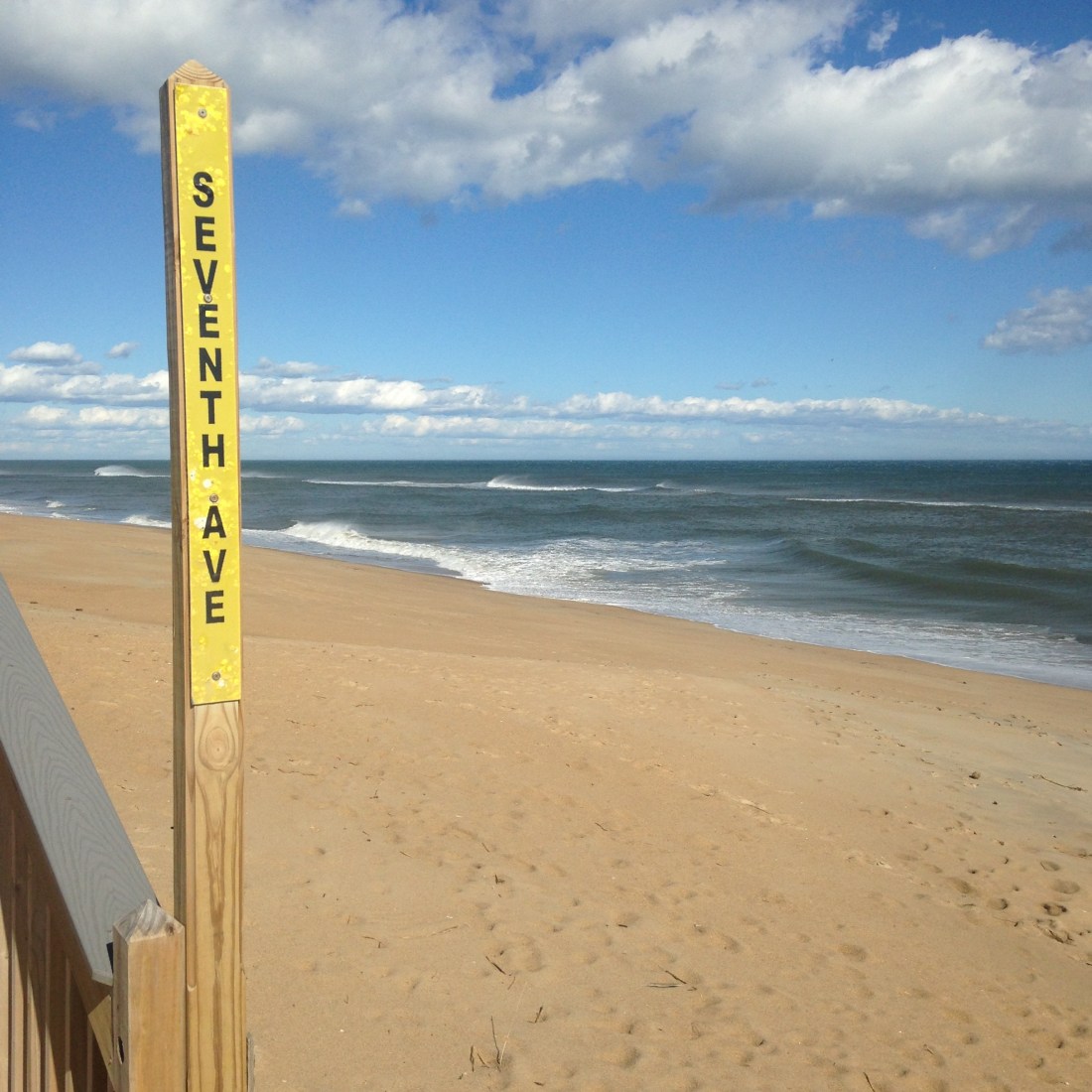
Concern expressed by two property owners on Seventh Avenue about the state of the beach there led the Southern Shores Town Council to expand the area targeted by a beach nourishment project beyond the recommendations of the Town’s coastal engineering consultant, APTIM.

The credibility of the financial consultant the Town of Southern Shores has hired to advise it about a potential $16 million beach nourishment project came into question at last night’s Kitty Hawk Town Council meeting.

In the course of discussing possible re-nourishment of Kitty Hawk’s beaches, Mayor Gary Perry said, “I am aware of a recent statement by the financial gurus advising the Town of Southern Shores, stating that once you nourish [the beaches], you never get out.

“That is not true,” Mayor Perry emphasized.” If a majority of Kitty Hawk property owners told this Council to stop taxing for re-nourishment, we must listen.”

Southern Shores has hired DEC Associates of Charlotte, whose principals are the father-son team of Doug and Andrew Carter, to provide it with financial advice.

Mayor Tom Bennett and other members of the Southern Shores Town Council are scheduled in a 3:30 p.m. meeting today to consider data prepared by those “gurus,” and, possibly, to approve a 2022 beach nourishment project based on their numbers.

Mayor Perry sought last night in a prepared statement to clarify Kitty Hawk’s responsibilities in continuing the oceanfront/oceanside municipal service district it established in order to finance its beach nourishment project, which was completed in 2017.

(The Beacon is uncertain how much property was included in Kitty Hawk’s principal MSD, which was the Mayor’s focus. A second “town-wide” MSD was also designated.)

Earlier in the meeting, the Mayor said that the Kitty Hawk Town Council had previously informed property owners incorrectly that new public hearings and new property-owner notifications would be required to continue the MSDs.

Having subsequently learned from the University of North Carolina School of Government that MSDs remain in existence until they are abolished, the Mayor exhorted property owners that “The Council must hear from you this year in order to set the MSD tax rate.”

A budget hearing has been scheduled June 1.

Mayor Perry further stressed: “If majorities of property owners do not want beach re-nourishment to occur, you had better tell us. Otherwise, I would expect Council to continue the current MSD tax rate.”

In contrast to DEC Associates’ admonition that “once you nourish, you never get out”—which is an accurate statement of advice the Carters have given the Southern Shores Town Council—Mayor Perry said it was more accurate to state: “Once out, never back.”

Mayor Perry said he thought Dare County would “surely” allocate the limited funding it has available for beach nourishment “to other places,” if Kitty Hawk were to “back out.” After he said this, a slide was projected on an overhead screen reading:

“Once out, extremely unlikely to ever be able to nourish Kitty Hawk beaches again.”

The Beacon would strongly urge the Mayor and Town Manager Andy Stewart to consult with Dare County Manager/Attorney Bobby Outten before reaching such a conclusion.

Mr. Outten has informed The Beacon, as well as Southern Shores officials and residents at a public meeting, that the County preserves monies in its Beach Nourishment Fund to ensure that it can contribute to maintenance of completed beach nourishment projects—whether the maintenance is done at five-year intervals or not.

It is not in Dare County’s interests to let the Kitty Hawk beaches decline.

Eight years lapsed between the Town of Nags Head’s 2011 beach nourishment project and its first maintenance. The Town of Kitty Hawk is not required to re-nourish in 2022, if it chooses not to.

In fact, Mr. Outten told The Beacon last December that the Town of Kill Devil Hills was seeking to delay its re-nourishment past 2022. (See The Beacon, 12/14/20)

It has long been an expressed assumption by the Southern Shores Town Council that the considerable set-up costs for Southern Shores’ new beach nourishment project would be shared by the towns of Duck, Kitty Hawk, and Kill Devil Hills because they would be doing re-nourishment at the same time.

After last night’s meeting, The Beacon has to wonder if there has been any communication between Southern Shores and Kitty Hawk, either through town managers or mayors, that confirms this assumption. Or with Kill Devil Hills, for that matter.

The Kitty Hawk Town Council meeting lasted less than 15 minutes and is available for viewing through the Town’s website.

Ann G. Sjoerdsma, 4/7/20

4/6/20: DARE COUNTY TO RESIDENTS WANTING DETAILS ABOUT LOCAL COVID-19 CASES: KEEP YOUR FOCUS ON STAYING AT HOME. Kitty Hawk Mayor to Address Beach Nourishment at 6 p.m. Town Meeting Today.


facemask
There’s no place for vanity during a public-health crisis. My heartfelt thanks to Southern Shores resident Geri Sullivan for making me a fashionable–and reversible–face mask. According to Geri, who made the mask from a pattern provided by a hospital, it is 100 percent cotton, which makes it much easier to breathe through than a hospital face mask, albeit less effective. 

Dare County residents are apparently inquiring about where the people who have tested positive locally for COVID-19 live and have traveled because today’s Dare Emergency Management bulletin stresses that it is “neither helpful nor productive” to seek such details.

Bulletin No. 33 also reminds residents of the State testing criteria that medical personnel are observing and that have not changed: “fever of 100.4 or greater, cough and difficulty breathing.” People who are experiencing mild or moderate symptoms are still being advised to self-isolate and not be tested.

“What we all must do to protect ourselves doesn’t change because of a positive test result,” said Dr. Sheila Davies, director of the Dare County Dept. of Health and Human Services.

“To protect yourself, your family and our community, everyone must stay at home other than for essential needs. Now that community spread is likely, it is important to act as if everyone you come in contact with may be COVID-19 positive and has the ability to spread the virus.”

See the bulletin at https://www.darenc.com/Home/Components/News/News/6091/1483

In the Dare County portion of the bulletin, the technical difficulties experienced with this morning’s meeting are acknowledged and a link to a video is provided: https://www.youtube.com/watch?v=iZeMEIDdWqI&feature=youtu.be

KITTY HAWK MAYOR TO ADDRESS BEACH NOURISHMENT

We also would like to call your attention to the Kitty Hawk Town Council’s meeting today at 6 p.m., which will be held virtually. According to the agenda, Mayor Gary Perry will be giving a presentation on beach nourishment and municipal services districts. His presentation is the first order of business.

You may live stream the meeting at https://www.youtube.com/watch?v=QpiX5q4vA8w&feature=youtu.be.

The Kill Devil Hills Board of Commissioners’ meeting, originally scheduled today at 6 p.m., also, has been canceled.

Ann G. Sjoerdsma, 4/5/20


4/6/20: DARE COUNTY MANAGER TELLS COMMISSIONERS HIS FY 2020-21 BUDGET WILL START AS ‘NO-GROWTH’ UNTIL HE KNOWS MORE ABOUT REVENUES. Dare Schools Meal Service Suspended Until Thursday, When ‘Grab-and-Go’ Pickups Will Begin.

freelunch
Dare County Schools will start distributing twice-a-week pick-up meals on Thursday. (photo courtesy of Dare County School)

Dare County will start with a “no-growth budget” for fiscal year 2020-21, “or something less than that,” County Manager Bobby Outten advised the Board of Commissioners this morning at its regular monthly meeting.

Once he knows more about Dare County revenues, or has some projections of revenues, in light of the COVID-19 emergency restrictions, Mr. Outten said, he may increase or decrease preliminarily budgeted FY 2020-21 expenditures.

The Dare County Manager also said he has cut all discretionary spending.

The Beacon recommends that Southern Shores Interim Town Manager Wes Haskett follow Mr. Outten’s example and do the same.

A quorum of the Southern Shores Town Council will meet tomorrow at 3:30 p.m. in the Pitts Center to take up FY 2020-21 budgetary proposals. Two Council members will be participating remotely.

For the Town Council’s agenda, see: https://www.southernshores-nc.gov/wp-content/uploads/minutes-agendas-newsletters/Agendas_2020-04-07.pdf

For the meeting packet, see: https://www.southernshores-nc.gov/wp-content/uploads/minutes-agendas-newsletters/Meeting-Packet_2020-04-07.pdf

To learn how to participate electronically in the meeting, see:  https://www.southernshores-nc.gov/wp-content/uploads/2020/03/Southern-Shores-Notice-Electronic-Participation-2.pdf

The Beacon watched some of the Dare County Commissioners’ 9 a.m. meeting, which was to be live-streamed, on Current TV Government channel 191. Unfortunately, none of the three commissioners who participated remotely in the meeting—they were Danny Couch, Jim Tobin, and Ervin Bateman—could be heard.

Commissioner Steve House, who represents Duck, Southern Shores, and Kitty Hawk, attended the meeting, which was held in the Commissioners’ chambers in Manteo, with all of the participants observing physical distancing. The meeting lasted about 45 minutes. A videotape will be posted on the DCBOC website soon.

You may read Chairman Robert Woodard’s remarks at the outset of the meeting about the tough decisions that the Dare County Control Group has made to thwart the spread of COVID-19 on The Outer Banks Voice’s website at https://www.outerbanksvoice.com/2020/04/06/these-restrictions-will-save-lives/.

The Beacon notes that Commissioner Couch is on the Control Group as a representative of Hatteras Island. We omitted him from a list of Control Group members that we published in a post yesterday.

DARE SCHOOLS SWITCHING TO PICK-UP MEALS TWICE A WEEK

The Dare County school system is suspending its free meal service until Thursday, at which time it will implement twice-a-week grab-and-go pickups of meals at three designated elementary schools.

Superintendent John Farrelly announced the change in meal service in an email to families yesterday. Citing yesterday’s report of a sixth COVID-19 positive case in Dare County, he said he would like to reduce the risk of viral exposure to employees and families.

Starting Thursday (April 9), “grab-and-go” meals will be available to anyone age 18 and younger from noon to 1 p.m. on Tuesday and Thursday at Cape Hatteras Elementary, First Flight Elementary, and Manteo Elementary.

According to Superintendent Farrelly, multiple pick-up stations will be set up in front of the Cape Hatteras and Manteo elementary schools. First Flight Elementary pick-up stations will be located in the bus parking lot on the west side of the building, between FFES and FFMS.

Each Thursday’s meal pickup will provide lunch for that day, breakfast and lunch for Friday and Monday, and breakfast for the next Tuesday. Tuesday’s meal pickup will provide lunch for Tuesday and breakfast and lunch for Wednesday, and breakfast for Thursday.

In his statement, Mr. Farrelly said that more than 9,000 meals have been served during the past few weeks. He also expressed a commitment to try to continue meal service throughout the duration of the COVID-19 emergency.

The Outer Banks Voice is reporting today that NC Coast Grill & Bar, Red Sky Café, and Saltaire Cottages are teaming up today, tomorrow, and Wednesday to provide free lunches to children, courtesy of Chef Wes. The hot lunches will be available from noon to 1 p.m. at Saltaire Cottages, 4618 N. Virginia Dare Trail, in Kitty Hawk.

See https://www.outerbanksvoice.com/2020/04/06/stepping-up-to-fill-a-gap-on-free-lunches/

The NC Coast Grill & Bar and Red Sky Café are restaurants in Duck.

Ann G. Sjoerdsma, 4/6/20

4/5/20: DARE CONTROL GROUP CONSIDERED IMPOSING CURFEWS, CLOSING BEACHES, DUCK MAYOR REPORTS. GOVERNOR COULD DO BOTH. DUCK POSTPONES 2020-21 BUDGET DISCUSSIONS UNTIL MID-MAY.

beachhires
Beaches in Southern Shores have been open and unpopulated during the COVID-19 emergency.

On April 1, the Dare County Control Group, which oversees and manages multi-jurisdictional emergencies and disasters, discussed imposing curfews on residents and closing the beaches, according to Duck Mayor Don Kingston, one of the group members.

But “there was no support for these actions at this time,” advised Mayor Kingston, one of the five town mayors on the Control Group, in a COVID-19 update that he gave at the April 1 Duck Town Council meeting, which was live-streamed.

North Carolina Governor Roy Cooper, Mr. Kingston observed, “said [such] actions may be taken.”

As The Beacon previously reported, we tried to watch the live stream of the Duck Town Council meeting in real time, but were foiled by technical difficulties: There was no sound.

A link to a video of the meeting, with audio restored, has been posted on the Town of Duck website, and we accessed it. The video is still far from perfect—beset by audio problems and an unfortunate tendency for the camera not to move to the next speaker after the previous speaker has finished. But Mayor Kingston’s voice rings out loud and clear.

We also appreciate hearing from Duck Fire Chief Donna Black and Duck Police Chief John Cueto about how they are managing, and what they are experiencing, during the COVID-19 emergency.

Neither Southern Shores Police Chief David Kole nor Fire Chief Ed Limbacher is on the Southern Shores Town Council’s meeting agenda this Tuesday. The meeting is primarily a rescheduling of the March 24 budget workshop meeting and does not include reports of town fire and police services during March.

Early in the Duck Council meeting, Mayor Kingston gave a welcome chronological review of the COVID-19 crisis in Dare County, starting on March 16 when the Control Group declared a countywide state of emergency in response to the new coronavirus that causes COVID-19. Governor Cooper declared a statewide emergency on March 10.

Mayor Kingston’s timeline also included actions taken by Currituck and Hyde counties and COVID-19 case counts on the state level.

The Dare County Control Group is comprised of nine members: Robert Woodard, chairman of the Dare County Board of Commissioners; the mayors of the towns of Duck, Southern Shores, Kitty Hawk, Kill Devil Hills, Nags Head, and Manteo; Dave Hallac, Superintendent of the National Park Service; and Dare County Sheriff Doug Doughtie.

[UPDATE 4/6/20: Today, The Beacon learned that Dare County Commissioner Danny Couch has been participating in the Control Group as a representative for Hatteras Island.] 

According to Mayor Kingston, the Control Group has a daily video conference at 8:30 a.m., which he said, as of April 1, lasted “about an hour and a half.” He described the discussions and debates among the members as “pretty intense.”

Of further interest to The Beacon was the Mayor’s report that on March 26, the Control Group “started monitoring airports and airstrips” because “we found that [nonresident] individuals were becoming very creative about coming into Dare County.”

Many of us have heard anecdotal accounts of nonresidents boating, flying, and otherwise gaining access to the Outer Banks, but this behavior by outliers has not been addressed officially by the Control Group.

Later in the meeting Town Manager Chris Layton asked the Town Council to postpone until mid-May all budget planning and discussions so that the Town will have a better idea of “when we can expect restrictions to lift.”

He described the COVID-19-related restrictions on access to the Outer Banks and on Dare County businesses as having a “drastic impact” on the fiscal year 2020-21 budget, and said he did not wish to make any assumptions.

“Even in mid-May, we may not know,” Mr. Layton said, later observing, as The Beacon has in regard to the Southern Shores Town Council’s budget decisions, “We have until June 30.”

The Duck Town Council unanimously approved the postponement, acknowledging that it may have to schedule several meetings after mid-May to get business done.

BULLETIN NO. 32

Bulletin No. 32 of the Dare County Emergency Management Bulletin appeared at 12:30 p.m. today: https://www.darenc.com/Home/Components/News/News/6087/1483.

Its intent seems to be to update COVID-19 data statewide, but it provides out-of-date statistics. As of 11 a.m. today, according to the N.C. Dept. of Health and Human Services, 2,585 cases of COVID-19, across 89 of the state’s 100 counties, have been confirmed, and 31 people have died.

The bulletin also asks people to be patient during these unusually stressful and exhausting times.

ANN G. SJOERDSMA, 4/5/20

4/5/20: BREAKING NEWS: SIXTH DARE COUNTY RESIDENT TESTS POSITIVE FOR COVID-19

CV test GENERIC 0010 

A sixth Dare County resident has tested positive for COVID-19, according to a bulletin released this morning by the Dare County Emergency Management.

“The individual is currently in isolation and being monitored,” said Dr. Sheila Davies, director of the Dare County Dept. of Health and Human Services.

According to DCEM Bulletin No. 31, the infected person may have acquired the coronavirus from an asymptomatic person, indicating community spread, which is transmission that cannot be traced to a known infected person or to travel to an epidemic area. In other words, the source of transmission cannot be identified.

County public health officials have not “found any connection between this individual and any other individuals who have tested positive in Dare County,” according to the bulletin.

Dr. Davies further commented that the U.S. Centers for Disease and Prevention has reported that as many as 25 percent of the people infected with COVID-19 may not show symptoms. That fact is one of the principal concerns of this new highly contagious virus.

Bulletin No. 31 also stresses the “likelihood” that Dare County is “starting to see community spread of COVID-19.” It is “imperative,” the bulletin states, that people restrict all nonessential movement and only go out when absolutely necessary.

Don’t cheat, in other words. (See The Beacon, 3/30/20.)

For the bulletin, see https://www.darenc.com/Home/Components/News/News/6085/1483.

The Beacon is expecting to post other news of positive COVID-19 tests later today and during the coming days. It would appear that more testing is taking place and viral transmission is spreading. If you protect yourself, you protect others, too.

Ann G. Sjoerdsma, 4/5/20

4/4/20: BREAKING NEWS: COVID-19 CASES 4 AND 5 ANNOUNCED BY DARE COUNTY  

CV test GENERIC 0010

Two more Dare County residents have tested positive for COVID-19, according to bulletins posted today by the Dare County Division of Public Health just three hours apart.

Bulletin No. 29 (fourth positive test): https://www.darenc.com/Home/Components/News/News/6080/1483

Bulletin No. 30 (fifth positive test): https://www.darenc.com/Home/Components/News/News/6082/1483

Dare’s fourth confirmed positive test is of a resident who was tested in the county, but is “currently receiving care at a hospital outside of Dare County,” said Dr. Sheila Davies, director of the Dare County Dept. of Health and Human Services.

According to Bulletin No. 29, public-health officials do not know how this person acquired the coronavirus and are conducting an active investigation into his/her activities. People who are determined to have had direct contact with this person will be notified.

The fifth person to test positive for COVID-19 in Dare County is the spouse of the person whose positive test was the second for the county. Bulletin No. 30 reports that the spouses were tested two days apart, and that neither contracted the virus by community spread. Both spouses are in isolation and are said to be “improving daily.”

The other two Dare County residents who tested positive for COVID-19 are reported to have completely recovered.

Ann G. Sjoerdsma, 4/4/20

4/4/20: LAWYERS WITH HEALTH POLICY EXPERTISE EXPLAIN HOW THE U.S. COVID-19 RESPONSE CAN AND SHOULD BE NATIONALIZED SO THAT STRATEGY IS UNIFIED. Also Dare Bulletin No. 28.

covidsign
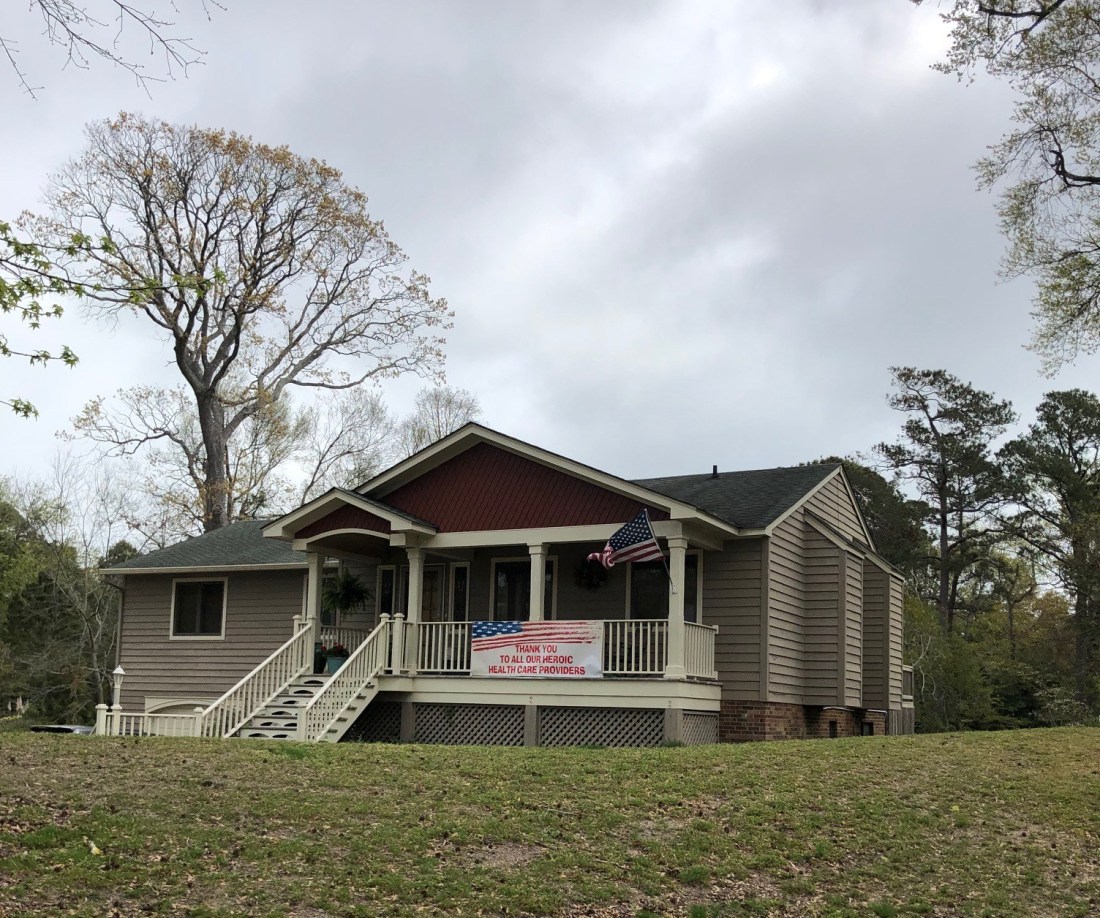
Homeowners on South Dogwood Trail give a big-banner thank you to “all our heroic health care providers.”

The Beacon is gratified by the positive reader response we received from yesterday’s post about Dr. Harvey V. Fineberg’s six-step national plan to defeat COVID-19 by early June.

Dr. Fineberg, an M.D.-Ph.D. with the independent, nonprofit, and nongovernmental National Academy of Sciences, outlined his eradication campaign in an editorial in The New England Journal of Medicine (NEJM) titled “Ten Weeks to Crush the Curve.”

See Dr. Fineberg’s article at https://www.nejm.org/doi/full/10.1056/NEJMe2007263?query=featured_home

Today, we offer more expert advice and commentary to help you become more informed about the viral pandemic.

We strongly believe that the choices and decisions we all make—including our public officials—must be based on evidence, not on anecdote, emotion, denial, shaky conjecture, and/or wishful thinking. What we don’t know, we simply don’t know, and we shouldn’t guess or posture.

This pandemic is actually the second one declared by the World Health Organization in the past dozen years. The last one occurred in 2009 when a novel strain of influenza A/H1N1 virus emerged.

(Since then, I have attended two seminars in Washington, D.C., on emerging infectious diseases, including one conducted by Dr. Anthony Fauci, and can tell you that the fear expressed by Dr. Fauci and the other specialist was that a new lethal influenza would emerge. Preparation for such an event is never far from such experts’ minds.)

You may recall when President Obama and the U.S. Centers for Disease Control and Prevention were encouraging people, especially those over age 65, to get the so-called “swine flu” vaccination to protect themselves from contracting the new influenza subtype.

Fortunately, much was already known then about influenza A viruses, which cause epidemics of disease in the United States every winter (i.e., flu season), and a vaccine to combat the H1N1 strain quickly became available.

Nonetheless, the CDC reported that nationally more than 60 million people were sickened, and 12,469 died, from the 2009 swine flu. The seasonal flu vaccine that people now get includes protection from the H1N1 “swine” virus.

No vaccine was ever developed for the strain of coronavirus that emerged in 2002, however.

Known as severe acute respiratory syndrome coronavirus 1 (SARS-CoV-1), that virus strain was largely contained to Asia. The United States had relatively few cases of SARS—mostly on the West Coast—and no one died here. SARS-CoV-1 had roughly the same incubation period as SARS-CoV-2, but it was much less contagious than the new coronavirus strain threatening us now.

A UNIFIED RESPONSE WILL NOT VIOLATE THE U.S. CONSTITUTION

Today we feature a NEJM opinion column written by two attorneys with doctorates in health policy: Rebecca L. Haffajee of the University of Michigan School of Public Health, and Michelle M. Mello of the Stanford Law School and the Center for Health Policy/Primary Care and Outcomes Research at the Stanford School of Medicine.

In their article, “Thinking Globally, Acting Locally—the U.S. Response to Covid-19,” the authors address “major weaknesses” in the United States’ “federalist system of public health governance, which divides powers among the federal, state and local governments.”

By the federal government, they refer to everyone on the federal level, not just the Trump Administration.

The authors contend that SARS-CoV-2 is “exactly the type of infectious disease for which federal public health powers and emergencies were conceived,” because “it is highly transmissible, crosses borders efficiently, and threatens our national infrastructure and economy.”

But, as we all know, the response to COVID-19 has been on a state-by-state basis, and, in some localities, such as our own, even county-by-county.

Drs. Haffajee and Mello say “strong, decisive national action” is “imperative,” and describe the federal response to date as “alarmingly slow to develop, fostering confusion about the nature of the virus and necessary steps to address it.” States and localities (such as Dare County) have been at the front lines of the response, but, not surprisingly, they have exercised their public health powers “unevenly,” according to the authors.

Although, constitutionally speaking, the states—and through their delegated authority, cities and counties—have primary responsibility for public health, and the federal government’s more limited authority focuses on measures to prevent interstate or international spread of disease, this structure applies only during ordinary times, the authors contend.

In “extraordinary times,” such as we are experiencing now, states and the federal government can “activate emergency powers to expand their ability to act swiftly to protect human life and health.”

Indeed, all 50 states and the federal government have declared emergencies, although not all states have issued stay-at-home orders, and President Trump has so far declined to impose a national stay-at-home order.

The executive powers that result from declarations of emergency can range, Drs. Haffajee and Mello write, “from halting business operations, to restricting freedom of movement, to limiting civil rights and liberties, to commandeering property.”

Unquestionably, the first three restrictive actions have occurred via executive orders, but there is nothing unconstitutional about any of them.

Usually the fear of such restrictions, according to the authors, is that government officials will over-react and impose unduly coercive measures. They give as an example N.J. Governor Chris Christie’s decision to order a nurse returning from Sierra Leone into quarantine during the 2014 Ebola outbreak, even though her case did not merit it under the CDC’s guidelines.

Today, with the COVID-19 outbreak, the authors say, “the federal government has done too little,” and “misleading early statements from federal officials about the gravity of the threat” has encouraged public sentiment against taking steps that would “impose hardship on families and businesses.”

During a public-health crisis, however, hardship and sacrifice are to be expected.

Arguing that the “defining feature of the U.S. response to Covid-19 . . . continues to be localized action against a threat that lost its local character weeks ago,” the public-health specialists urge the federal government to promote a “unified” national response. Just like Dr. Fineberg, they advocate for a national strategy and suggest the following:

*A convening of governors and state directors of public health for the purpose of reaching consensus on a “coordinated set of community mitigation interventions and a timeline.” No one is talking about a realistic timeline based on the best available evidence. (This suggestion is akin to Dr. Fineberg’s step one of establishing unified command.)

*The use of congressional spending power to “further encourage states to follow a uniform playbook for community mitigation that includes measures for effective enforcement of public health orders.” Congress could threaten to withhold some federal funds—e.g., for schools and highways—from states that do not comply.

*The leveraging of Congress’s interstate commerce powers “to regulate economic activities that affect the interstate spread of SARS-CoV-2.” They offer as an example restricting large businesses from having employees travel and operate across state lines in ways that expose them to risk. Those businesses that do not provide their employees with adequate personal protective equipment and paid sick leave, they state, “could be declared a threat to public health.”

Among the other federal actions they recommend is an implementation by the CDC of interstate travel restrictions on those people with known exposure to or symptoms of COVID-19.

“[W]hen epidemiologists warn that a pathogen has pandemic potential,” Drs. Haffajee and Mello conclude, “the time to fly the flag of local freedom is over. Yet national leadership in epidemic response works only if it is evidence-based.”

Going forward, the U.S. response must be both national and rational.

You may access their article at https://www.nejm.org/doi/full/10.1056/NEJMp2006740?query=featured_home

(FYI, the National Academy of Sciences is one-third of what is known as the National Academies. The other two-thirds are the National Academy of Engineering and the National Academy of Medicine. The mission of all three is to advise the nation and the world on challenges that they are confronting.)

IN DARE COUNTY TODAY

Today’s Dare County Emergency Management bulletin, No. 28, reminds people of the “uncertainty” of knowing who may be carrying the virus and of the “understanding that this virus is highly contagious.” You are urged to “continue to be vigilant and follow guidelines for practicing social distancing, having direct contact with immediate family members only and good hygiene.”

See https://www.darenc.com/Home/Components/News/News/6075/1483

Ann G. Sjoerdsma, 4/4/20

4/3/20: SCIENTIFIC EVIDENCE SUPPORTS COVID-19 TRANSMISSION THROUGH TALKING, BREATHING. NATIONAL MEDICAL EXPERT OFFERS SIX-STEP PLAN TO DEFEAT COVID-19 BY EARLY JUNE. MORE ON THE TOWN COUNCIL’S DECISION TO MEET NEXT WEEK.

Coronavirus-CDC-678x381

The coronavirus may be spread through an infected person’s breathing and talking, as well as through droplets generated by a person’s coughing and sneezing, according to an expert scientific panel of the prestigious National Academy of Sciences.

In a letter reportedly sent to the White House last night, Dr. Harvey V. Fineberg, M.D., Ph.D., chairman of the Academy’s Standing Committee on Emerging Infectious Diseases and 21st Century Health Threats, wrote: “Currently available research supports the possibility that coronavirus could be spread via bioaerosols generated directly by patients’ exhalation.”

(BREAKING NEWS: While writing this post, we received an updated briefing from The New England Journal of Medicine (NEJM). Included in it is an editorial by Dr. Fineberg titled, “Ten Weeks to Crush the Curve,” in which he recommends taking six steps to “mobilize and organize the nation,” in order to defeat COVID-19 by early June.  See below for more details. You may access the article at https://www.nejm.org/doi/full/10.1056/NEJMe2007263?cid=DM89429_NEJM_COVID-19_Newsletter&bid=179900194.)

While research of aerosol transmission is limited, Dr. Fineberg said in his letter that studies in China and at the University of Nebraska suggest that aerosolized droplets produced by an infected person when he or she talks or breathes could be suspended in the air long enough for another person later to inhale them. The second person could have been standing well clear—beyond the currently recommended six feet of physical distancing—of the infected person.

The question, Dr. Fineberg noted, is how long the virus can be suspended in the air—a question that is not yet answerable. No projection on how long the virus may linger has been made yet, but air circulation, he said, is definitely a factor.

“If you generate an aerosol of the virus with no circulation in a room,” Dr. Fineberg wrote, “it’s conceivable that if you walk through later, you could inhale the virus.”

Outdoors, however, he said, “the breeze will likely disperse it.”

Dr. Fineberg, 74, a trained internist, is a former dean of the Harvard School of Public Health and a former president of the Institute of Medicine.

In his NEJM editorial, published April 1, Dr. Fineberg challenges analysts who assume that the COVID-19 pandemic must play out over a period of many months and that economic recovery will take even longer. He writes, instead, that “with a forceful, focused campaign to eradicate COVID-19 in the United States,” we can “crush the curve” we are trying to flatten—just as China did in Wuhan–and we can do it nationwide in 10 weeks.

FINEBERG’S SIX-STEP PLAN FOR ERADICATION

We summarize the six steps outlined by Dr. Fineberg in his NEJM editorial—which laypeople can easily read and understand—as follows:

1) Establish unified command

Dr. Fineberg writes that “The President should surprise his critics and appoint a commander who reports directly to the President.” This person must have the President’s and the American people’s confidence and must carry “the full power and authority of the American President to mobilize every civilian and military asset needed to win the war.”

Dr. Fineberg also asks every state governor to appoint an individual state commander with “similar statewide authority.”

2) Make millions of diagnostic tests available

Everyone with symptoms must be tested, Dr. Fineberg argues. “The nation needs to gear up to perform millions of diagnostic tests in the next 2 weeks. This was key to success in South Korea.”

3) Supply health workers with PPE and equip hospitals to care for a surge in severely ill patients

Dr. Fineberg writes: “We wouldn’t send soldiers into battle without ballistic vests; health workers on the front lines of this war deserve no less. Regional distribution centers should rapidly deploy ventilators and other needed equipment from the national stockpile to hospitals with the greatest need.”

4) Differentiate the population into five groups and treat accordingly

The five groups Dr. Fineberg identifies are:

*People who are infected

*People who are presumed to be infected (have signs and symptoms consistent with infection who initially test negative)

*People who have been exposed to the virus

*People who are not known to have been exposed or infected

*People who have recovered from infection and are “adequately” immune

How he proposes to manage these five groups is somewhat complicated. People with severe disease or at high risk would be hospitalized. He also suggests establishing infirmities by using empty convention centers to care for people who have mild or moderate disease and are at low risk and converting “now-empty hotels into quarantine centers to house those who have been exposed and separate them from the general population for 2 weeks.”

Being able to identify those who have recovered and “are adequately immune,” he says, “requires development, validation, and deployment of antibody-based tests.”

5) Inspire and mobilize the public

Dr. Fineberg writes: “We have begun to unleash American ingenuity in creating new treatments and a vaccine, providing a greater variety and number of diagnostic tests, and using the power of information technology, social media, artificial intelligence, and high-speed computing to devise novel solutions. These efforts should be intensified.”

He also recommends that everyone wear a surgical mask outside of home.

6) Learn while doing through real-time, fundamental research

“Clinical care would be vastly improved by effective antiviral treatment,” Dr. Fineberg says, “and every plausible avenue should be investigated. We did it with HIV; now, we need to do it faster with SARS-CoV-2. Clinicians need better predictors of which patient’s condition is prone to deteriorate rapidly or who may go on to die. Decisions to shape the public health response and to restart the economy should be guided by science.

Guided by science. Period.

The governors of New York, New Jersey, Connecticut, Michigan, and California, among others, have been asking the White House for a national plan for coping with and defeating COVID-19 in the United States. Dr. Fineberg has offered one, and it’s based on science and the basic tenets of public health.

“If we act immediately,” he concludes, “we can make the anniversary of D-Day on June 6, 2020, the day America declares victory over the coronavirus.”

THE BEACON’S AND MY OWN PERSONAL RESPONSE

Dr. Fineberg’s report on aerosol transmission supports a position earlier stated by The Beacon that it is too soon to know everything there is to know about the new coronavirus’s transmission.

The restrictions imposed by governors and other elected officials on the strength of what mostly state and local government public-health officials—who are part of a system that has failed—are advising them are not necessarily foolproof. They are based on the best evidence they have to date, but not on all of the evidence.

The six-step plan that Dr. Fineberg outlines in his NEJM editorial is what my late father would have called public health. Dr. Fineberg is trying to build an infrastructure and to give it what it needs to succeed.

Long before he died in 2014, my father was bemoaning the collapse of the public-health system in the United States. He especially abhorred the corruption of the office of the U.S. Surgeon General, who once was an elite scientist-physician in charge of the U.S. Public Health Service, not a partisan political appointee. There was a time when the Surgeon General could have been the commander about whom Dr. Fineberg speaks. But no longer.

My late father was a brilliant scientist-physician, a medical pioneer in the field of clinical pharmacology (drug discovery by rational means, not chance), and a 20-year member of the then-militarized U.S. Public Health Service. He did wondrous things at the National Institutes of Health as a leader in the Heart Institute in the 1950s and 1960s, during what is known as the Golden Age of Research and Development.

He also distinguished himself later in the pharmaceutical industry, overseeing the development, among other therapeutics, of the antihistamine, Allegra. (An aside: He was very familiar with the old anti-malarial drugs that have been in the news. He knew the people who did the clinical trials with them.)

I learned a lot from my father, especially during the six years that I spent researching and writing his biography. He was among the medical elite in this country, as well as internationally—just like Dr. Anthony Fauci, another brilliant scientist-physician at the NIH whom I respect and trust.

I wish my father were here for me to ask him about COVID-19. He was an encyclopedia of medicine and all biological sciences and would give me sound and informed advice.

This much I know: My father always asked of any topic of argument, whether scientific or otherwise: What is the evidence? That’s the critical question. What is known? What are the facts?

Science is about the facts; it is about reason. It is not about supposition and bias.

We don’t know yet what’s in store with COVID-19. We have to follow the scientific evidence, some of which is well-known—for example, the virus’s genome and how it enters the body’s cells—and some of which is emerging, such as why the vast majority of the people dying from COVID-19 are men. We have to make decisions based on reliable evidence, and we don’t make assumptions when evidence is lacking.

We also have to have a well-reasoned, organized, and coordinated national public-health plan, which the President and his coronavirus task force have yet to give us.

SOUTHERN SHORES TOWN COUNCIL: Yesterday, The Beacon addressed the Town Council’s upcoming budget workshop session, which was postponed from March 24 to next Tuesday, April 7, at 3:30 p.m. We spoke about the burdens placed on the public if it wishes to join in the discussions of this meeting, which is top-heavy with important, but non-essential business items, including approval of a beach nourishment project and the implementation of no-left-turn weekends this summer.

(According to Tommy Karole, the chairperson of the cut-through traffic exploratory committee, his committee never finalized and sent a report to the Town Council, nor did it provide cost estimates.)

We characterized this meeting as a business-as-usual meeting being held during conditions that are anything but usual and that are in flux. What we do know for sure is that people are suffering financially, physically, and emotionally now; businesses are shuttered and may remain closed for months yet; and the start and strength of our summer tourist season are in doubt.

I have no doubt that Mayor Tom Bennett and the rest of the Town Council are cognizant of the changed circumstances, especially the economic conditions. Decisions they make on Tuesday may well be conditional on the future state of the Southern Shores and Dare County economies.

If I were on the Town Council, I would be considering a tightening of Town expenses and a tax break for Southern Shores property owners next year—a lowering of the tax rate—not a tax increase.

Also, if I were on the Town Council, I would not attend a meeting in person. The risk of my being exposed to the coronavirus, and then exposing someone else, may be infinitesimal, but I would not take that risk—especially since I don’t have to.

Electronic meetings can be held without much difficulty, and they should be held when essential business must be transacted, but not for business that can be held over to another time, when more evidence will be available to make better-reasoned decisions.

TODAY’S DARE EMERGENCY MANAGEMENT BULLETIN offers resources to people who may be experiencing stress and anxiety during the COVID-19 crisis. See Bulletin No. 27 at https://www.darenc.com/Home/Components/News/News/6071/1483.

Ann G. Sjoerdsma, 4/3/20


4/2/20: TOWN COUNCIL: PLEASE READ NEXT TUESDAY’S MEETING PACKET AND GIVE THE BEACON YOUR COMMENTS. PROPOSED COUNCIL ELECTRONIC POLICY SEEKS TO CIRCUMVENT STATE LAW ON PUBLIC HEARINGS.

beachnourishment

The Beacon has much to say about the Southern Shores Town Council’s decision to hold a business-as-usual meeting next Tuesday, at 3:30 p.m., when business now is anything but usual, including the means of “attending” the meeting and otherwise accessing it.

But we will withhold much of our comment until later. Or, at least, we’ll try.

We will note, however, that today’s bulletin from the Dare County Emergency Management cautions people to understand that “the number of positive cases reported [in Dare County] doesn’t give the full picture of what is happening with COVID-19 in our community.” Testing here and elsewhere in the state has lagged.

DCEM’s Bulletin No. 26 encourages people to “focus more on staying at home except for essential work or needs.” That applies to elected officials, too.

North Carolina currently has 1,857 cases of COVID-19 in 83 counties; and 16 people have died because of the coronavirus, according to the bulletin and the N.C. Dept. of Health and Human Services.

See https://www.darenc.com/Home/Components/News/News/6065/398.

Instead, today we ask you to read the Town Council meeting packet that was posted on the Town website yesterday. You will find it at:

https://www.southernshores-nc.gov/wp-content/uploads/minutes-agendas-newsletters/Meeting-Packet_2020-04-07.pdf  (You may need to increase the page size by zooming in. We did.)

We direct you in particular to pages 10-27, which provide data for the financing of four potential beach nourishment projects that range in cost from about $14 million to $17 million; and to page 26, which is a map of the three designated municipal service districts that will pay 75 percent of the Town’s projected costs of the nourishment in tax increases.

You will note that in each case, the Town’s commercial district pays nothing.

It is unfortunate that the packet contains only beach nourishment project financial data, and not a report, which State law requires to be prepared. It is yet another inconvenience for the public to hurdle in already uncertain and stressful times when many are losing income and wealth and face hard economic decisions.

It is quite realistic to imagine that we will not have a summer tourist season.

We also ask that you read the proposed policy on pp. 57-59 about “Electronic Participation in Town Council Meetings” and “Electronic Meetings of Town Council.” It is this policy that will allow two Council members to participate in Tuesday’s meeting “remotely” and still vote. We know of no other beach town that has taken this approach.

We strongly oppose section 2(F)(iii) of the “electronic meeting” policy, which permits the Council to make only a “reasonable attempt to allow for . . . public participation for any public hearings required by law for the decisions being made during the meeting.” (We added the emphasis.)

The Council is inviting legal action with a restriction like this. The Council cannot ignore a State statute with a simple “reasonable attempt” shrug. Town councils don’t have the power to override State law.

POSSIBLE TECHNOLOGICAL FAILINGS

Last night The Beacon tuned into the live stream of the Duck Town Council’s meeting, which dealt largely with emergency concerns, and had an unexpected experience: We couldn’t hear it. There was no audio. Our experience was it didn’t work. (Please note: All five Council members were present.)

Can Mayor Tom Bennett and the Town Council guarantee that the electronic means and the telephone access they are employing to enable the public to join in their meeting next week will work? No, they can’t. The Zoom software, in particular, may pose challenges, especially to people with limited computer skills.

There is also no guarantee that the “remote” Council members will be able to hear the meeting and be heard. Good planning requires anticipation of problems.

If the Town Council is determined to go ahead with a non-essential meeting about costly budgetary business during a national public-health crisis that has yet to peak and has caused extreme anxiety for many people locally, the least it can do is a trial run of the meeting’s “openness.” (Yes, there is critical comment in the preceding sentence.)

Instead, it puts the burden on the public to “download the application from their website at Zoom.us and try it out prior to the meeting,” as stated in the Town’s meeting notice. All the Town offers is a thank you for the public’s “patience and understanding” while we navigate “these uncharted waters together.”

It is inconvenience enough that we are being asked to write and submit our comments in advance of the meeting to the Town Clerk or to rapidly type in our comments on our computer keyboards in real-time (according to Town Clerk Sheila Kane)—you know that won’t work smoothly—we also are given no assurance by the Town that our inconvenience will pay off.

We may be dealing with frozen screens, audio echoes, inaudible voices, and other technological glitches while we strain to exercise our right to participate in municipal government. We even may be dealing with security and privacy concerns because of so-called Zoombombing! Hackers and others determined to do cyber-harm are not on holiday and have always operated well from home.

The Town’s fiscal year 2020-21 budget must be finalized and approved by June 30. The last time we checked, that was three months from now. Much will be known about the COVID-19 spread in the United States and our prospects for economic recovery in just a month from now, or two. But our Town Council just can’t wait.

Ann G. Sjoerdsma, 4/2/20