4/14/21: TOWN COUNCIL UNANIMOUSLY APPROVES MSDs WITH SLIGHT CHANGE TO DEFINITION OF MSD-1; NEXT VOTE WILL BE MAY 4.

The Town Council voted unanimously last night to approve the two proposed municipal service districts, with a modification to MSD-1 so that it includes only those properties that abut the Southern Shores beach and have at least 25 feet of frontage.

The modification means that so-called oceanside properties, which are on the east side of Ocean Boulevard, but are not oceanfront, and those that are oceanfront but have an eastern boundary of less than 25 feet, are now exclusively in MSD-2, not MSD-1.

The vote was 4-0. Councilman Jim Conners did not attend the meeting.

The Town Council also tabled the proposed beekeeping ordinance—apparently having heard from the beekeeping community about its rigors—and delayed action on the noise ordinance until May 18, so that it could be revised.

The North Carolina statute on municipal service districts requires the Town Council to approve proposed districts by majority vote of those present in two votes held at two separate meetings before it can adopt an ordinance establishing them. The Council’s next vote will be at its May 4 regular meeting.

The Beacon will give a full report on last night’s meeting, with editorial commentary, later in the week.

On a personal note: I am moving today from my Hickory Trail home of the past 23 years and will write more when I have somewhat recovered from the experience. I am not leaving Southern Shores, just moving to a house that suits me better. When I hold my obligatory moving sale, I hope some of you will stop by and say hello.

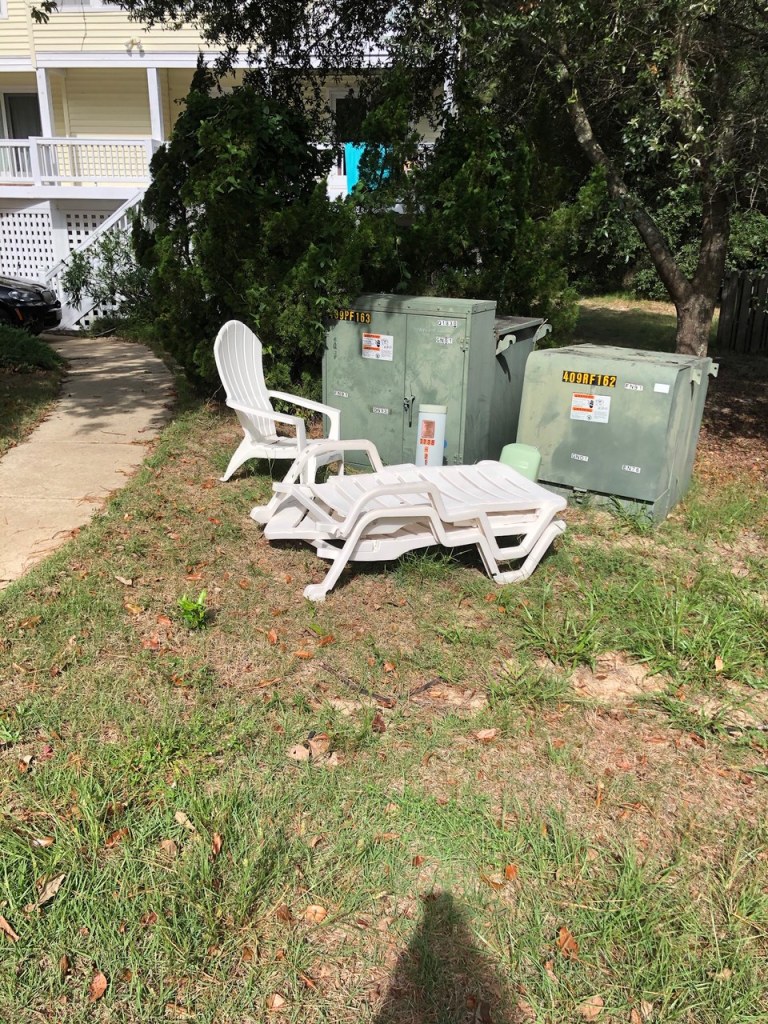
I note in passing that the Titanic sank on this date 99 years ago. The Titanic’s sinking may be a fitting metaphor for my move, but I chose the date as my move day because I wanted to take advantage of the bulk-trash pickup on Friday.

Ann G. Sjoerdsma, 4/14/21

4/10/21: TOWN COUNCIL TO TAKE 1ST VOTE ON MSDs TUESDAY, CONSIDER EXCLUSION REQUESTS; THE BEACON CITES MANY IRREGULARITIES IN THE MSD PROCESS.

The Southern Shores Town Council will take its first vote next Tuesday on whether to establish two proposed municipal service districts (“MSDs”) in town that would enable it to levy higher ad valorem taxes on properties on or near the oceanfront to pay for its $14.5 million beach nourishment project.

Before the Council votes, according to the meeting agenda. it will rule upon three written requests for exclusion from the proposed MSDs submitted by property owners, only two of which merit any real discussion. (See below.)

The Southern Shores Civic Association, which has substantial land holdings on the oceanfront—an area designated as MSD-1—has submitted a request for exclusion “out of an abundance of caution,” according to its cover letter to the Town Council.

The SSCA is a tax-exempt, non-profit corporation and will not bear any tax burden for the beach nourishment project, which is scheduled to occur from May to October 2022.

See agenda at https://www.southernshores-nc.gov/wp-content/uploads/minutes- agendas-newsletters/Agendas_2021-04-13.pdf.

The Town Council’s meeting will be held at 5:30 p.m. Tuesday in the Pitts Center. Anyone who attends the meeting in person must wear a face covering and observe other COVID-19 safety protocol. The meeting will be live-streamed on the Town of Southern Shores’ You Tube website.

Before the Town Council can establish the proposed Southern Shores MSDs, North Carolina law requires it to approve them by a majority vote of the voting members present at two separate meetings. The MSDs would be effectuated by the adoption of a Town ordinance.

If the Council rejects the proposed MSDs on its first vote, it will not take a second vote. 

While the process for creating MSDs is fairly well defined by N.C. statute, the process for evaluating requests for exclusion is not. Beyond what the exclusion claimant must include in his or her request, the State’s MSD statutory scheme is silent—leaving the municipality to decide how to proceed.

(N.C. General Statutes sec. 160A-536 through sec. 160A-544 deal with municipal service districts. NCGS sec. 160A-537 defines MSDs and outlines the process for establishing them. NCGS sec. 160A-537(c1) gives property owners the right to petition to have their properties excluded from a proposed MSD.)

We believe that in making a “staff recommendation” in his agenda item summary that the Town Council not exclude any properties from the MSDs, Town Manager Cliff Ogburn has exceeded his authority. The exclusion request is made of the “city council,” according to the statute, not the Town or the Manager.

You may access the meeting packet at https://www.southernshores-nc.gov/wp-content/uploads/minutes-agendas-newsletters/Meeting-Packet_2021-04-13.pdf.

We actually find Mr. Ogburn’s intervention in this matter one of a number of irregularities that occurred in the MSD-creation process in Southern Shores.  

IRREGULARITIES IN THE PROCESS

The first such irregularity dates to a motion unanimously approved by the Town Council at its Jan. 21, 2020, workshop to have its financial consultant, DEC Associates, Inc., of Charlotte, work with Town staff to prepare actual beach-nourishment tax-rate increases, based on whether the Town levied a tax increase town-wide or used MSDs to fund the proposed 2022 project.

The problem that we have with this directive is that it was made without any reference to the legal standard imposed by N.C. statute for establishing an MSD, which requires the Town to find that a proposed MSD is in “need” of beach nourishment to a “demonstrably greater extent than the rest” of the districts in town. (See N.C. Gen. Stat. 160A-537(a).)

In January 2020, the Town Council had not yet approved a project and was considering four options presented by its coastal engineering consultant, Coastal Protection Engineering of North Carolina, Inc. (CPE), then known as APTIM.  

Newly elected Councilman Matt Neal, who made the motion—which Mayor Pro Tem Elizabeth Morey seconded—set forth three tax assessment/MSD scenarios that he said the Council wanted DEC and Town staff to investigate and “price”:

1) A town-wide tax levy in which all property owners would pay the same amount;

2) A tax-increase levy on property owners in an oceanfront MSD, with a contribution made by the Town’s General Fund revenues; and

3) A tax-increase levy on property owners in three MSDs—the oceanfront and two more districts heading west from the oceanfront—with a contribution by the Town.

Both Mr. Neal and Ms. Morey said they wanted to get a sense of the “pain” that beach nourishment would cause taxpayers before they reached a final decision on doing the 2022 project.

(See The Beacon, 2/2/20.)

Less then two months later, Interim Town Manager Wes Haskett announced at the Council’s March 4, 2020 regular meeting, that “We have finalized a map showing proposed MSDs,” whose boundaries were drawn on the basis of property values provided by the Dare County Tax Dept.

These values, Mr. Haskett said, had been forwarded to DEC Associates so it could work up “models and funding options for the County to consider.” (See The Beacon, 3/8/20.)

Subsequently, Mr. Haskett presented to the Town, and disseminated to the public through online Town Council meeting materials, four “beach nourishment financial models,” one for each of CPE’s project options, prepared by DEC. Each showed a proposed town-wide tax rate and tax rates for three MSDs.

You may see these models at https://www.southernshores-nc.gov/wp-content/uploads/minutes- agendas-newsletters/Meeting-Packet_2020-05-19.pdf.

We have long maintained that this exercise in MSD definition and tax-rate assessment was improper and misleading.

In determining district boundaries, Mr. Haskett, who was assisted by Councilman Neal, did not apply the “need to a demonstrably greater extent than the rest” legal standard imposed by N.C. statute.

No, they formed the boundaries of the MSDs on the basis of mathematical calculations, looking at the sum of assessed values of properties on and proximate to the oceanfront—heading westward—proposing tax rates that were comparable to what other Dare County towns have used, and then multiplying the property values by the tax rates to arrive at the number of properties that would need to be in the various MSDs to pay for what was then presumed to be a $14 million to $16 million project.

Their method was a matter of number-crunching, not an assessment of need.

Mr. Neal has since characterized this exercise in a Town Council meeting as “ad hoc,” meaning, we suppose, that it was for discussion purposes only. But we do not believe that it was perceived that way by the public. 

When Southern Shores property owners spoke at the June 16, 2020 public hearing on beach nourishment—before the Town Council voted on whether to move forward with a 2022 project—they did so with what they believed was knowledge of what their likely tax increase would be if the three MSDs were approved.

At the time, the proposed town-wide tax rate was 1.96 cents per $100 of property value.

In fact, Mr. Neal had paperwork with him at this meeting so that he could tell an individual property owner what the likely dollar-amount tax “hit” would be for him or her.

This Town Council-Town staff “ad-hoc” exercise served as the foundation for the two currently proposed MSDs and the statutorily mandated report, prepared by Mr. Ogburn, that demonstrates and justifies the proposed district boundaries.

We understand that Mr. Neal—and the rest of the Council, which backed him—had good intentions in doing these computations.

Nonetheless, we consider this “ad-hoc” exercise to be an irregularity that unduly influenced the June 16, 2020 public hearing on beach nourishment; the Town Council’s decision to pursue beach nourishment; and the creation of the two MSDs upon which the Council will vote on Tuesday.

It was a classic case of putting the cart before the horse. In this case, however, the horse was a well-established statutorily mandated legal process and a legal standard that was ignored.

THE EXCLUSION REQUESTS

In their request to exclude their property at 121 Ocean Blvd. from proposed municipal service district 2, Charles and Janan Usher contend that the Town’s proposed MSDs “were constructed without explicit criteria” and that, as a result, properties were not consistently classified.

The Ushers looked at Dare County’s assignment of oceanfront and ocean influence (OI) ratings to Southern Shores land parcels and determined that “significant groups of OI-rated parcels” in town were arbitrarily excluded from MSD-2, and that other parcels were inconsistently assigned to MSD-1 and -2.

They quite reasonably ask the Town Council to “clarify the criteria used to assign parcels to MSD-1 and -2 and to demonstrate that they were applied consistently across all parcels in the Town.”

The only criterion that the Town should apply is the one pronounced by the N.C. General Assembly: An MSD must “need” beach erosion control to a “demonstrably greater extent than the rest” of the districts in town.

This legal standard was not stated at a Town meeting until Mr. Ogburn presented his proposal and report for the two MSDs at the Council’s Feb. 2, 2021 meeting.  

In a preview of this meeting, we wrote on 1/31/21 that the Town Manager had failed in his MSD report to meet the “need” standard:

“We believe the report that Mr. Ogburn has filed in support of these two MSDs, which are defined solely by their proximity to the ocean, is inadequate to meet the standard imposed by North Carolina law for such special tax districts . . .

“The law requires a showing of need, not benefit, and the Town Manager’s report contains no shoreline data supporting the need for a townwide sand fill. With the exception of the beach section south of Skyline Road, the 2022 project is specifically designed to limit future, speculative damage, not to address current need.”

Homeowner Thomas Peabody, of 13 Sixth Avenue, uses the critical need-benefit distinction to argue in his request for exclusion that the need for beach-erosion control at the Sixth Avenue oceanfront does not exist—and surveys done by the Town’s coastal-engineering consultant evidence the lack of need.

We agree.

We would refer Mr. Peabody, whose property is in proposed MSD-2, to remarks made by Mayor Tom Bennett and other Town Council members at their Feb. 2 meeting about limiting the “scope” of the 2022 beach nourishment project to only those areas of the coastline that have a “critical need.”

The northern section of the town’s 3.7-mile-long coastline, which CPE defined as being from about Third Avenue north to the Southern Shores/Duck line, “has gained sand,” the Mayor said, and is “not as vulnerable as far as the dunes and the properties behind” them.

Addressing complaints last year by Seventh Avenue homeowners about the width of the northern beach, the Mayor said, the beach “is definitely wider this year than it was last year.”

Later in the meeting, he noted: “I don’t see the north beach in trouble.”

Even Councilman Neal, who has been a consistent proponent of beach nourishment, acknowledged at this meeting that Dare County’s 50-percent financial contribution, not the Southern Shores coastline’s need, “has been the driving force” for the Town’s 2022 project.   

(See The Beacon, 2/5/21.)

In recommending that the Town Council not exclude Mr. Peabody’s or the Ushers’ properties from MSD-2, Mr. Ogburn says only that “Staff finds nothing unique about these properties that distinguishes [sic] them from the rest of the district. Granting these requests could imply that those adjacent to these properties were also not in need.”

All that is legally germane for purposes of evaluating an exclusion request is the “need . . . to a demonstrably greater extent” standard stated in the N.C. statute. “Uniqueness” need not be established. If granting these two exclusions would “imply” that adjacent or other properties “were also not in need,” so be it. The MSD boundaries should be changed.

‘FOR DISCUSSION PURPOSES ONLY’

The Ushers point out in their exclusion request that the maps of the proposed MSDs in Mr. Ogburn’s MSD report are labeled as “Conceptual Municipal Service Districts” and described as “preliminary and intended for discussion purposes only.”

The notice of the March 16 public hearing that was mailed four weeks in advance to property owners in the proposed MSDs specifically informed them that the outlined MSDs were preliminary and, therefore, subject to change.

But the proposed Town ordinance—upon which the Council will vote Tuesday—reproduces verbatim the language in Mr. Ogburn’s MSD report about the two proposed MSD boundaries. There has been no discussion. The preliminary “conceptual” MSD boundaries are, in fact, as the Ushers allege, the “final” MSD boundaries. It would seem that the Town has misled people.  

Was the public hearing really nothing more than a pro forma exercise that the Town conducted only because the State required it to do so?

Like the Ushers, we had assumed that the “for discussion only” language meant the Town Council was actually going to listen to what property owners had to say and discuss what they had heard.

We were flummoxed when the Council adjourned the March 16 meeting—the hearing lasted only 70 minutes—without responding to, much less discussing, any of the public comments.

At the conclusion of the June 2020 beach nourishment public hearing, the Council conferred and unanimously voted to “pursue” beach nourishment. At the conclusion of the MSD hearing, it said nothing.

In his recommendation to the Council about the exclusion requests, Mr. Ogburn writes:

“An alternative to the maps as originally presented could be considered by the Council. However, some changes may be considered substantive and could require reinitiating the public hearing process.” (Our italics.)

Members of the Town Council have publicly stated that changes to the proposed MSDs could occur. But Mr. Ogburn’s latter statement clearly discourages members from making any changes—even though they have heard from dozens of property owners in Southern Shores who might have convinced them otherwise.

We don’t like it.

Further, if we are going to be advised about the possibility of “reinitiating” the public hearing process, we would like Town Attorney Ben Gallop to do the advising.

We also view as irregularities the fact that the notice mailed to property owners, many of whom are non-resident, failed to offer them the option of presenting their comments via Zoom—although the general public notice mentioned this option—and did not inform them that their written comments would not be read aloud at the hearing.

We do not believe that posting written comments on the Town website is an acceptable substitute for reading them into the public record and airing them at a public forum. We also wonder how many property owners who submitted written comments know where they ended up.

MISLEADING ‘NEXT DOOR’ THREAD

Finally, we find it inappropriate that on March 24, Town Councilman Jim Conners, who had been circumspect about not commenting publicly about the emails the Council had received regarding the MSDs because of the on-going “legal process,” participated in a comment thread on the social-networking service, Next Door, that was initiated with the misleading title of “New tax districts in Southern Shores.”

The Town Manager has proposed levying an additional ad varolem tax of 23.5 cents per $100 of property value on properties in MSD-1; an additional 9 cents per $100 of value on properties in MSD-2, and an additional 2.75 cents per $100 on remaining properties.

These are not definite tax rates. Only the Town Council can set tax rates, and it will set MSD tax rates only after it approves the MSDs and adopts a Town ordinance.

Unfortunately, a homeowner on South Dogwood Trail did not know this. Her “New tax districts” comment on Next Door, which we believe was posted in good faith, reminded people “to send in comments to the city of southern shores regarding the new districts 1 and 2.” She continued:

“The city is considering having Districts 1 and 2 pay a higher portion of the multi million beach nourishment project as they more directly reap the benefits. There have been a lot of comments from [these] owners . . . that everyone should share the cost equally. There are very few comments from residents outside of these two districts. If you have an opinion, please take the opportunity to read through the information on the city’s website and send in comments so that you can be heard.”

Although the Town gave ample notice of the March 16 public hearing, and no one was precluded from participating in the hearing, this homeowner was unaware of it.

In the conversation that ensued among her and others in Southern Shores, she stated that “I do not believe that a final determination of the increased tax rates for each of three areas has been finalized.”

Councilman Conners intervened in the thread here, replying to this post: “As an individual councilperson, I feel comfortable station [sic] that as of this date, you are absolutely correct.”

We find this comment troublesome. Despite the homeowner’s reference to “district 1 and 2 property owners,” Mr. Conners gave no indication that the municipal service districts had not yet been established. In not correcting this misconception, he perpetuated it.

Subsequently, the Councilman urged property owners to submit comments, writing:

“As an individual councilmember in SShores, I’d like to HIGHLY encourage everyone to relay your thoughts to the town of Southern Shores. Humongous decisions are being discussed and made on beach renourishment, but unfortunately, sites like this have little, if any, influence on those decisions. If you’re a resident or property owner in SShores, PLEASE send your thoughts to the Town.” (The capitalizations are Mr. Conners’s.)

Property owners are certainly free to email their comments to Town Council members at any time, but it seems to us to be both inappropriate and improper for a Council member to encourage people on a subscription social-media website to do so—especially after a duly noticed public hearing has been held and when they clearly are misinformed.

Mr. Conners went a step further when he expressed his belief that off-the-public-record Next Door chat should have more influence on the Town Council’s decision-making than he believes it currently does. Judging from how uninformed the participants in this Next Door thread were, one might more reasonably argue just the opposite.

At no point did the Councilman explain the legal process for establishing MSDs, including the “need to a demonstrably greater extent” standard, and reveal that the public hearing had been held. He also mistakenly implied that residents of Southern Shores who do not own property have a stake in the creation of the special districts.

We consider this social-media exchange both improper and prejudicial. Another irregularity.

Ann G. Sjoerdsma, 4/10/21

4/9/21: N.C. COURT OF APPEALS OVERTURNS RULING IN FAVOR OF FACEBOOK-SAVVY DUCK SURFER IN BEACH ACCESS CASE, FINDS NO PUBLIC EASEMENT: The Beacon Provides Opinion.

Bob and Tanya Hovey pose for a Facebook photo in 2019 in front of the disputed easement in the Duck subdivision of Sand Dollar Shores.

The N.C. Court of Appeals overturned on Tuesday a 2019 ruling by a Dare County Superior Court judge that Duck business owner and surfer Bob Hovey could use a beach access at Sea Breeze Drive in Duck because it is public.

In its decision, the three-judge Court of Appeals panel* that heard the case, known as Hovey v. Sand Dollar Shores Homeowner’s Assn. and the Town of Duck, ruled that not only did Mr. Hovey fail to prove, as a matter of law, that the beach access he had sought to use was public, but there are no public beach accesses in Duck, only private ones.

The Court remanded the case to the Dare County Superior Court with an order that summary judgment be entered for the HOA and the town, which did not actively participate in the appeal. 

See Hovey v. Sand Dollar Shores Homeowners’ Assn. and the Town of Duck at https://appellate.nccourts.org/opinions/?c=2&pdf=39934

Bob Hovey, who owns Duck Village Outfitters, was arrested in May 2019 for trespassing at the Sea Breeze Drive access, which he argued in both the media and in court was a dedicated public easement.

Mr. Hovey created a social-media frenzy when he posted videotapes on Facebook of confrontations he had with angry homeowners in the Sand Dollar Shores subdivision of Duck and with police, who ultimately arrested him.

He wrote on Facebook then that he believed he was “the first person in the history of Duck to get arrested for going to the beach.”

Encouraged by public support and financial donations, Mr. Hovey filed a lawsuit, with his wife, Tanya, against the HOA and the town, contending that the language in the 1981 plat map for the Sand Dollar Shores subdivision intended to dedicate a public beach access/easement at Sea Breeze Drive.

When Judge L. Lamont Wiggins of Dare County Superior Court ruled in February 2020 in favor of the Hoveys on summary judgment, the misdemeanor trespassing charges against Mr. Hovey were dropped. 

According to the Court of Appeals’ opinion, which was authored by Judge Lucy Inman, the plat map included a “certificate of dedication” in which developer Sand Dollar Shores dedicated “all roads, alleys, walks, parts, and other sites to public or private use as noted.”

The certification also stated that “the streets and roads in this subdivision are dedicated to public use.” It did not specifically mention the eight-foot-wide pedestrian beach easement.

“Nothing on the face of the plat maps,” Judge Inman wrote, “notes the Easement as for either public or private use.”

Dare County accepted the developer’s plat map for recordation, as well as the developer’s dedication certification.

Two days after this acceptance, according to the Court’s opinion, Sand Dollar Shores recorded restrictive covenants for the new subdivision, among which was a covenant stating that the beach easement was for the sole use of homeowners in Sand Dollar Shores and their guests and that use by anyone else was prohibited and could result in a prosecution for trespassing.

After the Sand Dollar Shores Homeowner’s Assn. was established nine years later, the developer transferred ownership of the beach access to it. The HOA enacted its own restrictive covenants in 2015, making it clear that the easement was for the use of its members and their guests only.

The appellate panel, which consisted of Judge Inman and concurring Judges John M. Tyson and Tobias Hampson, had no difficulty ruling in favor of the HOA and the town as a matter of law.

The Court found that the language used by the developer in the plat map did not establish a “clear” and “unambiguous intention” to dedicate the easement to public use and distinguished all other cases argued by the Hoveys as inapplicable.

Gregory E. Wills, of The Wills Group in Grandy, represented the Hoveys on appeal.

Attorneys in the Raleigh and Greensboro offices of the Washington, D.C.-based law firm, Fox Rothschild LLP, represented the homeowners’ association. The Town of Duck did not file a brief.

Under N.C. appellate court rules, the Hoveys do not have a right of appeal to the N.C. Supreme Court, and it is highly unlikely that the State’s highest court would hear the case on discretionary review.

ACCESS TO PUBLIC-TRUST BEACHES

Local media have picked up on the Court of Appeals’ last paragraph in the opinion in which Judge Inman wrote that the court, in upholding “private property rights under the law,” was aware that Duck lacks public access to its beaches. She went on to say that:

“Plaintiffs are not barred from the beach. They may, as suggested by counsel, negotiate for access with Defendant [i.e., the HOA] or, failing that, drive to nearby municipalities or any unincorporated areas in the county to the north and south that maintain public beach accesses.”

This language may seem like “let them eat cake” language to many Outer Bankers, but the appellate judge was compelled to this conclusion by the law.

Regardless, it is ludicrous that the Hoveys, who own a house on N.C. Hwy. 12 across from Sand Dollar Shores, would have to travel to Kitty Hawk or Kill Devil Hills to access the beach.

The Beacon often hears from readers about the lack of public access in Southern Shores to the beaches, which are owned in trust for the public by the State of North Carolina. Anyone may use and enjoy the dry-sand beach areas, if they can access them.

The beach accesses in Southern Shores are owned and maintained by the Southern Shores Civic Assn., which allows the public to use them freely—but, as readers like to point out, as long as public parking is not provided, that use is more theoretical than real.

The North Carolina General Assembly has acknowledged as much and taken some initiative through the Coastal Area Management Act to incentivize the creation of public beach accesses.

In N.C. General Statutes sec. 113A-134.1(b), the N.C. legislature observed decades ago already that “Public access to beaches and coastal waters in North Carolina is . . . becoming severely limited in some areas. Also, the lack of public parking is increasingly making the use of existing public access difficult or impractical in some areas. The public interest would best be served by providing increased access to beaches and coastal waters and by making available additional public parking facilities. There is therefore, a pressing need in North Carolina to establish a comprehensive program for the identification, acquisition, improvement, and maintenance of public accessways to the beaches and coastal waters.”

We appreciate both private property rights and public access/use and believe it is unfortunate that the parties to this lawsuit could not work out a compromise. Their money—and that of the public—would have been better spent in community mediation than in litigation.

(*The N.C. Court of Appeals, often referred to as the intermediate appellate court because the N.C. Supreme Court is the highest appellate court, is made up of 15 judges who hear appeals in panels of three.)

Ann G. Sjoerdsma, 4/9/21

4/5/21: PROPOSED REWRITE OF TOWN NOISE ORDINANCE NEEDS A REWRITE. Plus Regulating Beekeepers in Neighborhoods.

A recent peaceful morning at the marina on Loblolly Drive, which is off of Holly Trail.

An illogically constructed and confusing rewrite of the Town’s noise ordinance is among the changes to the Southern Shores Code of Ordinances that the Town Council will consider at its April 13 regular meeting, according to the meeting packet posted on the Town website. 

We hope the Council will not waste much time on this proposed ordinance. It needs a substantial rewrite.

The Town Council will meet at 5:30 p.m. on Tuesday, April 13, in the Pitts Center. You may access the agenda here:

https://www.southernshores-nc.gov/wp-content/uploads/minutes-agendas-newsletters/Agendas_2021-04-13.pdf.

While the headliner on the Council’s agenda is its first vote on a Town ordinance that would establish two municipal service districts for purposes of taxing property owners and paying for the 2022 beach nourishment project, Town Code amendments offered by staff are also noteworthy, especially the noise ordinance.

(We will preview the Council’s scheduled actions on MSDs and beach nourishment later in the week. Three parties have filed requests to have their properties excluded from the MSDs: two private landowners and the Southern Shores Civic Assn. If the Council approves the MSDs, it will take its second vote at its May 4 regular meeting, according to Town Manager Cliff Ogburn.)

When the public was surveyed by CodeWright Planners for the Town Code revision, and we last met with principal Chad Meadows more than two years ago, there was interest in bolstering Town regulations about noise. Not many of us enjoy someone else’s loud music at late-night parties—or at gatherings at any other time of day—and Southern Shores definitely has its share of them.

Unfortunately, Mr. Meadows’s proposed replacement of Town Code sec. 22-3, titled “Noises prohibited,” increases the verbiage of the current ordinance five-fold without improving upon its clarity, notice, or substance and without protecting us from unreasonably loud or excessive noise generated by our fellow residents.

It is evidentiary support for the Town Council’s decision to reject as unacceptable most of the Durham-based planning consultant’s work product. 

On March 2, the Town Council tasked Town staff—in particular, Planning Director/Deputy Town Manager Wes Haskett—with trying to salvage any “valuable elements” that might exist in the Adoption Draft of the revised Town Code that CodeWright submitted for final review.  

If the proposed noise ordinance is indicative of the “elements” that may exist in the draft, few can be considered valuable. We challenge you to read CodeWright’s “replacement” noise ordinance and arrive at a different conclusion:  

See pages 69 to 78 in the meeting packet at https://www.southernshores-nc.gov/wp-content/uploads/minutes-agendas-newsletters/Meeting-Packet_2021-04-13.pdf.

In contrast, a proposed new ordinance about the consent that non-commercial beekeepers in town must obtain from their neighbors before they may keep an apiary, is tightly written and specific, spelling out how they must proceed. (Heretofore, there has been no beekeeping ordinance in Southern Shores. State and federal laws are applicable.)

The intent of the ordinance, which has been proposed because of “changes in state law,” according to Mr. Haskett, is to ensure that a Southern Shores resident’s beekeeping does not adversely affect “the use and enjoyment of neighborhood properties surrounding the property on which the bees are kept.” The new ordinance would be codified as sec. 4-28.

The beekeeper must obtain written consent—the details of which are spelled out in the proposed ordinance—from all adjoining landowners for a proposed apiary site and provide it to the Town Manager. Absent such consent, a beekeeper cannot operate. (See pp. 67-68 of the meeting packet.)

Another proposed change to the Town Code would delete an article in chapter 18 that created an auxiliary police force to consist of as many volunteer members as the Town Council “may, from time to time, deem necessary.”

According to Mr. Ogburn’s summary in the meeting packet, the abolition of the auxiliary police and changes to the noise ordinance “were initially requested by the Police Department.”

Unfortunately, a volunteer auxiliary police force has become an anachronism. Forty years ago it seemed like a good idea.

A CACOPHONY OF NOISE (Yes, That’s Redundant)

The poor construction of the proposed new noise ordinance is immediately apparent.

The so-called “prohibited acts” that constitute “prohibited noise,” for which the police can issue a violation citation, are buried beneath:

  • an excessive and unnecessary definition section;
  • a listing of exemptions to the prohibitions (exemptions should never come before the standards themselves); and
  • confusing and overly complicated language about the difference between “maximum sound levels” and “noise” and what constitutes “maximum permitted sound levels” in different zoning districts.

Consider these three over-the-top definitions:

[Please note: We admit to a pet peeve, left over from our newspaper editing days, about the misuse of “which” for “that,” hence the “sic” signifying improper grammar.]

1. “Noise: Any sound which [sic] annoys or disturbs humans or which [sic] causes or tends to cause an adverse psychological or physiological effect on humans.”  

Any sound that annoys or disturbs—whatever those verbs mean—“humans”? An “adverse psychological or physiological effect”—determined how? By medical judgment or testimony?—on “humans”? How many humans do you need?

Such a vague, overbroad definition has no place in law, on the municipal level or elsewhere. It is better to identify what constitutes unacceptable noise rather than to try to define noise.

2. “Noise disturbance: Any sound which [sic] endangers or injures the safety or health of humans or animals; a noise that disturbs a reasonable person with normal sensitivities; endangers or injures personal or real property; or is unreasonably loud, disturbing or excessive noise.”

Does this definition modify the “noise” definition, so that we now know that only sounds that endanger or injure the health or safety of humans or animals can “disturb”? Or is this a different kind of noise experience? There is no section in the ordinance titled “Noise Disturbances.”

As for animals, are we talking about farm animals here? My dog is traumatized by the sounds emitted by helicopters, backfiring pickup trucks, and a myriad of other loud traffic sounds. They are a hazard to his mental health. Can I call the police and report the offenders? 

And what’s this business about a reasonable person “with normal sensitivities”? The noise definition only dealt with humans, regardless of their reasonableness or sensitivities. Now we’re applying the well-known hypothetical reasonable person who appears in legal cases.

3. “Unreasonably loud, disturbing or excessive noise: Any sound which [sic] because of its volume, level, duration or character disturbs, discomforts, injures or endangers the health, peace or safety of a reasonable person with normal sensitivities. For purposes of this chapter, such a sound shall be deemed to be a noise disturbance.”

If you’re still with us, you must now be wondering what the difference is between a noise that is prohibited—which we’ll get to—and a “noise disturbance.” If there is a legal distinction, it was lost on us until we really dug into the ordinance, and it will be lost on anyone who attempts to read and make sense of this ordinance.

Laws should not obfuscate.

Is it necessary to have three different terms defining “noise”? Of course not. It is confusing.

Even more baffling, after belaboring the definition of noise, the proposed ordinance prohibits “mechanical, amplified or [another type of generated] sound from any source which [sic] registers more than 60 dB(A) [decibels],” between 7 a.m. and 10 p.m. in all residential districts. During the nighttime hours of 10:01 p.m. to 6:59 a.m., such sounds may not exceed 55 decibels in the residential districts.

We ask: Why bother figuring out what noise is, if decibel level and time of day ultimately determine prohibited sounds?

Of course, once decibel levels are introduced, you have to figure out how to measure them. The ordinance seeks to explain how noise can be measured for purposes of proving a violation, but it also creates loopholes that make a sound-emission decibel measurement superfluous.

If you don’t know the decibel level, according to the proposed ordinance, you can substitute “complaints of numerous persons, at least one of whom resides in a different location from the other complaining person or persons” for a decibel measurement on a “sound level meter,” because, after all, people know when sounds are “unreasonably loud, disturbing, or excessive noise.” (See definition.)

Alternatively, you can prove that the noise was of such a “nature that a reasonable person with normal sensitivities should have known that the noise was creating an unreasonably loud, disturbing or excessive noise.” (See definition.)

And round and round, we go.

SPECIFICALLY PROHIBITED NOISES

The prohibited noises enumerated by the ordinance start with this one:

“The playing of any television set, musical instrument, or other electronic sound amplification system in such a manner or with such volume as to annoy or disturb the quiet, comfort, or repose of a reasonable person with normal sensitivities as determined by the Town Manager (or a designee).”

Now it would seem that decibel level no longer determines what constitutes prohibited noise, Cliff Ogburn does!

The second noise prohibited by the proposed ordinance is:

“The keeping of an animal which [sic], by causing frequent or long continued noise, shall disturb the quiet, comfort, or repose of the immediate area to such an extent as to constitute a nuisance.”

We assign a sic here because an animal is a “who,” not a “which.”

To quote the late Dick Enberg: “Oh, my.”

What, we wonder, is the meaning of “frequent,” “long continued,” “immediate areas,” or “nuisance”?

There are definitions of nuisance elsewhere in the Town Code—nuisance being a legal term—but they currently do not apply to barking dogs.

This prohibition is actually a rewrite of the current Town Code noise prohibition about animals that reads:

Loud animal noises: The keeping of any animal which [sic], by causing frequent or long continued noise, shall disturb the comfort and repose of any person in the vicinity.”

No ordinance is going to solve the everyday problem of how long must a barking dog bark before you justifiably can call the police and report it–and the police can issue a citation. You just know how much time must pass before any “reasonable person” has had enough.

Among the 10 exemptions to the ordinance’s prohibitions, this is our personal favorite:

“The playing of a musical instrument between the hours of 3:00 p.m. and 7:00 p.m. Monday through Friday and 12:00 p.m. to 7:00 p.m. on Saturdays and Sundays provided said sound does not exceed 65 dB(A) at the property line of the property from which the sound emanates.”

So, even though the playing of a musical instrument “in such a manner or with such volume as to annoy or disturb the quiet, comfort, or repose of a reasonable person with normal sensitivities,” as determined by Mr. Ogburn, is prohibited, and sounds “from any source” that register more than 60 decibels are prohibited during the daytime in the residential districts, a person may still play an instrument during afternoons and evenings—provided the sounds he or she creates do not exceed 65 decibels at their property lines.

Another proposed exemption of interest is the following:

“Noise resulting from the loading and unloading, opening, closing or other handling of boxes, crates, containers, building materials, or similar objects between the hours of 7:00 a.m. and 10:00 p.m.”

OK. Certain workers have to work, and they make noise when they do.

Interestingly, this exemption serves to “balance” the following overwritten and poorly constructed noise prohibition:

“The loading, unloading, opening, closing, or other handling of boxes, crates, containers, building materials, garbage cans, dumpsters of similar objects between the hours of 10:00 p.m. to 7:00 a.m., the following day, in such a manner as to cause a noise disturbance across a residential real property boundary or within a noise sensitive zones is prohibited as set forth in the maximum decibel levels set for each zone at the times of day consistent with this chapter.”

For some reason, this prohibition does not parallel the others in sentence structure.

But, aha! Now we know what can constitute a “noise disturbance.” But why is this prohibition among “Prohibited Noises,” instead of in a separate section called “Noise Disturbances”? And do we really want to have differing terms for noise just to stop people from complaining about trash trucks?

Former Town Manager Peter Rascoe once told me that the most common single complaint he received from residents was about the noise caused by early morning garbage trucks.

To complain about this noise under the proposed ordinance, you would have to assert that Bay Disposal created a noise disturbance (see definition above) that crossed your property line or that you live in a “noise-sensitive zone” and that the sounds made by the garbage truck exceeded the maximum decibel levels (see above) for the zone in which you are located.

Noise-sensitive zones are actually buildings, according to the proposed ordinance. They include “rest homes, healthcare facilities, places of worship, educational institutions, and day care facilities.”

What a mess. And we haven’t even touched on CodeWright’s [and potentially others’] attempts to regulate “equipment noise” and motor-vehicle and motor-boat sounds.

Among the latter is a prohibition on motorists playing or operating “any sound system or sound producing instrument, device or apparatus when the speaker volume is elevated to such an extent that the sound is clearly audible more than 50 feet from the vehicle.”

Why would anyone bother with trying to snag the oblivious music boomers who drive through town? What a waste of law enforcement’s time.

And what is the harm really? So what if residents, including myself, gnash their teeth and tolerate some fleeting seconds of head-banging music? It is our neighbor’s hours-long head-banging music that really concerns us.    

As we see it, the only people who benefit from most of the prohibitions against “loud or disturbing” motor vehicle/boat noises are defense lawyers.    

As for equipment noise, we do not think the Town should prohibit people from performing “lawn care” after 8 p.m., which the ordinance does. In the summertime, daylight continues past 8 p.m., and people should be able to take advantage of it and mow their lawns.

We also see a significant contradiction between the sections titled “Prohibited Construction Activity” and “Prohibited Equipment Noise.” While the former continues the prohibition of construction (“the erection, . . . demolition, alteration, or repair of any building”) on Sunday, and from 8:01 p.m. to 6:59 a.m., on Monday through Saturday, the latter permits “equipment being used for construction” every day of the week, between 7 a.m. and 8 p.m. There is no definition of construction in the equipment noise section.

Unquestionably, the Town’s current noise ordinance can be improved upon with more specificity and with some thoughtful additions and deletions, but enforcement is always going to be an issue.

We lean toward criminalizing only those acts that create persistent (duration to be specified) “unreasonably loud noise” that violates residents’ right of use and quiet enjoyment of their properties. Property use and quiet enjoyment are components of the public’s health and general welfare.

We all have to expect and tolerate a certain amount of noise generated by other people, whether they live next to us or just drive past us.  

As it is written now, the current noise ordinance is far superior to what CodeWright has wrought simply because it can be easily read and understood, even if it is not terribly useful.  

Ann G. Sjoerdsma, 4/5/21

3/29/21: TRAFFIC COMMITTEE RECOMMENDS TOWN COUNCIL ENACT TRAFFIC-CALMING ORDINANCE THAT WOULD PREVENT CUT-THRU TRAFFIC, SPEEDING ON TOWN ROADS; OUTLINES OTHER SOLUTIONS. MSDs’ Approval Requires 2 Votes by Council at Separate Meetings.

In recent years, Southern Shores homeowners have posted their own signage to deter cut-thru traffic. Erection of this sign on a South Dogwood Trail yard pre-dates construction of the eastside sidewalk.

Tommy Karole, the chairperson of the citizens’ Exploratory Committee to Address Cut-Thru Traffic, has provided The Beacon with a copy of the written report he submitted to the Town of Southern Shores on March 15. We reproduce it, with editing changes for style and clarity–but with Mr. Karole’s boldfacing and underlining–below:

Traffic Committee’s Recommendation for an Ordinance

All long- and short-term solutions suggested below should be supported by a traffic calming ordinance that prevents cut-thru traffic and excessive speeds on local roads, thereby promoting public health, safety, and welfare for the citizens of the Town of Southern Shores. An ordinance will help ensure that phone traffic navigation apps such as Waze and Google Maps will reroute traffic accordingly. An ordinance alone will go a long way toward accomplishing our goal of eliminating cut-thru traffic in Southern Shores.

Traffic Committee’s Short-Term Traffic Mitigation Recommendations

The traffic committee supports the recommendation of [consultant] J.M. Teague Engineering and Planning to install a gate on South Dogwood Trail, [but the committee recommends that] this gate be closed on Saturdays and Sundays from May 1 through September 30. The committee recommends placement of this gate at the entrance of South Dogwood Trail and [agrees with the J.M. Teague report that it] should be supported by signage on U.S. Hwy. 158, alerting drivers that South Dogwood Trail is CLOSED.  In addition, the left-turn arrow at the U.S Hwy. 158 intersection should remain RED. This short-term, inexpensive solution would offer the citizens cut-thru traffic relief during the 2021 summer season and allow the Town of Southern Shores time to implement a long-term solution.

Radio Frequency-Controlled Gates

The radio frequency-controlled gates, mentioned below in the Long-Term Mitigation Recommendations, are economical and eliminate the need for on-site staff or police. These gates allow a small windshield tag to control opening of the gate from approximately 18 feet. A tamper-resistant option is available at no additional cost. Tags should be distributed to property owners only, in a manner similar to the Town of Southern Shores parking permits. If convenient for the Town staff, tags could be incorporated into Town of Southern Shores parking permits. These gates not only solve the problem of cut-thru traffic traveling north but [they would] also trigger navigation apps to block traffic leaving the northern beaches and traveling south through Southern Shores.  If needed, the traffic committee would be happy to share information and to do additional research on tags and gates.

[Mr. Karole provided an example of a tag that looks like a product bar code.]

Cut-Through Traffic Committee’s Long-Term Mitigation Recommendations

Gates

We recommend installation of TWO year-round radio frequency-controlled gates located at A) the entrance to South Dogwood Trail, OR on South Dogwood Trail near Widgeon Court AND  B) Juniper Trail.  Turnarounds would need to be installed to allow vehicles ample space to maneuver.  A gate at the entrance to South Dogwood Trail would be left open during the school year at pickup and drop-off times (for example, 7 am to 9 am and 2 p.m. to 4 p.m.) to accommodate Kitty Hawk Elementary School parents and staff. Traffic engineers should be consulted to determine the best placement of the gates.

Hinged Seasonal Signage

Hinged folding signs would allow for easy control of seasonal signage. [Mr. Karole’s report includes examples of such signage.]

Signs Saying Road Closed to Thru Traffic and/or Local Traffic Only tell you that you need to take a different route and should only enter if you have no other option to reach your destination.

For example, if the driveway to your home or worksite can only be accessed on the restricted roadway, you are local traffic and not thru traffic. If your destination is beyond that stretch of road, you should take another route. These signs need to be supported by local ordinance. The installation of these signs would trigger traffic apps such as Waze and Google Maps to reroute traffic and would discourage travelers from exiting off Duck Road to access residential streets. The committee suggests consulting with a traffic engineer to discuss the most effective placement of seasonal signage.  The committee would like to share with the engineers the following suggestions:

Seasonal Signage Suggestions

A) A Do Not Enter Sign should be placed on Ocean Boulevard at the cellular tower [Duck Road split] to prevent people from traveling north to Hickory Trail [then cutting over to Duck Road].

B) Do Not Enter Signs should be placed at the east entrance to Porpoise Run, Trout Run, and Dolphin Run [off of Duck Road] (prevents the same cut-over to Duck Road at Hickory Trail).

C) Do Not Enter Signs should be placed at the west entrance to Porpoise Run and Dolphin Run [off of Duck Road] (prevents passage north via Wax Myrtle Trail).

D) Stay on Route 12–No Thru Traffic Allowed signage should be located on Duck Road between Chicahauk Trail and Porpoise Run AND between Trout Run and East Dogwood Trail. 

E)  Local Traffic-Only Signs should be placed at the entrance to Wax Myrtle Trail, Sea Oats Trail, Hillcrest Drive, and Hickory Trail, off of East Dogwood Trail (prevents northbound travel by unauthorized vehicles and triggers navigation apps).

F)  Stay on Route 12—No Thru-Traffic Allowed signage should be located on Duck Road between East Dogwood Trail and Hickory Trail (to discourage cutting through on northern portions of Wax Myrtle, Sea Oats, and Hillcrest). 

Mr. Karole first presented the recommendations of the traffic committee verbally at a public meeting March 11 with the committee’s two Town Council sponsors/advisers, Mayor Pro Tem Elizabeth Morey and Councilman Matt Neal. (See The Beacon, 3/11/21).

Since that meeting the Town Council has held a fiscal year 2021-22 budget workshop during which both techniques and costs for cut-thru traffic mitigation for this summer came up for discussion. (See The Beacon, 3/17/21.)

Council members indicated at this March 16 budget workshop that they support prohibiting the left turn from U.S. Hwy. 158-east on to South Dogwood Trail over eight summertime weekends, starting in late June. Town Manager Cliff Ogburn also made reference to four streets at which, The Beacon confirmed later, the Town is considering erecting “Local Traffic Only” signs and barricades to prevent northbound traffic from entering them off of East Dogwood Trail.

Those four streets are Hickory Trail, Hillcrest Drive, Sea Oats Trail, and Wax Myrtle Trail.

Mr. Ogburn has not yet presented the Town’s plan for mitigating cut-thru traffic this summer, which the Town Manager said he has been developing with Police Chief David Kole’s assistance, and the Town Council has not yet approved any cut-thru traffic mitigation plan.

MSDs, TAXES, AND TOWN COUNCIL’S BUDGET MEETING SCHEDULE

Barring the scheduling of a special meeting before then, the Council’s next meeting is a regular monthly meeting to be held Tuesday, April 13, at 5:30 p.m. in the Pitts Center—a week later than usual because of local schools’ spring break time.

The agenda has not been released yet for the April 13 meeting, but the Town Council will definitely be taking a vote then on whether or not to establish any municipal service districts for purposes of funding beach nourishment by levying higher taxes on property owners on or near the oceanfront.

(The Beacon has written extensively about the proposed municipal service districts, most recently on 3/17/21, in a report on the Town Council’s March 16 MSD public hearing.)

N.C. law requires these service districts to be defined in a Town ordinance and for the Town Council to approve the adoption of that ordinance by a majority vote of the members present at two separate meetings. See NCGS sec. 160A-537(f).

It is likely that a morning budget workshop will be held on Tuesday, April 20, but the Town has not announced one yet. If the Town Council approves the MSD ordinance on April 13, it will likely take its second vote at the April 20 workshop, and proceed to set tax rates for the districts and the Town, to finance both beach nourishment and the general Town operating fund.

The Council could decide to hold another budget workshop on or around April 27, however.

Mr. Ogburn has said that he will have a Town Manager’s recommended FY 2021-22 budget ready to present to the Town Council at its May 4 regular meeting.

This budget must be balanced. At the March 16 budget workshop, Mr. Ogburn reported a shortfall of more than $1 million in his preliminary revenue-expense calculation.

Ann G. Sjoerdsma, 3/29/21

3/25/21: TOWN LARGE-ITEM PICKUP TO OCCUR APRIL 16.

Discarded deck furniture is a common sight in Southern Shores before the town’s two large-item pickup dates.

The Town of Southern Shores’ bulk trash pickup date this spring is Friday, April 16. All bulk-waste items that the Town has approved for collection must be placed in the street right-of-way by 5 a.m. that day. The Town requests that you not place any items by the roadside earlier than the previous Friday, April 9.

Among the approved bulk-waste items that can be placed on the roadside are the following, according to a release by the Town:

  • Furniture, including sofas, chairs, dressers, mattresses, etc.
  • Exercise equipment
  • Hot tub covers (but no hot tubs)
  • Appliances (refrigerators, freezers, and any other appliances that may contain refrigerant must have a tag on them stating that the Freon has been removed. Refrigerator/freezers doors should be removed, as well.)
  • Yard waste and vegetative debris (the debris must be bagged in clear or brown paper bags)

Among the bulk-waste items that will NOT be collected are:

  • Televisions (TVs may be taken at no charge to the Kitty Hawk/Dare County Recycling Center or to the Dare County landfill)
  • Hot tubs, water heaters (these items also may be taken at no charge to the Kitty Hawk/Dare County Recycling Center and the landfill)
  • Hazardous materials, such as paints, solvents, chemicals
  • Building materials, including lumber, roofing, doors, screens, windows, stairs, carpet, cabinets, toilets and demolition debris, etc. (these items may be taken with a $50 permit to the Kitty Hawk/Dare County Recycling Center or to the Dare County landfill at no charge)
  • Soil, rocks, concrete, and stumps (these items may be taken at no charge to the Kitty Hawk/Dare County Recycling Center or to the landfill)
  • Tires and any item containing gasoline (they may be taken at no charge to the Kitty Hawk/Dare County Recycling Center, a maximum of four at a time)

For more information about acceptable items for the Town’s bulk-waste pickup, as well as details about the collection itself, see:

https://www.southernshores-nc.gov/wp-content/uploads/2021/03/Bulk-Pickup-04_16_2021.pdf?fbclid=IwAR1k0l_J4YDRwDIakLc_YjpEXLOX4OlJCsfzUAArsUZ-SrF3ggDfUULYIfg

All items will be picked up by the contractor in one day.

The Town conducts two large-item collections each year, one in the spring, usually in April, and the other in the fall, usually in October.

For more information about the Kitty Hawk/Dare County Recycling Center, see:

https://www.southernshores-nc.gov/wp-content/uploads/2012/07/Kitty-Hawk-RECYCLING-INFO1.pdf.

See also: https://www.kittyhawknc.gov/departments-and-services/public-works/recycling/

The recycling center is located at 4190 Bob Perry Road in Kitty Hawk, which is off of Kitty Hawk Road. You may take Woods Road, which is the extension of South Dogwood Trail, south to Kitty Hawk Road, turn right, and then make a left on to Bob Perry Road.

The center is staffed by an attendant and is open Monday, Tuesday, Thursday, and Friday, from 8 a.m. to 3 p.m., and 8 a.m. to noon on Saturday. It is closed on Wednesday.

If you have any questions, you may call the Kitty Hawk Public Works Dept. at (252) 261-1367.

We have dropped many items off at the Kitty Hawk Recycling Center and have found it to be a well-run operation that is very convenient for Southern Shores residents.

The county landfill is located at 1603 Cub Road in Manns Harbor and is not very convenient. The phone number is (252) 473-2059.

For more information about the landfill, see: https://www.darenc.com/departments/public-works/c-d-landfill-rubble-transfer-station.

Ann G. Sjoerdsma, 3/25/21

3/23/21: GOVERNOR EASES MAXIMUM OCCUPANCY LIMITS IN RETAIL SHOPS, BARS, RESTAURANTS, GYMS, OTHER INDOOR VENUES, STARTING FRIDAY; MASK MANDATE REMAINS IN EFFECT. PLUS Dare’s COVID-19 Cases Increase.

Dr. Mandy Cohen, Secretary of the N.C. Dept. of Health and Human Services.

Governor Roy Cooper will ease maximum occupancy limits in retail shops, salons, restaurants, gyms, bars, sports arenas, and other indoor venues, starting Friday at 5 p.m., when his current COVID-19 executive order expires. The statewide mask mandate and requirements for social distancing, however, will “remain in place,” the Governor said this afternoon at a COVID-19 update briefing.

According to Governor Cooper, the “main changes” under his new Executive Order 204 are:

  • 100 percent: Retail businesses and shops, salons and other personal-care businesses, museums, and aquariums will increase in maximum occupancy to 100 percent, up from the current 50 percent.
  • 75 percent: Restaurants, breweries and wineries, gyms and pools, and amusement parks will increase in occupancy to 75 percent, up from the current 50 percent.
  • 50 percent: Bars, sports arenas, conference centers, and live-event venues will increase in occupancy to 50 percent, up from 30 percent.

All businesses will be expected to enforce six-foot social distancing among customers and patrons, as they do now, he said.

Executive Order 204 also will raise the mass-gathering size limits to 100 people for outdoor gatherings, up from 50 people; and to 50 people for indoor gatherings, up from 25. The 11 p.m. curfew for on-premises alcohol sales also will “be lifted,” the Governor said, ending at 5 p.m. Friday.

The new Executive Order will remain in effect until 5 p.m. on April 30, unless it is rescinded, amended, or otherwise altered before then.

You may access EO 204 here:

https://files.nc.gov/governor/documents/files/EO204-Further-Easing-Restrictions.pdf.

FAQs about the order are available here:

https://www.nc.gov/covid-19/current-restrictions/faqs-eased-restrictions-under-executive-order-204#what-are-the-major-changes-under-this-order.

The easing of restrictions comes after a sustained period of improvement in the state’s COVID-19 metrics and a “fast and fair” administration of vaccines statewide, the Governor said.

North Carolina is “holding stable” in the COVID-19 pandemic, and “our numbers are remaining steady,” he said.

“We’re in a promising place,” agreed Dr. Mandy Cohen, Secretary of the N.C. Dept. of Health and Human Services, who joined the Governor at the briefing.

But we still “need to keep our guard up,” the Secretary cautioned, because of the presence in North Carolina of COVID-19 variants, including the UK variant.

Dr. Cohen also said that while COVID-19 cases statewide have been declining, they “are starting to plateau,” which may be a consequence of the variants.

“This virus is changing,” she said, expressing concern about the “more contagious [UK strain that] spreads more easily.”

Dr. Cohen described as “lower-risk settings” those business venues and other public settings whose occupancy restrictions were either eliminated or increased above 50 percent by the new Executive Order. The COVID-19 risk is considered to be lower in settings where people are more apt to wear their masks consistently and to maintain six-foot social distancing, she said.

Bars, sports arenas, and other venues in the new 50-percent category are considered “higher-risk settings,” because people are gathered closely together indoors and do not consistently wear their masks when they “are not actively eating or drinking,” she said, nor do they maintain their distance from each other.

According to Dr. Cohen, 31.7 percent of North Carolina’s 18-and-over adult population has received at least one dose of a COVID-19 vaccine, and 18.8 percent of adults have been fully vaccinated.

“We’ve administered more than 4.1 million doses,” Governor Cooper said.

LOCALLY, the Dare County Dept. of Health and Human Services reported today a sharp increase in COVID-19 cases during the past week. Fifty-four new COVID-19 cases were diagnosed in Dare County from March 17 to March 23, an increase of 12 over the previous week and 20 or more cases over the two weeks immediately preceding it.

According to the DCDHHS’s bulletin today, “More than one-third of these new cases were linked to small outbreaks among employees at three different businesses and nearly all of the remaining new cases were linked to direct contact between family members and close friends.”

Fifty of the 54 people who newly tested positive for COVID-19 acquired the virus by direct contact with “an individual or individuals who were positive for COVID-19,” according to the DCDHHS.

The bulletin also noted encouragingly that there have been no cases in Dare County of “fully vaccinated people getting the COVID-19 virus”—at least, none, we would point out, who experienced symptoms and then tested positive for it. The possibility of fully vaccinated people becoming infected with COVID-19, but being asymptomatic and not seeking testing, still exists.  

Ann G. Sjoerdsma, 3/23/21

3/19/21: PLANNING BOARD: HASKETT IDENTIFIES 7 N.C. LAW CHANGES THAT MUST BE INCORPORATED INTO TOWN CODE, INCLUDING ALLOWANCE OF MANUFACTURED HOMES, NEW RULES ON SIGNAGE.

Planning Director Wes Haskett identified at the Town Planning Board’s Monday meeting seven state law changes that must be incorporated into Southern Shores’ zoning and subdivision ordinances and will make up a single zoning text amendment (ZTA) application that he will prepare for the Planning Board’s consideration either at a special meeting or at its regular meeting in April.

Mr. Haskett, who is also the Town’s Deputy Town Manager, also announced at the meeting that longtime Planning Board member David Neal, whose current three-year term was to expire on June 30, has resigned.

The Town is seeking applications from volunteers for a Planning Board alternate position that will be vacant when the Town Council appoints, as it is expected to do as a matter of policy, first alternate Robert McClendon to Mr. Neal’s seat. (See below for details.)

The seven legal changes identified Monday by Mr. Haskett affect the following substantive areas, he said:

  • Performance guarantees (part of the subdivision ordinance)
  • Temporary health-care structures (zoning)
  • Requirements of protest petitions (zoning)
  • Allowable signage (zoning)
  • Minimum size of single-family dwellings (zoning)
  • Procedure for establishing a “minor” subdivision, which consists of four or fewer lots (subdivisions)
  • Manufactured homes (zoning)

The Town Council instructed “Town staff” at its March 2 meeting to take from CodeWright Planners’ “Adoption Draft” of a new Town Code of Ordinances those “valuable elements” that they believe should be incorporated into the current Town Code.

Mr. Haskett has started his review of the Adoption Draft for “valuable elements” by identifying state law changes that must be made.

(In a radical departure from its earlier implicit approval of CodeWright’s product, the Town Council decided unanimously that it prefers the language and format of the current Town Code to most of the language and the new format of CodeWright’s proposed revision.)

See The Beacon, 3/3/21.

Among the seven changes, the Planning Board focused most of its attention on manufactured homes, which, Mr. Haskett explained, are of one piece, like single-wide or double-wide trailers, whereas “modular homes” are typically transported in multiple pieces and assembled on a housing construction site.

The Town of Southern Shores allows modular homes, the Planning Director said. “We currently do not allow manufactured homes. State law says we have to.”

Planning Board Chairperson Andy Ward asked Mr. Haskett how Southern Shores might be able to “stiffen” its regulations on manufactured homes, after meeting the State’s requirements.

Mr. Haskett said that the CodeWright Adoption Draft includes some aesthetics requirements that the Town can impose, such as mandating a deck around the manufactured home and steps up to the home’s entry/exit.

He read aloud CodeWright’s language about aesthetics, as well as other restrictions proposed by the consultant for governing manufactured homes in Southern Shores: It specifies, for example, that a manufactured home “shall be occupied only as a single-family dwelling,” not used for storage, and, thus, it would be subject to all building and flood-protection requirements that apply to all single-family dwellings in town. 

(Mr. Haskett specifically stated that a manufactured home would have to conform to the Town’s setback, lot-coverage, and other residential district requirements.)

According to section 22.4.4(A)(1)(a) of the CodeWright Adoption Draft, the exterior of a manufactured home in Southern Shores would be required to be made of vinyl or aluminum lap siding, cedar or another wood, stucco, brick or stone. The home would have to be at least 16 feet in width and be free of “towing apparatus, wheels, axles, and transporting lights.”

For other proposed restrictions on manufactured homes, see the Adoption Draft at https://www.southernshores-nc.gov/wp-content/uploads/2020/12/11-24-2020-Adoption-Draft.pdf

The Planning Board did not discuss whether it could propose creating a new residential district for manufactured homes, and, therefore, regulate their location in town—the presumption apparently being that where a single-family dwelling exists, a manufactured home may, too.

Mr. Ward said he would like to make restrictions on manufactured homes “as stringent as possible,” and no one on the Board disagreed with him.

As for some of the other six state law changes, Mr. Haskett said that:

  • The new signage language is a “complete replacement” for what is currently in the Town Code. (We look forward to reading it in one place.)
  • The Town must abolish its ordinance requiring single-family dwellings to have a minimum of 1,000 square feet of “enclosed living space” because minimum house-size requirements are no longer legal in North Carolina.
  • The Town’s review procedure for a proposed minor subdivision must be altered so that it will no longer be as extensive as the review procedure for a proposed subdivision of more than four lots.

After the Planning Board considers Mr. Haskett’s seven-in-one ZTA, which it may decide to edit, it will make a recommendation to the Town Council, which will vote about enacting the ZTA into law.

In other business, Mr. Ward asked Mr. Haskett to draft recommended Town Code language that would make it clear that the outermost three feet of eaves are excluded from calculations of all building setbacks, not just from front setbacks, as sec. 36-56 of the Code currently requires.

The setback exclusion for eaves, Mr. Ward said, “should go all around a house, not just the front.” In other words, the setbacks from the back and side property lines should be 15 feet from those lines to the building structure itself, not to an overhanging eave.

In discussing this minor change, Mr. Ward recalled that the Planning Board excluded eaves from consideration in computing maximum lot coverage for single-family dwellings in a ZTA that the Town Council enacted into law in 2018.

Planning Board member Ed Lawler, who was not on the Board in 2018, objected to this exclusion, saying that since eaves are “impervious,” they should count toward lot coverage.

Mr. Ward calmly replied that the Planning Board of three years ago did not agree.

If you would like to apply for the vacant Planning Board second-alternate position, go to the following link:

Planning Board members, who also serve on the Board of Adjustment, serve three-year terms. Both Mr. McClendon’s term as first alternate and Jan Collins’s term as second alternate are scheduled to expire June 30. If the Town Council elevates Mr. McClendon to the full Board, it will likely elevate Ms. Collins to first alternate.

The Beacon also would like to heartily thank David Neal, a longtime Southern Shores homeowner and builder, for his many years of service on the Planning Board and the Board of Adjustment.

David’s judgments on the Board were always thoughtful, careful, and deliberate, and they always derived from his love of Southern Shores and his desire to preserve the town’s low-density development and natural beauty, while also furthering individual property owners’ goals and dreams. We will miss his experience and expertise, as well as his warm and friendly manner.

Ann G. Sjoerdsma, 3/19/21

3/18/21: HOW MUCH MORE IN PROPERTY TAX WOULD YOU PAY FOR BEACH NOURISHMENT?

The tax-rate increases that the Town of Southern Shores has proposed by district* in order to pay for its 2022 beach nourishment project are as follows:

Townwide: 2.75 cents on $100 of assessed property value

MSD-2: 6.25 cents (plus the townwide rate of 2.75 cents, for a total of 9 cents)

MSD-1: 14.5 cents (plus the townwide rate of 2.75 cents and the MSD2 rate of 6.25 cents, for a total of 23.5 cents)

In order to meet its funding obligation for the $14.5 million project—which is $6,123,873—the Town must collect $1,224,775 per fiscal year for the next five years.

All Town tax rates will be set by the Town Council in an upcoming budget meeting. If the Town Council does not vote to establish the municipal service districts, it would have to determine a uniform townwide tax rate to underwrite beach-nourishment funding.

The annual MSD and townwide tax assessments for beach nourishment would be indefinite—in effect as long as the Town is engaged in beach-erosion control and maintenance—although the Town Council could decide to reduce the tax rates.

We are concerned that our 3/17/21 article about the public hearing on municipal service districts may have misled people into believing that the increases for MSD-2 and MSD-1, respectively, are only 6.25 cents and 14.5 cents, when, in fact, property owners in these districts also pay the rate of districts that their properties overlap. Oceanfront property owners, therefore, pay a total of the increases in all three districts.

We believe the slide presented by Town Manager Cliff Ogburn at Tuesday’s hearing showing the proposed tax-rate increases was confusing, and we do not wish to contribute to that confusion. The cumulative tax rate should have been clearly indicated for each district: 2.75 cents; 9 cents; 23.5 cents.

The Town Council has brought up in session the possibility of raising the townwide tax rate to at least 3 cents, which, obviously, would have a ripple effect on the tax rates in the municipal service districts, if they are approved.

The Town Council will take its first vote on the MSDs at its April 13 meeting. Two votes of approval are required for the districts to be established.

Also yesterday we posted an article about FY 2021-22 budget considerations for cut-thru traffic mitigation measures and a possible general tax-rate increase in the next fiscal year, based on our coverage of the Town Council’s budget workshop on Tuesday morning.

The current Town tax rate is 19.58 cents on $100 of property value. This is a “revenue-neutral” tax rate that went into effect in FY 2020-21 after Dare County performed its property reevaluation. The revenue-neutral rate is designed to keep property owners’ taxes at the same level, even though the assessed value of their properties has increased.

Before the reassessment, the Town tax rate was 22 cents and had been for some years.

The Council did not reach a consensus at its workshop on raising taxes in FY 2021-22 to fund the Town’s general operations, exclusive of beach nourishment, but a majority of Council members appeared to support a one- or two-cent increase.

See The Beacon, 3/17/21.

The Town is unquestionably facing increased expenditures, especially in capital improvements.

The Council gave Mr. Ogburn permission Tuesday to increase annual expenses on street improvements to $1 million per fiscal year, as the Town Manager had recommended, starting in 2021-22. Before the pandemic 2020-21 fiscal year, annual expenses for capital improvements were most recently about $660,000.

The Town is also obligated to pay $314,020 per fiscal year for debt service on a 25-year loan that was taken out to pay for the new Southern Shores Volunteer Fire Dept. fire station.

******

* The Town has proposed establishing a municipal service district (MSD-1) that would include all properties that “abut the ocean” and all “oceanside” properties east of Ocean Boulevard that do not abut the ocean.

A second proposed district (MSD-2) would encompass all properties in MSD-1, all properties east of N.C. Hwy. 12 (both the Ocean Boulevard and Duck Road segments), and all properties west of and abutting Ocean Boulevard, from the southern town limit to 137 Ocean Blvd., and all properties west of and abutting Duck Road beginning at 139 Duck Road and extending north to 149 Duck Road.

Ann G. Sjoerdsma, 3/18/21

3/17/21: DARE COUNTY EXCEEDS 20 NEW COVID-19 CASES FOR FIRST TIME IN SIX WEEKS; GOVERNOR WARNS OF ‘MORE CONTAGIOUS VARIANTS’ IN N.C. THAT CAN ‘MAKE US SICKER,’ WHILE FOCUSING ON VACCINES.

The Dare County Dept. of Health and Human Services reported 22 new COVID-19 cases today, the first time since Feb. 2 that the county’s single-day new-case total has exceeded 20. Local residents accounted for 15 of the new cases.

At a COVID-19 update briefing today, Governor Roy Cooper described North Carolina’s COVID-19 metrics, including single-day case reports, as “low and stable” and “improving,” but he warned that “While our trends look good, we’re keeping a watchful and concerned eye on the more contagious COVID-19 variants we are seeing increasing in our state.

“Health experts tell us,” the Governor said, “that these variants spread more easily and can even make us sicker.”

Although the DCDHHS announced yesterday that it is moving into Group 5 in the COVID-19 vaccine rollout—accepting registrations from anyone age 16 or older who would like to be vaccinated—the Governor did not announce today an acceleration of vaccine eligibility statewide.

North Carolina is still in Phase or Group 4, which the Governor divided into two groups last week when he announced that people ages 16 to 64 with high-risk medical conditions and those of the same age who are in close congregate living settings, such as prisons, are eligible for vaccination as of today. All others in Group 4 will become eligible as of April 7. See The Beacon, 3/12/21.

The breakdown of today’s 22 new cases on the DCDHHS dashboard shows that three are people age 17 or younger; four are between the ages of 18 and 24; six are ages 25 to 49; and nine are ages 50-64. All are in home isolation. The seven nonresidents have been transferred into isolation outside of Dare County. 

Currently, there are no Dare County residents hospitalized with COVID-19, according to the dashboard.

Dr. Mandy Cohen, Secretary of the N.C. Dept. of Health and Human Services, said at today’s briefing that fewer people are getting tested now for COVID-19, which may account in part for a current “plateauing” of case reports in the state. Dr. Cohen urged people to get tested if they have COVID-19 symptoms—even if they are fully vaccinated.

Both Dr. Cohen and Governor Cooper stressed keeping up virus-transmission prevention efforts, such as wearing a mask and observing six-foot distancing.

“We’ll continue emphasizing prevention,” the Governor said, “even as we focus our priority on distributing vaccines in a way that’s fast and fair.”

Statewide, according to the Governor, 3.4 million people age 18 or older—or 25.7 percent of North Carolina’s adult population—have received at least one dose of a COVID-19 vaccine, while 1.2 million people, or 16.5 percent of the adult population, are fully vaccinated.

“That’s fast,” he said of these vaccination numbers.   

Ann G. Sjoerdsma, 3/17/21