As of today, you can add Wednesday to the days when summer vacationer traffic cuts through Southern Shores on South Dogwood Trail.
Yes, that was cut-thru traffic that you saw all afternoon streaming up South Dogwood Trail, running the stop sign at East Dogwood Trail, turning left on Hickory Trail, and then making another left on Hillcrest Drive.
Homeowners in the 200 block of Wax Myrtle Trail also reported watching a steady flow of cut-thru traffic on their street during the afternoon. They traced it to traffic turning off of a backed-up Duck Road at Porpoise Run and Dolphin Run.
I also saw “jump-off” traffic on Ocean Boulevard north of the Duck Road split, as I came and went several times today from the Southern Shores woods to the beach.
Bob Woodard , chairperson of the Dare County Board of Commissioners, recorded a videotaped message last Friday in which he asked Dare residents to “be respectful” and “patient with those around us,” as we experience “record-high visitation numbers at Dare County beaches and attractions” this summer.
The cut-thru traffic in Southern Shores yesterday and Monday was noticeably greater than it usually is on a week day during the summer, but it did not reach the volume of traffic heading north on our roads today.
At different times, northbound traffic on N.C. Hwy. 12 backed up to Chicahauk Trail.
Mr. Woodard advised us in his message that we are going to be confronting “some challenges” this summer, “particularly in the amount of traffic” on the roads.
He told us to “expect some delays and traffic jams on [our] way to work and to visit [our] friends and family,” as well as “longer lines and wait times” at restaurants and at shops.
He told us to be “prepared” for these challenges and to make allowances, as he once again held aloft King Midas’s golden cup of vacationers’ money, calling our out-of-town visitors “the lifeblood of Dare County.”
You may recall that we heard that same refrain last summer when the tourist hordes arrived in the middle of the COVID-19 pandemic.
Mr. Woodard told us then: “Be respectful. Be patient.” Nice words. I don’t disagree.
At no time in his four-minute video, however, did Mr. Woodard ever mention what Dare County would do to help to alleviate the congestion, the crowds, the unsafe conditions, the sheer misery in what the Chairman called “our little slice of Outer Banks paradise.”
Government unquestionably played a role in creating the “challenges.” So where is government now? Backing up to a laissez-faire stance, taping messages about respect.
I know tourism makes resort areas go round. No surprise there.
I also know how resort areas are ruined by over-developing land with high-occupancy “structures” like those you see on the Kill Devil Hills and Nags Head oceanfronts, one after another, where modest cottages and family motels once stood, and by constructing over-sized houses in remote places that are not served by adequate infrastructure.
Sorry, Mr. Woodard, telling me to be patient just doesn’t cut it.
It took me an hour and 15 minutes to travel round-trip today from the intersection of East and South Dogwood trails to the Outer Banks Hospital–an essential errand–and I considered that good time.
It was the middle of the day; the sun was shining brightly; and people were on the U.S. Hwy. 158 bypass, jamming it up, as if a mandatory evacuation were in effect.
I took Woods Road to Kitty Hawk Road to the bypass and stayed on it until I reached the Dare Centre. At that point, I saw no future in driving on the highway and diverted to the beach road. I returned to the bypass at Dowdy’s Park, near the YMCA, and took it past the Nags Head Woods Preserve and Jockey’s Ridge, and on to the hospital.
Thank goodness for the nature preserves and parks. If only the Outer Banks had more.
I’m going to give you better advice than the Chairman of the Dare County Commission gave you: Avoid N.C. 12 in Southern Shores and take the beach road if you have to drive anywhere south of the Kitty Hawk Post Office.
I also encourage restaurant owners and other businesspeople to remember their local clientele by offering us special incentives (discounts, hours, nights) for coming out. We don’t want to avoid you, but patience can only get us so far.
This photo was posted yesterday on Next Door by a Hillcrest Drive resident. The traffic is backed up well beyond the SSCA tennis courts to an area in the road known decades ago as Lookout Point, before the trees grew to obscure the ocean-to-sound views there.
Residents of Hillcrest Drive seem to have borne the brunt of the cut-thru traffic in Southern Shores yesterday when both a left-turn ban from U.S. Hwy 158 on to South Dogwood Trail and “local-traffic-only” road closures were in effect, according to reports received by The Beacon from homeowners as well as comments posted on our Facebook page that were mixed, but mostly favorable.
(In a background story on 6/18/21 about this weekend’s traffic mitigation, we called the addition of road closures to the left-turn ban at the 158 intersection “Plan B.” The Town Council authorized Town Manager Cliff Ogburn to implement the Plan B local-traffic-only barriers if, in his sole discretion, he thought they were warranted.)
Homeowners in the 300 block of Wax Myrtle Trail, where traffic—including a commercial-size bus—came to a standstill on Memorial Day weekend for hours, emailed The Beacon that “Whatever the town did today 100 percent solved our problem at this end of town. . . . [There was] absolutely no backup or cut-through traffic of any type” yesterday. The couple described the change as “Absolutely wonderful.”
“Without question, the Local Traffic Only signs were a success!” emailed another homeowner in the 200 block of Wax Myrtle Trail.
The reason for the traffic backup on Hillcrest Drive, which extended westward from Duck Road (N.C. Hwy. 12) up the hill well past the SSCA tennis courts, was obvious to any observer of the South Dogwood Trail-to-East Dogwood Trail cut-thru traffic flow: Despite a local-traffic-only barrier on Hickory Trail, out-of-towners were routinely turning left there and then taking a left on Hillcrest Drive.
With Sea Oats Trail closed because of road construction, most motorists reached N.C. Hwy. 12 via Hillcrest Drive, not Sea Oats.
Mary Ann Hurd, who lives in the closed 300 block of Sea Oats Trail, which is generally jammed with cut-thru traffic on a summer Saturday, said it was “relatively quiet” on her street yesterday. Traffic seemed to have increased today, Mrs. Hurd reported, noting, “I can hear them crunching by” on the gravel pavement.
Homeowners who live on Sea Oats Trail between Hickory Trail and Hillcrest Drive also told The Beacon that yesterday’s traffic was “relatively quiet, but we did see several cars race by quite quickly.”
Hickory Trail homeowner David Watson said he watched through traffic making illegal turns on to his street yesterday whenever he went out to walk his dog. Motorists with out-of-state license plates only obeyed the barrier, Mr. Watson said, when a police officer was on the scene. As soon as the officer left, they resumed turning illegally on to Hickory Trail.
Mr. Watson also noted that the heaviest cut-thru traffic flow on Hickory Trail occurs between 5 p.m. and 8 p.m., a time when there typically is no police coverage.
While one homeowner who lives on East Dogwood Trail near Holly Trail commented that “there seemed to be more than normal traffic on East Dogwood” yesterday, it would appear that Hickory Trail, the westernmost of the four cut-thru streets restricted by the Town yesterday and today, experienced the heaviest flow of scofflaw motorists, while the other roads were largely spared.
This same homeowner said he had no trouble driving to the Hillcrest Beach in the morning, but on his way home around 2 p.m., he saw a backup of about a dozen vehicles waiting at the Hillcrest Drive-Duck Road intersection.
The Beacon heard from only one oceanfront/oceanside homeowner, who reported in the late afternoon yesterday that the “traffic wasn’t that bad on Ocean Boulevard before the [Duck Road] split and pretty non-existent on the split,” meaning on Ocean Boulevard between the cell tower park and Hickory Trail.
Remaining on Ocean Boulevard past the cell tower has been a way that northbound vacationers have tried to get around the congestion on Duck Road.
No one from Chicahauk contacted The Beacon yesterday to weigh in on road conditions there.
The Beacon looks forward to a comprehensive assessment from the Town about the effectiveness of Plan B on the weekend cut-thru traffic.
We also welcome comments from all Southern Shores residents about their experiences this weekend with traffic. We especially would like to hear from people who went through the U.S. 158-South Dogwood Trail intersection. Police presence there appears to have made a difference in the volume of traffic on South Dogwood Trail.
“Local-traffic-only” barriers with signage are in place already today at the entrances to four residential roads off of East Dogwood Trail that are part of Southern Shores’ notorious weekend cut-thru traffic route.
The barriers will block northbound through traffic tonight and this weekend at East Dogwood Trail’s intersections with Hickory Trail, Hillcrest Drive, Sea Oats Trail, and Wax Myrtle Trail.
The road closures are part of a “Plan B” that the Southern Shores Town Council authorized Town Manager Cliff Ogburn earlier this month to invoke in conjunction with a weekend left-turn ban at the intersection of U.S. Hwy. 158 and South Dogwood Trail.
Unlike last weekend’s left-turn ban, which proved especially unsuccessful on Saturday, Mr. Ogburn told “The Outer Banks Voice” this week that the June 19-20 ban will be enforced by the Southern Shores Police Dept.
He also said that the left-turn signal off of U.S. 158, which is controlled by the N.C. Dept. of Transportation, will be red at all times. Last weekend the light went through its green-yellow-red rotation, appearing to be operational.
We have driven legally by a local-traffic-only barrier three times this afternoon. The first time, we were the only travelers on the road. The second time, another vehicle with a North Carolina—but not an OBX—license plate passed through in front of us, and an SUV with New Jersey plates that was jammed with beach vacationer equipment passed through behind us.
The third time we observed the driver of a pick-up truck with Virginia plates in front of us hesitate and then drive straight on East Dogwood Trail, instead of turning left on to Hickory Trail at the local-traffic-only barrier.
The left-turn ban at U.S. 158 and South Dogwood Trail will be in effect Saturday from 10 a.m. until 8 p.m. and Sunday from noon until 6 p.m., according to the Town of Southern Shores newsletter, which was published online today.
Please post your comments about the effectiveness of Plan B tomorrow and Sunday below today’s Beacon blog and Facebook posts. Thank you.
I have been in the hospital the past four days, sitting bedside with my mother, who became so sick last week that I had to call for emergency assistance. An ambulance transported her home yesterday around 5:15 p.m., and I followed in my car.
While sitting at the traffic light at Woods Road and U.S. Hwy. 158—waiting to cross over to South Dogwood Trail—I observed five vehicles turn right from 158 on to Woods Road and then turn around in the middle of the road. I saw more doing the same after the light turned green, and I passed through the intersection.
I observed no police presence at the intersection.
I drove as slowly as I could on South Dogwood Trail until the traffic came to a standstill, somewhere between Tall Pine Lane and Yaupon Trail.
From my brief encounter with the cut-thru traffic yesterday, I would say that the left-turn ban was a failure. I have received text messages from friends in Southern Shores who confirm that assessment.
It is time for the Town Council to step up and “gate” South Dogwood Trail and Juniper Trail on summer weekends, so only locals can use those roads, and close all of the “jump”-off roads from N.C. Hwy. 12 into the residential areas, including Ocean Boulevard at the Duck Road split, Porpoise Run, Dolphin Run, Hickory Trail, Hillcrest Drive, and Eleventh Avenue.
East Dogwood Trail must remain open, but the arteries off of it—Wax Myrtle Trail, Sea Oats Trail, Hillcrest Drive, and Hickory Trail—should be open only to local traffic.
Desperate times call for (long-overdue) desperate measures. The cut-thru traffic in Southern Shores is no longer just a matter of diminished quality of life and inconvenience. It is a threat to the well-being of all residents, an obvious safety hazard. The Town Council cannot just look away and pretend it does not exist and does not demand preventive action.
I will say more when I can. In the meantime, please record your comments on the Beacon blog and Facebook pages. Thank you.
The bus stops with the Southern Shores Town Council, which last night voted to move the start of no-left-turn weekends up by two weeks.
The Southern Shores Town Council voted unanimously last night to start the no-left turn weekend program on June 12, instead of June 26, as originally planned, in light of the crush of cut-thru traffic that jammed residential roads for hours over the Memorial Day weekend.
The Council also gave Town Manager Cliff Ogburn authority to initiate road closures to try to further mitigate the traffic problems created by vacationer traffic entering Southern Shores at South Dogwood Trail, traveling to East Dogwood Trail and Hickory Trail, and then coming to a standstill on Hillcrest Drive, Sea Oats Trail, and Wax Myrtle Trail.
The dates when eastbound motorists will be prevented from legally turning left on to South Dogwood Trail from U.S. Hwy. 158 are as follows:
June 12, but not Sunday, June 13, as of yet;
June 19-20
June 26-27
July 3-4
July 10-11
July 17-18
July 24-25
July 31-Aug. 1
Aug. 7-8
Aug. 14-15
As Councilman Matt Neal explained—and the Town Council finally made clear—the Council’s intent is to evaluate the effect that prohibiting the left turn at South Dogwood Trail-U.S. Hwy. 158 has on the volume of residential cut-thru traffic before deciding to close roads.
The Council is well aware of where vacationers “jump the line” on Duck Road by turning into the residential area and would like to see traffic counts on these roads, as well as on South Dogwood and Hickory trails, when the no-left-turn is in effect.
Mr. Ogburn was delegated the authority to restrict entry to Hickory Trail, Hillcrest Drive, Sea Oats Trail, and Wax Myrtle Trail at their intersections with East Dogwood Trail to “local traffic only,” a measure that would force all other traffic to join N.C. Hwy. 12 at the East Dogwood Trail intersection.
Although the Council did not discuss enforcement measures, in the event that these roads are closed, it indicated an awareness that police presence is necessary.
The Town Council also discussed closing Ocean Boulevard to through traffic at the Duck Road split/cell tower park. Diverting off of N.C. Hwy. 12 on to the section once known as the “low traffic area” of Ocean Boulevard and then rejoining Hwy. 12 at Hickory Trail has become increasingly popular among vacationers headed to the northern beaches.
According to Mr. Ogburn, week-day closures of the section of Sea Oats Trail now under construction are scheduled to start today.
The Town Council further directed that Sea Oats Trail be closed to through traffic on the weekends, during the duration of the road project, preferably at its intersection with Hillcrest Drive, but it did not take a formal vote to authorize such a closure. Presumably this closure, too, is within the discretion of the Town Manager to execute.
BEACH NOURISHMENT TAX RATES SET
In other action last night, the Town Council approved the fiscal year 2021-22 town budget with the following tax rates to fund the 2022 beach nourishment project:
Properties in municipal service district (“MSD”) 1 (oceanfront): 7.15 cents per $100 of property value
Properties in municipal service district 2: 3.0 cents
Remaining properties townwide: 4.0 cents
These rates compute to cumulative totals for each property category as follows:
MSD-1: 14.15 cents for every $100 of property value, for a total tax in FY 21-22 of 33.73 cents (14.15 cents plus the general tax of 19.58 cents)
MSD-2: 7 cents, for a total tax of 26.58 cents
Townwide: 4 cents, for a total tax of 23.58 cents
These rates are only in effect for the next fiscal year and may be changed by the Town Council in subsequent years of the five-year debt cycle for the project.
The Town’s annual debt for the project is about $1.4 million, of which the Town will pay $200,000 from its undesignated fund balance.
According to Mr. Ogburn’s figures, the tax rates approved by the Town Council mean that of the remaining $1.2 million, MSD-1 property owners will pay 20 percent; MSD-2 owners will pay 17 percent; and the remaining property owners in town will pay 63 percent.
While last night’s meeting was unusually sluggish and the Council adjourned after 3 ½ hours without finishing its agenda, The Beacon appreciates and commends members for the decisions they made.
PLEASE NOTE: Mayor Tom Bennett announced that the Council will no longer accept written public comments transmitted to the Town Clerk and read aloud at meetings. Henceforth, the Council will observe its customary pre-pandemic policy of receiving only in-person verbal public comments, which are limited to three minutes.
The Council will not meet again until July 6, so I will have ample time to attend to the demands of my real life and put The Beacon on the back burner.
Yes, I lied about not reporting on the meeting, but I just couldn’t leave you in the dark, especially about the cut-thru traffic.
A 45-foot-long, exhaust-spewing, gray Prevost touring bus made an unscheduled hourlong stop in the 300 block of Wax Myrtle Trail yesterday, according to a homeowner on the residential street who submitted the above photograph to The Beacon.
Traffic on the northern end of Wax Myrtle Trail was “at a standstill on both Saturday and Sunday,” reports the homeowner, who took the photo at 4:50 p.m. yesterday.
The Beacon published a photograph on Saturday that Wax Myrtle Trail resident Susan Ferretti posted on Next Door, depicting similar stoppage in this block from what we called a “bird’s eye view.” It, too, was a picture worth a 1,000 words.
“Yesterday was the worst traffic on a Sunday that I’ve ever seen,” said Tommy Karole, who has lived for more than 20 years on East Dogwood Trail near its intersection with South Dogwood Trail and was the chairperson of the citizens’ committee to explore cut-thru traffic in Southern Shores.
“It was unbelievable yesterday,” he said. “I sat there [watching from home] in amazement.”
Mr. Karole, whose committee has submitted a final report to the Town Council with recommendations for action, checked yesterday on the traffic on nearby roads. He confirmed the backup on Wax Myrtle Trail and said that the traffic on the Hillcrest Drive-to-Sea Oats Trail-to Duck Road route was “jammed up,” especially at the SSCA tennis courts.
Residents who live on the stretch of Sea Oats Trail that is under construction told The Beacon that the construction did not deter northbound vacationers from using their road: The rough road conditions only made the drive and the backup worse.
We were able to zoom in on the lettering on the side of the wayward tour bus–or is it someone’s idea of a motorhome?–on Wax Myrtle and pick up “Security Coach [Lincoln or Lines] Ltd.” The third word definitely begins with Li, but we cannot be certain of the other letters.
The lettering on the back of the bus clearly spells out Prevost.
If you can provide more identification about this vehicle, please contact The Beacon at ssbeaconeditor@gmail.com.
Vicky Green of Hillcrest Drive also complained yesterday on Next Door about a tour bus inching along her street. She then corrected herself and called the invader a recreational vehicle.
Could there have been two such montrosities painfully coursing the narrow streets of Southern Shores yesterday?
While residents on South Dogwood Trail, East Dogwood Trail, Hickory Trail, Hillcrest Drive, and Sea Oats Trail have tolerated bumper-to-bumper standstill traffic on summer weekends for going on 10 years now, residents on Wax Myrtle Trail are relatively new to the phenomenon.
In our recollection, it is only within the past few years that the cut-thru traffic standstill has spilled over on to Wax Myrtle Trail, the easternmost road of the three roads in the Southern Shores dunes that run north-south, parallel to Duck Road.
The drivers who contribute to this hazardous, as well as grossly inconvenient and dispiriting, congestion typically divert to Wax Myrtle from Duck Road by turning left on Porpoise Run, Dolphin Run, East Dogwood Trail, and even Hickory Trail.
Rather than being aided by the no-left-turn weekends that the Town Council has planned this summer as its sole effort to prevent cut-thru traffic, residents on Wax Myrtle Trail are potentially disadvantaged by it—unless the Town blocks traffic flow on the diversion streets.
TOWN COUNCIL MEETINGTOMORROW
We remind residents that the Town Council meets tomorrow at 5:30 p.m. in the Pitts Center. There will be two public-comment periods during the meeting, as well as a public hearing on the proposed $8.8 million FY 2021-22 budget, which allocates only $30,400 to seasonal cut-thru traffic control efforts.
(See The Beacon, 5/29/21.)
In lieu of speaking in person at the meeting, you may submit written comments, which will be read aloud by a Town Council member, to Town Clerk Sheila Kane at skane@southernshores-nc.gov.
ON A PERSONAL NOTE: I would like to reiterate that I am still on hiatus from The Beacon and do not plan to report on tomorrow’s meeting. My sense of outrage over injustice, however, drew me back in on Saturday.
I am reminded of Michael Corleone’s famous and deliciously wonderful quote from “The Godfather Part III”: “Just when I thought I was out, they pull me back in.”
I could not resist responding to the outrageous circumstances that occurred on Memorial Day weekend (!) on our residential streets, and I empathize with everyone who had to put up with the traffic scourge.
If a tour bus, or whatever the beached whale was, had been stopped in front of my house, I would have sought a conversation with the driver. I also would have taken note of any names on the side of the bus and written down the license plate number.
We do have a vehicular weight limit on our roads, and tour buses, by any name, are definitely verboten.
I have moved off of the cut-thru route, but I still consider it my problem and will as long as it exists. It contributes to the progressive degradation of a place I have loved for more than 50 years, and I seek to protect this special place, as well as the people who choose to live here.
A quick story . . . I recently flew to BWI airport in Baltimore from Jacksonville, Fla., as the first leg of a two-leg trip to Norfolk and then home.
I had helped a family member drive back with her pets to Florida, after a month-long visit in Southern Shores, and hopped a plane as soon as we arrived.
I was exhausted when I slid into my middle seat on the packed Southwest airliner and just wanted to sleep, but the passenger to my right was chatty, so I obliged for a while.
It turned out my flight companion and I were from the same hometown and had gone to rival high schools, graduating in the same year! The more we talked, the more “it’s a small world” overlaps in our lives became apparent, including long-term relationships with the Outer Banks.
My family started vacationing in Kill Devil Hills in the mid-1960s, and settled on Southern Shores in 1969, while hers continued to go to Ocean City, Md. But for some time now, my new friend said, she, her husband, and other family members had traveled yearly to Duck for a vacation.
“I hate to tell you this,” she said, sheepishly, “but we cut through your neighborhood to get there. I really feel bad about it because I know how much the residents must object.”
“Believe me,” I told her, “I am well aware of the cut-thru traffic.”
The next time you cut through, I added, “I hope you will think of me.”
And then I nodded off.
Today, Memorial Day, we remember and thank our veterans and pay tribute to those who made the ultimate sacrifice for our country. It’s a good day for calm reflection—far removed from the roads.
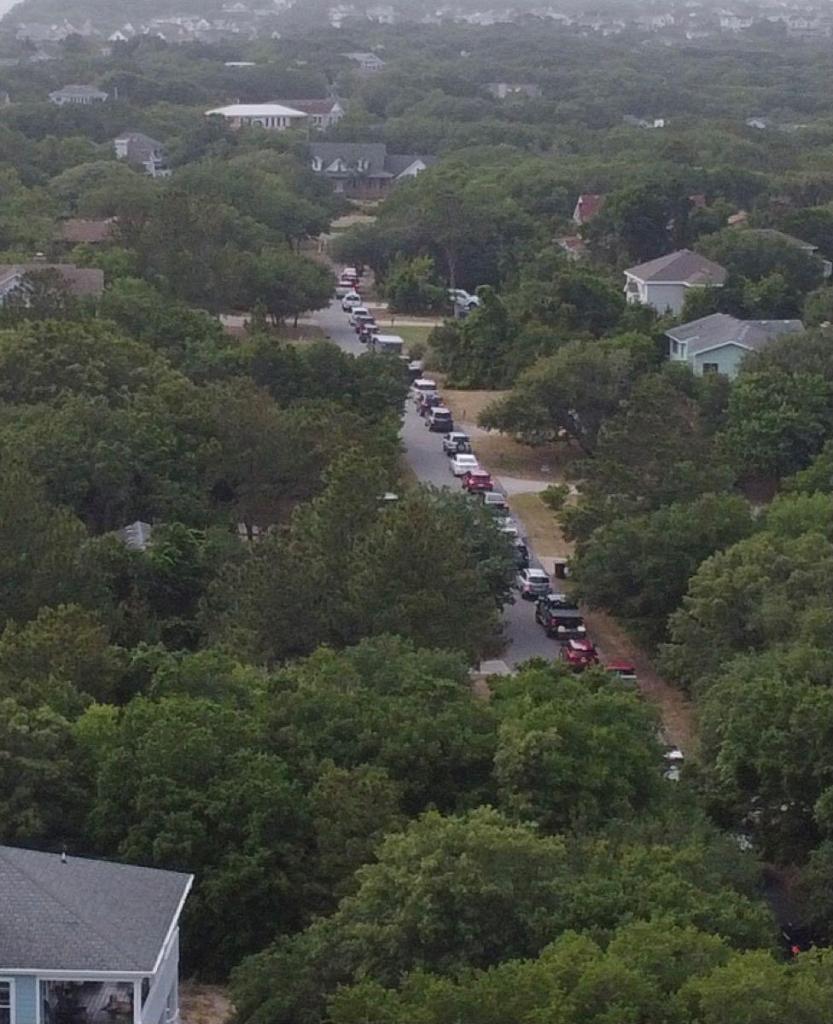
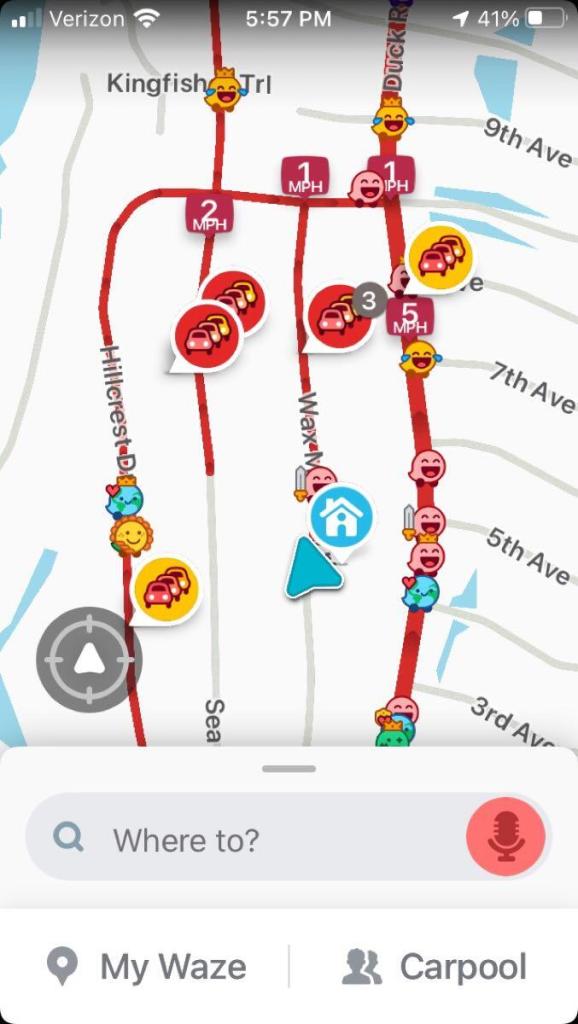
Susan Ferretti of 296 Wax Myrtle Trail posted on Next Door today: 1) the top photograph of traffic on Wax Myrtle heading north to Hillcrest Drive; and 2) the cell-phone depiction of traffic jam-ups in Southern Shores, courtesy of the navigator app, WAZE.
Please see The Beacon’s previous posting today for an accompanying article.
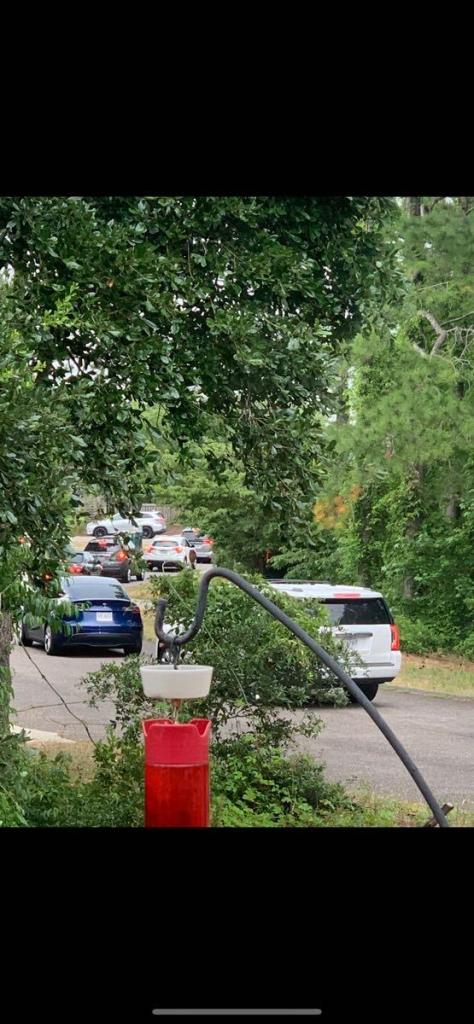
Bumper-to-bumper traffic heads north this afternoon on Hillcrest Drive near the SSCA tennis courts.
I see some of you are posting today on Next Door about the oppressive cut-thru vacationer traffic that started flowing steadily this morning and grew into the usual summertime backup in the Southern Shores dunes this afternoon.
According to Dan and Pat Hardy of 172 South Dogwood Trail: “The traffic is worse than ever.” They also complain about someone in a “jacked-up truck” with Virginia plates “trying to run us over” yesterday.
Writes Vicky Green, of 317 Hillcrest Drive, who formerly served on the citizens’ committee to explore cut-through traffic: “Here we go!!! ALL THE WAY DOWN HILLCREST!” Ms. Green submitted the photograph above.
(You cannot count on the citizens’ committee any more. As far as the Town Council is concerned, it has completed its work and no longer has a purpose.)
One person on Next Door asks about prohibiting the left turn onto South Dogwood Trail from U.S. Hwy. 158 in order to deter the cut-thru traffic.
It is a lack of understanding by residents about when that deterrence technique will be employed this summer that compels me to interrupt my hiatus.
Despite all of the efforts made during the past year to study the obvious and already thoroughly studied cut-thru traffic problem and to receive and consider solutions to prevent it, neither the Town Council nor the Town Manager has openly and honestly informed the public about what will be done this summer about it.
You will recall that the Town Council allocated spending $7500—funding for two no-left-turn weekends—on a professional traffic study. Its five members timely received that report from their expert consultants in February, and never even discussed the report’s recommendations in a public meeting.
Oh, but they did agree to buy more roadside traffic counters to analyze the problem some more.
FACT: There will be no-left-turn weekends this summer, starting June 26-27, but no details about the hours that the turn prohibition will be in effect and whether or not police enforcement will occur have been announced by the Town.
Apparently the Town has not heard that the single-most important issue to residents in Southern Shores is traffic. It is not beach nourishment.
And I say that as someone who co-owns oceanfront property, solely owns property in the MSD-2 district, and solely owns property in a part of town outside of the municipal service districts and will be fleeced by Town taxation to fund beach nourishment I do not support for at least the next five years, if not much longer.
If only the Town Council cared as much about the quality of life, the health, and the safety of people who live in Southern Shores NOW as it does about what the beach may look like in 30 years.
All that has been released by the Town to the public is the fact that the fiscal year 2021-22 Southern Shores budget contains a line item of $30,400 budgeted for “seasonal cut-thru traffic.”
And you only know about this item if you read the Town Manager’s message that accompanies the recommended budget, which was first proposed May 4.
The $30,400 expense represents .0034 of the overall FY 2021-22 budget of $8,867,588—the largest budget in Southern Shores history. Only one-third of 1 percent of the revenue supporting this engorged budget is being spent on cut-thru traffic control. It’s jaw-droppingly inadequate.
Nearly half of the revenue for next year’s budget—$4,332,526—comes from our property and vehicle taxes, including increased ad valorem taxes to pay the Town’s debt on the beach nourishment project. And what do we get for our tax investment during the summertime weekends that we, too, would like to enjoy?
If you look in the budget itself, you will find a line item of $30,400 in the Public Works Dept. budgetary expenses, labeled “Contracted Service.” Presumably, this is the cost for setting up and taking down the barriers used to block the left-turn lane on U.S. Hwy. 158.
In the Town Council’s consent agenda for its meeting next Tuesday, at 5:30 p.m. in the Pitts Center, is a budget amendment for the current fiscal year that appropriates $3800 from the Town’s occupancy tax reserve to pay for “Seasonal Cut-Thru Traffic Measures (No Left Turn Weekend, June 26 & 27).”
The actual expenditure, according to Budget Amendment No. 28, is for “PW Contracted Services.”
This is how I know that the first no-left-turn weekend will occur at the end of June, after a month of resident aggravation and safety threats by out-of-towners who abuse residential streets for their own convenient thoroughfare to the northern beaches.
There is still time to urge the Town Council to appropriate monies for no-left-turn weekends on June 5-6, June 12-13, and June 19-20. The amount needed is apparently a measly $11,400, or one-tenth of 1 percent of next year’s budget.
Last summer hordes of COVID-19 refugees, eager to find sanctuary in the Outer Banks, arrived here well before the end of June, swarming Southern Shores’ residential roads and causing backups to the Wright Memorial Bridge. The gridlock was unprecedented in Southern Shores, as desperate vacationers even circled around Circle Drive trying to find a shortcut to Corolla.
The Town Council took emergency—albeit late—action then to protect residents from this vehicular scourge by implementing some unplanned no-left turn weekends. This summer the Town Council should know the hordes are coming again—everyone else does—this weekend and continuing next week and the week after and the week after that.
I encourage you to go to the Town Council meeting on Tuesday and demand action. You can speak during an early three-minute public comment period and/or you can speak during the public hearing on the FY 2021-22 budget.
There is no place in Southern Shores for the kind of “let them eat cake” attitude that our Town officials have evinced by their inadequate response–after a YEAR of planning time–to the cut-thru traffic “problem.”
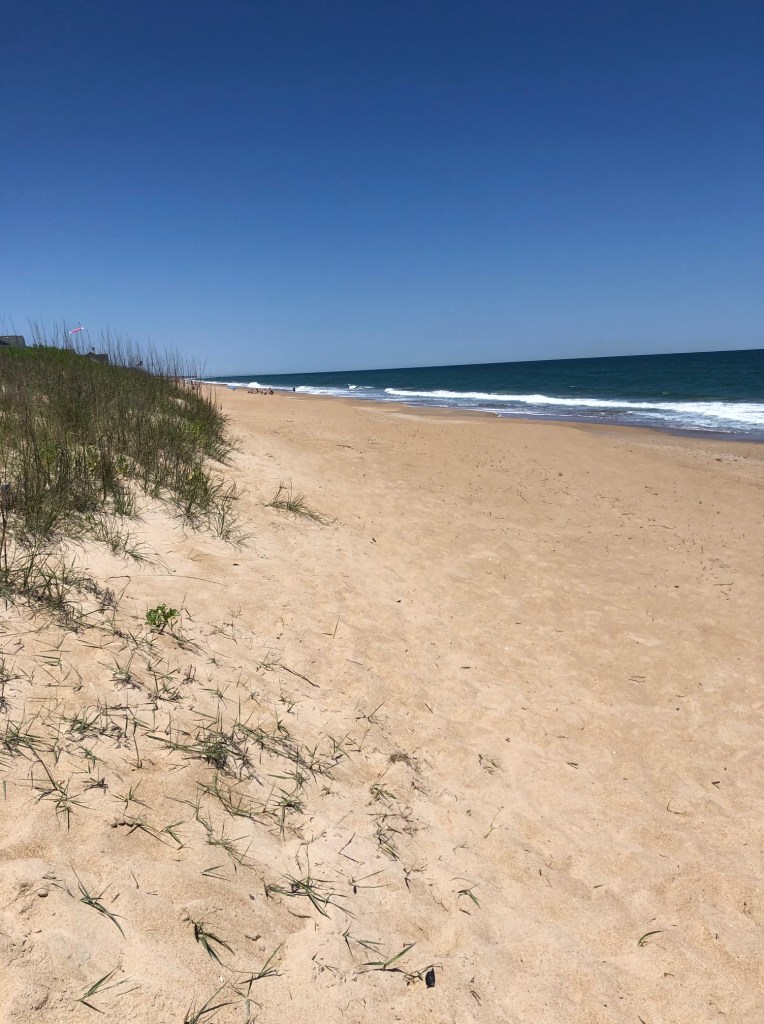
The Southern Shores beach as it appeared yesterday at 1 p.m., looking north from the SSCA access next to 230 Ocean Blvd.
Councilman Matt Neal’s assertion at the May 4 Town Council meeting that beach nourishment is “a public infrastructure investment on private property,” as well as an “improvement” to private property, drew an outcry of dissent from oceanfront property owners assembled to oppose the two municipal service districts (MSDs) proposed by the Town for use in funding its 2022 nourishment project.
The two MSDs, whose boundaries were established solely by proximity to the oceanfront, were approved unanimously by the Town Council in two mandatory votes, the second of which took place on May 4.
Mr. Neal, who has taken an active role since January 2020 in defining the boundaries for the Town’s MSDs and in advocating for their establishment, said he did not think that paying for the 2022 beach nourishment project by levying an “equal, across-the-board tax” on all Southern Shores property owners would be fair.
Some property owners in the two MSDs, as well as landowners outside of the districts, have suggested that all Southern Shores property owners should pay equally for the beach project, just as they did for the multi-million-dollar canal-dredging project. The beach, after all, benefits all property owners, they say, regardless of where they live, because it is the backbone of the town’s economy. Most people also use and enjoy it.
He may be “tarred and feathered” for his views, the Councilman said, but “I can’t get past the improvement that’s occurring on private property.”
When oceanfront property owners called out that they do not exclusively own the dry-sand area of the beach east of the vegetation line—which may or not be built up by the 2022 dredging project—Mr. Neal suggested that they read their deeds.
We can assure Mr. Neal that reading deeds will not help resolve the legal murkiness of who owns the dry-sand beaches in Southern Shores or anywhere else along the North Carolina coast—especially after beach nourishment is done.
We also question Mr. Neal’s assertion that the beach nourishment project is going forward because “a majority of oceanfront owners are asking us for” it.
The truth is the Town did not directly solicit opinions from property owners until its public hearing in June 2020—inconveniently scheduled in the middle of the pandemic—which was held after the Town Council had already identified tentative MSDs and had proposed tax-rate increases per MSD.
The 2022 beach nourishment project is NOT being done because oceanfront property owners requested it. It is being done because Mayor Tom Bennett was determined to make it happen, despite the Town’s coastal engineering consultant advising him that the Southern Shores dunes are stable, and there is “no rush” to replenish them.
PUBLIC ACCESS AND USE RIGHTS
Under the confusing N.C. common-law doctrine of public trust, the public has a legal right to use the dry-sand beaches of North Carolina for recreational purposes, even though they are “owned” by private landowners.
Oceanfront property owners hold legal title to the beach up to the mean high-water mark, but they do not have the right, as the N.C. Court of Appeals has repeatedly confirmed, to exclude the public from this area.
(The State of North Carolina owns the “wet-sand beaches,” from the mean high-water mark eastward.)
If a stranger can use private oceanfront property without the consent of the landowner and without being liable for trespass, then that property ownership is qualified, regardless of who holds the legal title.
Hence, the outcry from the Town Council’s audience.
More problematic for us, but never addressed by the Southern Shores Town Council or the Town Attorney, is a North Carolina statute that declares that “title to land in or immediately along the Atlantic Ocean raised above the mean high water mark by publicly financed [beach nourishment] projects . . . vests in the State.”
N.C. General Statute sec. 146-6(f) unequivocally states that publicly financed replenished beaches are public beaches. Any placement of sand on the Southern Shores coastline above the mean high water mark would seem to result in a re-titling of the property from private to public.
But what public ownership interests are we talking about here? Just rights of access and use and enjoyment, or is there more to the ownership than that? The statute says title to the land vests in the State of North Carolina. But is there an actual taking of property?
It also states that “all such raised lands shall remain open to the free use and enjoyment of the people of the State, consistent with the public trust rights in ocean beaches . . . .”
The Town of Southern Shores should clarify for oceanfront property owners—many of whom feel blindsided by the decision to use MSDs—what their ownership status will be after any deposition of sand on the dry-sand beach. It also should explain what the project construction involves.
Mr. Ogburn’s report says that 591,000 cubic yards of sand will be “used to construct a variable width berm at +6.0 ft. NAVD88, [and an] additional 286,000 cy is proposed to account for diffusion losses and advanced fill.”
We understand that imported sand will be deposited in the wet-sand area of the beach, which the State owns, in order to block the waves so that they break much farther out, and the beach is, thus, “widened.” But what does the construction of a “variable width berm” do for the dry-sand area that makes it an improvement for oceanfront property owners?
A berm is not a dune. So what can oceanfront property owners expect for their increased tax dollars?
It is more accurate to say that the change made by beach nourishment to the “public infrastructure” will be enjoyed, or not, by anyone who uses the beach, regardless of their property ownership.
Speaking as an oceanfront property owner who has a 50-year perspective of the Southern Shores beaches, I see the 2022 project as both unnecessary (in most areas of the coastline) and destructive.
Mr. Neal said he wanted to hear first from oceanfront property owners regarding: “Should we do the project?” My answer is emphatically no.
We have a beautiful natural beach at the oceanfront properties that my family and I co-own (see above photo) that will be transformed into an unnatural beach created by sand that does not belong in Southern Shores and will have to be replenished periodically—at exorbitant expense, and from our pockets—in order to maintain the unnatural width.
Bonnie Anderson of Yellow Fin Lane, told the Town Council that her family cannot afford to pay the tax increase that is projected for MSD-1 property owners, and asked its five members—none of whom owns property in the MSDs—to think about “the little folk.” We also are not high rollers.
Further, the last time we saw the text of the easement that the Town is asking oceanfront property owners to grant voluntarily, it was written unnecessarily to last into perpetuity, and was so vague as to be legally void.
I consider this project to be the destruction of, or at least an interference with, the natural coastal environment. If ocean waves were lapping up at property owners’ back doors, as they are in Avon, that would be a different proposition. But they are not.
Over the past 50 years, Southern Shores’ natural coastal shoreline has held up well, eroding maybe six inches in a given year at certain locations, but also accreting six inches or so in a given year at certain locations. No question, some of the shoreline has been lost. But there are no erosion hot spots; and no buildings are imminently threatened.
I may sound like a broken record, but when a Council member whose reasoning and judgment I respect, tells me that I’m getting a compulsory “improvement” in my property even though my property does not need improvement and I did not request it, and I must pay a premium for that unwanted “improvement,” I am a broken record.
DISCRETIONARY DECISION-MAKING, AMPLE CHOICE
A majority of the Town Council who approved the two MSDs on May 4 said they had no choice.
“The only way to do [beach nourishment] that’s practical,” said Mayor Pro Tem Elizabeth Morey, “is [with] the special obligation bond.” And that meant approving the MSDs. What else could she do?
The Town Councils of the past three years have had ample choice regarding the need for beach nourishment, and the financing, scope, and timing of a project: They did not explore these choices because Mayor Bennett, and his majority, had no interest in exploring them.
Every step the Town Council has taken has been one of discretion. Project manager Ken Willson of APTIM/Coastal Protection Engineering of North Carolina (CPE-NC) made a point in public meetings of telling the Council that he was not recommending beach nourishment; he was just giving the Council “options” to consider.
Town Manager Cliff Ogburn is wrong when he describes the 2022 beach-fill project in his project report as having been “recommended” by CPE-NC. Mr. Willson was very careful in his meetings with the Town to characterize the Council’s decision-making as both discretionary and subjective.
He never recommended a project; he simply offered options. The options he offered were based on computer calculations of theoretical storm damage that would occur after a theoretical hurricane the likes of which Southern Shores has not experienced since the 1940s. Isabel, a 2003 hurricane, had fizzled out by the time it reached the Southern Shores shoreline.
Except for maintenance in the southern section of Southern Shores, the 2022 project is strictly proactive, not rehabilitative.
When it finally decided in June 2020 to do a 2022 project, the Council only voted to “pursue” beach nourishment. It never singled out a specific option offered by Mr. Willson’s firm. It never defined the project for the public.
From February 2019 forward, the Council focused exclusively on special-obligation bond/MSD funding, and it hired DEC Associates to provide tax-rate numbers according to potential MSDs before it even voted to approve beach nourishment!
We repeatedly wrote that the financing cart improperly preceded the horse of public and Council endorsement of a beach nourishment project.
As recently as its May 4 meeting, the Town Council could have changed the boundaries of the MSDs so that properties in the Chicahauk and Southern Shores dunes, where many vacationers rent, and commercial properties, which have contributed much of the beach-nourishment tax revenue in other Dare County beach towns, would be included in an MSD.
There was still time to start over with giving the requisite notice to property owners in the newly revised MSDs, with holding the required public hearing, and with taking two votes to approve an ordinance establishing the MSDs. Special Council meetings could have been scheduled.
The decision not to include any of them—and to use Duck Road as an arbitrary dividing line—was a choice. A discriminatory one, but a choice, nonetheless.
The Town Council insisted on an arbitrarily small inclusion of properties in the MSDs, based solely on number-crunching. Members did this even though they knew how harsh the burden would be on oceanfront property owners.
So, please. Do not tell us that you did not have a choice. You made your choices, whether you recognized them as choices or not.
SALES TAX INCREASE TO PAY FOR BEACH NOURISHMENT
Before I sail off into the sunset for a while, I would like to say a word about the 2005 “sand tax,” which, if it had not been repealed by Dare County voters in 2006, would have paid for all of the beach nourishment projects undertaken in its eight-year cycle and created a surplus of funds.
In 2005, after receiving approval from the N.C. General Assembly, the Dare County Board of Commissioners imposed a 1 percent increase in the general sales tax to boost the balance in the County’s beach nourishment fund, which was known then as the Shoreline Management Fund.
At the time, the occupancy tax was 5 percent, not 6 percent, and 20 percent of that tax also went into the shoreline fund.
Fifteen years ago, only Nags Head was contemplating beach nourishment, and Dare County locals who lived elsewhere were resentful that they were paying a sales-tax booster to fund Nags Head’s costly first project and deriving no benefit. A local group known as the Beach Huggers secured enough signatures on petitions to force a referendum in 2006 to repeal the so-called sand tax.
In February 2006, voters defeated the tax by an overwhelming margin.
This was an extremely short-sighted measure taken by people who could not foresee the future. I include myself among them. In 2022 nearly $100 million will be spent on beach nourishment in Dare County.
According to a 2014 analysis done by The Outer Banks Voice with Dare County Finance Director David Clawson’s input, if the 1 percent sales tax increase had remained in effect for its full eight-year cycle, it would have generated $95.05 million, and the Shoreline Management Fund would have had a surplus of $47.6 million after paying cash for Nags Head’s $36 million project and all other proposed projects, including those on Hatteras Island.
The sand tax, which could have been renewed after its initial eight-year cycle, could have paid for all of Dare County’s subsequent beach nourishment projects. It is worth reconsidering.
We recently asked Dare County Manager Bobby Outten about requesting another sales-tax increase, and he discouraged the idea, saying he thought Dare County voters would simply defeat it in a referendum again. We would like to have the opportunity to try.
In arguing at the Council meeting last week for a flat town-wide tax rate to pay for the 2022 beach nourishment project, many oceanfront property owners analogized its funding to that of the star-crossed canal dredging project, which went way over-budget and involved litigation. Town taxpayers not only had to pay much more for the dredging than anticipated–regardless of whether they had canal-front property–they also paid for legal fees and a settlement in a breach-of-contract lawsuit.
Dear Readers:
We will be suspending publication of The Beacon for an indefinite time, starting this weekend. We will not be covering the Town Council’s 9 a.m. workshop next Tuesday or its June 1 regular meeting, during which the public hearing on the fiscal year 2021-22 budget will be held. We will resume publication when we are able to do so.
We encourage you to check the Town of Southern Shores website for announcements and agendas of upcoming meetings, which, in the next week include:
Tomorrow, May 14: The Exploratory Committee for a Potential Branch Library meets at 12:30 p.m. in the Pitts Center to continue its pandemic-delayed efforts to establish a library in Southern Shores on Juniper Trail.
Monday, May 17: The Planning Board meets at 5:30 p.m. in the Pitts Center. The Board will be considering an application from the property owners at 279 Hillcrest Drive to subdivide their lot into two lots.
Tuesday, May 18: The Town Council will meet at 9 a.m. for a workshop session with a wide-ranging agenda that includes an update from project manager Ken Willson about the design of the 2022 beach nourishment project and a discussion of items on the Town Manager’s recommended General Fund FY 2021-22 budget, which totals $7,850,910.
In order to balance the FY 2021-22 budget without raising the general town-wide tax rate, Town Manager Cliff Ogburn is recommending that $453,392 be appropriated from the Unassigned Fund Balance to cover a revenue gap. If the Town Council accepts Mr. Ogburn’s recommendation, the general tax rate will remain in the next fiscal year at 19.58 cents per $100/property value.
As The Beacon reported last week, Mr. Ogburn has recommended the following tax rates to cover the Town’s beach nourishment debt in FY 2020-21:
Properties in MSD-1: 18.42 cents (for a total tax rate of 38 cents)
Properties in MSD-2: 6.42 cents (for a total of 26 cents)
All other town properties: 3.42 cents (for a total of 23 cents)
(See The Beacon, 5/5/21.)
According to Mr. Ogburn, he will likely recommend an increase in the general tax rate in FY 2022-23.
We encourage you to review it—or at least to read the Town Manager’s message that precedes it—and to participate in the June 1 public hearing.
CUT-THRU TRAFFIC MITIGATION COSTS
As The Beacon reported last week, Mr. Ogburn has budgeted only $30,400 for cut-thru traffic mitigation.
Despite the knowledge that cut-thru traffic is a hot-button concern for hundreds of people in town—and despite a commissioned traffic study from professional engineers and a thoughtful report by a long-term citizens’ committee that studied the problems—the Town Manager does not explain in his budget message what this paltry amount will buy.
The $30,400 expense appears as “contracted service” in the Public Works Dept. budget.
The budget figure mentioned for traffic mitigation at the Council’s March 16 budget workshop (by Councilman Matt Neal) was $50,000. Clearly, the Town Council has directed Mr. Ogburn—without informing a very interested public at an official meeting—to scale back on the deterrents employed this summer.
We hope an explanation will emerge from the Town Council next Tuesday.
Mr. Ogburn said at the March budget workshop that the per-weekend cost for implementing an unstaffed left-turn prohibition—meaning no police on site—at the U.S. Hwy 158-South Dogwood Trail intersection would be $3700. The $30,400 budget expense, therefore, would cover about eight weekends.
We also would like to point out that the traffic study report submitted in February by J.M. Teague Engineering and Planning, whom the Town hired for $7,500, has never been discussed by the Town Council as an agenda item in a public meeting.
We do not know what individual Town Council members think about the solutions offered by J.M. Teague.
FOLLOW-UP TO MAY 4 MEETING ON MSDs
Last week, we wrote that we would be exposing this week some misinformation and ignorance expressed by Town Council members during the discussion that led to their unanimous vote approving the done deal on municipal service districts (MSDs).
There is so much to criticize about that discussion that we have been unable to find the time to follow through on our pledge. We aspire to do so in full by this weekend and will just make a start now.
We simply cannot let stand Mayor Tom Bennett’s falsehood about Dare County’s funds for beach nourishment “drying up” so that Southern Shores may not get another opportunity to do a project with County monies after 2022.
Balderdash.
The County’s beach nourishment fund is contingent on the collection of county occupancy taxes (not sales taxes, too, as Mayor Pro Tem Elizabeth Morey said): It is made up of one-third of the occupancy taxes collected.
As long as Dare County has tourists occupying its many rental lodgings, the fund will be flush. The occupancy rate also can be increased.
The problem is not that the beach nourishment fund is “drying up.” The problem is that there is great demand for the monies in the fund, and the County has pledged to assist towns that have undertaken beach nourishment with their project maintenance.
The County would never deny funding to Southern Shores after providing it to Duck, Kitty Hawk, Kill Devil Hills, Nags Head, Buxton, and now Avon for their first-time beach nourishment projects, as well as other projects thereafter. (Did we miss a jurisdiction?)
The fund does take a hit, however, when towns like Southern Shores engage in proactive nourishment, rather than repair-nourishment of a beach that has eroded.
Towns in dire need of beach nourishment should work together to identify a recurring funding source at the State level. An increase of the Dare County sales tax rate is also a viable option. We doubt that the 2005-06 experience of the 1-percent “sand tax,” which voters repealed by referendum, would be repeated in 2021-22.
Fifteen years ago, Nags Head was the only town talking about beach nourishment. Now they all are. (More about the sand tax later. Any Town Council member who is unaware of this history is uninformed.)
We have long been on record as opposing the beach nourishment project in Southern Shores as unnecessary to do now, except for the southern section where maintenance of the 2017 sand fill is needed. We also have been on record for opposing the unorthodox process that the Town used to define and establish the MSDs.
Last week Mayor Bennett played Chicken Little, as did Councilman Leo Holland, in suggesting that the Southern Shores beaches, which have an 80-year history of stability, might not “hold up” as long as “five or six or seven years down the road.”
“They may well” hold up,” the Mayor said, “but we don’t know that.”
More balderdash. Of course, we know that. Some of us actually do our homework and know the historical trends and the features of the coastline that protect Southern Shores.
Southern Shores has not experienced a severe storm since the Ash Wednesday nor’easter of 1962. This is not just dumb luck or chance. Hurricanes, such as Isabel in 2003, scatter by the time they reach Southern Shores, according to two eminent N.C. coastal geologists whom we consulted in January 2020.
Laypeople may fear sea-level rise and speculate about future storm damage—which is what the Town’s coastal engineer did—but the Town Council must hang its hat on historical data, not on prejudicial conjecture.
There is no reason to believe that Southern Shores, which has a much lower long-term average erosion rate than our neighbors to the south, is suddenly going to be “compromised,” as Mr. Holland said.
Indeed, we challenge him to provide evidence that it will be.
Comparisons in shoreline change rates in Southern Shores that the N.C. Division of Coastal Management compiled in 1998, 2009, and 2016 clearly show its stability. In fact, the shoreline gained width (it accreted) and never lost more than about 0.7 foot in those years, depending on the location of the beachfront.
This stability contrasts sharply with the DCM’s shoreline change rate comparison in Kitty Hawk over the same time period. Sections of the Kitty Hawk oceanfront lost more than 3 feet in 2016 and more than 4 feet in 1998.
Mr. Holland admitted last week that he does not go to the Southern Shores beach and has no firsthand knowledge of its condition. We suggest that he do more scientific research and consult more with coastal environmental experts, rather than waste time talking with uninformed town property owners about their views on beach nourishment and MSDs.
Town Council members who approve a $14.5 million beach nourishment project and then unequally tax property owners to pay it off should know the unique features and history of the Southern Shores coastline. Erosion, or severe damage, of the Southern Shores coastline should not be not a matter for wild speculation by elected officials.
Mr. Ogburn displayed slides last week from a Power-Point presentation given by financial consultant DEC Associates that showed financing options available to the Town to pay for its beach nourishment project.
Although Mr. Ogburn said this information dated to a January 2020 presentation by DEC Associates, the consultant actually first provided it to the Town Council at a February 2019 meeting—in plenty of time for the Council to consider funding the 2022 project in a different manner, including with general obligation bonds, which would have to be approved by a voter referendum.
Mr. Ogburn falsely characterized the question a 2020 referendum would have posed to Southern Shores voters as “whether they would be willing to raise the taxes on themselves” to pay for beach nourishment. In fact, Southern Shores voters would have been voting on whether or not to do beach nourishment at all.
A referendum would have taken this huge undertaking out of the hands of five people with no particular acumen for making this decision. It might even have forced the Town Council to bring in oceanographers and other coastal environmental experts to answer the public’s questions.
Neither the 2019 Southern Shores Town Council nor the 2020 Town Council ever investigated any other financing method except special obligation bonds and MSDs because that is what DEC Associates was peddling.
We attended all of the Town’s meetings with Andrew and Doug Carter, the folksy father-son team of DEC Associates. They breezily dismissed the general obligation bond option because it requires a referendum, which they viewed as unnecessarily time-consuming.
Last week, Councilman Holland suggested that DEC Associates’ financial information be put on the Town website, where it has been displayed for more than two years.
Ms. Morey thanked Mr. Ogburn for the financial refresher, saying: “I know we saw this before, [but] maybe just the repetition . . . I get it now.”
I get it NOW? This is unacceptable.
Mayor Bennett and Councilman Conners were on the Council in 2019. They both opted for the Carter team’s cookie-cutter approach, without question. The terms of both expire this year.
We will continue our critique as soon as we can and then retreat for a while. We definitely will return in time for Town Council candidate filings in July.