Yesterday, in discussing ZTA 18-09PB01, the latest proposed amendment to the nonconforming lots ordinance enacted by the Town Council last September, The Beacon wrote the following:
“If the Planning Board recommends allowing three sisters to divide a 150-foot-wide oceanfront parcel owned by their father, a multimillionaire real estate investor and developer who died without a will, The Beacon believes it would be contravening both the letter and intent of the Town Code sec. 36-132 that was in effect when the patriarch owned all three. Owning nearly $13 million in real estate, and much more in stocks and other assets, according to the estate inventory, the deceased father-property owner would have been well-advised to plan his estate and write a will.”
Upon further research, The Beacon has learned that the deceased father owned only two of the three 50-foot-wide lots at 76 Ocean Blvd., and his widow owned the third. He owned the northernmost and southernmost lots, and she owned the lot in the middle, such that the decedent’s two lots were not adjacent.
The Beacon regrets this error. Mea culpa for writing under time pressure on a Sunday afternoon.
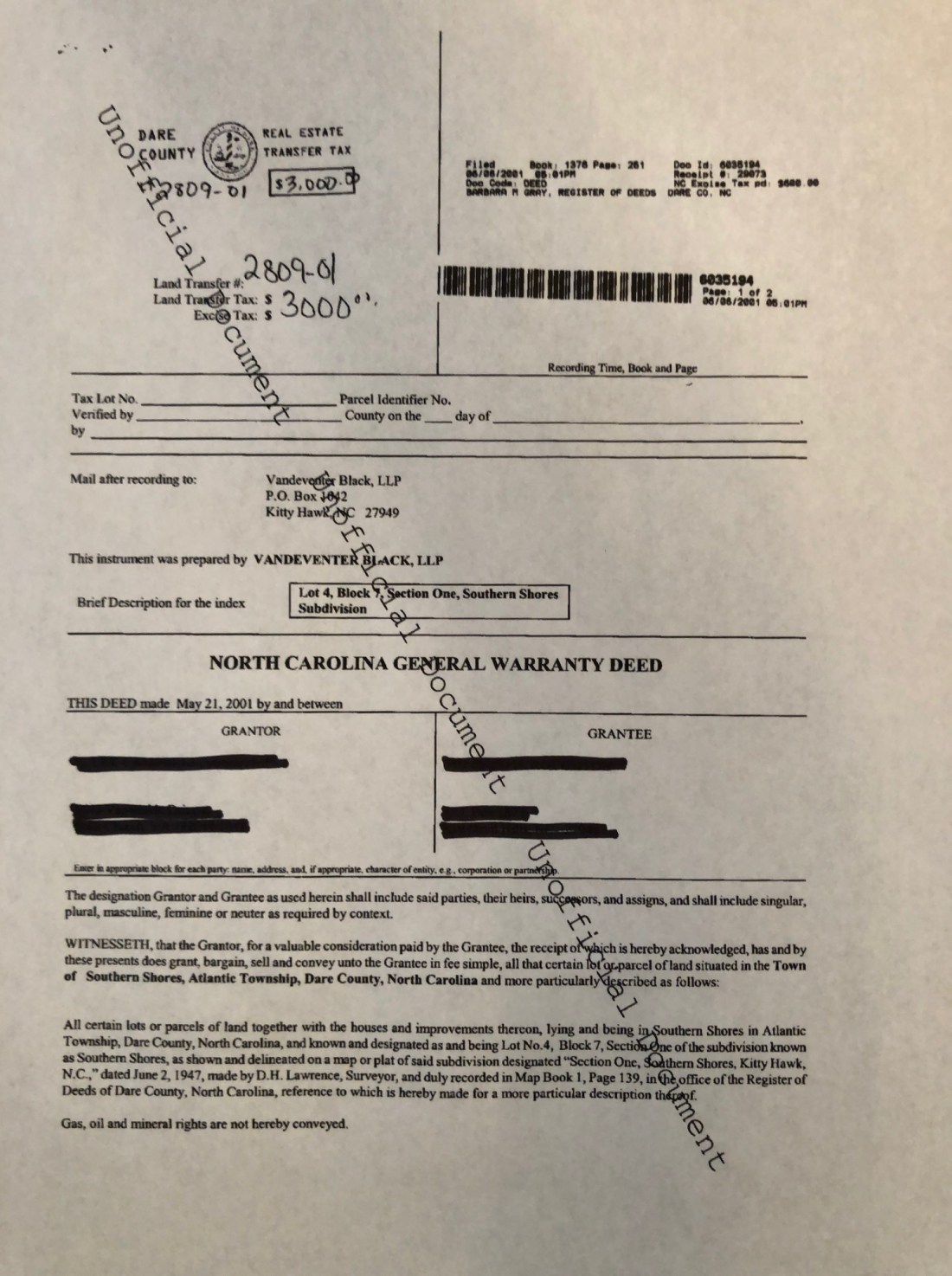
The Dare County Register of Deeds records show that the three 50-foot-wide lots were acquired by husband and wife on June 6, 2001 from three different individuals, who, until they altered ownership two weeks before the sale, had owned them together.
According to the subject deeds, each of these lots was owned jointly by three unmarried persons who did not share a common surname, but shared a home address. They may have been siblings. One of their signatures on the deeds shows signs of age, so they may have been a mother and her two children.
(The Beacon does not have the time to go to the Register of Deeds Office in Manteo to research old deeds that are not online in an effort to try to establish their likely familial relationships. Online deeds only date to 1999.)
On May 21, 2001, the three jointly transferred ownership to the three 50-foot-wide lots so that each ended up owning only one. Each then sold his or her lot to either the decedent or his wife. The law firm of Vandeventer Black made all of this happen for the parties involved. The same firm assisted the decedent’s widow with administering his large estate.
The decedent was a longtime real estate investor and developer. He was a player on the Outer Banks.
Although the decedent and his wife apparently did not violate the letter of Town Code sec. 36-132, The Beacon still believes they contravened the spirit and intent of the law, as did their predecessors in ownership. If their three daughters, who each now own one of the 50-foot-wide lots, are given an exception to the new sec. 36-132, this contravention will continue.
If the sisters are allowed to sell their lots, individually, and their buyers develop them, or they develop them themselves, there will not be low-density development along this 150-foot-wide section of the oceanfront, and both the intent of the law and the vision of Southern Shores will be thwarted. This should not happen.
It is fair to say that “shenanigans” accompanied more than a few of the real estate transactions in Southern Shores. Deals were made informally, and lawyers have always known how to skirt the law, especially when it’s not tightly written.
The Beacon asks the Town Planning Board to delve into the facts behind those transactions that it would give an exemption to Town Code regulation and ensure that it is perpetuating fairness, not just enabling shenanigans that benefit the few and harm the many. The Board should protect the town, especially the oceanfront, and its land-use plan from further degradation.
The nameplate, G.W. Mackey, has long been a fixture in the neighborhood around the Mackey Cottage at 218 Ocean Blvd. A public hearing on the flat-top cottage’s historic landmark designation will be held June 25.
The Town Planning Board will take another crack at proposed legislation designed to except certain property owners from the reach of the nonconforming lots ordinance passed by the Town Council last September when it meets tomorrow, at 5:30 p.m., in the Pitts Center, behind Town Hall.
The Board also will take up a special events ordinance that the Town Council considered and rejected in 2015-16. The ordinance proposes establishing a permitting system for events held in residences at which homeowners anticipate more than 25 attendees. Please see The Beacon, 6/9/19 for background.
In each case the Planning Board will give the Town Council its recommendation regarding the proposed ordinance, and the Council will make the final decision. The Board is not required by the Town Code to evaluate the special events ordinance, however. It is doing so at the request of the Town Council, which so voted on June 4.
The nonconforming lots ordinance is a zoning text amendment (ZTA), whereas the special events ordinance is a Town Code Amendment (TCA) that does not pertain to zoning. The Planning Board only has delegated authority over zoning matters.
You may access the latest proposed nonconforming lots ordinance, styled as ZTA 18-09PB01, here:
NONCONFORMING LOTS: A LONG HISTORY OF LOW-DENSITY DEVELOPMENT
The Planning Board has been dealing with the regulation of nonconforming lots for more than a year, during which time The Beacon has written numerous reports and editorials about such lots and the legal language used in the Town Code to limit them and their sale, transfer, and/or (re)development.
The Town Code section that addresses nonconforming lots is sec. 36-132. A version of this section has been in effect since the first Town Code was enacted after the town’s incorporation in 1979.
Nonconforming lots are tracts of land that do not meet the Town’s legally mandated dimensional requirements, such as the minimum lot width of 100 feet and the minimum lot size of 20,000 square feet.
Proposed ZTA 18-09PB01 seeks to exempt certain identifiable property owners from the current nonconforming lots ordinance because of what the Planning Board perceives as an undue hardship to them. But there is a danger that, in going to extremes to protect known individuals, the Board may harm the community and the rule of law.
The Town Council may or may not agree with the Board’s judgment. The Beacon certainly does not agree with at least two of the exceptions that ZTA 18-09PB01, which was drafted by Town Attorney Ben Gallop, at the Board’s direction, carves out.
One of them speaks to exempting a nonconforming lot that is “one of three or less [sic] adjacent nonconforming lots under the ownership of related siblings on September 5, 2018.”
The other exempts a nonconforming lot that is adjacent to land that is made up of “a single conforming lot not adjacent to any other land under the same ownership that was created after January 1, 2015 due a recombination of two (2) previously nonconforming lots.” (If you are scratching your head, you have just cause.)
The Beacon believes strongly that personal bias and favoritism should not influence members of the Planning Board. They should seek to enforce the law as they find it—sec. 36-132 has been on the books for decades—in an even-handed fashion, without regard to whom it may adversely affect, provided it serves the greater good. Legislating on behalf of friends and cronies—what you might call “good-ole-boy” legislating—should be an unpleasant fact relegated to the past.
If the Planning Board recommends allowing three sisters to divide a 150-foot-wide oceanfront parcel owned by their father, a multimillionaire real estate investor and developer who died without a will, The Beacon believes it would be contravening both the letter and intent of the Town Code sec. 36-132 that was in effect when the patriarch owned all three. Owning nearly $13 million in real estate, and much more in stocks and other assets, according to the estate inventory, the deceased father-property owner would have been well-advised to plan his estate and write a will.
Current sec. 36-132 clearly prohibits the three sisters, who did a post-mortem division with their mother of all of their father’s real estate holdings, from selling or developing their 50-foot-wide lots, and for good reason. Such a division is destructive of the vision and character of Southern Shores. If the Planning Board permits this, it would betray the larger community, which depends upon government appointees and elected officials to protect the town.
It also would send the message to homeowners in the immediate vicinity of the subject properties, 76A, 76B, and 76C Ocean Blvd., who might have to contend with three developments, instead of one, that their rights and interests are secondary to those of a crony of the Planning Board who should have split his properties legally among his daughters before he died.
Theirs is not a hard-luck case.
In previous articles, The Beacon has argued that the owners of a vacant 50-foot-wide lot at 64 Ocean Blvd. should be prevented from developing it because they, too, ran afoul of sec. 36-132. Mr. Gallop says my interpretation of the former sec. 36-132 is “wrong.” I say Mr. Gallop knows that no attorney’s interpretation of an ordinance is “right.” Judges decide how to interpret ordinances and other regulations correctly, and Mr. Gallop is not a judge. (This is one potential zoning challenge by an affected neighboring owner that the Town Board of Adjustment would not be able to preside over impartially.)
The Beacon wonders if the five members of the Planning Board have read and interpreted for themselves the version of sec. 36-132 that was in effect before Sept. 5, 2018. If not, then they have not done their independent duty.
The owners of 64 Ocean Blvd., who own the developed lot at 62 Ocean Blvd., get a pass under proposed ZTA 18-09PB01, even though the Town Council stalemated 2-2 on the exact same Code language when that body voted on it March 5, 2019. Councilman Christopher Nason was recused from voting because he has both a personal and a professional relationship with the property owners.
***
Seventy years ago, the founder of Southern Shores envisioned a community of low-density housing with a lot of open space. Frank Stick (1884-1966), a New Jersey native, wanted people of more modest means to enjoy the luxurious privacy that ultra-rich oceanfront property owners in the Northeast enjoyed.
The Town perpetuates his vision in its land-use plan, which states that the “quiet seaside residential community” of Southern Shores is “comprised primarily of low density neighborhoods consisting of single family homes primarily on large lots (i.e., at least 20,000 sq. ft.).”
The developers of Southern Shores sought to ensure low-density development and open space in town by requiring that homes be built on large lots. It was standard for them to plat and record a 100-foot-wide tract of land as two separate 50-foot-wide lots, even though a property owner could not build on just one lot. This was especially true of oceanfront property.
After the town was incorporated in 1979, the initial Town Council enacted the first Town Code. These officials addressed nonconforming lots in sec. 36-132, which specified precisely when such lots, adjacent and owned by the same person or entity, should be treated as a combined single conforming lot.
So-called “single” nonconforming lots of record, which are not adjacent to other such lots that are under the same ownership, have never been an issue.
Mr. Gallop and I disagree on the meaning of the following language in the version of sec. 36-132 that was in effect until last September:
If “two or more adjacent and vacant nonconforming lots are in single ownership at any time, and such lots individually have less frontage, area or width than the minimum requirements of the district in which such lots are located, then such lots shall be considered and treated as a single lot of several lots that meet the minimum requirements of this chapter for the district in which such lots are located.”
How do you interpret this language? The words “shall be considered and treated” seem to me to have a plain meaning.
Despite the legal requirements of sec. 36-132, an unwelcome trend emerged in Southern Shores in 2016 toward redeveloping 100-foot-wide lots on or near the oceanfront as two nonconforming 50-foot-wide lots.
The Town Council sought to stop it and finally enacted ZTA 18-07, a rather confusing replacement of sec. 36-132 that supposedly made crystal-clear when the “recombination” of adjacent lots under the same ownership into a single conforming lot or multiple conforming lots is required.
You will find the text of ZTA 18-07, which is the current sec. 36-132, here:
You will find the regulation that was in effect from the town’s incorporation until Sept. 5, 2018, in the copy of the Town Code that is on the Town website. The Town Code has not been updated.
I’ll leave it at that and report later this week on the Planning Board’s action.
ALSO UPCOMING:
THURSDAY, JUNE 20: The “Exploratory Committee for Potential Branch Library” will meet Thursday at 6 p.m. in the Pitts Center.
TUESDAY, JUNE 25: The Historic Landmarks Commission will hold a public hearing at 9 a.m. in the Pitts Center on the landmark designation application submitted by Dave Mackey for the Mackey Cottage at 218 Ocean Blvd.
REMEMBER: Juniper Trail is expected to be closed to all through traffic at the 32 Juniper Trail street address, starting tomorrow. The closure for repairs is expected to last a week.
Homeowners on the cut-through route in the woods and dunes would love to see more police enforcement of traffic violations, especially speeding and stop-sign running.
On Oct. 2, 2014, an estimated crowd of 130 people filled the Kitty Hawk Elementary School gymnasium for a public forum whose purpose had been publicized as “to receive public comments, ideas, and concerns on any possible solutions to increased seasonal vehicular traffic on any public street of the Town of Southern Shores.”
I sometimes wonder if I imagined this meeting, because I seem to be the only one in Southern Shores who ever recalls it in private conversations and public comments.
Whenever I bring it up at Town Council meetings, Mayor Tom Bennett does not react, but I know he was there, as were Town Manager Peter Rascoe and all of the then-Town Council members, except Leo Holland: David Sanders, Jodi Hess, and Larry Lawhon.
So that history either will or will not repeat itself, I detail the facts of the 2014 meeting below. Please consider this an editorial.
As The Beacon reported June 5, 2019, the Town Council unanimously approved at its June 4 meeting a sanctioned seven-member citizens’ advisory committee to study ways in which the cut-through traffic can be curtailed. Homeowner Tommy Karole, who lives on East Dogwood Trail near its intersection with South-North Dogwood trails, is to chair the committee, and Councilman Fred Newberry, a North Dogwood Trail resident, will serve as an adviser. Mr. Newberry championed its formation.
The committee should know what it’s up against. As should the public, especially those who are newcomers.
Within minutes after the October 2014 special meeting opened, it became clear to audience members that the public forum on traffic would not be the welcome airing and unfiltered exchange of views that they had anticipated and hoped for. It would not be a series of public speakers, much less a free-flowing discussion.
No, it would be a carefully orchestrated “facilitation” by a paid professional from Raleigh who had been instructed by Mayor Bennett and the Town Council on how to focus and direct the meeting. I called it a dog-and-pony show then, and I repeat the description today. Frankly, I felt manipulated.
A number of homeowners walked out in disgust after Madeleine Henley of Walking Stick Associates explained the hours-long exercise that would occur that night and started writing the rules of the exercise on a board—items along the lines of be respectful and polite; listen to others, without interrupting or talking over them.
I have participated in a number of facilitated organizational meetings and have even been the mediator/facilitator, but I did not attend this public forum expecting it to be so tightly controlled and scripted. Nor did I expect it to consume the whole night. Like others, I was hugely disappointed, but I hung in.
Back then, I knew nothing about the modus operandi of Mayor Bennett’s administration.
The “forum” lasted more than three hours. Many ideas for either discouraging or restricting summertime weekend cut-through traffic in the residential areas were suggested—the overwhelming majority of which were summarily dismissed later by the Mayor and Town Council, who showed little interest in doing anything.
Before the forum, the only tactic that I can recall having been used to discourage cut-through traffic was the police checkpoint. Police officers would stop vehicles on South Dogwood Trail between the elementary school and the Duck Woods Country Club to check driver’s licenses, car registrations, and car inspections.
I do not believe “decoy” or unmanned police vehicles on the side of the road were tried until later. But we all know how effective they are once drivers figure out, and pass the word, that there’s no one in them.
Among the many ideas that were offered by forum participants were the following:
*lowering speed limits on the affected streets during the high season;
*installing speed humps (either mobile temporary ones or permanent ones) and speed cameras;
*installing more stop signs (one person suggested a temporary stop sign at every side street off of South Dogwood Trail)
*installing a traffic light at the South-North-East Dogwood trails intersection;
*changing certain streets so that they run one-way during certain hours on summertime weekends;
*making the center-turn lane on N.C. Hwy. 12 a flex through-lane on weekends, depending on the time of day;
*increasing police presence and police enforcement of speed limits and stops;
*staggering vacation rental check-ins over Friday, Saturday and Sunday;
*asking MapQuest (the only problem navigator then) not to direct drivers through the Southern Shores woods;
*declaring the cut-through roads to be private and then closing them to non-residents;
*prohibiting through trucks, according to vehicular weight restrictions;
*putting up signage indicated there is no through traffic;
*expanding turn restrictions, in particular, prohibiting the left turn from U.S. Hwy. 158 on to South Dogwood Trail; and
*gating Southern Shores at South Dogwood Trail, Juniper Trail, and Porpoise Run.
The consensus achieved with forum participants through Mr. Henley’s mediation was to prohibit the left turn at U.S. 158 and South Dogwood Trail. But this was only one of numerous proposed strategies. It was not the be-all-and-end-all.
The Council took no action on it. A little over two months later, Mayor Bennett put the kibosh on the left-turn prohibition and any other cut-through traffic solutions that had a realistic chance of making a difference.
In a memorable “Word From the Mayor” column in the Jan. 23, 2015 Town newsletter, Mayor Bennett rejected “prohibiting access to any of the Town’s public streets by barricades or outright closures” and failed to address any of the other ideas that came out of the forum.
(The roads in Southern Shores, with the exception of N.C. Hwy. 12 and some privately owned roads, such as a section of Fairway Drive, are owned by the Town, not by the State of North Carolina.)
The Mayor also reminded Southern Shores homeowners that tourists “provide the bulk of the fuel for our economy” and that most of us bought or built our homes in Southern Shores “well aware that the Outer Banks was and continues to be a most popular tourist destination” and able to anticipate the “dynamic growth of our northern beaches and the potential impact on our community.” (See the 1/23/15 newsletter here: http://www.icontact-archive.com/vbh4RGfk5zTd6P1EhGEnwxgUIb2y1Z9h.)
The Mayor chose to support promoting alternative travel routes, such as Interstate 95 south to N.C. 64, then east to the Outer Banks (an out-of-the-way idea that was bound to fail); encouraging “industry-established alternate rental check-in days” (Southern Shores Realty Co. has long had Friday-Saturday-Sunday check-ins); and assisting with traffic control at the big U.S. 158-N.C. 12 intersection (an idea that has only limited effect).
In the years since the 2014 forum, the cut-through traffic has only become worse, as the tools for navigating around the backup on N.C. Hwy. 12 have become more numerous and Southern Shores town officials persist in taking no action to protect residents.
Residents now think about how they can outsmart the popular navigation app, Waze, so that they can run an errand to the Marketplace without spending an hour or more on the road getting home.
That’s the obvious problem with cutting through on South Dogwood Trail: Drivers end up sitting in gridlock on Hillcrest Drive and Sea Oats Trail, instead of on N.C. 12!
The June 23-24, 2018 no-left-turn trial weekend came about only because Town Councilmen Fred Newberry and Gary McDonald, having listened to residents complain for years about the cut-through traffic, lobbied for a public meeting with representatives from the N.C. Dept. of Transportation. When these representatives made it clear at the Town Council’s Sept. 5, 2017 meeting that DOT would support the Town in any actions it wanted to try to curb the cut-through traffic, Councilmen Newberry and McDonald pushed for the directive that enabled the no-left-turn trial to occur.
The Beacon reported extensively on the “peaceful, safe weekend” that we enjoyed last June, noting that not only were there no backups on residential streets, the traffic on Hwy. 158 and N.C. 12 moved faster: N.C. 12 did not get blocked by side traffic turning left on to the thoroughfare from Hickory Trail, Hillcrest Drive, Eleventh Avenue, and Sea Oats Trail. There was no “blocking of the box.” (See The Beacon, 6/25/19.)
Despite the overwhelmingly positive experience that Southern Shores residents had last June during the no-left-turn weekend, a majority of the Town Council—Mayor Bennett and Councilmen Christopher Nason and Jim Conners—has refused to build upon this success and has perpetuated false conclusions and biases whenever they discuss the trial. (See The Beacon, 6/29/18 and 7/6/18.)
They also have not offered any other strategies for reducing traffic.
OPPORTUNITY FOR CHANGE: THE MAYOR SPEAKS AGAIN
The formation of the new cut-through traffic committee that Mr. Karole will chair represents an opportunity for change. Even Councilman Conners, who persists in believing that his own personal anecdotes are evidence of something more than a few anecdotes that may or may not be biased, told Mr. Karole at the Council’s June 4 meeting: “Bring us ideas.”
But Mayor Bennett would not leave it at that.
Saying that he was not “trying” to “put a damper on things,” the Mayor nonetheless issued the following cautionary message, reminiscent of his January 2015 “Word From the Mayor,” after the Council’s vote on the new committee:
“I find it interesting,” he said, “that Dare County through their tourist bureau and their efforts spends millions of dollars every year to bring visitors to the Outer Banks and encouraging people to take their vacations with us. . . . Currituck does the same thing. We benefit directly from those dollars that the tourist industry provides to the county. There’s no question about that. We get back a good part of our budget that we operate with from those tourist dollars.
“I wonder what kind of message Southern Shores is sending if we’re going to start dreaming up ways to keep people off our streets. I think it’s something we have to consider pretty carefully. What are we saying to the tourists when they come to an intersection and they can’t go any further?”
First of all, it has yet to be determined if all cut-through traffic will be prohibited. The committee may have other ideas in mind.
Secondly, most of the tourists traveling through our neighborhood, wearing down our roads, are headed to Currituck County, not Dare, and the tourism dollars they spend in Currituck County do not end up in Southern Shores’ revenues.
But money is not the issue. Nor is tourism.
What we’re saying to the cut-through drivers is what people throughout this country say to cut-through drivers when they block or otherwise hinder their path because they’re posing a safety and welfare threat to residents, and what those same cut-through tourists would say to drivers cutting through on their residential streets: Stick to the main road. Stick to the thoroughfare. Stop endangering, disturbing, inconveniencing, and harassing residents.
And incidentally, if you stick to the main road, you’ll get where you’re going faster because when you enter N.C. 12 from a side street, block the intersection, and slow the traffic flow, you only make things worse.
I wonder if Mayor Bennett would be so concerned about northbound tourists and Dare County tourism dollars if Hickory Trail were blocked so that the cut-through traffic were to turn left on Hillcrest Drive from East Dogwood Trail and drive past his house. Would he be so solicitous of tourists’ welfare?
Every time the Town Council discusses changing the cut-through traffic pattern, Councilman Nason, who lives on Trinitie Trail, which is an extension of Juniper Trail, is quick to insist upon protection for residents on Juniper Trail.
He seemed very concerned at the June 4 Council meeting about the people on Wax Myrtle Trail who allegedly complained about increased traffic on their street, down near Porpoise Run, during the no-left-turn weekend. Why does he worry about them, but not the hundreds of others who are weekly affected by the traffic load?
Councilman Conners, who lives on Duck Woods Drive, does not want to see his street used by drivers for U-turns so that they can return to South Dogwood Trail and turn right, rather than left.
Aren’t we all in on this together?
We need our elected officials to take care of all of us and the tourists who vacation in Southern Shores. Duck and Currituck County seem to have no trouble looking after their own interests.
As soon as Mr. Karole announces his plans for the cut-through study committee, The Beacon will publish a report.
Dear Readers: I was in Chesapeake yesterday and could not attend the Dare County Planning Board meeting last night. I have learned from people who did attend that, in light of considerable public opposition—both in comments expressed at the meeting and in emails sent to the County Planning Dept.—SAGA Construction has withdrawn its application to amend the Dare County Zoning Ordinance to enable it to build the hotel development that it has proposed. (See The Beacon, 6/10/19)
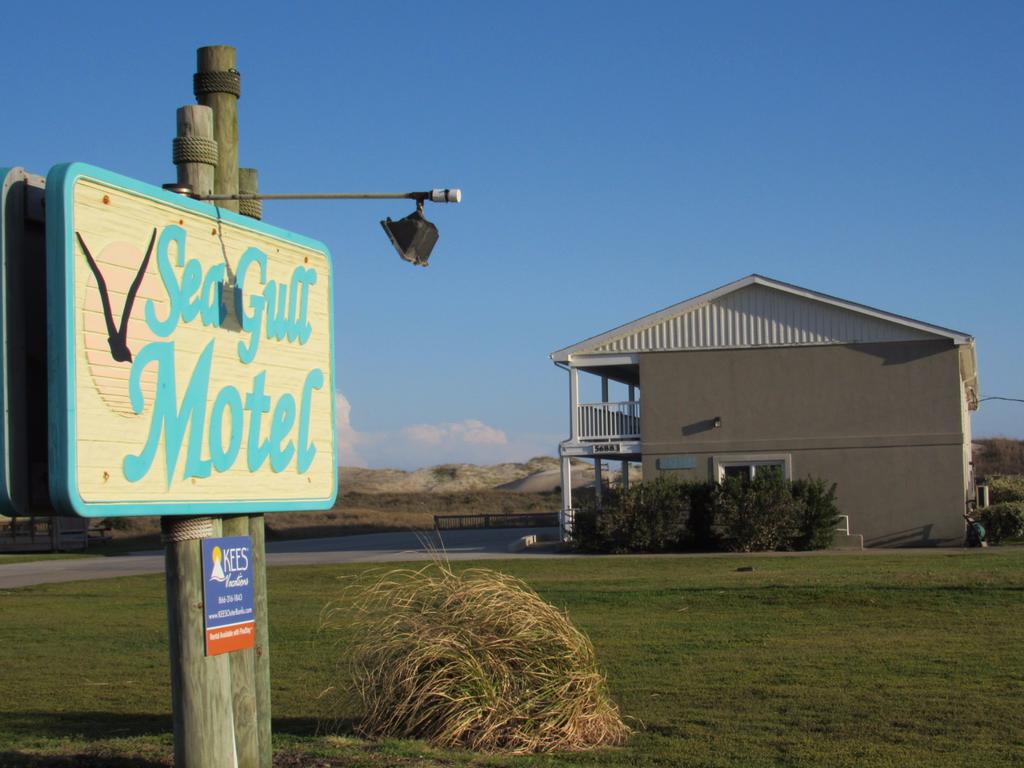
The resort-style hotel that SAGA envisions would replace the Sea Gull Motel, which the Kill Devil Hills-based developer purchased in 2016 from the Oden family, who had owned it since 1955. The legendary motel was severely damaged during Hurricane Isabel in 2003. Two of the three buildings that then encompassed the motel were destroyed, and the third had to be rebuilt.
As the Island Free Press reports today, it’s “back to the drawing board” for SAGA’s Hatteras project:
The primary objections reportedly expressed by opponents to the SAGA hotel project are those that The Beacon highlighted in its post yesterday: the height of the hotel and the lot coverage of the five-acre development, which SAGA sought to increase from the current Dare County Code standard of 60 percent to 70 percent.
Sumit Gupta, who is co-founder, principal partner, and chief executive officer of SAGA Construction, Inc., represented the applicant at the Planning Board meeting.
According to a Beacon reader who received a copy, Dare County Planning Director Donna Creef sent the following email this morning to people who had previously contacted her about SAGA’s project and application. Ms. Creef wrote:
“I wanted to follow-up with those folks that had emailed Dare County concerning the proposed C2-H text amendment. Copies of the 60+ emails were provided to the Planning Board, the majority were opposed to zoning changes. There were 19 speakers at the public comment period of the meeting last night with the majority opposed to zoning changes.
“Comments from the Planning Board indicated a reluctance to recommend a 90-ft building height and a desire to not increase lot coverage.
“The application SAGA Construction voluntarily withdrew the zoning amendment application to revise their request based on feedback from the Planning Board. Sumit Gupta, the SAGA representative, indicated it would take some time to revise the amendment but he would re-submit. The Planning Board acknowledged his voluntary request to revise the application. Mr. Gupta was advised that any resubmission of the proposal will follow the Planning Board submission procedures—3 weeks before the meeting date. The Planning Board monthly meetings are held the second Monday of each month.
“At this point I am unsure when the item will be re-submitted. It will not be scheduled for the July 8 Planning Board meeting. I will email those on this email list when SAGA re-submits.”
The Beacon applauds Ms. Creef for being in touch promptly and personally with members of the Hatteras community who took the time to write to the Planning Dept. This type of public service should occur throughout the Outer Banks.
The Beacon will continue to follow this story and bring you updates as they occur.
SAGA reportedly proposes to replace the old-style, two-story Sea Gull Motel, which is on the oceanfront in Hatteras, with a six-story, 100-room hotel that the Dare County zoning ordinance currently prohibits.
SAGA Construction Inc. will argue today to the Dare County Planning Board why it should support changing longstanding county commercial zoning rules solely to allow it to build a six-story hotel, with a seventh-story “rooftop amenity,” and other commercial projects it has proposed on southern Hatteras Island.
According to local news reports, SAGA seeks to transform the two-story Sea Gull Motel, which was built in 1955 and hit hard by Hurricane Isabel in 2003, and adjacent property. (See http://www.seagullbuxton.us/.)
The seven-member Planning Board, which is chaired by at-large member John Finelli, who lives in Martin’s Point, will hear SAGA’s application to amend the county zoning ordinance pertaining to the C-2H general commercial district at 6 p.m. in the Board of Commissioners Meeting Room, 954 Marshall C. Collins Drive, in Manteo.
The Planning Board’s consideration of SAGA’s application is a review, not a public hearing. The Board has the option of conducting a public hearing on SAGA’s proposed amendment to Dare County’s commercial zoning regulations, and Dare Planning Director Donna Creef has recommended that it do so.
Like the Southern Shores Planning Board, which Mr. Finelli also sits on as an at-large member, the Dare County Planning Board is an advisory body only. It will decide whether or not to recommend SAGA’s proposed zoning text amendment, as is or with changes, to the Dare County Board of Commissioners, which will make the ultimate decision.
In a June 4, 2019 county memorandum, Ms. Creef stated that the “entire zoning amendment process takes a few months to complete.”
The Planning Board will take up SAGA’s application this evening after it holds a public hearing on zoning amendments to improve year-round housing prospects, according to the Board’s agenda. There will be a public-comment period offered at the beginning of the meeting, before this hearing, at which time you may speak.
WHAT DOES SAGA WANT?
The Beacon has done a fast study of what’s at stake here and strongly urges others to do their homework, especially if they plan to speak at the meeting. We will provide links to useful information at the bottom of this post.
You’ll find the Dare County Zoning Ordinance in Appendix A to Chapter 155 of the Dare County Code of Ordinances. Within Article II of Chapter 155 is a section specific to the C-2H general commercial district, designated 22-25.1. Within this section, is a listing of all currently approved uses, both permitted and conditional, of property in the C-2H general commercial district.
The current permitted uses of property within the C-2H general commercial district are broad, encompassing all manner of offices, retail stores, service establishments, single-family dwellings, schools, public buildings, etc. Hotels and motels are permitted, but they are qualified by dimensional requirements spelled out in section 22-25.1(d), which includes limitations on the number of stories in a building, its height, and its lot coverage.
The current conditional uses permitted in the C-2H general commercial district number far fewer. They include automobile service stations, seafood markets, boat building and boat repair facilities, and fishing piers. (See sec. 22-25.1(c).)
What SAGA proposes to do is to create a new permitted conditional use, called “mixed use development,” which as it defines and describes this use in its zoning text amendment, would allow it to do precisely what it wants to do. The new conditional use it suggests the county commissioners enact into law may as well be titled “The SAGA Use.”
What SAGA’s rather detailed amendment essentially says is that, all existing dimensional restrictions in the Dare County Zoning Ordinance on motels and hotels do not apply to its hotel in its mixed-used development, nor do any other zoning regulations, such as those for off-street parking, that it does not like. SAGA is exempt from the county’s zoning regs.
This is stark corporate bullying by a developer whose message is, if you, Dare County and Hatteras Island, want our investment dollars, you have to cater to us. We don’t care about your Zoning Ordinance. It doesn’t apply to us. We make our own rules.
SAGA’S ‘MIXED USE’ DEVELOPMENT
The Beacon finds the concept of a “mixed use development” ludicrous.
As SAGA defines it, this type of development is “a planned development consisting of mixed uses including those listed as permitted and/or conditional in the underlying district.” SAGA is reportedly considering a restaurant, a pier, and retail shops, in addition to a high-rise hotel.
But a so-called “mixed use” development is already permitted by the Zoning Ordinance, simply by its component parts. There is no logic behind creating an entity known as a “development.” Uses already may be mixed.
Of course, SAGA is proposing this fictitious entity, a “mixed-use development,” so that it can make its own rules about the number of stories that its hotel can have, the height its hotel can be, the amount of lot coverage its “development” can consume, and all the other zoning exceptions it wants.
Under the current dimensional requirements, no structure can have more than three “habitable” floors or stories, measured from the bottom of the floor joist to the top of the top plate. (See sec. 22-25.1(d)(6).)
SAGA would like to build a six-story hotel with a rooftop “amenity” that would be open and not “habitable,” in the sense that it’s not enclosed living space, so that guests presumably can drink and party at all hours while they gaze out over the ocean.
Under the current zoning requirements, the height of buildings in the C-2H zoning district is limited to a maximum of 45 feet, unless an “elective elevation option” is exercised, in which case the maximum height can be 52 feet. (See sec. 22-25.1(d)(6).)
SAGA’s amendment would allow the developer to build its hotel with six stories, plus the seventh-story roof-top functional space, and up to a maximum of 78 feet, if only the six stories are built, and 88 feet, if the seventh story is added.
SAGA also seeks a 70-percent lot coverage for all uses within its development, which is 10 percent more than the current zoning regulations would allow. (See sec. 22-25.1(d)(5).)
If you click on this link, you will arrive at a page that you can use to get to Ch. 155, Art. II, Section 22-25.1, which is the section on the C-2H zoning district:
We in Southern Shores have become accustomed to seeing NO! MINI-HOTELS signs around town, protesting SAGA’s “minihotels” on our oceanfront. Hatteras Island locals may wish to consider a variation on our theme:
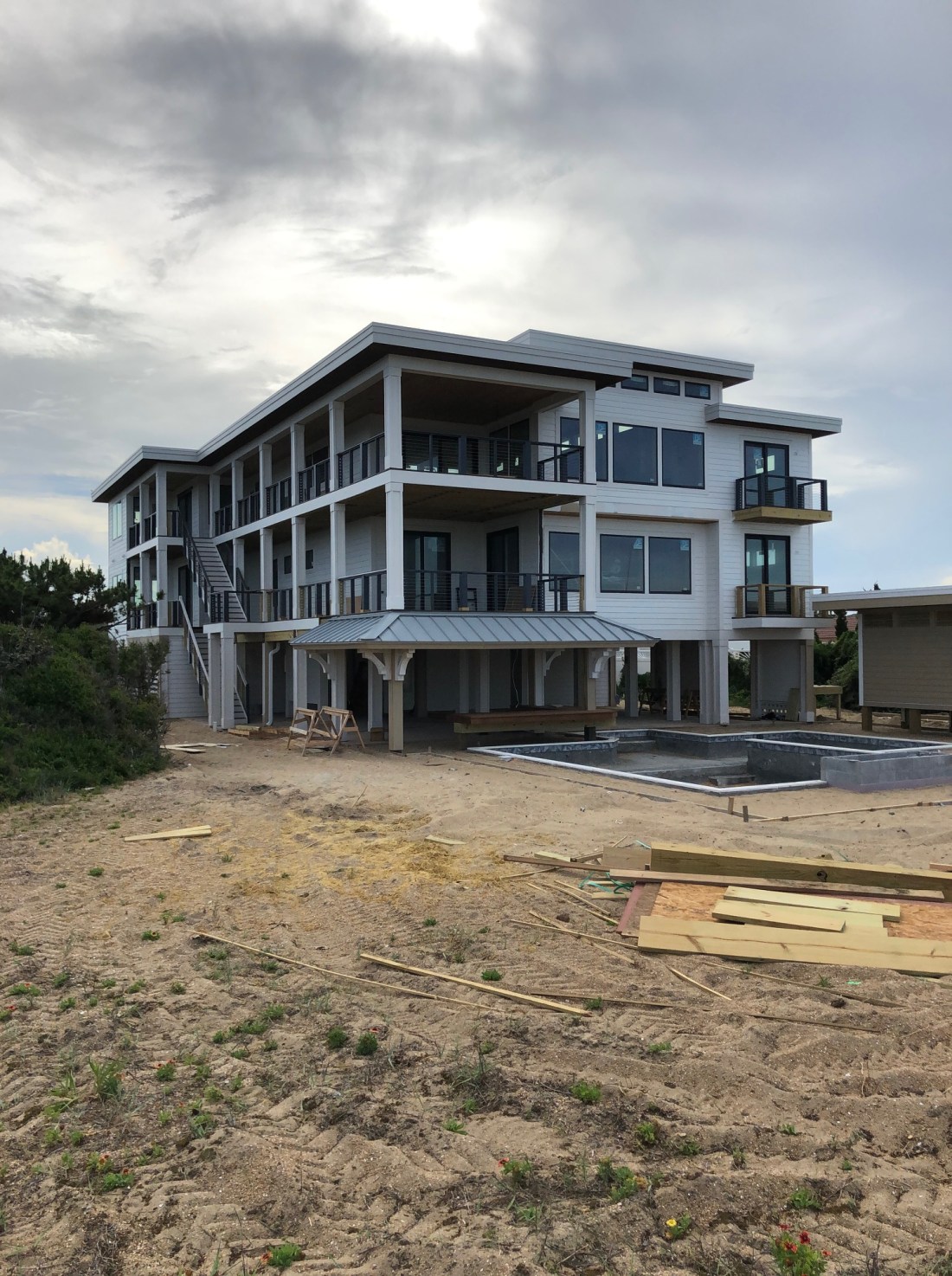
This photograph of the east and south sides of the dwelling at 98 Ocean Blvd. readily illustrates how much exterior space there will be for guests to congregate: on two stories of connecting decks, on balconies, around the pool, under the house at what will be a built-in bar, and multiple tables and chairs, and in the yard.
An ordinance prepared in December 2015 to regulate “special events” in town came back before the Town Council at its meeting last week at the request of Councilman Gary McDonald. This time around, however, the Council’s discussion lacked the focus, direction, and purpose it had the first time.
The Council’s deliberation suffered, The Beacon believes, because the problem or problems that Mr. McDonald was seeking to address were not adequately defined. Until the Council precisely defines the problem, a solution is going to be difficult to find.
In addition, major changes in the Town’s zoning have occurred since late 2015. Town Attorney Ben Gallop drafted the special-event ordinance long before the Town Council’s enactment last month of a permitted-use distinction between residential dwellings that are “detached single-family dwellings” and those that are “vacation cottages.”
The Beacon asks: Why not build on this distinction and treat differently those special events that are held in vacation cottages and those held in single-family homes that are not vacation cottages?
When the Town Council first considered what is known as the “Special Event and Occupancy Limitation” ordinance, SAGA Construction Inc. was threatening to build a 16-bedroom wedding-destination venue on the oceanfront at 64 Ocean Blvd. The Council’s purpose was clear: Stop this from happening.
Six months earlier, the N.C. General Assembly had cleared the way for the first-ever “special-event house” to be built in Southern Shores by taking away the town’s power to limit the number of bedrooms in dwellings. Southern Shores’ seven-bedroom restriction, in effect since October 2001, became invalid.
Representing the overwhelming public opinion, a majority of the Town Council did not want SAGA to build its 16-bedroom venue. To stop it, the Council had to amend the Southern Shores Town Code: It had to make new law.
Town Attorney Gallop prepared four draft ordinances to prevent SAGA’s project, three of them zoning text amendments (ZTAs) and the fourth, the newly resurrected special-event ordinance, which was Mr. Gallop’s primary effort.
The special-event ordinance is a police-power ordinance, relating to public health, safety, and welfare, not to zoning. Because it is not a zoning measure, the Town Planning Board is not required to review it. The Town Council can move forward on its own, without the Board’s consideration, but it also can seek the Board’s review, if it chooses, and it did, unanimously, on Tuesday.
In its first go-round, the special-event ordinance dropped by the wayside Jan. 5, 2016 when the Town Council decided at a regular meeting to consider only the three ZTAs.
At a special meeting held Jan. 22, 2016, the Council passed into law, by a 3-2 vote, a ZTA that limited maximum house size to 6,000 square feet, thereby defeating SAGA’s plans—at least, the plans the Kill Devil Hills-based developer had then. (See The Beacon, 5/29/19 for background.)
Now, as we all know, SAGA has two oversized dwellings, which The Beacon has called “minihotels,” in construction at 98 and 134 Ocean Blvd. Litigation over these structures is ongoing, and SAGA has built them at its own risk. (See nominihotels.com.)
Despite that risk, SAGA’s investor groups have advertised these minihotels on Carolina Designs Realty’s website as being special-event houses that can accommodate up to 100 guests. (Rentals bookings have been taken for September.)
That the current online rental advertisements for “Aquadisiac” (98) and “Transcendence” (134) no longer use the words “special event” or quantify the number of guests that may party in them does not mean that these minihotels will not be used for pre-planned events.
If the purpose in bringing up Mr. Gallop’s 2015 special-event ordinance is to prevent SAGA’s investor groups, when and if they rent these two minihotels, from being used for large special events, with upwards of 50, 75, 100, or more people, then that is where the Council should start with its brainstorming about a regulatory scheme.
Last Tuesday, however, Mr. McDonald described the Town Council of January 2016—which also included Mayor Tom Bennett and Councilmen Christopher Nason, Fred Newberry, and Leo Holland—as being “more attuned to the size of houses than to events.” Mr. McDonald said only that he would like to look at regulating events “for the benefit of our public-safety folks,” chiefly the police and fire departments.
As an observer in December 2015 and January 2016, I would say that the Town Council was very attuned to the prospect of large special events being held on the oceanfront, but it was bowled over by the special-event ordinance that Mr. Gallop drafted. And it will be bowled over again, if it persists in using this 3 ½-year-old ordinance as its blueprint.
The Beacon asks: Why not ask Mr. Gallop to draft a new ordinance designed to address the perceived problem today?
The Town Attorney clearly stated last Tuesday that he would be happy to work on appropriate regulatory language if the Town Council would give him “direction,” starting with: “What is the problem you’re trying to solve?”
The Beacon beseeches the Town Council to be precise, purposeful, and forthcoming. Give Mr. Gallop the direction he requests and don’t waste any more time.
SPECIAL-EVENT REGULATORY LANGUAGE
You will find the text of the old ordinance in the minutes of the Dec. 18, 2015 meeting, on pp. 8-12:
The old ordinance regulates special events by creating a permitting process and imposing permitting requirements upon those who hold the events. The larger the event, the more permitting requirements are imposed. During last Tuesday’s meeting, the Town Council embraced the permitting concept, but pretty much decimated the ordinance’s provisions.
The old ordinance defines “special events” as “temporary public or private gatherings,” which include, but are not limited to, “pre-planned events, community uses, private parties, and traditional family events.” It imposes permitting requirements on property owners who hold special events that they expect will be attended by more than 25 people.
The Town Council quickly rejected this attendee threshold as being too low. All it took for them to jettison this number was for home builder and homeowner Matt Neal to point out in public comments how quickly a birthday-party guest list for one of his children exceeds 25 attendees.
Pursuant to the old ordinance, permit application and inspection requirements vary and increase according to the number of attendees, with 25 to 75 people being viewed as a “small” special event; 75 to 125 as a “limited” special event, and over 125 attendees as a “large” special event.
Property owners hosting a small special event, for example, must file their permit applications five days before the event, whereas those hosting large special events must file 30 days ahead of the event.
The small-event application requires little more than the date, times, and location of the event and contact information for a person in charge. The host of a large event must permit advance inspections of the property and premises and furnish a detailed site plan, a traffic-management plan, and certifications pertaining to sufficient parking, wastewater facilities, and on-site first-aid supplies.
Last Tuesday, a majority of the Town Council gravitated toward imposing permitting requirements only on those property owners who hold events for 75 people or more.
The old ordinance also provides, significantly, that no more than three special events requiring a permit may occur during a continuous 12-month period on any parcel of property. If more than three occur, then the property’s use is to be considered commercial, rather than residential, and, therefore, in violation of the Town’s zoning code.
“Traditional family events,” which the ordinance defines as gatherings for “traditional events such as holiday parties and meals, birthday parties, funeral services, religious ceremonies and weddings for family members,” are not subject to the three-event limitation.
The Town Council ended up saying that it wanted to exempt all traditional family events from the permitting process.
It also seemed to want to dispense with the three-event limitation altogether. If it does that, what’s left of the old ordinance?
As Mr. Gallop neatly stated: The “essence” of the ordinance is “the bigger the party, the more information you have to provide to the police and fire department so that they can be prepared if there’s an emergency.”
Emergency responders need to know that traffic will not hinder their ingress and egress to the property and that they can readily contact a responsible person on the scene.
The Beacon believes that the real concern here is one that Mr. Gallop pointed out, but no Council member stated. The concern is that the Town regulate special events so as to ensure that they do not become the primary use of a dwelling, in particular, of a large “vacation cottage”—like the two SAGA minihotels.
This is a focused potential problem.
The Town Planning Board will take up the subject at its June 17 meeting. At the same time, pursuant to the Town Council’s directive, Mr. Gallop and Town Planning Director Wes Haskett will consider the ordinance anew and decide whether to bring it back to the Council at its July meeting.
NEXT UP: THE CUT-THROUGH TRAFFIC COMMITTEE
Before tackling the traffic, which noticeably increased on the cut-through route yesterday, and the citizens’ advisory committee that the Council approved last week, The Beacon asks you this question: What do arriving northbound vacationers actually gain by cutting through on South Dogwood Trail-to-East Dogwood Trail-to-Hickory Trail-to the streets in the dunes?
As long as there’s a bottleneck at Duck caused by its 25-mile-per-hour speed limit and impeding infrastructure, do the vacationers who cut through Southern Shores actually gain any time? If so, how much, do you think? Eventually, they all end up in gridlock.
If all summertime weekend cut-through drivers inevitably succumb to bumper-to-bumper backups, would they really be harmed if they were prevented from taking all or a portion of the cut-through route?
As things stand now, they unwittingly add to their frustrating predicament by boxing intersections on N.C. Hwy 12 when they finally rejoin the thoroughfare.
Depicted above is the north entrance into the Southern Shores Cemetery, where the east-side sidewalk on South Dogwood Trail ends.
The Beacon opposed appropriating $1 million from the Town’s undesignated funds for the 1.3-mile South Dogwood Trail sidewalk, which a simple majority of the five-person Town Council approved Tuesday, and continues to oppose the Town Engineer’s design of the proposed five-foot-wide concrete sidewalk. (See The Beacon, 6/5/19.)
We believe all infrastructure improvements should be funded by the set-aside capital budget, which the Town Council should increase to accommodate long-range planning of projected capital needs. The Town’s undesignated fund balance, which is principally for emergency natural-disaster relief, should only be “raided,” as one resident called the $1 million appropriation at Tuesday’s Town Council meeting, for necessary expenses that all Town Council members approve.
Three people in this town should not be permitted to transfer hundreds of thousands of dollars—much less $1 million—from our emergency “insurance” fund for non-essential capital projects, no matter how popular they may be. If such a financial decision is to be made, unanimity should be required.
Town Manager Peter Rascoe said at Tuesday’s meeting that the Town would notify by U.S. mail all property owners on both sides of South Dogwood Trail about the proposed sidewalk construction, but not meet with any of them unless an owner requests a meeting.
In response to an inquiry from Councilman Fred Newberry, who has shown concern for uninformed homeowners, Mr. Rascoe said he believes the property-owner population on the street is too large for the customary pre-construction meeting with affected owners.
The Beacon not only opposes elements of the sidewalk design because of issues we have with its width, appearance, and pathway, we question its location.
Why isn’t this sidewalk projected to run along the west side of South Dogwood Trail, instead of the east side? Or, alternatively, why isn’t it running along some of the west side and some of the east side, with a single crosswalk connecting the sides?
WHAT ABOUT THE WEST SIDE?
According to a member of the Town’s Capital Infrastructure Improvements Planning Committee with whom The Beacon spoke, the committee never had before it the decision of whether to construct the sidewalk on the west side of the road or on both sides. The Town Engineer, they said, resolved the location.
Although the Town has a contract with Deel Engineering, PLLC, exclusively, and the name Anlauf Engineering, PLLC, is not mentioned in that contract, both Deel Engineering and Anlauf Engineering perform work for Southern Shores.
Joe Anlauf, who owns Anlauf Engineering of Kitty Hawk, describes Andy Deel of Deel Engineering on his company’s website as a “common subcontractor” or “project teammate.” See https://www.anlaufengineering.com/about.html.
Mr. Anlauf has overseen the South Dogwood Trail sidewalk project. The Beacon would like Mr. Anlauf to explain publicly to homeowners, or to release in writing for publication on the Town’s website, the comparative cost, engineering, and environmental-impact analysis he did on the two sides of the road to decide the sidewalk’s placement.
It is not enough to say that the South Dogwood Trail sidewalk should connect with the existing sidewalks in front of the cemetery and on East Dogwood Trail and, for that reason, should be on the east side. Crosswalks can be provided.
In fact, The Beacon believes a crosswalk could be easily and safely designated at Wild Swan Lane. The sidewalk could run along the west side south from the North-South-East Dogwood Trails intersection to Wild Swan Lane, and then from there, along the east side, where the land is flat and the right-of-way is already clear, up to the cemetery.
It does not take a land survey to see that most (clearly, not all) of the houses on the west side of the road are built farther back from the right-of-way than those on the east side. Whether or not the west-side lots are generally deeper than those across the street is a question that cannot be resolved by mere visual inspection from the road. But the terrain on the west side certainly does appear to be far less hilly than that on the east side—in toto, not in all areas.
The Beacon believes that far less destruction to the roadside environment and aesthetics would occur if the sidewalk were built on the west side, or, alternatively, if it were to be on the west side between the Dogwoods intersection and Wild Swan and on the east side between Wild Swan and the cemetery. Certainly, fewer yards would be adversely affected.
Of course, we may be wrong about this.
Mr. Anlauf should confirm or refute this observation with his environmental-impact assessment. Further, he should tell homeowners about the engineering challenges he would confront on both sides of the road.
This project is transformative of the signature road in Southern Shores. There is much desirable “old growth” on South Dogwood Trail, growth that developer David Stick sought conscientiously to preserve. In fact, dogwood trees are specifically protected by the Town Code. They cannot be removed from the right-of-way unless the Town Manager gives his or her written permission (TC sec. 28-4).
In the 31 years that have passed since this Town Code protection was enacted, both the Town Council and the Town Manager’s office have become more political. The Beacon believes that the fate of dogwood trees in the right-of-ways of the dogwood trails and elsewhere should be in the hands of a citizens committee.
The Town needs to do far more than it has done to this point to elucidate the nature and consequences of the South Dogwood Trail sidewalk project.
SIDEWALK PEDESTRIAN SAFETY
As for the pedestrians who would use the sidewalk, The Beacon believes they would be at far less risk of being struck by a vehicle driven by a distracted driver that veers on to the right-of-way if they were on the west side of the road than on the east side.
The incoming summertime cut-through traffic on South Dogwood Trail already tends to be faster and more intense than the outgoing cut-through traffic, which trickles off after the morning. After the proposed sidewalk is constructed, arriving northbound tourists will not have to slow down for pedestrians and other obstacles in the road, nor will they be on the alert for them. We can expect them to drive even faster.
The same can be said of the flow of northbound trucks and other commercial traffic that traverses the cut-through route during week-day mornings. I see these “rush-hour” vehicles streaming through every morning on East Dogwood Trail and Hickory Trail when I walk my dog. Homeowners on South Dogwood Trail must see them, too.
The Beacon will further investigate the west-versus-east-side road analysis. Please let us know what you think, especially if you live on South Dogwood Trail. Please send your comments to ssbeaconeditor@gmail.com.
Thank you.
OVERLOOKED TOWER: The Beacon should have mentioned in Wednesday’s post that the Town Council unanimously approved the 20-foot extension of the AT&T cell tower at 148A Ocean Blvd., also known as Triangle Park, bringing its height to 150 feet.
The extension was requested by American Tower LLC and Verizon Wireless for the express purpose of improving Verizon Wireless’s coverage and capacity in the area. Verizon Wireless is not now on the tower.
The Southern Shores Civic Assn., which owns Triangle Park and the adjacent parking lot, receives rent from American Tower for the cell tower. In November 2013, the Town permitted the tower to be a conditional use of the SSCA property, which is in the RS-1 residential district.
According to American Tower attorney David Allen, who testified Tuesday in a public hearing about the corporation’s request to amend its conditional use permit to allow for the extension, the construction is expected to occur from October through May 2020. There will be “some brief outages” of cell-phone coverage, he said, but they will be for hours, not days or weeks.
Mr. Allen also confirmed that there will be no lighting added to the cell tower.
THE TOWN COUNCIL MUST WORK THE DOG DAYS: Councilman Christopher Nason made a motion Tuesday to cancel the Town Council’s August meeting. His motion was defeated 3-2, with only Mr. Conners joining Mr. Nason in seeking a summer break.
In opposing Mr. Nason’s motion, Councilman Gary McDonald spoke of the “duty” the Town Council has to property owners to conduct the Town’s business regularly, and Councilman Newberry pointed out that the Council’s meetings are an opportunity for the public to speak.
AND FINALLY . . . JUNIPER TO CLOSE TEMPORARILY: Starting around Monday, June 17, Juniper Trail will be closed to through traffic in the area of 32 Juniper Trail in order for street repairs to occur. The road closure is expected to last about a week.
UPCOMING: The Beacon will look next at the special events ordinance discussed by the Town Council Tuesday and at the committee it approved to study ways to restrict and/or reduce cut-through traffic in town.
It is unfortunate that traffic reduction did not factor into the Town’s planning of the South Dogwood Trail sidewalk. It is not too late for planning on traffic reduction and sidewalk construction to proceed hand-in-glove.
The Town Council approved last night, by a 3-2 vote, the Town’s proposed $7,450,846 FY 2019-20 operating budget, without amendment, with members dividing on the transfer of $1 million from reserve monies set aside for emergencies to fund a sidewalk on South Dogwood Trail.
As expected, the simple majority of Mayor Tom Bennett and Councilmen Christopher Nason and Jim Conners, who voted at the Council’s April 23 budget work session to appropriate $1 million from the Town’s undesignated fund balance for this infrastructure project, again voted last night in favor of the appropriation. Councilmen Fred Newberry and Gary McDonald, who explained that they do not oppose a walkway on South Dogwood Trail, just the way it is being funded, voted against it.
Mr. Newberry also objected to the budget lacking a “provision for addressing the cut-through traffic.” He pointed out that besides having a “dramatic effect on South Dogwood Trail,” in terms of its aesthetics and environment, the sidewalk is “not the total answer” for problems on the road, such as speeding and other traffic violations routinely committed and routinely observed by Mr. Newberry, who regularly walks on South Dogwood.
There will be a public hearing at the Council’s July meeting to discuss the design of the proposed walkway, which now is envisioned as a five-foot-wide concrete sidewalk identical to the one recently built on East Dogwood Trail. Both Councilmen Newberry and McDonald expressed an interest in a narrower walkway of between three and four feet, a concept that Mayor Bennett said had not been foreclosed.
The Town Council’s next meeting was originally scheduled July 9, when the Republican primary runoff election for the third district U.S. Congressional seat will occur. The Pitts Center is a polling place. Town Manager Peter Rascoe did not announce an alternate date last night.
In other developments during the Town Council meeting, which lasted until past 9 p.m., the Council unanimously approved Town-sanctioned citizens’ advisory committees to study ways in which the cut-through traffic can be curtailed and whether and how to establish a Dare County branch library in Southern Shores. Each committee is to have seven members. Tommy Karole will chair the traffic committee, and Michael Fletcher will chair the library committee.
After considerable discussion, the Council also voted unanimously to refer a Town Code Amendment regulating special events in residential districts to the Planning Board for its review and recommendation and to the Town Attorney and Town Planning Director for revision of its terms, which it specifically requested. (See The Beacon, 5/29/19 for background.) The Planning Board will take up this ordinance at its June 17 meeting.
The Council renewed the Town Attorney’s legal services contract with the increased fee schedule requested by Ben Gallop’s firm, Hornthal, Riley, Ellis & Maland of Nags Head—it is actually the firm, not Mr. Gallop, who represents the Town—and agreed to extend the contract of Deel Engineering, PLLC, for a year.
Both Mr. Newberry and Mr. McDonald expressed disappointment with being presented with renewal of the engineering company’s contract “at the last minute”—the contract expires June 30—so that the Council could not solicit other proposals without putting ongoing projects that require engineering oversight at a disadvantage. (See The Beacon, 6/4/19.)
The Beacon will report further about last night’s Town Council meeting later in the week.
Come in from the beach and join your neighbors for the Town Council’s meeting today at 5:30 p.m. in the Kern Pitts Center behind Town Hall.
A public hearing on the Town’s proposed fiscal year 2019-20 operating budget and consideration of a citizens’ cut-through traffic committee and further regulations of special events in residences top an unusually varied agenda for the Town Council meeting today, which will be held at 5:30 p.m. in the Kern Pitts Center.
Also on the agenda are announcement of the road projects that the Capital Infrastructure Improvement Planning (CIIP) Committee recommends for FY 2019-20 and appointment of members to an advisory committee to explore opening a Dare County branch library in Southern Shores.
On May 30, the CIIP Committee unanimously approved recommending as its first priority “target” the repair and makeover of Hillcrest Drive, from the road’s intersection with Hickory Trail to the SSCA tennis courts, a length of about 3,700 linear feet. This project, which Mayor Tom Bennett said would cost between $500-$550,000, also would reduce the width at the hilltop once known as Lookout Point.
Rounding out the committee’s top-four recommended projects are 2) East Dogwood Trail, from N.C. Hwy. 12 to Ocean Boulevard, with stormwater improvements; 3) Sea Oats Trail, from Eleventh Avenue north to N.C. Hwy. 12; and 4) Dewberry Lane.
The Council will conclude its new business tonight with a public hearing to consider a 20-foot extension of the cell tower in the SSCA’s Triangle Park, at the Ocean Boulevard-Duck Road split. The Planning Board unanimously approved the extension at its May 20 meeting, subject to explicit conditions. (See The Beacon, 5/21/19.)
American Towers LLC and Verizon Wireless have applied to amend a conditional use permit that the Town issued in November 2013 for the flagpole-style monopole tower, which is currently 130 feet. The extension is being proposed to improve cell-phone coverage and capacity by Verizon, which is not currently on the tower.
If you wish to speak at the meeting, be sure to arrive before 5:30 p.m. to sign up. You will find sign-up sheets on a table in the back of the room, near the entry door. There will be opportunities to speak during both public hearings as well as during two public-comment periods.
(See The Beacon, 5/29/19, for background on issues.)
PROPOSED $1 MILLION APPROPRIATION FOR SIDEWALK
The most controversial proposed appropriation in the $7,450,846 FY 2019-20 budget submitted May 7 by Town Manager/Budget Officer Peter Rascoe is a transfer of $1 million from the Town’s undesignated funds balance (reserves) to pay for construction of a five-foot-wide concrete sidewalk on South Dogwood Trail. (As of June 30, 2018, this fund had $4,752,187 in it.)
A simple majority of Mayor Tom Bennett and Councilmen Jim Conners and Christopher Nason voted at the Town Council’s April 23 budget work session to appropriate these monies from reserves that are maintained principally for natural-disaster relief. The same three Council members rejected an attempt by Councilman Gary McDonald to increase the capital-improvements budget, which is used to pay for all other infrastructure projects. Councilman Fred Newberry supported Mr. McDonald.
Currently, five cents out of every 22 cents per $100 of property value collected in Town real-estate taxes is set aside for the capital-improvements budget. Councilman McDonald proposed increasing that amount to seven cents out of every 22 cents.
In FY 2019-20, the capital budget is projected to be $662,340, which will not go far if a half-million dollars are spent on a portion of Hillcrest Drive. The proposed South Dogwood Trail sidewalk, which has been designed to run along the east side of the road, would have consumed that amount and an additional $300,000-plus.
The Beacon does not support the design of the sidewalk proposed by the Town Engineer, which is on the Town’s website and does not comport with the recommendation of the Dogwood Trails Task Force; nor do we support funding a non-emergency infrastructure project with monies from what is essentially an emergency fund. A simple majority of the Town Council should not be allowed to cherrypick projects it favors for such sizeable funding from the Town reserves.
The Beacon also believes the Town Council should thoroughly explore restricting access to South Dogwood Trail by cut-through drivers and using other traffic-reduction methods before it decides to take $1 million from the emergency reserve fund for a sidewalk that ostensibly would be built for the public’s safety.
The Beacon also questions the wisdom of repairing the section of Hillcrest Drive that is subject to the most wear-and-tear by cut-through traffic without also implementing traffic-reduction methods to protect the finished product.
How the Bennett-Conners-Nason majority can ignore the obvious adverse consequences of cut-through traffic to the health, safety, welfare, and quality of life of hundreds of homeowners on the streets involved—as well as the road damage such traffic causes—eludes The Beacon. It would cost far less than $1 million to erect gates and control access to South Dogwood Trail and Juniper Trail (and perhaps Porpoise Run) on summertime weekends. Controlled access also would be more respectful of the natural environment.
TOWN LEGAL EXPENSES
I conclude with a word (actually many words) about legal expenses.
In the proposed FY 2019-20 operating budget that Mr. Rascoe presented to the Town Council April 23, he highlighted in yellow only one figure among the dozens that comprised expenses that then added up to $6,220,846: that of the $100,000 budgeted for legal expenses.
Legal fees, the Town Manager/Budget Officer told the Council at its April budget work session, had “drastically increased” from “last year’s original approved appropriation in the [FY 2018-19] budget.”
As of April 23, the proposed $100,000 appropriation for legal services represented 0.016 percent of the overall proposed budget. Now that the proposed budget has grown to $7,450,846, it represents just 0.013 percent.
During the 2018-19 fiscal year, Mr. Rascoe explained at the budget session, the Council increased the “line” for legal fees by $50,000 “due to the number of permit appeals” at the level of the town permit officer “and other legal matters” in which the town was involved. (The original budgeted amount was $61,500.)
It bothered me a lot that Mr. Rascoe singled out “permit appeals,” but failed to identify any other “legal matters.”
It also bothered me that he spoke about “the number” of appeals.
There has been only one appeal of a zoning permit in which the Town was a party.
I would like very much to see Town Attorney Ben Gallop’s time sheets for the past fiscal year. Perhaps the Town Council, which is Mr. Gallop’s client, could release the hourly accounting he submitted with his invoices so that the people who pay for all of the legal services that his firm provides could see where their money is going.
In FY 2018-19, Mr. Gallop spent an inordinate number of hours on drafting, redrafting, and redrafting yet again the zoning text amendment to regulate nonconforming lots, which the Town Council spent months trying to understand and still has not completely signed off on.
Mr. Gallop also spent numerous hours consulting with town officials—elected, hired, and appointed—about regulatory options to restrict large, high-occupancy dwellings in town and then countless more on drafting and redrafting proposed zoning text amendments, a process that just concluded May 7 with enactment of the new limitations on septic capacity and occupancy.
As someone who has been involved in the nominihotels.com movement to stop SAGA Construction Inc.’s structures at 98 and 134 Ocean Blvd., I know that the Town is not a party to the appeals filed by two homeowner-property owners of the CAMA (Coastal Area Management Act) permits that the State of North Carolina issued to SAGA.
Town Permit Officer Dabni Shelton conducted a local review of SAGA’s CAMA-permit applications, but the permits are State-issued. The N.C. Dept. of Environmental Quality, which is represented by the N.C. Attorney General’s Office, is a party in this consolidated case, not the Town.
Perhaps Mr. Rascoe could enlighten Southern Shores taxpayers as to the role the Town Attorney has played in this litigation and how much he has charged the Town for this role. According to James L. Conner II, the Durham attorney who represents the two property owners, Mr. Gallop’s name has not appeared on any of the case pleadings or correspondence.
Pursuant to the proposed FY 2019-20 budget presented April 23, an amount of $95,614 was transferred from the undesignated fund balance in order to balance the budget.
In an email yesterday, Mr. Rascoe confirmed that “increases in legal service costs, mandated increases in solid waste tipping fees, and a previous Council directed fence at the new fire department site resulted in the April 23 work-session draft-proposed transfer to balance the budget.”
I frankly do not understand this thinking. Other expenses in the proposed budget, for example, those for computer services in the administration and police departments and for equipment purchases by the public works department, also increased. So why single out legal services? (The solid-waste tipping fee and the fence combine for only $20,000 in expense, and the tipping fee was only a matter of discussion on April 23.)
The proposed FY 2019-20 budget also includes 2.5 percent cost-of-living raises for administration, planning and code enforcement, and public works employees. Why isn’t the $95,614 seen as going toward paying for increased salaries, and increased benefits, rather than for increased legal services?
Expenses do go up.
Why isn’t the additional $23,000 requested next fiscal year by the public works department for equipment purchases implicated in the $95,614 shortfall between projected revenues and expenses?
I’m still trying to figure out a $35,000 request for financial planning, which is included in the budget for streets, bridges, and canals.
In his May 7 budget message, which he filed in writing and read to the Town Council at its last meeting, Mr. Rascoe explains that the proposed FY 2019-20 operating budget shows a transfer of $1,325,614 from the Town’s undesignated fund balance to cover:
1) Approximately $1 million for construction of the South Dogwood Trail sidewalk;
2) $220,000 for “Town-owned building updates to meet current building code minimums” [at the April 23 meeting, the Town Council approved “around $200,000” for building improvements]; and
3) The remainder ($105,614) for “ongoing increased legal costs due to increased Town land-use permit challenges by Town property owners”
He doesn’t mention any other increased expenses. The Town Manager’s focus on increased legal costs incident to “challenges” by property owners shows a harmful bias that makes my former-practicing-attorney antennae tingle.
Property owners have a legal right to appeal permit decisions, if they have been injured, and the Town should not burden or in any way chill the exercise of this right by suggesting that they hurt the Town financially in doing so. This language about “increased challenges” supports that interpretation and is bullying and offensive.
A Town property owner should not be chastened for “increased legal costs.” You might just as easily say that poor decisions by Town staff have led to permit appeals (the appropriate legal term) and increased legal costs. You also might question Town Attorney Ben Gallop’s competence, efficiency, and work product. I’m not saying I do, but it is certainly reasonable to do so.
NEW LEGAL SERVICES CONTRACT
As it happens, renewal of the Town’s contract with Mr. Gallop’s firm is on the consent agenda for the Town Council’s meeting tonight, as is renewal of its contract with Deel Engineering, PLLC. (Deel’s contract, which originally was for a three-year term, can be canceled by the Town without cause, provided it gives 30 days’ written notice.)
Both of these contracts are patently inappropriate for disposition by “consent,” which should be used only to dispose of routine business that does not merit discussion.
The Beacon would like to know how the Town Council is protecting Town interests by not considering other contractual offers from other legal and engineering professionals.
In an April 16, 2019 memorandum to the Town Council, Mr. Gallop describes changes in the legal fees that his firm, Hornthal, Riley, Ellis & Maland of Nags Head, will charge if the Council renews its contract, effective July 1.
Although he has had the firm’s proposed new legal services contract since April 16, Mr. Rascoe made no mention of fee increases at the April 23 budget meeting or at the May 7 Town Council meeting. In fact, his projected $100,000 factors in the old fee rates.
According to its proposed contract, Hornthal, Riley, Ellis & Maland’s non-refundable monthly retainer would increase to $3,000, from $2,500, and the Town Attorney’s hourly rate for legal services would increase to $195, from $185. As of June 1, 2020, the hourly rate for legal services would go up to $200, and as of June 1, 2021, increase to $205.
Paralegal and law-clerk services are to be compensated, respectively, at $105 per hour and at $115 per hour. Mr. Gallop’s memorandum, which you’ll find in the packet for the Town Council’s meeting, indicates that as of July 1, 2015, when the Town first entered into a contract with Hornthal, Riley, Ellis & Maland, the fees for paralegal and law-clerk services were $105/hour and $95/hour, respectively.
The Beacon erred in believing that the Town’s Capital Infrastructure Improvement Planning Committee (CIIP) would review at its meeting today the latest design plans for the proposed South Dogwood Trail sidewalk and would include this project in its priority list of improvements for fiscal year 2019-20, even though its funding is separate from other infrastructure projects.
We regret these errors.
The South Dogwood Trail sidewalk project is now under the exclusive auspices of the Southern Shores Town Council, which first must decide whether to fund it by appropriating $1 million from the Town’s general undesignated fund balance. If a majority of the Council approves this monetary transfer, it then will have to make decisions regarding the sidewalk’s design and construction.
The proposed five-foot-wide concrete sidewalk would run along the east side of South Dogwood Trail.
According to Town Manager Peter Rascoe, if and when the Town Council approves the $1 million appropriation, the Town will notify South Dogwood Trail property owners about the project, but staff will not meet personally with them. Instead, a public hearing about the sidewalk design will be held at the Town Council’s regular July meeting and “residents will be invited to comment,” Mr. Rascoe said.
Mr. Rascoe added, however, that South Dogwood Trail property owners are welcome to contact him with their questions, as well as to meet with him. His email address is prascoe@southernshores-nc.gov.
The Town Council’s July meeting is currently scheduled July 9, the same day as the Republican primary runoff election for the U.S. House of Representatives District 3 seat that was held by the late Congressman Walter Jones. The Pitts Center is a polling place for this election, which will take place from 6:30 a.m. to 7:30 p.m.
When The Beacon asked Mr. Rascoe today about the scheduling conflict, he said he was not aware of it.
The Town Engineer has prepared a design of the proposed sidewalk in two segments: the northern segment runs from the East-North-South Dogwood Trails intersection south to Fairway Drive and the southern segment runs from Fairway Drive to the Southern Shores cemetery. Because of hills and dense forestry, the southern segment is the more problematic of the two.
With a price tag of nearly $1 million, the sidewalk’s construction would far exceed the annual capital improvements budget.
By previous agreement, the Town Council has determined that five cents out of every 22 cents per $100 of property value collected in Town real-estate taxes will be appropriated for the annual capital improvements budget. A motion by Town Councilman Gary McDonald at the Council’s April budget session to increase this tax allocation to seven cents was defeated 2-3, with only Councilman Fred Newberry voting with Mr. McDonald.
In FY 2019-20, the capital budget amount is projected to be $662,340.