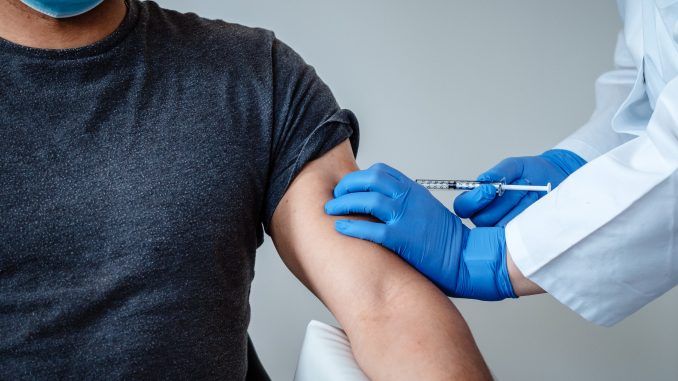
The State of North Carolina has nearly cleared its supply “backlog” of first-dose COVID-19 vaccine, N.C. Health and Human Services Secretary Dr. Mandy Cohen reported at a press conference this afternoon, and will have to strictly ration the 120,000 first doses it receives each week from the U.S. Government until its allotment is increased.
Dr. Cohen does not expect the State to receive more vaccine for at least the next two or three weeks, and when it does, the “bump up,” she said, is likely to be on the order of 10 or 20 percent more.
The Secretary declined to specify in response to a reporter’s question just what communications the NCDHHS has had with federal officials, saying only, “We are advocating for more vaccine.”
Only 84,000 of the State’s weekly 120,000 first doses will be distributed to local vaccine providers, such as the Dare County Dept. of Health and Human Services, Dr. Cohen said, according to a distribution plan based on county population.
The remaining 36,000 doses are being kept “in reserve” for “large-scale vaccination events”—such as those scheduled this weekend at Charlotte Motor Speedway and the Panthers’ Bank of America Stadium—and for distribution to communities where minorities historically have been under-served.
As a result, about 300 COVID-19 vaccination appointments scheduled for this Friday in Dare County may have to be postponed because the State cut Dare’s vaccine allocation in half, according to a bulletin issued yesterday by Dr. Sheila Davies, Director of the DCDHHS.
When asked by a reporter how the NCDHHS decided “per capita” vaccine allocation, which varies considerably from county to county, Secretary Cohen made clear that she is not trying to achieve per capita equity.
More of Friday’s 1,100 appointments in Dare would have had to be canceled if arrangements had not been made for a transfer of vaccine from the Outer Banks Hospital and an anticipated transfer from Onslow Hospital, Dr. Davies said in her bulletin, COVID-19 Update No. 78.
As of midnight yesterday, Dr. Cohen said, North Carolina had “exhausted” 95 percent of its first-dose backlog by speeding up vaccine administration statewide. By tonight, she predicted, 100 percent of the backlog will have been eliminated.
This backlog has nothing to do with second doses of the COVID-19 vaccines. The State will always have sufficient second doses “on hand,” Dr. Cohen assured.
As The Beacon reported 1/21/21, North Carolina has lagged behind most of the other states in “getting vaccines in people’s arms,” which the new Biden Administration has pledged to do quickly. The State’s poor showing disadvantaged it in terms of its vaccine supply from the federal government. North Carolina had to prove that it was deserving of more vaccine.
Five days ago, North Carolina ranked only 43rd among the 50 states in the percentage of people vaccinated among its population, according to the COVID Data Tracker of the U.S. Centers for Disease Control and Prevention. Today, its ranking is 25.
The State will receive its next federal shipment of 120,000 first doses tomorrow, Dr. Cohen said. Local vaccine providers typically have just a “48-hour window,” Dr. Cohen said, “on when vaccine will arrive.”
“Demand for vaccine,” she said in one of many understatements made at today’s briefing, “vastly exceeds supply.” Another was that “supply is incredibly limited.”
According to Dr. Davies’s bulletin, people whose Friday vaccination appointments have to be rescheduled will be contacted by DCDHHS. She asks that people “be patient and wait for a staff person to call you.”
Dr. Davies also said that DCDHHS could “vaccinate 2,000 to 4,000 people per week [if vaccine were] allocated to us.”
As of Jan. 24, DCDHHS had administered 4,588 first doses and 51 second doses of vaccine, according to its vaccine dashboard, which is updated every Sunday.
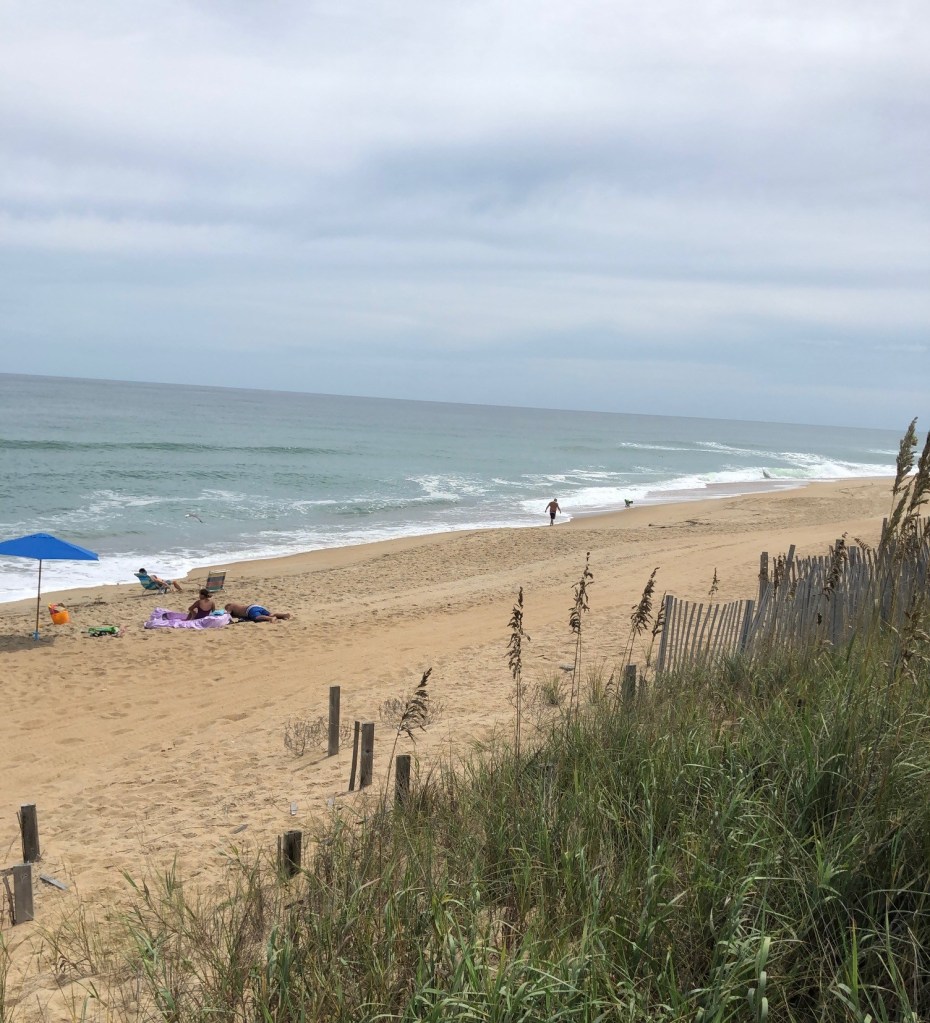
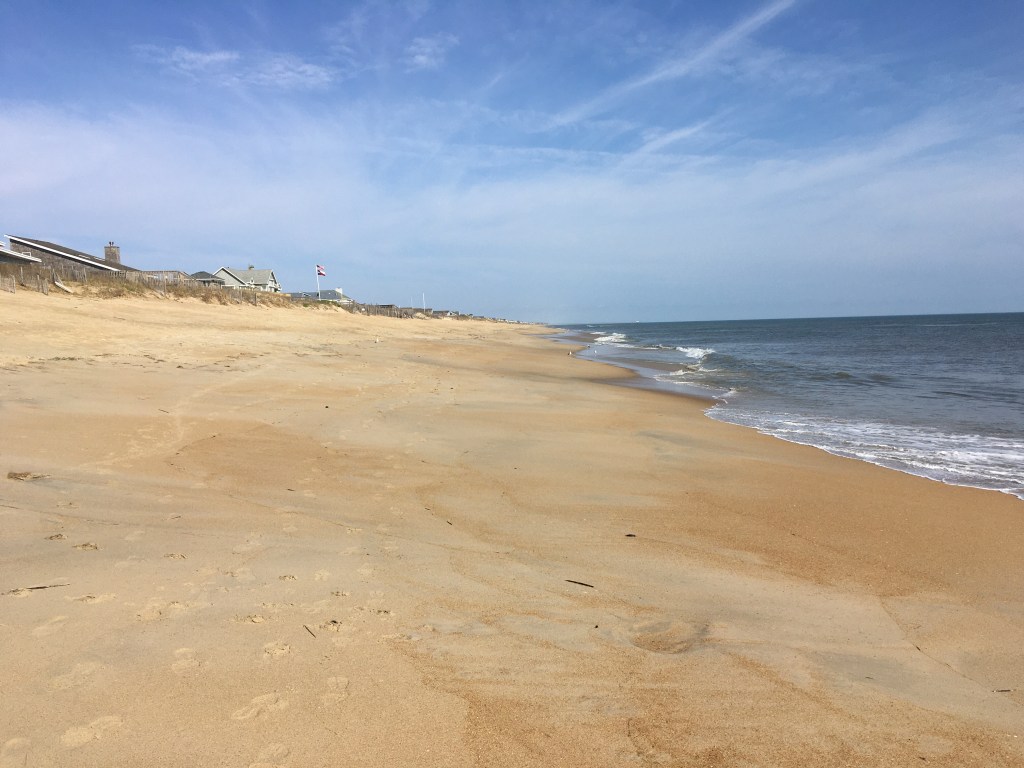
The beach near Trout Run in September 2019, close to high tide and shortly before Hurricane Dorian passed by.
No meaningful conclusions can be drawn about the Southern Shores beaches from the surveys performed in the past few years by the Town’s coastal engineering consultant because the data are too short-term, and there are insufficient historic data with which to compare them. They are too short-term even to suggest trends.
We have reviewed the draft report of the “2020 Beach Assessment Report” presented at last week’s Southern Shores Town Council meeting by Ken Willson of Coastal Protection Engineering of North Carolina (CPE)—just as we did the consultant’s 2017 and 2019 beach surveys and find it, like the others, to be of little value except as a recent snapshot in time.
Mr. Willson is program manager for the $14 to $16 million 2022 town-wide beach nourishment project approved unanimously by the Town Council last year. CPE is responsible for permitting, design, and oversight of the project; it will not do the actual construction.
A series of beach snapshots taken over an extended period of time—during the same month each year—eventually will yield a useful portrait of Southern Shores’ ever-changing 3.7-mile-long shoreline. But we are not there yet.
The 2022 project, however, does not address actual damage to the beaches—except in the “hot spot” area south of Skyline Road, where a fill project occurred in 2017.
Slated for construction from May to October 2022, the town-wide beach nourishment project is designed to put sand on the beaches in order primarily to reduce potential storm damage from a potential storm comparable to Hurricane Isabel.
Isabel hit Dare County in 2003, but as one noted North Carolina coastal engineer and erosion specialist told The Beacon, it “pretty much petered out by the time it got to Kitty Hawk.”
“Storm patterns are pretty scattered” in the northern Outer Banks, in contrast to Hatteras Island and the southern Outer Banks, Spencer Rogers of UNC-Wilmington’s Center for Marine Science told us in an interview last year. Nor’easters that occur in the fall through the late spring pose more of a threat to the Southern Shores shoreline than hurricanes do. (A nor’easter has been forecasted for later this week.)
According to Mr. Rogers, Southern Shores has not been directly hit by a severe storm since the Ash Wednesday storm of 1962, an “Extreme Nor’easter” that took out the old Sea Ranch Hotel at the current site of Pelican Watch, next to the Kitty Hawk Pier. Since this March 1962 event, no buildings in Southern Shores have been destroyed or even threatened by erosion. This makes Southern Shores unique among Dare beach towns.
We have written extensively about beach nourishment in the past few years and bring up this background because people still do not understand that the 2022 project is based on a storm-simulation computer model. Southern Shores has a history of low long-term average erosion rates, but long-term erosion has never part of the beach-nourishment conversation held by the Town Council. (These rates are obtainable from the N.C. Division of Coastal Management.)
Aptim Coastal Planning and Engineering (APTIM), of which CPE is a corporate offshoot, performed beach surveys of the Southern Shores shoreline in December 2017 and May 2019. In 2018, it produced Southern Shores’ “Beach Management Plan,” which provided three “discretionary” beach-nourishment options for the Town to consider. This plan was updated in 2019, when the options were reduced to two, and then modified in 2020 with the addition of a new goal beyond storm damage reduction: that of maintaining a “sufficient useable beach.” The project options then expanded.
(For an elaboration of “useable beach,” see the section, “The 2020 Report Data,” below.)
In the 2020 Beach Assessment Report (“The 2020 Report”), which Town Manager Cliff Ogburn provided us, CPE states that its data will be used for “updating” the 2022 beach nourishment project design and will serve as “the conditional survey to develop construction documents to bid the proposed project.”
The bidding process will occur in June. Mr. Willson said last week that there are only five beach construction companies in the nation that can handle a project of this scope.
The 2020 Report compiles measurements taken last June along the Southern Shores shoreline at 22 “stations,” which are locations on the beach that are spaced 1,000 feet from one to the next. These same stations were monitored in the earlier two surveys.
We will discuss some of the data collected by CPE in 2020, as compared with 2017 and 2019, but only with the red-alert caveat that such short-term comparisons do not yield reliable conclusions upon which reliable recommendations can be made.
Before we get into the data, we would like to discuss the natural processes of the coastal environment and how beach nourishment works. Warning: We wax long in this blog.
All of CPE’s 2020 data will inevitably change as the beaches inevitably change. Changes in data over 13 months (from May 2019 to June 2020) or 2 ½ years (December 2017 to June 2020) are just a drop in the bucket.
THE SEASONAL CYCLE OF THE COASTAL ENVIRONMENT
To quote Spencer Rogers, who has worked with the renowned research, education, and outreach program, N.C. Sea Mark, for more than 40 years: “The beach oscillates in width from season-to-season and from year-to-year.”
Seasonal erosion occurs because of variations in wind and wave energy, the two drivers of coastal environmental change.
The beach is at its widest in late July and early August, according to retired longtime U.S. Army Corps (USACE) of Engineers Field Research Facility coastal engineer and former Southern Shores homeowner Bill Birkemeir. As most of you know, the USACE’s Field Research Facility (FRF) is in Duck.
In the “seasonal cycle,” Mr. Birkemeier told The Beacon last year, the beach is “narrow and steep in winter” and “comes back in the summer.” Passing hurricanes and other storms push the sand off-shore, but it returns. The beach maintains an equilibrium.
“It’s really simple,” Mr. Birkemeier noted, and very important to understand. (See “How The Beach Works 101” below.)
On Sept. 19, 2020, oceanographer Dr. Katherine L. Brodie of the FRF, who lives in Southern Shores, told the Town Council at a special planning meeting that APTIM’s conclusions about the town’s need for beach nourishment were “based on limited data” and “on short-term trends that are not particularly helpful.”
“There is lots of seasonal variability” in erosion [loss] and accretion [gain] of beaches, she said, and the time to measure beach erosion is not in the winter, as APTIM had done in 2017.
“Historically,” Dr. Brodie advised, “Southern Shores has been one of the most stable areas of our coastline here on the Outer Banks.”
The Beacon interviewed both Mr. Rogers and Mr. Birkemeier for a comprehensive report about beach nourishment that we published 2/1/20. We refer you to it now as a helpful guide. We also recommend that you read the opening sections of Mr. Rogers’s book, “The Dune Book,” which is an excellent primer on how the beach works and changes.
The only “historic” data referenced in CPE’s draft report date to October 2006, when the Field Research Facility collected measurements on the southern 15,000 feet of the Southern Shores shoreline, roughly from Third Avenue south to the Kitty Hawk line.
Unfortunately, the FRF’s data-collection methodology is not explained, so we don’t know whether a comparison of the 2020 data with the 2006 data is even valid. (This may be explained in the report appendix, which we did not obtain.)
CPE tries to fill the historic gap by referencing some data collected in September 2013 in the three northernmost stations—this is from Ninth Avenue to the Duck line—by an engineering firm hired by the Town of Duck. It does not disclose this methodology, either.
HOW THE BEACH WORKS 101
A fundamental principle in “How The Beach Works 101” is that change is the only constant. The coastal environment is dynamic, filled with energy and constantly changing.
“[O]cean waves dominate the beach,” Mr. Rogers explains in “The Dune Book,” and “waves absorb energy from the wind.”
Another principle: Stronger winds and larger storms create larger waves, which have a stronger impact on the coast when they break. Where and how the waves break on the visible beach is critical to understanding how beach nourishment works.
In The 2020 Report, CPE discusses the design of beach-nourishment projects, but this material is woven into data analyses and lost.
For a straightforward explanation, we refer you to a 2017 white paper written by Mr. Willson and other members of the Science and Technology Committee of the American Shore & Beach Preservation Assn.: WhitePaper_85_2_Profile_Eq.pdf (asbpa.org). Some of the language of this article is incorporated into The 2020 Report.
The dry-sand beach that we see and walk upon represents only a “fraction,” Mr. Willson writes, of the active beach “profile,” which is the area from the landward dunes and vegetation line east to what is known as the “depth of closure,” the seaward boundary.
The depth of closure is just beyond where the largest waves break; it is usually 15 to 25 feet beneath the ocean.
The dry-sand beach where you put your towel is known as the berm.
According to Mr. Rogers, who spoke at Southern Shores’ beach nourishment forum at the Hilton Garden Inn: “It is very difficult to eyeball the shoreline” and assess its status, which, of course, is what laypeople tend to do.
Not only is much of the beach profile under water, there are “radical changes” going on in the dry-sand area that the eye cannot detect, Mr. Rogers said.
Let’s consider erosion.
There are four different types of erosion, according to Mr. Rogers, only two of which we believe most people appreciate: seasonal fluctuations caused by varying weather and storm patterns, and storm-induced erosion, such as dune escarpment.
Neither of these “erosions” is permanent, because the dunes and berm will recover when the beach profile regains its equilibrium.
Long-term or chronic erosion, which causes the dune to erode and move landward, is one of the other two, but as we noted, the Southern Shores shoreline has held up well over the decades. The fourth type, inlet erosion, does not apply to our area.
“On summer days,” Mr. Rogers writes in “The Dune Book” (p. 5), “it is hard to imagine that the berm is temporarily eroded almost every year. On a typical North Carolina beach, the waterline moves about 75 to 100 feet every year due to seasonal fluctuations.”
Actually, he writes, seasonal fluctuations are not true erosion—provided the volume of sand that is lost in the winter returns for the summer.
Similarly, sand is moved from the visible beach to submerged areas off-shore by severe storms that create large breaking waves on the shoreline and a rise in water level. Large wave action may flatten the slope of the berm and temporarily erode the dunes.
But as more sand moves off-shore, the water depth near the shoreline gets shallower, a change that forces the waves to break farther off-shore. As soon as the breaking of the waves recedes, erosion of the visible beach slows down. You may have noticed that storm waves frequently form off-shore sand bars, which also act as a filter for the largest waves, slowing them.
In time, as the wave action reduces, the beach moves toward its equilibrium, experiencing little erosion. Dunes also provide protection from the waves.
When a beach-nourishment project is designed, the natural processes of the entire profile from season-to-season are accounted for and taken advantage of. Wind and wave action will distribute any sand placed on the dunes and/or the berm by dump truck or dredge over the entire profile, including, and perhaps most importantly, off-shore.
Sand deposited on the dunes and the berm is known as design or beach fill. Sand placed just to the east of the design fill in an area of the profile that is more steeply sloped is known as advance or advanced fill. Advanced fill is critical to reducing or dissipating the wave energy. It forces the waves to break farther off-shore, thus “widening” the dry-sand beach area.
(According to Mr. Willson, the sand that will be transported from off the shores of Kitty Hawk and Kill Devil Hills to “nourish” our beaches in 2022, will be “finer” and, as a result, “the slope of [our] beach may end up being a little flatter.”)
“The most important protective feature of the beach and dune system is the submerged offshore slope,” Mr. Rogers writes. “As a wave moves into shallower water, friction-like factors internally affect the wave form, slowing the base of the wave but having less effect on the crest or top of the wave. The decreasing depth [the shallow waters] causes the wave to increase in height, slow in speed and become much steeper. At some point, the crest of the wave is moving too fast for the bottom of the wave form to keep up. Then the wave becomes unstable and breaks, dissipating part of its energy before reforming into a smaller wave.”
The shape of the beach—its elevation contours, both in the dry sand area and off-shore—also changes constantly with changes in wave action.
A picture of the Southern Shores beaches in December (egad!), May, or June is not a picture of the beaches at their most robust. If CPE is going to continue its annual monitoring, it should pick a summer month in which to do it.
If CPE elects to continue with springtime monitoring, because of a concern about an early hurricane, it should choose one month or the other—May or June—and make its timeframe consistent.
Indeed, CPE itself recognizes in its draft report that “the same timeframes” should be used from year to year “to mitigate the influence of seasonal differences.”
We wonder why it did not do this last year.
You may recall that Hurricane Dorian passed by the Southern Shores shoreline in September, and we experienced several damaging nor’easters last winter and early spring. The effects of Dorian’s passage and the pounding of the other storms on the shoreline’s condition in 2020 are not mentioned in CPE’s draft report.
THE 2020 REPORT DATA
For purposes of monitoring the Southern Shores shoreline, CPE-NC divided it into three areas:
The Northern Section: from around Third Avenue north to the Southern Shores/Duck line.
The Central Section, formerly known in the Beach Management Plan as the “Main Fill”: from Third Avenue south to about 450 feet south of Chicahauk Trail.
The Southern Section: from 450 feet south of Chicahauk Trail south to the Southern Shores/Kitty Hawk line.
CPE then measured shoreline change; sand-volume change (called “volumetric change”), and useable beach width at the 22 stations in these three sections. There are seven stations in the Northern Section; nine in the Central Section; and six in the Southern Section.
Data can and do vary substantially from one station to the next. With such variability, we do not find averages useful, but note that CPE-NC calculated them.
The metrics the consultant used to assess the condition of the shoreline are as follows:
Shoreline change: The “bar” for measuring shoreline change is the mean high-water (MHW) mark on the dry-sand beach. If the MHW moves landward, there is a negative shoreline change; seaward movement connotes a positive change.
Volumetric change: This metric essentially refers to the volume of sand measured at a beach station, both what is visible in the profile and what is off-shore up to the closure depth. Volumetric changes are measured in cubic yards per linear foot (cy/lf).
Useable beach width: APTIM/CPE-NC defined this concept, in response to a request by the Town Council in late 2019, as the distance between two specific elevation contours on the beach. They are identified as the +12.0 ft. NAVD88 Contour, which marks the landward limit on the dry-sand beach; and the +4.0 ft. NAVD88 Contour, which is the seaward limit on the dry-sand beach.
On Dec. 3, 2019, a unanimous Town Council—with three new members sworn into office just that evening—decided to add “sufficient useable beach width,” as a goal of the Town’s Beach Management Plan. This action was taken in response to repeated complaints from two Seventh Avenue homeowners about their allegedly narrow beach.
Persistent and driven, and armed with visual aids during their many appearances before the Town Council, Paul Borzellino and Mark Peters of Seventh Avenue are primarily responsible for the Council’s decision to include the beach north of Third Avenue in the 2022 nourishment project.
As we understand it, CPE relied upon photographs of the Southern Shores stations taken in May 2019 to derive both station-by-station measurements, as well as an average useable beach width in town south of Third Avenue of 84 feet.
It also came up with an average useable beach of 103 feet for the beaches from Skyline Road in Southern Shores, south to a point about 200 feet south of the Asheville Street beach access in Kill Devil Hills. The 2020 Report does not recap how CPE made this determination. This is the area that was nourished in the 2017 projects.
At no time did the coastal engineering firm ever evaluate sufficiency. See The Beacon, 12/14/19.
The station-by-station June 2020 measurements of beach width represent a “one point-in- time reading,” Mr. Willson explained in response to Councilman Matt Neal’s question last week about the existence of historic data documenting the beaches’ linear footage. Mr. Willson said LIDAR (Light Detection and Ranging) data dating to 1996 could be “pulled together” to give a perspective of 24 years. We hope this will be done.
In this draft report, we are only looking at a few years in the life of a shoreline that has existed for thousands of years—during which residential development has existed for about 80 years.
CPE’s data on shoreline and sand-volume changes in the Northern Section do not support beach nourishment. They did not in December 2017, and they do not in June 2020.
From December 2017 to June 2020, according to The 2020 Report, the entire Northern Section experienced a positive change in sand volume in the beach profile. In the same time period, the shoreline change along the seven stations varied, with a purported positive gain in the MHW mark of 9.1 feet around Eighth Avenue—in other words, the MHW moved seaward—and a loss of 8.7 feet between Third and Fourth Avenues.
The Seventh Avenue beach experienced a negligible change of -0.2 ft., or a landward move of 2.4 inches.
As for the measured change in the useable beach of the Northern Section between May 2019 and June 2020, it increased by an average of about 12 feet. The Seventh Avenue beach purportedly picked up 8 feet.
We find the comparative data conclusions reached by CPE-NC about the Central Section to be the most problematic. According to the draft report, the change in sand volume for this area in the 2 ½-year period was an average of -0.3 cy/lf per year.
CPE measured primarily negative volumetric changes from Third Avenue to the southern boundary of 226 Ocean Blvd. and in an area between 600 feet north of Chicahauk Trail to 450 feet south of Chicahauk Trail.
Between 330 feet south of East Dogwood Trail to about 500 feet south of the Duck Road split, however, the volume of sand increased during the same time.
Notably, between October 2006 to June 2020, all of the Central Section stations gained sand volume.
Shoreline change between December 2017 and June 2020 was also variable for the Central Section, with the station around First Avenue gaining 9.6 inches per year; the station around Dolphin Run picking up 13 ft./yr.; and the station at Bluefin Lane gaining 7.7 ft./yr.
CPE shows a loss of shoreline, as measured by the MHW, in other stations within this section for the same timeframe, especially near Trout Run; but the long-term shoreline change, assessed by using the FRF’s 2006 data, is not nearly so dramatic. The shoreline change at all Central Section stations from October 2006 to June 2020 is much less severe, suggesting again that short-term data are not reliable indicators.
CPE reports that between May 2019 and June 2020, the useable beach width in the Central Section decreased at every station, except one near the Duck Road split—and by as much as 33 feet between Bluefin Lane and Trout Run. We will be interested to see the 2021 measurements for this metric. The width measurements are “one point in time” measurements, and the 2019-20 off-season was a turbulent one.
The Southern Section, part of which was nourished in 2017, experienced volume loss in all of its stations in the 2 ½-year period, the worst occurring around Skyline Road. The shoreline change in the south also was uniformly negative, as well as precipitous, and the useable beach width change in one year took a dive of between 10 feet and 45 feet!
We have never argued that the Southern Section of the Southern Shores shoreline is not an erosion hot spot. The Southern Section needs beach maintenance in order for its oceanfront to remain attractive to vacationers.
We are troubled, however, by the Town Council’s decision to broad-swipe the rest of the shoreline in a beach nourishment project that can best be described as proactive, but not necessary.
If you would like to receive a copy of the consultant’s draft report, please write to us at ssbeaconeditor@gmail.com, and we will email a PDF to you. We welcome readers’ opinions.
THE PELICAN WATCH NOURISHMENT PROJECT
Thanks to a question by Councilman Leo Holland at last week’s meeting about sand lost in the Southern Section of the shoreline where beach nourishment occurred in 2017, we learned for the first time that this project was not designed. It was largely a matter of placing advance fill as a “stop-gap” measure, Mr. Willson explained.
Councilman Holland voted to approve the so-called Pelican Watch project when he served on the Town Council from 2013-2017 and was surprised to learn this, as were we. Mayor Tom Bennett said that advance fill “saved” the Pelican Watch oceanfront.
When engineers like those employed by CPE design a nourishment project, they determine how much sand must be placed in a beach profile to meet “a stated goal”—such as preventing waves from overtopping the dunes during a storm event and washing out N.C. Highway 12, as the community of Avon on Hatteras Island seeks to do. (See Mr. Willson’s White Paper, above, for this proposition.)
Some of the sand that is placed on the dry-sand area is intended to be transported off-shore, in order to change wave action, as we explained above.
According to Mr. Willson, the Pelican Watch project was an “emergency” project to stop a “crisis.” It was not designed. Within a month of placing beach fill on the shoreline, most of the sand had moved off-shore, he said. Advance fill created the wider beach, and sand fencing installed by the Town helped the dune to rebuild itself, he explained.
This project cost $1 million, of which the Town of Southern Shores paid $500,000 and Dare County paid the other $500,000, according to an accounting given at last week’s Town Council meeting.
Thirty percent of the Town’s contribution, or $150,000, was paid by Pelican Watch homeowners through a special assessment. The rest of us (we are the Town) picked up the tab for $350,000.
The Town Council is not proposing to contribute any monies from the Town’s general fund for the 2022 project.
The SSCA’s Sea Oats Park is located at the intersection of Sea Oats Trail and Hickory Trail.
We pass along the following email from the Southern Shores Civic Assn., which we just received, as a public service:
“Many [SSCA] members have Ameri-Kart trash and recycle totes, and Joel Newton, board member and fixer of all broken things, orders parts for them from the only known distributor in the country. This individual just informed Joel that he had found 24 more brown recycle cart lids in his warehouse. Once they’re sold, the only replacement lid will be black. So if your Ameri-Kart recycle cart lid is cracked/split/broken, you may wish to take this opportunity to replace it. Cost is about $35 including tax, handling and shipping from Arizona.
“Please let Joel know ( jrnewton@charter.net ) by January 28th if you wish to order a new brown recycle cart lid, or for that matter, parts such as axles and wheels.”
Of course, you can only take advantage of this offer if you are an SSCA member.
Having paid $90 for a new recycling can because of damage caused by Bay Disposal during its pickup—the cans are probably more expensive now—we consider this offer a bargain. Your dues also support a good cause.
Newcomers to Southern Shores may not know how much the SSCA does on a budget that consists largely of membership dues to maintain the town, its character, its beauty, and its amenities. The founders of Southern Shores set up the SSCA as a major property owner in order to preserve the area’s open spaces and protect its natural beauty, including the beaches.
The existence of the SSCA sets Southern Shores apart from every other beach town in Dare County. It has always been committed to preserving Southern Shores’ environment and the quality of life in its diverse neighborhoods.
Everyone who lives and/or owns property in Southern Shores should know that the SSCA owns and maintains—through the efforts of dedicated volunteers who do hands-on repairs–the 33 beach-access walkways and dune crossovers in Southern Shores.
The Town of Southern Shores contributes nothing to the maintenance of these walkways and crossovers, nor does it give the SSCA any money for the maintenance of its other properties, which include:
*The Hillcrest Drive beach parking area, which currently has two showers, toilets, a gazebo, benches, and a wheelchair-accessible viewing platform.
*The North Marina, South Marina, and Loblolly Marina. There is a boat launch ramp at the North Marina off of South Dogwood Trail, as well as a pavilion for parties and events. The SSCA offers wet and dry slips to SSCA members who join its Boat Club, for a minimal annual fee, as well as kayak storage.
*Soundview Park on North Dogwood Trail, which features a children’s playground, picnic tables, charcoal grill, bocce ball court, horseshoe pit, park benches, and a kayak launching platform on a sandy beach. (Many people head to Southview Park to watch the sun set over the Currituck Sound)
*The Hillcrest tennis courts, which may be used by SSCA members who pay a modest annual fee.
*Sea Oats Park, which provides a basketball half court, a children’s play area, soccer field, and picnic tables.
*And many other natural open green spaces, as well as ponds.
Membership in the SSCA entitles you to access all of these properties.
(The SSCA also owns a large tract of oceanfront property north of Hickory Trail–a fact that was not directly addressed by the Town Council during its discussion Tuesday about the designation of municipal service districts for purposes of beach-nourishment taxation.)
Membership in the SSCA entitles you to access all of these properties.
The SSCA is a 501(c)(4) organization, which is an organization operated exclusively for the promotion of social welfare.
The Internal Revenue Service considers an organization that is “primarily engaged in promoting the common good and general welfare of the people of a community”–which the SSCA is–to be a social welfare organization, and, as such, it is exempt from federal income taxation. Donations to 501(c)(4) organizations are not tax deductible for the donors, however.
Annual SSCA dues are $65 for residents and second-home owners and $95 for rental property owners. You may apply and pay your membership dues online via the SSCA website or send in your application with a check to the SSCA office. (Check the website for details.)
Every member receives two SSCA window decals, entitling him or her to park in SSCA parking lots, as well as two parking passes for guests.
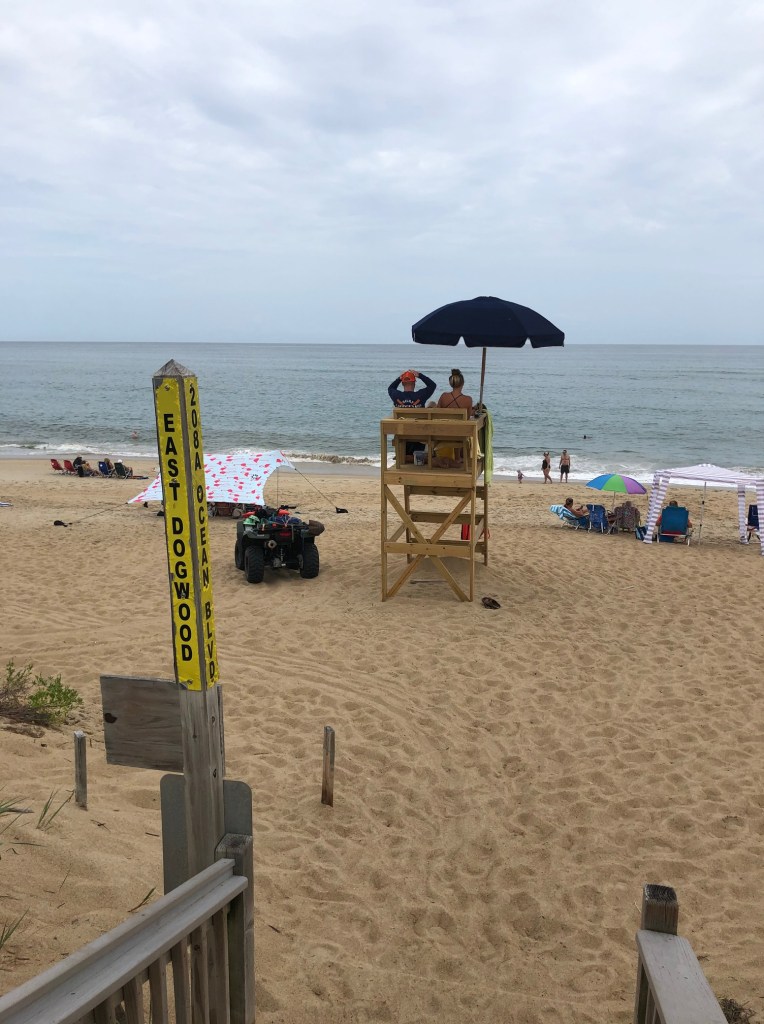
The SSCA owns the park and parking lot at the Duck Road split where the cell tower is located. Parking permitted along certain roads, such as East Dogwood Trail, near the SSCA’s beach access, is regulated by the Town.
The recent rapid increase in Dare County-reported COVID-19 cases is being driven by “viral spread in the workplace from prolonged exposure between co-workers,” according to an update Tuesday by the Dare County Dept. of Health and Human Services.
This “workplace spread,” the DCDHHS says in its COVID-19 Update No. 77, “is not linked to brief interactions between employees but rather meetings, lunch gatherings, and shared working spaces.”
This spread, abetted by people who are not observing COVID-19 safety protocols, such as wearing masks, is “also driving more spread among families,” the DCDHHS continues, “as workers are unknowingly bringing the virus home to their families before they realize they were infected.”
The workplace-to-family COVID-19 spread may account for a marked, and unusual, trend upward that The Beacon has observed recently in the number of cases reported by Dare County among people age 65 or older.
Of the 30 new cases reported on the DCDHHS dashboard yesterday, 13, or 43 percent, were in the 65-or-older age group, and 11 of them were Dare County residents.
On Tues., Jan. 19, eight of the 31 new COVID-19 cases, or 26 percent, were in the 65-or-older age group. On Sun., Jan. 17, the figures were 10 of 57 new cases, a more modest, but higher-than-usual, 18 percent.
On Monday, 50 percent of the four new COVID-19 cases reported were in the 65-or-older group, and both of those people were Dare County residents who required hospitalization.
(UPDATE: Nine of the 40 new cases reported today are in the 65-or-older age group, including a local woman who has been hospitalized. Twenty-one of the cases are Dare County residents, and 19 are nonresidents.)
The Beacon considers the number of hospitalizations an important indicator of disease severity and mortality risk and observes that DCDHHS’s hospitalization reports do not always add up.
We keep a daily record of dashboard reports and count 13 current hospitalizations, not the 12 the DCDHHS is reporting. The counting error occurred on Sunday when the reported hospitalization of a local girl age 17 or younger was not added to DCDHHS’s total. (UPDATE: The number should be 14 now.)
COVID-19 positivity rates have spiked locally with the increase in cases.
Between Jan. 12 and Jan. 19, 16.1 percent of the COVID-19 tests administered in Dare County were positive, according to the DCDHHS. The previous week the positivity rate was a very high 18.8 percent. Between Dec. 29, and Jan. 5, the rate was 14.9 percent.
Between Dec. 22 and Dec. 29, the Dare County positivity rate was 13.6 percent. Before the holidays, the positivity rates computed each week by DCDHHS were generally below 10 percent.
Dr. Mandy Cohen, Secretary of the N.C. Dept. of Health and Human Services, has repeatedly said that any rate above 5 percent is too high. It is one of the many metrics that Dr. Cohen has found “worrisome” as COVID-19 continues to spread throughout North Carolina.
The positivity rate at the state level has not been 5 percent or lower since last spring.
According to this dashboard, the DCDHHS had administered, as of last Sunday, 1,699 doses of the Moderna vaccine. The dashboard does not indicate whether those doses were only first doses or first and second doses of the two-dose vaccine.
The dashboard also reports that 3,878 vaccination appointments have been scheduled in Dare County between Jan. 20 and Feb. 6, and 3,218 people are on a waiting list for an appointment.
Currently, all adults age 65 or older, regardless of their health status or living situation; all healthcare workers with high exposure to COVID-19; and all residents and staff of long-term care facilities are eligible to receive a COVID-19 vaccine. Frontline essential workers are in the next priority group.
If you are eligible, you may register online for a vaccination appointment at: Vaccine Registration | Dare County, NC (darenc.com). A Dare County employee will call you with an appointment time, when one is available.
The NCDHHS also has a vaccine dashboard. According to it, 2,025 first doses and 193 completed doses (first and second) had been administered in Dare County through Monday, Jan. 18.
Statewide, the NCDHHS reports 344,456 first doses and 60,073 completed doses of a COVID-19 vaccine had been administered through Jan. 18.
Do the figures for first doses and completed doses overlap? The NCDHHS dashboard does not make this clear. We do not believe they do.
As of yesterday, according to the COVID Data Tracker of the U.S. Centers for Disease Control and Prevention, 1,118,250 doses of COVID-19 vaccine had been distributed to North Carolina, which had administered a total of 427,480 doses.
The number of people receiving one or more doses in North Carolina as of yesterday, the CDC says, was 368,818, while 58,407 people in our state had received two or more doses.
Only 3.5 percent of North Carolina’s population has received a first dose, a percentage that ranks it 43rd among the 50 states.
The states that are doing a poorer job than North Carolina in vaccinating its population are Georgia, Idaho, California, Missouri, South Carolina, Nevada, and Alabama, which ranks dead last.
As of today, the NCDHHS reports, 8,339 people have died of COVID-19 in North Carolina, and 3,666 people are currently hospitalized for treatment.
Nationally, the CDC reports, 35,990,150 doses of vaccine have been distributed, and states collectively have administered 16,525,281 of those doses. A total of 14,270,441 people have received one or more doses, and 2,161,419 have received two or more doses.
Overall, then, 4.3 percent of the U.S. population has received a first dose, and 0.7 percent have received two doses, according to the CDC.
NEW CDC DIRECTOR ROCHELLE WALENSKY
We happened to catch an excellent interview last Sunday on “Face the Nation” with new CDC Director Rochelle Walensky, M.D., M.P.H., who was, until her appointment, the chief of the Division of Infectious Diseases at Massachusetts General Hospital (“Mass General”) and a professor of medicine at Harvard Medical School.
Dr. Walensky, who has been involved in the nation’s COVID-19 response from the beginning, is a powerhouse physician/scientist whom the federal government is fortunate to hire. She is an expert in HIV and AIDS.
We bring up this interview because Dr. Walensky said Sunday that, although President Biden’s goal of vaccinating 100 million people within the first 100 days of his administration is ambitious, it can be done.
Dr. Walensky also referred to the “tens of thousands of people,” known as long haulers, who are coping with persistent COVID symptoms after they have “recovered”—meaning after they have tested negative for COVID-19.
The Beacon takes all reports of “recoveries,” including those the DCDHHS regularly reports, with a large grain of salt. A presumed recovery is not a confirmed recovery. The Beacon also has learned of Dare County residents who tested positive for COVID-19 and were never tested again.
(Dr. Sheila Davies, Dare County’s public health director and director of DCDHHS, is not a scientist or a medical professional. According to her Linked-in profile, Dr. Davies earned two doctoral degrees–one in health policy analysis and the other in public policy and administration–from Walden University, an online university headquartered in Minneapolis.)
We have reported on long haulers in several previous blogs. We are eager to learn more about how long haulers, many of whom are in their 20s, 30s, and 40s, are faring, and why certain people are predisposed to COVID-19 symptoms that endure for months. (We have read some theories.)
We also would like to know if infectious disease experts have reason to believe these symptoms, which include shortness of breath, fatigue, muscle weakness, and “brain fog,” could be permanent.
We will be attending a Johns Hopkins Medicine COVID-19 update webcast on Feb. 3 and will report what we learn. Johns Hopkins has a COVID-19 survivors clinic, just as the Mass General has.
Dr. Walensky received her M.D. in 1995 from the Johns Hopkins School of Medicine and trained in internal medicine from 1995 to 1998 at Johns Hopkins Hospital. She then did a fellowship in infectious diseases at the Mass General. In 2001, she earned a Masters in Public Health from the Harvard School of Public Health.
No Senate confirmation is required for Dr. Walensky’s appointment. She assumed office yesterday, succeeding Dr. Robert Redfield.
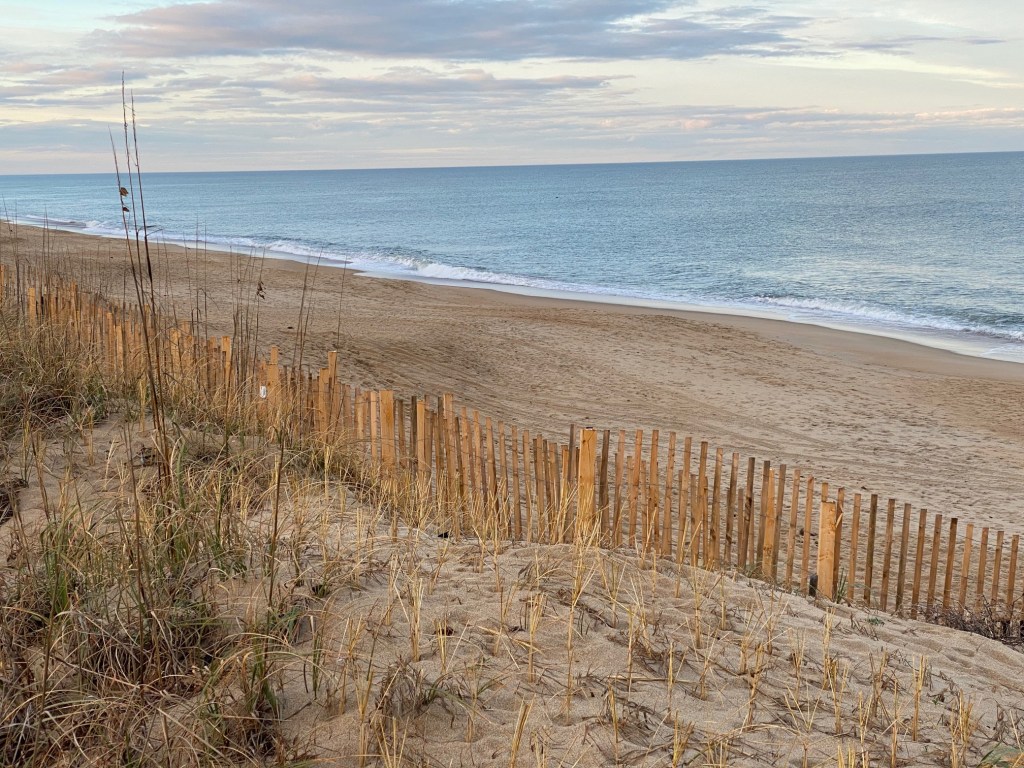
It is well-known, coastal environmental experts say, that the beach is at its widest in August. This photo was taken Aug. 3, 2020. The beach is in perpetual motion, annually undergoing erosion and accretion (the addition of sand).
The Southern Shores Town Council agreed by consensus this morning to a preference for a slightly modified version of Option 1, which outlines two municipal service districts, from among the three MSD boundary options recommended by Town Manager Cliff Ogburn for purposes of assessing increased property taxes for the town’s 2022 beach-nourishment project.
(See The Beacon, 1/18/21, for background.)
Mr. Ogburn will take the guidance he received from the Council at today’s workshop meeting and incorporate it into an MSD proposal for Council members to consider at their Feb. 2 regular meeting.
The Beacon will post this proposal as soon as it is available on the Town website.
Option 1 has two MSDs:
*MSD 1, which includes all oceanfront properties, which Mr. Ogburn described as those that “abut” the ocean, and all properties within the Pelican Watch development; and
*MSD 2, which includes 1) all properties on the west side of Ocean Boulevard, from the southern end of town to around the Duck Road split; 2) all properties north of the split and east of Duck Road, including Seacrest Village, that are not oceanfront; and 3) all oceanside properties that are east of Ocean Boulevard, but do not abut the ocean, and are between the Duck Road split and Hickory Trail.
In the latter category are properties on Sandpiper, Purple Martin, and Mockingbird lanes, three block-long, dead-end streets off of Ocean Boulevard that have some of the older homes in Southern Shores.
The Council modified the original version of Option 1 to eliminate an MSD-2 designation for some of the properties in Pelican Watch, proposing that they all be considered in MSD-1, which will be the highest-taxed district.
The Town is seeking to raise $6.2 million in taxes from the MSD properties over a five-year period, according to Mr. Ogburn, or about $1.24 million per year. This assumes a beach-nourishment project costing between $14 million and $16 million.
The Council engaged in a long, wide-ranging, and thoughtful discussion about the three MSD options and the tax-rate increases that might be assessed to properties within them.
Mayor Pro Tem Elizabeth Morey and Councilmen Jim Conners and Matt Neal were the most active participants, each accounting for points to consider that the other two did not raise. The Beacon will share some of their viewpoints—all of which served constituents’ interests—in a future blog.
The purpose of this morning’s MSD discussion was to zero in on the proposed district boundaries, not to set tax rates, which the Town Council will determine in its fiscal year 2021-22 budget meetings.
A public hearing on the MSDs, described by Mr. Ogburn as a “pretty significant event for the town,” is tentatively scheduled for March 16.
Prior to the Council’s consideration of the MSD options, consultant Ken Willson of Coastal Planning and Engineering of North Carolina gave a report on the changes in the condition of the Southern Shores beaches between December 2017 and June 2020.
(For the questionable value of short-term data, see The Beacon, 9/20/19.)
We will abstain from reporting on this update until after we have had a chance to read Mr. Willson’s report to the Town, which is currently in draft form.
As Councilman Conners aptly put it, Mr. Willson’s presentation was “quite a bit to digest,” and we need time to do so.
One impression that Mr. Willson reinforced for us was that the four-mile-long Southern Shores shoreline varies considerably in terms of erosion and the need for nourishment.
The southern end is well-known historically and in modern times for its high rate of erosion and volume of sand loss; Pelican Watch is on the same site as the old Sea Ranch Hotel, which was swept away in the Ash Wednesday Storm of 1962, along with every other structure in the vicinity of the Kitty Hawk Pier. This will always be a hot spot.
The so-called “central” area between Chicahauk Trail and Third Avenue is, and has always been, stable and has actually gained sand.
The northern end can only be characterized by looking at the data from different beach profile stations, which Mr. Willson did not provide. What has happened to the oceanfront at Seventh Avenue does not necessarily track with the beach at 11th Avenue or at the Hillcrest Beach.
Indeed, it was not until the Town Council altered the longtime goal of the Town’s beach management plan from storm-damage protection to the preservation of a “useable beach width” that the northern end was even targeted in a beach nourishment project.
(For background on the change in goal, see The Beacon, 1/19/20.)
Mr. Neal referred several times to the “many heritage and legacy properties” on the oceanfront that have been in families for generations and “will feel the brunt of the tax burden.” These same property owners may not be able to “pass on” the cost of increased taxes to renters because they do not rent.
Mr. Neal suggested that these longtime family-property owners look into the prospect of having their homes designated as historic landmarks.
We will report more when we can! You may view the videotape of today’s meeting, which lasted two hours and 41 minutes, at Southern Shores – YouTube.
Southern Shores has always had stable beaches that restore themselves after seasonal storms cause erosion. The town’s 2022 beach nourishment project is based on hypothetical future damage mitigation, not on current need or past trends. Dare County Manager Bobby Outten has referred to the project as “proactive.”
The Southern Shores Town Council may decide at its 9 a.m. workshop meeting tomorrow the boundary lines of municipal service districts (MSDs) that it will propose using to assess beach-nourishment taxation on property owners, starting in the 2021-22 tax year.
The Council will meet in the Pitts Center, subject to COVID-19 safety protocols.
Town Manager Cliff Ogburn has recommended three options for the MSD boundary lines, each of which he has outlined with corresponding tax increases for the properties located within these districts.
These options derive from MSDs drawn and proposed last winter by Town staff with the assistance of Town Council—chiefly Councilman Matt Neal—before the Council’s March 24 budget hearing. The boundaries are based on proximity to the beach and on the assessed value of the properties within the defined districts.
Any additional ad valorem tax that is levied on Southern Shores property owners to pay for the 2022 townwide beach nourishment project would be assessed annually for the duration of the debt service. It would be levied in perpetuity, at a rate to be determined, if the Town “maintains” renourishment on what is usually a five-year cycle.
The Town’s 4-mile-long project has been estimated, but not confirmed, to cost between $14 million and $16 million.
In each of the three proposed options, MSD-1 is defined as all property “abutting the Atlantic Ocean.” The proposed increase in taxes on oceanfront property owners ranges from a low of 25.98 cents more per $100 of assessed property value to a high of 33.36 cents per $100 of value.
The high-end tax is proposed in an “Option 3” in which there would be only one MSD, the oceanfront, and OF property owners would pay 75 percent of the revenue that the Town must raise to fund its nourishment project.
The other two options carve out an MSD-2, which appears to include all of the westside properties on N.C. Hwy. 12 (Ocean Boulevard) until the Duck Road split. North of the split, properties are treated differently, according to the option.
Properties that are north of the split, but east of Hwy. 12 (Duck Road) are included in the MSD-2 proposed in “Option 1.” An “Option 2” reduces this MSD-2 to include only the second and third row of properties back from the ocean and east of Duck Road. (See the illustrations in the meeting packet.)
Property owners in the proposed MSD-2 pay either an additional 9.23 cents per $100 of value or an additional 12.02 cents per $100.
Every other property owner in Southern Shores would pay an additional 1.96 cents per $100, or what the Town has calculated to be a collective 25 percent of the revenue that needs to be raised, regardless of which MSD option is selected.
Although N.C. law requires a town to attest that a proposed district is in need of beach nourishment to a “demonstrably greater extent than the rest” of the districts in town—thus, justifying what would otherwise be an unconstitutional tax burden— Southern Shores has based its MSD designations strictly on how much money it can raise per district.
No justification has ever been given by the Town for its determination of the percentage of cost that property owners in the proposed MSDs and townwide should bear. If it used other Dare County towns’ beach nourishment funding schemes/percentages for its model, it has not said so.
N.C. law requires a town to hold a public hearing about the proposed MSDs and permits property owners to seek exclusion from a district. Owners may request exclusion by the Town Council at the public hearing or submit a written request for exclusion to the Council up to five days after the hearing date.
A timeline for the public hearing and the Council’s approval of the proposed MSDs—which requires two votes—is included in the meeting packet. We will discuss the timeline after the Council makes its decision about the MSDs.
Also on the agenda tomorrow are a presentation by Ken Willson of Coastal Planning and Engineering of North Carolina about his firm’s 2020 Southern Shores beach monitoring report and an update by Mr. Willson on the permitting and design for the Town’s beach nourishment project.
It is unfortunate that the results of CPE-NC’s beach monitoring last year are not in tomorrow’s meeting packet to be perused in advance.
We note further that the Town Council also will consider tomorrow whether or not it wishes to submit a proposal to participate in the N.C. Dept. of Environmental Quality’s Division of Air Quality’s program promoting zero-emission vehicles by funding charging stations. (See pp. 12-31 of the meeting packet.)
You may attend the Town Council meeting in-person, provided you wear a face covering and observe COVID-19 safety protocols.
The meeting will be live-streamed on YouTube at Southern Shores – YouTube. We have been assured by Mr. Ogburn that the video feed, this time, will be audible.
There will be one public-comment period before the business agenda. If you do not wish to attend the meeting, but would like to comment, you may email your remarks to info@southernshores-nc.gov. Please write “public comment” in the subject line.
ALSO TOMORROW: The Town Planning Board will meet at 5:30 p.m. in the Pitts Center to begin its final review of CodeWright’s rewrite of the Southern Shores Town Code, a controversial project that is now 6 ½ years in the making.
North Carolina will make COVID-19 vaccines available to anyone age 65 or older, Governor Roy Cooper told county commissioners this morning, according to a breaking news report in The Raleigh News & Observer.
The change in the state’s phased system for distributing the vaccine conforms to a change in federal guidelines announced Tuesday by Alex Azar, U.S. Secretary of Health and Human Services—just two hours before the Governor held his latest COVID-19 update briefing in Raleigh.
Governor Cooper expressed frustration at his briefing with the federal government’s shifting advice “on what the priorities of the vaccine should be,” but told reporters he would evaluate the new recommendation with his public-health advisers and make a decision. He has made it.
According to media reports, Mr. Azar said Tuesday that vaccinating everyone age 65 or older would speed up the vaccination process nationwide, which has been lagging. Medical experts believe the acceleration will further the goal of herd immunity to the coronavirus, which many say requires up to 80 percent of the population to be vaccinated.
Mr. Azar also announced that the U.S. government would ship all of the vaccine it currently has on hand, rather than holding back some for the second doses that both the Pfizer/BioNTech and Moderna vaccines require.
The Trump Administration’s policy previously had been to withhold vaccine to ensure the availability of second doses, in the event manufacturing problems occurred.
President-elect Joe Biden recently announced that, upon his inauguration, he would order the shipment of all vaccine on-hand, contending, as Mr. Azar did Tuesday, that vaccine production has become reliable enough that second doses could be shipped directly from manufacturers to the states.
To implement this change in the N.C. vaccination system, the county health departments, including Dare County’s Dept. of Health and Human Services, will have to ramp up. But first, the State will have to improve its distribution system. We would expect DCDHHS Director Sheila Davies to address how Dare will manage this new directive soon. Stay tuned.
According to today’s N.C. Dept. of Health and Human Services vaccine dashboard, Dare County had vaccinated 1,461 people with first doses and 192 people with first and second doses, as of yesterday at 11:59 p.m.
(Yes, we’re still on break, but we thought this announcement and news yesterday of another Dare County resident’s death due to COVID-19 were worthy of our making exceptions.)
A seventh Dare County resident has died of COVID-19, according to a dashboard update tonight by the Dare County Dept. of Health and Human Services, which also reported 55 new COVID-19 cases.
The DCDHHS provided no identifying or circumstantial details about the person who died, although it would appear from the dashboard that he or she was not hospitalized. For the past five days, 12 Dare County residents have been reported as hospitalized, the last one being a woman age 65 or older who was admitted on Jan. 9.
Of the 55 new COVID-19 cases reported today, 39 are Dare County residents, and 16 are nonresidents. Varying widely in age and representing all age groups, the 55 people are in home isolation.
The Beacon extends its sincere condolences to the loved ones of the person who lost his or her life.
Consultant Ken Willson of Coastal Protection Engineering of North Carolina (CPE-NC) will discuss the results of his firm’s recent Southern Shores beach survey/monitoring and give a briefing on the design and cost of the Town’s planned 2022 beach nourishment project at a Town Council workshop meeting Jan. 19 at 9 a.m. in the Pitts Center.
The meeting agenda also shows that the Town Council will discuss the boundaries of proposed municipal service districts that would be drawn for the purpose of imposing a higher tax burden on some Southern Shores property owners than on others for beach nourishment.
For a report about Dare County’s financial contribution to the Southern Shores project, as well as to other towns’ projects, and proactive suggestions by the Nags Head Board of Commissioners for identifying other sources of beach nourishment funding than just the County and local property taxpayers, see The Beacon, 1/10/21.
The Beacon is taking a week off and will resume publication on Monday, Jan. 18, at which time we will report on information in the Council’s Jan. 19 meeting packet.
Jan. 18 is Martin Luther King Jr. Day, a national holiday.
The following two town meetings are also scheduled to be held in the Pitts Center next week:
Tues., Jan. 19, TOWN PLANNING BOARD MEETING, 5:30 p.m.
The Planning Board, which has not met for months, will begin its final review of consultant CodeWright’s rewrite/update of the Southern Shores Town Code. According to the Town’s meeting notice, the five-member Board will review the following revised Town Code chapters: ch. 4, definitions; ch. 22, zoning; ch. 26, subdivisions; and ch. 28, flood damage prevention.
Thurs., Jan. 21, TOWN STREETS COMMITTEE, 2 p.m.
The Streets Committee, formerly known as the Capital Infrastructure Improvement Planning (CIIP) Committee, has not released a meeting agenda. The committee is co-chaired by Town Councilmen Matt Neal and Jim Conners.
All three of the meetings next week are open to the public, subject to COVID-19 safety protocols, but only the Town Council meeting will be live-streamed on You Tube.
The Town Council will hear public comments, which may be presented in person or submitted by email in advance to info@southernshores-nc.gov. Please indicate “public comments” in your subject line.
The Planning Board and Streets Committee also may hear public comments, but neither is required by formal rule or policy to do so.
COVID-19 ROUNDUP: SUPER STRAINS AT THE U.S. GATES
We promised a roundup on COVID-19 today before our break, but we have little local and state news to report.
Both the Dare County Dept. of Health and Human Services and the N.C. Dept. of Health and Human Services reported lower numbers of new COVID-19 today than in the past week—which is in line with Monday trends.
The results of COVID-19 tests are ready within 24 hours, and Monday dashboard reports are usually the lowest of the week.
After reporting a record-high 75 new COVID-19 cases yesterday, the Dare County DHHS reported just 11 cases today, 10 residents and one nonresident.
The NCDHHS reported 5,936 new COVID-19 cases today—two days after reporting a record-high 11,581 cases—and 3,843 hospitalizations, an increase of 69 over yesterday.
Eleven more people in North Carolina died of COVID-19 during the most recent 24-hour period, bringing total fatalities to 7,578.
Because the coronavirus has infected so many millions of people around the world, it has had more opportunity to mutate, and it is adapting to become better at infecting people. It has seized a competitive advantage, you might say.
No doubt you have read about the new “super strains” that are reportedly 50 percent more infectious than the first variant of the Sars-CoV-2 virus.
According to www.webmd.com and other news sources, the super strain from the United Kingdom is already in the United States, and the highly contagious strain from South Africa could be on its way.
The so-called U.K. variant has been detected in Colorado, California, Georgia, New York, Florida, Texas, Pennsylvania, and Connecticut.
Dr. Ashish Jha, dean of the Brown School of Public Health projected last week that as the new strains “take hold in the United States,” according to WebMD, “they could cause an additional 10 million new infections by the end of February and as many as 150,000 more deaths.”
Viruses mutate all of the time, but that does not necessarily mean that they become more harmful. Because of its pervasiveness, however, experts believe the first SARS-CoV-2 virus variant mutated in order to outperform other viruses around it.
Both the U.K. strain and the South Africa super strain have the same mutation on their spike proteins, but each strain developed the mutation independently, according to scientific reports.
The spike proteins on the virus attach to ACE2 receptors on human cells in order to cause infection. This receptor is the virus’s portal or door, if you will, into the body.
ACE2 stands for angiotensin-converting enzyme, and the receptors are essentially proteins on the surfaces of many cell types, including those in the lungs and heart.
The coronavirus’s increased potency is a good reason for stricter measures to control its spread, such as those cited in NCDHHS Secretary Mandy Cohen’s recent Secretarial Directive, which stresses staying at home except for essential activities, limiting contact with people outside of one’s household, and always wearing a mask indoors when in the presence of people outside of one’s household.
From what we read, experts believe that the approved COVID-19 vaccines will work against the super strains, but pharmaceutical companies are running clinical tests now to make sure. Preliminary results are encouraging.
The vaccines will not help, however, if they are not made more widely available, more quickly.
According to the U.S. Centers for Disease Control COVID Data Tracker, North Carolina had received as of Jan. 11 820,825 doses of vaccine, but only 211,572 first doses had been administered to people. See CDC COVID Data Tracker
The NCDHHS vaccine dashboard shows 151,902 first doses having been administered to people as of Jan. 8, with 9,115 people having received both doses. The dashboard reports 946 first doses having been given in Dare County. The DCDHHS held another vaccination event yesterday in Kill Devil Hills whose numbers would not be included in this accounting.
We also remain interested in the health status of people infected with COVID-19 who are “long haulers,” i.e., people who experience symptoms weeks or months after they have “recovered.”
The most common long-COVID symptoms are reportedly extreme fatigue, shortness of breath, and cognitive confusion (“brain fog”).
Some major institutions nationwide, including Johns Hopkins Hospital and the Massachusetts General Hospital, have established COVID-19 survivors clinics to study long haulers and to treat them.
Seventy-five new COVID-19 cases were reported today on the Dare County Dept. of Health and Human Services’ dashboard, a new single-day record high.
Forty-seven of the 75 cases are Dare County residents, and 28 are nonresidents.
Yesterday the DCDHHS reported that a local woman age 65+ had been hospitalized for COVID-19.
The State of North Carolina set a new record on Saturday when the Dept. of Health and Human Services reported 11,581 new COVID-19 cases in a 24-hour period.
Hospitalizations declined slightly statewide to 3,774 today, while COVID-19-related deaths climbed to 7,567.
We will post a COVID-19 roundup tomorrow before taking a week off to attend to other business.