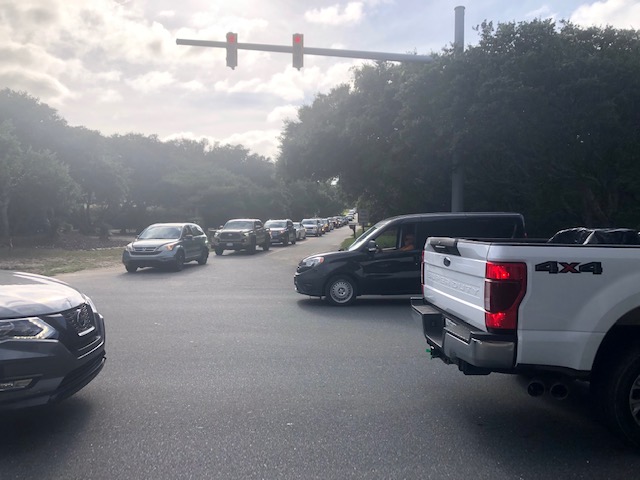
No sooner had we mentioned the unusually heavy cut-through traffic yesterday than Beacon reader Greg Pensabene submitted this photo of the traffic backed up on Sea Oats Trail, at the Hwy. 12 intersection, around 4:45 p.m., to prove it. Vacationers fleeing COVID-19 elsewhere are driving an increase in post-Labor Day occupancy at Outer Banks rental properties, extending the summer into October.
The Dare County League of Women Voters, in partnership with the N.C. Coastal Federation, is sponsoring virtual candidate forums via Zoom later this month for the Dare County Board of Commissioners and Dare County Board of Education races.
We congratulate the Dare LWV for bringing voters their traditional election-year forums for local candidates despite the COVID-19 pandemic. Dare County voters have no other opportunity than these events to see and hear their potential representatives respond in a nonpartisan setting to questions that they themselves ask.
The eight candidates running for the five seats up for election on the County Board of Commissioners will appear in a webinar on Tues., Sept. 22, from 7 p.m. to 8:30 p.m.; and the five candidates vying for a seat on the Board of Education will appear in a webinar on Thurs., Sept. 24, from 7 p.m. to 8:30 p.m.
After you register to attend the virtual forum, a link enabling you to join the webinar at the assigned date and time will be emailed to you.
ABOUT THE BOARDS, THE CANDIDATES
Each of the county boards has seven members, who represent a total of five geographic districts in Dare and serve four-year staggered terms. Elections take place in November of even-numbered years.
District 1 covers Roanoke Island and the Dare County mainland and is served by two commissioners and two BOE representatives. District 2 encompasses Nags Head, Colington, and Kill Devil Hills and is also served by two representatives on each board. District 3 includes Duck, Southern Shores, and Kitty Hawk, and District 4 covers Hatteras Island. District 5 is an at-large district.
The seven members of each board elect their own chairperson and vice-chairperson.
The chairperson of the Dare County Board of Commissioners also serves as the chairperson of the Dare County Control Group, which is the county’s governing body in an emergency, such as the one we are currently experiencing with the COVID-19 pandemic.
All of the BOC and BOE candidates whose names appear on your 2020 ballot (see photo above for back side of the two-sided ballot) are participating in the League’s forums, even those who are running unopposed. They include, in the order that they are listed on the ballot:
BOC, District 1: Wally Overman, Republican, unopposed
BOC, District 2: Amanda Hooper Walters, Democrat; Robert L. (Bob) Woodard, Sr., Republican
BOC, District 3: Steve House, Republican; Kathy McCullough-Testa, Democrat
BOC, District 4: Danny Couch, Democrat, unopposed
Both Mr. House, the current District 3 (Southern Shores, Duck, Kitty Hawk) incumbent, and Ms. McCullough-Testa live in Southern Shores.
There currently are no women or African Americans on the Dare County Board of Commissioners.
The candidates running for a seat on the Dare County Board of Education include, as they are listed on the ballot:
BOE, At-Large: Charles Parker, Democrat; David Twiddy, Republican
BOE, District 1: Bea Basnight, Democrat; Carl Woody II, Republican
BOE, District 2: Jen Alexander, Democrat; Susan Bothwell, Republican
BOE, District 4: Mary Ellon Balance, Republican, running unopposed
Mr. Twiddy, of Manteo, is the District 5 incumbent; his opponent, Mr. Parker, lives in Kill Devil Hills. Both Ms. Basnight, who is the current BOE chairperson, and Mr. Woody are from Manteo.
Ms. Alexander, of Colington, and Ms. Bothwell, of Nags Head, are vying for the District 2 seat that incumbent Harvey Hess is vacating at the end of his term.
Ms. Balance, of Hatteras, is the incumbent District 4 representative. She also serves currently as vice chairperson.
As The Beacon reported on 9/11/20, Margaret Lawler, a Southern Shores homeowner, currently represents District 3. Her term expires in November 2022.
There currently are three women and four men on the Board of Education, one of whom is African-American.
The League is already collecting questions for the candidate forums. You may submit questions for the BOC and BOE candidates by email to DareLWV@gmail.com. Be sure to specify the forum and include your name and town of residence.
Both virtual forums will be videotaped and available to be viewed on YouTube, Current TV, and other local media outlets.
PLANNING BOARD VACANCY
A vacancy exists on the Town Planning Board for an alternate to serve out the remainder of the three-year term of Lynda Burek, who was appointed to the Board as a regular member on Aug. 18.
Ms. Burek, who replaced regular member Don Sowder on the full Board, initially was appointed on Jan. 7, 2020 to replace Tony DiBernardo as first alternate to the Planning Board after Mr. DiBernardo was named on the same day to the full Board. The first alternate’s term runs until June 30, 2021.
Second Alternate Robert McClendon, who also was appointed Jan. 7, 2020, replaced Michael Basilone, who resigned. Mr. McClendon’s term also runs through June 30, 2021.
Mr. Sowder resigned from the Planning Board on Aug. 1, after just a year. Ms. Burek will serve out the remainder of his term, which runs until June 30, 2022.
If you are interested in applying for the Planning Board vacancy, which is a voluntary position, you may submit an application to info@southernshores-nc.gov or to the Town Hall, 5375 N. Virginia Dare Trail, Southern Shores, NC 27949.
You will find an application form, as well as information about the Planning Board, which also serves as the Town Board of Adjustment, at:
Besides Ms. Burek and Mr. DiBernardo, Southern Shores homeowners Ed Lawler, David Neal, and Andy Ward are on the Planning Board. Mr. Ward is the chairperson.
John Finelli serves on the Board as the Extraterritorial Jurisdiction representative, voting only on matters pertaining to Martin’s Point. Mr. Finelli is a Dare County appointee.
CUT-THROUGH TRAFFIC STUDY
As expected, the Town Council unanimously approved on Sept. 1 the hiring of a traffic engineer consultant to conduct a study of the Southern Shores summertime traffic and make recommendations for relieving the cut-through traffic and otherwise improving congested conditions. It is anticipated that Town Manager Cliff Ogburn will present to the Council at its Oct. 6 meeting the proposals he has received from consultants so that it can choose the one to conduct the study, which the Council authorized funding up to $7,500.
The Beacon will update this story as soon as we can. We found it ironic that certain Town Council members insisted at the Sept. 1 meeting that the study be conducted without “emotion” and “bias” when, in fact, their bias against doing anything about the cut-through traffic has thwarted discussion about previous action initiatives for years.
Yesterday we observed a steady flow of vacationer traffic heading north on Hickory Trail, which was the heaviest around 4 to 5 p.m. We cannot recall ever noticing weekend cut-through traffic this late in the calendar year.
Dare County lately has been reporting few new COVID-19 cases, and nearly all of them can be traced to direct close contact with a person known to be infected. We will give you the latest COVID-19 numbers in our next report.
U.S. flags are to fly at half-staff today from sunrise until sunset.
On Tuesday, Sept. 11, 2001, 19 men hijacked four airplanes bound for the West Coast of the United States and carried out the deadliest terrorist attack ever on U.S. soil in a mission orchestrated by al-Quaida leader Osama bin Laden.
“Where were you when you first heard about the 9/11 attacks?” became the historic question of a lifetime for a new generation of Americans, just as “Where were you when you heard about JFK being shot?” was for an earlier one.
Sept. 11 is now commemorated as Patriot Day, which is alternately known as National Day of Service and Remembrance, and U.S. and state flags fly at half-staff from sunrise to sunset.
Today we remember the 2,977 people who died as a result of the attacks on the twin towers of the World Trade Center and the Pentagon, and the crash of United Flight 93 in Shanksville, Pa., as well as those who lost their lives later because of their exposure to the toxic environment of the crash scenes and other damage they suffered that did not kill them immediately.
We also think about the loved ones of the thousands of people who died on 9/11 because we know their pain endures. It is the fate of all survivors that no matter how or when their loss occurs, there will always be some pain, if the love was genuine.
Today we recall the devastating events of 19 years ago because in divisive times, like those in which we are living now, we believe that the observance of a national day of remembrance is unifying. It reminds us of what we have in common and share. We are all joined as a people in our feelings of loss, our desire for remembrance, and our belief in hope. We all want things to be better.
Friday trash collections in Southern Shores ended last week with the Labor Day weekend. If you wheeled out your garbage can for trash collection today, you will be wheeling it back (if you would, please), still filled with garbage.
The Town’s Monday trash collection continues, as usual, year-round, and the recycling pickup remains on Wednesday mornings.
Southern Shores Town Manager Cliff Ogburn suggested at the Sept. 1 Town Council meeting that a temporary resumption of trash collections on Friday may occur, if vacation home occupancy in September and October warrants it. But, as of now, there is no plan to resume it.
PLEASE NOTE: The Town Council workshop meeting scheduled for Tuesday, Sept. 15, at 9 a.m., has been canceled.
CANDIDATE FORUMS
The Beacon has been relatively quiet this month because we have been very busy elsewhere. We are keeping an eye on local news, but doing very little reporting. This status should continue through most of September, but we do plan to post occasional updates of news highlights, including one this weekend.
Please mark your calendars for the following candidate forums sponsored by the Dare County League of Women Voters, in partnership with the N.C. Coastal Federation, and presented as Zoom webinars:
*The Dare County Board of Commissioners candidate forum will be held Tuesday, Sept. 22, at 7 p.m.
*The Dare County Board of Education candidate forum will be held Thursday, Sept. 24, at 7 p.m.
Two Southern Shores residents are vying for the District 3 seat of the Board of Commissioners, which represents Southern Shores, Duck, and Kitty Hawk. They are Kathy McCullough-Testa, a Democrat, and incumbent Steve House, a Republican.
Board Chairman Bob Woodard also has competition for his District 2 seat, which represents Nags Head, Colington, and Kill Devil Hills. His opponent is Democrat Amanda Hooper Walters.
Three of the four Board of Education seats up for election are being contested: an at-large position and representatives for Districts 1 and 2. Southern Shores homeowner Margaret Lawler, who represents District 3 on the seven-member Board, which includes Southern Shores/Duck/Kitty Hawk, is in the middle of her four-year term.
We will provide details about the candidate forum webinars in our upcoming news update.
The front of the new SSVFD fire station at 15 S. Dogwood Trail as it appeared today.The station is expected to be operational later this month.
Police arrested Ken A. Kelley of North Dogwood Trail in Southern Shores on Aug. 29 and charged him with various drug-dealing and drug possession offenses after executing a search warrant at his residence and seizing “a large amount of marijuana, drug paraphernalia and drug equipment,” according to a media statement released yesterday by the Southern Shores Police Dept.
The Department’s release also announced three other recent felony drug-related arrests in Southern Shores, but only one was of a town resident.
This is the second time in a month that law enforcement officials have arrested a North Dogwood Trail resident for drug crimes. On Aug. 5, the Dare County Sheriff’s Office conducted a traffic stop on South Dogwood Trail near the Kitty Hawk Elementary School and arrested Carlton Lynn Morris, Jr., charging him with trafficking in heroin and possession of cocaine, the Sheriff’s Office reported last month.
Mr. Kelley was reportedly released on a $4,000 secured bond.
Mr. Morris was released previously on a $15,000 secured bond, according to the Dare County Sheriff’s Office, which credited the Camden County Sheriff’s Office with assisting in its investigation and arrest.
Mr. Morris was described by the Dare County Sheriff’s Office as being a resident of the 300 block of North Dogwood Trail. The Southern Shores Police Dept. did not provide a block address for Mr. Kelley in its statement.
North Dogwood Trail is a tree-lined, lightly traveled road that runs along the Currituck Sound. The peaceful and picturesque street becomes a single lane at 291 N. Dogwood and dead-ends in a secluded cul de sac, where the highest numbered address is 341 N. Dogwood.
Among the charges filed against Mr. Kelley were felony possession with the intent to sell and deliver schedule VI (marijuana) and felony maintaining a dwelling, according to the Southern Shores Police announcement.
It would appear that Southern Shores has had a drug house on North Dogwood Trail—certainly rumors have been to that effect—but the police statement does not elaborate on the situation. The charge of “felony maintaining a dwelling” refers to maintaining a dwelling for use, storage, or sale of controlled substances.
During his report to the Town Council Tuesday evening, Police Chief David Kole said that most of the people arrested in town lately on drug-related charges are “not from here,” but rather from “across the bridge.”
Drug-related arrests have increased this summer over last summer, he said, an increase that he attributed to the pandemic and the influx of people to the Outer Banks. Southern Shores’ drug-related arrests have been the result of either traffic stops or “drug incidents we’ve been investigating over several months,” Chief Kole said.
Southern Shores police officers made seven drug-related arrests in July, according to the Chief’s report for that month. In August, he said, 16 total criminal arrests occurred, involving 37 charges, and 19 of those charges were drug-related. He did not specify how many of the 16 arrests were of people charged with drug-related offenses.
Chief Kole described the drug offenses as being for “dealing . . . selling and using,” in response to a question from a Town Council member about the nature of the offenses.
Overall, according to the Chief, the Police Department received 2,045 “calls for service” in July, an increase of 53 percent over the 1,338 calls received in July 2019. In August, he said, the Department received 1,873 calls for service, an increase of 49 percent over the 1,257 calls received in August 2019.
Chief Kole also announced that in the next two weeks Southern Shores officers will start wearing body cameras in the field.
(If you would like to read about the three other drug-related arrests made by the Southern Shores Police Dept., one of which was of a Virginia fugitive now living in Nags Head, we refer you to reports in The Coastland Times and OBX Today, which reproduced the press release. )
After his report to the Town Council, Chief Kole was asked about how many of the traffic citations issued by his officers in July and August were attributable to the cut-through traffic. His quick, precise response of “73 percent” elicited laughter.
If you would like to know how many citations 73 percent would be, we refer you to the YouTube videotape of the Town Council’s meeting and Chief Kole’s report therein.
The Beacon tuned into the Council meeting live via Zoom and had persistent problems with hearing the speakers, especially Chief Kole. In preparing this posting, we viewed a section of the YouTube meeting videotape and discovered, much to our surprise and delight, that not only could we hear every word of every speaker, but we could actually see speakers who are typically off-screen or who have their backs to the camera.
The videotape camera actually followed the action of the meeting and focused on speakers! When Town Manager Cliff Ogburn spoke, we could see his face, not just his back. It’s a breakthrough!
Watching the meeting on videotape turned out to be a far more productive exercise for us than joining it live on Zoom, a communication platform that will always show a static picture and be hampered by sound-quality issues.
Thanks to a roving videotape camera, we could see Chief Kole at the speakers’ lectern, as well as Fire Chief Ed Limbacher, who reported Tuesday that the architects of the new fire station on South Dogwood Trail will do a final walk-through with Town Building Inspector Buddy Shelton on Sept. 16-17. Once Mr. Shelton issues a certificate of occupancy, the SSVFD will move in, Chief Limbacher said.
THERE WILL BE GARBAGE PICKUP ON LABOR DAY, BUT NO MORE FRIDAYS
Today was the last scheduled garbage pickup this year in Southern Shores on a Friday. The Town returns to its off-season schedule on Monday. Please note: Garbage will be collected on Monday, Labor Day.
Mr.Ogburn left open the possibility that, if the tonnage of trash produced by visitors to Southern Shores continues in September and October to be as high as it was over the summer, Friday garbage pickups may resume for the short term.
FLAG FLYING AT HALF-STAFF
You may have noticed the North Carolina flag being flown Wednesday, yesterday, and today at half-staff. Governor Roy Cooper ordered all state flags at state facilities to fly at half-staff from Sept. 2 until sunset today in honor of former N.C. Representative Melanie Wade Goodwin, 50, who died Tuesday of breast cancer.
An attorney, Representative Goodwin served three terms in the N.C. House (2004-10), representing the 66th district, which includes Richmond and Montgomery counties and a part of Stanly County. In 2008, Ms. Goodwin became the first member of the N.C. General Assembly to give birth while in office, when her second daughter was born.
Representative Goodwin decided not to run for a fourth House term and was appointed to the N.C. Industrial Commission. She was Chief Deputy Commissioner of the Industrial Commission at the time of her death.
Gyms, health clubs, bowling alleys, and other exercise facilities may reopen at 30 percent capacity at 5 p.m. Friday, as North Carolina moves into what Governor Roy Cooper called at a briefing today Phase 2.5 of the state’s reopening.
Museums and aquariums, which, like the fitness facilities, have been closed since March, may reopen at 50 percent capacity, the Governor announced this afternoon, while “entertainment facilities,” such as bars, night clubs, movie theaters, amusement parks, and gaming establishments will remain closed.
Playgrounds may resume full operation.
The Governor also liberalized the maximum attendee capacity for indoor and outdoor “mass gatherings,” increasing the former from 10 to 25 persons and the latter from 25 to 50 persons.
All of the new regulations—which also include requiring children as young as 5 years old to wear face coverings—are detailed in the Governor’s Executive Order 163. Previously, the face covering mandate applied only to children over age 11. Capacity is defined as “stated fire capacity.”
The new Executive Order remains in effect until 5 p.m. on Friday, Oct. 2, unless it is rescinded or otherwise modified.
Yesterday Governor Cooper extended until Oct. 2 the so-called alcohol curfew, which requires restaurants, convenience stores, and other businesses to stop selling at 11 p.m. alcoholic beverages to be consumed on their premises. Sales may resume at 7 a.m.
On Aug. 5, the Governor said that the existing Phase 2 regulations would remain in place until 5 p.m. on Sept. 11. In easing restrictions a week early, Mr. Cooper cited the continued stability of statewide COVID-19 metrics, such as the number of new cases and the number of hospitalizations daily, but also noted that they still remain elevated.
“We’re encouraged,” he said, “but cautious.
“The forest isn’t as thick,” the Governor elaborated, “but we’re not out of the woods.”
Dr. Mandy Cohen, Secretary of the N.C. Dept. of Health and Human Services,” echoed the Governor’s caution as she updated the metrics, calling attention to the fact that the “positivity rate”—the percentage of positive test results in a daily batch of completed tests—is still above her 5 percent target. She also said that new cases “remain at a level that is too high.”
New N.C. cases reported today on the NCDHHS dashboard totaled 2,111. Yesterday’s dashboard total was 1,186, but case reports after a weekend are typically lower.
On Saturday, because of a backlog of case reports, a record-high 2,585 cases were registered. Subsequently, however, the NCDHHS dialed back the number of these cases to 1,699, citing an error.
Today’s dashboard shows 169,424 positive test results statewide, out of 2,295,698 completed tests, and 2,741 deaths since the COVID-19 crisis began.
Dr. Cohen characterized the past six months of living with COVID-19 as “difficult” and said that “the unfortunate truth is that this pandemic is not yet over.”
Both the Governor and the Secretary encouraged people to continue to wear face coverings and to observe social distancing and other infection-control measures, such as hand washing. Dr. Cohen urged people to get a flu vaccine this fall.
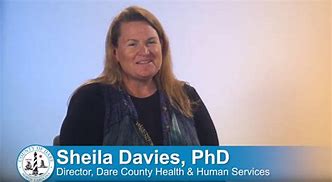
For the first time since she started posting details about how people who test positive for COVID-19 in Dare County acquired the virus, Dr. Sheila Davies did not describe an “unclear” transmission in her update yesterday as an indication of community spread. She simply stated that “it is unclear how this individual acquired the virus.”
This omission by the Director of the Dare County Dept. of Health and Human Services follows a statement she made in her Tuesday update that “Close contact continues to be the predominant way we are seeing the virus spread.”
In our COVID-19 report Tuesday, we drew attention to Dr. Davies’s emphasis on direct- contract transmission because we had not seen it before. For months now, whenever a person was deemed to have acquired the virus by “unclear”—or, perhaps more precisely, unrecognized or unknown—means, Dr. Davies has said he/she may have acquired it by community spread. In some of her updates, more than 50 percent of new cases were deemed to be possibly attributable to community spread.
According to the U.S. Centers for Disease Control and Prevention, community spread occurs when a virus spreads through an area, and cases occur in which people (and health officials) cannot identify the initial source of their infection.
The Beacon has long been skeptical of people’s ability to identify or even recognize when they have had direct contact with infected people, especially asymptomatic people who may transmit the virus. Self-reporting—i.e., simply asking someone if he/she has had contact with a person who tested positive for COVID-19 and then accepting that report as accurate—is inherently unreliable.
We have already rejected the assumption that an acquisition of the virus by “unclear” means indicates community spread, and we further question whether community spread of COVID-19 is even occurring in Dare County.
In her update yesterday, Dr. Davies reported on nine new COVID-19 cases since her Tuesday update. Six of them are nonresidents, and four of the six are college students. Of the three nonresidents, one is college-age.
This morning’s DCDHHS dashboard records 445 total COVID-19 positive cases in Dare County: 240 residents and 205 nonresidents.
For a sobering comparison, check out the COVID-19 dashboard of my alma mater, the University of North Carolina at Chapel Hill:
This morning the Carolina dashboard shows a total of 1,025 positive COVID-19 cases since February: 971 students and 54 employees. Eighty-five percent of the student cases—a total of 822—have been reported since Aug. 12.
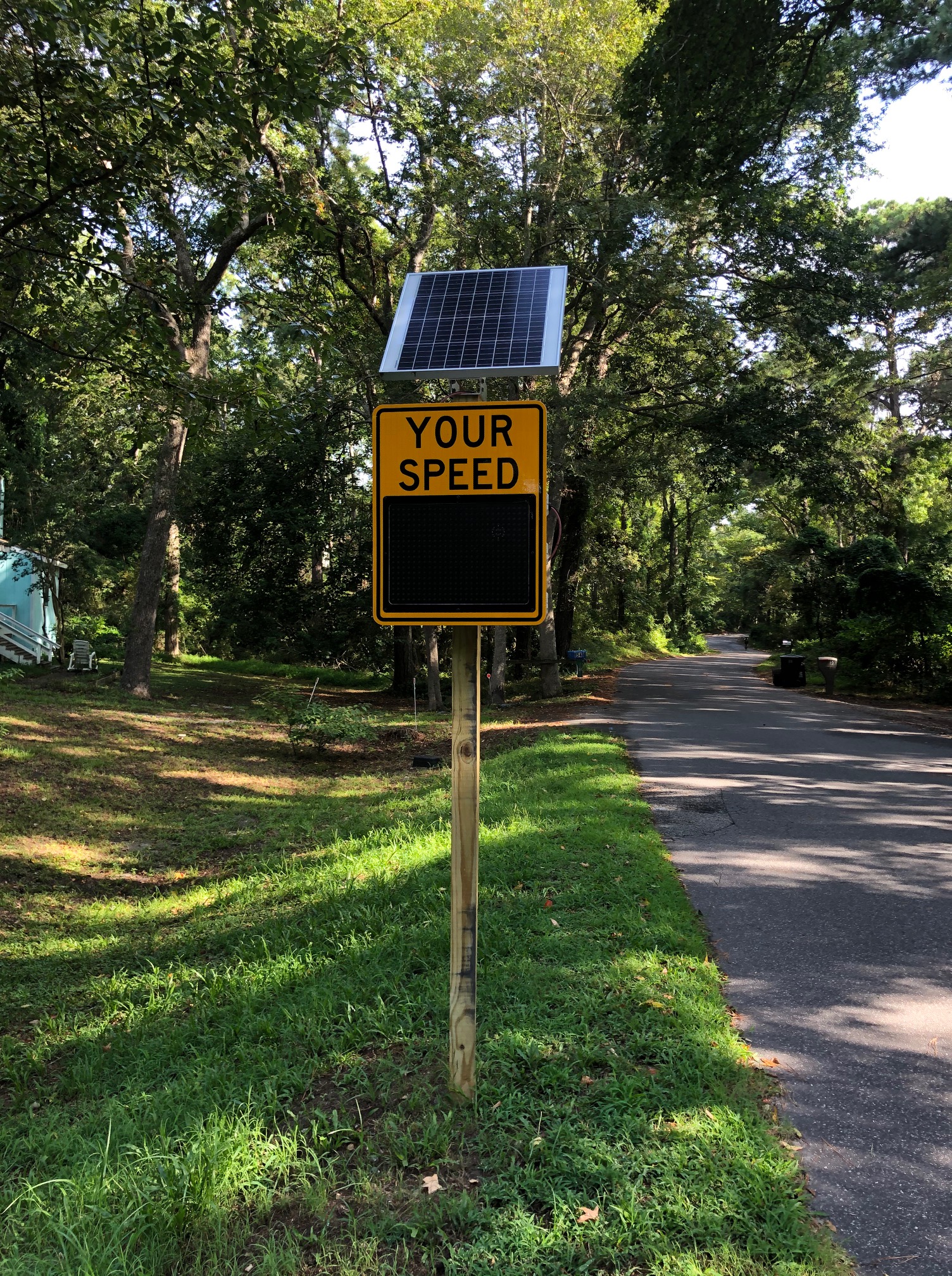
This radar sign around 55 Hickory Trail also has a data-collection feature attached to it that enables the Southern Shores police to obtain vehicle counts.
Town Manager Cliff Ogburn is proposing that the Town hire a “traffic engineer” consultant to study the summertime vehicle-count data that the Southern Shores Police Department has collected and prepare a report that would include recommendations for “addressing” residential cut-through traffic and congestion.
Mr. Ogburn will present his proposal to the Town Council at its Sept. 1 meeting, scheduled for 5:30 p.m. in the Pitts Center. The meeting is open to all members of the public who wear face coverings and practice social-distancing.
In a summary included in the meeting packet, the Town Manager advises that he has already “reached out” to five firms that may wish to be considered for the traffic engineer consulting contract, which he suggests would not exceed $7,500.
He also has been in touch with the Dept. of Technology Systems at East Carolina University and The Transportation Research Institute at Old Dominion University to solicit their expertise, he says.
“Staff believes that an independent analysis by a professional and objective traffic engineer or traffic planner of the problem and of the traffic county data that [have] been collected thus far,” Mr. Ogburn writes, “would result in a report indicating plausible potential solutions.
“These solutions, both in terms of policy and infrastructure, could then be vetted by the community and Council to determine a cost-benefit analysis as well as tolerance for their impacts.”
Mr. Ogburn describes the envisioned traffic study as a “detailed examination and analysis of a transportation system supported by data collection.” He does not rule out having to collect further traffic data, “such as hourly vehicle counts, speed, travel time, and time delay.”
It is our expectation that the Town Council will unanimously approve Mr. Ogburn’s proposal.
NO-LEFT-TURN WEEKENDS; VEHICLE COUNT DATA
Northbound motorists were prohibited on five weekends this summer from making a left turn on to South Dogwood Trail from U.S. Hwy. 158 between 11 a.m. and 8 p.m. During these weekends radar signs with data-collection features attached were positioned on highly traveled roadways in order to count the number of vehicles that traversed them.
(For more information about these signs and data collection, see manufacturer Trafficlogix’s website at trafficlogix.com.)
According to Mr. Ogburn’s summary, the Police Department collected vehicle count data at the following roadway locations:
On Duck Road (N.C. Hwy. 12), at Thirteenth Avenue, both northbound and southbound;
On Ocean Boulevard (N.C. Hwy. 12), at Skyline Road, both northbound and southbound;
On South Dogwood Trail, northbound, no address given;
On South Dogwood Trail near the entrance to the SSCA’s north marina, no direction indicated, but presumably northbound;
At 186 Wax Myrtle Trail;
At 286 Sea Oats Trail;
At 332 Sea Oats Trail;
At 274 Hillcrest Drive;
At 55 Hickory Trail.
Data collection on the residential streets north of South Dogwood Trail was only for northbound arriving traffic.
The Beacon is disappointed to learn that no vehicle data collection occurred on Juniper Trail/Trinitie Trail or on Chicahauk Trail in Chicahauk. Chicahauk property owners have long objected to blocking the left turn at the 158-South Dogwood Trail intersection because of their fear that motorists would bail to Juniper Trail as an alternative.
Empirical evidence of the impact on Chicahauk this summer would have been helpful to have. Anecdotal evidence suggests that motorists did not chose Juniper Trail as an alternate cut-through road.
While Mr. Ogburn refers in his summary to the Police Department having collected traffic data in Southern Shores since 2008, its collection before this summer was done sporadically, with an inconsistent methodology, and under different factual circumstances, making any pre-2020 data of questionable value.
According to Mr. Ogburn, “NC DOT [N.C. Dept. of Transportation] has agreed to further examine their own traffic count data collected on NC 158 and NC 12 in an effort to further assist the town with the problem.”
During public meetings of the Citizens’ Committee to Address Cut-Through Traffic, Town Council co-sponsors of the committee, Elizabeth Morey and Matt Neal, made clear that a study was the objective of the no-left-turn weekends this summer. Mr. Ogburn’s proposal may be viewed as the expected followup to what turned out to be five- weekend experiment in blocking the South Dogwood Trail left turn.
MAYOR BENNETT’S LONGTIME OPPOSITION
Nonetheless, those of us who participated in the mediated hours-long community workshop about cut-through traffic in October 2014 at the Kitty Hawk Elementary School and later witnessed Mayor Tom Bennett unilaterally reject the solution proposed by public consensus—implementing the no-left-turn option—and have since suggested other well-thought-out ideas for calming and/or curbing the traffic to a stone-deaf Town Council may feel that the proposed study is reinventing the wheel, this time by so-called experts.
But, to invoke another cliché, Rome wasn’t built in a day, and when Caesar opposes the construction, its completion can take far longer than it should.
Mayor Bennett has consistently voted during the past six years against prohibiting the left turn at South Dogwood Trail or taking any other actions suggested by homeowners to reduce cut-through traffic, and there have been many proffered.
The facilitator who mediated the 2014 workshop came from Raleigh and was paid with taxpayer money, but that didn’t matter to the Mayor, who was supported in his rejection of the workshop results by all four of the then-Town Council members, including current Councilman Leo Holland.
Adopting a Chamber-of-Commerce sort of attitude, the Mayor is on the public record as opposing any measure that would discourage or impede vacationers who use the Southern Shores cut-through route—even though dollars spent in Currituck County do not benefit Dare County.
What message does it send to tourists, he has asked, that they cannot use our roads?
Indeed, he cast the sole dissenting vote in April against holding the three no-left-turn weekends planned for July 4-5, July 25-26, and Aug. 1-2.
At the Council’s June 16 workshop, the Mayor said that he had long considered the traffic “the burden of living here”—and he was not inclined to try to alleviate that burden.
But, with the traffic crush of the June 6-7 and June 13-14 weekends, the Mayor finally felt compelled to act. He really had no choice: Public safety was at stake. And the Town was on notice.
June 13 was an especially bad day, with traffic solidly backed up from the Duck Road intersections with the dune streets (Sea Oats, Eleventh, Hillcrest, etc.) all the way to U.S. Hwy. 158 and the eastbound span of the Wright Memorial Bridge.
We recall this history because the Town has not, as Mr. Ogburn, who is a newcomer to Southern Shores, writes, “spent a considerable amount of time and effort in trying to come up with solutions to address the problem.” In fact, the opposite is true.
Until the June 23-24, 2018, no-left-turn trial, which former Councilmen Gary McDonald and Fred Newberry spearheaded, all the Town had ever done to affect the traffic flow was to conduct sporadic police checkpoints on South Dogwood Trail and Ocean Boulevard. To my recollection, none has been done since the 2014 workshop.
This summer is the first time that the Town has taken serious action to thwart the cut-through traffic and attempt to ameliorate the situation.
MAKE YOUR VOICE HEARD
The Beacon is still on hiatus from the Town Council–still disbelieving, among other things, that it allowed Police Chief David Kole to write a First-Amendment-sensitive Town ordinance to bolster his department–but you do not have to be.
There will be two public-comment periods during the meeting, one after staff reports and before Council business, which includes Mr. Ogburn’s traffic engineer proposal; and the other after the Council has concluded its business.
You may speak in person at the meeting (subject to COVID-19 requirements) or email written comments to Town Clerk Sheila Kane to be read aloud by the Mayor or the Mayor Pro Tem. You also have the option of speaking for up to three minutes via Zoom by alerting Ms. Kane through the website’s chat feature that you would like to speak.
To send written comments, email Ms. Kane at skane@southernshores-nc.gov. Be sure to include your name and address and indicate in the email subject line: “Public comment for Town Council meeting, 9/1/20.”
Regardless of whether you choose to comment, you may join the Town Council meeting via Zoom videoconferencing.
It is very easy to Zoom, folks. All you have to do is go to zoom.us and sign up. You will be directed through a process that will culminate in the downloading of the website’s software to your computer’s hard drive.
Once you have signed up, you may join Tuesday’s Town Council meeting by clicking on the “join a meeting” link at the top of the Zoom home page and typing in the meeting ID and passcode when you are prompted:
Meeting ID is 920 9768 9159
Passcode is 537934
You need not even be seen on Zoom. If you right-click on the picture of yourself that appears on your computer screen once you have logged in, you may hide your image.
The meeting currently has very few agenda items and should be brief.
Also on the agenda are a modification and extension of the Town’s contract with Sandski, LLC, which provides its ocean rescue services. The current contract calls for full ocean-rescue service through Labor Day and a reduced presence after Labor Day until Oct. 15.
According to Mr. Ogburn’s summary in the meeting packet, “There are many indicators pointing to an extended tourist season beyond Labor Day and further into the fall. This increase will likely result in larger than normal visitors on the beach.
The Town Manager offers three options for modification/extension, which you will find outlined in the meeting packet, with estimated costs ranging from $13,500 to $23,000.
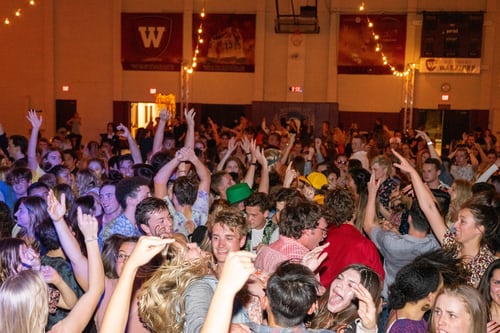
For illustrative purposes only. We sincerely hope that college students who are noncompliant about facial coverings and social distancing are not gathering together en masse like the scene above.
Dare County reported 12 new COVID-19 cases diagnosed locally today, 10 of them nonresidents ranging in age from 17 and under to ages 50 to 64. One nonresident man, reportedly between the ages of 50 and 64, has been hospitalized with the disease outside of the area.
Dr. Sheila Davies, director of the Dare County Dept. of Health and Human Services (DCDHHS), also confirmed in her COVID-19 update today that seven of the nine new cases among Dare County residents reported since last Friday are college students.
Yesterday, the DCDHHS reported seven new cases, six of them Dare County residents, and all of them age 24 or younger.
If you are following the news about COVID-19 “clusters” breaking out among returning college students this month in the state, then you know that the University of North Carolina at Chapel Hill, N.C. State University, and East Carolina University all have reported clusters of positive test results among students living in certain dormitories, off-campus housing, and fraternity and sorority houses.
A cluster is five or more COVID-19 cases in close proximity, according to the N.C. Dept. of Health and Human Services.
The positive test result of a college student from Dare County counts here, not in Chapel Hill, Raleigh, or Greenville. Some college students who reside permanently in Dare County may have returned home for remote learning and been tested locally. But at least four appear to have been tested outside of the area and to be isolating away from home, according to the DCDHHS dashboard.
Dare County has reported 21 new COVID-19 cases since Dr. Davies updated the numbers Friday. Of those 21, the Health Department director said today, only three did not have known direct contact with a person who has tested positive for COVID-19.
In an emphasis that we have not seen in her earlier updates, Dr. Davies stated today that “Close contact continues to be the predominant way we are seeing the virus spread.”
The Beacon has tended to believe this, despite Dr. Davies’s reports of many COVID-19-positive people having acquired the virus by “unclear” means, which she has interpreted to suggest community spread. We are skeptical of people’s ability to remember or recognize when they have had direct contact with infected people.
To summarize the 21 cases reported since Friday:
Nine are Dare County residents (seven of them college students); and 12 are nonresidents.
Of the 12 nonresidents, six are isolating in Dare County, and one is hospitalized outside of the county.
The age breakdown of the 21 people is as follows:
Age 17 or younger: Three
Ages 18 to 24: 11
Ages 25 to 49: Five
Ages 50 to 64: Two
Age 65 or older: None
There are currently 21 active COVID-19 cases among Dare County residents, only 13 of whom are in home isolation here.
The total number of cases in Dare County is now 436, 234 among local residents and 202 among nonresidents.
The new COVID-19 testing center in Nags Head for asymptomatic people who have had no known exposure to the disease is being run by the Outer Banks Hospital, according to a representative of the center who responded to an inquiry from The Beacon today.
The Outer Banks Testing Center, whose opening was announced last week by the Dare County Dept. of Health and Human Services, is located at 4917 S. Croatan Hwy., Suite E, in Nags Head. Its business hours are Monday through Friday, from 8 a.m. to 5 p.m., and Saturday, from 8 a.m. to noon. Call (252) 449-6174 to make an appointment.
(See The Beacon, 8/22/20, for the initial report.)
Diagnostic testing for COVID-19 is covered by Medicare, Medicaid, and other forms of health insurance. If you are uninsured, you may explore your payment options with a representative of the testing center.
The DCDHHS reported no new COVID-19 cases yesterday.
UPDATE: Today at 4:30 p.m., the DCDHHS reported seven new COVID-19 cases, six of them Dare County residents between the ages of 18 and 24 (college age) and one a nonresident age 17 or younger.
All seven young people are in isolation; three of the Dare County residents are isolating outside of the area.
The total number of COVID-19 cases diagnosed in Dare County now stands at 424: 232 Dare County residents and 192 nonresidents.
Statewide, according to today’s N.C. Dept. of Health and Human Services dashboard, 156,396 cases of COVID-19 have been reported, and 2,535 people have died. Currently, 948 people are hospitalized with the disease.
The NCHHS says the state’s positivity rate–which is the percentage of COVID-19 cases diagnosed among the total number of tests performed–is about 7 percent.