Are you preparing to travel or to have a surgical procedure and would like to be tested for COVID-19 before you do, but you have no symptoms of the disease and, therefore, clinicians at existing testing centers in Dare County will not see you?
You finally have a resource that will not turn you away because you don’t have a fever and you aren’t coughing or smell-impaired.
People who are COVID-19-asymptomatic and have had no known exposure to the disease caused by the new coronavirus may now be tested at a new site in Nags Head, the Dare County Dept. of Health and Human Services announced yesterday.
The newly opened Outer Banks Testing Center, located at 4917 S. Croatan Hwy., Suite E, in Nags Head, is specifically for people who are asymptomatic and would like to be tested, regardless of the reason. The new center’s business hours are Monday through Friday, from 8 a.m. to 5 p.m. Call (252) 449-6174 to make an appointment.
DCDHHS’s announcement yesterday did not indicate whether the Outer Banks Testing Center is operated by the county or not. No one answered the telephone at the center today. A outgoing voice message informed us of the center’s hours and asked callers to leave their name, date of birth, and telephone number for a call back. We will call the center Monday to find out who is staffing it and to ask about cost.
Although COVID-19 diagnostic testing is widely available in Dare County, the N.C. Dept. of Health and Human Services has advised clinicians to test only those people in whom they suspect COVID-19. A healthcare provider first must clinically assess a symptomatic person before deciding to test him or her for COVID-19.
The COVID-19 symptoms that the NCDHHS advises providers to consider include:
*A fever of 100.4 degrees F. or greater;
*A cough;
*Chills or shaking with chills;
*Muscle pain;
*Shortness of breath or difficulty breathing;
*A headache; and/or
*A new loss of, or alteration in, taste or smell
The currently available testing sites in Dare County for symptomatic people, all of which have telephone numbers with a 252 exchange, are:
Beach Medical, Nags Head: 261-4187
Outer Banks Urgent Care, Kitty Hawk: 449-7474
Outer Banks Urgent Care Center & Family Medicine, Nags Head: 261-8040
Surf Pediatrics & Medicine (testing for established patients only), Kill Devil Hills: 449-5200
All of these providers ask that you call ahead and undergo a brief telephone screening process.
The Dare County Dept. of Health and Human Services also reported yesterday that, after seeing a “decline” in new COVID-19 cases for four consecutive weeks, it has seen “an uptick” in new cases over the past few days.
Frankly, we don’t find this helpful—especially in light of the fact that Tropical Storm/Hurricane Isaias visited during this period.
Until the DCDHHS goes 14 days without reporting any new cases, we will not consider any case-reporting trend significant.
The virus is out there. There are many reasons why infected people don’t get tested, including the obvious one that they don’t realize they’re infected.
As of noon today, the DCDHHS dashboard showed a total of 415 locally diagnosed COVID-19 cases: 224 Dare County residents and 191 nonresidents.
Among Dare County residents, there currently are 19 active positive cases, eighteen of whom are in isolation, either in Dare County or outside of the area. One person is hospitalized outside of the area.
The most recent DCDHHS data show that transmission of the virus has occurred predominantly through direct contact with a person who is known to be COVID-19-positive.
The NCDHHS reported this morning that 153,641 people have been diagnosed statewide with COVID-19, and 2,521 have died as a result of the disease. Currently, 996 people are hospitalized.
June cut-through traffic on East Dogwood Trail, heading toward Hickory Trail, in Southern Shores. So far today, the traffic flow is favorable to residents.
We heard the sweet sound of silence this morning, instead of the usual non-stop noise of tire tread striking the pavement on Hickory Trail, as departing vacationers cut through the residential area of Southern Shores instead of using N.C. 12. Traffic today seems to us to be so far, so good.
What’s happening on your street?
We have been out and about this morning near the ocean and have seen no backups in northbound traffic on Duck Road. We have observed only minimal cut-through traffic on East Dogwood Trail and Hickory Trail.
This promising picture may change later, but it does suggest a light traffic day for beleaguered Southern Shores homeowners.
Let us hear from you!
In case you missed our report from Town Manager Cliff Ogburn last week, we will repeat that Mr. Ogburn suggested at the Town Council meeting Tuesday that the Town hire a traffic engineer to analyze the weekend traffic-count data that, Mr. Ogburn said, Chief Kole has been collecting and reporting by email to Council members and to make recommendations on how to address the cut-through traffic.
The Council viewed this suggestion favorably. Mr. Ogburn said he would have a further report at the Council’s Sept. 1 meeting, which will be held at 5:30 p.m. in the Pitts Center.
While the Beacon is concerned about the cost for such a hire, we believe that if Mr. Ogburn is allowed to select the engineer and manage the methodology of this analysis without any oversight by Town officials, elected or otherwise, it will be handled properly. We have confidence in the new town manager.
Check back with The Beacon later today for details on the COVID-19 testing that is now available in the Outer Banks for asymptomatic people.
The Beacon is taking a break from the Town of Southern Shores.
We abhor ignorance and incompetency in government and witnessed too much of both in yesterday’s Town Council “discussion” of the Town Code Amendment (TCA) to regulate public assemblies—which, in this Council’s usual display of groupthink passed 5-0, despite obvious problems that Councilman Matt Neal tried to point out before he, unfortunately, surrendered.
Even Councilman Jim Conners said the regulations pertaining to parades in TCA 2020-08-01 gave him “pause,” but he did not pursue his objections after Mayor Tom Bennett pointed out that rarely, if ever, are parades held in Southern Shores. Not only is that not the point of lawmaking, but the Mayor is wrong. He simply does not live on a street where parades—such as those on the Fourth of July—occur.
The Council met yesterday for a workshop session at 9 a.m. in the Pitts Center. No members of the public attended, and Mr. Neal participated remotely from his office.
TCA 2020-08-01 was before our elected officials on first reading. There was no need for them to rush to judgment. Last we looked, there are no protesters poised at the gates of Southern Shores, preparing to wreak havoc on our small seaside town.
We read recently a suggestion by a Southern Shores homeowner on the social-media site, Next Door, that a police-support rally be held in town, but, according to an informed source who knows this homeowner, Mayor Tom Bennett shut down that idea, “censoring” him, as the source said.
All five Council members are lawmakers for this town—not rubberstampers of what Police Chief David Kole says he wants or needs and what Town Attorney Ben Gallop says is legal. They could have done this right, but they did not want to bother to take the time to do so. (For background on TCA 2020-08-01, see The Beacon, 8/15/20 and 8/17/20.)
They would rather enact a flawed piece of legislation and fix it “down the road,” as Mayor Pro Tem Elizabeth Morey said, after thanking the people who created the mess.
The only member who showed an aptitude for independent analysis and a public responsibility to perform that analysis was Mr. Neal, who said the new ordinance sets a “bad tone” by the Town.
But he said this after he curtailed his objections and voted against his reasoned judgment to approve the amendment, saying he did not want to be “the lone speed bump” to its passage.
Councilman Neal, your constituency needs “speed bumps.”
It looks like the Town is “trying to corral free-speech gatherings,” Councilman Neal stated after the TCA had been passed. It is targeting and burdening political speech.
The next time you run into a Council member, ask him or her to explain First Amendment law on free speech/peaceable assembly to you. If any—except for Mr. Neal—have a clue, we would be shocked. Certainly Mr. Gallop did not inform them.
The Town Attorney said he did a “cut and paste” of Raleigh’s public-assembly ordinance, after receiving Chief Kole’s attempt to cobble together a Town ordinance based on what other Dare County beach towns have done.
“I can’t guarantee that any of it’s perfect,” Mr. Gallop said. That means he cannot guarantee that it is constitutional.
Contrary to what Mr. Gallop also said, First Amendment law does not change all of the time. It is well-established. (See The Beacon, 8/15/20) What changes are the factual circumstances to which First Amendment law about permissible time, place, and manner regulations is applied.
Beacon readers, we have hit the wall on our ability to tolerate ignorance and incompetent government groupthink on matters of public consequence and are taking a break of indeterminate length.
We are thinking about organizing an 11-member picket of the new public-assembly ordinance to be held in an orderly single-file fashion on the South Dogwood Trail sidewalk without getting a permit first because the Town cannot constitutionally require us to get one when no “significant governmental interest,” such as public safety, is involved.
We will not block or disrupt pedestrians or impede traffic flow. We may even leaflet passersby so that more than eight people who live in town—the five Council members, Chief Kole, and the two members of the public who remotely attended yesterday’s meeting (including myself)—will know how the Town regards citizens’ First Amendment rights.
TOWN MANAGER’S REPORT: Hiring of “traffic engineer” proposed
Before we start our break from the Town, and particularly, the Town Council, we would like to report to you that Town Manager Cliff Ogburn suggested yesterday:
Hiring a traffic engineer to analyze the weekend traffic-count data that, Mr. Ogburn said, Chief Kole has been collecting and reporting by email to the Town Council—but not sharing with the public—as well as past traffic data, and to make recommendations on how to address the cut-through traffic. (The Council viewed this suggestion favorably.)
Extending the Ocean Rescue season until the end of September by keeping at least two lifeguard stands and two ATVs in operation. (Vacation home occupancy is strong through September, the Town Manager said.)
Updating the Town website, either with a “full-blown makeover” or via upgrades. (It’s about time. The website is embarrassingly deficient.)
Working on a permitting process for large outdoor gatherings on public property. (This is where the Town should have started, not with Chief Kole’s initiative.)
COVID-19 IN DARECOUNTY
We have not said much lately about COVID-19, which is having such a devastating effect on how we live, socialize, and do business with each other. Certainly, it has chilled public involvement in Town Council meetings. Here is the latest news:
Dare County continues to report daily about one to four newly diagnosed COVID-19 cases. Yesterday, none was reported.
Since Aug. 1, 55 new cases have been reported on the Dare County Dept. of Health and Human Services’ dashboard, 19 Dare County residents and 36 nonresidents.
Yesterday the overall COVID-19 case total stood at 402—216 Dare County residents and 186 nonresidents who tested positive locally. Fifty-four of them are age 17 or under; 90 are between the ages of 18 and 24; 137 are between the ages of 25 and 49; 76 are between the ages of 50 and 64; and 45 are age 65 or older.
Since Aug. 1, there have been more than four new cases reported by the DCDHHS on only four dates: Aug. 1 (nine); Aug. 7 (five); Aug. 8 (seven); and Aug. 17 (six).
Currently, there are 11 active COVID-19 cases among Dare County residents, one of whom is hospitalized outside of the area, while the remaining are in home isolation.
THE RELIABILITY OF THE STATEWIDE DATA provided on the N.C. Dept. of Health and Human Services’ dashboard came into question last week with an acknowledgment by the department that it had unknowingly reported inflated numbers of completed COVID-19 tests. The total number of administered tests was corrected with a reduction of 194,215, so that, as of yesterday, the dashboard showed that 1,951,120 tests have been performed.
Other problems that originated with reporting laboratories and necessitated corrections in the data have occurred previously. This error, however, has convinced us that we cannot calculate an estimated positivity rate. Henceforth, we will only report on what the NCDHHS says are the total number of COVID-19 cases in the state, the current number of COVID-19-related hospitalizations, and the number of people who have died as a result of the disease.
Yesterday’s NCDHHS data showed 146,779 cases and 2,396 deaths to date, and 1,026 hospitalizations.
This signsofjustice.com sign is on display in the front yards of several Southern Shores homes.
A government in the United States may not burden citizens’ rights of expression under the First Amendment by requiring them to obtain a “public assembly” permit when it does not have the right to do so. We are talking here about a government, such as the Town of Southern Shores, interfering with constitutionally protected activity by over-regulating it.
If marchers stay on public sidewalks and obey traffic and pedestrian signals, their activity is constitutionally protected even without a permit, according to the American Civil Liberties Union—and anyone else who knows First Amendment law, which the U.S. Supreme Court has delineated through rulings dating back to the 19th century.
The Town Council is currently scheduled to consider at its 9 a.m. workshop meeting tomorrow an amendment to the Town Code of Ordinances that creates a chapter about the regulation of public assemblies. A key feature of Town Code Amendment (TCA) 2020-08-01 is the implementation of a permit process.
(The Council meeting will be held in the Pitts Center and is open to members of the public who wear facial coverings. Social distancing will be observed.)
We believe TCA 2020-08-01 goes too far in requiring permits of people who gather for constitutionally protected expression. It does not withstand First Amendment scrutiny and should be withdrawn for further revision.
BEACON ANALYSIS OF TCA 2020-08-01
In The Beacon’s 8/15/20 post about TCA 2020-08-01, we pointed out that the amendment would require a group of 10 people distributing political-campaign literature on South Dogwood Trail sidewalk to obtain a permit. Such Town interference would be unconstitutional.
People may approach pedestrians on public sidewalks with leaflets, petitions, solicitations for donations, etc., without a permit provided they do not block entrances to buildings or physically or maliciously detain passers-by, according to the online ACLU, in explaining Supreme Court law.
The Town has no “significant governmental interest” in protecting passers-by from being leafleted, provided the leaflet distributors are not disruptive, and it cannot impose a permit on this activity.
(For more legal background, please see our 8/15/20 post about the three-pronged constitutionality test that the U.S. Supreme Court applies to governmental “time, place, and manner” restrictions on public assemblies. All restrictions, including the requirement of a permit, must be “narrowly tailored” to serve a “significant governmental interest.”)
People also have a right to picket on public sidewalks without obtaining a permit first, provided they do so in an orderly, non-disruptive fashion so that pedestrians can pass by and entrances to buildings are not blocked.
As TCA 2020-08-01 is written now, every “assembly” of more than 10 people in or on any street, sidewalk, alley, or other public place in town, requires a permit, regardless of whether a “significant governmental interest” is involved. This approach is fatally flawed.
As we noted 8/15/20, the TCA defines “assembly” vaguely, and much too broadly, as an “assembly or concert of action” of two or more people for the purpose of “protesting or demonstrating for or against any matter.” (An “assembly” is an “assembly,” basically.) According to the proposed ordinance, public assemblies “include, but are not limited to, parades, picketing and other demonstrations.”
Town Manager Cliff Ogburn informed The Beacon that the language of TCA 2020-08-01 originated with Southern Shores Police Chief David Kole, not Town Attorney Ben Gallop. Chief Kole looked at public-assembly ordinances in other Dare County towns to compose his draft for Southern Shores, and Mr. Gallop provided some review.
Besides imposing permits on constitutionally protected activity that towns cannot burden with a permit, TCA 2020-08-01 goes too far in other respects.
For example, it impermissibly prohibits all parades on town streets year-round between the hours of 7 p.m. and 8 a.m.—without citing any “significant governmental interest” in doing so. The Town does not have a right to shut down parades simply because of darkness. There is nothing inherently dangerous or threatening about darkness.
If the Town’s concern is noise, then it should regulate the noise. A more limited hour prohibition (9 p.m. to 7 a.m., perhaps) would make sense in the context of a noise regulation. The Town Code permits construction to start at 7 a.m. and end at 8 p.m. every day except Sunday, and it is rarely quiet.
(The Town’s noise ordinance was rewritten by Codewright Planners as part of its “update” of the Town Code, but its work product has not been discussed since January 2019. See The Beacon’s 7/30/20 post, “The Making of a Fiasco,” about the Codewright project.)
The TCA also prohibits parades on a Saturday or Sunday between Memorial Day and Labor “upon streets or highways with high volumes of tourism-related traffic.”
We had some limited emailed conversation with Mr. Ogburn about this provision last week. The Town has a “significant governmental interest” in traffic control and pedestrian safety, but we do not believe this language about “high volumes” is narrowly tailored enough to pass First Amendment muster.
We also question attempts by the Town to safeguard minors from safety hazards apparently perceived as unique to them, but not stated, and unclear to us.
TCA 2020-08-01 requires permit applicants to indicate how many people under the age of 18 are expected to participate in the assembly (why?) and prohibits allowing minors to participate in a public assembly “during a time or at a place that would be detrimental to or endanger the health, safety or welfare of such minors.”
The effect of this language seems to us to be the chilling of both assembly organizers’ and minors’ First Amendment rights. We honestly do not understand it. Any “significant governmental interest” that the Town has in ensuring public safety extends to all citizens, regardless of their age.
A provision that any assembly permit that the Town issues “may proscribe reasonable requirements that the Town Manager determines are reasonably necessary to insure [sic] the control and free movement of pedestrian and vehicular traffic or for the health, safety and property rights of the participants and the general public” also concerns us.
A proscription is a prohibition. To proscribe is to prevent or to forbid. Perhaps what is intended in this provision is a prescription, rather than a proscription. Whatever the case, we believe this language introduces ambiguity and uncertainty and is unnecessary.
The Town, acting through the Town Manager, may impose reasonable, narrowly tailored restrictions on public assemblies to further “significant governmental interests,” which include traffic control and pedestrian safety. This is basic First Amendment law. This provision suggests that the Town is vesting in the Town Manager more discretion than he is constitutionally entitled.
The Beacon believes TCA 2020-08-01 is too flawed to be voted upon tomorrow by the Town Council, whose members may or may not be knowledgeable enough to evaluate it.
We urge you to read the latest draft of Town Code Amendment (TCA) 2020-08-01 and to be informed:
There is no public hearing scheduled for TCA 2020-08-01, but there will be an opportunity for the public to comment—for up to three minutes—during the customary general public comment period that is held before the Council takes up its business.
You may speak in person at the meeting (subject to COVID-19 requirements) or email written comments to Town Clerk Sheila Kane to be read aloud by the Mayor or the Mayor Pro Tem. You also have the option of speaking for up to three minutes via Zoom by alerting Ms. Kane through the website’s chat feature that you would like to speak.
To send written comments, email Ms. Kane at skane@southernshores-nc.gov. Be sure to include your name and address and indicate in the email subject line: “Public comment for Town Council meeting, 8/18/20.”
Regardless of whether you choose to comment, we strongly urge you to participate in the Town Council’s meeting by Zoom videoconferencing. The number of people who join Council meetings via Zoom has trickled off to less than a handful. This is not the way to ensure public accountability by elected officials.
It is very easy to Zoom, folks. All you have to do is go to zoom.us and sign up. You will be directed through a process that will culminate in the downloading of the website’s software to your computer’s hard drive.
Once you have signed up, all you need to do to join tomorrow’s Town Council meeting is to click on the “join a meeting” link at the top of the Zoom home page and type in the meeting ID and passcode when you are prompted:
Meeting ID is 912 3721 9720
Passcode is 635026
You need not even be seen on Zoom. If you right-click on the picture of yourself that appears on your computer screen once you have logged in, you may hide your image.
ALSO ON THE AGENDA: Recycling Contract, Beach Nourishment, Planning Board Appt., Town’s Allocation from Coronavirus Relief Fund.
The Beacon previewed the agenda for the Aug. 4 Town Council meeting, which was canceled because of Tropical Storm Isaias, on 8/3/20. The Council postponed most of the 8/4 business agenda until tomorrow’s workshop meeting.
We refer you to our 8/3 post for background on some of the other business items that the Council is scheduled to consider tomorrow, including a new recycling contract and monies to compensate the Town’s coastal engineering consultant for tasks.
New to tomorrow’s agenda are the appointment of a new Planning Board member, necessitated by a resignation, and consideration of the money the Town can receive from Dare County as part of the Coronavirus Relief Fund, which was established by the federal Coronavirus Aid, Relief, and Economic Security (CARES) Act.
Planning Board Vice Chairperson Don Sowder has resigned his seat after serving only one year of his three-year term, which started July 1, 2019. According to Mr. Ogburn’s agenda item summary, Planning Board alternates Lynda Burek and Robert McClendon have both expressed interest in filling the vacancy.
Both Ms. Burek and Mr. McClendon were appointed Jan. 7, 2020—Ms. Burek as first alternate, Mr. McClendon as second alternate.
In the past, a three-person Council majority has played personal politics and elevated a second alternate to the Planning Board, over an equally qualified first alternate, who subsequently resigned because of the slight.
We clearly recall the Council minority asking the majority why the second alternate was a superior candidate to the first alternate and receiving no response. This should not happen again. The membership composition of the Planning Board should reflect the entire community, not the biases of three people on the Town Council.
No mention is made in the agenda about appointing a new alternate to replace either Ms. Burek or Mr. McClendon. This opening should be advertised in the Town newsletter.
As for the Town’s allocation from the County of Coronavirus Relief Fund monies, it amounts to $37,088. There is no mention in the meeting packet about how those monies might be applied.
Coastal engineer CPE-NC seeks $18,039 to prepare a 2020 beach profile analysis and report based on “profile data” it has already acquired. Profiling looks at shoreline and sand-volume changes.
Although it is well-known that East Coast beaches are at their widest in July and August, CPE-NC collected its data for purposes of evaluating the current status of the Southern Shores coastline before June 30. It did the same last year, with its May analysis.
CPE-NC’s initial 2017 study was conducted in December, when the beaches are their most eroded. They restore themselves in the summertime, according to all of the coastal environmental experts interviewed by The Beacon for past articles.
The Beacon questions the need for an annual beach profile study this year. Not only is short-term assessment of the coastline of little value, the Town has decided to do beach nourishment in 2022, regardless of the state of the coastline.
The Town Council previously authorized an appropriation of $17,357 to CPE-NC for the “profile data acquisition,” $5,208 of which was not dispensed during last year’s fiscal year budget and must be added to the current fiscal year budget. Thus, the Town is spending more than $35,000 on its 2020 beach profile and will likely pay for another profile next year.
Public protests are as American as the Fourth of July. Here, Steve Gudas pickets construction of the oversized “single-family” dwelling at 98 Ocean Blvd.
The Town debuted a redesigned biweekly newsletter yesterday that is more professional and public service-oriented than any we have ever seen published before.
Gone are the notices for Outer Banks SPCA pet adoptions and for applying to serve on the Town Planning Board, or in a different volunteer capacity, even when there are no openings.
Instead, you have a “friendly reminder” that dumping “trash, landscape debris or other material” in a canal or other waterway is illegal; a link to a “recent history” of the Town’s “fund balance”; a subtle admonition about pedestrians crossing at crosswalks and walking facing oncoming traffic when they are in a road that does not have a sidewalk; and a link to “updated” 2022 beach nourishment project information.
While we would have preferred friendly articles with some context accompanying both the “friendly reminder” and the presentation of “bicycle and pedestrian laws,” we do approve of an apparent move toward providing public information and actual Town news. Next time, perhaps, the legal language could be couched in a conversational style, so that such items look less like warnings and more like inducements to community cooperation and protection of public health.
We also would like to see summarized the reports to which the newsletter’s beach-nourishment link connects so that the public does not have to pore through deadly and excessive prose submitted by the Town’s coastal engineering consultant. A set of FAQs about the project would be very helpful.
The item about the Town’s fund balance connects to an explanatory note about basic accounting and a pie chart, which shows that the unassigned fund balance as of June 30, 2019 was $4,173,321. We will not know the auditor’s 2020 assessment of the unassigned fund balance until the fall. While the explanatory note could use punching up with more details, it is a start in the right direction to have an item about the Town’s financial accountability in the newsletter.
Bravo to new Town Manager Cliff Ogburn, who is gradually putting his managerial imprint on important matters of public information.
The new newsletter also encourages the public’s communication with Town Hall. At the top of the newsletter are links to the Town’s website, Facebook page, Twitter account, and general email address. At the bottom is printed the main telephone number for Town Hall, which, when called, connects you to a voice menu for departments.
We strongly urge you to subscribe to the Town newsletter, which is usually published biweekly—or, at least semimonthly—not bimonthly, as it says on the website.
TOWN OFFERS NEW REDLINED VERSION OF PROPOSED PUBLIC-ASSEMBLY ORDINANCE; Beacon Urges Town Manager to Withdraw TCA 2020-08-01 for Further Legal Review.
Yesterday’s redesigned newsletter presented all of the information you need to be prepared for the Town Council’s Tuesday workshop meeting, which starts at 9 a.m. in the Pitts Center, including an updated “redlined” version of the proposed Town Code amendment to regulate public “assemblies.”
You may see the latest draft of Town Code Amendment (TCA) 2020-08-01 here:
If the Town Council actually votes upon this draft Tuesday, four of the five Council members must approve it for it to be enacted. On first reading, a Town Code amendment must be approved by a “super-majority” of the Council.
I reached out yesterday by email to Mr. Ogburn about at least one problem I had with the original draft of TCA 2020-08-01, and he was very responsive and thoughtful, as he always is. I have other concerns, but, honestly, I have not had the time to analyze the TCA in a thorough manner and to commit my analysis to writing because I was traveling last week, including yesterday when I emailed Mr. Ogburn.
I will do my best to publish something more substantive tomorrow or Monday, and I may speak to Mr. Ogburn personally. There is long-established First Amendment law that towns must adhere to when regulating public assemblies—if they want their ordinances to be constitutional—and I believe that TCA 2020-08-01 needs to be further vetted.
“There isn’t a rush to get this done,” Mr.Ogburn wrote to me in an email, “and there aren’t any events planned that I am aware of.”
In light of that, I would like to see the Town Manager withdraw TCA 2020-08-01 and subject it to further legal review by First Amendment-savvy professionals. Mr. Ogburn explained to me that the draft originated with a layperson, who used Code language from nearby beach towns as a model.
The very first paragraph of TCA 2020-08-01, which defines a public assembly, in part, as “any assembly or concert of action between or among any two or more persons” makes me stumble. I have never seen or heard of a two-person assembly nor have I seen a lawful public assembly defined in this manner. This definition definitely needs correction.
It also uses words that need to be precisely defined, including “assembly,” “protesting,” “demonstrating,” “parades,” “picketing,” and the like.
At English common law, an “unlawful assembly” could occur between three or more people who meet to commit a crime or carry out an unlawful act or unlawful purpose, or whose meeting breaches the public peace. Not only was this law established long before the First Amendment of the U.S. Constitution guaranteed the people the right “peaceably to assemble,” it did not pertain to “peaceable” assemblies that are lawful.
I also stumble over requiring a public assembly—whatever that means—of just 10 people to apply for a permit from the Town. That is what most of us would consider a group, not an assembly.
Ten or 15 people who gather on the South Dogwood Trail sidewalk to give out political-candidate leaflets to passersby should not have to wonder if they need to apply for a permit. They should not be so burdened. I believe more work needs to be done on the definition section and the threshold permit requirements of TCA 2020-08-01.
FIRST AMENDMENT LAW
Returning to the First Amendment law on public assemblies, which also encompasses the constitutional right to free speech—and sometimes other First Amendment protections, such as the right to “petition the Government for the redress of grievances”—it is well established that:
Governments may only impose time, place, and manner restrictions on such expressive activities. All such restrictions must be content-neutral. Governments may not directly regulate the message of the messengers who assemble peaceably in public, nor may they do so indirectly by leaving permit decisions up to the sole discretion of a public official who may act in a biased manner.
Permissible time, place, and manner restrictions include, for example:
*Imposing limits on the noise level of the speech by the protesters, demonstrators, picketers, etc.
*Capping the number of protesters who may occupy a given public forum, such as the parking lot at Town Hall.
*Barring early-morning or late-evening demonstrations.
*Restricting the size or placement of signs on government property.
These restrictions also may take the form of requirements to obtain a permit for an assembly, as TCA 2020-08-01 imposes.
To survive a First Amendment constitutional challenge, time, place, and manner restrictions—such as those in TCA 2020-08-01—must meet a three-prong test set forth by the U.S. Supreme Court in Ward v. Rock Against Racism, 491 U.S. 781 (1989).
First, the challenged regulation must be content-neutral.
Second, it must be “narrowly tailored” to serve a “significant governmental interest.”
Third, it must leave open ample alternative channels for communicating the speaker’s message.
This test balances the people’s First Amendment rights with important government interests, such as its police-power interests of protecting public safety, health, and welfare.
As you might imagine, it is the second-prong of the test that is usually the “rub.”
To be narrowly tailored, a time-place-manner restriction need not be the least restrictive or least intrusive means for a government to achieve its objective. That said, the interest that the government seeks to protect must be “significant.”
For example, the Town can require a permit for parades in public streets, given a foreseeable adverse impact on vehicle traffic, but it cannot categorically ban parades in such a manner as to allow them only when streets are bereft of onlookers.
The Town has a significant interest in maintaining public safety, which may involve keeping streets open and traffic moving. But the Supreme Court has also held that local authorities may not break up public protests simply because they slow traffic, inconvenience pedestrians, are annoying, or make people angry.
The Town also cannot require a permit for a protest on a public sidewalk that would not significantly burden or disrupt pedestrian or vehicle traffic.
There are nuances to consider in drafting a public-assembly ordinance that passes constitutional muster, and I believe that the Town Manager needs to spend more time with legal advisers on TCA 2020-08-01 to ensure that it is such an ordinance.
Southern Shores homeowners have tended to use yard signs and flags to convey political messages, not public assemblies such as demonstrations and picketing.
The Southern Shores Town Council will consider a proposed Town Code ordinance to impose a permitting process and other regulations on all public assemblies of more than 10 people on public property—including parades, picketing, and other demonstrations—at its workshop meeting next Tuesday at 9 a.m. in the Pitts Center.
If enacted by the Town Council, proposed Town Code Amendment (TCA) 2020-08-01 also would prohibit certain acts during public assemblies, such as the carrying of firearms or other deadly weapons and other threats to public health or safety and to the rights of private property owners.
In his summary of TCA 2020-08-11, Town Manager Cliff Ogburn writes that:
“The Town currently does not have any ordinance to address Public Assembly Gatherings, leaving the town vulnerable, especially under current conditions throughout the United States. This Ordinance will give the town the ability to have some control and provide a clear process for those that may want to express their Constitutional Rights peacefully.”
It appears that this Town Code amendment is at the request of Southern Shores Police Chief David Kole, who has brought up in Town Council meetings the prospect of protests on the Outer Banks similar to those occurring around the country.
(Recently, we read on the social-media site, Next Door, a suggestion by a Southern Shores homeowner that a demonstration on behalf of police be held in town, as a response to what some perceive as anti-police demonstrations elsewhere. Our first thought was about the requisite permit process, and we are surprised that none exists.)
The U.S. Supreme Court has settled through a series of decisions the tension between the exercise of citizens’ First Amendment rights to free speech and to peaceful assembly and the government’s right to regulate that exercise in order to ensure public health, safety, and welfare.
All five clauses of the First Amendment protect what is a fundamental right of Americans to protest peaceably. Clearly, if public protests threaten law and order, the State (the government in all of its forms) has a responsibility to intervene.
Supreme Court decision-making instructs that the government may regulate the conduct of public assemblies, but not the content of the speech that is being expressed.
There are a few narrow categories of expression that the Supreme Court has determined are not protected by the First Amendment, such as fighting words and incitements to imminent law-breaking, but most messages are constitutionally protected.
In regulating conduct of public assemblies, the government may impose reasonable “time, place, and manner regulations,” and it is those regulations that underlie permit applications and processes.
Where does a permit applicant propose to have the public assembly? On what date and during which hours? How many people are expected to participate? What do they propose to do? Who is sponsoring the public assembly?
TCA 2020-08-01 specifies that an application for a public assembly permit must be made in writing to the town at least 48 hours before the event.
(As a former attorney, I have studied constitutional law, but I am not a First Amendment scholar. I do know permits are not required for “spontaneous protests” in response to breaking news, as was the case with the protests after George Floyd’s death.)
In skimming TCA 2020-08-01, I saw some potential red flags of over-regulation, but I would have to consult a First Amendment lawyer in order to confidently argue that they should be removed. The Town must have reasonable grounds for believing that its time, place, and manner regulations are for the purpose of protecting the public. Mere speculation is not sufficient.
The Council’s meetings are open to members of the public who wear masks and practice social distancing. You are free to attend Tuesday’s meeting, under those conditions.
You also may join the meeting on Zoom, using the meeting ID 912 3721 9720, passcode 635026.
In order to participate via Zoom, you must first download the Zoom software to your computer’s hard drive. Zoom is online at https://zoom.us. The website URL provided by the Town in its notice will not work unless you have already downloaded the software.
DUKE FACE-MASK ‘STUDY’ IS JUST A LIMITED DEMONSTRATION
The face-mask efficacy “study” conducted by a multidisciplinary team of Duke University scientists that we thought would be fun to plunge into turns out to be a one-speaker “demonstration” whose significance is qualified by quite a few limitations.
It always pays to read the scientific paper underlying a report that makes the news. This one, which proposes to evaluate the effectiveness of various face masks and coverings in reducing the spread of respiratory droplets containing coronaviruses, does not impress us.
According to the researchers themselves, their “measurements provide a quick and cost-effective way to estimate the efficacy of masks for retaining droplets emitted during speech for droplet sizes larger than 0.5 [microns].
As they write: “Our proof-of-principle experiments only involved a small number of speakers[—actually just one for the 14 masks they tested—]but our setup can serve as a base for future studies with a larger cohort of speakers and checks of mask performance under a variety of conditions that affect the droplet emission rate, like different speakers, volume of speech, speech patterns, and other effects.”
We think we will wait for the future studies that account for all of the limiting variables.
In brief, here is how the researchers—who represent Duke’s departments of psychology and neuroscience, chemistry, physics, radiology, biomedical engineering, and medicine—set up their experiment, and we quote:
“[A]n operator wears a face mask and speaks into the direction of an expanded laser beam inside a dark enclosure. [The respiratory] droplets that propagate through the laser beam scatter light, which is recorded with a cell phone camera. A simple computer algorithm is used to count the droplets in the video.”
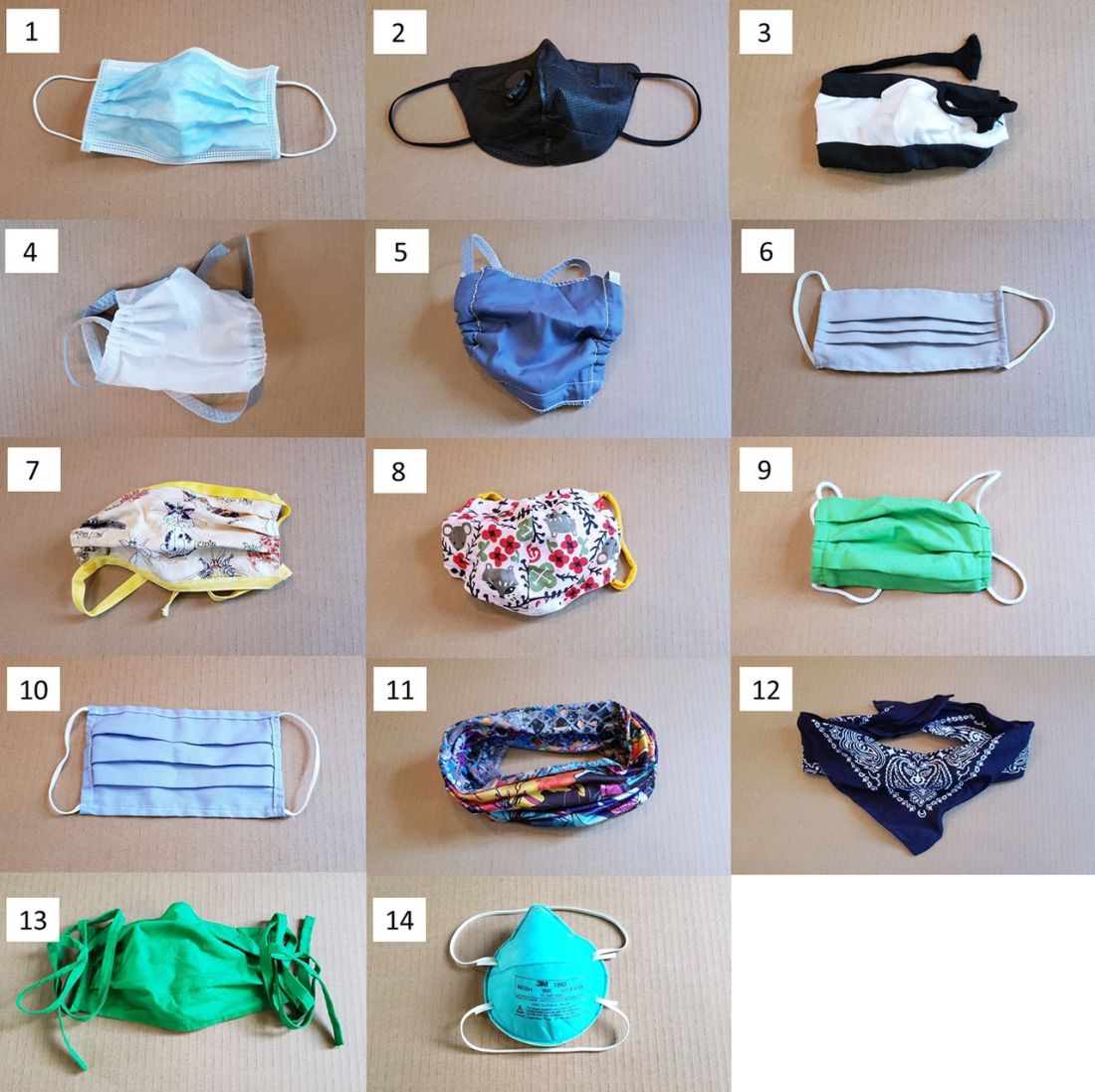
Each of the 14 masks tested underwent 10 trials with the same speaker. As we reported yesterday, a fitted nonvalved N95 mask and a surgical mask prevented the most droplets from becoming airborne, and a bandana and fleece gaiter performed the poorest.
The Duke demonstration also showed that a cotton-polypropylene-cotton facial covering provided more protection than five different pure cotton masks that differed in terms of layers and style. It further supported the proposition that a valved N95 mask decreases the protection of people near the wearer, but does not compromise the wearer’s protection.
Duke University scientists tested 14 different face masks, pictured above, for their efficacy in filtering expelled respiratory droplets during the wearer’s speech. (Photo by Emma Fischer of Duke University.)
A Dare County man in the 65-or-older age group who has been hospitalized is among the 15 people who have tested positive locally for COVID-19 since last Friday, according to the Dare County Dept. of Health and Human Services, which issued an update today.
The local man’s hospitalization outside of the area was reported by the DCDHHS Sunday. On Saturday the DCDHHS reported that another Dare County man, who is between the ages of 50 and 64, also had to be hospitalized for COVID-19.
Of the 13 other new COVID-19 cases diagnosed since last Friday’s DCDHHS update, 12 are nonresidents; and of these 12, the DCDHHS reported today, 11 acquired the virus by direct contact with an individual who either tested positive outside of Dare County (seven) or acquired the virus outside of Dare County (four).
The mode of transmission of the thirteenth is unclear, an “indication” of community spread, according to the DCDHHS.
We frankly do not understand how useful it is to the Dare County public to know that a nonresident had direct contact with a person who “tested positive for COVID-19” outside of Dare County, as opposed to direct contact with a person “who acquired the virus” outside of Dare County. The DCDHHS should explain this distinction, if it is significant.
The Beacon reported Friday on the seven nonresidents whose positive COVID-19 test results made the DCDHHS dashboard that day. Another non-resident case was reported on the dashboard yesterday.
The COVID-19 cases of the four remaining nonresidents, including two who are age 17 or younger, were reported today. These two young people are isolating in Dare County. Today’s other two cases transferred to isolation in their home counties. One is between the ages of 18 and 24, and the other is between the ages of 50 and 64.
The total number of COVID-19 cases diagnosed in Dare County is now 384, of whom 210 are residents and 174 nonresidents.
There currently are two Dare County residents and two nonresidents hospitalized for COVID-19, according to the DCDHHS dashboard.
SORRY, KIDS, BANDANAS DON’T CUT IT
Duke University researchers tested 14 different face masks or mask alternatives to find out how effective they are in reducing the transmission of respiratory droplets during regular speech and discovered that fitted N95 masks and surgical masks worn by healthcare workers are the most effective and “mask alternatives, such as neck fleece or bandanas, offer very little protection.”
Neck fleeces—also called gaiters—actually provided worse protection than not wearing a mask at all because they dispersed the wearer’s largest respiratory droplets into “a multitude of smaller droplets,” the research team wrote in its study report, and “smaller particles are airborne longer than large droplets,” which sink faster.
We will give more details tomorrow about the Duke study, which used a simple, inexpensive optical measurement method to evaluate the masks. Amateur physicists can easily re-create their experimental setup.
A Dare County man has been hospitalized with COVID-19, and another local man is in home isolation after testing positive for the disease caused by the new coronavirus, according to a 6:30 p.m. report today by the Dare County Dept. of Health and Human Services. Both men are between the ages of 50 and 64.
In a blog that The Beacon posted at 6 p.m. today, we reported that seven nonresidents had tested positive for COVID-19 and been transferred to isolation in their home counties, according to yesterday’s DCDHHS dashboard, but no cases had been posted on the dashboard today.
It never fails. If it weren’t such an absurd proposition, we would think someone in the county health department was reading The Beacon and waiting to update case results after we filed our reports.
The two new COVID-19 cases today bring the total number diagnosed in Dare County to 378 people: 209 Dare County residents and 169 nonresidents. There currently are two Dare County residents, and two nonresidents, hospitalized outside of the area.
Please see The Beacon on 8/7/20 for details about a COVID-19 diagnostic and antibody testing event this Tuesday in Kill Devil Hills. An appointment is required.
We would like to hear what Town Manager Cliff Ogburn says at Town Council meeting. His words are too often inaudible on videotapes and during Zoom sessions.
The Town Council met in emergency session last Monday for 10 minutes in order to approve contracts for debris monitoring and to cancel its regular 5:30 p.m. meeting on Aug. 4. The Council postponed all remaining business on the regular-meeting agenda until its Aug. 18 workshop meeting at 9 a.m. in the Pitts Center.
(The Beacon earlier reported that the Town Council would meet Aug. 4, not Aug. 3, in emergency session. We misread the Town’s notice and apologize for this error.)
The Beacon previewed on 8/2/20 the Aug. 4 agenda that was postponed and will do so again, along with additional business items for the workshop. Today we wish only to point out again that the You Tube videotape of the emergency meeting is—like so many other Town Council meeting videotapes and Zoom sessions before it—deficient because Town staff and Council members do not give enough thought to whether they are audible or not.
The Town’s meeting videotapes during the pandemic have played like bad home movies from the 1970s when everyone had to ask: “What happened to the sound?”
This time, the placement of the tables at which the Council members have become accustomed to sitting behind actually resulted in obscuring the camera’s view of two of the Council members. Both Councilmen Leo Holland and Matt Neal appear headless on the videotape.
Now, we’re talking about bad still photos from the 1960s when annoying relatives deliberately took shots of people’s feet because they thought it was funny.
The problem is a matter of simple physics. The stationary camera at the front of the Pitts Center meeting room cannot shoot through the two solid computer monitors hanging in front of it. (You know, they are the screens that display graphics and other data for meetings.)
The two monitors appear as two large black rectangular objects on the videotape. They are always there, but this time one large black rectangular object obliterated Mr. Holland’s head; and the other obliterated Mr. Neal’s head.
The object obliterating Mr. Neal’s head also wiped out the one audience member present, who was identified as a journalist, but not by name. She could not be seen at all.
Town Manager Cliff Ogburn continues to speak during Town Council meetings with his back to the camera. We do not know precisely how the sound system works, but we know we have to strain to hear what Mr. Ogburn says and are fortunate to pick up 50 percent of his words.
If the Southern Shores public needs to hear anyone, it is Mr. Ogburn. He should be easily visible and audible in every videotape and Zoom session.
But Mr. Ogburn’s 50 percent is plentiful, compared to the number of audible words spoken by Deputy Town Manager/Planning Director Wes Haskett, who, since the new Town Manager’s arrival, has moved off-camera altogether.
Please, Mr. Haskett, if the camera is going to stay where it is, position yourself in front of it, near where Town Councilman Jim Conners sits, so we can see and possibly hear you. You are the second person that the Southern Shores public wants to hear.
To accommodate the public, the rest of the meeting room must be altered along with position of the Town Council members and their tables. That means, in particular, that the lectern before which people stand when they make public comments and the microphone into which they speak must be moved on-camera.
Disembodied, nearly inaudible voices by people who often don’t identify themselves don’t cut it for an open meeting. And that is what we too often have.
Please, Council and staff, play to the audience, not to each other.
TACO BELL OPENS: A reader contacted us today to report that the traffic heading into the new Taco Bell at the Southern Shores Marketplace last night was backed up into U.S. Hwy. 158. We received no other details.
Unlike the drive-through fast-food restaurants across the highway in Kitty Hawk, the Taco Bell cannot be accessed by a side street. It does not take much of a drive-through line for traffic to back up into the busy thoroughfare.
The Beacon reported on the history of Taco Bell’s arrival—which necessitated a change in town law to allow drive-through businesses on small lots—on 7/15/20.
The former site of Nu-Quality ice cream and the current site of Taco Bell—5415 N. Croatan Hwy.— is only 18,260 square feet, or 0.42 acres.
In 2017 when “5415 OBX-LLC,” the limited liability company of ice-cream proprietor Spiro Giannakopoulos, bought the lot, the Southern Shores Town Code prohibited drive-through businesses on lots smaller than 2.5 acres.
Having attended all of the Town Planning Board and Town Council meetings about amending the Town Code to permit a Nu-Quality ice cream shop on the site, we can tell you that the only town official concerned about traffic problems in the foreseeable future was former Councilman Fred Newberry. Everyone else was pro-ice cream and uninterested in traffic, which, of course, was the reason the law existed as it did.
Former Councilman Christopher Nason was the architect for the Nu-Quality building.
Mr. Giannakopoulos talked about becoming a member of the Southern Shores community, but Nu-Quality was in business here less than two years.
Mr. Giannakopoulos’s LLC bought the lot three years ago for $275,000. It sold the property in June to Restaurant Property Investors IV, LLC, of Virginia Beach, for $1.2 million.
That’s a lot of cones.
LOCAL COVID-19 UPDATE: Dare County reported yesterday that seven people tested positive locally for COVID-19, all of them nonresidents who have transferred to isolation in their home counties.
They are two men between the ages of 25 and 49; one man ages 50 to 64; and four women between the ages of 50 and 64.
The Dare County health department had not reported any new COVID-19 cases today as of 6 p.m.