4/26/20: COUNCILMAN NEAL STEPS UP: THE TOWN COUNCIL BUDGET WORKSHOP REPORT CONTINUED.

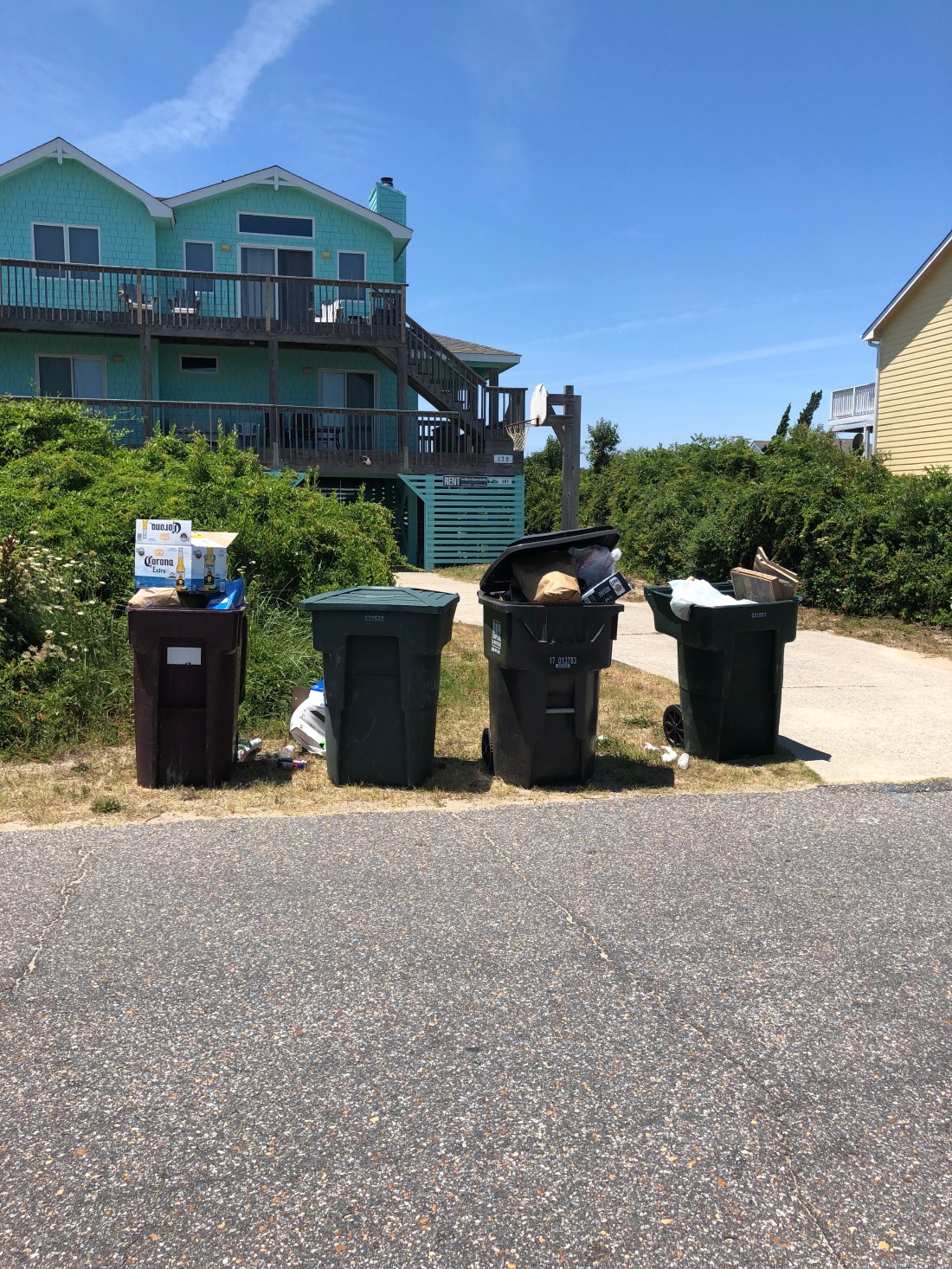
trashcans
The Beacon will discuss the possible future of Southern Shores’ curbside recycling program in an upcoming post.

The Beacon would like to appoint Town Councilman Matt Neal to be town manager, mayor, planner, and all-around problem-solver and fixer for the Town of Southern Shores.

But first we would like Mr. Neal to take elocution lessons so he can learn to speak up, project out, and not mumble—or at least mumble less.

And we would like the Town staff to ensure that, as long as the public has to participate in Town Council meetings by Zoom videoconferencing, we can hear Mr. Neal! Town Councilman Jim Conners’s voice is also hard to pick up.

After painstakingly reviewing the videotape of last Tuesday’s Town Council budget workshop, we still could not hear Councilman Neal well—and closed captions didn’t help!—but what we could hear, we liked. He was knowledgeable, prepared, and on the ball. We did not always agree with his priorities, but we respected his thinking.

In his speed to wrap up the budget workshop, however—or, just simply, because his mind works quickly—Mr. Neal inadvertently stoked the confusion upon which we commented, with dismay, last week.

After Town staff spent 2 ½ hours last Tuesday morning, painstakingly going over the proposed fiscal year 2020-21 budget—department-by-department, line-by-line, nickel-by dime—the Town Council finally got a chance to analyze the proposal and weigh in on how they would like to eliminate a projected $348,853 shortfall.

(This tedious process has to end. A town manager, who is also the town budget officer, does not need to present to the Town Council at a public meeting every line-item cost of every town department. We hope the new town manager will mercifully create a new process. The Town Council will be electronically interviewing top candidates for the job next Friday in a closed session.)

The proposed FY 2020-21 budget prepared by Interim Town Manager/Budget Officer Wes Haskett and Finance Officer Bonnie Swain projects $5,953,243 in revenues and $6,302,096 in expenses, hence, a deficit of $348,853.

Mayor Tom Bennett suggested using monies from the Town’s undesignated fund balance to cover the deficit and balance the budget, but he received no support from other Town Council members for this proposal. After his idea met with silence, Mr. Neal essentially took over the discussion—politely, of course—framing an analysis and approach that eventually held sway.

There is no question that the young builder likes numbers, and he knows how to work with them. The Beacon endorsed him last fall for this aptitude, as well as others that he possesses. We just wish we could hear him!

TAXES AND SAVINGS

Key to Mr. Neal’s analysis and Council members’ discussions that culminated in unanimous approval of Mr. Neal’s analysis were figures provided by Finance Officer Bonnie Swain in a handout that was not included in the meeting packet posted online.

Ms. Swain presented these figures before the line-by-line examination of the proposed budget. They were of some FY 2019-20 budget revenues and expenses that showed how the current fiscal year has been up-ended by the coronavirus pandemic.

According to Ms. Swain, the Town this year has collected about 70.52 percent of the occupancy taxes that she and former Town Manager Peter Rascoe budgeted for FY 2019-20. Of the sales taxes budgeted for the current fiscal year, 73 percent have been collected, she said; and of the budgeted land-transfer taxes, 78.38 percent.

Dare County pays towns their proportionate share of occupancy taxes on a monthly basis, Ms. Swain explained. Southern Shores’ share of May and June occupancy taxes will not be paid to the Town until July and August.

How much LESS tax money will the Town receive in FY 2019-20 than the staff budgeted to receive?

In a “worst-case scenario,” the Finance Officer said, where “no more money comes in” for FY 2019-20 occupancy, sales, and land-use transfer taxes, the Town’s revenues from these taxes would be $595,048 less than budgeted. That’s the bad news.

The good news, she said, is that the Town has “savings” in the current fiscal-year budget from projects that came in under budget, projects that did not get done, and expenses that were not incurred. We’ll call these savings “surplus.”

This surplus includes $278,000 left over from the $1 million appropriated for the South Dogwood Trail sidewalk; $315,000 in capital-improvement project money that was not spent; $314,000 for a year’s debt service on the new fire station that will not be paid until July 1; and $194,030 in funds budgeted for Town building upgrades that did not occur.

(SSVFD Fire Chief Ed Limbacher is now projecting a completion date of the new fire station in June or July.)

The Town also expects to receive a grant from the Dare County Tourism Bureau of $260,993, to offset some of the costs of the South Dogwood Trail sidewalk.

Considering the more than $1 million surplus, which will roll over into the undesignated fund balance, Ms. Swain said, “I think that we’re in pretty good shape.”

As for the undesignated fund balance itself, the Finance Officer said, “You can only get a true picture of the fund balance on June 30” each year, because it’s a “moving target every day,” what with receivables and payables.

“It’s a hard thing to predict,” she said.

The Beacon would have liked Ms. Swain to guesstimate what is in this reserve fund, which is used for emergencies and for budget amendments throughout a fiscal year. A Southern Shores financial officer certainly should have a general sense of how much the Town has in reserve, especially since the Town is required to maintain a minimum for disaster relief.

As of June 30, 2019, nearly 10 months ago, the Town’s auditor reported the balance was $4,173,321. During FY 2019-20, according to Town budget accounting, $1,406,411 were appropriated from the fund for expenditures, chiefly the construction of the South Dogwood Trail sidewalk.

Ms. Swain also explained that in estimating tax revenues for FY 2020-21, she and Mr. Haskett figured that the Town’s share of the County’s occupancy taxes in July would be reduced by 50 percent; in August, by 30 percent; in September, by 20 percent; and in October, by 10 percent. After October, she projected that the revenues would be flat, with no reduction.

Ms. Swain said that Dare County towns have “worked collectively” on these projections, but acknowledged that no one has a “crystal ball.”

“When we open, are the people going to come?” she asked. No one knows.

Over the full proposed FY 2020-21 budget, occupancy taxes are 20 percent lower than last year’s revenue, “a number we feel comfortable with,” Ms. Swain said.

She also calculated an overall reduction in sales tax revenue of 5 percent over last year, and a 2.5-percent reduction in land-transfer taxes.

Ms. Swain included no expenses in the proposed FY 2020-21 budget for hurricane cleanup and recovery. If the Town does incur hurricane-related expenses—which, eventually, the Federal Emergency Management Agency would reimburse—it will have to do a budget amendment and appropriate monies from the undesignated fund balance.

“We’re being optimistic,” Ms. Swain said, “we’re not going to have any hurricanes.”

COUNCILMAN NEAL’S ANALYSIS

Councilman Neal considered the additional worst-case scenario tax shortfall of $595,048 in the current fiscal year; the surplus this year of over $1 million; the estimated reductions in occupancy, sales, and land-transfer tax revenues; and the possibility of hurricane expenses—in addition to the $348,853 budget deficit and a “short list” of elective expenses that he sought to prioritize—and came up with a plan.

And he did this without being clearly audible to the Zoom audience.

The first step, he said, was not the one suggested by the Mayor. It was to remove from the proposed budget $662,340 in expenses that had been allocated for infrastructure projects. This dollar amount was the same amount set aside during the current fiscal year. It is “revenue derived from 5 cents on the current [ad valorem] tax rate,” as Mr. Rascoe explained in his draft FY 2019-20 budget proposal.

In comparison to the details included by Mr. Rascoe, and presumably, Ms. Swain, in last year’s draft proposal, the memorandum accompanying the draft FY 2020-21 proposal is skimpy.

Mr. Neal subtracted the $348,853 deficit from this amount and then started subtracting other expenses from the roughly $313,000 that remained. Some of these expenses had been proposed by Mr. Haskett and Ms. Swain; some of them were scheduled on the agenda to be decided later; and one of them Mr. Neal initiated on his own. They were:

*$35,000 to pay the salary for six months of a new full-time building inspector/code enforcement officer (staff);

*$20,000 or so (someone said $24,000; the public did not receive the dollar amount) for three no-left-turn weekends (on agenda for discussion later);

*incidental costs for a beach nourishment project (later);

*increased costs for a recycling contract (about $6,000 more; discussion on-going)

*$35,000 for one-time COVID-19 bonus payments to staff members (Mr. Neal suggested rewarding the staff, who were not getting cost-of-living increases under the proposed budget, and Mr. Haskett and Ms. Swain had a bonus system at the ready: $1,000 for full-time employees, $500 for part-timers.)

This is when the meeting went off the rails, but it was not Mr. Neal’s doing, it was Mr. Haskett’s.

The Interim Town Manager opened up the afternoon deliberation session by inviting the Town Council to address balancing the budget before they considered what Mr. Neal referred to as “elective” expenses, chiefly, beach nourishment, the no-left turn weekends, and capital street projects. Mr. Haskett needed to be more directive and not so open-ended—especially now that Mr. Neal is on the Council.

Understandably, given the opening, Mr. Neal was off and running—his mind was clicking, and the morning session had been long and tedious—until Mr. Haskett eventually stopped him. But the young Councilman’s big-picture analysis was out of the box, and it influenced later proceedings.

As The Beacon complained in our first blog about the budget workshop, the Town Council voted to apply for two beach nourishment grants from the N.C. Dept. of Environmental Quality’s Coastal Storm Damage Mitigation Fund without first approving beach nourishment itself and then choosing a project from among the four options it had to consider.

This was highly irregular. Now we understand better what happened because we have heard more of what happened.

FINISHING UP AND COUNCILMAN CONNERS’S ‘MY BAD’

We will tie up this budget workshop report here and pick up tomorrow or Tuesday with amplification, based on the videotape, on the decision-making about the recycling contract, the no-left-turn weekends, the beach-nourishment grants, and the engineering consultant’s contract, which expires June 30.

We believe some of the Town Council members did not appreciate that a fixed-rate recycling contract for five years—which RDS of Virginia has offered—is preferable to a contract with a price that is market-variable.

Under RDS’s contract, the recycling company assumes the risk of the market volatility, not the Town, but the Town has to do something about contamination in recyclables. And we believe it should. Abandoning the program should not be an option on the table.

Councilman Neal propounded a policy of “pushing down the road” decisions that could be delayed, and the Council embraced this approach. It voted unanimously, for example, to delay a decision on spending money on rebuilding Dewberry Lane until the fall, when the Town will know better what financial shape it is in.

“In 90 days,” Mr. Neal suggested, the financial picture will be “less uncertain.”

The Dewberry construction project has been bid, and the low bidder, RPC, came in at $85,250, Mr. Haskett said.

It is a shame that Mr. Haskett and Ms. Swain did not propose this approach themselves, instead of the Town Council. They  should have generated ideas and recommendations for the Council to consider.

‘OUR BAD’

Although we think we were justified in believing that Councilman Conners admitted to an open-meeting violation at the workshop, we now know that Mr. Conners’s precise words were: “We talked about that [the proposed recycling contract] at length earlier, inappropriately, and that’s my bad.”

Mr. Conners was difficult to hear, and we did not believe he had talked inappropriately about anything during the meeting, but he apparently believed he had.

The Councilman discussed the proposed recycling contract during a morning breakdown of proposed costs in the sanitation department budget. It came up because Mr. Haskett and Ms. Swain have budgeted $189,500 for FY 2020-21 recycling collection, an amount to be paid to Bay Disposal and Recycling to haul curbside recycling to the Wheelabrator incinerator in Portsmouth, not to a recycling facility.

This amount would increase to roughly $195,000, Ms. Swain said, if the Town were to contract with RDS of Virginia and Bay Disposal separately. Bay Disposal would haul the Town’s curbside recyclables to RDS’s processing facility where they would be recycled, not burned.

The morning discussion on recycling seemed quite appropriate and informative and certainly nothing for which Mr. Conners had to apologize. The recycling contract was not on the afternoon meeting agenda.

We regret the error in our interpretation. In normal times, we would have contacted Mr. Conners and confirmed the meaning of his statement. But, with all of the COVID-19 reporting we have been doing, we were pressed for time. No excuses. We should have reached out to Mr. Conners.

Our bad.

We would like to end this blog by giving more credit where credit is due. Mayor Pro Tem Elizabeth Morey was the Council member who spoke of a worse worst-case scenario, not Mr. Neal, as we thought.

“This thing could come back,” she said in reference to the coronavirus.

The thoughtfulness in Ms. Morey’s decision-making came out in the afternoon session after Mr. Neal unveiled his analysis.

Town Councilman Leo Holland also sought austerity in these uncertain and hard times, as did Mr. Conners, both of whom tried to reduce or stagger some big-ticket expenses in the police and fire department budgets, respectively.

“I don’t think it’s [the economy] going to come back as quick as we all think it is,” Mr. Holland said, after relating a Wall Street Journal item he had read that predicted it would take 27 months for the national economy to rebound.

To which, Mr. Neal replied: “I don’t disagree with you, Leo.”

Time—even just 90 days—will tell more.

Ann G. Sjoerdsma, 4/26/20

4/25/20: HYDE COUNTY REPORTS FIRST COVID-19 CASE ON DAY IT ANNOUNCES REENTRY OF OCRACOKE NON-RESIDENT PROPERTY OWNERS. STATE CASE REPORTS HIT SINGLE-DAY HIGH.

Coronavirus-CDC-678x381

Hyde County yesterday reported its first confirmed case of COVID-19 and announced plans to lift on May 11 entry restrictions imposed upon Ocracoke non-resident property owners. The county’s Board of Commissioners also yesterday extended Hyde’s stay-at-home order until May 22.

The Hyde Board of Commissioners had previously adopted the guidelines set forth in Governor Roy Cooper’s statewide stay-at-home order, which, set to expire April 29, was extended last week to May 8. Hyde County’s extension to May 22 tracks with the extension announced by Dare County of its Stay Home-Stay Healthy order.

Hyde County lifted restrictions on the entry of non-resident property owners to the county’s mainland on April 9. The county seat is Swan Quarter.

Ocracoke entry information: http://www/hydecountync.gov/ocracoke-covid/index.php

Mainland entry: http://www.hydecountync.gov/mainland_covid-19_entry/index.php

Yesterday’s announcement: http://hydecountync.gov/Press%20Release%20-%20SOE%20Admendment%204.pdf

Hyde County’s report of its first COVID-19 case means that among counties in Eastern North Carolina, only Camden County, which is between Currituck and Pasquotank counties, has not reported a case. Only four other counties in North Carolina have not reported a confirmed COVID-19 case, and they are all in the western mountains.

The N.C. Dept. of Health and Human Services today reported 571 more confirmed cases of COVID-19 over yesterday’s total, marking the state’s largest single-day increase. The previous high for a single-day increase was Friday’s total of 444 new cases.

NCDHHS also reported an increase in the number of COVID-19-related deaths of 20, for a total of 289 deaths.

The Beacon does not usually report case or death totals, but we considered the record single-day increase significant in light of the metrics outlined by NCDHHS Secretary Dr. Mandy Cohen at the Governor’s press conference last Wednesday. Governor Cooper said he was extending his stay-at-home order until May 8 because the case data do not yet justify reopening the state by initiating Phase One of a three-phase plan he outlined.

Among the telltale metrics that must decline before reopening will begin, the Governor said, are the number of lab-confirmed COVID-19 cases over a 14-day period and the number of positive COVID-19 test results over 14 days.

 Ann G. Sjoerdsma, 4/25/20


4/24/20: GOVERNOR CLOSES K-12 SCHOOLS THROUGH SCHOOL YEAR, ANNOUNCES HOW HE WOULD LIKE $1.4 BILLION IN FEDERAL COVID-19 AID TO BE DISTRIBUTED IN STATE. Plus, He Has Georgia On His Mind.

remotelearning 

As expected, Governor Roy Cooper today extended through the academic year that ends in June his executive order that closed all K-12 public schools until May 15. Students will “continue remote learning for the rest of the school year,” he said.

In announcing his decision to keep public schools closed indefinitely for “in-person instruction,” the Governor, as well as two top state education officials who spoke at today’s press conference, made clear that they are preparing for a “new normal” model of education and learning in the fall.

“The next school year will not be business as usual,” the Governor said, a message echoed by N.C. School Superintendent Mark Johnson and N.C. Board of Education Chairman Eric Davis, each of whom spoke about being ready and proactive during a continued COVID-19 crisis.

The Governor also announced today his proposal for how $1.4 billion in federal aid to North Carolina should be spent. The federal monies are available through the Coronavirus Aid, Relief, and Security (CARES) Act.

State Budget Director Charles Perusse outlined how the Governor’s proposed allocations address the “immediate needs” in three areas: 1) public health and safety; 2) continuity of operations for education and state government services; and 3) assistance to small businesses and local governments.

According to Mr. Perusse, the Governor has proposed $300 million be allocated to public health and safety; $740 million to education and state government; and $175 million to small businesses and municipal governments in need.

Breaking down these figures further, Mr. Perusse said that the Governor has recommended $243 million be allocated to K-12 public education; $77.4 million to higher education; $300 million to on-going major transportation operations; $75 million to small businesses through the Golden LEAF Foundation; and $300 million to local governments, who would benefit based on their populations.

Mr. Perusse said that leadership in both the N.C. House of Representatives and the N.C. Senate is supportive of the Governor’s proposal. The N.C. General Assembly will be back in session on Tuesday.

According to Superintendent Johnson, “Plans for next [school] year are already under way” and take into account the safety of students, educators, and all school workers.

Some of the ideas suggested by the Governor and the school officials for instruction in the fall include 6-foot physical distancing among students and teachers, increased spacing between classrooms, the elimination of common areas, the staggering of instruction days, and revised hygiene protocols.

The Governor also mentioned the possibility of eliminating sports programs.

As he did in his earlier press conferences this week, Governor Cooper spoke about making decisions based on “science, data, and trends” and warned: “This pandemic will be with us for some time.”

WHAT ABOUT GEORGIA?

 During the media question period, Governor was asked about his concerns related to the loosening of COVID-19 restrictions by the nearby states of South Carolina and Georgia. He expressed concerns about both states, but focused on Georgia.

Georgia Governor Brian Kemp, who was slow to issue a stay-at-home order, has permitted hair and nail salons, gyms, tattoo parlors, massage therapists, and other close-contact businesses to reopen today even though COVID-19 cases and deaths in that state are still on the rise.

Despite the close proximity of people in such businesses, the Governor also has urged people to continue to observe social distancing, as well as to wear face masks and gloves and to practice rigorous hygiene protocols

On Monday, Georgia’s theaters, social clubs, and dine-in restaurants will be able to open, as well, on a limited basis.

Governor Cooper said he is very concerned about Georgia’s actions “potentially hurting North Carolinians,” either by North Carolinians traveling to Georgia and being infected by the coronavirus or by Georgians traveling to North Carolina and bringing the coronavirus with them. He said he would be speaking with Governor Kemp today and would be asking him to “take a second look at” his rollback of restrictions.

A portion of Western North Carolina shares a state border with Georgia.

Atlanta Mayor Keisha Lance Bottoms has publicly disagreed with Governor Kemp’s decision, favoring taking less drastic steps to make the stay-at-home order more palatable to citizens.

Governor Kemp received unwelcome notoriety earlier when he belatedly issued the state’s stay-at-home order only after he admitted to learning that asymptomatic people could transmit COVID-19—months after this mode of transmissibility had become well-known.

TODAY’S DARE COUNTY EMERGENCY MANAGEMENT BULLETIN

 In today’s emergency bulletin, Dare County announces that starting next week the Joint Information Center, which the Dare County Control Group set up to coordinate important COVID-19 communications, will provide video updates twice weekly on Tuesday and Thursday, and issue COVID-19 bulletins three times a week on Monday, Wednesday, and Friday, unless information warrants additional updates.

Dare County and N.C. COVID-19 cases will continue to be updated daily and will be available at darenc.com/covid19.

See Bulletin no. 51 at https://www.darenc.com/Home/Components/News/News/6190/1483.

Ann G. Sjoerdsma, 4/24/20


4/24/20: THE BEACON EXPOUNDS UPON THE GOVERNOR’S STAY-AT-HOME ORDER EXTENSION AND 3-PHASE GRADUAL PLAN FOR REOPENING. Plus, We Refer You to NCDHHS’s Dashboard for Demographic Data and Try to Explain the Dare County Control Group.   

CV test GENERIC 0010 

The Beacon’s coverage yesterday of Governor Roy Cooper’s afternoon press conference was based on our watching it live, not on reading a press release or the new executive order that extended the current statewide stay-at-home order to 5 p.m. on May 8. Today, we fill in some blanks.

First, you may access the Governor’s Executive Order 135, which is titled “Extending Stay at Home Order and Orders Limiting Mass Gatherings, Requiring Social Distancing and Restricting Visitation at Long Term Care Facilities,” at https://files.nc.gov/governor/documents/files/EO135-Extensions.pdf.

A press release issued by the Governor’s Office that summarizes yesterday’s conference is available at https://governor.nc.gov/news/governor-extends-stay-home-order-through-may-8-plans-three-phase-lifting-restrictions-based.

We found the most confusing aspect of the Governor’s news yesterday to be his description of Phase One of the three-phase gradual reopening that he outlined.

Judging by the questions asked by the media after the Governor finished his remarks, we were not the only ones. But we were ahead of many of them in understanding that the stay-at-home order will not be lifted in Phase One. If and when the reopening progresses to Phase Two, the order will be rescinded then.

The press release clarified for us that in Phase One, people will be allowed to travel for non-essential reasons to businesses that currently are allowed to be open, such as sporting goods stores, hardware and houseware stores, clothing stores, book shops, and other retailers.

The current stay-at-home order requires people to go out only for essential reasons, such as for grocery shopping and prescription drug pickups. But we all know that people are not adhering to that restriction, shopping for non-essential items at this time, too.

We were confused yesterday as to what, if any, differences the Governor was saying would be implemented in Phase One. As a practical matter, there would be little change.

Any stores that are open in Phase One would have to implement employee and consumer social-distancing, hygiene and cleaning protocols, symptom screening of employees, and other protective public-health measures. There would be no lifting of any restrictions on social distancing and mass gatherings, and face coverings would continue to be recommended for public settings when 6-foot social distancing cannot be maintained.

THE NCDHHS DASHBOARD

The Governor said his three-phase plan would be based on the “science, data, and trends” of COVID-19 in the state. NCDHHS Secretary Dr. Mandy Cohen expounded yesterday on all three, illustrating her explanation with graphs showing how key indicators, such as the number of new COVID-19 cases in the past 14 days, are trending.

One Southern Shores resident raised reasonable questions on The Beacon’s Facebook page yesterday about the demographic data upon which Governor Cooper, Dr. Cohen, and other members of the N.C. coronavirus task force are relying. We replied that there is demographic information available on the NCDHHS dashboard, to which Dr. Cohen repeatedly alluded yesterday.

The dashboard is accessible at https://www.ncdhhs.gov/divisions/public-health/covid19/covid-19-nc-case-count. We encourage you to check it out.

At the top of the dashboard are the latest statewide statistics on the number of positive COVID-19 test results, the number of tests run, the number of COVID-19-related deaths, the number of hospitalizations, and the number of N.C. counties that have reported a COVID-19 case.

These data are updated every day by 11 a.m., and the Dare County Emergency Management bulletin that appears later in the day always provides them.

Today, the dashboard shows statewide laboratory-confirmed positive test results are up to 8,052, out of 100,584 tests completed, which means 8 percent of the tests came back positive; the number of deaths have increased by 16 from yesterday to 269 deaths; there are 477 hospitalizations; and 93 counties are reporting cases.

That only 100,584 tests have been done in a statewide population of nearly 10.5 million—North Carolina is the ninth most populous state in the nation—is a big problem for the Governor, Dr. Cohen, and members of the State coronavirus task force. They do not know how big the iceberg beneath this tip may be.

Under these overall statistics, you will find links on the dashboard to demographic data, such as lab-confirmed COVID-19 cases and COVID-19-related deaths, according to age, race/ethnicity, and gender, among other categories.

Here is a link to the breakdown of cases and deaths by age: https://www.ncdhhs.gov/divisions/public-health/covid19/covid-19-nc-case-count#by-age.

It shows the following percentages among the total number of cases reported:

Ages 0 to 17: 2 percent

Ages 18-24: 7 percent

Ages 25-49: 40 percent

Ages 50-64: 28 percent

Ages 65+: 24 percent

The deaths are reported to be as follows:

Ages 0 to 17: none

Ages 18-24: none

Ages 24-49: 4 percent

Ages 50-64: 11 percent

Ages 65+: 85 percent

The gender data show that of the total number of deaths, 61 percent are of men and 39 percent of women, even though more women than men have been diagnosed with COVID-19. Diagnoses skew 51 percent female and 47 percent male.

Similar statistics have been reported throughout the country. More men than women are dying from the virus. Theories have been explored as to why, but The Beacon will not explore them here today.

The Governor will hold a press briefing today at 2 p.m. to address a possible opening of the K-12 public schools and to discuss how the N.C. General Assembly will proceed with its fiscal year 2020-21 budget.

The Raleigh News and Observer reported this morning that the Governor is expected to extend the school closure, which currently expires May 15.

THE DARE COUNTY CONTROL GROUP

The Beacon has discovered that many people are confused about who and what the Dare County Control Group is and what legal authority it has. Little wonder. No one at the County or town level has publicly sought to explain the Control Group.

Unlike in Currituck County, where the county board of commissioners is making decisions during the COVID-19 emergency, the Dare County Board of Commissioners is not directly calling the shots. You are seeing and hearing from Dare County Board of Commissioners Chairperson Bob Woodard, not because he is announcing actions approved by the Board, but because of his unique status in the event of a declared county state of emergency.

The key to understanding the lines of authority is Chapter 92 of the Dare County Code of Ordinances, which outlines emergency management and is known as the Dare County Emergency Management Chapter. This chapter sets up an Emergency Management Plan (the “Plan”) and designates who has authority, and what their duties and powers are, in regard to administering the Plan.

The Beacon may devote a future blog to this Plan. For now, suffice it to say that, pursuant to Chapter 92, the Dare County Board of Commissioners has delegated authority to its Chairman “to determine and declare the existence of a state of emergency . . . , to order the evacuation of some or all portions of the county, to authorize the reentry of persons into the county . . . and to impose . . . prohibitions and restrictions deemed necessary to protect public health, safety and welfare and minimize damage to property.” (See Code sec. 92.05(B))

In exercise of this authority, Mr. Woodard has declared all of the emergency orders and restrictions that have been issued by Dare County during the COVID-19 pandemic. See Dare County orders at https://www.darenc.com/home/showdocument?id=6324.

Chapter 92 also establishes an Emergency Management Department to act as “the agency through which” the Dare Board of Commissioners exercises its authority, and authorizes the Board to appoint a director of that department.

The person currently in the job is Drew Pearson. His duties and responsibilities are enumerated in sec. 92.07 of the Dare County Code of Ordinances. The Dare Emergency Operations Center is located on Airport Road in Manteo.

So how does the Dare County Control Group fit into the mix?

Under sec. 92.08 of the Dare Code of Ordinances, Mr. Pearson, the emergency management director, is charged with developing a comprehensive Emergency Management Plan that the Dare County Board of Commissioners must adopt and maintain by resolution.

Among the legal requirements of the Plan is the establishment of a Dare County Control Group, which “shall work collectively to make timely decisions regarding implementation of the Plan in response to actual or imminent emergencies.” (Sec. 92.8(F)

Membership of that group must include the “Chairman of the Dare County Board of commissioners or the Chairman’s designee, the Mayors, or their designees, of all incorporated municipalities in the county, the Dare County Sheriff, and the Superintendent of the National Park Service Outer Banks Group.”  (Sec. 92.8(F))

Nine people. You will find them all listed by name here:

https://www.darenc.com/departments/emergency-management/about

So, although the Dare County Board of Commissioners has delegated authority to both the Director of the Emergency Management Department and to the Dare County Control Group, it is not correct to say that individual members of the current Board are making decisions during the COVID-19 crisis—although Mr. Woodard did announce at a commissioners’ meeting that Commissioner Danny Couch has been serving on the Control Group. By what authority, we do not know.

Pursuant to the Dare County Code, all proclamations issued by the Control Group, or by its chairperson—now Bob Woodard—“shall have the same force and effect of law” as any other provision in the Emergency Management Chapter.

We will leave it there for now. Clearly, Currituck County does not have an emergency management plan remotely like the one in effect in Dare County.

SOUTHERN SHORES BUDGET WORKSHOP: I have not forgotten about covering Tuesday’s Southern Shores Town Council budget workshop in more detail. I simply have not had time, with all of the county and state news of the week, to think about it, much less to look at the videotape to pick up voices that could not be heard through Zoon.

The videotape of the Town Council’s workshop is available online at https://www.youtube.com/watch?v=nIsG7Y-9bvk&feature=youtu.be.

Town Councilman Jim Conners has informed me that I misinterpreted what he said at the meeting about speaking with his colleagues out of the public forum regarding the proposed recycling contract and that I have done him an injustice. He insists he did not violate the open-meeting law, as I alleged, and I take him at his word. Before I do a major mea culpa, however, I would like to view the videotape.

Ann G. Sjoerdsma, 4/24/20


4/23/20: GOVERNOR EXTENDS STAY-HOME ORDER TO MAY 8, OUTLINES THREE-PHASE ‘REOPENING’ PLAN DEPENDENT ON ‘SCIENCE, DATA, AND FACTS.’ WILL ADDRESS SCHOOLS, GENERAL ASSEMBLY BUDGET TOMORROW.

cooper2

Governor Roy Cooper today extended North Carolina’s stay-at-home order until May 8 and outlined a three-phase plan for “reopening” the state, but he made clear that “science, data, and facts” will determine when the first phase of that plan begins.

“We’re not there yet,” he emphasized at an afternoon press conference in Raleigh.

“It is clear that we are flattening the curve” of COVID-19 cases in the state, the Governor said, “but our state is not ready to lift restrictions yet. We need more time to slow the spread of the virus before we can ease the social restrictions.”

The Governor did not loosen any restrictions that he has imposed by executive order in the past month and said he would be addressing the reopening of K-12 public schools tomorrow, along with the N.C. General Assembly’s fiscal year 2020-21 budget.

The initiation and progression of the Governor’s three-phase plan, which, he said, is designed to stimulate the economy while also protecting public health, would be based on four metrics—or “data points”—that Dr. Mandy Cohen, secretary of the N.C. Dept. of Health and Human Services (NCDHHS), presented and discussed at the conference.

Although the State is seeing “a lot of positive signs,” Dr. Cohen said, the trend trajectories of three of the metrics, all of which serve to quantify the prevalence, threat, and health-care demands of COVID-19 in North Carolina, are not moving in the right direction yet. (The Beacon will elaborate on this below.)

THE THREE PHASES OF ‘REOPENING’

The earliest Phase One of the Governor’s plan could begin would be May 9. The next 15 days will give the Governor and his coronavirus task force team a “window,” he said, to “look at the trends” of COVID-19 and to decide if May 9 is an appropriate time to initiate the plan or if it is still too early.

PHASE ONE: As the Governor explained, Phase One would leave the stay-at-home order in place, but modify it slightly to encourage more essential businesses to operate and more people to exercise outdoors. It would reopen parks that have been closed, but it would not reopen any non-essential businesses, such as restaurants, bars, hair salons, and other “close-contact” businesses that have been closed, and it would continue physical distancing and the restriction of mass gatherings to 10 people or fewer.

Phase One is simply the beginning of “the process of moving forward,” the Governor said.

PHASE TWO: If the science, data, and trends support progression to Phase Two, it would occur two to three weeks after initiation of Phase One, the Governor explained.

In Phase Two, he said, the stay-at-home order would be lifted, and those non-essential businesses that have been closed would be opened on a limited basis.

Restaurants, bars, and other businesses that have been closed because of customers’ proximity to each other would be required to reopen with “reduced [customer] capacity or with specific restrictions requiring social distancing,” the Governor said. Physical distancing between people remains key to controlling the spread of COVID-19.

PHASE THREE: Phase Three would occur four to six weeks after Phase Two, the Governor said, and would allow “increased capacity” at restaurants, bars, houses of worship, entertainment venues, and other close-contact businesses and venues.

If you add up the required time between phases and determine a best-case scenario, restaurants, bars, and other entertainment venues that Outer Banks vacationers like to frequent would be operating at diminished customer capacity until at least June 20.

The Governor did not discuss a Phase Four resumption of what some may think is normalcy as we experienced it before the coronavirus pandemic.

Instead, he said, “This virus is going to continue to be with us until we have a vaccine,” and all North Carolinians must continue to be vigilant about physical distancing and observing other infection-control measures, such as thorough hand washing and disinfection of surfaces.

He also cautioned that if the metrics indicate a regression—for example, if COVID-19 cases spike—“We may have to move back to a previous phase to protect public health.”

THE CRITICAL COVID-19 METRICS

Dr. Cohen cited four statewide “metrics” as critical objective determinants “to guide our decisions” moving forward and exhibited graphs of the trajectories of each one. They are:

  • The number of COVID-19-like syndromic cases over a 14-day period.
  • The number of lab-confirmed COVID-19 cases over a 14-day period.
  • The number of positive COVID-19 test results over 14 days.
  • The number of hospitalizations of COVID-19 patients over 14 days.

North Carolina has not seen a surge of cases or a peak, Dr. Cohen said, because it initiated infection-control measures, such as physical distancing, early enough to slow the spread of COVID-19; but neither have the number of cases in the state plateaued or declined. The daily numbers continue to rise.

Although she said “North Carolina is in a very good place,” Dr. Cohen also noted that, “We want to see a decrease or substantial leveling of cases” before going into Phase One.

She reiterated what the Governor said: “We have flattened the curve, but we’re not there yet.”

Of the four metrics, Dr. Cohen said, only the first, which she called the “surveillance metric,” is moving in a positive direction—downward.

The lab-confirmed COVID-19 cases in the state are “still going up,” she said, and positive COVID-19 test results have yet to decrease as a percentage of the total tests done. Hospitalizations are “largely level,” she said, but the task force would like to see a downward trend, not just a leveling.

The NCDHHS secretary also discussed testing and tracing capacity in the state and the availability of personal protective equipment.

She said there should be 5,000 to 7,000 tests conducted every day, “but we’re not there yet” (only 2,500 to 3,000), and 500 people doing contact tracing—twice the number who are currently doing it. There also are shortages in medical face masks, gowns, and other protective equipment.

The bottom-line message that Governor Cooper delivered today was that “we can rebuild the damage that this virus has done to our state,” but it is going to take time and “hard work” by everyone. Fortunately he said, North Carolinians “are tough.”

The Governor urged people to stay safe, to stay at home, and to look after each other for as long as necessary.

Ann G. Sjoerdsma, 4/23/20

4/23/20: VEHICLES MOVED SMOOTHLY THROUGH BRIDGE CHECKPOINT THIS MORNING. GOVERNOR TO UNVEIL PLANS FOR GRADUAL ‘REOPENING’ OF STATE AT 3 p.m. CONFERENCE.

checkpoint423
The checkpoint at the Wright Memorial Bridge was quiet around noon today.

Currituck County’s lifting today of access restrictions placed on non-resident property owners did not affect the flow of eastbound traffic at the Wright Memorial Bridge checkpoint, according to people interviewed by The Beacon who crossed the bridge after 9 a.m. and our own observations.

The Currituck County Commissioners voted Monday to allow non-resident Currituck-Outer Banks property owners to enter the county, starting today at 9 a.m. Currituck also has proposed lifting the access ban on visitors around May 15.

In yesterday’s emergency bulletin, Dare County advised non-resident Currituck County property owners that their “travel in Dare County should be used only as necessary to reach the Currituck Outer Banks or for essential needs such as health care. Plan to travel directly to your destination once passing through the checkpoint at the bridge.”

The Dare County Control Group also reminded the new arrivals that they must respect Dare County’s Stay Home-Stay Healthy order when they are in Dare.

See Bulletin no. 49 at https://www.darenc.com/Home/Components/News/News/6176/1483

Peggy Irvin, who works as a caregiver in Southern Shores, said she noticed no uptick in traffic when she arrived in Dare County around 9:45 a.m. She described the traffic flow at the checkpoint as “smooth” and “no different” from any other week day morning when she has passed through during the COVID-19 pandemic.

Dorothy Pettaway, another caregiver who lives in Currituck County and works in Dare, agreed. When she arrived in Dare County around 10:30 a.m. she noticed no increase in traffic flow through the checkpoint. “No change,” Ms. Pettaway told The Beacon.

The number of confirmed cases of COVID-19 in Dare County has remained at 15 for the past 12 days, according to today’s Dare County emergency bulletin.

Bulletin no. 50 also announces that the Dare County COVID-19 webpage now has a section for quick reference that provides the most current information on COVID-19 cases in the county. It is available at darenc.com/covid19.

See Bulletin no. 50 at https://www.darenc.com/Home/Components/News/News/6182/1483.

Earlier this week, the Dare County Control Group announced a plan for a staggered re-entry of non-resident property owners into the county, starting May 4, as well as an extension of the Stay Home-Stay Healthy order until May 22.

For more details, see The Beacon, 4/21/20.

GOVERNOR TO UNVEIL PLANS FOR ‘REOPENING’

Governor Roy Cooper will announce key decisions in his plan to “reopen” North Carolina at a 3 p.m. press conference today. The Governor has said that he will address a possible extension of his statewide stay-at-home executive order, which expires April 29, as well as the possible reopening of K-12 public schools.

The press conference will be covered on television, but The Beacon does not know which local network affiliate will carry it. The Raleigh News and Observer reported that the Raleigh affiliate of ABC-TV usually covers the Governor’s press conferences.

The News and Observer is also offering a live stream of the conference on its website, http://www.newsobserver.com.

See today’s News and Observer story about the Governor’s press conference at https://www.newsobserver.com/news/coronavirus/article242226216.html?utm_source=pushly&intcid=%7B__explicit:pushly_514826%7D.

Ann G. Sjoerdsma, 4/23/20

4/22/20: HAPPY EARTH DAY. PLUS NEWS FROM THE GOVERNOR ABOUT EASING RESTRICTIONS IN NORTH CAROLINA, INSIGHT FROM A JOHNS HOPKINS INFECTIOUS DISEASE EXPERT ON THE COVID-19 FRONT LINES, AND A LOOK AT THE WORST-CASE SCENARIO.

Happy Earth Day. Carpe diem.

Today is the 50th anniversary of one of the most successful national demonstrations in the history of the United States.

Soon after millions of people took to the streets April 22, 1970, to protest in behalf of cleaning up our natural environment, the federal government took action to do just that. It created the Environmental Protection Agency and enacted new laws to protect our waters and our air and to stop the spewing and dumping of toxic substances.

Earth Day also brought national attention to the problem of increasing waste and the importance of recycling.

When we heard two members of the Southern Shores Town Council seriously suggest yesterday that the Town jettison its curbside recycling program, instead of investing the time and money it would take to make it work efficiently, we wondered what calendar year it is.

Earth Day may have been the best thing to come out of the 1960s countercultural movement. Certainly, it had—and continues to have—an impact on the daily lives and health of all people living in this country. We believe it would be a mistake to roll back the progress that has been achieved, especially on a local level, simply because the tasks at hand are too hard for some to figure out or manage, and/or environmental protection and recycling are not the personal priorities of an elected official.

Please see The Beacon’s post yesterday about the SSCA’s “Earth Week” beach cleanup.

The SSCA is seeking volunteers’ help with clearing the beaches near its crossovers and on the crossovers themselves of storm debris. The beach areas that have “more significant debris” than others, according to the SSCA Board of Directors, are from Sandpiper Lane to Mockingbird Lane (access via Purple Martin Lane); from Hickory Trail to Second Avenue; and from Ninth Avenue to the Hillcrest Beach.

UPDATE ON EASING COVID-19 RESTRICTIONS IN NORTH CAROLINA

Governor Roy Cooper announced yesterday that he likely will make announcements by week’s end about the statewide stay-at-home order, which is in effect until April 29, and the reopening of K-12 public schools. These decisions will be part of the Governor’s plan of moving forward and gradually easing COVID-19-related restrictions in North Carolina.

Whatever the Governor decides about extending his executive stay-at-home order, those of us in Dare County will continue to be subject to the County’s Stay Home-Stay Healthy order, which the Dare County Control Group extended yesterday to May 22. (See The Beacon, 4/21/20.)

The Control Group also ordered all people in Dare County to wear a mask or other face covering when they are in public settings, such as a grocery store or pharmacy, where they cannot maintain the six-foot social or physical distancing requirement.

Such coverings, public-health experts say, reduce the secretions emitted into the air by the person wearing the covering. They protect others from being infected by airborne droplets; they do not protect the masked person.

The Governor expressed interest yesterday in reopening North Carolina’s K-12 public schools this school year, but said he has to be confident first that students will be safe before he makes that decision. N.C. public schools have been closed since March 16 and will remain closed until at least May 15.

The Governor’s Office also announced yesterday that self-employed workers in North Carolina who did not qualify for state unemployment benefits will be able to apply for federal unemployment benefits starting Friday.

The N.C. Division of Employment Security is administering three federal unemployment-assistance programs created by the Coronavirus Aid, Relief and Economic Security (CARES) Act, which was signed into law March 27.

People who are self-employed, who work as independent contractors or as freelancers, or who work in the “gig economy” and do not qualify for state benefits can apply for federal benefits starting Friday through the federal “Pandemic Unemployment Assistance” program. See the website of the Division of Employment Security for more information at http://des.nc.gov.

Unemployed workers who qualify for state benefits may be eligible for federal benefits through the Federal Pandemic Unemployment Compensation program, which has already been implemented.

The third federal unemployment program created by the CARES Act extends benefits up to 13 weeks for individuals who have exhausted their state benefits. No timeline for this program has been set yet.

So far the State has paid more than $580 million in unemployment to more than 257,000 people since the coronavirus pandemic began, according to The Raleigh News and Observer.

COVID-19 AND DARE COUNTY’S GRADUAL ‘REOPENING’

The Beacon advisory board would like to congratulate the Dare County Control Group on preparing and initiating a “reopening” plan that is based on “science, trends, data, epidemiology, and resource availability,” as it states in yesterday’s bulletin about the staged re-entry of non-resident property owners that starts May 4.

In The Beacon’s last blog posting yesterday, we enumerated some of the facts and factors that the Control Group weighed in deliberating upon a plan. We refer you again to Bulletin no. 48, which detailed them:

https://www.darenc.com/Home/Components/News/News/6172/1483

In today’s bulletin, Dare County advises non-resident Currituck County property owners, that their “travel in Dare County should be used only as necessary to reach the Currituck Outer Banks or for essential needs such as health care. Plan to travel directly to your destination once passing through the checkpoint at the bridge.”

The Currituck County Board of Commissioners approved re-entry of non-resident property owners starting tomorrow at 9 a.m. The Dare County Control Group reminds the new arrivals that they must respect Dare County’s Stay Home-Stay Healthy order when they are in our county.

See Bulletin no. 49 at https://www.darenc.com/Home/Components/News/News/6176/1483

‘THE WORST-CASE SCENARIO’

Yesterday during the Southern Shores Town Council budget workshop, Councilman Matt Neal spoke of planning for “the worst-case scenario” with the COVID-19 pandemic, and even a “worse worst-case scenario.”

Mr. Neal emerged yesterday as the most reasonable, practical, and prepared member of our Town government—a leader if he chooses to be one—and The Beacon will give him his due when we have a chance to actually hear him on the videotape.

While other members had their moments—we especially appreciate Councilman Leo Holland’s repeated admonition that “It is easier to give back than to take away.”—Mr. Neal was consistently on the front lines of each discussion.

Today, another front-liner, Dr. Robert R. Redfield, who is director of the U.S. Centers for Disease Control and Prevention, is in the news for predicting that the second wave of the COVID-19 pandemic will be more devastating than the first.

(You will recall that the CDC horribly bungled the first COVID-19 test, which it developed and distributed nationwide, with the inclusion of a contaminated reagent. The contamination was found to have occurred in the manufacturing process, not in the design.)

Dr. Redfield, who is a virologist, is warning that next winter the seasonal influenza epidemic will overlap with a second coronavirus epidemic and possibly overwhelm the nation’s health-care system, whose shortcomings have been exposed during the current COVID-19 wave.

Dr. Redfield is not the first physician-scientist to raise this warning. Of more concern to The Beacon is the message that Dr. Anthony S. Fauci has tried repeatedly to deliver and that Dr. Lisa L. Maragakis, M.D., M.P.H., Senior Director of Infection Prevention for the Johns Hopkins Health System, echoed in a webinar broadcast last night:

Judging by its “characteristics,” Dr. Maragakis said, “The virus is likely to remain with us” through the summer.

It may have “seasonality in the future,” the epidemiologist and infectious disease expert said, such that it would be less prevalent in warmer weather, but it does not yet. It is, therefore, important that people stay focused on “the basics of infection control,” she stressed, and not assume that when case counts plateau and start to decrease we are out of the woods.

Dr. Maragakis also confirmed an earlier report by The Beacon that the antiviral drug, remdesivir, shows promise in treating COVID-patients in clinical trials that are being conducted at Johns Hopkins, but so far there is no evidence of efficacy in trials with hydroxychloroquine, the anti-malarial drug touted by PresidentTrump.

Remdesivir is administered by IV. Dr. Maragakis also mentioned a nebulizer medication (it is inhaled) called DAS181, which works by interfering with the virus’s ability to bind with receptors on cells in the lungs. This is now the virus invades the body and why pneumonia develops. Unlike the common cold, COVID-19 is not upper-respiratory.

For the record, the Johns Hopkins professor said a vaccine is “still many months away” and the mortality rate of COVID-19, which she estimated at 0.7 to 1.5 percent of all patients, is 10 times higher than the mortality rate for seasonal influenza.

Dr. Maragakis also identified obesity as a risk factor for COVID-infected patients, along with comorbidities, such as diabetes and heart disease, which are associated with obesity.

The Beacon supports planning for the worst-case scenario by focusing on infection controls, and not relaxing, like the Dare County Control Group seems committed to do.

Happy Earth Day.

Ann G. Sjoerdsma, 4/22/20

4/21/20: DARE OPEN TO NON-RESIDENT PROPERTY OWNERS IN ORDER OF LAST NAMES, STARTING MAY 4. NO DECISION ON VISITOR ACCESS YET. COUNTY STAY-HOME ORDER EXTENDED TO MAY 22, WITH FACE COVERINGS NOW BEING REQUIRED.

facemask
Dare County is now requiring individuals to wear face coverings in public settings when they cannot maintain six-foot social distancing.

Dare County will be open to non-resident property owners who have valid entry permits and government-issued IDs starting Monday, May 4, and continuing on Wednesday and Friday of that week, in order of the owners’ last names, according to an elaborate plan announced this afternoon by the Dare County Control Group.

As part of that plan, the Control Group also has extended the County’s stay home-stay healthy order until May 22, leaving in place all current restrictions and adding to them the requirement that people wear a mask or cloth covering in public settings when they cannot maintain other social-distancing measures.

According to Bulletin No. 48, which lays out the new plan, the Control Group will address access for visitors “at a future date to allow for necessary syndromic surveillance and monitoring of resource availability.”

See bulletin at https://www.darenc.com/Home/Components/News/News/6172/1483

To apply for an entry permit, see: https://lfp.darecountync.gov/Forms/nonresident.

Starting May 4 at 6 a.m., non-resident property owners with proper permits and IDs whose last names begin with a letter between A and I will be allowed entry.

On May 6, at 6 a.m., non-resident property owners with proper paperwork whose last names begin with a letter between J and R will be given access, and all remaining non-resident property owners (S-Z) will be allowed entry on May 8, at 6 a.m.

Law enforcement officers at the entry checkpoints will check the identification of every person in a vehicle, according to the “Frequently Asked Questions” portion of the Dare County bulletin. Only those people who are listed on a permit with matching government-issued ID will be allowed entry, along with their minor children.

The Control Group further asks that non-resident property owners bring “their own supplies to sustain themselves in their homes as much as possible, including groceries, prescriptions, paper products, and other essentials.”

In response to an FAQ about why Dare County is lifting restrictions later than Currituck County is, the bulletin states: “Dare County has developed a plan for gradual lifting of restrictions on entry based on the science, trends, data, epidemiology, and resource availability. We do not have information on what criteria Currituck County used to make their decision on entry.

The Currituck County Board of Commissioners voted yesterday to approve reentry of non-resident property owners to the Currituck-Outer Banks this Thursday at 9 a.m. The Beacon wrongly expected Dare County to follow suit and is pleased to discover that Dare has been quite circumspect in its planning.

But shouldn’t law enforcement officers deny entry into Dare County to all non-resident Corolla property owners who are not essential workers? They don’t have permission to be in Dare County, and they cannot get to Corolla without going through Dare.

Oh, well.

The Control Group cites in its statement of “plan rationale” a number of changes that have improved the county’s position regarding COVID-19, including:

*The number of positive COVID-19 cases in Dare County has been stable for over a week, and there have been no new cases during that time.

*Syndrome surveillance indicates no immediate increase in respiratory illness or COVID-19-related symptoms.

*Testing is now readily available in Dare County in accordance with current N.C. Dept. of Health and Human Services guidelines.

*Testing turnaround—the time between specimen collection and test results—has dramatically decreased over the past few weeks so that results are now received within 24 to 72 hours.

*The Dare County Dept. of Public Health has increased capacity for contact tracing.

Non-resident property owners would be well-advised to read the details about Dare County’s stay home-stay healthy order and the answers to the FAQ that are provided in the emergency bulletin.

The Governor’s statewide stay-at-home order is in effect until April 29 and will likely be extended.

In other COVID-19 news, The Charlotte Observer reported today that North Carolina’s LabCorp has received the first approval from the U.S. Food and Drug Administration for an at-home testing kit for COVID-19.

According to The Observer, the company said its kit will involve placing a swab inside a person’s nose, then mailing the swab to LabCorp for testing.

The FDA has not officially cleared or approved the LabCorp product, but it has authorized its use. For now, the kit will be used on the pandemic’s front lines, going to healthcare workers and first responders who need it.

LabCorp said its kit will be available to the general public within the coming weeks and will cost $119, according to The Observer’s article.

See https://www.charlotteobserver.com/news/local/article242168736.html

Ann G. Sjoerdsma, 4/21/20


4/21/20: TOWN COUNCIL HOLDS SLOPPY BUDGET WORKSHOP. DARE COUNTY TO ANNOUNCE ENTRY PLAN AT END OF DAY.

beachnourishment

Today’s Town Council budget workshop, which consumed more than five hours, was the most sloppily conducted meeting I have ever witnessed in Southern Shores, and I have attended dozens of them.

When Council members finally got around to making decisions, they clumsily worded their motions, which were unduly confusing and which Mayor Tom Bennett did not repeat upon calling votes—most likely because he could not remember them.

Perhaps in a day or two, after I have recovered from my shock and dismay, and I have been able to view the videotape, I will publish a more upbeat post about today’s workshop. But today, I am struck by the lows.

The lowest points of this poorly run meeting were:

BEACH NOURISHMENT: The Town Council implicitly approved a beach nourishment project option without bothering to take a vote on either the approval of beach nourishment or the four options themselves, which were presented in the meeting packet.

I have never seen such backhanded maneuvering by elected officials in Southern Shores. Or maybe it was just ineptitude. Or confusion?

Council members dodged a straightforward, honest vote and discussion on the four plans by instead authorizing Interim Town Manager/Budget Officer Wes Haskett to work with APTIM to apply for two beach nourishment grants available through the N.C. Dept. of Environmental Quality’s Coastal Storm Damage Mitigation Fund: one grant to finance project option no. 4 and the other to finance renourishment of Pelican Watch.

In framing her motion about the grants, Mayor Pro Tem Elizabeth Morey made clear that she and her Council colleagues had discussed the project options among themselves before the meeting and had coalesced around option 4, which is priced at $14,755,600. There is no doubt about this.

But let’s be honest. You do not pay a consultant thousands of dollars to prepare a $2.5 million grant application for a project that you do not intend to perform. You do not apply for grants to finance theoretical projects. You are accountable to the grantor for how you progress with your project, for how you spend the grantor’s money–in this case, State taxpayers’ money–for goodness sake.

Mr. Haskett said that APTIM will handle the grant applications for $4,970, but he was a little unsure of whether the fee covered both grants or just one. He thinks both.

Those Council members who showed ignorance about this grant possibility—which was announced by NCDEQ in early March and by Mr. Haskett at the Council’s April 7 meeting—need to start doing their homework.

Also, according to Mr. Haskett, the beach-nourishment financial/tax increase data that have been in the Council’s meeting packet for the past two workshop meetings are just numbers “to start the discussion” on such financing—which, of course, was not held. The numbers apparently are not for real. They are “just information,” Mr. Haskett said, “not a recommendation.”

Did it ever occur to Mr. Haskett to inform the public of that fact, and then to explain it?

Here is my bottom-line question: What happens if the State no longer has money for these grants–as Councilman Neal suggested–or if Southern Shores is not awarded one?

The NCDEQ advertised that up to $11.5 million total would be available for coastal storm mitigation grants.

A VIOLATION OF THE OPEN-MEETING LAW/RECYCLING: Councilman Jim Conners admitted that he and other Council members had violated the open-meeting law during the lunch recess they took by conferring about curbside recycling in town, in particular, about a proposed contract from RDS of Virginia to handle processing the Town’s recyclables.

Upon realizing that he had admitted he had conducted the public’s business privately with a quorum of the Council, Mr. Conners said simply: “My bad.”

Overall, the Council’s discussion about recycling showed a profound lack of knowledge about the recycling market locally, nationally, and internationally, and a profound lack of commitment to recycling, despite the commitment the State of North Carolina has made and the obligations the State has imposed on municipalities by statute.

Councilman Matt Neal showed the most clearheaded thinking on RDS’s contract, and on the state of recycling, as he did on most of the issues the Town Council took up, but too often he backed away from his microphone and could not be heard.

Mr. Neal was inclined to work with RDS to negotiate some of the terms that Council members objected to, such as the length of the contract and the chargebacks to the Town for contaminated recycling that RDS rejects. Mr. Haskett should have tried to renegotiate the contract before the budget workshop. The chargebacks were an obvious sore point.

With Ms. Morey’s assistance, Mr. Neal was able to steer his colleagues in the direction of continuing with having Bay Disposal haul curbside recyclables to the Wheelabrator incinerator in Portsmouth and pursuing a “better contractual relationship” with RDS, as Ms. Morey put it in a motion discussion. But I could not tell you what her motion actually said, and the Mayor did not restate it upon calling the vote.

For the first time, Ms. Morey proclaimed herself a “huge fan of single-stream recycling” and said “we’re not recycling now.”

NO LEFT-TURN WEEKEND FUNDING: Mayor Bennett attempted to put words in Councilman Jim Conners’s mouth by suggesting AFTER Mr. Conners had said that he favored appropriating $6500 per weekend to block the left turn at the intersection of U.S. Hwy. 158/Dogwood Trail that instead Mr. Conners had advised taking the funding off of the table. After the Mayor’s interruption, which contradicted him, Mr. Conners decided not to speak further and deferred to other people’s opinions.

The motion that eventually passed unanimously was so confusingly worded, so softly spoken by Mr. Neal, and not repeated by the Mayor that I cannot tell you precisely what did pass. I believe the Council postponed a final decision on this funding until its June meeting, when members will have an idea of what the summertime traffic will be.

THE BIGGEST DECISIONS otherwise made by the Town Council were:

*To balance the budget by covering the proposed $348,853 shortfall, as well as budget additions that the Council approved today, with monies budgeted for fiscal year 2020-21 infrastructure projects, which total $662,340.

Mr. Conners made the motion to balance the budget by covering the shortfall with the capital-projects monies, and Councilman Leo Holland seconded it. But before a vote could be taken, Mr. Neal interjected comments—which I could not hear on Zoom—and when the audio returned, Council members were amending Mr. Conners’s motion by adding costs to the budget.

By the time the motion unanimously passed—without anyone seconding the amendments—the Council had approved the hiring of a full-time building inspector/code enforcement officer, to start in December so he/she can “shadow” Building Inspector Buddy Shelton for two months before he retires in February, and the awarding of bonuses to all staff members of either $1,000 or $500.

Ms. Swain calculated the new building inspector’s full-time salary for six months would be $35,000, but she gave no figures for his/her benefits. She also calculated the staff bonuses to total $35,000. (Had all staff members received a cost-of-living increase in FY 2020-21, Ms. Swain said, the increase to the budget would have been $58,000.)

Representing Southern Shores residents, who are suffering financially, too, Mr. Holland tried to argue that the staff bonuses should be less, suggesting $500 or $250, but he did not find support among his colleagues.

At one point, Ms. Swain advised that she had heard from Police Chief David Kole, who attended the morning session of the workshop, that a $45,000 grant the Chief had included in the proposed FY 2020-21 police department revenues would not be received, after all. So, the Council deducted $45,000 from what was left of the capital-improvement funds.

Mr. Neal quite accurately characterized decisions about subtracting from the capital-improvement budget as “just a shell game, anyway.” The Council always has the option of moving funds from the undesignated fund balance to fill a gap by way of a budget amendment during the fiscal year.

At the beginning of the morning session, Ms. Swain provided figures for FY 2019-20 surpluses—for example, from projects that came in under-budget—and a figure for the June 30, 2019 total of undesignated funds, information that was not disclosed to the public. Last June the undesignated fund balance had $4,173,321 in it, she said.

Asked to guesstimate about where the fund stands now, she declined, as she has at every other budget workshop I have ever attended, saying the balance is a “moving target.”

To leave the revenue-neutral tax rate of 0.1958 in effect for FY 2020-21. The Council had the option of assessing the current tax rate of 0.22 to property values, but decided not to do so this year, suggesting it may resurrect the 0.22 rate in FY 2021-22.

Ms. Swain sought to explain that if other Dare County towns increase their tax rates, Southern Shores will be at a disadvantage when it comes to “shared revenues,” in particular, when the County determines the town’s proportion of shared county occupancy taxes. But she was not specific about how the towns’ shares are calculated—even though the Mayor referred to a “formula”—and she really should have been.

It is quite likely that some Council members do not know how shared occupancy-tax revenues are calculated. Certainly, the public does not.

DARE COUNTY RE-ENTRY PLAN

The Dare County Control Group announced at 1 p.m. today that it is finalizing a plan to address “the lifting of restrictions on entry to Dare County while protecting the safety of our community.” The plan will be released by the end of the day.

See Bulletin no. 47: https://www.darenc.com/Home/Components/News/News/6170/1483

Ann G. Sjoerdsma, 4/21/20

4/21/20: BREAKING NEWS: TOWN COUNCIL RECESSES BUDGET WORKSHOP UNTIL 12:45 p.m. BEACH NOURISHMENT YET TO BE DISCUSSED.

Seventhavenue

After nearly three hours of a line-by-line examination of proposed fiscal year 2020-21 revenues and expenses, led by Interim Town Manager/Budget Officer Wes Haskett and Finance Officer Bonnie Swain, the Southern Shores Town Council took an hourlong recess from today’s budget workshop for lunch. When it resumes the meeting at 12:45 p.m., it will finally get to a discussion about balancing the budget and about a prospective beach nourishment project, as well as other proposals.

Mayor Pro Tem Elizabeth Morey, who said, “I expected us to be a lot further along” after three hours, expressed an interest in scheduling another meeting next week, but she was informally overruled by Town Council members who wanted to “plow through,” as Councilman Matt Neal said.

Ms. Swain said that scheduling a meeting next week would compromise her ability to work with Mr. Haskett on preparing a balanced budget to present to the Council at its May 5 meeting.

As The Beacon reported yesterday, Mr. Haskett, as interim town manager/budget officer, is obligated by N.C. law to submit a balanced budget, but he is not obligated by law to submit one as early as May 5. That is his choice.

State law requires a municipal budget officer to submit the budget, along with a budget message, to the governing board no later than June 1; and the submission need not be at a formal meeting. (See N.C. Gen. Stat. sec. 159-11(b).)

Please tune into Zoom videoconferencing at 12:45 p.m., if you can.

Once you have downloaded the Zoom software, all you need to do to watch the workshop is to click on “Join the meeting” and to provide the following meeting ID number when you are prompted: 952-9642-3158.

(If anyone from Town Hall or the Town Council reads this, please tell Mr. Neal that he is not audible. He needs to speak directly and clearly into his microphone.)

The Beacon will post a report about the budget workshop later in the week. We anticipate that we will be busy with news of Dare County’s plan to lift entry restrictions. As reported earlier today, we expect non-resident property owners to be allowed entry some time on Thursday.

Ann G. Sjoerdsma, 4/21/20