There are a number of obvious problems with the draft zoning text amendment (ZTA) that was prepared by Town staff pursuant to Town Councilman Jim Conners’s lengthy motion at the Nov. 7 special meeting on large houses. That draft is on the Town Council’s meeting agenda for discussion tonight.
The Town Council meets at 5:30 p.m. in the Pitts Center.
Overriding them all is this simple question: What effect, if any, would enactment of this draft ZTA, as written, have on the construction of high-occupancy residential structures like the two SAGA Construction & Development has proposed for 98 Ocean Blvd. and 134 Ocean Blvd.?
My own response, upon quick study, is: Not much. Minimal, at best. I believe the draft ZTA functions more as a punitive measure than as a preventive measure. (See my Dec. 9, 2018 blog for proposed requirements to hide trash and recycling cans in “fenced areas” and to create 10-foot-wide landscape buffers with plantings “of a species” known to adapt and survive locally.)
Fortunately, the draft ZTA has a process to go through, including referral to the Town Planning Board and a public hearing before the Council before a vote would be taken.
I detailed in my Dec. 9 blog some of the sections of the draft ZTA, which appears to create an “oceanfront overlay residential district” (called an RSOF-1 district) via a new Town Code section, 36-209. I will not belabor what I presented then, but rather highlight some of what I consider to be obvious problems with it.
PARKING REQUIREMENTS: You Have to Focus Number, not Size
The draft ZTA specifies that, in addition to existing Town Code off-street parking requirements, the following shall apply to single family dwellings in the new RSOF-1 district:
*Parking spaces shall be 10 feet by 20 feet. [Currently, Town Code sec. 36-163(1)(a) requires a minimum length of 18 feet and a minimum width of 9 ½ feet, with no maximum.]
*All parking spaces shall be adjacent to a two-way 18-feet-wide (minimum) drive aisle. [Currently, sec. 36-163(1)(a) requires a minimum of 22 feet.]
*No stacked parking shall be allowed. [The current Code has no provision regarding stacked parking.]
What’s missing from this ZTA, however, is a regulation on the NUMBER of parking spaces. Enlarging the size of the parking space and changing the drive aisle does not necessarily restrict the number of spaces on a land parcel–which, on the oceanfront, can be quite large–and, therefore, the residential occupancy.
The Town Code now limits parking spaces as follows:
*Three parking spaces for each dwelling unit with up to eight-person septic capacity;
*One additional space for each additional two persons of septic capacity, or fraction thereof, over eight people and up to 12-person septic capacity;
*One additional space for each person of septic capacity over 12. (Sec. 36-163(a)(1)(a))
This parking-space regulation made sense when the Town limited septic-use capacity in houses in the RS-1 residential district to 14 people. But when you have a house like the one SAGA is building on 98 Ocean Blvd., which has a septic capacity of 24 people, you can end up with 17 parking spaces.
Under the draft ZTA, you would still end up with 17 parking spaces, albeit of a different size.
This is a problem.
When the Town Council enacted in January 2016 the maximum house-size limit of 6,000 square feet and eliminated the septic-capacity restriction, it should have addressed other areas of the Town Code that were contingent on the septic-capacity limit. It neglected to do so.
DIMENSIONAL REQUIREMENTS: The Restrictions Must Be Complementary
The draft ZTA also specifies in a section titled “Dimensional Requirements” that “dimensional requirements and analysis of the RS-1 zoning district shall apply except the following requirements shall apply to all single-family dwellings”:
Impervious pavement side yard (setback): 10 feet
First, I have to assume that this is an attempt to draft RS-1 zoning district dimensional requirements onto the new RSOF-1 district, but the language does not say that, and it should. Further, it would appear that this non-porous pavement side-yard setback of 10 feet applies to ALL single-family dwellings, either just in RSOF-1 or throughout some other area. The language should be precise, not vague.
But then, consider this: Beneath this provision appears an exception to what has just been stated to apply to ALL single-family dwellings. That exception applies only to single-family dwellings that are between 4,001 and 6,000 square feet in size. For houses of this size, the impervious pavement side-yard setback must be 15 feet.
So which is it for these setbacks? All single-family houses or just some?
ARBITRARINESS OF DESIGNATING 4,000 SQUARE FEET CUTOFF: And What About Nonconforming 50-Foot-Wide Lots?
The draft ZTA differentiates between single-family dwellings that are 4,000 square feet or less in size and those that are between 4,001 and 6,000 square feet. This strikes me as an arbitrary and capricious distinction. Here is how the preamble to the draft ZTA attempts to justify it:
“WHEREAS, the Town finds that having a reasonable maximum size limitation of single-family dwellings of 6,000 sq. ft. and providing additional regulation of single-family dwellings between 4,000 sq. ft. and 6,000 sq. ft. is a fair and equitable balancing of the Town’s interests to regulate size and population density and to maintain the historical and residential character of developed areas of Town compared with property owners’ interests in using their property for residential purposes.”
What’s “fair and equitable” about it? Fairness is not achieved by simply calling a regulation fair. Why not put the cutoff at 3,500 square feet? What’s the “equitable” difference?
Pursuant to this draft ZTA, a property owner could build a 3,606-square-foot house, such as the one Councilman Christopher Nason has designed for his clients Steve Love and Kathleen Gorman at 64 Ocean Blvd., which is a nonconforming 50-foot-wide lot, without having to adhere to the ZTA’s new, more restrictive front- and side-yard setbacks, allowable lot coverage, and height restriction. The Love/Gorman house would be treated the same as a comparable-size house on a conforming lot.
How is that fair? The population density at 64 Ocean Blvd., on which a five-bedroom house with five parking spaces is planned, will increase more than at a 100-foot-wide oceanfront lot on which the same size house could be built.
Mayor Tom Bennett would have sole, exclusive authority to cancel any Town Council meeting he wants “for lack of agenda items,” and the number of public budget planning sessions for fiscal year 2019-20 would be reduced from two to one, if the Town Council approves the 2019 Council meeting schedule submitted by the Town Manager’s office at its regular meeting Tuesday.
The Town Council meets Tuesday at 5:30 p.m. in the Pitts Center.
The Council also will take up a Town staff-prepared draft zoning text amendment to create and regulate an “oceanfront overlay residential district” that substantially differs from the draft amendment that the Council unanimously directed it to prepare at the Nov. 7 meeting on large houses. I will analyze the differences below.
At that same meeting, you will recall, the Council defeated, by a vote of 3-2, a more modest proposal by Councilman Gary McDonald to restrict residential occupancy by redefining the living space used to evaluate house size and/or by restricting septic-use capacity and parking. The Mayor and Councilmen Jim Conners and Christopher Nason opposed Mr. McDonald’s motion.
The FY 2019-20 budget will be the Town’s first with the additional annual expense of $333,551.96, to pay for the debt incurred to construct the new $5.4 million Southern Shores Volunteer Fire Dept. fire station. The Town Council unanimously voted to finance the 25-year mortgage secured by the SSVFD. (See The Beacon’s report on fire station funding, 11/23/18.) Although not yet indicated, a property-tax increase is a possibility.
Inasmuch as Mr. Nason has a client who is actively constructing a house on the oceanfront at 64A Ocean Blvd. and another client who is seeking to construct a house on the oceanfront at 64 Ocean Blvd., The Beacon does not believe Mr. Nason should have participated in either vote taken on Nov. 7. He also should abstain from any vote that the Town Council may take on the draft ZTA. (See The Beacon, “The Saga of an Architect,” 12/7/18.)
Missing from the Town Council’s meeting agenda is the appointment of a Planning Board member to fill the unexpired term created by Chairperson Glenn Wyder’s sudden death. The first Board alternate is not automatically elevated.
According to Code sec. 24-24, Planning Board “vacancies occurring for reasons other than expiration of terms shall be filled as they occur, for the period of the unexpired term, by the council.”
Glenn’s death, which shocked and saddened many of us, occurred just two weeks ago. While I know many people are grieving, I do not believe it is disrespectful to Glenn and his family to be thinking about his “replacement.” In fact, I believe Glenn would advise us: “Move on. The Planning Board has a lot to get done.” The Board next meets on Dec. 17, 5:30 p.m., in the Pitts Center.
(Please consider the remainder of this blog an editorial, not a news report.)
CHANGES IN MEETING SCHEDULE ARE UNDEMOCRATIC POWER PLAYS
During his tenure as mayor, Mr. Bennett has succeeded in eliminating the Town Council’s agenda workshop meetings, which took place at 9 a.m. on the third Tuesday of the month, and three of the four Council committees (Planning, Finance, and Public Safety), whose meetings were open to the public.
He retained the Capital (Infrastructure) Improvement Planning Committee and has consistently assumed its chairpersonship, either alone or with a co-chairperson.
Mr. Bennett now seeks to control the scheduling of the remaining 12 monthly meetings by assuming sole power to cancel them for the undefined reason of “lack of agenda items.” When a meeting may be canceled for this reason and whether or not agenda items are lacking—there are always staff reports and public comments—would be solely within the discretion of Mayor Bennett to decide, without oversight, if the Town Council approves this change.
I find this power play both undemocratic and appalling. If any change should be made to the meeting-cancellation clause in the Council Meeting Schedule Resolution (2018-12-01), it should be to make cancellation contingent on a unanimous vote of the Town Council.
In light of the emergence of SAGA Construction and Development’s proposed 12-bedroom, 17-parking space “mega” structures on the Southern Shores oceanfront, cancellation of the October 2018 meeting—on Sept. 5 by a 3-2 vote, with the Mayor and Councilmen Nason and Conners in the majority—looks suspicious.
As we now know, Councilman Nason knew months before the Sept. 5 meeting about SAGA’s plans. (See The Beacon, 11/17/18.)
And, as I’ll tell you now, because I’ve read the Town permit file on 98 Ocean Blvd., it was only a “mistake” by SAGA that kept the Southern Shores Civic Assn. from being informed about its development plans a month earlier than it was.
Had SAGA properly notified the SSCA as the rightful adjacent riparian owner to the south of 98 Ocean Blvd., in early September, instead of the Southern Shores Realty Co. (SSR), c/o Frank Stone, which owns 96 Ocean Blvd., the SSCA would have learned about its development around Sept. 8.
And once the SSCA learned, the Town would have learned, too.
Instead, SAGA sent a CAMA-required notice, dated Sept. 6, 2018—one day after the Town Council voted to cancel the October meeting—to SSR, which did not accept delivery until Sept. 19.
The SSCA, which owns a beach access adjoining 98 Ocean Blvd., finally received notice from the Kill Devil Hills developer on Oct. 5, three days after the date of the Council’s canceled meeting.
How does a big developer, one with more than 10 years of experience on the Outer Banks, make that kind of mistake? Surely, its attorney, E. Crouse Gray Jr., who has 40 years of local real-estate experience, knows CAMA requirements and what constitutes adjacent property.
Likewise appalling, and flagrantly so, is the proposed elimination of one of the traditional work sessions between the Town Council and the Town staff for annual budget planning. These important sessions give the Town Council an opportunity to interact meaningfully with the Town Manager and Town Finance Officer in the preparation of the fiscal-year budget. These are times for probing questions. The sessions also give the public an opportunity to observe and participate in the budget process.
Reducing both the Town Council’s participation in, and the public’s access to, budget planning is yet another way in which the Town of Southern Shores, under Mayor Bennett, perpetuates a closed government. I honestly am shocked that Mayor Bennett and Town Manager Peter Rascoe seek to do this after the serious concern that has been repeatedly expressed by Town Councilmen Fred Newberry and Gary McDonald about budget planning to accommodate the new fire-station debt.
Councilman Newberry, in particular, has sought planning for the $333,551.96, annual debt, which will remain at this level for the first 10 years of the 25-year loan. He now has his answer: He will not be included.
ZTA CREATING “OCEANFRONT OVERLAY DISTRICT” LAYS AN EGG
At the Nov. 7 meeting on large houses, Councilman Conners made a motion, which was approved unanimously, to:
“direct Town staff to draft a proposed zoning text amendment to the existing Town Code, for Council’s review at its December meeting, proposing an oceanfront area residential overlay district to encompass all properties east of N.C. Hwy. 12 and those properties abutting the west side of N.C. Hwy. 12, as well as development standards for this overlay district . . . ”
Not only does the draft ZTA not define the “oceanfront residential overlay district” in this manner—only referring vaguely to “the oceanfront area of the Town”—it does not track all of the precise development standards that Mr. Conners enunciated in his motion.
I consider the failure to effectuate the motion, as made and approved, a breach of public trust. The draft does not reflect what the Town Council authorized. (See the footnote below, which reproduces Mr. Conners’ motion, verbatim.) It also does very little to address the problem of large high-occupancy houses.
The draft ZTA appears to create a residential district, abbreviated as “RSOF-1,” via an amendment to the Town Code that would create a new section, 36-209. But the draft only refers to RSOF-1 once, citing RS-1 in all other proposed subsections. (Code sections 36-209 through 36-238 are “reserved,” meaning, essentially, they haven’t been written yet.)
For example, a subsection (d) in the draft, which is titled “Dimensional Requirements,” reads as follows:
“The dimensional requirements and analysis of the RS-1 zoning district shall apply except the following requirements shall apply to all single-family dwellings:
“(1) Impervious pavement side yard (setback): 10 feet.”
Presumably, the phrase “to the RSOF-1 zoning district” should be inserted after the word, “apply”—an implication is sloppy drafting—but even assuming this, what is the intended result here? I’m confused. Would someone please write to me and explain it? What impervious pavement? And how do these 10 feet square with the standard side-yard setback of 15 feet?
Unlike Mr. Conners’s motion, the draft ZTA does not set forth regulations for setbacks, building height, and lot coverage of houses that have 4,000 square feet of enclosed living space or less—except the impervious pavement side-yard setback, which I don’t get. The section on “Dimensional Requirements” is also so poorly written that are contradictions within it.
Significant among the restrictions imposed upon single-family dwellings that are between 4,000 and 6,000 square feet are a maximum building height of 28 feet and a maximum allowable lot coverage of 25 percent—both of which were included in Mr. Conners’s motion. How the floor on this house-size category (4,000 square feet) is anything but arbitrary—as Mr. Conners acknowledged at the Nov. 7 meeting—I do not know.
After these regulations, the draft ZTA goes off in a new direction, one that was neither expressed in the original motion nor discussed. It requires all single-family homeowners, presumably in the RSOF-1 district, to conceal their refuse and recycling receptacles in a “fenced area hidden from view of the public, but accessible to users of the property.”
Excuse me?
What does “hiding” trashcans have to do with the public safety, health, and welfare?
I believe the Town exceeds its municipal authority with such a heavy-handed regulation. Not only must homeowners create fenced areas, but subsection (e) of the draft specifies that this “area” must be of a “sufficient size to enclose and contain the number of trash receptacles required by Town Code Sec. 26-6.”
What—no dictates on the aesthetics of the fences?
The regulations that really take the cake, however, are the ones that require landscaping buffers. I have to wonder where Big Brother lives in town. I know when he moved in.
Not only does the draft ZTA require rows of plantings, of a specified width, on property lines of single-family dwellings—presumably in the RSOF-1 district—it also prescribes the types of permissible plantings: “All plantings shall be of a species that is known to adapt to and survive in local conditions.”
So now the Town Attorney, the Town Council, the Town Manager, the Town Planning Director, whoever, are telling us what the vegetation in our yards should look like. Will homeowners have to submit their plant species choices to the plant police?
We’re talking about people’s homes here, folks, not buffer strips next to banks or other commercial buildings or in shopping-center parking lots. We’re also talking about sticking homeowners with a big landscaping bill. How biased and discriminatory.
The section on parking requirements does not vary from Mr. Conners’s motion, except to note that there is already a parking section in the Town Code: Sec. 36-163. Yes, and it’s rather extensive. It should have been the Town Attorney’s guide.
To address large houses through parking requirements, the Town Council has to amend Sec. 36-163(1)(a)(1), which specifies that three parking spaces are allotted “for each dwelling unit with up to eight-person septic capacity and one additional space for each additional two (2) persons of septic capacity . . . in excess of eight-person septic capacity up to 12-person septic capacity.” Over 12, the Code allows one additional space per person of septic capacity.
This is how SAGA counted up to 17 parking spaces: three spaces for up to eight people; two spaces for four people up to 12-person septic capacity, and one space per person for 12 and up to the house’s maximum septic capacity, which in SAGA’s case is 24.
Of course, the Town’s ordinance on off-street parking requirements assumes a maximum septic capacity of 14 persons. That was the law until Jan. 22, 2016.
I have a great idea: Scratch this cumbersome, intrusive, and regressive draft ZTA and draft two others: One that limits maximum house size in residential districts to 5,000 square feet (or less) and another that limits septic-system capacity to 14 persons. Mr. McDonald was on the right track. So was the late Glenn Wyder, who supported an occupancy limitation based on septic capacity.
PLANNING BOARD: The Town Planning Board will meet Dec. 17 at 5:30 p.m. in the Pitts Center. On the agenda is discussion of ZTA 18-09, which fine-tunes ZTA 18-07, the nonconformings lots ordinance that the Town Council approved, 4-1, in September. I discussed ZTA 18-09 in my blog, “Saga of an Architect,” 12/7/18. Vice-Chairperson Elizabeth Morey is expected to chair the meeting.
Footnote one: Councilman Jim Conners’s motion on Nov. 7:
“I move that Council direct Town staff to draft a proposed zoning text amendment to the existing Town Code, for Council’s review at its December meeting, proposing an oceanfront area residential overlay district to encompass all properties east of N.C. Hwy. 12 and those properties abutting the west side of N.C. Hwy. 12, as well as development standards for this overlay district that will include the following:
“1. Setbacks: side setbacks of 20 feet for structures up to 4,000 square feet (“SF”)
side setbacks of 25 feet for structures over 4,000 SF and not greater than 6,000 SF
front setback of 25 feet for structures up to 4,000 SF
front setback of 50 feet for structures over 4,000 SF and no greater than 6,000 SF
rear setback of 25 feet for all structures or as established by CAMA regulations
impervious paving setback of 10 feet from side property line for structures up to 4000 SF
impervious paving setback of 15 feet from side property line for structures
over 4,000 SF and no greater than 6,000 SF
“2. Building height: 35 feet for structures up to 4,000 SF
28 feet for structures over 4,000 SF and no greater than 6,000 SF
“3. Lot coverage: 30 percent for structures up to 4,000 SF
25 percent for structures over 4,000 SF and no greater than 6,000 SF
“4. Refuse/recycling: a number recommended by Town staff of trash receptacles required for all structures up to 4,000 SF; a number recommended by Town staff of trash receptacles required for all structures over 4000 SF and no greater than 6,000 SF.
“5. Landscape buffer: 10 foot-wide single row of plantings (type to be either installed or preserved and selected from a list dictated by the Ordinance) for structures up to 4,000 SF along the sides property lines; 15 foot-wide, double-staggered row of plantings (type to be either installed or preserved and selected from a list dictated by the Ordinance) for structures over 4,000 SF and no greater than 6,000 SF along the side property lines; 10-foot-wide single row of plantings (type to be either installed or preserved and selected from a list dictated by the Ordinance) along the front property line for all structures no greater than 6,000 SF.
“6. Parking: all parking spaces to be 10-feet-by-20-feet; all parking spaces to be adjacent to a two-way, 18-foot-wide (minimum) drive aisle; no stacked parking allowed.”
Town Councilman and architect Christopher Nason designed the large red-roofed white house at 62 Ocean Blvd., in Southern Shores where a historic flattop once sat.
Councilman Nason also designed the 10-bedroom, Mediterranean-style house undergoing construction at 64A Ocean Blvd. This property was once part of the parcel that SAGA Construction & Development sought in 2016 to develop as a 16-bedroom wedding-destination/event house.
Further, Mr. Nason is the architect for a proposed house to be built between these two villas on a nonconforming 50-foot-wide lot owned by the red-roof homeowners, Steven D. Love and his wife, Kathleen M. Gorman (“Love/Gorman”). Love/Gorman bought this lot in January 2016 from SAGA, after the Town Council disrupted the developer’s plans by enacting a maximum-house-size ordinance, which Mr. Nason opposed.
All of this information is public record, but it has never been public knowledge, even though the three properties are in a heavily scrutinized, contested, and highly visible area of the oceanfront. I propose in this blog to shed some light on the area.
When and how did Mr. Nason, who is owner of Beacon Architecture & Design in Kill Devil Hills, become engaged in these projects?
Did the Town Councilman, who is in the last year of a four-year term, cast votes on proposed town zoning-ordinance changes that directly affected these projects? If so, should he have?
On Nov. 17, 2018, I reported that SAGA approached Councilman Nason to design its two proposed 12-bedroom, 17-parking-space mega-houses at 98 and 134 Ocean Blvd. at least three months before the Southern Shores Civic Assn. announced the 98 Ocean Blvd. project at its Oct. 8 general meeting.
My report last month was a followup on Mr. Nason’s disclosure at the Nov. 7 special meeting about large houses that SAGA had asked him to design the structures. The Councilman offered this public glimpse into his private business dealings because two Chicahauk homeowners had pointedly questioned his involvement.
In November, I asked you: Do Mr. Nason’s knowledge of the SAGA projects and the Kill Devil Hills developer’s overtures toward him matter?
Today, I will give more facts that I have either uncovered or confirmed, largely by perusing Town permit files, and I will answer that question, directly: Yes. Mr. Nason’s business associations, as well as the business associations of other Southern Shores public officials, elected or appointed, matter. Absolutely, they matter.
Southern Shores property owners deserve to be represented by a Town councilman who makes neutral and objective decisions about town business, especially about its growth and development, based on what is in the public interest, not on what is of actual or potential benefit to him.
As a Town Council member, Mr. Nason is accountable to the public and owes the public explanations about his business dealings when they are pertinent to the public interest.
The following account traces Mr. Nason’s footprints on the oceanfront at 62, 64, and 64A Ocean Blvd.
62 OCEAN BLVD.—NEXT DOOR TO SAGA’S PROPOSED EVENT HOUSE
Architect Chris Nason and Love/Gorman became acquainted before Mr. Nason was sworn into office, and probably before his election to the Southern Shores Town Council.
Love/Gorman purchased 62 Ocean Blvd., the site of “Dunne’s Dune,” a vintage white flattop, on July 2, 2015. Ironically, Mr. Nason measured the flattop, inside and out, as part of his community-service effort to document the historic cement-block cottages, before he designed the $1.5 million house that replaced it.
The Love/Gorman property was then next door to SAGA’s proposed site for its 16-bedroom wedding-destination house at 64 Ocean Blvd.
According to preliminary drawings of the “Love residence” in the Town permit files, “client review” of Mr. Nason’s plans occurred Nov. 13 and Dec. 7, 2015.
Mr. Nason was elected to the Town Council on Nov. 3 and sworn into office on Dec. 1, 2015.
Toward the end of its Dec. 1 meeting, the Town Council went into closed session to discuss with Town Attorney Ben Gallop N.C. Session Law 2015-86, also known as SB 25, and its consequences for Southern Shores. The Council was interested in preventing SAGA’s wedding-destination house and large, high-density structures, generally.
SB 25 amended the North Carolina statute on municipal powers so as to deprive the Town of the power to regulate the number and types of rooms in a house. From October 2001 until SB 25 took effect, the Town controlled occupancy by limiting the number of bedrooms in a single-family dwelling to seven or the septic-system capacity to 14 people.
Upon return to open session, Mr. Nason disclosed that he was designing a seven-bedroom home for “Steve Love and Katie Gorman.” He offered to “recuse myself from any future votes regarding this matter,” if the Council thought it was appropriate for him to do so.
This was commendable on Mr. Nason’s part. I also believe it was necessary.
Mr. Gallop asked Mr. Nason some questions about his relationship with Love/Gorman and his communication with his clients about his role on the Council. Mr. Gallop then said that, if no one on the Council had any objection, he did not believe Mr. Nason had a direct financial interest that would constitute a conflict that mandated his recusal.
Neither Mayor Tom Bennett nor the other three Council members raised an objection, although new Councilman Gary McDonald can be heard on the meeting videotape saying he has no objection “at this time.”
I believe someone should have objected, or, at least, reserved objection, subject to further investigation. As adjacent landowners, Mr. Nason’s clients certainly had a potential stake in any action that the Council might take that would affect the development at 64 Ocean Blvd.
But this was the first day of Councilmen Nason’s, McDonald’s, and Fred Newberry’s terms in office, and the mood was convivial. The meeting also was almost three hours long when Mr. Nason made his disclosure.
At the Town Council’s Dec. 18, 2015 meeting, Mr. Gallop presented three draft zoning text amendments intended to address large residential structures, especially SAGA’s proposed 16-bedroom structure. The ZTAs were referred to the Planning Board for consideration at its Jan. 21, 2016 session.
According to the preliminary drawings of the Love residence, Mr. Nason designed a seven-bedroom, seven-bath, two-story house with a loft, whose enclosed living space was 5123 square feet. His early plans also called for a detached cabana, a 560-square-foot swimming pool with a large concrete patio around it, and extensive house decking.
Had the Town Council sought to enact on Jan. 22, 2016, an ordinance limiting maximum house size to 5000 square feet, as Councilman McDonald has publicly said he wanted to do, Mr. Nason could not have built such a large house on 62 Ocean Blvd.
But the maximum-size zoning text amendment (ZTA 16-03) that Town Attorney Ben Gallop presented to the Council for consideration that January limited the maximum to 6,000 square feet, not 5,000 square feet, and Councilman McDonald did not make a motion to amend it.
Also under consideration was a ZTA (16-02) prepared by Mr. Gallop that would have limited septic-system capacity in residential structures to 14 people. ZTA 18-02 would have prevented the current controversy over SAGA’s proposed 12-bedroom structures, each of which has a proposed septic capacity of 24 people.
It also would have curbed the trend in Southern Shores to build houses with nine or 10 bedrooms, such as Mr. Nason’s Mediterranean-style house at what is now 64A Ocean Blvd., and to add bedrooms to preexisting houses.
The Planning Board recommended adoption of ZTA 16-02, but Mr. Gallop discouraged it because of concerns over its enforceability. I attended the Jan. 22 meeting and do not recall any Council members advocating for ZTA 16-02.
Unfortunately, there is no videotape of the hearing online, only a recording of minutes, which are by nature subjective. Mr. Nason voted against the maximum-house-size ZTA 16-03, which passed 3-2. No motion was made in support of ZTA 16-02.
SAGA SELLS OFF 64 OCEAN BLVD. AS A 50-FOOT-WIDE LOT . . .
A mere three days after the Town Council enacted the 6000-square-foot cap on house size—on Jan. 25, 2016, according to Dare County records—Steven Love and Kathleen Gorman bought a 50-foot-wide lot adjacent to 62 Ocean Blvd. that was part of SAGA’s vacant property at 64 Ocean Blvd.
The Southern Shores Town Code specifies a minimum lot width for development of 100 feet, so the lot purchased by Love/Gorman was considered “nonconforming,” unless it was “recombined” with their 100-foot-wide, two-lot parcel at 62 Ocean Blvd., to make the total width 150 feet.
It’s safe to assume that the $620,000 sale of this nonconforming lot was in the works before Jan. 22, 2016. Comments made during a Town Board of Adjustment variance hearing held four months later for a variance on the 50-foot-wide lot make clear that Mr. Nason’s clients had a preexisting relationship with the seller. (See page 5 in https://www.southernshores-nc.gov/wp-content/uploads/2018/07/5-16-16-PB-Mtg.pdf.)
The seller was the limited liability corporation that SAGA set up as the owner of 64 Ocean Blvd.: Nags Head Freehold, LLC. Prem Gupta, who is currently SAGA’s chief financial officer, signed the deed as manager of Nags Head Freehold, LLC.
SAGA’s practice of setting up limited liability corporations as owners of its properties obscures its own involvement in real estate deals, but the LLC principals are always traceable. (The LLCs clutter up a blog post, however.)
Nags Head Freehold LLC acquired 64 Ocean Blvd. by gift, dated June 16, 2015, from 64 Ocean Blvd. LLC, whose manager was Sumit Gupta, SAGA’s current chief executive officer, according to the corporation’s website.
The nonconforming Love/Gorman 50-foot-wide lot became known as 64 Ocean Blvd. On May 16, 2016, the Town Planning Board, sitting as the Board of Adjustment, unanimously granted Love/Gorman a side-yard-setback variance on the lot of 12 feet. This variance was the first of a number of such side-yard-setback variances granted by the Board of Adjustment to owners of nonconforming lots before the Town Council stepped in to prevent the creation and (re)development of 50-foot-wide building lots in town. (See below, ZTA 18-07.)
According to the minutes of the Love/Gorman variance hearing (there is no videotape), the owners’ general contractor, Allan Hutten, said, as paraphrased by the notetaker:
“The Love family bought 62 Ocean Blvd. to build a seven bedroom oceanfront family house. . . . SAGA was willing to sell the 50 foot lot (64 Ocean Blvd.) and the Loves bought it. It didn’t make sense to add the 50 foot lot to what they already had because for what they paid it would not reflect in the overall property value if combined. Now the Loves are in a position to try and make the best decision. They would like to have a structure next to them that would satisfy them, be aesthetically pleasing to the community and also maybe get some return if they needed to rent.”
When asked by Board Chairperson Sam Williams what he meant by the phrase, “maximizing value,” Mr. Hutton replied that “if you added that 50 foot lot to the Loves’ other adjoining parcel it would not add much value in contrast to what they paid for it.”
The land at 62 Ocean Blvd. was then vacant, the Dunne flattop having been demolished.
The fact remains that Mr. Love and Ms. Gorman bought the 50-foot-wide lot with their eyes wide open, after considerable controversy in town over SAGA’s proposed wedding house. I believe it was incumbent upon them to do their due diligence regarding the development of nonconforming lots in Southern Shores.
I also believe it is arguable that after Love/Gorman razed “Dunne’s Dune”—the demolition permit was issued Jan. 28, 2016—and both 62 and 64 Ocean Blvd. were vacant, the then-Town Code ordinance on nonconforming lots required the properties to be treated as a single lot. If the then-Town Code is interpreted as I interpret it, then the variance was improperly granted.
The Town Attorney and Town Planner Wes Haskett did not agree, and a variance from the Town-mandated 15-foot side-yard setback was approved.
. . . AND AN 87 ½-FOOT-WIDE LOT
The remaining 87 ½-foot-wide parcel of land owned by SAGA was sold by 64 Ocean Blvd., LLC, to 64A Ocean Blvd., LLC, on July 19, 2016, for $900,000.
Hence, the Mediterranean-style 10-bedroom house that Councilman Nason designed is being built on 64A Ocean Blvd.
Please don’t ask me how the principals of 64A Ocean Blvd.—who are ophthalmologist Dr. J. Carey Pate and his optometrist wife, Rena Pate, of Raleigh—managed to develop their nonconforming lot or how they made Mr. Nason’s acquaintance.
I know this much: The 64A Ocean Blvd. property was not offered for sale on the multi-listing service. It was a private sale.
According to Town Planning Dept. files for 64A Ocean Blvd., Mr. Nason had his preliminary drawings done by March 14, 2017. He indicated in his plans that his clients had reviewed his work twice in November 2016 and three times in December 2016.
The “Pate Residence,” as Mr. Nason refers to this $2 million house, purportedly consists of 5,852 square feet of enclosed living space, 1,044 square feet of unheated living space on the first floor, and 847 square feet of stairs.
Originally designed with seven bedrooms, Mr. Nason’s final building drafts of the house on file show 10 bedrooms.
Should Mr. Nason have brought this to light during the discussion at the Nov. 7 special meeting about SAGA’s proposed 12-bedroom houses?
DEVELOPING THE 50-FOOT-WIDE 64 OCEAN BLVD.
On July 5, 2018, five days before the Town Council was expected to vote on the zoning text amendment (ZTA 18-07) to curtail the development of nonconforming lots, Mr. Love and Ms. Gorman transferred ownership of 64 Ocean Blvd. to their limited liability corporation, For the Love of Pete, LLC.
At no time during the extended discussion about ZTA 18-07, which the Town Council tabled July 10, 2018, and referred to the Planning Board, did Councilman Nason indicate that he had 64 Ocean Blvd. on his drawing table.
The Beacon reported exhaustively about consideration of the nonconforming lots ordinance, which was filed by Town staff on April 20 and first taken up by the Planning Board on May 21. Mr. Nason never mentioned his relationship with Love/Gorman, nor did he ever attend a Planning Board meeting when the ZTA was discussed.
During the Town Council’s first reading of ZTA 18-07 on June 5, however, Councilman Nason said he had “no problem” with developing 50-foot-wide lots. He voted with Mayor Tom Bennett against approving the amendment.
The Town Council finally enacted ZTA 18-07 on Sept. 5, 2018, after the Planning Board unanimously recommended its adoption. The Council voted, 4-1, to pass ZTA 18-07, with the understanding that the ZTA would return to the Planning Board for further “refinements,” as the Mayor called anticipated fine-tuning of the amendment’s language and exceptions to its operation.
Mr. Nason was the sole dissenter. He offered no disclosures, but this time there was a videotape. I recall his objections as being vague.
According to the meeting video, Councilman Nason said he was “torn” over supporting ZTA 18-07 and called it “a very imperfect solution.”
Despite the understanding that the Planning Board would be shoring up ZTA 18-07, he characterized the amendment as “coming at [the problem] with a hammer instead of a scalpel.” But he didn’t say why.
At no time during the nearly four months after the Planning Board first considered ZTA 18-07 did Councilman Nason publicly offer any disclosures about his work with Love/Gorman nor did he offer suggestions for fixing the ZTA. On Sept. 5, he said: “I still feel like we didn’t quite get there.”
It is clear from site plans in Town permit files that Mr. Nason had been working on the 64 Ocean Blvd. project in early June 2018. The timing of the Love/Gorman ownership transfer—five days before a presumably critical vote in the Town Council about nonconforming lots—is troubling. Mr. Love and Ms. Gorman live in Mechanicsville, Va., not Southern Shores, and their LLC is “headquartered” in their residence.
The two-story house that Mr. Nason designed for Love/Gorman/FortheLoveofPeteLLC consists of 3606 square feet of enclosed living space and 980 square feet of “unconditioned”/unheated space, according to drawing plans on file with the Town Planning Dept. It has five bedrooms, each with its own bathroom, parking for five vehicles, an elevator, and the seemingly usual amenities of an outdoor cabana and swimming pool.
Town Permit Officer Dabni Shelton is currently reviewing the CAMA permit application filed by For the Love of Pete, LLC for the property. When I spoke with her earlier this week, I questioned whether 64 Ocean Blvd. could be separately developed.
ZTA 18-07, RECOMBINATION OF LOTS AND FINE-TUNING
As I read ZTA 18-07, which is now part of the Town Code of Ordinances as Section 36-132(a)(1)-(4), For the Love of Pete LLC cannot build on 64 Ocean Blvd. It must “recombine” the 50-foot-wide lot with 62 Ocean Blvd. into a single lot.
But, wait a minute, you say, Love/Gorman received a variance on the property. Doesn’t that mean 64 Ocean Blvd. is “grandfathered in”—for lack of a better term—to the preexisting Town Code ordinance on recombination, and, therefore, exempt from the operation of the new Sec. 36-132(a)(2)(a)?
Good question.
As I understand it, variances run with the land, so For the Love of Pete, LLC, does not have to apply for its own variance.
But what about the fact that the Town land-use law changed in September? Didn’t Love/Gorman lose the benefit of the variance by delaying? I honestly don’t know.
As I read ZTA 18-09, which will be heard before the Planning Board on Dec. 17, it does not help Love/Gorman/FortheLoveofPete unless they want to sell 64 Ocean Blvd.
ZTA 18-09 contains proposed new language that would allow property owners who own a nonconforming single lot adjacent to land that they also own and on which a single-family dwelling exists to sell the nonconforming lot, without recombining it.
For those of you who have followed the nonconforming lots story, this is the Richard White exception. Mr. White owns a 50-foot-wide former paper road at 85A Ocean Blvd., adjacent to his rental cottage at 85 Ocean Blvd.
ZTA 18-09 also makes clear in a manner that ZTA 18-07 did not that a single family dwelling may not be erected on a currently nonconforming single lot if the lot is under the “same ownership as any adjacent lot.” The term “same ownership” covers the situation that exists with Love/Gorman and their LLC.
When ZTA 18-09 makes its way to the Town Council in January, will Councilman/architect Chris Nason recuse himself?
I conclude this lengthy “saga” of an architect/elected official’s dealings with sensitive land-use issues with a statement of principle:
Property owners are entitled to a Town Council member who upholds the integrity and independence of his office, avoids impropriety and the appearance of impropriety in the exercise of his official duties, and minimizes the risk of conflict of his private dealings with his official duties—all of which Mr. Nason agreed to do when he signed the Town Council’s Code of Ethics on Nov. 16, 2015.
The public deserves full disclosure, and nothing less. Mr. Nason honored that on Dec. 1, 2015, the first day of his four-year term. I await his public accounting on his involvement with 64 Ocean Blvd. and 64A Ocean Blvd. It matters.
Ann G. Sjoerdsma, Dec. 7, 2018
My shadow and I in the public right of way yesterday in front of 64 Ocean Blvd., which is a 50-foot-wide lot. Chris Smith, the worker who confronted me in front of 65 Ocean Blvd., emerged from the construction site on the left, at 64A Ocean Blvd., not from the red-roofed Love residence.
This is the photograph I took today of the 50-foot-wide lot at 64 Ocean Blvd.
At 4:36 p.m. today, I heard a knock on my front door and opened it to two Southern Shores police officers who asked me if I was on the property at 63 Ocean Blvd. today, taking a photograph.
I said no, I was in the public right of way in front of 64 Ocean Blvd., which is a vacant 50-foot-wide lot between 62 Ocean Blvd., the red-roofed white house owned by Steven Love and his wife, Kathleen Gorman, and 64A Ocean Blvd, taking a photograph.
The officer then told me that the homeowner at 62 Ocean Blvd.—whom I established as Mr. Love—had been informed by a worker that he “had to chase me off of his property.” Mr. Love was not at his home to be able to see anything firsthand, but he nonetheless called the police to report a trespass that did not occur.
Again, I said no, I never left the public right of way, and I explained to the officers why I was taking the photograph. It will accompany a blog that I have written concerning development of the 50-foot-wide lot, which Mr. Love’s and Ms. Gorman’s limited liability corporation, For the Love of Pete, LLC, owns, and town politics.
I did not tell the officers that my blog post, which will appear tomorrow, is titled, “The Saga of an Architect: Councilman Chris Nason and His Designs on the Southern Shores Oceanfront.”
Councilman Nason is the architect for the houses at 62 and 64A Ocean Blvd., and for the proposed house at 64 Ocean Blvd.
Chris Smith, who was working on the house at 64A Ocean Blvd., which is the large Mediterranean-style house, actually crossed Ocean Boulevard to speak with me in the driveway in front of 65 Ocean Blvd., which was unoccupied. He did not “chase me off” of Mr. Love’s property. I did not see him until I was on the west side of the road, having crossed over in the markd pedestrian right of way after taking the photograph I needed.
If Mr. Smith told Mr. Love, who lives in Mechanicsville, Va., that he “chased me off,” then he told an audacious, bold-faced lie. For what purpose, I have no idea.
I am very careful not to walk outside of the public right of way when I take photographs for this blog.
Mr. Smith, who introduced himself after he asked my name—which I readily provided—asked what I was doing. I told him I was a reporter for The Southern Shores Beacon and that I was writing a political blog about the development of the 50-foot-wide lot between the two houses. I told him I was photographing the vacant lot (see above) and that I walked in the right of way in front of 62 Ocean Blvd. because my shadow kept intruding upon shots that I was taking in front of 64 Ocean Blvd.
Mr. Smith seemed to accept this explanation and then told me that someone had vandalized Mr. Love’s house, writing a word underneath the word “Glory,” which appears above the driveway, and drawing male genitalia in black paint. Damage caused by the obscene graffiti, he said, would cost Mr. Love $20,000-$25,000 to repair.
I was shocked by the vandalism, but even more so by the fact that Mr. Smith did not spare any details in telling me what had been painted. I can assure you that he did not use anatomically correct terms, and that glory h— was a term I had to look up on the Internet to understand.
I had seen workers cleaning up the house’s façade, but I never imagined that it had been defaced. I thought the workers were performing regular maintenance.
Mr. Smith and I spoke pleasantly for several minutes about the vandalism, how it could have happened undetected, who might have done it, and other such crimes that occur in Southern Shores. People have stolen things from the front yards of my rental cottage and year-round house, I told him. That Mr. Smith then reported to Mr. Love that he “chased” me off of the property, frankly, is beneath contempt.
I took the above photograph at 3 p.m. on my cell phone. Just over 90 minutes later, the police paid me a visit.
My name is a difficult one to catch, much less spell. I doubt Mr. Smith caught it, but somehow Mr. Love, whom I have never met, identified me and, rather than call me and talk about the encounter I had with Mr. Smith—I’m in the book—he called the police.
I told the two officers, who were very courteous and professional, that Mr. Love’s report constituted harassment. He threw his weight around. He bullied me, and I resent it.
I sincerely hope the police find and arrest the criminals who vandalized Mr. Love’s seaside home.
Glenn R. Wyder, a good friend to so many in Southern Shores and an important voice in our town’s preservation and growth, died suddenly Sunday night. He was 61.
As many of you know, Glenn, who lived with his wife Florence in Chicahauk, moved here from New Jersey–realizing their dream–and quickly became involved in the community.
At the time of his death, Glenn was chairperson of the Southern Shores Planning Board and president of the Chicahauk Property Owners Assn. He was an invaluable public servant, hard-working, dedicated, and smart. He deeply cared about Southern Shores and its future.
As Planning Board chair, Glenn was ready to assume a major role in tackling the development issues that have arisen in town recently—just as he did over the summer in resolving conflicts over lot coverage and the sale and development of 100-foot-wide land parcels as two 50-foot-wide lots. I felt confident that as long as Glenn was doing his “due diligence,” as he called it, all opinions on an issue would be considered, and reasoned, methodical decision-making would occur.
After his election to the chairpersonship of the Planning Board, Glenn made it clear that he would run no-nonsense and focused meetings that ended at a reasonable time. He was quick to notice when discussion on the board had become “circular,” as he said, and he would rein it in. Glenn also made it clear that he would always be prepared and would listen to people—until they started repeating themselves.
In short, Glenn was a leader.
He also had an abundance of energy. Although living in Chicahauk, Glenn continued to work full-time as general manager of Mediterranean Tile and Marble in Bernardsville, N.J. (The photo above is from Mediterranean’s website.) He was able to telecommute successfully, driving back to New Jersey periodically.
Glenn sought me out soon after I started publishing The Beacon, and we developed a mutual respect and understanding. I considered him a trusted friend—a straight shooter with heart— and I grieve his loss today. Glenn never failed to ask about my 94-year-old mother whenever we saw each other. He understood what it means to be a caregiver, and he knew how important it is to caregivers to have others reach out to them.
Besides his wife, Glenn is survived by his two sons, his daughter, and a granddaughter upon whom he doted. He was very proud of his family. I think I learned about all of them in the first telephone conversation I had with Glenn. They were his joy.
Gallop Funeral Services is handling arrangements for the Wyder (pronounced Wee-der)family. Here is a link to Gallop’s Facebook page, which has a notice of Glenn’s death: https://www.facebook.com/pg/gallopfuneralservices/posts/.
According to Gallop, Glenn’s wish was to be cremated and to have his ashes scattered at sea. Gallop will be publishing a detailed obituary soon.
The Town of Southern Shores issued building and zoning permits to SAGA Construction and Development for 98 Ocean Blvd. on Nov. 20, according to Deputy Town Manager/Planning Director Wes Haskett.
I thought the activity I saw on-site yesterday looked suspiciously like the early phase of building, but, inasmuch as SAGA had not posted its building permit on-site, as required, I was hopeful.
I went by Town Hall last Wednesday afternoon to inquire about the permit status, and to do other research, but it had already closed for Thanksgiving.
SAGA is assuming the risk of its CAMA permit for the property’s development being suspended or rescinded as the result of an administrative hearing granted to a third-party property owner who appealed its issuance. (See yesterday’s “Good News.)
I regret that I posted erroneous information in yesterday’s blog about the building permit status. Thank you.
SAGA’s cleared lot at 98 Ocean Blvd. as it appeared this morning. The shadow in the foreground was cast by a street fixture.
Three of the seven property owners who contested the issuance of CAMA minor permits for SAGA Construction and Development’s proposed 12-bedroom, 17-parking-space “mega” houses on the Southern Shores oceanfront have been granted hearings on their claims.
Coastal Resources Commission Chair M. Renee Cahoon, a current and longtime member of the Nags Head Board of Commissioners and a former Nags Head mayor, granted the hearings to the three property owners, over the recommendation of staff counsel that they be denied. Her decision was issued Nov. 19.
Each of the three homeowners has property either adjacent to or across the street from the structure planned for 98 Ocean Blvd. or for 134 Ocean Blvd.
The limited legal question in the hearings, which will be held before a North Carolina administrative law judge (ALJ) in Raleigh, will be whether or not the permits’ issuance was consistent with Southern Shores’ CAMA land-use plan, which was adopted in 2012.
FULL DISCLOSURE: I was one of the seven contesting property owners, but I was not granted a hearing. I played a crucial role in the preparation of the third-party appeal petitions for the other six property owners, whose names are part of the public record, but which I will not provide here in order to protect their privacy. Each had to file a request for a hearing, with a written argument about their standing to contest the permits’ issuance and the legal basis for their claim, with the N.C. Division of Coastal Management and the Environmental Division of the N.C. Attorney General’s Office.
I will play a role as these claims go forward, but it will not be as the attorney of record. As I have disclosed before, I am licensed to practice law in North Carolina, but my license is “inactive,” at my request, so I cannot represent clients. The three property owners will have their own counsel. I will assume a non-legal advisory role.
Administrative hearings are quasi-judicial, meaning that ALJs have powers to investigate and evaluate facts and to make legal findings, just like trial court judges do, but their procedures are less formal and their decisions are subject to court appeal. The rules of evidence applied in an administrative hearing are more relaxed than they are in a court trial. Like a court trial, administrative hearings are public.
To assist the property owners with legal fees, a GoFundMe campaign may be established. I will pass along details about this fund, when and if they become available.
Pursuant to North Carolina statute, the three property owner/petitioners have 20 days after the date of Ms. Cahoon’s decision in which to file a form petition for a contested case hearing with the Office of Administrative Hearings (OAH) in Raleigh. After that, the OAH will assign hearing dates. State statute requires that the petitioners receive at least 15 days’ notice of their hearings.
This state administrative process does not stop the local permitting process from going forward. No “stay” has been issued to the Town of Southern Shores to prevent it from issuing a building permit to SAGA for 98 Ocean Blvd. The Town has already issued a lot-disturbance permit that allowed the developer to demolish the flattop on the site and prepare it for construction. As of this writing, however, it has not issued a building permit, although SAGA has applied for one. [11/26 UPDATE: The Town issued building and zoning permits to SAGA on Nov. 20. I went by Town Hall last Wed. afternoon, 11/21, to inquire, but it was closed. SAGA has not yet posted the new permits on-site.]
The Beacon has learned that SAGA’s settlement on 134 Ocean Blvd. has been delayed again. The developer still does not own that property and cannot request a Town permit until it does.
Governor Roy Cooper appointed former Nags Head Mayor Cahoon in 2017 as CRC chair. She served on the CRC for 15 years before her appointment.
The Swan Quarter native, who owns Cahoon’s (Market &) Cottages in Nags Head, a family-run business established in 1962, has a long history of public service in Dare County. Besides serving on the Nags Head Board of Commissioners, Ms. Cahoon has been a member of the Dare County Board of Commissioners. The name Cahoon is synonymous with Nags Head, and that’s good for Southern Shores.
PRIMER ON N.C. COASTAL MANAGEMENT: WHO’S WHO?
When you talk about coastal management in North Carolina, you toss around initials: CAMA, DCM, CRC, and others. I have discovered that most people refer to CAMA when they really mean the DCM, and the DCM when they mean the CRC. Here is an explanation of who’s who:
In 1974, the N.C. General Assembly (i.e., the state legislature) adopted the Coastal Area Management Act, also known as CAMA. Many people believe that CAMA is an agency, but it is actually a legal act made up of statutes. You will find it in chapter 113A, article 7 of the North Carolina General Statutes.
The Coastal Resources Commission (CRC), of which Ms. Cahoon is now chair, was created at the same time as CAMA. The CRC establishes policies for the N.C. Coastal Management Program and adopts rules for both CAMA and the N.C. Dredge and Fill Act. It also designates areas of environmental concern (known as AEC), adopts rules and policies for coastal development within the AECs, and certifies local land-use plans.
SAGA had to obtain CAMA permits for its two proposed oceanfront projects because the properties are located in the “ocean hazard” AEC, where the risk of flooding and beach erosion is great.
The Division of Coastal Management (DCM) provides staffing services to the CRC, including legal services; implements the CRC rules; and issues CAMA permits. The DCM is a division of the N.C. Dept. of Environmental Quality (DEQ). According to the DEQ website, the DCM “works to protect, conserve, and manage North Carolina’s coastal resources through an integrated program of planning, permitting, education, and research.”
People who work for the DCM are staff hires. The CRC consists of 13 members appointed by the Governor, the Speaker of the House, and the Senate President Pro Tempore. It has not been spared by the Republican takeover of the legislature.
Eleven of the 13 appointees must have experience in “a particular area of expertise,” according to the DEQ website, “including land development, coastal engineering, marine science, coastal-related business, local government, coastal agriculture, commercial fishing, coastal forestry, sports fishing, and wildlife.” Two of the 13 may be at-large.
CAMA also created a 20-member Coastal Resources Advisory Council (CRAC), made up of appointees and designees, many of whom are elected officials. The CRAC provides the CRC with local-government perspectives and advice.
As The Beacon reported earlier this month, the Southern Shores Town Council unanimously voted at its Nov. 7 regular meeting to approve construction of the new $5.4 million SSVFD fire station and to fund it, according to mortgage terms secured by SSVFD Chief Edward Limbacher.
It also unanimously approved the new 10-year fire services (FY 2019-2029) contract with the Southern Shores Volunteer Fire Dept., which is expected to have a base annual compensation in its first fiscal year of $545,914. (See The Beacon’s blogs, Nov. 7-8.)
The new fire station will be built on the site of the current station at 15 S. Dogwood Trail. According to Chief Limbacher, construction is expected to begin Jan. 2, 2019 and to take 12 months to complete. The mortgage on the project is for 25 years.
During its displacement, the SSVFD will be based in a temporary structure in the back of the Kitty Hawk Elementary School, the Chief told the Council, “right next to the batting cages.”
Work on setting up this site began two years ago, he said, and involved the approval of the Dare County Board of Education. (Protecting the fire trucks is vitally important. “They have to stay warm,” the Chief said.) The SSVFD’s administrative headquarters relocated roughly two months ago to the Southern Shores Crossing.
“It’s going to be rough next year,” the Chief acknowledged.
How will the Town cover the new fire-station costs, along with expenses for fire services, continuing infrastructure improvements, and maintenance of other Town services? Is a property-tax increase inevitable? Or, as Town Manager Peter Rascoe would say, will “revenues” have to be increased?
Before answering these questions, I would like to review some background on the new station. I will say, however, that I was pleased by the numbers that accountant Teresa Osborne gave in her fiscal year 2017-18 audit report, which she presented at the Council’s meeting, and by Mr. Rascoe’s “fiscal note” about the new station.
A COLLABORATION OF NEARLY FIVE YEARS
The new fire station, according to the SSVFD Chief, is the result of “five years of effort.” It is the culmination of a lot of “hard work,” he said, involving a collaboration of many people in Town Hall, the Southern Shores community, the SSVFD, and elsewhere in Dare County.
Whether or not you believe the Town should be footing the entire bill for the new fire station, I believe you can feel confident that the considerable planning involved in taking it from a vision to a near-reality has been competent, smart, and highly professional.
“The Town and the fire department need each other,” Chief Limbacher said in his presentation to the Town Council, in which he emphasized the cooperation and good feeling between TOSS and the SSVFD. The fire station “is an investment in our town.”
After the Town Council had green-lighted the new fire station and its funding, the Chief gave a prepared thank-you speech with many names in it. The speech was one of two speeches he had at the ready to deliver and certainly was the one he had hoped to give.
Upon leaving the lectern, at which he had stood for a slide presentation and lengthy discussions concerning the fire station’s conditional use permit and the debt funding, the Chief gave a thumbs-up sign to the many volunteer firefighters who had filled chairs in the Pitts Center.
It was definitely a happy moment for the SSVFD’s 53-member firefighting force.
NOW, THE BACKGROUND
The Town Council unanimously accepted Chief Limbacher’s choices of A.R. Chesson Construction Co. of Elizabeth City for construction of the new 14,000-square-foot fire station and United Financial of Asheville to service the debt.
Project architect Kenneth C. Newell, who is a partner in the Gastonia, N.C.-based firm of Stewart, Cooper, Newell, PA, participated in this decision-making.
Chesson was the winning bidder out of three companies that bid on the fire-station project; it submitted the lowest qualified bid of $5,409,223. Chief Limbacher said that this amount represents $376 per square foot, which is within the range of between $325 and $425 per square foot that Mr. Newell gave the Town Council at its Sept. 5 meeting. (If you do the math, you’ll figure out that either the fire station will be larger than 14,000 square feet or the cost per square foot is slightly more.)
United Financial offered financing over a 25-year term of $5,419,223, at an initial interest rate of 3.71 percent. The interest rate would be fixed for the first 10 years and reviewed at the end of the 10th year. Any adjustment to the rate would be based on the interest rate for a 10-year Treasury bill, according to a bank official.
The Chief sent a Request for Proposal to five lending institutions. The second best proposal that he received, he said, came from PNC Bank of Raleigh, which proposed a 10-year loan with payments based on an amortization of 25 years.
The mortgage amount includes $10,000 over Chesson’s bid because it covers “regulatory inspections as required by code,” according to Chief Limbacher. (See The Beacon’s report, Nov. 5.)
The Town Council decided to add another cost to the fire-station construction after hearing from several homeowners in Southern Shores Landing that they would like a barrier erected. The Landing is the housing development that borders the south side of the fire-station property.
The homeowners requested a noise buffer, as well as a fire-retardant barrier that would reduce the effect on their homes of the heat emitted by training exercises performed by the volunteer firefighters.
The Council ultimately framed a somewhat protracted motion to approve the conditional use permit with the Planning Board’s conditions and with the further condition that a vegetative buffer and/or a fence or “a combination thereof” be constructed between the fire station and the adjacent Landing properties. The motion specified that no barrier be constructed of masonry, the cost of which greatly concerned Councilman Jim Conners.
PAYING THE DEBT
Mr. Rascoe informed the Town Council that the impact of the 25-year fire-station mortgage on the Town’s budget, starting in FY 2019-2020 and continuing for at least nine fiscal years thereafter, would be an additional annual expense of $333,551.96, if the debt were paid in quarterly payments. He also made a point of saying that the financing did not require a guarantee from the Town.
The Town Council has already appropriated $267,700 in FY 2018-19 toward the debt service, he observed, so that interest payments during the next two quarters can be paid from this amount.
According to Mr. Rascoe, if the Town Council keeps in FY 2019-20 its “current level of services” to Southern Shores citizens and appropriates the same amount for infrastructure improvements as it did in FY 2018-19—that being $654,870—then:
“The cost of funding the Fire Department’s debt service of $333,551.96 can be absorbed into your balanced general operating budget for next year with no or little use of the fund balance. That would negate the necessity of having to increase your revenues [i.e., raise taxes] otherwise.”
This additional cost, Mr. Rascoe clearly told the Council, “can be absorbed into the operating budget. . . . It would represent 2.55 cents of the town’s current 22 cents of ad valorem tax rate.”
The rub is the “what-if” of new projects or unanticipated expenses for FY 2019-20.
Say, for example, the Town Council voted to take on building a sidewalk along the east side of South Dogwood Trail, as the Capital Infrastructure Improvement Planning (CIIP) Committee discussed doing at its Nov. 15 meeting. With only $654,870 appropriated for “infrastructure improvements,” the Town would be lacking in necessary funds.
Mr. Rascoe responded to speculation like this from Town Councilman Fred Newberry that, if Council, indeed, proposed new projects for 2019-20, “You would certainly have to also consider increasing revenues [i.e., raising taxes] for your increased budget or using the town’s undesignated fund balance at that time.”
As of June 30, 2018, according to Ms. Osborne’s audit, the Town had an unassigned fund balance of $4,752,187, of which $1,750,000 must be maintained as “working capital.”
She also said that the $4,752,187 is about 80 percent of the Town’s “annual general fund expenditures.”
Ms. Osborne, a CPA who is owner of Dowdy & Osborne, LLP, in Nags Head, reported that the Town is in “great financial condition.” In FY 2017-18, revenues exceeded expenses by $617,759, she said. Revenues from land-use, occupancy, and sales taxes were all up, as were investment earnings.
CIIP COMMITTEE
The discussion among Council members about absorbing the debt service into the general operating budget was a thoughtful one. Councilman Conners, who is a co-chair of the CIIP Committee, with Mayor Tom Bennett, said he would consider transferring some of the $654,870 annual appropriation for infrastructure “back to the general budget,” if it was needed.
“I’m just feeling very cautious here,” Mr. Conners said during deliberation over the fire-station debt.
At the CIIP meeting a week later, however, Mr. Conners expressed an interest in building sidewalks throughout Southern Shores, especially on South Dogwood Trail, which he called a “thoroughfare,” according to a Beacon correspondent who attended the meeting.
Mayor Bennett, the correspondent reported, expressed an interest in widening and straightening South Dogwood Trail. Generally speaking, Mr. Conners and the Mayor agree with each other and obtain a majority of three on the five-man Council with Councilman Chris Nason’s vote.
In fact, Mr. Nason’s suggestion that the word infrastructure be added to what was once just the capital improvements committee resulted in the committee’s current name, which I’ve seen in various word combinations. He wanted “to include paths,” Mr. Nason said, at the Nov. 7 Council meeting.
But 5-foot-wide concrete sidewalks—which, incidentally, are not every property owner’s preference in a beach and maritime forest environment—are not part of a town’s “infrastructure.” Roads, bridges, water supply, and other services and facilities necessary for an economy to function constitute infrastructure.
According to the correspondent’s report, Town Engineer Joe Anlauf of Deel Engineering recommended dividing South Dogwood Trail into three sections/phases, for purposes of building a sidewalk, similar to the one that was built recently on East Dogwood Trail. Mr. Anlauf designated the first section/phase as being from the three-way stop at East Dogwood Trail south to the Tall Pine Bridge, a relatively easy project.
Mr. Anlauf reportedly is already at work designing the sidewalk with the existing road footprint, not with a wider one, as suggested by the Mayor. He recommended starting with an easy section and leaving other sections that have more curves and hills, and the need for more tree removal, for later.
According to The Beacon’s correspondent, Mayor Bennett suggested an FY 2019-20 budgetary allocation of $250,000 for the first sidewalk section on South Dogwood Trail.
Line items for the Town’s FY 2019-20 budget will come together in April and May next year, and budget approval will occur in June. The designation of infrastructure projects for the fiscal year, however, does not occur until July and is based on recommendations from the CIIP Committee.
So, can the Town pay for the new fire station debt without raising property taxes? The answer depends on what other projects a majority of the Town Council decides to tackle and whether unanticipated expenses, such as those related to a severe storm, arise.
There is always the possibility, as Town Councilman Newberry suggested, that current budgetary expenses could be reduced, but I have not seen majority support for that strategy in budget-planning sessions held by the Council during the past few years.
The property at 98 Ocean Boulevard as it appears today.
During the Nov. 7 Town Council special meeting, Councilman Christopher Nason addressed the suggestion that he had a financial interest in SAGA Construction & Development’s proposed 12-bedroom “mega”-houses on the Southern Shores oceanfront and that, indeed, he or his architectural firm had designed them.
In setting the record straight, The Beacon believes that Mr. Nason, an architect who owns Beacon Architecture & Design in Kill Devil Hills, raised some serious questions about whether he is serving the public interest, as his elected office compels, before his own.
All Town Council members are governed by a town code of ethics, whose content is largely based on North Carolina statute. The code requires Town Council members, in significant part, to be “independent, impartial and responsible to the people.” Council members must “uphold the integrity and independence” of their office; “always avoid any impropriety or the appearance of impropriety” in all of their activities; and “always minimize the risk of conflict of [their] private life dealings with [their] official duties.”
Did Councilman Nason do so? You can decide for yourself.
I have not concluded that he violated the code of ethics–ethics is a gray area–but I find some of his actions troubling, in light of the public office he holds.
***
During the public-hearing portion of the special meeting, Chicahauk homeowner, Shelley Tarleton, pointedly questioned whether someone on the Town Council, whom she did not name, would benefit financially from SAGA’s proposed projects at 98 Ocean Blvd. and 134 Ocean Blvd.
Mr. Nason decided to respond to Ms. Tarleton’s charge, acknowledging that he knew she was speaking about him. Mr. Nason noted that Gard Skinner, another Chicahauk property owner, had asked him in an email “during the deliberation process” before the special meeting if he or someone in his firm was the architect on the SAGA projects. Mr. Nason said he called Mr. Skinner and assured him that “We did not design these structures.”
“In fact,” he elaborated at the meeting, “we had the opportunity to design them, but very honestly, did not feel it was appropriate for the Town of Southern Shores; it wasn’t a good fit for us. Realistically, it probably wasn’t a good fit for them either.
“So, on a personal level,” he continued, “I just didn’t think it was appropriate to this area. That doesn’t mean they can’t do it—there’s other folks out there who can perform these services for them.”
Mr. Nason concluded his remarks about a potential conflict of interest by acknowledging: “. . . I have worked for SAGA in the past, but I’ve never worked for them in the Town of Southern Shores.”
He then addressed the appropriateness of SAGA building its mega-houses in Southern Shores.
“As an architect,” he said, “I am acutely aware of the surroundings. Our town isn’t like all the other towns.”
There “are a ton of these [SAGA] houses,” he said, in Corolla, which he characterized as a “whole different ball game” from Southern Shores. In Corolla, he said, “the cat’s already out of that bag.”
But, The Beacon wonders, won’t the cat be out of the bag in Southern Shores when SAGA builds its 5,981-square-foot, 12-bedroom, 12-bathroom, 17-parking-space house with septic capacity for 24 people at 98 Ocean Blvd., where it last week demolished a vintage flattop?
According to Planning Director Wes Haskett, SAGA filed its building-permit application for 98 Ocean Blvd. on Nov. 5, and it is currently under review. The photo above depicts the property as it appeared the morning of Nov. 17.
I find it troubling, first, that SAGA approached Mr. Nason for these jobs, even though, as he told me in a subsequent telephone call (see below), that there are only a few architects on the beach. That action implies that SAGA perceived little or no risk in contacting Mr. Nason, even though he is a Town Council member in a town that repelled the Kill Devil Hills-based developer less than three years ago and could initiate action to do so again.
The Town’s 6,000-square-foot maximum house size ordinance was enacted Jan. 22, 2016, in direct response to SAGA’s plan to build a 16-bedroom wedding-destination/ “event” house at 64 Ocean Blvd. The opposition from Southern Shores property owners at that time was intense, and Mr. Nason was in the thick of it, his business relationship with SAGA being hotly called into question then. SAGA corporate officials, who were seen at the Jan. 22 hearing, experienced community outrage firsthand.
Mr. Nason and Mayor Tom Bennett voted against the 6,000-square-foot limitation, but it passed 3-2, with Town Councilmen Leo Holland, Gary McDonald, and Fred Newsberry in the majority. Mr. McDonald, who made the motion to approve the zoning text amendment that changed maximum house size, is on record as having favored a 5,000-square-foot limit.
I also find it troubling that Mr. Nason admits that, “on a personal level,” he did not think SAGA’s proposed houses were “appropriate” for Southern Shores, but he apparently did not consider his responsibilities as a public official.
Question: As a public official, and therefore, a steward of the public’s trust, should Mr. Nason have reported his contact with SAGA about designing the two houses, knowing that the public he serves doesn’t want the Corolla cat out of the bag in Southern Shores?
That was abundantly clear in January 2016.
Question: Should Mr. Nason have participated in any debate, discussion, or deliberation that concerned the Town Council’s response to the proposed SAGA developments?
The Town Council had the option of fast-tracking an amendment to the Town zoning code that would have prevented at least one of the two proposed SAGA houses, from going forward—lowering the maximum house size from 6,000 square feet to 5,500 or 5,000 square feet, for example—but it did not explore any such options.
SAGA still does not own 134 Ocean Blvd. and cannot apply for local permits until it does. More than a month has passed since SAGA’s plans for 134 Ocean Blvd. became public knowledge, ample time to take preventive action.
***
As I reported 11/7/18, the special meeting initially troubled me because the majority bloc of Mayor Bennett, Councilman Nason, and Councilman Jim Conners rallied around the lengthy motion made by Mr. Conners to create an overlay zoning district and to regulate new construction within it. I felt that the majority had made up its collective mind and would not entertain other viable options, which were offered by Councilman McDonald. The public was force-fed a “done deal.”
After my reporting, I got to thinking about Mr. Nason’s disclosures. On Nov. 9, I emailed him, asking: “When did SAGA approach you with this opportunity?”
When he had not responded by Tuesday, Nov. 13, I called him at his office and asked him again: When had SAGA contacted him? I caught him by surprise.
He replied: “About a month or two ago.”
When I suggested that didn’t seem possible, and I pressed for a more precise answer, Mr. Nason said, “I don’t know the exact dates.” More persistence from me drew the response: “I’m not sure.”
Chris is an acquaintance of mine. We are friendly. He and I have spoken many times in the Pitts Center—always cordially, never with anger or rancor. Full disclosure: I lost to him in the 2015 election for Town Council. I have not taken down my campaign website, which is www.vote4ann.com, because I want Beacon readers to know who I am, not because I plan to run again.
I was not when I called him, nor am I now, out to “get” Chris. I just wanted to know how long he had known about SAGA’s plans and what his business association is with the developer. I think such information falls within the purview of the public’s right to know.
It has long been said in ethics law that a public official “cannot serve two masters,” and the one he/she must serve is the public.
Chris quickly became uncomfortable with my questions, saying, “I’m not prepared to give an interview,” and “I’m not going to get grilled on this stuff.”
When I asked him to tell me about the work he has done with SAGA, he replied: “No comment.”
When I asked if he has any ongoing projects with SAGA, he also replied: “No comment.”
I asked him if he had told anyone, such as the Mayor, about SAGA giving him the opportunity to design these houses: “No comment.”
I suggested to Councilman Nason that he fully disclose to the Southern Shores public his past, current, and anticipated relationship and projects with SAGA. I believe that the integrity of his elected office demands such transparency. If he didn’t want to be in a position of revealing details about his business dealings and his clients, he shouldn’t have run for Town Council.
***
My telephone messages to Amit Gupta, president of SAGA, and Gracelyn Mirick, the developer’s assistant construction manager—whose extension number is included on CAMA permit applications—went unanswered last week.
I did manage Friday to reach Ralph Lasater, the architect with Community Planning and Architectural Associates who designed the houses for SAGA, in his Kitty Hawk office. I identified myself as a blogger, with The Beacon. I don’t do “gotcha.”
Like Mr. Nason, Mr. Lasater was caught off-guard by my call. He was reluctant to say much without talking with his client first. He did tell me, however, that he had been working on the SAGA projects “about four months now” and that he had put “more effort” into them, in order “to meet [SAGA’s] goals and the goals of the town.”
According to the public record, the construction plans for the CAMA permit at 98 Ocean Blvd. were submitted by SAGA on Aug. 13, 2018. Mr. Lasater’s time frame of four months fits with this date.
SAGA’s contact with Councilman Nason, therefore, appears to date back to July or earlier. It was on July 10 that Mr. Nason made an impassioned argument at a Town Council meeting in favor of a zoning text amendment (ZTA 18-04) that would have changed the calculation of the 30-percent lot coverage limit in town.
Had Mr. Nason been successful in getting the ZTA passed, as written, up to 500 square feet of the water area of a swimming pool and 50 percent of the area consumed by pervious materials and turfstone/pavers for driveways and parking areas would have been eliminated from the building footprint, i.e., the 30-percent lot coverage. Unquestionably, SAGA would have directly benefited from these changes.
I am not suggesting that Mr. Nason was doing SAGA’s bidding here. I certainly have no evidence of that. I am suggesting, however, that knowing that Mr. Nason has a business association with SAGA and was offered the design work at 98 and 134 Ocean Blvd. casts a different light on his previous actions. How can it not? That’s the premise behind the phrase, “appearance of impropriety.”
Doubt creeps in: Can he be impartial?
Mr. Nason tried to get the lot-coverage changes enacted in 2017 in the form of ZTA 17-03, which a majority comprised of Councilmen Newberry, McDonald, and Holland defeated in September 2017. The ZTA was resurrected, with only a minor change, by the Mayor and Councilmen Conners and Nason at the Feb. 6 Town Council meeting—just three months after Mr. Conners’s election—in the form of ZTA 18-04.
***
Does it matter that Town Councilman Christopher Nason knew about the SAGA houses months ago, and kept this knowledge secret from the public that he was elected to service, if he has no financial or personal interest in them?
If disclosure was not incumbent on Mr. Nason earlier, should he have disclosed “the opportunity” that SAGA extended to him to design these houses as soon as the news of the developments broke in October?
Should he have disclosed the nature of his relationship with SAGA and any ongoing projects that he may have with the developer?
Does it matter that Mr. Nason participated in Town Council’s deliberations, discussions, and decision-making—outside and within a public forum—precipitated by the SAGA developments? And that, perhaps, as a consequence, there was no movement within the Council to take preventive action? To stop the development at 134 Ocean Blvd.?
I spoke with Mayor Bennett shortly after my telephone call with Mr. Nason. He said he first learned about the SAGA houses in early October and that Chris was approached by SAGA “some time ago.”
He saw no problem with Councilman Nason’s actions. He characterized the architect as “forthright” about his business dealings, noting that he has recused himself before.
(I remember only one recusal since his 2015 election: Mr. Nason was the architect of a project upon which the Town Council was directly voting, that of the drive-through Nu-Quality Ice Cream shop at 5415 N. Croatan Hwy., between the banks in front of the Marketplace. The property owner, Spiros Giannakopoulos, was/is Mr. Nason’s client.
(But it was not until late in the approval process—which began with a Planning Board hearing on April 16 and concluded June 5 in the Town Council, with a vote on the second reading of a zoning text amendment that former Planning Board Chairman Sam Williams wrote in order to change the town’s drive-through ordinance to accommodate Mr. Nason’s client—that Mr. Nason’s professional association was publicly and openly revealed. It was on June 5. Mr. Nason was absent for the first reading of the ZTA in May.)
“Chris is trying to maintain relationships with developers and builders,” Mr. Bennett told me on the telephone, something the Mayor views as understandable, considering his profession.
I certainly don’t begrudge Mr. Nason a livelihood.
But I invite Mayor Bennett to tell his constituents about the process—the who, what, when, where, why, and how—that led to the Town Council’s lengthy motion, which Mr. Conners read and Mr. Nason seconded, at the special meeting, and to its decision not to act quickly to stop the SAGA developments, at least the one, when there was still time.
The public’s business should be conducted in public.
The appearance of impropriety, even if no impropriety occurred, always undermines the public’s faith that a process is fair. Full disclosure should be every mayor’s mantra.
It may well be that the issues I’m raising here are better resolved at the ballot box. Architects, builders, and other development and construction professionals may simply be poor choices for public office in a town that is being transformed, and with opposition from property owners, by the building industry. One sure way to resolve any concerns about conflicts of interest is to elect people who won’t have them.
It’s difficult to find free clip art to illustrate a story about septic capacity.
As The Beacon reported 11/7/18, Town Attorney Ben Gallop enumerated at last week’s special meeting 12 legal options for preventing high-occupancy houses in Southern Shores—such as the two 12-bedroom, 17-parking-space structures with septic capacity for 24 people that SAGA proposes to build on the oceanfront—that he did not recommend. Among them were limitations on septic-use capacity.
In his “risk-reward analysis,” Mr. Gallop supported the position that the Senate Bill 25 amendments to N.C. General Statute §160A-381, which took effect in 2015, prohibit towns from regulating septic-use capacity because such a limitation would be an “indirect” application of a regulation on the number of bedrooms. He essentially argued in favor of the Outer Banks Home Builders Assn.’s interpretation of NCGS §160A-381(h).
But not all land-use lawyers agree with this interpretation. Among them is Professor David W. Owens, of the University of North Carolina School of Government, whose Oct. 30, 2018 letter to Mayor Tom Bennett, expressing a different view, was read aloud by the Mayor at the Nov. 7 special meeting.
Professor Owens, who lives part-time in Southern Shores, is the author of the basic legal reference, “Land Use Law in North Carolina.” Before joining UNC’s faculty in 1989, he spent 10 years with the N.C. Division of Coastal Management, according to his profile on the UNC School of Government’s website.
Mr. Gallop acknowledged Professor Owens as a foremost authority on N.C. land-use law and even held up the professor’s textbook as a go-to source for him.
This time, however, the Town Attorney disagrees with the expert.
The new state law, NCGS §160A-381(h), lists those building-design elements that counties and towns cannot regulate, and one of them is “the number and types of rooms.” Hence, the invalidation of the seven-bedroom restriction in Southern Shores that kept occupancy in check since its enactment in 2001. [See The Beacon’s blog, 10/11/18.]
The new statutory subsection further specifies that:
“Regulations prohibited by [160A-381(h)] may not be applied, directly or indirectly, in any zoning district . . . unless voluntarily consented to by the owners of all the property to which those regulations may be applied . . . ”
Mr. Gallop said that a limit on the septic-use capacity of single-family dwellings would be an “indirect” application of a regulation on the number of bedrooms. In other words, it’s another way of restricting the number of bedrooms without restricting the number of bedrooms.
In his letter to the Mayor, Professor Owens notes that another subsection of the law, NCGS §160A-381(a) “expressly allows the town to regulate both the size of buildings and the density of population. . . . [The town may] regulate the density of population by setting maximum septic and parking capacity for residential lots.”
Professor Owens then cites a 2014 N.C. Court of Appeals’ case upholding a Chapel Hill zoning restriction that limited the number of cars that could be parked at residences in a particular zoning district as a “good illustration of this authority.” At the Nov. 7 special meeting, Mr. Gallop disagreed with Professor Owens’s reading of the legal holding (outcome) of this case, Patmore v. Town of Chapel Hill, but I don’t believe that Patmore need come into the septic-use capacity question.
The most relevant section of Professor Owens’s letter is his conclusion that:
“If the town elects to include [a septic-use capacity] restriction in your ordinance, it should be based on regulating maximum occupancy by limiting the total septic capacity allowed per lot, setting a maximum daily flow rate, or using a similar measure based on occupancy and density, not the number of bedrooms in the structure. It should be the maximum number of occupants of a residence that is regulated, not how many rooms are used to house those occupants.”
I agree. As Professor Owens describes the “land use and zoning concern,” it is “having twenty-four occupants of a single-family home, whether they are all in a single bunkroom or are in twelve bedrooms.” It’s occupancy, not bedrooms.
I have attached a copy of Professor Owens’s letter to the Mayor here: Large house
It is part of the public record.
The Southern Shores Town Code used to limit occupancy with an ordinance that defined a single-family dwelling as “consisting of no more than seven bedrooms or septic capacity for more than 14 people.”
I see no reason why the Town couldn’t resurrect the provision limiting septic capacity to no more than 14 people, using ordinance language that stays steer of any reference to the number of bedrooms as the means by which septic capacity is determined. How the Dare County health department determines septic capacity is not directly the Town’s concern.
Members of the Town Planning Board indicated at their Oct. 15 meeting that they were interested in pursuing occupancy control via a restriction on septic capacity.
Member Andy Ward, a longtime Southern Shores homeowner and builder, said then that he believes such a restriction “is very feasible to do. We just have to figure out how to do it. As a town, we have to figure out how to regulate septic capacity.” [See The Beacon’s blog, 10/16/18.]
Mr. Ward spoke at the special meeting in his capacity as a private citizen and renewed this appeal. After Mr. Gallop opposed such a septic-capacity restriction, however, only two of the five Town Council members showed an interest in pursuing one. They were Councilmen Gary McDonald, who made a motion to have Town staff prepare a zoning-text amendment that included a septic-capacity limit, and Fred Newberry.
Mr. McDonald’s motion was defeated, 3-2, with the Mayor and Councilmen Jim Conners and Chris Nason voting against it. [See The Beacon’s blog, 11/7/18.]

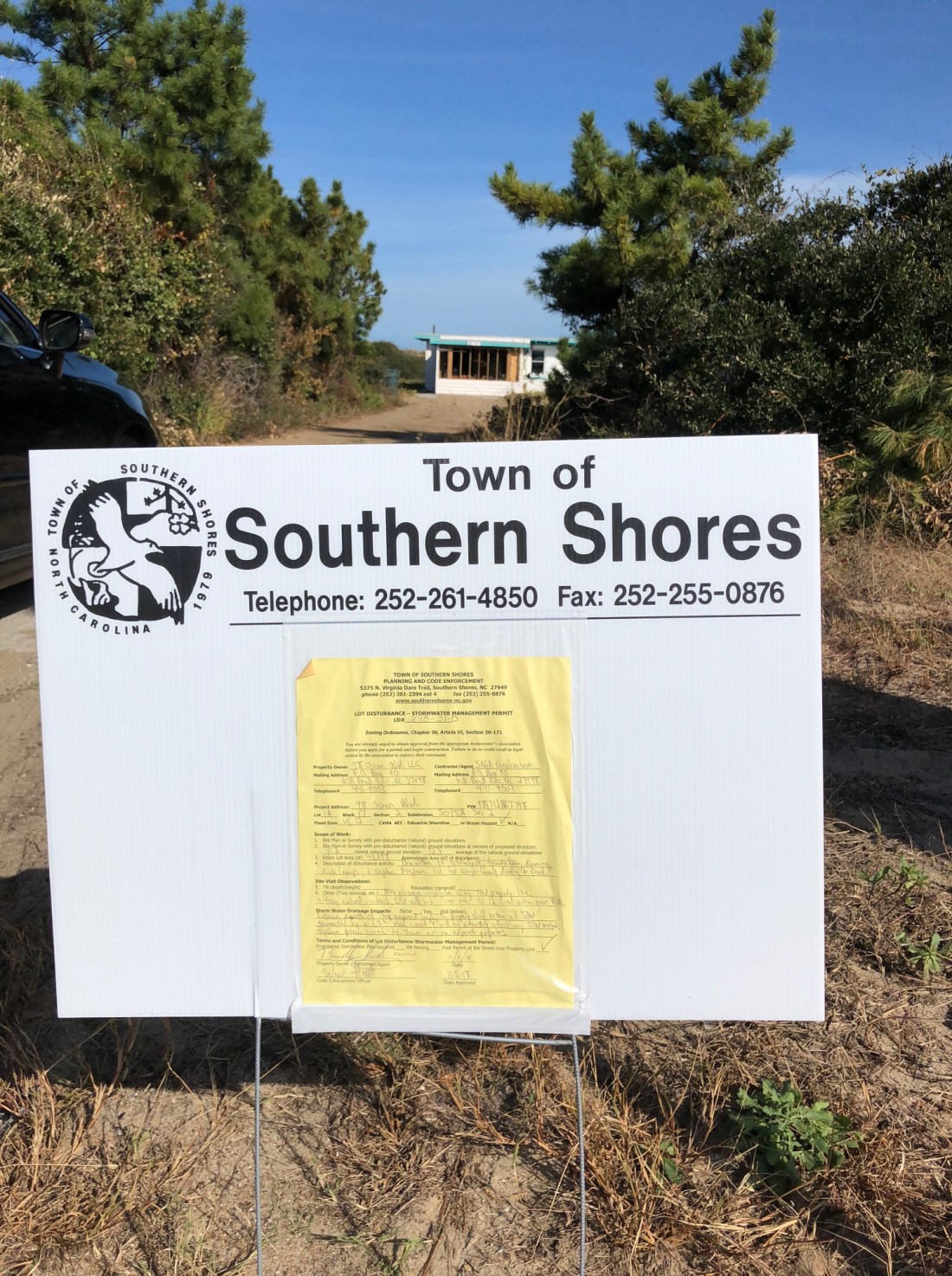




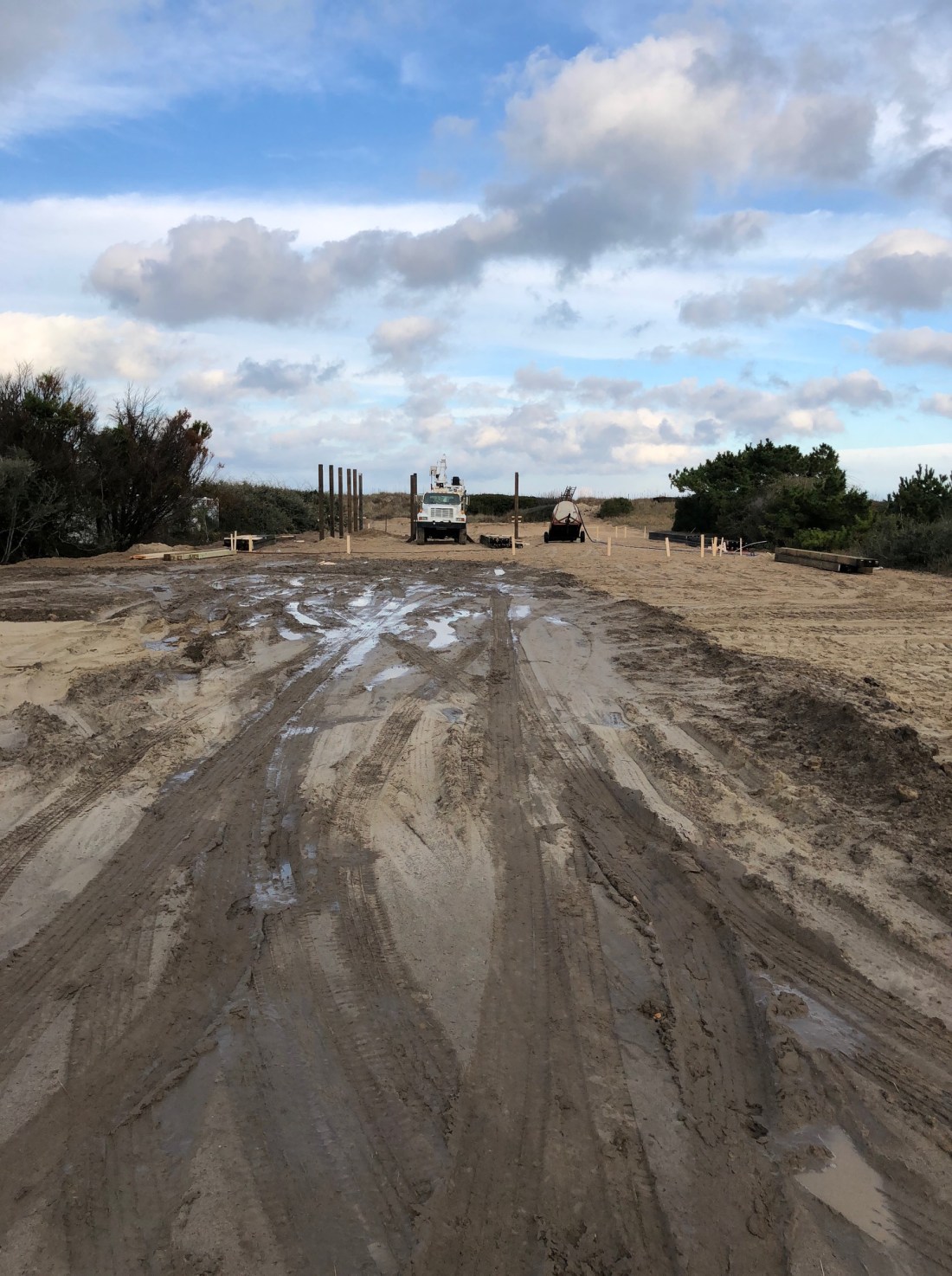




 The Southern Shores Beacon