Another Dare County resident has died of COVID-19, according to the Dare County Dept. of Health and Human Services, which reported the death today, but did not update the number of fatalities and new cases on its COVID-19 numbers dashboard.
Today’s COVID-19 dashboard still shows yesterday’s numbers.
(UPDATE 2/9: We are still seeing yesterday’s numbers on the dashboard on all of our computers, but The OBX Today reported updated numbers this morning. Apparently, the person who died had been hospitalized.)
Five Dare County residents have died of COVID-19 in the past week. The DCDHHS described one of the people in a report as having been hospitalized and recorded a reduction in the number of hospitalizations on its dashboard to suggest that three others were hospitalized, too.
The DCDHHS has given no details about the individuals’ ages or sex.
We strongly suspect that all five people were residents of Peak Resources, the nursing home and rehabilitation center in Nags Head where a COVID-19 outbreak recently occurred. We await confirmation and/or clarification from Dr. Sheila Davies, DCDHHS director, as to whether this is true.
There is no privacy interest that would prevent Dr. Davies from confirming (or not) that the five people who have died were residents of Peak Resources. It is in the interest of the Dare County public, and public health generally, to know why the number of local residents who have died from COVID-19 has nearly doubled in a week.
Twelve Dare County residents have died as a result of an infection with SARS-CoV-2 since last March.
The DCDHHS also reported that, as of yesterday, it had administered 7,197 first doses of the Moderna vaccine and 662 second doses of the vaccine.
The DCDHHS has 600 first doses of vaccine scheduled to be administered between now and Feb. 18, and 2,821 people on its waiting list, to be contacted when vaccine becomes available, according to the DCDHHS vaccine dashboard.
Last week the DCDHHS reported that it would have only 300 first doses of vaccine this week and next week and would be informed later by the N.C. Dept. of Health and Human Services how many first doses it will receive after the week of Feb. 15.
(Please note: We did not expect to write today, but we feel obligated to recognize publicly the death of a member of our community from COVID-19.)
The Beacon will not be publishing or responding to email during most of the upcoming week. Duty calls elsewhere. We expect to resume blogging on Friday or Saturday.
Looking ahead, the Town Council will be holding a workshop session on Tuesday, Feb. 16, at 9 a.m., and the Town Planning Board will be meeting on Feb. 16, at 5 p.m. Both meetings will be held in the Pitts Center, subject to COVID-19-safety protocols.
The Planning Board will be reviewing the revised Chapter 4, which is the Town Code’s definitions section, that consultant CodeWright Planners submitted as part of the final draft of its Code update and rewrite.
According to a member of the Planning Board with whom The Beacon consulted, the Board will take up at separate meetings the Town Code sections over which it has final-review authority, starting with Chapter 4.
The other chapters are Chapter 22, zoning; Chapter 26, subdivisions; and Chapter 28, flood damage prevention.
For more information about the Town Code update/rewrite, contact Town Planning Director/Deputy Managing Editor Wes Haskett at whaskett@southrnshores-nc.gov.
Planning Board meetings are not videotaped or live-streamed, but minutes are taken and are expected to be posted on the Town website.
Unfortunately, no minutes have been posted online since Feb. 18, 2020. This is an oversight that needs immediate correction.
The Town Council meeting will be live-streamed and videotaped. The meeting agenda will be posted on the Town website by this Tuesday.
Happy Super Bowl, Puppy Bowl, and Super Sunday, everyone. We are pulling for “the old guy,” of course. Any time an ageist (or sexist or racist or any other kind of) stereotype can be shattered, we are all in.
The DCDHHS had administered 6399 first doses and 232 second doses of COVID-19 vaccine as of last Sunday.
Another Dare County resident has died from COVID-19, the Dare County Dept. of Health and Human Services reported today.
The person is described on the DCDHHS’s COVID-19 dashboard only as having been hospitalized at the time of his or her death.
Since last March, 11 Dare County residents have died as a result of COVID-19–four of them just this week. (See The Beacon, 2/3/21.)
The DCDHHS’s next COVID-19 update should be next Tuesday. Perhaps then we will learn if the four latest deaths were of residents at the Peak Resources nursing home and rehabilitation center in Nags Head, where DCDHHS Director Dr. Sheila Davies recently confirmed a COVID-19 outbreak.
A surprising announcement by Mayor Tom Bennett at Tuesday’s Town Council meeting that he was reconsidering the “scope” of the town’s estimated $14 to $16 million 2022 beach nourishment project and the means for funding it led to a half-hour discussion about the actual need for sand fill along the entire 3.7-mile-long Southern Shores shoreline.
Although the Town Council unanimously voted last June to “proceed” with beach nourishment, it never defined how and to what extent it would proceed. The assumption has been that the project would be townwide, but no formal vote was ever taken.
“If we reduce the scope of the project to those things that are really critical now,” the Mayor said, “we could probably pay for it in a different way” than by levying higher taxes on property owners in specially established municipal service districts (MSDs).
“We could probably pay for it with an even tax for the whole town of so many cents,” he said, except perhaps for the Pelican Watch homeowners whose properties are in the hot-spot southern section of the shoreline.
The Mayor’s supposition clearly caught his Council colleagues and Town Manager Cliff Ogburn off-guard. He prefaced it by explaining that he had been “trying to agonize over how we’ll handle this project” for “a couple of months.”
The five Town Council members did not reach a consensus about the project’s scope, but they nonetheless unanimously approved holding a public hearing March 16 to receive comments about the two MSDs that Mr. Ogburn has proposed establishing in a report that he presented Tuesday.
(Property owners whose properties fall within one of the MSDs are required by statute to receive four weeks’ written notice of the public hearing.)
The Mayor’s remarks came after Mr. Ogburn outlined the MSDs he has proposed in order to raise enough revenue by taxing property owners on the oceanfront, the oceanside, the west side of Ocean Boulevard, and the east side of Duck Road more than other Southern Shores property owners would be taxed to pay for the project.
In support of a reduction in project scope—and, possibly, an elimination of MSDs—Mayor Bennett summarized the advice that he said the Town’s coastal engineer, Ken Willson of Coastal Protection & Engineering of North Carolina (CPE), had given him about the three shoreline sections that CPE has identified and is monitoring.
The Northern Section, which is from around Third Avenue north to the Southern Shores/Duck line, “has gained sand,” the Mayor said, and is “not as vulnerable as far as the dunes and the properties behind” them.
Cognizant of homeowners’ complaints last year about the width of the northern beach, he said, the beach “is definitely wider this year than it was last year.”
Later in the meeting, the Mayor noted: “I don’t see the north beach in trouble.”
The Central Section, from Third Avenue south to about 450 feet south of Chicahauk Trail, has “held up pretty steady,” the Mayor said. It “hasn’t gained or lost a lot.” While the dunes “are not as sturdy as they could be” in the Central Section, he continued, “it’s not in extremis.”
Mayor Bennett characterized the decision to do anything in the Central Section as a coin toss.
The Southern Section, from 450 feet south of Chicahauk Trail south to the Southern Shores/Kitty Hawk line, is in extremis. This section, which is the site of the 2017 beach nourishment project, has “lost a lot of sand,” the Mayor said, and “needs work.”
(See The Beacon, 1/26/21, for an exhaustive analysis of the latest shoreline change data in these three sections; and The Beacon, 1/31/21, for a report of erosion and accretion measured from September 2019 to September 2020 along the Duck shoreline.)
“The way [the project] is structured right now,” the Mayor concluded, “we’re taking on a major project that might not be required.”
Instead, he suggested, “we might be OK for two or three years,” at which time he said he had heard Nags Head might be doing a project, and Southern Shores possibly could share mobilization costs with that town.
IS THE MSD STRUCTURE APPROPRIATE FOR SOUTHERN SHORES?
As The Beacon has previously explained, the rationale and procedure for establishing MSDs is governed by N.C. statute. In order to define an MSD, a city council must find that “a proposed district is in need of [beach erosion control and flood and hurricane protection works] . . . to a demonstrably greater extent than the remainder of the city.” (NCGS sec. 160A-537(a)).
It seemed to us that Mr. Ogburn sought to respond Tuesday to some of our criticisms of his report, but we continue to read the statutory language differently from the Town Manager. (We were just kidding about taxing homeowners who live on an improved street more for the street improvements.)
The emphasis in the MSD statute is on need. If an MSD definition were not need-based, too much subjectivity and caprice would enter into elected officials’ decision-making.
Property owners, who can request exclusion from a proposed MSD at the March 16 public meeting or in writing up to five days after it, also would be more inclined to object. (See The Beacon, 1/31/21.)
In the public comment period of Tuesday’s meeting, Rod McCaughey, who is president of the Southern Shores Civic Assn. and a resident of Eleventh Avenue, questioned the use of MSDs in Southern Shores, saying, “It just seems like there are a lot of inequities.”
He further explained: “It’s not my way of thinking of Southern Shores, that someone on one side of Duck Road will be paying, someone on the other side won’t be paying . . . someone on North Dogwood Trail,” just as an example, “could get into their car and drive to Eleventh Avenue” and use the beach there, and “what did they pay?”
The SSCA president also challenged the idea that beachfront owners in Southern Shores “will be getting a golden opportunity” as a result of the beach nourishment, that because of it, their properties will go “up in value.”
Mr. McCaughey, who was speaking for himself, not the SSCA, said he was not convinced this would be true in Southern Shores, which has an ordinance restricting maximum occupancy in rental homes. Rental property owners will not be able “to rent to more people,” he suggested, simply because the beaches are wider.
In a Jan. 29 email, Mr. McCaughey informed SSCA members that the civic association, which owns the oceanfront from Hickory Trail north to the Duck town line, as well as 32 beach accesses, had granted easements to the Town for it to perform the 2022 project.
But he stopped short in his email of giving the project the organization’s blessing, saying: “I want to be perfectly clear that granting the easement does not constitute an endorsement of any particular beach replenishment plan or project.”
Earlier in the meeting, Mr. Ogburn reported that N.C. House Representative Bobby Hanig had introduced the necessary legislation (H.B. 30) to add Southern Shores to the list of towns that may “condemn property for beach nourishment.”
If the N.C. State Legislature passes, and the Governor signs, the legislation, the Town will be able to “quick take” privately owned property, such as easements, for beach nourishment without going through a formal eminent domain proceeding.
Mr. Ogburn said that 45 of the 185 easements required of oceanfront property owners for the Town’s 2022 project have been mailed. The Town is asking that these property owners voluntarily grant perpetual and irrevocable easements, without any compensation.
(For background on quick-take condemnation and the easements, see The Beacon, 7/26/20 and 10/2/20.)
The Town Council voted unanimously at its Oct. 6, 2020 meeting to give Mr. Ogburn authority to proceed with trying to procure the voluntary easements from oceanfront property owners. We have heard nothing about these easements since then.
The Council also unanimously approved, with some modifications, a draft perpetual easement prepared by Town Attorney Ben Gallop, which Mr. Gallop said Oct. 6 was a compilation of language taken from easements applied in other Dare County towns, as well as in Atlantic Beach, Emerald Isle, and Topsail Beach.
The Beacon did not support the granting of a perpetual and irrevocable easement and objected to some of the draft language. The draft easement never returned to the Town Council for approval in its final form.
A DIVIDED TOWN COUNCIL
Mr. McCaughey’s comments seemed to give Mayor Bennett a transition into his analysis of the 2022 project’s scope, but he claimed his remarks had not been “triggered by” what the SSCA president said.
The discussion that the Mayor triggered revealed a divided Town Council, with young Councilman Matt Neal clearly taking a long view of any beach nourishment in Southern Shores, calling the 2022 project part of “long-term, 30-year protection for our shoreline,” and Mayor Pro Tem Elizabeth Morey supporting his thinking.
Both premised their views on what The Beacon considers speculation as to the future damage that future storms may cause and the future effects of future sea-level rise.
While sea-level rise may be inevitable, mitigation efforts also will occur–electric cars, for example–and we are not comfortable with merely taking CPE’s computer models and projecting the future, as Mr. Neal seems to be.
Mr. Neal even mentioned managing a “shoreline retreat” during his lifetime, which would mean moving oceanfront homes to protect them from sea-level rise.
To a great extent, we believe the issue of scope is a matter of timing.
Mayor Bennett and Town Councilman Leo Holland were more inclined to look at today’s conditions, including—thank you, Mr. Holland—the fact that property owners may be coping with financial difficulties during the COVID-19 pandemic. At the very least, the health climate is poor for a major public hearing like the one scheduled March 16, even with a Zoom option, which Mr. Ogburn said there will be.
Mr. Holland brought up “selectively” nourishing the beach, starting with the Southern Section, and then figuring out later “how we can do the rest.”
The Mayor confirmed that Mr. Willson had advised him that selective nourishment could be done, and that a different amount of cubic yardage of sand could be placed at different locations along the shoreline.
The fifth Council member, Jim Conners, advocated for defining the scope of the project at the meeting, but did not express his opinion.
“Now’s the time,” he said.
That turned out not to be the case.
THE RELATIVE MERITS OF THE AVON PROJECT, COUNTY FUNDING
“That project is so important to keeping Highway 12 open,” Mr. Holland said, further observing that it has a greater “economic impact” on Dare County than the proposed Southern Shores project, which “doesn’t have a real economic impact to the county.”
With Dare County contributing monies to each project from its Beach Nourishment Fund, Southern Shores and Avon, which is an unincorporated community of the county, are essentially competing with each other.
According to Mr. Ogburn, the Dare County Board of Commissioners has not yet approved the funding that County Manager Bobby Outten said Southern Shores would receive.
Mr. Outten’s commitment of $7 million up-front for Southern Shores’ project costs and another $4 million for its debt service is not yet “firm,” the Town Manager said.
According to an overview of the Avon project prepared by Dare County, the “rate of erosion along the beaches of Avon [which is on Hatteras Island] has accelerated dramatically. The sand dunes along much of the beach have been washed away, allowing the ocean to wash over and flood Highway 12, as well as the properties on the ocean side of Highway 12. This occurs not only in named storms but also in common nor’easters and hard blows.”
Beachfront houses in Avon literally teeter above the ocean during storms—they never do in Southern Shores—and ocean overwash on Hwy. 12, which is the only access roadway, often causes major disruptions in the local economy and everyday life.
To fund a project estimated to cost $11 to $14 million, Dare County is proposing to tax properties in Avon east of Hwy. 12 at a rate of 40 cents per $100 of real estate value and all remaining parcels at a rate of 10 cents per $100.
The Beacon has problems with Southern Shores taking $11 million from Dare County for what would be a non-emergency, proactive nourishment project—except for the Southern Section—while our neighbors in Avon, who are in dire straits, pay such shocking tax-rate increases.
Commissioners in Nags Head and Duck also expressed concern at public meetings when Mr. Outten told them how much “skin in the game” Avon property owners would be contributing.
In advocating for his long-view position, Councilman Neal said that the Town Council should view beach nourishment “as a county issue,” but he made no mention of Avon’s plight.
All members of the Town Council agreed that if the Dare County commissioners were to deny Southern Shores county funding, or to reduce that funding, they would be compelled to address just the “emergency areas” on the town’s shoreline.
“The County’s participation,” Mr. Neal said, “has been the driving force.”
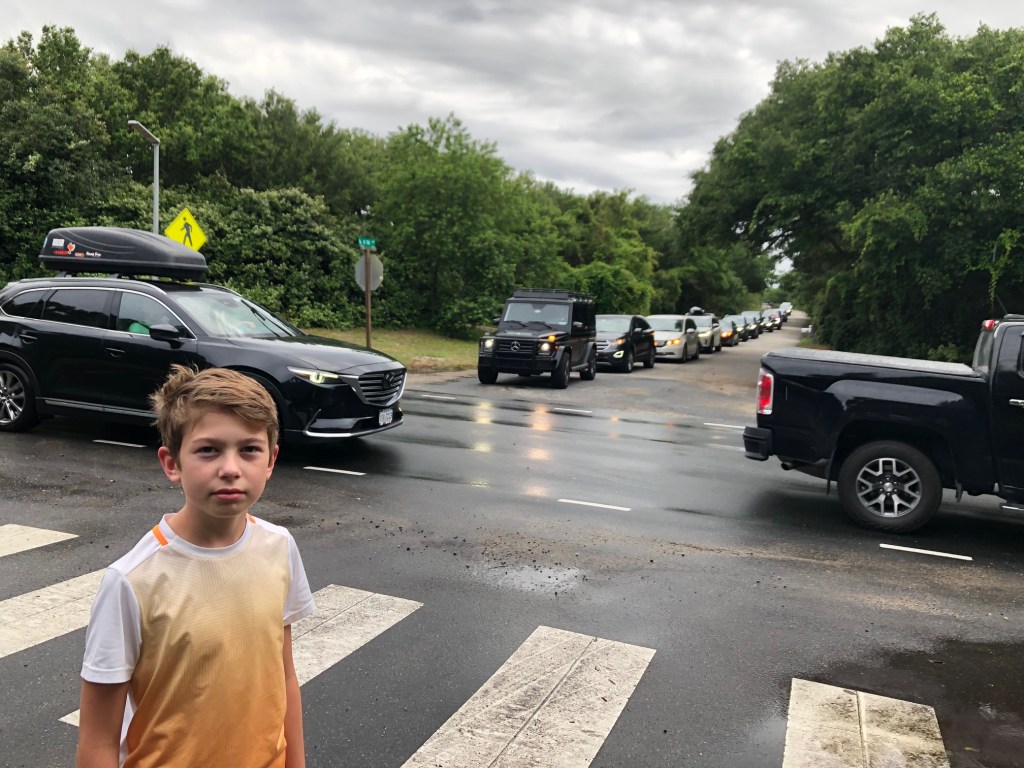
A Southern Shores homeowner’s grandson stands last summer across from a weekend traffic backup on Sea Oats Trail at its intersection with Duck Road.
A special cut-through traffic meeting proposed by Mayor Pro Tem Elizabeth Morey at Tuesday’s Town Council meeting–during which, she said, recommendations from the Town’s traffic-engineering study consultant and the citizens’ cut-through traffic committee would be discussed–has not been agreed to by committee chairman, Tommy Karole, The Beacon has learned.
Mr. Karole told The Beacon today that “The committee would like to wait to see the traffic engineer’s report and use all of the information [that it makes] available before we issue our report.” He said that the committee, known formally as the Exploratory Committee to Address Cut-Through Traffic, “would like to be thorough.”
Ms. Morey, who is a Town Council co-sponsor with Councilman Matt Neal of the citizens’ committee, proposed the special meeting in comments that she made at the end of the Council’s regular monthly meeting on Tuesday. (You may view a videotape of the meeting on the Town’s You Tube site.)
Without speaking first to Mr. Karole, Ms. Morey said that his committee would be filing its report within the next two to three weeks and that the Council would “discuss all of the potential recommendations” for the problem of seasonal cut-through traffic at the special meeting.
Mr. Karole said his committee would not be prepared to do this. He also said that he was just informed Jan. 25 by Town Manager Cliff Ogburn that a Zoom information meeting he had believed for more than six weeks the Town would set up between his committee and traffic consultant J.M. Teague Engineering and Planning of Waynesville, N.C. would not take place. (See The Beacon, 2/2/21, for background.)
As The Beacon reported 12/14/20, Mr. Karole, who lives on East Dogwood Trail near its intersection with South Dogwood Trail, suggested an exchange of information at a Dec. 10 “progress report” meeting that the Town held for members of his committee and the two Teague engineers who were studying the cut-through traffic problems.
Both of the engineers, who appeared at the December meeting via Zoom, said they would welcome hearing from locals “on the ground”—“in the trenches,” as Mr. Karole described his committee members—and Mr. Ogburn said he would coordinate this session.
Mr. Karole sought scheduling followup with Mr. Ogburn, he told The Beacon today, until he learned from the Town Manager last week that his committee would not be given an opportunity to meet with the Teague engineers.
Ms. Morey attended the Town’s Dec. 10 progress report meeting via Zoom. Mayor Tom Bennett and Councilmen Leo Holland and Jim Conners appeared in person, but Mr. Neal did not participate.
Without specifically mentioning the cancellation of the meeting between the committee and the consultant, Ms. Morey explained Tuesday: “We as a Council decided to allow the consultant to put together his findings and to make his recommendations without influence” from members of the Town Council, the Town staff, or “members of the community.”
She did not say when the Town Council had decided this.
The Beacon recalls, and reported upon, the FY 2020-21 budget workshop last spring during which the Town Council agreed to commission the $7500 traffic study. The Town Council made clear then that it wanted to “keep the emotion out” of the study—as two Council members phrased it—and to ensure an objective, independent report. Objectivity, however, should not be compromised by the sharing of factual information.
Surely traffic engineers with decades of experience know how to receive, process, and evaluate information received from stakeholders in a project without being unduly influenced by any bias that may emerge.
During her comments Tuesday, Ms. Morey confirmed that J.M. Teague would file its traffic study report on Feb. 12 (a date the Town Manager gave her) and said that a special meeting had been “tentatively” planned for both the consultant and the committee to present their separate reports.
Ms. Morey reported having spoken earlier Tuesday to a member of the six-member citizens’ Exploratory Committee to Address Cut-Through Traffic, whom she did not name, about the proposed special meeting and said that this member was “completely OK with that.” She also reported that she had left a voice message on Mr. Karole’s phone.
According to Mr. Karole, Ms. Morey’s message was left at 4:10 p.m. Tuesday—an hour and 20 minutes before the Town Council’s meeting.
Mr. Karole expressed disappointment that the Town Council did not allow his committee to “get together [with the consultants] in the interest of sharing information.”
SEA OATS TRAIL CONSTRUCTION PROJECT MOVES AHEAD
In other roadway news, the Town Council unanimously approved Tuesday putting out for bids the repaving project on Sea Oats Trail from Eleventh Avenue to Duck Road.
This project, which already has been designed by the Town’s engineer, was ready to move forward last year, but the Town Council postponed it because it was concerned about a revenue shortfall during the COVID-19 crisis
The Council also considered soliciting contractors’ bids for the much larger Hillcrest Drive project, which also was postponed, but it decided not to go forward. Surveying and design work remain to be done on this project, according to Mr. Ogburn.
Councilman Neal reported that the Town’s Streets Committee, which met Jan. 21, did not recommend moving ahead with either project.
Mr. Neal, who co-chairs the Streets Committee—formerly known as the Capital Infrastructure Improvement Planning Committee—with Councilman Conners, further said that the committee discussed at some length the implementation of a 10-year capital improvement plan.
It would have been more informative if Mr. Neal and Mr. Conners had explained why the Streets Committee–which is another committee comprised of “members of the community”–did not support either project. Minutes for the committee’s meetings are no longer being posted on the Town website, even though the committee is a Town Council-appointed and -sponsored committee.
The Beacon considers this lapse a significant failing, especially in the light of the fact that the committee’s meetings are not videotaped.
The Sea Oats Trail project has been estimated to cost $484,609, while the Hillcrest Drive project, which extends from the street’s intersection with Hickory Trail north to the SSCA tennis courts and is 3,700 linear feet long, has been estimated to cost $937,493.
The funding for the Sea Oats Trail project will come from the Town’s unassigned fund balance, which must maintain a $3 million balance as a hedge against emergency expenses, according to Mr. Ogburn.
SURPRISING BEACH NOURISHMENT AND MSD UPDATE
Tuesday’s meeting went in an unexpected and interesting new direction when Mayor Bennett suggested that the Town Council consider reducing “the scope” of the anticipated 2022 beach nourishment project along the entire Southern Shores shoreline and funding the scaled-down project in “a different way” than through levying increased tax rates on properties in municipal service districts.
The Beacon welcomes the Mayor’s new perspective and approach, but we need time to process what he said and the response he received from his colleagues on the Council, as well as from the Town Manager, before we report on what we heard. We need to percolate, if you will. We will get back to you as soon as possible.
In the meantime, we urge you to listen to the meeting videotape, which you may access via You Tube.
Despite this unexpected new direction, the Town Council unanimously approved scheduling a public hearing March 16 at 5:30 p.m. in the Pitts Center about the two proposed municipal service districts and their boundaries.
We will discuss this hearing, for which Mr. Ogburn said “a Zoom option” would be offered, in an upcoming blog post.
Three more Dare County residents have died from COVID-19, the Dare County Dept. of Health and Human Services reported today on its dashboard.
The DCDHHS gave no personal details about the people who died, but a reduction in the number of hospitalizations on the dashboard suggests all three were hospitalized at the time of their deaths.
Since Christmas, 12 local residents have been hospitalized with COVID-19, according to DCDHHS dashboard records. Nine of them have been people age 65 or older.
The dashboard also reported today 16 new COVID-19 cases in Dare County, 11 of them local residents.
Since March 2020, 10 Dare County residents have died because of COVID-19. We extend our condolences to all who are grieving the lives that have been lost.
Dr. Sheila Davies, Dare County’s health director, gave no accounting in her COVID-19 update yesterday of the outbreak she has confirmed at Peak Resources nursing home and rehabilitation center in Nags Head. Instead she touted “hopeful trends” in COVID-19 cases—saying last week’s total of 153 cases was the lowest total in Dare County since before Christmas—and focused on vaccines.
Also yesterday, the COVID-19 dashboard of the Dare County Dept. of Health and Human Services reported 32 new cases, 24 of them Dare County residents. Of the 24 locals, six are age 65 or over, and two have been hospitalized.
The day before—Monday—the dashboard reported only three new cases, all of them Dare County residents. Monday is always the lightest day of the week for case reports.
One of the newly hospitalized residents is reportedly a man age 65 or over; and the other is a male minor age 17 or younger.
If the DCDHHS dashboard has accurately reported all hospitalizations and hospital discharges, there should be 12 residents—not nine, as the dashboard currently shows—still hospitalized with COVID-19
DCDHHS Director Davies confirmed with The Outer Banks Voice last Friday an outbreak at Peak Resources of at least 45 people, 39 residents and six staff members.
Residents and staff at Peak have been offered the opportunity to be vaccinated with the Pfizer/BioNTech COVID-19 vaccine, which is being administered by Walgreens and CVS through a partnership program with the federal government.
Dr. Davies gave no indication yesterday in her report, COVID-19 Update No. 80, how many of the residents and staff at Peak have been vaccinated with first and second doses, and how many of the infected residents may have been vaccinated.
In fact, she has not given an individualized accounting about how people newly diagnosed with COVID-19 likely acquired the virus since Dec. 22, 2020—after providing this public information in every update since she started her updates.
The Beacon believes that Dr. Davies’s withholding of information about the means of viral spread in Peak Resources and elsewhere in the county is a failure in local public health, which should be guided by science and the public interest, not politics.
As for vaccines, Dr. Davies reported that the DCDHHS’s “guaranteed weekly allocation from the state for the next three weeks is 300 doses per week.”
These are only first doses; second doses are in separate shipments.
Dr. Mandy Cohen, Secretary of the N.C. Dept. of Health and Human Services, has said that there are no problems with the federal government’s supply of second doses, just first doses.
This week, Dr. Davies said, DCDHHS was able to secure an additional 500 doses “through a special event request.” For the next two weeks, however, no more than 300 doses per week are guaranteed.
GOVERNOR URGES IN-PERSON LEARNING FOR SCHOOLCHILDREN
Governor Roy Cooper and Secretary Cohen strongly urged local school districts yesterday “to get our children back into the classroom,” as the Governor said at an afternoon COVID-19 briefing, in which top State education officials participated.
The Governor was eloquent in describing schools as not only sites for academic instruction, but as places where children “learn social skills, get reliable meals, and find their voices.” He also mentioned the role that teachers play in identifying child abuse and other problems that students may be experiencing at home.
Newly elected Superintendent of N.C. Public Instruction, Catherine Truitt, said that the pandemic is having “negative effects on children’s mental health and overall well-being, as well as their academic instruction.” In returning to in-person learning, she said, “We face a challenging pathway ahead.”
But, she insisted, “Our students cannot lose any more time”—after noting that even before COVID-19, “children were behind.”
Those of you with school-age children probably know that the Dare County Board of Education has decided to discuss a return to in-person learning at its Feb. 9 business meeting.
Previously, the Board had announced that it would hold a special meeting Feb. 13 about reopening schools—the day that many Dare County school staff receive their second dose of a COVID-19 vaccine.
The DCDHHS held a special vaccination clinic Jan. 23 for Dare County teachers and administrators and law enforcement personnel—even though Dr. Davies knew soon after she received State approval for the event that North Carolina’s vaccine prioritization had changed to advance all people age 65 or older ahead of teachers and other “essential workers.”
Governor Cooper said yesterday that he and Dr. Cohen had not discussed changing the state’s prioritization groups.
The Secretary reiterated that 83 percent of the nearly 10,000 people who have died from COVID-19 in North Carolina were age 65 or older. The vaccine prioritization, she said, is based on the “highest risk of death.”
“We will get vaccines to our essential workers as soon as possible,” she said.
The Dare County school staff members who were vaccinated Jan. 23 received first doses of the Pfizer vaccine.
We found Dr. Cohen’s remarks about school studies yesterday to be the most interesting. She reported on research that, she said, has determined schools are a “lower-risk setting” for COVID-19 than other public places. She also distinguished between elementary schoolchildren age 10 and younger and older students in middle school and high school.
She said that studies show “younger children are less likely to get and spread COVID-19,” and when they do contract the virus, they have very mild cases. Severe COVID-19 cases among young children are extremely rare.
The NCDHHS Secretary also said that children age 10 or younger “rarely transmit” COVID-19 to other children or to adult staff members. (Dare County had COVID-19 outbreaks in several of its elementary schools last year before the School Board reverted to remote learning exclusively.)
Regardless of the age of the students in a school building, Dr. Cohen explained, all students participating in in-person instruction will have to weak masks at all times and maintain six-foot distancing from each other.
She also said infection-prevention protocols such as screening students and staff for fevers and wiping down high-use surfaces will be in effect.
The NCDHHS has a “Strong Schools N.C. Public Health Toolkit (K-12)” for schools to implement and observe.
“The science is clear,” Dr. Cohen concluded. “It is safe to reopen our schools in accordance with the health protocols.”
In response to a reporter’s question, however, she acknowledged that the NCDHHS’s safety guidance will be more difficult to observe in middle schools and high schools because of the “physical configuration” of buildings and “the number of students.”
The Governor elected not to issue an executive order requiring N.C. public schools to open because he prefers to give local school districts “flexibility.” He would rather “spur action” by local school boards, he said, than to dictate it.
Asked by a reporter whether he would sign N.C. Senate Bill 37, a fast-moving bill filed Monday to require all school districts to provide in-person instruction while also observing NCDHHS safety protocols, the Governor demurred, saying “I have not seen the legislation.”
But he also expressed concern that the bill is “stripping some health protocols.”
Northbound traffic backs up on East Dogwood Trail, west of its intersection with Hickory Trail, last June.
The report of the $7500 traffic study being performed by the Town’s traffic engineering consultant is expected to be submitted by Feb. 12, according to Tommy Karole, chairman of the citizens’ Exploratory Committee to Address Cut-Through Traffic, who has been in contact recently with Town Manager Cliff Ogburn.
Feb. 12 is the same date that Mr. Ogburn gave at the Dec. 10 study progress report meeting that the Town held via Zoom between two employees of consultant J.M. Teague Engineering and Planning of Waynesville, N.C. and members of Mr. Karole’s committee.
(See The Beacon, 12/14/21, for a report on that meeting. For other background on the study, see 12/4/20 and 10/14/20.)
Mr. Karole asked at the December meeting if his committee could meet remotely with the two Teague employees, Engineering Director Will Thompsen and Engineering Technician Forrest Lundgren, to share with them homeowners’ observations “in the trenches.”
Both Mr. Thompsen and Mr. Lundgren, who gave a slide presentation about their early study data analysis, said they would welcome hearing from locals “on the ground.”
Mr. Karole informed The Beacon Sunday, however, that Mr. Ogburn has advised him the Town will not permit this information session to occur. This is a decision that would have had to have come from Mayor Tom Bennett, with or without consultation with individual Town Council members.
There has been no discussion at a Town Council meeting since Dec. 10 about the traffic study. Nothing public.
Mayor Bennett has been opposed for years to taking any action to prevent summertime weekend traffic from cutting through the residential areas of Southern Shores. Last June for the first time, and under emergency conditions, he supported prohibiting a left turn at U.S. Hwy. 158 on to South Dogwood Trail on two weekends.
It bears mentioning that Mr. Bennett’s term ends in December. The four-year term of Councilman Jim Conners, who, until Council members Elizabeth Morey and Matt Neal were elected in November 2019, also refused to take action to curb cut-through traffic, expires this year, as well.
The picture of Southern Shores traffic that the Teague engineers painted at the Dec. 10 meeting was a grim, but accurate, one. They said that N.C. Hwy. 12 is operating over-capacity, at what they called “forced saturated flow,” during the peak-season weekends, and that because of this saturation, traffic “cascades” to alternative routes that affect Southern Shores’ neighborhoods.
The traffic bottleneck in Duck, caused by that town’s 25-mph speed limit and pedestrian crosswalks, is “the common denominator of all congestion that is formed in Southern Shores,” said Mr. Lundgren.
At the conclusion of their slide presentation, Mr. Thompsen said, “We’re continuing with examining different strategies to cope with [the] cut-through traffic, as we were tasked within our scope of services.” He did not offer any last December.
The Beacon is disappointed that the “Town” has decided not to allow the public (members of the citizens’ committee) to meet with the Teague study engineers.
People who have not experienced the oppression and hardships posed by the cut-through traffic cannot ever truly imagine its effects and, therefore, can never be fully informed in their decision-making. The value of their detached objectivity is diminished by their lack of firsthand experience.
The one site visit that Teague made to Southern Shores was in September, after the summertime traffic crush had subsided.
We look forward to receiving the Teague consultants’ recommendations later this month.
TOWN COUNCIL MEETING TODAY AT 5:30, IN THE PITTS CENTER
The Beacon will not be able to attend or to live-stream today’s Town Council meeting at 5:30 p.m. in the Pitts Center. We will view the videotape as soon as possible and report to you what happened.
See The Beacon, 1/31/21 and 2/1/21, for commentary about two business items on the agenda: the Town Manager’s filing of his report supporting the establishment of two municipal service districts for the purpose of levying higher tax rates on certain properties to pay for the Town’s proactive 2022 beach nourishment project; and the initiation of the construction bidding process for “improvement” projects on sections of Hillcrest Drive and Sea Oats Trail.
Regarding the MSDs, we would like to note further that the Southern Shores Civic Assn., which owns oceanfront property from Hickory Trail north to the Duck town line, as well as all of the beach accesses along the town’s 3.7-mile-long shoreline, has not endorsed the 2022 project.
In an email Jan. 29 to SSCA members, in which he announced that the SSCA Board of Directors has granted the Town easements for the project, president Rod McCaughey said: “I want to be perfectly clear that granting the easement[s] does not constitute an endorsement of any particular beach replenishment plan or project.”
(The SSCA is a 501(c)(4) non-profit organization and is exempt from real estate taxation.)
There also will be a public hearing at today’s meeting regarding a change in Town Code chapter 17, which established the Historic Landmarks Commission, to add an alternate member to the five-member commission.
The public hearing is strictly pro forma. We foresee the Town Council unanimously approving this change and appointing Michael Guarracino of Tall Pine Lane to the newly created alternate position.
Mr. Guarracino’s background is in law enforcement and security. You may view his application for the Historic Landmarks Commission, which he filed to fill a regular membership position that he did not get, in the meeting packet.
The Town Council also will honor Lorelei Costa, one of the founding members of the Historic Landmarks Commission, who, we are sorry to report, is leaving Southern Shores.
The members of the Historic Landmarks Commission serve as volunteers, without any compensation.
It is not too late to submit public comments to be read at the meeting. Just send an email with “public comment” in the subject line to info@southernshores-nc.gov.
The Southern Shores shoreline near Trout Run just days after Hurricane Dorian passed by.
In August 2019, the Town of Duck laid the groundwork for what would be a yearlong monitoring program of its dunes and beaches using an Unmanned Aerial System (UAS), which relies upon what are commonly known as drones.
Duck partnered with APTIM Coastal Planning & Engineering of North Carolina—the Wilmington-based firm with which Southern Shores has contracted since 2017 for all of its coastal engineering surveys and plans—to monitor the dunes and beach berm on its coastline before and after storms, starting with Hurricane Dorian in September 2019.
APTIM, now known as Coastal Protection Engineering of North Carolina (CPE), used UAS technology and special software to measure the volumetric change of sand along Duck’s shoreline above the mean high-water mark (MHW). Other sand within the beach profile, such as the off-shore sand that is under water, was not measured. (See The Beacon, 1/26/21, for “How the Beach Works 101.”)
The bottom line: Although Duck’s dunes and berm generally (but not all) experienced an erosion of sand when Dorian passed by and when two other storm events occurred in October and November 2019, they also experienced an accretion (an addition) of sand by September 2020, when data were collected after Hurricane Teddy, which became a nor’easter.
With the exeption of Duck’s beach-nourishment project area, which is approximately from the northern end of Skimmer Way south to Spindrift Court, the overall accretion in cubic yards after the Teddy nor’easter was substantial.
But even in the project area, 8,600 cubic yards of sand were added between Skimmer Way south to just north of Canvasback Drive.
Unlike the Southern Shores Town Council, which has committed to a townwide nourishment project despite the lack of need along most of the beaches north of Skyline Road, the Duck Town Council has carefully evaluated the variability in its shoreline.
Also, unlike Southern Shores, the Town of Duck had substantial shoreline erosion and houses teetering on the ocean in its project area before it did beach nourishment. It did not proceed with a proactive project based on speculation, as Southern Shores is doing.
For purposes of the drone surveying and analysis, Duck divided its shoreline into three sections, designated as:
1) “Area North of Project,” between North Baum Bay, near the Sanderling development, and Skimmer Way;
2) “Project Area,” between Skimmer Way and Spindrift Court; and
3) “Area South of Project,” between Spindrift Way and the Southern Shores town line.
Southern Shores had an opportunity to join Duck in this UAS monitoring program and to obtain aerial photographs of its 3.7-mile-long shoreline before and after storm events, but the Town Council declined to make the small investment. It declined, even though the same coastal engineering firm that Duck hired to perform the monitoring was already doing Southern Shores’ annual beach surveys.
Indeed, Ken Willson, who is now managing all of the myriad details of Southern Shores’ $14-$16 million 2022 beach nourishment project, filed the first report in the Duck drone monitoring program.
Thereafter, his colleague, Adam Priest, who submitted the draft report of Southern Shores’ June 2020 beach survey, which The Beacon reviewed 1/26/21, submitted Duck’s other reports.
HURRICANE DORIAN, THREE OTHER STORM EVENTS MONITORED
Between Aug. 26 and Aug. 29, 2019, APTIM installed 70 painted and pole-mounted Ground Control Points (GCPs) on the backside of the dune and on roadways and walkways along the Duck shoreline.
GCPs are used to “georeference data collected during UAS flights,” Mr. Willson wrote in a letter Nov. 5, 2019 to former Duck Town Manager Christopher Layton.
APTIM also “created and provided UAS flight plans to the Town, which were used to conduct rapid assessment UAS aerial surveys of the Town’s beach and dune,” he continued, “. . . Flights were planned to maximize coverage of the beaches while maintaining the resolution needed to derive an accurate topography of the ground.”
Drones are unmanned or uncrewed aerial vehicles: You may think of them as small aircraft without pilots whose mission is to take aerial photographs.
While Mr. Willson goes into detail in his letter about how APTIM collected data within the GCP network and then analyzed them, we will stop here in the methodology and refer henceforth to the data collection and processing as “drone surveying.”
The Beacon has this letter from Mr. Willson to Mr. Layton because the leadership of the Southern Shores Civil Assn. shared with us the files it received from the Town of Duck about its 2019-20 drone surveying. We have imagery as well as written reports.
APTIM’s drone surveying covered four events:
HURRICANE DORIAN, which “impacted the Dare County shoreline,” Mr. Willson wrote, between Sept. 6-7, 2019. Duck town staff conducted pre-storm drone flights of the shoreline between Sept. 3-5 and post-storm flights between Sept. 8-12.
STORM EVENT TWO, which, Mr. Priest wrote in a Dec. 13, 2019 letter to Mr. Layton “impacted Dare County between Oct. 9-12, 2019,” was “non-tropical,” and was “produced by the combination of two coastal low-pressure systems that stalled off the East Coast creating days of high wind and sea conditions.” APTIM used data taken from the Dorian monitoring Sept. 8-12 to represent the pre-storm conditions for Event Two, and Duck town staff conducted drone flights between Oct. 15-22 to obtain post-storm conditions.
STORM EVENT THREE, which, Mr. Priest wrote in a Dec. 30, 2019 letter to Mr. Layton, “impacted the Dare County shoreline” between Nov. 16-18, 2019. This storm also was reportedly non-tropical and produced a nor’easter that “transited offshore of the East Coast creating days of high winds and sea conditions,” he wrote. The post-storm data of Oct. 9-12 from Event Two served as the pre-storm data for Event Three. Duck town staff conducted post-storm flights for Event Three between Nov. 25-26.
STORM EVENT FOUR, whose “impacts to the Dare County shoreline,” Mr. Priest wrote Nov. 17, 2020, to then-Interim Town Manager Joe Heard, “occurred between Sept. 19 and 24, 2020.” This storm, the CPE engineer wrote, was “associated with Hurricane Teddy as it moved north in the Atlantic, offshore of the East Coast and reached Category 4 strength.” It created “days of high wave conditions and elevated water levels,” he said. Mr. Priest went all the way back to Nov. 25-26, 2019, and the aftermath of Event Three, for his pre-storm data, while Duck town staff conducted post-storm flights between Oct. 1-6, 2020.
We have, but we will not belabor, the volumetric change data from each of these storm events, over all three sections of the Duck shoreline.
We will say, however, that, until data were collected after the Hurricane Teddy-associated storm, the drone surveying generally showed erosion of the berm—which is the backshore of the beach, next to the dune—along the upper portion, and scarping at the toe of the dunes.
But not across the board.
Interestingly, a positive volumetric change was measured in the Area North of the Project after both Hurricane Dorian and Event Two, which APTIM attributed to “a result of the visual differences between the pre- and post-storm imagery and not a true representation of measured elevation differences between the datasets.” But it may have been simply a natural occurrence.
After Event Three, the northern section experienced a volumetric loss of 33,200 cubic yards above the MHW, much of which it had gained back after Event Four.
In his Hurricane Dorian letter, Mr. Willson described the linear coverage area used to calculate volumetric change as being from the backside of the dune seaward about 120 to 150 feet to the waterline.
As we noted earlier, every section of the Duck shoreline experienced accretion, much of it substantial, between Event Three, which occurred in October 2019 and was assessed Nov. 25-26, 2019, and Event Four in November 2020.
Although we said we would not belabor data, we do think that Duck’s “Area South of Project,” which abuts Southern Shores at its southern end, is worth a closer look.
THE SOUTHERN SHORES LINE
According to SSCA President Rod McCaughey, who has conferred with Duck officials, data were collected in this section as far south as Eleventh Avenue in Southern Shores.
The data analyses by APTIM/CPE show that this southern section experienced the following:
After Dorian: Some erosion in the beach berm, but no escarpments along the toe of the dunes because of the steeper beach slope in this area. The net volumetric change above the mean high-water mark was a loss of about 18,000 cubic yards.
After Event Two: Some berm erosion, but no escarpments along the toe of the dunes. Net negative volumetric change was about 16,000 CY of sand above MHW.
After Event Three: Erosion along the beach berm resulting in a negative volumetric change of 15,350 CY of sand above MHW.
After Event Four: Accretion occurred throughout the section, with a positive volumetric change of 36,000 CY above the MHW.
If drone data were to be continuously collected, would we see that the amount of sand lost eventually returns? Would we see, and would our decision-makers better appreciate and respect, the seasonal and post-storm fluctuations that occur on the shoreline?
When Mr. Willson presented the results of APTIM’s first Southern Shores beach assessment to the Town Council at its March, 6 2018 meeting, he told Council members that “the shoreline is looking fairly stable” and there is “no big rush” to “jump” on beach nourishment.
“I think time is in on your side,” he concluded.
The results of his company’s data collection in the shoreline’s 22 beach stations showed, according to Mr. Willson: 1) the shoreline is “stable,” having lost only 0.4 feet (that’s five inches) between 2006 and 2017; and 2) the volume of sand in the system had actually increased during the same time period.
“The shoreline is looking pretty stable,” he said. “We’re not seeing any hot spots right now. The long-term averages and the short-term averages [for shoreline changes] look to be pretty stable, pretty manageable.”
And yet, here we are just three years later, with the Town Council on the verge of committing to a monster beach-nourishment project that is not only unnecessary, but pits property owners against each other, as it sorts them into different tax districts to pay for this unnecessary project.
Us-versus-Them. My back yard-versus-not my back yard. A town and community divided.
Selling out and moving to Duck is starting to seem like a darn good idea.
Town Manager Cliff Ogburn will propose at the Town Council’s Tuesday meeting establishing two municipal service districts (MSDs) for the purpose of levying a higher tax rate starting in FY 2021-22 on property owners near the oceanfront to pay for the Town’s 2022 beach nourishment project.
We believe the report that Mr. Ogburn has filed in support of these two MSDs, which are defined solely by their proximity to the ocean, is inadequate to meet the standard imposed by North Carolina law for such special tax districts, the creation of which would be unconstitutional otherwise.
The law requires a showing of need, not benefit, and the Town Manager’s report contains no shoreline data supporting the need for a townwide sand fill. With the exception of the beach section south of Skyline Road, the 2022 project is specifically designed to limit future, speculative damage, not to address current need.
Although the FY 2021-22 town property tax rates will not be determined by the Town Council until springtime budget sessions, the Town Manager presented at the Council’s Jan. 19 workshop proposed increased tax rates for the two proposed MSDs. When combined, property owners in these two MSDs would pay for 75 percent of the Town’s portion of the 2022 beach nourishment bill.
Mr. Ogburn suggested a tax rate increase of 25.98 cents per $100 of value for MSD 1, which runs along the oceanfront, and 9.23 cents per $100 for MSD 2. (We refer you to Mr. Ogburn’s report in the Feb. 2 meeting packet for the precise boundaries of proposed MSD 1 and MSD 2, and to The Beacon, 1/19/21.)
(For the first time, you will need to sign into Dropbox, which is a free online service, in order to access the materials in support of the agenda items that are in blue type. Click on MSD BOUNDARIES.pdf (dropbox.com) for the MSD report.)
The cost of the 2022 project has been estimated by Mr. Ogburn at $14 to $16 million, but these figures date to 2019 and are not firm.
Dare County has pledged to contribute from its Beach Nourishment Fund, which is supported by county occupancy taxes, no more than $7 million up-front and an additional sum for debt service.
The Council’s Tuesday meeting will be held at 5:30 p.m. in the Pitts Center, with COVID-19 infection-prevention protocols in effect. As usual, you may email public comments to the Town Council at info@southernshores-nc.gov before the meeting or appear in person to present them.
The Council also will consider Tuesday initiating the bidding process for the street-rebuilding projects on Hillcrest Drive and Sea Oats Trail that were postponed last year because of concerns over reduced revenue during the pandemic.
The Hillcrest Drive project extends from the street’s intersection with Hickory Trail north to the Southern Shores Civic Assn. tennis courts. The Sea Oats Trail project targets the section between Eleventh Avenue and Duck Road.
Those two projects combined will cost an estimated $1.42 million and will be paid equally by all Southern Shores taxpayers, not just the ones who own property on the improved streets.
The funding will come from the Town’s unassigned fund balance, which will be left with an estimated $3 million in available funds above the $3 million balance that must be maintained as a hedge against emergency expenses, according to Mr. Ogburn’s meeting report.
STATUTORY REQUIREMENTS OF MSD CREATION
North Carolina law allows a city council to define service districts in order to finance “beach erosion control and flood and hurricane protection works.” (See North Carolina General Statutes sec. 160A-536(a)(1)).
The state law authorizes a city council to define an MSD, however, only upon a finding that “a proposed district is in need of [beach erosion control, etc.] . . . to a demonstrably greater extent than the remainder of the city.” (NCGS sec. 160A-537(a)).
The city council must prepare a report that contains a map of a proposed MSD and “a statement showing that the proposed district meets the standards” set out in NCGS sec. 160A-537(a), that is, that it needs beach erosion control and hurricane protection to a demonstrably greater extent than the rest of the city. (NCGS sec. 160A-537(b)).
At no point in the report that Mr. Ogburn has prepared and included in Tuesday’s meeting packet does he substantiate a demonstrably greater need that the properties in the two proposed MSDs have now for beach nourishment. He does not because he cannot.
The 2022 townwide project is proactive and not based on current need.
Dare County Manager Bobby Outten expressly recognized the proactive nature of the Southern Shores project when he responded to a question at Duck’s January town council meeting about whether Southern Shores was really going ahead with beach nourishment. Mr. Outten administers the County’s Beach Nourishment Fund and is well aware of the parameters of the Town’s project.
As we exhaustively explained 1/26/21, long-term average erosion rates for the Southern Shores shoreline do not support the 2022 beach nourishment project. They are low and show, in fact, that the 3.7-mile-long shoreline is stable, except for the southern hot-spot section near Pelican Watch.
The short-term data that exist—largely, a comparison of Coastal Protection Engineering of North Carolina (CPE)’s measurements in 2017 with its data last year—are variable, according to the 22 stations where CPE took measurements, and are attributable to seasonal fluctuations, which are not really erosion. (See The Beacon, 1/26/21.)
Had the previous Southern Shores Town Council elected to join with the Town of Duck in the drone surveying that it contracted with CPE to do from September 2019 to September 2020, these fluctuations of erosion and accretion would be readily apparent.
But the Council rejected Duck’s offer, so we do not have data that show how storms, such as Hurricane Dorian in September 2019 and nor’easters in November 2019 and September 2020, cause both the erosion of sand, as well as the addition (accretion) of sand, on the dunes and the berm during an entire year.
(Southern Shores would have had to change the timing of its annual surveying, which would not have been difficult to do.)
Instead, all we have are measurements by CPE of shoreline and sand-volume changes taken once during a calendar year and during different months of the year: December in 2017; May in 2019; June in 2020.
For some of the 22 beach stations measured by CPE there are data from 2006 compiled by coastal engineers with the U.S. Army Corps of Engineers Field Research Facility in Duck, but they do not show significant shoreline change and sand loss.
It is well known that the beaches are at their narrowest during the wintertime and at their widest in July and August, and that measurements from different seasons are of little to no value. Apples to oranges. Even CPE admitted in its latest annual Southern Shores beach survey that measurements should be done during the same month each year.
Duck’s drone data, which we will discuss tomorrow, show pre- and post-storm conditions of that town’s beaches, extending south to Eleventh Avenue in Southern Shores.
CPE, which is performing Southern Shores’ annual surveys, could have done 12-month drone surveying, too, but the Town Council declined to pay for such detailing.
BENEFIT IS NOT NEED
The Town Manager cannot cite in his report shoreline erosion data that support the establishment of the two proposed MSDs. They do not exist. As a consequence, he focuses on the speculative benefit that these properties would enjoy.
But speculative benefit is not the determining factor for the establishment of special tax districts; need is.
For example, the Town Manager writes in his report:
“The Town Council . . . has determined that the creation of two Municipal Service Districts are necessary as those districts receive a greater benefit from the beach nourishment project than the rest of the Town . …”
Elsewhere, he similarly writes:
Proposed “District One receives the greatest benefit as it is closest to the ocean, benefits to a greater degree by ocean influence and beach access and is at greater risk of storm damage than those in District Two and the rest of the Town. District Two receives those same benefits but to a lesser extent than District One as it is set back further from the improvements, but to a greater extent than the rest of the Town.”
Always benefit, never need.
Indeed, the report specifically states that “The beach nourishment project is designed to limit damage from erosion and storms, thus protecting structures from this damage in District One and District Two.”
This statement is significant because it clearly addresses future speculative damage from erosion and storms. Southern Shores’ 2022 project is not designed to repair damage, as all of the beach nourishment projects in other Dare County towns and unincorporated areas have been, and there currently are no structures in Southern Shores that are threatened by erosion.
The report also states that the “The Town is committed to beach nourishment to maintain a wide recreation beach strand.” Whatever the Town’s commitments may be, they are not a factor in the needs assessment required for establishing a tax district that otherwise would be unconstitutional.
The new concept of “sufficient useable beach width,” introduced by the current Town Council in December 2020 in response to Seventh Avenue homeowners who complained about the width of their beach, has no basis in need.
Not only has the Town’s coastal engineering consultant failed to define what constitutes a sufficiently wide beach in Southern Shores, it has not deemed any Southern Shores beach to be insufficient in width. It has only measured shifting widths from May 2019 to June 2020, a 13-month drop in the shoreline-data bucket.
We have not seen any crowds on the Southern Shores beaches, which might suggest an insufficient beach width, and we have not heard any complaints about the beaches being too narrow, except from the Seventh Avenue complainers, and in 2016-17, from Pelican Watch homeowners.
CPE’s decision in its beach-width report of January 2020 to consider the width of Kitty Hawk’s and Kill Devil Hills’ beaches, which are much more congested than Southern Shores’ beaches because of the much denser development in those towns, is arbitrary and without apparent reason. More apples and oranges.
CPE has consistently reported that the area of the Southern Shores shoreline that includes Seventh Avenue has ample sand in its beach profile. (See The Beacon, 1/26/21, for details about the profile and other “How the Beach Works 101” facts.)
The Beacon finds Mr. Ogburn’s report to be inadequate to meet the N.C. statutory standard required to establish MSDs. The decision to define MSDs and to perform an exorbitant beach nourishment project—which will have to be “maintained” every five years—should be based on actual need, not on speculative benefit. We would have no objection if it were, but the data are not there.
As a postscript, we note that properties on the east side of Ocean Boulevard between the Duck Road split and Hickory Trail that do not abut the ocean are included in the Town Manager’s proposed MSD 1, not in proposed MSD 2, as Councilman Matt Neal suggested putting them at the Jan. 19 workshop.