12/11/19: THE TOWN COUNCIL FURTHER DELAYS THE ALREADY DELAYED SEARCH FOR A NEW TOWN MANAGER; Behind-the-Scenes Deliberations Raise Red Flags; The Mayor Shows Bias

The “new” Town Council last week delayed until Jan. 21 any action on the already delayed search for a town manager to succeed Peter Rascoe without explaining the behind-the-scene deliberations that led to the delay.

Mr. Rascoe gave notice of his Sept. 1 retirement on July 19. His last day on the job was Aug. 16.

During the Council’s Dec. 3 meeting Mayor Tom Bennett said that he had held three meetings with members of the new Town Council during the period between the November election and the swearing-in of the newly elected members.

It was during this time that the new Town Council apparently decided to have a consultant speak at its Jan. 21 workshop regarding “the process of hiring a town manager,” as the Mayor said, thus delaying the selection of a search firm for at least another seven weeks.

According to Town Human Resources Director Bonnie Swain, if the Town does not contract with a search firm until January, the new town manager will probably not be hired and appointed until late May.

That the “new” Town Council made such a significant decision outside of a public forum, without public accountability and public participation, raises a large red flag for The Beacon. That Council members freely did so, despite three of them lacking any legal authority to speak for the Town Council until they were sworn in Dec. 3, raises another.

Although the newly elected Town Council members were not yet subject to North Carolina’s open meeting laws—also called “sunshine” laws because they illuminate—they would do well to remember why they exist. They ensure the public’s right to access to the internal workings of government, not just to announcements of its “done deals.”

Sunshine laws ensure greater transparency, candidness, and openness in government deliberations, as well as votes and meetings.

In a council-manager form of government, such as Southern Shores has, the mayor’s role is—and should be—limited. The duties and powers of the council, manager, and mayor are defined by state law. It is the full council that governs, not the mayor.

As we explain below, the N.C. legislature has delineated the powers and duties of a city/town manager, providing a well-known job description. Southern Shores has had six permanent managers since 1988 and should have records detailing previous searches.

This isn’t rocket science. We believe a delay for a consultant is absurd.

TOWN MANAGER HIRING SEARCH AND MAYOR’S BIAS

Planning Director Wes Haskett has been serving as Interim Town Manager since Sept. 1.

At its Aug. 6 regular meeting, the former Town Council directed Mr. Haskett and Mr. Rascoe to prepare a list of search firms to consider at its September meeting “for the process of going forward to hire and appoint a full-time manager.”

The vote on the directive was 4-1, with the Mayor dissenting. According to N.C. law (General Statutes sec. 160A-69), a mayor only has the right to vote when the vote among Town Council members is tied. Unfortunately, Southern Shores has not traditionally observed this restriction.

N.C. law also specifies that mayors “preside” at Town Council meetings; they do not control them.

After first erroneously identifying him, Mayor Bennett explained at last week’s meeting that the consultant coming to the Jan. 21 workshop would inform the Council “what he recommends we look for in a manager based on his history and experience.” No other Town Council member publicly commented on the need or desire for such advice.

The adviser is Hartwell Wright, a human resources consultant with the N.C. League of Municipalities (NCLM), which is a membership organization well-known to all N.C. town staff. Ms. Swain correctly, but offhandedly, identified Mr. Wright in remarks she made to the Council Dec. 3, after Mayor Bennett said the consultant was from the UNC-CH School of Government (SOG).

Mr. Wright’s name appears on a list of four “management search consultants by fee” that Mr. Haskett compiled for the Town Council to consider in September, when Mayor Bennett stopped “the process of going forward” with the search.

In her presentation to the Council last week, Ms. Swain discussed—largely, in general terms—her contact with the three firms: N-Focus of Kannapolis; Developmental Associates, LLC, of Chapel Hill; and The Mercer Group of Raleigh.

She said one of the firm representatives was a former town manager, but did not identify him. Based on our research, we believe this would be Steve Straus of Developmental Associates, who has a Ph.D. in political science from Duke and formerly served as an assistant city manager in Southern Pines.

Ms. Swain said nothing about the arrangement the Town made with Mr. Wright, including whether, and how much, it is paying for his consultancy.

The Mayor’s Postponement

After opposing in August the preparation of a search-firm list, Mayor Bennett succeeded at the Town Council’s Sept. 10 meeting with postponing any recommendation of a choice among the firms, until the new Town Council’s December meeting.

The Mayor initiated this postponement by making a confusing motion to defer any action on the search for three months in order “to ensure” that the new town manager’s “education, experience, and qualities are compatible with our new Town Council” and with the “best interests of the town.”

The Beacon wonders if Mayor Bennett knows what the N.C. General Assembly has specified on the subject. The powers and duties enumerated by the state legislature in N.C.G.S. sec. 160A-148 clearly require a person with executive-level decision-making ability and experience in the job. N.C.G.S. sec. 160A-147 actually specifies that “the manager shall be appointed solely on the basis of the manager’s executive and administrative qualifications.”

Most important among the eight paragraphs of the N.C. law that describe the manager’s powers and duties is the second one, which states that the town manager shall “direct and supervise the administration of all departments, offices, and agencies” of the town, subject only to the “general direction and control of the council.”

Councilman Jim Conners quickly seconded the Mayor’s deferral motion, but Councilman Nason, who typically voted with the Mayor and Mr. Conners, did not go along, initially. Not wishing to delay the hiring search unduly, he suggested asking the Town staff to proceed with contacting the firms to obtain their fees, qualifications, and other information, so as to enable the new Council to choose one on Dec. 3.

Ultimately—and speciously, we believe—Mr. Nason decided that the “qualifications” and “criteria” that the then-Town Council might have for the new town manager might be “different” from the qualifications and criteria that the new Town Council would have. On that basis, he voted with the Mayor and Mr. Conners in approving a postponement.

The Beacon wonders if Mr. Nason was aware, as he should have been, of the state laws governing a town manager’s qualifications, powers, and duties. (See “It Isn’t Rocket Science,” below.)

Councilman Newberry asked the Mayor to explain his awkwardly worded motion, which contravened the wishes expressed in August of the other four Town Councilmen.

In restatement, the Mayor said that he thought both the selection of the search firm and the selection of the new town manager should be within “the purview of the new Council,” despite the months-long delay in the process. He repeatedly mentioned that the new Town Council would be working with the new manager for “four years.” The Mayor has two years remaining in his term.

Both Councilmen Newberry and Gary McDonald objected, but they lost to the majority bloc.

Mr. Newberry asked the Mayor: “Why do you want to delay [the search]?”

“What’s the harm?” the Mayor sharply and tellingly replied. “. . . We got a new manager in place. As far as I can tell, he’s doing a fine job.”

As of Sept. 10, Mr. Haskett had been on the job only nine days. Although it may have intended to do so, the Town Council did not vote Aug. 6 to appoint him Acting Town Manager from Aug. 19-Aug. 31, when Mr. Rascoe was still on the job, but on leave. It only voted on his interim appointment—pursuant to another confusingly worded motion made by the Mayor after a closed session between the Council and the Town Attorney.

After the Sept. 10 postponement motion carried, 3-2, Councilman McDonald called out the Mayor on the political maneuver, suggesting that he sought to stall the search.

“You were not in favor of going forward with this process at the last meeting,” Mr. McDonald said. “That’s just a delay tactic, Tom.”

Exercising far more than a limited, largely ceremonial role, Mayor Bennett sternly said, “You expressed your opinion, Gary. . . . It’s been voted on. . . . That’s pretty much the end of it. Thank you.”

But Councilman McDonald had every right to speak on the public record.

The Beacon does not believe this should be the end of it. Instead, we believe an investigation into the Mayor’s conduct and his personal bias is in order.

We recall asking Mayor Bennett after a 2018 spring budget workshop about the Town’s creation and funding of Mr. Haskett’s deputy town manager position. He said then that the need for this position existed because of the possibility that Mr. Rascoe would retire.

That was the first we heard about the then-60-year-old Mr. Rascoe, whose contract had years remaining on it, retiring. The Town subsequently paid for Mr. Haskett to attend weeks of training at the School of Government to do the job that it created for him.

REPORT ON SEARCH FIRMS

During the month that the Mayor was conferring with the new Town Council, he could have asked Ms. Swain to file a written report summarizing the contact she has had with the three search firms—if she has not already done this as a matter of good business practice—and including the information she has obtained from them. But he did not.

If he had, or if Ms. Swain had acted on her own initiative, she would have been able to do more last week than tell the Council that she would be “glad to forward” the client lists, references, and other information she has received from the firms about their practices and qualifications. She could have had this information in the December meeting packet for both the Town Council and the public to peruse.

Instead, Ms. Swain referred vaguely to “some” of the firms (Does that mean two?) having handled town-manager searches for “large cities and counties,” “smaller towns,” and “coastal communities . . . that are comparable to us.” And she told the Council, not surprisingly, that the three firms are “very qualified” and “equally qualified” and that their service fee—$20,000—would be comparable.

She dropped a few of the firms’ client names—Duke, East Carolina University, North Carolina State University—and said that, if the Town contracts with one of the firms in January, “the soonest that the process would allow us to hire a manager would be about the end of May.”

The Beacon has never heard of a process negotiating and signing a contract.

The Town might be able to “hurry them along,” Ms. Swain said, but she noted that all three firms recommend advertising a job opening for “about six to eight weeks.”

I attended UNC-Chapel Hill law school with Ellis Hankins, who is senior vice president of The Mercer Group in Raleigh. I know Mr. Hankins by reputation as an exceptional attorney with a lifetime of experience in representing local governments in different capacities. He is a former executive director, general counsel, chief lobbyist, and board member of the League of Municipalities. He practices law with The Brough Law Firm.

See Mr. Hankins’s biography at http://broughlawfirm.com/team/s-ellis-hankins/.

If Ms. Swain thinks that the three firms are “equally” qualified, then the Town can’t make a bad choice.

IT ISN’T ROCKET SCIENCE

Despite the Mayor’s and Mr. Nason’s concerns about “qualifications,” hiring a town manager is not rocket science. Those of us who have been effective executives and managers or have worked for effective executives and managers can readily knock off a list of qualifications needed in an effective town manager. This wheel is well-tread and does not need reinvention.

Since 1988, Southern Shores has had six town managers: Cay Cross (1988-97), who resigned just ahead of the Blue Sky misappropriation-of-funds scandal being exposed; Tom Gjestson (1997-98?-2003); Carl Classen (2003-06); Webb Fuller, as both interim and permanent TM (2006-07); Charles Read Jr. (2008-10); and Peter Rascoe (2010-19).

Interestingly, Police Chief David Kole has served twice as interim town manager: the first time between Mr. Fuller’s and Mr. Read’s tenures, after he’d been on the job for only six months, and again between Mr. Read’s and Mr. Rascoe’s tenures.

Also interestingly, former Mayor Don Smith sought to install his wife, then-Town Administrative Assistant Merrie Smith, as interim town manager after Mr. Fuller stepped down, but his motion was defeated. Instead, Chief Kole was appointed by a 3-2 Town Council vote.

Mr. Smith was the first of Southern Shores’ activist mayors. Since his tenure, the job of town manager—despite it being a matter of state law—has become political, which was never the intent of the North Carolina legislature.

Mr. Fuller, who was Nags Head’s Town Manager for 20 years, assisted the Town as a search consultant during the hiring process that led to Mr. Rascoe’s appointment. He is still on the Outer Banks and can be readily consulted without a fee or any fanfare.

There are a handful of beach town managers (Duck, Kitty Hawk, KDH, Nags Head, Manteo) within easy driving distance of Southern Shores who can advise the Town on the hiring process, as well as give their opinions on town-managerial “right stuff.”

Manteo underwent a rigorous search process to hire its current manager earlier this year, after 30-year Town Manager Kermit Skinner retired. Mayor Bobby Owens would likely be pleased to share his wisdom with the Town Council.

A 20-year Town employee, Ms. Swain also has had ample experience with town-manager searches.

Local governments in North Carolina operate under several different forms: 1) a county-manager or council-manager form, like we have; 2) a mayor-council or mayor-county commissioner form; or 3) an alternative form that complies with state law.

As noted above, NCGS sec. 160A-148 enumerates a town manager’s powers and duties. This statute is codified, verbatim, in Southern Shores Town Code section 2-22.

The Town Council cannot reinvent the wheel, even if it wants to.

The Makings of an Effective Town Manager

The UNC-CH School of Government has written extensively about county and city managers, including about what makes for an “effective” manager.

In a widely circulated 2014 publication, SOG recommends that, in a search for a new town manager, the local government first should “determine the future needs” of the community and the government, and then list the “critical competencies and skills that are required to deal with those future needs.”

To assist in this list-making, the SOG helpfully offers “18 manager competencies” considered by the International City/County Management Assn. (ICMA) to be “essential to effective local government management.”

The ICMA is a professional association of managers, who may become credentialed through its voluntary credentialing program and then commit to 40 hours of professional development each year to retain their credentials. The ICMA also has a professional code of ethics.

The North Carolina association affiliated with the ICMA is known as the N.C. City & County Management Assn. Peter Rascoe was an active member of the N.C. association as of late July 2019.

Among the competencies listed by the ICMA are the following:

*Initiative, risk-taking, vision, creativity, and innovation;

*Budgeting expertise;

*Financial analysis expertise and experience;

*Human resources management experience;

*Skills in strategic planning; advocacy and interpersonal communication; and presentation;

*Integrity; and personal development.

It also included competencies in “democratic advocacy and citizen participation,” “policy facilitation,” “quality assurance,” “media relations,” and “diversity.”

The Beacon urges the Town Council to form a three-person town-manager search committee, comprised of the Council members who will be in office the next four years, and to vest in this committee the authority to make a hiring recommendation that the other two members must accept, without question.

We believe the fundamental fairness of the town-manager search process is at stake.

NEXT UP: BEHIND-THE-SCENES ACTION ON BEACH NOURISHMENT

Ann G. Sjoerdsma, 12/11/19

12/7/19: THE TOWN COUNCIL ON RECYCLING.: WHY BAY DISPOSAL IS SEEKING A PRICE HIKE; WHY YOUR CURBSIDE RECYCLABLES SOMETIMES END UP IN A LANDFILL; AND WHY THE BEACON ENDORSED MATT NEAL (Bravo!)

trashcans.JPG
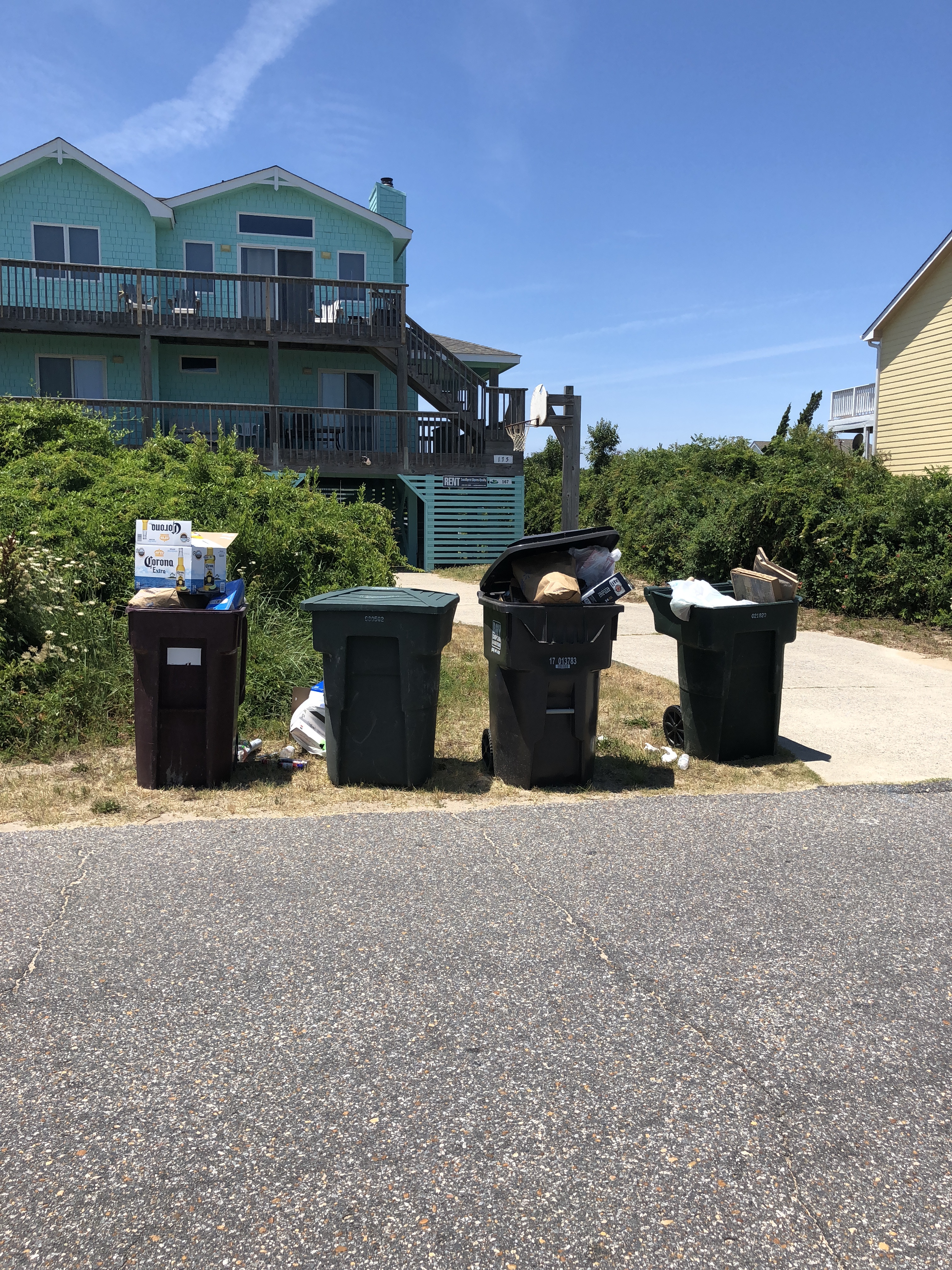
A curbside scene on Ocean Boulevard during one Saturday morning last summer.

In the course of the April 23, 2019 work session on the FY 2019-20 budget, former Councilman Gary McDonald brought up the question of whether Bay Disposal & Recycling, LLC, which picks up the Town’s curbside recycling, is “dumping these items into a landfill,” as The Beacon reported 4/24/19.

“Mr. McDonald mentioned this prospect,” we reported nearly eight months ago, “and other Town officials concurred with him. . . . [We distinctly remember Councilman Christopher Nason agreeing with Mr. McDonald.]

“This appalling bit of news,” The Beacon continued, “elicited no action from the Town Council, and no definitive explanation from [former Town Manager Peter] Rascoe, who did not dispute the allegation.”

A dedicated recycler since the mid-1980s, when I lived in Baltimore, I was horrified. I beseeched every member of the Town Council, as well as Mr. Rascoe, to investigate this claim. “Pick up the phone,” I implored.

At last Tuesday evening’s Town Council meeting, we learned exactly what Mayor Tom Bennett; the former Town Council, which included current Councilman Jim Conners; former Town Manager Rascoe; and follow-up Interim Town Manager Wes Haskett have done about the landfill allegation since April:

Absolutely nothing.

The Beacon believes that, based on his performance Tuesday, if newly sworn Councilman Matt Neal had been on the Town Council in April, we would have received a prompt explanation. He would have found out eight months ago.

Joshua Smaltz, Bay Disposal’s Outer Banks Site Manager, appeared before the Town Council at its December regular meeting to request an increase in the monthly per-home collection rate that the Town now pays. In the course of the Council’s dialogue with him, Councilman Conners sought to dispel “rumors” about the company dumping recyclables in landfills. He asked Mr. Smaltz to address the rumors.

In so doing, Mr. Smaltz actually confirmed them: The issue is not whether recyclables are going to landfills, but who’s physically doing the dumping.

Bay Disposal seeks an increase from a monthly fee of $5.42 per home in Southern Shores—which itself is an increase of 10 cents over the original June 15, 2018 contract price—to $7.40 per home. According to the contract, which Mr. Smaltz and Mr. Rascoe signed, there are 2,394 homes in Southern Shores.

As Councilman Neal astutely pointed out, the contract between Bay Disposal and the Town, “lacks an escalation clause.” In fact, as Mr. Neal noted, the contract states that additional fees or costs are Bay Disposal’s responsibility. The Town has no obligation to even consider Bay Disposal’s request for a rate increase, effective Jan. 1.

Mr. Neal was the only Council member who addressed Mr. Smaltz’s request for a rate increase as a matter of contract, rather than as a request for help. He (again astutely) observed that if the Town agrees to amend the contract to increase the monthly rate, further amendments may be necessary. He even brought up the possibility of a more extensive rewriting of the contract.

Bravo!

THE PROBLEM OF CONTAMINATION

According to Mr. Smaltz, the $1.98 monthly per-home fee increase—which Mr. Neal termed “considerable”—is necessary because Bay Disposal’s “processing fees” for “transporting and processing the recycling” have increased precipitously.

At the time of the Town’s June 2018 contract, Bay Disposal was paying $20/per ton of recycling material for processing. This amount gradually increased. As of Nov. 1, 2019, he said, the company was paying $110/per ton. In just “the last two weeks,” he noted, that cost has increased to $120/per ton.

From Jan. 1, 2019 to Nov. 1, 2019, Mr. Smaltz said, Bay Disposal collected 482.06 tons of recycling from Southern Shores, at a processing cost of $22,813.95. If the company were to pay $120/per ton, that amount would be $57,847.20.

In response to inquiries from Councilmen Conners and Leo Holland, the Bay Disposal manager explained the recycling process, which starts with the curbside collection.

Bay Disposal’s recycling trucks transport the loads they collect to the company’s “recycling transfer facility” in Powell’s Point, where they are transferred to a “53-foot tractor-trailer” that hauls the material to three recycling plants in Virginia. These plants sort and process the material, rejecting any recycling that is “contaminated.”

“Anything unclean,” such as unwashed glass jars or bottles, “is contaminated,” Mr. Smaltz said; but there are other causes of contamination, upon which the Outer Banks Site Manager could have elaborated, but did not.

Plastic bags, for example, which he said “are an issue,” are considered recycling “tanglers,” The Beacon learned in doing some quick research online, because they “get tangled in the equipment at the recycling processing facility, wasting time and resources,” according to The Recycling Partnership, a national non-profit organization.

Styrofoam is also a common problem, even egg cartons, meat trays, and packing peanuts that have the recycling symbol imprinted upon them. These products are recyclable, says The Recycling Partnership, but NOT in the curbside recycling service system. Typically, local grocery stores take them back, or local governments set up drop-off locations for foam packing, the nonprofit observes on its website.

See https://recyclingpartnership.org/itsallyou/

Any material that one of the Virginia recycling centers rejects as contaminated ends up in a landfill. This year, Mr. Smaltz said, these centers hired “third-party graders” to assess the arriving recyclables so as to ensure fairness in the sorting and rejection process.

Material that is not considered contaminated is sold to an overseas buyer, which, Mr. Smaltz said, may decide independently to reject it for reasons of contamination. Anything that an overseas buyer rejects is returned to the United States and dumped in a landfill!

China was the first country to refuse recycling because of contamination, he said. India and Thailand followed suit.

If Mr. Conners listened to everything that Mr. Smaltz said after the manager first denied that his company transports recyclables to a landfill, he would have learned that landfill dumping is exactly what is occurring—only a processor or buyer down the “recycling stream,” not Bay Disposal itself, is doing the actual dumping.

After his denial, Mr. Smaltz acknowledged that his company had “six to eight loads” that it delivered to the Virginia recycling centers this year rejected as contaminated. But he qualified this waste by saying that the actual rejected material constituted “less than 50 percent of the [individual] load.”

Much more helpful to the Town Council would have been a quantification of the recycling tonnage from Southern Shores that ended up in a landfill. Just what is the Town’s cost-benefit ratio here?

“There are a lot of contamination issues across the country,” Mr. Smaltz said. No one overseas wants to buy U.S. recycling.

The Beacon wonders why Bay Disposal, as well as the Town, has not sought to educate the public about recycling dos and don’ts. (See photo below.) The “issue” of plastic bags and the problems with unwashed containers are not new.

No food, no batteries, no tanglers (including garden hoses, electric cords, etc.) . . . flatten your cardboard boxes . . . and when in doubt, throw it out.

A MATTER OF CONTRACT: COUNCILMAN NEAL EXCELS

According to Mr. Smaltz, on July 10, 2019, a peak-season Wednesday, Bay Disposal’s trucks collected 2,131 “carts” of recycling in Southern Shores. This amounted to 21.58 tons or an average of 20.25 pounds per home, he said.

In contrast, on Nov. 13, 2019, the trucks collected 910 “carts” for 8.42 tons or an average of 18.5 pounds per home in Southern Shores.

Mr. Smaltz said he would give the Town Council a “can count,” but spoke about “carts,” not “cans.” The terms are interchangeable. The contract refers to “carts,” “receptacles,” and “containers,” not cans. Homeowners who participate in Bay Disposal’s curbside recycling purchase receptacles from the company for $90 apiece.

Mr. Smaltz estimated that about 80 to 85 percent of Southern Shores homeowners availed themselves of curbside recycling this past summer, and about 35 to 40 percent used curbside recycling during the off-season. Last year, the summer use was greater, he said.

When Mayor Pro Tem Elizabeth Morey pressed Mr. Smaltz for more precise can-count data—“from your memory”—he said that in April, “when the season begins to pick up,” about 45 percent of Southern Shores homes use the curbside service. Numbers from the remainder of the year are 80 to 85 percent during the July peak; 60 percent in mid-September; 40 percent in mid-October; and 35 to 40 percent in November, December, and January.

To evaluate these numbers, it would be helpful to know how many of the 2,394 homes in Southern Shores are occupied in the off-season.

Ms. Morey expressed an interest in “subscription rate” curbside recycling, but said she was “more comfortable with the idea” when she believed, as the Mayor said he did, that only 35 to 40 percent of homeowners used the curbside service.

Mr. Smaltz did not differentiate between use by year-round homeowners vis-a-vis seasonal vacationers.

In response to earlier questioning about whether Bay Disposal could provide Southern Shores homeowners private “subscription” curbside recycling service and how much it would cost, Mr. Smaltz replied that it could, at a cost of $13 per home per month.

Kitty Hawk, Kill Devil Hill, and Nags Head homeowners currently have the option of purchasing a subscription recycling service, he said.

Ms. Morey asked Mr. Smaltz to provide the Town Council with as many “can counts” as he can: “Whatever you got,” she said.

She concluded by saying that she would like to “hear from the community as to what they would like us to do.”

Rather than household-use percentage, Councilman Neal focused on annual tonnages in order to assess what Bay Disposal’s “actual burden is,” what he called its “hardship.”

He pointedly asked of Mr. Smaltz: “What would you do if we didn’t give [the increase] to you?”

The Bay Disposal employee said his company would “consider canceling the contract,” which is the response Mr. Neal anticipated.

“I want to gingerly step into this,” the new Councilman said, sounding very much like an experienced contract negotiator. “The more data you give me, I would be more comfortable supporting your hardship.”

Mr. Neal asked Mr. Smaltz to “edify us on paper” as to “what the dollar hardship is to [Bay Disposal] over the value of this contract,” which expires June 30, 2021.

He also inquired as to whether Bay Disposal would consider “disconnecting” its processing (disposal) fees from its servicing (route) costs, suggesting a rewrite of the contract.

Bravo, again! Councilman Neal also might like to know whether Bay Disposal has any competitors who would offer the Town of Southern Shores a better service contract.

It was not possible to hear clearly on the meeting videotape Finance Officer Bonnie Swain’s responses to the Mayor’s questions about the increased cost to the Town if it agrees to work with Bay Disposal on a rate hike. A budget amendment would be required. The Beacon strongly urges Ms. Swain to use a microphone when she comments.

Just as Councilman Neal did, however, we can look at the contract and do the math.

The Town is currently paying $5.42 per month for 2,394 homes. This amounts to $12,975.48 per month; $77,852.88 for six months; and $155,705.76 per year.

If the monthly fee were increased to $7.40, the Town’s costs would be $17,715.60 for a month; $106,293.60 for six months; and $212,587.20 for a year.

Councilman Neal was spot on in asking Mr. Smaltz for annual and monthly tonnage amounts processed by Bay Disposal over the course of the contract, as well as an accounting of the scheduled tonnage rate increases that have occurred over the past 18 months.

These figures, as well as other data that the Town Council requested, could have been obtained and furnished to the Council by the Town staff members who met with Mr. Smaltz after he contacted the Town about the November 2019 processing fee increase.

The Town Council deferred its decision on Bay Disposal’s increase request until its January meeting.

Recycle-Me-Img1

NEXT UP: THE SEARCH FOR A NEW TOWN MANAGER


Ann G. Sjoerdsma, 12/7/19

12/5/19: TOWN COUNCIL MEETING: CORRECTION AND CONFUSION; CONSTRUCTION OF SOUTH DOGWOOD TRAIL SIDEWALK UNDER WAY, COMPLETION EXPECTED JUNE 1

Treedestruct4
Tree removal started in earnest this week along the east side of South Dogwood Trail in preparation for the concrete sidewalk.

Dear Beacon Readers:

I finally have had a chance to watch the videotape of the Town Council’s regular meeting Tuesday evening and have discovered, much to my chagrin, that my decision to rely upon correspondents and publish news they reported to me was misplaced.

In their defense, I would say that this Town Council meeting was unduly confusing, starting with an appointment period during which Mayor Tom Bennett twice forgot to call votes and haltingly recommended nominations and appointments—at one point, Councilman Conners asked, “Which one did my name pop up on?”—and ending with a convoluted discussion about the Town’s “goals” in its “beach management plan” that I will have to transcribe in order to make sense of it.

The point of “updating” the goals of the beach management plan, as the Council voted unanimously to have APTIM, the coastal engineering consultant, do seems to be to have APTIM sign off on a beach-nourishment project that would involve the entire Southern Shores coastline. In its previous studies, APTIM has exempted a northern area from around Fourth Avenue to the Duck border as not being in need of nourishment—an assessment that did not sit well with very vocal homeowners on Seventh Avenue.

In between the missed votes/confusing appointments and the Mayor’s confusing motion about how APTIM Program Manager Ken Willson is to revise the Town’s “goals” in order to loop Seventh Avenue into any beach fill project it approves was a discussion about an increase in Bay Disposal and Recycling, LLC’s monthly per-household recycling rate that had Town Council members seemingly at cross purposes.

Here again, I will have to transcribe the discourse, especially the comments made by Councilman Matt Neal, who showed he is very contract-savvy.

Bay Disposal is requesting an increase from the agreed-upon June 2018 contract amount of $5.42 per home per month to $7.40 per home per month. This would be an increase, roughly, of $30,000 for the next six months, and is intended to go toward paying increased processing fees that Bay Disposal now incurs.

In other news, Finance Officer/Human Resources Director Bonnie Swain informed the Town Council that she has spoken with the three town-manager search firms that the Town is considering, and all are “very qualified” and “equally qualified.” (The meeting packet shows four choices, the fourth of which is an individual.)

According to Ms. Swain, each firm would charge $20,000 for its service, and each would enable the hiring of a new town manager by late May, if the Town were to execute a contract in January. Town Manager Peter Rascoe stepped down Aug. 16 before his Sept. 1 retirement.

Contrary to what was published in The Beacon yesterday, the Town Council’s decision to table the Planning Board appointment(s) until Jan. 7 was not discussed. No reason was given, and there was no mention made of the applications that the Town has received. Mayor Tom Bennett simply said he wanted to table the appointment(s); Mayor Pro Tem Elizabeth Morey quickly made a motion to that effect; Councilman Matt Neal just as quickly seconded it; and the full Council unanimously approved it.

The Mayor did offer a reason, however, for tabling the appointments for the seven-member Capital Infrastructure Improvements Planning Committee. He said that the Council has not yet “gotten the people nominated for two positions.”

In his report as Interim Town Manager, Wes Haskett said the Town would seek “input” from the current CIIP Committee when it meets Dec. 18, at 2 p.m., in the Pitts Center, on “multiple options” that the Town Engineer has offered for street improvement plans on Dewberry Lane.

According to Mr. Haskett, the Town Engineer also has finalized the street improvement plans for the section of East Dogwood Trail between Duck Road and Ocean Boulevard and will be meeting tomorrow at 3:30 p.m. in the Pitts Center with adjacent property owners to review them.

As you may have noticed, the destruction of trees on South Dogwood Trail, to make way for the five-foot-wide concrete sidewalk on the east side, started Tuesday, and sidewalk construction was to start yesterday, Mr. Haskett said. The target date for completion of the sidewalk is June 1.

Again, I regret the errors published yesterday. I will try to fill in some blanks soon about the beach management plan, Bay Disposal’s rate increase request, and the town manager search.

Thank you.

Ann G. Sjoerdsma, 12/5/19

12/4/19: TOWN COUNCIL OKs MONTHLY WORKSHOPS; ELECTS MOREY MAYOR PRO TEM; TABLES PLANNING BOARD & CIIP COMMITTEE APPTS.; NAMES MOREY & NEAL CO-SPONSORS OF CUT-THRU TRAFFIC COMM.; TAKES UP 7TH AVE. BEACH NOURISHMENT, RECYCLING CONTRACT PRICE HIKE

Moreysign
Elizabeth Morey emerged as a leader in last night’s Town Council meeting, being elected Mayor Pro Tem and appointed a sponsor of the cut-through traffic committee. She also may serve on the Capital Infrastructure Improvement Planning Committee, whose members have not been appointed yet.

The Town Council unanimously approved last night the revival of its mid-monthly workshop sessions, which it suspended in 2017, and elected Elizabeth Morey as Mayor Pro Tempore, while tabling until Jan. 7 Planning Board and Capital Infrastructure Improvement Planning Committee (CIIP) appointments, during the first regular meeting of the newly elected Council.

Ms. Morey joined Leo Holland and Matt Neal, all of whom were elected in November to four-year terms, in being sworn into office. Mr. Holland previously served on the Council from 2013-17.

The Town announced today that the seven-member CIIP Committee will meet Wed., Dec. 18, at 2 p.m. in the Kern Pitts Center. Mayor Tom Bennett and Councilman Jim Conners currently co-chair this committee.

When the CIIP Committee was first organized in 2017, the Council decided to name the Mayor and the Mayor Pro Tem its co-chairs, but the Mayor soon defeated this intent with a motion, which passed 3-2, to appoint Mr. Conners after his election that year.

The Exploratory Committee to Address Cut-Through Traffic will meet Mon., Dec. 16, at 5:30 p.m., in the Pitts Center, according to chairperson Tommy Karole, who gave a short report to the Council last night. The usual third-Monday-of-the-month meeting of Planning Board has been canceled in December.

The new Council also considered the hiring of a management-search consultant, from among a list of four submitted by Interim Town Manager Wes Haskett, to assist with its search for a new town manager; the revision of coastal engineering consultant APTIM’s “beach management plan” to include nourishment of the Southern Shores oceanfront at Seventh Avenue; and a request by Bay Disposal and Recycling, LLC, to amend its 2018 contract with the Town to increase the per-household cost paid for its recycling services.

(See The Beacon’s preview of the meeting, 11/29/19.)

Because of a pre-existing commitment out of town, I was unable to attend last night’s meeting and am relying upon correspondents for this report. I will provide a full account of the Council’s actions after I view the meeting videotape and make inquiries. Meeting attendees say that a very well-prepared Councilman Neal took issue with Bay Disposal’s proposed price increase. (To be continued.)

Mr. Haskett told The Beacon in an email today that the Town Council “decided not to select a [search] consultant until after a representative with the North Carolina League of Municipalities comes to the Jan. 21 Council workshop meeting to present information on the roles and responsibilities of a town manager and things to consider when hiring a new town manager.”

The Town Council’s workshop sessions in 2020 will be held at 9 a.m. on the third Tuesday of the month at the Pitts Center.

***

The December meeting of the Town Council is traditionally an organizational one, with Council members voting upon the next year’s meeting schedule and making necessary appointments. Among the appointments it did make last night, according to Beacon correspondents, are the following:

*Ms. Morey and Mr. Neal were named co-sponsors of the Exploratory Committee to Address Cut-Through Traffic, succeeding outgoing Councilman Fred Newberry;

*Ms. Morey, Mr. Holland, and Mr. Conners were nominated for a seat on the Dare County Tourism Board of Directors, which chooses from among them; the Mayor did not indicate a primary nominee, as is standard procedure;

*Mr. Conners was named to the Dare County Gov-Ed Access Channel Committee;

*Mr. Neal was appointed to the Albemarle Rural Planning Organization; and

*Lee Whitley and Kristine Klousis were re-appointed to three-year terms on the Southern Shores Historic Landmarks Commission.

Beacon correspondents report that Tuesday’s meeting was sparsely attended. Outgoing Councilman Gary McDonald, who chose not to run for re-election, did not attend, and neither Councilman Christopher Nason, who also decided not to run, and Councilman Newberry, who lost his bid for re-election, stayed for the meeting after being recognized for their service.

I will post a followup to this blog, with more information, in the next few days.

Thank you.

(I mistakenly stated earlier that the Town Council’s decision to suspend the mid-monthly workshops was a 3-2 one. It was not. It was unanimous.)

Ann G. Sjoerdsma, 12/4/19


11/29/19: TUESDAY’S MEETING (12/3): NEW TOWN COUNCIL LOOKS TO REVIVE MONTHLY WORKSHOP MEETINGS; ALSO WILL ADDRESS BEACH ‘MANAGEMENT,’ SEARCH FOR NEW TOWN MANAGER, AND NUMEROUS APPOINTMENTS

sunsetwithbirds

The newly elected Town Council members already appear to be exerting an influence on the conduct of Town business with an action directed toward restoring in 2020 the second Council meeting of the month—which was “suspended” unanimously by the Town Council on June 20, 2017, to be held only as needed.

According to the meeting packet released with the Town Council’s agenda for its Tuesday, Dec. 3, meeting, the reconstituted Council will vote on a prepared resolution that sets forth a 2020 Council schedule of two meetings each month, a “regular” meeting on the first Tuesday and a “workshop” meeting on the third Tuesday. Two exceptions to this scheduling are regular meetings held on the first Wednesday in March and November.

The Town Council will meet Tuesday at 5:30 p.m., in the Kern Pitts Center.

See agenda at https://www.southernshores-nc.gov/wp-content/uploads/minutes-agendas-newsletters/Agendas_2019-12-03.pdf

Meeting packet of background materials: https://www.southernshores-nc.gov/wp-content/uploads/minutes-agendas-newsletters/Meeting-Packet_2019-12-03.pdf

The Council’s regular December meeting is traditionally a time for decision-making about organizational matters, particularly those arising in the ensuing year.

Next week’s meeting also will feature a changing of the guard, as outgoing Council members Fred Newberry, Gary McDonald, and Christopher Nason receive recognition for their service and incoming members Matt Neal, Elizabeth Morey, and Leo Holland take their oaths of office. Mayor Tom Bennett’s and Councilman Jim Conners’s terms expire in 2021.

According to the agenda, the new Town Council will—in no particular order—take up the coastal engineering consultant’s “beach management plan”; make important Planning Board and other appointments, including to the Capital Infrastructure Improvement Planning Committee; and consider a list of recruiters from which to choose to assist with hiring a new town manager.

The Town has been without a permanent, full-time town manager since Aug. 16, when former Town Manager Peter Rascoe went on two weeks’ leave before his retirement.

The Council also will elect a new Mayor Pro Tempore, who would serve in place of the Mayor in the event of his absence or disability. The Mayor Pro Tem’s term is two years.

Among the reports scheduled to be given at the Council’s meeting is one by Tommy Karole, chairperson of the Exploratory Committee to Address Cut-Through Traffic, which held a public forum Nov. 19. (See The Beacon, 11/20/19)

While all of the Town Council’s organizational and business items are important, the apparent decision to revive the monthly workshop meetings, which again would be held at 9 a.m. on the third Tuesday of the month, may be the most consequential to property owners. The proposed meetings present a second opportunity each month for the full Council to confer openly and publicly, and for the public to be privy to their discussions.

During the recent election campaign, Mr. Neal suggested holding workshop sessions, and Ms. Morey stressed the importance of communication among all Council members and between the Council and the public.

The Beacon wonders, however, what effect the addition of these morning workshops will have on the conduct of the regular evening meetings, in particular, whether the new Town Council might consider eliminating one of the two public-comment periods currently held then.

The Beacon strongly discourages such action. These comment periods enable a vital exchange of views among members of the public and the Council both before and after sometimes controversial issues are discussed.

Further, most people are indisposed at 9 a.m. on a week day, preoccupied with work and other daytime business, including the running of a household, and unlikely to attend workshops at that hour.

We will be interested to see what the Town Council has in mind.

PLANNING BOARD, CIIP COMMITTEE, & OTHER APPOINTMENTS

Ms. Morey’s election to the Town Council has created a vacancy on the Town Planning Board, the filling of which may create a vacancy among Planning Board alternates.

A longtime member of the Planning Board, which also serves as the Town’s Board of Adjustment, and its chairperson since January, Ms. Morey was just appointed in July to her latest three-year term on the Board. She submitted her resignation on Nov. 26. The person appointed to complete her term would serve until June 30, 2022.

The Beacon believes that, in order to preserve integrity in the appointment process and to ensure that appointments are not driven by political bias and/or personal favoritism, the two current alternate members of the Planning Board should always be given a right of first refusal whenever a regular member vacancy occurs.

Appointments should not depend upon the predilections of whoever happens to be serving on the Town Council.

According to a Nov. 27 memorandum to the Council from Interim Town Manager Wes Haskett (which is in the meeting packet): “Traditionally, Council has appointed the most senior Alternate Member to fill the seats of Regular Members when vacancies arise.”

When it does not do so—for example, when the Council majority of Bennett-Nason-Conners passed over a very capable senior alternate, Carlos Gomez, to appoint the late Glenn Wyder, who was second alternate—it sends a poor message to anyone who volunteers in Town about his/her value and service. The message is politics come first.

Second Alternate Michael Basilone is the most senior alternate, but he has declined the opportunity to serve as a regular member, according to Mr. Haskett. Planning Board First Alternate Tony DiBernardo, who was appointed in June to succeed Leo Holland, who resigned after serving one year of his three-year term, has expressed an interest in being elevated to the regular Board. He should receive the appointment.

Three other Southern Shores resident property owners have submitted applications, according to Mr. Haskett. They are Lynda Burek, George Berry, and Robert McClendon.

The Beacon will not address their qualifications, which you will find in the meeting packet. If Mr. DiBernardo is appointed to the full Board, one of these three individuals will be appointed to serve out his term as an alternate.

Curious to us is the date of each person’s application. Ms. Burek’s application is dated Aug. 11, 2014: We believe it should have been updated. A statement by Ms. Burek about her current circumstances would seem to be both helpful to the Town Council and the public, as well as mindful of the public record.

Ms. Burek, who ran unsuccessfully for Town Council in 2015 and has been active in the SSCA, may be known to most of the members on the Town Council, but her application is to the Town, not to the Council.

Mr. Berry’s application is dated July 17, 2019, so it was “on file,” and Mr. McClendon’s is dated Nov. 25, 2019—one day before Ms. Morey’s resignation, hardly a coincidence.

Once again, we will be interested to see what the Town Council has in mind.

AMONG THE OTHER APPOINTMENTS that will be made Tuesday are the following that the Mayor traditionally makes from among Council members:

*Three nominees, with one designated as the primary nominee, for a seat on the Dare County Tourism Board of Directors (Mr. Holland served in this capacity during his previous term on the Town Council);

*A member of the Dare County Gov-Ed Access Channel Committee; and

*A member of the Albemarle Rural Planning Organization.

Appointments to the seven-member Capital Infrastructure Improvement Planning Committee are also on the agenda, as an item presented by Mayor Bennett

The Beacon believes the new Town Council should take time to reevaluate the composition and terms of the CIIPC membership and to standardize the appointment process so that it, too, is fair and impartial.

APPOINTMENTS TO CIIP COMMITTEE NEED RETHINKING

On Sept. 5, 2017, the Town Council appointed five members—one per elected official—to the newly organized Capital Infrastructure Improvement Planning Committee (CIIPC). Named as co-chairs of the CIIPC were the Mayor and the Mayor Pro Tem, who was then Fred Newberry.

Three months later, Councilman Nason became Mayor Pro Tem, by a 3-2 Council vote. According to the minutes of the Council’s Dec, 5, 2017, meeting, the Mayor appointed newly elected Councilman Jim Conners to serve on the CIIPC, in lieu of the Mayor Pro Tem; the same 3-2 majority of Bennett-Nason-Conners approved this appointment.

In the span of just months, therefore, Mr. Newberry lost his co-chairmanship on the CIIPC, and the junior-most member of the Council, Mr. Conners, ascended to this powerful position. He has served in this capacity for the past two years.

It is time for him to pass the gauntlet.

The other current members of the CIIPC are:

Al Ewerling: appointed by Councilman Newberry

Jim Kranda: appointed by Councilman Holland, even though Mr. Holland left office Dec. 5, 2017

Glenn Riggin: appointed by Mayor Bennett, giving him, arguably, two votes on the committee

Andy McConaughy: appointed by Councilman Nason

Carlos Gomez: appointed by Councilman Gary McDonald

The Beacon sees no compelling reason for the Mayor and Mayor Pro Tem, or a Council substitute, which Mr. Conners was, to serve as co-chairpersons, especially considering that former Town Manager Peter Rascoe set the committee’s agendas and led its meetings, and the Council has delegated authority over the South Dogwood Trail sidewalk project to the town manager, interim or otherwise.

Indeed, we see more compelling reasons for the Council not to have such consolidated power over discussions of important and far-reaching Town infrastructure decisions. We believe the membership on the committee should provide a diversity in viewpoint and a demographic cross-section. The Council needs to look for qualified women and invite one or two to serve on the CIIPC.

The Capital Improvement Plan Committee, which preceded the CIIPC, was loosely organized with voting and non-voting members described as “committee members,” “citizen representatives,” and “staff representatives.” As an attendee of some of its meetings, I was never quite sure who had the power to vote. It was confusing.

In 2015, Mayor Bennett and Town Councilman Larry Lawhon, who lost his bid for reelection in November of that year, served as “committee members.” The Mayor appointed new Councilman Chris Nason to serve on the committee after Mr. Lawhon’s defeat. He also appointed Jim Conners to be the committee’s “citizen representative.”

The Mayor made these unilateral appointments in the Council’s Dec. 1, 2015 session. Indeed, he unilaterally made appointments to all Town Council standing committees, which, at the time, numbered four. The others were planning, public safety, and finance.

The Mayor sat on all four committees and selected the Council member he wanted to sit with him on a given committee. This organization may have been simpler to administer, and more desirable to the Mayor than delegation would have been, but it did not enable the committees to thrive.

On Dec. 6, 2016, Mayor Bennett moved to abolish all standing committees. Then-Councilman Leo Holland seconded his motion, and Mr. Nason voted in favor of it, for a 3-2 approval. Councilmen Newberry and McDonald opposed the motion.

Interestingly, Elizabeth Morey served in 2015 on the Capital Improvement Plan Committee as a citizen representative, along with Mr. Conners. Glenn Riggin also pops up as a citizen representative in meeting minutes taken during that year.

The former capital improvement committee last met on Oct. 13, 2016. The first meeting of the CIIPC was Oct. 4, 2017.

We rehash this history because we believe it informs the makeup of the CIIPC. We rehash it because we urge the new Town Council to scrutinize and give thoughtful consideration to the CIIPC’s organization.

There is no good reason to vest in the Mayor and the Mayor Pro Tem leadership authority over the CIIPC. There also is no good reason to have a seven-member committee, instead of a five- or a nine-member committee. And there is no good reason for the committee chairs, whoever they are, to appoint other members of the committee.

Southern Shores will be better served if there are more than just a select few involved in determining its capital-improvements projects and protecting its environmental welfare.

Historic Landmarks, Cut-Through Traffic Appointments

Lee Whitley’s and Kristine Klousis’s three-year terms on the Southern Shores Historic Landmarks Commission expire on Dec. 6. Both are real estate brokers, and each has applied for reappointment. There is no indication in the meeting packet that anyone else has applied.

Also on the Town Council’s agenda is the appointment of a new Town Council sponsor to replace Councilman Newberry on the cut-through traffic committee.

FINAL NOTES:

RECYCLING: According to the agenda, the Town Council will consider a “request” by Bay Disposal and Recycling, LLC, to “amend” its 2018 contract with the Town. The contractor’s request is not included in the meeting packet. There was concern expressed at a previous Town Council session that Bay Disposal was carrying collected recyclables to a landfill, rather than to a recycling center.

CLOSED SESSION: The agenda concludes with the observation that the Town Attorney may “recommend Council convene a closed session . . . for the purpose of consulting with the Town Attorney” and preserving attorney-client privilege. No details are provided.

Ann G. Sjoerdsma, 11/29/19

11/20/19: PUBLIC FORUM: RESIDENTS SUPPORT PROHIBITING LEFT TURN AT U.S. HWY. 158-SOUTH DOGWOOD TRAIL TO REDUCE CUT-THROUGH TRAFFIC

afterdorian2

The message conveyed by the 40 or so people who attended last night’s public forum on cut-through traffic at the Pitts Center was clear: The no-left-turn (“NLT”) weekend of June 2018 worked, and they would like to see the no-left-turn option implemented in the summertime.

The forum, organized by the Southern Shores Exploratory Committee to Address Cut-Through Traffic, was an opportunity for residents to share their ideas about controlling the northbound vacationer traffic on the South Dogwood Trail-to-Hickory Trail-and-beyond route, and to meet the committee, which is headed by homeowner Tommy Karole.

While residents suggested other means for relieving the congestion on N.C. Hwy. 12, such as reversing lanes, controlling pedestrian crosswalks in Duck, and stationing police en route to move the traffic flow, only the NLT option garnered what appeared to be a consensus—just as it did among the more than 100 residents who attended the October 2014 traffic-control workshop.

Although “gating” was mentioned as a means of minimizing traffic spillover on to other residential streets (e.g., Juniper Trail, Porpoise Run) occasioned by prohibiting a left turn at South Dogwood Trail, no one suggested gate-controlled access to Southern Shores.

Pete Born, who owns a second home on North Dogwood Trail, a street that is “relatively secluded,” brought up the past use of barricades to close access to town roads.

Mr. Born and his wife sold a second home in Duck and moved to Southern Shores, he said, to avoid traffic congestion.

Barricades, such as sawhorses, have been used to close streets during hurricane evacuations, but no one could recall using them at other times.

A vocal “old-timer” on the traffic problems, Norman St. Laurent, who lives on Hickory Trail and has spoken repeatedly at Town Council meetings about speeding on his street, cautioned the committee “not to reinvent the wheel.” Many, if not most, in the audience were longtime residents who showed little interest or patience in doing so.

Mr. St. Laurent produced from a thick file folder a copy of a report from a Town traffic-control workshop conducted in 2009, which, one of the committee members discovered upon skimming it, documented a flow of 1,500 vehicles on the residential cut-through route during a summertime weekend.

Al Ewerling, who lives at the intersection of South Dogwood Trail and East Dogwood Trail, advised the forum gathering that a state government employee told him that 8,500 vehicles traveled on the cut-through route on a July weekend in 2018. Mr. Ewerling approached a worker who was fixing a roadside counter in Southern Shores and was referred to someone in Raleigh for an official count.

Several speakers remarked on the worsening of conditions during the past 10 years.

According to Paulette Jones, who has lived on South Dogwood Trail for 24 years and walks along that street “365 days a year,” this past summer “was the worst year” she has experienced. Mrs. Jones said she was stopped by one motorist who asked why Southern Shores does not make it easier for vacationers to get through the residential area.

Said Mark Dailey, who lives on Sea Oats Trail near its intersection with Hillcrest Drive, the cut-through traffic congestion has “gone on too long.”

“If we can’t get a solution to the traffic,” he suggested, “we should find a way to monetize it.” He did not mention the word “toll,” however.

JUNE 2018 NLT WEEKEND

During what was a very informal 90-minute discussion, only newly elected Town Council member Matt Neal, who lives on Wax Myrtle Trail near Porpoise Run, shared a negative experience with the no-left-turn weekend of June 23-24, 2018.

That weekend, U.S. Hwy 158-eastbound motorists were prevented from turning left on to South Dogwood Trail between 8 a.m. and 6 p.m. To effectuate this restriction, the Town had to have the cooperation of the Town of Kitty Hawk, which has jurisdiction over Hwy. 158 in this area, and the assistance of the N.C. Dept. of Transportation.

According to Mr. Neal, an increased amount of traffic diverted to Wax Myrtle from Duck Road via Porpoise Run, and drivers were speeding “up to 50 miles an hour” on his street.

Despite the heavier flow, he said, traffic did not come to a standstill, blocking driveways and preventing people from coming and going to their homes, a situation that Mr. Neal said he would find intolerable.

“I can empathize,” he said.

Newly elected Town Council members Elizabeth Morey and Leo Holland also attended the forum, as did Mayor Tom Bennett and current Council members Jim Conners and Fred Newberry. Among them, only Mr. Neal participated actively in the discussion.

There were no Town staff members or police officers present.

Mr. Newberry has served as the Town Council’s sponsor to the committee since the Council unanimously approved its formation in June. Mr. Neal would seem to be an excellent replacement for Mr. Newberry.

His comments about the 2018 NLT weekend echoed those of his former neighbor, Steve Uperti, whom The Beacon interviewed the Monday after the trial occurred. Mr. Uperti and his wife formerly lived on Wax Myrtle Trail where it connects with Porpoise Run.

On July 6, 2018, in an overview report of the NLT weekend, The Beacon quoted Mr. Uperti as saying that the traffic on Wax Myrtle was heavier than usual, but “It didn’t really bother us because there was no backup.”

He also said that one of his neighbors—Mr. Neal, whom The Beacon did not previously identify because we did not speak directly with him—placed an orange cone on the street in front of his house to slow down the speeders. Mr. Neal said last night that he indeed used this traffic-calming device, which could easily be used elsewhere in town.

The Beacon also interviewed at random Daphne Porter, who lives on Sea Oats Trail at its intersection with Hickory Trail and monitored the traffic throughout the NLT weekend. She told The Beacon that when the traffic slowed on Duck Road to between 4 mph and 11 mph, the free navigation app, WAZE, directed motorists to Wax Myrtle Trail by “rerouting” them to Porpoise Run.

No question, WAZE, which provides information about real-time traffic conditions, is a factor for the committee to consider.

Beacon correspondents traveled throughout Southern Shores during the NLT weekend, keeping a particularly close eye on the Hwy. 158-South Dogwood Trail intersection. We extensively reported on the results in blogs of June 25, June 29, and July 6, 2018.

Our observations coincided with those of Hendrik Pepler, who said last night that he biked to the intersection and observed traffic there for 30 minutes, seeing little evidence of drivers turning around “at Starbucks” and returning to South Dogwood Trail to make a legal right turn. We, too, did not witness many “work-arounds” of the left-turn obstacle, either coming from the Marketplace or turning around on Woods Road.

Mr. Pepler, who currently lives in Kill Devil Hills, is building a house on Beech Tree Trail.

Mr. Ewerling said he believes the green and red lights on the left-turn arrow at the intersection remained functional throughout the NLT weekend, confusing drivers, some of whom attempted to turn left from a through lane, ignoring the barrels that blocked the left-turn lane.

“It was incredible how well [the NLT weekend] worked,” said Ed Graham, who lives at 289 Duck Road. “The traffic flowed. . . . People who cut in [from the residential streets] just slow it down.”

In prohibiting a left turn at South Dogwood Trail, Mr. Graham said, “We’re preventing people from cutting in line.”

DIVERSITY IN RESIDENCE

The residents who spoke at the forum gave home addresses on Sea Oats Trail, South and North Dogwood trails, Hickory Trail, Hillcrest Drive, Ginguite Trail, Beech Tree Trail, Tenth Avenue, Wax Myrtle Trail, and Duck Road.

In selecting the cut-through traffic committee, Mr. Karole said he tried “to get a diverse group of people who live in different parts of Southern Shores.”

He said he did not know four out of the five people whom he chose, citing Linda Lauby as his only acquaintance. The other members were recommended to him.

In addition to Mr. Karole, who lives on East Dogwood Trail near South Dogwood Trail, the committee members are:

Ms. Lauby, a former resident of East Dogwood Trail who now lives on High Dune Loop in Chicahauk;

David Watson, who lives on Hickory Trail and is a longtime employee of Southern Shores Realty Co.;

Bill Timberlake, known as “T.”, who lives on South Dogwood Trail between Tall Pine Lane and Yaupon Trail;

Vicky Green, a resident of Hillcrest Drive, near the SSCA tennis courts; and

Jim Monroe, who lives on Ocean Boulevard near the East Dogwood Trail beach access.

Committee members may be reached by email at tosstraffic@southernshores-nc.gov.

Mayor Bennett, who said he had not intended to speak, gave a few remarks at the end of the forum. He related that he and others in the Town government are not “oblivious” to the problems and are “sympathetic” with residents.

“We’re all tuned into it,” the Mayor said. “. . . We’re aware of it. We’re conscious of it. . . . None of us wants to see this traffic through our neighborhood.”

Traffic is a problem, he said, that the Town will be dealing with in the next two to three years.

Compounding the traffic congestion is the increase in the number of Airbnb and other homeowner-controlled rentals in Southern Shores, a fact the Mayor observed, but neither the committee nor the forum audience discussed, although Mr. Watson mentioned it.

Mr. Watson, who is the broker in charge at Southern Shores Realty, said that the rental-house turnover days for his company, which manages about 450 properties, are Friday, Saturday, and Sunday, with Sunday being “the biggest day.”

He said there is “no appetite” among renters for weeklong rentals that start on any other day, although people who rent through Airbnb are not so selective. They may choose to rent during the week and avoid the weekend traffic.

Mr. Karole explained that the committee would be submitting its traffic-control proposal(s) to the Town Council in February or March, well ahead of the Town Manager’s preparation of a fiscal year 2020-21 budget.

He did not indicate when the committee might be meeting again in public, or even if it would be. The committee must observe N.C. open-meeting laws, which require all meetings of three or more committee members to be public and given notice.

The Beacon invites and encourages everyone who attended last night’s forum to give us their impressions of the proceedings either in comments to the blog or in posts on the Facebook page. Thank you.

Ann G. Sjoerdsma, 11/20/19

11/17/19: PUBLIC FORUM ON CUT-THROUGH TRAFFIC SET FOR TUESDAY; SCCA MEETING TO VOTE ON 2020 BUDGET, AMENDED BYLAWS THURSDAY

afterdorian
The intersection of Duck Road and Sea Oats Trail on the day after Hurricane Dorian that visitors to the Currituck County beaches were permitted entry. There was no increase in residential cut-through traffic in Southern Shores the day before when visitors to Dare County gained entry.

The Southern Shores Exploratory Committee to Address Cut-Through Traffic will hold a public forum Tuesday (11/19), at 5:30 p.m., in the Kern Pitts Center. According to chairperson Tommy Karole, the seven-member committee will be soliciting comments from property owners and residents, not formally presenting any conclusions of its own.

Formed in June, the traffic committee is a sanctioned committee of the Town Council and currently is sponsored by Town Councilman Fred Newberry, who lost his re-election bid earlier this month. Pursuant to a motion made by Mr. Newberry at the Council’s Nov. 6 meeting, the Council will select a replacement sponsor at its Dec. 3 meeting. Mr. Newberry’s motion passed 4-1, with Mayor Tom Bennett opposing it.

Besides Mr. Karole and Mr. Newberry, the members of the committee are homeowners Jim Monroe, Bill Timberlake, Linda Lauby, Victoria Green, and David Watson, whose properties represent a residential cross-section affected by the northbound cut-through traffic. Each member will be introduced at the forum.

“The committee encourages Southern Shores residents to come out, get involved, and express their views,” Mr. Karole told The Beacon about Tuesday’s event. “This is going to be an open forum. We have ideas, but we’d like to hear what folks have to say.”

There is no agenda for the forum. Mr. Karole said he will ask members of the public who would like to speak to sign up, give their names and addresses, and try to limit their comments to the standard three minutes. Because the committee is Town Council-sanctioned, official minutes of the forum will be taken.

SSCA SPECIAL MEETING ON BUDGET, BYLAWS TO BE HELD THURSDAY

Rod McCaughey, president of the Southern Shores Civic Assn., has called a special meeting of the general membership this Thursday (11/21), at 7 p.m. in the Pitts Center, for the purpose of finalizing the votes on the 2020 budget and the proposed changes to the SSCA bylaws.

The SSCA Board of Directors tabled these actions at the Oct. 14 general membership meeting, after a member raised a legal question about the SSCA’s proposed new annual dues structure, which is based on the use of a member’s property. (The boards of the Tennis Club and Boat Club set their annual dues separately.)

The SSCA Board has recommended that 2020 dues be increased and assessed so that owners of residential/second homes pay $65 and rental property owners pay $95. People who own undeveloped lots, as well as full-time residents who do not own property, may join the SSCA for $65.

According to Mr. McCaughey’s “President’s Message” in the September 2019 SSCA newsletter, the annual dues are being changed in order to increase revenue to cover ongoing and anticipated maintenance and repair projects.

Two-thirds of the eligible votes at Thursday’s meeting are required to approve both the proposed 2020 budget, which reflects the dues-structure change, and the proposed changes in the SSCA bylaws. (A property owner-voter may have more than one vote.)

According to the SSCA’s proposed 2020 budget, total revenues are projected to be $233,128, of which $126,330, or 54 percent, is membership dues income; and total expenses are projected to be $218,550, leaving $14,578 to be deposited in capital fund reserves.

Other significant sources of income for the SSCA, according to the 2020 budget, include marina slip rentals, projected to be $36,250, and annual cell-tower rent of $39,748.

The largest expenses for 2020 are projected to be special projects ($78,500); property maintenance/construction ($43,700); administrative services ($25,450); and grounds maintenance/beautification ($22,000).

You may peruse Mr. McCaughey’s message and the 2020 budget in the newsletter at https://www.sscaobx.org/assets/docs/September%202019%20SHORELINES%20FINAL%20EMAIL.pdf.

The Beacon was unable to find the proposed bylaw changes on the SSCA’s website. A redline copy of the current association bylaws, showing the proposed changes, was emailed to SSCA members before the October meeting.

One major proposed change is in the definition of eligibility for SSCA membership. Currently, all owners of real property in Southern Shores and all full-time Southern Shores residents, regardless of their property ownership status, are eligible to join the SSCA. The SSCA Board has recommended amending the definition of “owners of real property” to include “a corporation, limited liability company, partnership, trust or other legal entity provided that such entity has designated by written notice to the SSCA a natural person as a voter for the membership interest.”

For further proposed amendments, we reproduce below the cover-letter overview from Board member Jeff Johnson that accompanied the mailing of the redline copy. Mr. Johnson, an attorney, oversees the SSCA’s bylaws and long-range planning.

. . . Below is a brief overview of the context behind the SSCA Board’s proposing these revisions.

A number of these [bylaw changes] have to do with operational flexibility, like the changes in 3-4.5 re Robert’s Rules.  SSCA Board members are volunteers, many are retirees, and seldom is anyone a “parliamentarian” with a thorough command of Robert’s Rules.  On advice of legal counsel earlier this year, we propose to continue to use the Rules as a format for both Board and member meetings, but to provide that a technical deviation from the Rules does not necessarily invalidate action that the Board or the members have otherwise taken consistent with the Bylaws.

Similarly, in 4-1, there is some flexibility for a missed deadline where reasonable “do-overs” take care of the matter.  In 4-7, we clarified that some Board meetings and votes must necessarily happen using email and/or the telephone.  Again, flexibility and modern realities.  This section also adds the concept of a “closed session” meeting regarding certain confidential matters, for example, matters in litigation or matters concerning personnel.  This is intended to parallel somewhat the Town’s exception to Open Meetings Laws, even though the SSCA, as a private organization, is not subject to such laws.

In 8-3 regarding the budget, we wanted to add flexibility for the Board to use reserve funds to cover storm damage and/or legal costs that might exceed the approved budget for a given year.

Some of the changes have to do with membership and eligibility for membership.  Today, many properties in Southern Shores are owned by family trusts or limited liability companies.  Those entity owners should be able to be SSCA members as long as they designate a live person as their voting representative.  To the extent that a property owner is in violation of covenants or SSCA rules and regulations with respect to common properties, the Board should have the right to withhold membership until a problem is cleared up.  (See Section 3.)

In 3-6, there is some clarification regarding passes and decals and that the Board may revisit and determine the amount of membership dues from time to time.

Finally, in 9-1.5 regarding the right of 20 members to veto a Board decision that a proposed transfer of a real property interest is not “material,” there was never a timeframe included.  We have added “15 days” as reasonable and practical.

We hope this is helpful as you review the redline.  By building in some extra flexibility here, we are hoping to make it easier for members to volunteer to sit on the SSCA Board for a term or two.  We really encourage all of you to consider it.  Board participation can be interesting, rewarding and fun–an important contribution to the community.

— Jeff Johnson (SSCA Director/Bylaws and Long-Range Planning)


As previously announced, THE PLANNING BOARD will meet tomorrow at 5:30 p.m. in the Pitts Center. The Board will be discussing retaining walls and the bank cupola provision in ZTA 19-02.

Ann G. Sjoerdsma, 11/17/19

11/9/19: BEACH NOURISHMENT FUNDING, COUNTY AND TOWN; AN ADDENDUM

After speaking with Dare County Manager and Attorney Robert (“Bobby”) Outten by telephone late yesterday afternoon, I would like to take another stab at explaining the mathematics of beach nourishment funding. I also would like a clean slate:

$7.5 million is currently available in Dare County BNF for project(s)

Currently, Mr. Outten explained, there is $7.5 million in the Dare County Beach Nourishment Fund (BNF) that has not been allocated for other purposes, such as paying debt service and covering maintenance of the projects that have been completed. Part or all of this money is available to be given to a town for its beach-nourishment project.

As The Beacon explained yesterday (11/8/19), the county’s occupancy tax is 6 percent. One-third of the occupancy taxes collected is set aside for beach nourishment. This amount is often referred to as “2 percent,” but it’s actually one-third of the 6 percent. These “2 percent” monies can be used for no other purpose, but to “put sand on our beaches,” Mr. Outten said, and to maintain that sand fill.

The county puts a premium on maintaining beach nourishment, thereby protecting its investment, and anticipates, for planning purposes, that maintenance will occur every five years. In a given beach town, however, maintenance may not be necessary that frequently. Nags Head performed maintenance just this year of its 2011 beach nourishment project.

The occupancy tax money comes into the county as it is collected, according to Mr. Outten, so the BNF “grows and grows, then we spend it down.” What this means is that the unallocated amount can be expected to increase.

Formula for determining how much each town should pay for nourishment

As Mr. Outten explained at the Wednesday Town Council meeting, Dare County paid about 50 percent of the costs for Nags Head’s 2011 nourishment project, which was the first one on the Outer Banks. According to online reporting by the Town of Nags Head, the project’s total cost was $37 million.

When Kill Devil Hills, Duck, and Kitty Hawk subsequently came to the county to ask about funding for nourishment of their beaches, Mr. Outten said he had to figure out “how to fairly allocate county funds” among them. The BNF had insufficient funds to support a 50-50 split for each town, as was done in Nags Head.

What the County Manager eventually did was ask: “How much did Nags Head tax its taxpayers” in order to pay its share of the beach-nourishment project? Mr. Outten said he looked at how much Nags Head “spent out of its coffers,” and divided that number by its tax base, to arrive at a tax rate paid by “everybody” in town. It was about 7.85 cents, as he recalled, or 0.0785 per $100 of property valuation.

When each of the three towns applied that formula—i.e., multiplied their tax bases by the 7.85 factor—they all could afford a nourishment project, Mr. Outten said. The county intended to make up the difference in the costs of each town’s project, as I understand it.

Because its tax base is so large, however, when Kill Devil Hills applied the 7.85-factor formula, it “got virtually none of the occupancy-tax money”—because it could afford to do without it—“and that didn’t seem fair,” Mr. Outten said.

KDH and the county negotiated, arriving at a 5.2 factor instead, Mr. Outten said, so “they had skin in the game at some level, and we put some skin in, too, to make it fair.”

Of course, like Nags Head, the three towns didn’t actually apply the 0.0785 tax rate to every property because they used municipal service districts to tax oceanfront and oceanside property owners at a higher rate than other property owners.

It seems to me—and I defer to accountants and other numbers people—that if the Town of Southern Shores applied the 0.0785 tax rate to its tax base, it could estimate how much Dare County would expect it to contribute to its estimated $16 million beach nourishment project. It also would discover just how far short it falls.

The Town’s auditor provided the numbers needed to do the math in her FY 2018-19 report. See the section on ad valorem taxes in: https://www.southernshores-nc.gov/wp-content/uploads/2019/11/Town-of-Southern-Shores-2019-financial-statements-View.pdf.

$250,000 awarded for Southern Shores beach nourishment study

As The Beacon reported yesterday, Chairman Robert Woodard told the Town Council Wednesday that the County Board of Commissioners had unanimously voted Monday, at its monthly meeting, to give Southern Shores $250,000 to pay consultants for a beach-nourishment study. The county has done the same for other towns.

Southern Shores has spent considerably less than $250,000 for the survey work that its engineering consultant, APTIM Coastal Planning & Engineering of North Carolina, has performed on the town’s 3.7-mile shoreline in the past two years.

When I asked Mr. Outten in our telephone call yesterday if Southern Shores could use this money for other purposes, he said no. When I asked him if Dare County might reimburse the Town for money it has spent on coastal engineering surveys—another of which is scheduled for next spring—he replied that he was not sure.

“I hadn’t thought about that,” he said.

The Board of Commissioners’ action came as a surprise to Town Council members and Interim Town Manager Wes Haskett. Although Mr. Outten mentioned such study funding in his Jan. 3, 2017 talk with the Town Council, which was referenced in yesterday’s blog, its availability was never brought up by former Town Manager Peter Rascoe or the Town Council in any public meetings in which beach nourishment and/or APTIM’s surveys were discussed.

It is abundantly clear that, since APTIM submitted its beach-nourishment study last December, which it called a “vulnerability assessment” and updated this year, the Town has not conferred with Dare County Manager Bobby Outten–who lives in Chicahauk.

Ann G. Sjoerdsma, 11/9/19

11/8/19: TOWN COUNCIL MEETING: OUTTEN SPEAKS ABOUT COUNTY’S BEACH NOURISHMENT FUND; AUDITOR REPORTS TOWN’S FINANCES ‘STRONG’; ZTA 19-02 PASSES, AS RECOMMENDED (and more)

beachnourishmentkdh
This photo was taken during Kill Devil Hills’ 2017 beach nourishment project.

[PLEASE NOTE: This article has been updated since 5 p.m. Friday.]

Dare County Manager and Attorney Robert (“Bobby”) Outten gave the Town Council a course in what he called “Beach Nourishment 101 for Dare County” at its Wednesday meeting, tracing the history of the county’s involvement in local beach-town nourishment projects and clarifying how the county manages its financial contribution.

Mr. Outten’s talk was an expanded version of one that he gave the Town Council Jan. 3, 2017, when it was considering the Pelican Watch nourishment project. This time Robert Woodard, chairman of the Dare County Board of Commissioners, accompanied Mr. Outten, and spoke briefly about the county’s commitment to “nourishing our beaches.”

The decline of local beaches, the Chairman said, is something “we cannot, under any circumstances, afford.”

“Our economic engine is beach nourishment,” he said.

(To listen to Mr. Outten’s 2017 talk, fast-forward about an hour into the meeting video at https://www.youtube.com/watch?v=4UCV5oynwrU&feature=youtu.be.)

COUNTY FUNDING AND TOWN TAXATION

Dare County maintains a beach nourishment fund that annually receives one-third of the occupancy taxes it collects. The occupancy tax, which is 6 percent, is applied to gross receipts derived from the rental of rooms, hotels, motels, campsites, private residences, cottages, and other similar types of accommodations.

In fiscal year 2018-19, gross occupancy taxes totaled $30,678,036, of which the beach nourishment fund (“BNF”) received $10,214,436. Mr. Outten indicated that the fund currently has $7.5 million in it that has not been allocated and that this amount will “grow.”

According to Dare County tax records, distributions to the BNF have nearly doubled in the past five years. See https://www.darenc.com/tax-info/gross-collections/occupancy-distributions.

Funding one of the two beach-nourishment plan options recommended in September by the Town’s engineering consultant, APTIM Coastal Planning & Engineering of North Carolina, is very much on the minds of Town Council members. If Southern Shores proceeds with a plan, it would benefit financially from coordinating the timing of its sand dredging with the maintenance cycle of Duck, Kitty Hawk, and Kill Devil Hills, which expect to add fill to their 2017 projects in 2022.

Beach nourishment, a salvage technique used to combat erosion and to widen the beach, involves dredging large amounts of sand from offshore sand sources and placing this sand on eroded, narrowed beaches.

Equipment mobilization costs, which Mr. Woodard described as “humongous,” would be saved if the towns worked together. When Mr. Outten spoke to the Council in 2017, he estimated that such costs accounted for more for 10 percent of a project’s total.

The projected costs in September for APTIM’s two recommended options, each of which would place sand on the southernmost 15,500 feet of the Town’s 3.7-mile shoreline—from Fourth Avenue south to the Kitty Hawk line—are $14,026,800 and $16,749,900. The cost difference is attributable to sand fill density and volume.

Chairman Woodard told the Town Council that Dare County has spent $100 million on beach nourishment in the past nine years. As Mr. Outten explained, the county manages the BNF so as to assure that sufficient monies exist to cover both debt service and the maintenance costs of all projects “going forward.”

Nags Head, KDH, Kitty Hawk, Duck, the Pelican Watch beachfront in Southern Shores, and Buxton have all received monies from the county’s beach nourishment fund. In his January 2017 talk, Mr. Outten said that Kitty Hawk intended to nourish all 4 miles of its coastline; Duck, Kill Devil Hills, and Buxton all planned partial nourishment of 2-2 ½ miles of oceanfront; and Nags Head had already nourished 10 of its 11-mile shoreline.

See https://www.darenc.com/government/beach-nourishment/completed-projects for an overview of completed Dare County beach nourishment projects.

The goal of the Kitty Hawk project, Mr. Outten said Wednesday, was to prevent flooding on the side streets between the beach road and U.S. Hwy. 158, not to build up the dune.

Nags Head was the first Dare beach town to undertake beach nourishment.

According to Mr. Outten, Nags Head considered a nourishment project as early as the late 1980s and expected federal funds to pay for 75 percent of the costs, but those monies never came through. In 2011, when the town finally implemented its project, the total cost was $37 million, $18 million of which came from the Dare BNF. The town also borrowed $18 million and used $1 million from its general fund.

According to its online records, Nags Head covered much of its debt by adopting a town-wide tax increase of 2 cents (on $100 of property value) and a tax increase of an additional 16 cents on property owners in two municipal service districts on the oceanside.

For its 2019 nourishment maintenance project, Nags Head assessed a town-wide tax increase of 2.7 cents and an increase of 17.5 cents on all property owners in its two service districts, which are east of South Virginia Dare Trail and South Old Oregon Inlet Road. It also was able to take advantage of state and federal disaster-relief funds distributed after Hurricane Matthew.

Federal Emergency Management Agency (FEMA) monies are available, Mr. Outten explained, after a “declared storm,” but only then. “FEMA looks at a beach like infrastructure,” he said.

As Mr. Outten explained Wednesday, and The Beacon clarified in a telephone conversation late this afternoon, Dare County had a formula for determining how much it gave each town in BNF monies, so as to make contributions fair. The formula is based on the town’s tax base. [More on this tomorrow.]

The Town of Southern Shores has hired DEC Associates, Inc., a Charlotte-based financial planning firm that also works with Dare County, to advise it on funding options for its anticipated beach nourishment project. Southern Shores’ current tax rate is 22 cents per $100 of property value.

AVON’S REQUEST AND BNF PRIORITIZATION

According to Mr. Outten, citizens who live in Avon, the unincorporated community on Hatteras Island that was hit hard by Hurricane Dorian, have already submitted a request for Dare County BNF monies. If Southern Shores were to submit a request, it would essentially be competing with Avon, whose interest Mr. Outten also mentioned in his 2017 talk.

As Mr. Outten explained by telephone today, Dare County would do the study for the village of Avon, and then work with citizens to determine what a project would cost them and whether they can afford it.

“We haven’t ever had to prioritize projects,” the County Manager said Wednesday, suggesting that if prioritization of two requests were necessary to determine fund allocation, he would look at the cost-benefit equation of each and “who’s imminently threatened.”

A beach-nourishment study, like the one APTIM has done, is a prerequisite to any request by a town for BNF funds.

“We have to know how much the project is going to cost and how much the town can raise,” Mr. Outten said.

Chairman Woodard told the Town Council that the County Board of Commissioners unanimously voted Monday, at its monthly meeting, to give Southern Shores $250,000 to pay for such a study. The county has done the same for other towns.

Southern Shores has spent considerably less than $250,000 for the survey work that APTIM has performed in the past two years.

When The Beacon asked Mr. Outten in our telephone call today if Southern Shores could use those monies for other purposes, he said no. When asked whether the county might reimburse the Town for monies it has spent on coastal engineering surveys, he said he was not sure: “I hadn’t thought about that,” he replied.

The Board of Commissioners’ action Monday came as a surprise to Town Council members and Interim Town Manager Wes Haskett. Mr. Outten did mention the availability of such funding, however, in his Jan. 3, 2017 talk.

Noting that the Town is “short on survey data,” Mayor Tom Bennett asked Mr. Outten if Southern Shores has until Christmas to submit a request. The County Manager told him that Southern Shores can take the time it needs.

But, he noted, “We don’t sit on the money waiting” for requests. The point of the beach nourishment fund is to “put sand on the beaches.”

ANNUAL TOWN AUDIT: STRONG FINANCIAL CONDITION

Also Wednesday, Teresa Osborne, a CPA with Dowdy & Osborne, LLP of Nags Head, presented a brief overview of her firm’s independent audit of the Town’s financial statements for fiscal year 2018-19, reporting that the Town ended the fiscal year in “strong financial condition.”

According to Ms. Osborne, revenues in FY 2018-19 exceeded expenses by $344,361. At the close of the fiscal year, she reported, the unassigned fund balance for the General Fund contained $4,173,321, or 70 percent of annual General Fund expenses. Inasmuch as the Town requires $1.75 million of this balance to be maintained for emergency relief (“working capital”), $2,423,371 may be viewed as unrestricted.

Ad valorem taxes increased by 1 percent, bringing in $34,000 of revenue.

For more details about the audit and the Town’s financial status, please see Dowdy & Osborne’s report at: https://www.southernshores-nc.gov/wp-content/uploads/2019/11/Town-of-Southern-Shores-2019-financial-statements-View.pdf. Ms. Osborne’s “Financial Highlights” appear on p. 3.

OTHER GOINGS-ON: ZTA 19-02, S. Dogwood Trail Sidewalk Contract

The Town Council unanimously voted to approve those sections of Zoning Text Amendment 19-02, which deals with building height and lot fill, that the Planning Board recommended and to let the Board continue to “work to refine” section 6(b) of the ZTA, as Planning Board Chairperson Elizabeth Morey requested.

Please see The Beacon, 11/4/19, for more background on ZTA 19-02.

Section 6(b) of the ZTA grants an exception to banks that front on U.S. Hwy. 158 for “decorative cupolas or ornamental watch towers” that extend up to 15 feet above the 35-foot height restriction.

“We really don’t want any more banks with cupolas,” said Ms. Morey, who was elected to the Town Council on Nov. 5, in presenting the Planning Board’s position Wednesday.

Local general contractor Matt Neal, who also won election to the Town Council Tuesday, spoke in support of passing ZTA 19-02, with the exception of the bank cupola exception.

THE PLANNING BOARD WILL MEET NOV. 18, 5:30 p.m., in the Pitts Center, to continue its discussion on Town Code requirements for retaining walls—a topic that came up during its ZTA 19-02 discussions—and on bank cupolas. This will be the last meeting that Ms. Morey chairs.

It is standard procedure, when a Planning Board vacancy occurs, for the Town Council to ask the Board’s first alternate, who is now Tony DiBernardo, if he or she would like to be appointed to a regular Board membership. If the first alternate declines, it is customary for the second alternate, who is now Michael Basilone, to be offered the appointment. If this procedure is followed, there is likely to be an alternate’s seat available.

To be considered for an appointment to the Planning Board, as a regular volunteer member or as an alternate, you must submit an application, which you will find here: https://www.southernshores-nc.gov/wp-content/uploads/2012/05/10-14-16-Board-Volunteer-Application.pdf.

SOUTH DOGWOOD TRAIL SIDEWALK CONTRACT: The Town Council unanimously approved awarding the construction contract for the South Dogwood Trail sidewalk project to Hatchell Concrete, Inc., of Manteo, which submitted the lowest bid among three bids that the Town received.

Council members did not engage in any discussions about the relative merits and reputation of Hatchell Concrete or its proposal. RPC Contracting, Inc., with whom the Town has often worked, came in with the second lowest bid.

According to Mayor Bennett, the total cost of the contract with Hatchell is $645,280.10: $623,839.35 for the base amount and $21,440.75 for pedestrian crossovers on the street.

LIBRARY SURVEY RESULTS: Michael Fletcher, chairperson of the Town’s Exploratory Committee for Potential Branch Library, presented the results of the voluntary survey that the committee asked Southern Shores resident to take. You will find the results here: https://www.southernshores-nc.gov/exploratory-committee-potential-branch-library/library-survey-summary-results/.

Mr. Fletcher said he would present a library site proposal to the Town Council at its Dec. 3 meeting.

UPCOMING:

VETERANS DAY, NOV. 11: The Town Hall offices will be closed Monday, Nov. 11, in observance of Veterans Day. Trash collection will occur as usual.

THE AUTUMN BULK-TRASH PICKUP IS FRI., NOV. 15. As of today, you legitimately may put your large-item garbage in the roadside right-of-way.

THE EXPLORATORY COMMITTEE TO ADDRESS CUT-THROUGH TRAFFIC will hold a public forum on Nov. 19, 5:30 p.m., in the Pitts Center. The Beacon will furnish the committee’s membership and agenda, when we have received a release from committee chair Tommy Karole.

Town Councilman Fred Newberry, who had been serving as the committee’s Town Council sponsor and lost his seat in Tuesday’s election, made a motion at the Council meeting to place on the Council’s Dec. 3 meeting agenda the matter of appointing a new sponsor. This motion carried 4-1, with the Mayor dissenting. The Mayor’s dissent may indicate his desire to eliminate this committee. The Beacon urges you to turn out for the Nov. 19 meeting if you would like to see the committee continue.

(Please forgive my technical snafus today. I was trying to link this blog to The Beacon’s Facebook page, but was unable to do so after repeated attempts.)

Ann G. Sjoerdsma, 11/8/19

11/6/19: TOWN COUNCIL ELECTION: NEAL, MOREY WIN RESOUNDINGLY; HOLLAND TAKES THIRD SEAT

MattnealMoreysignLeo

Town Council newcomers Matthew Neal and Elizabeth Morey won resounding victories in yesterday’s election of three Council seats, receiving nearly 900 votes each.

Former Town Councilman Leo Holland, with 625 votes, won the third seat.

Incumbent Councilman Fred Newberry placed fourth with 508 places. Thirty-four write-in votes were also cast.

Mr. Neal is a Southern Shores native and local builder, and Ms. Morey is a self-employed political consultant who has been a member of the Town Planning Board for eight years. She currently serves as Board chairperson.

The percentage of the total votes cast and the number of votes received by each candidate were as follows:

Neal: 30.39% (896 votes)

Morey: 30.023% (885 votes)

Holland: 21.20% (625 votes)

Newberry: 17.23% (508 votes)

Write-in: 1.15% (34 votes)

By now all of you probably know the election results. I was victimized by a computer crash and other IT problems last night–during and after an election party–and could not post the vote totals last night, as promised. I apologize. The results were available within minutes after the polls closed at 7:30 p.m.

According to the N.C. State Board of Elections, the voter turnout in Dare County was 26 percent. As soon as I know the turnout in Southern Shores, I will publish it.

The State Board did report that of Mr. Neal’s 896 votes, 637 were cast on Election Day; 255 were cast in one-stop “early” voting; and four arrived by mailed-in absentee ballots. The comparable figures for the other three candidates are as follows:

Morey: 885; 612 (Election Day); 269 (early); four (by mail);

Holland: 625; 434 (Election Day); 191 (early); zero (by mail);

Newberry: 508; 386 (Election Day); 116 (early); six (by mail);

Write-in: 34; 26 (Election Day); seven (early); one (by mail).

No candidates running in a contested Southern Shores Town Council election have ever polled numbers as high as Mr. Neal and Ms. Morey did. The vote totals for all of the candidates were unusually high.

I would guesstimate that the turnout, counting all methods of voting, was somewhere in the neighborhood of 1,050 to 1,100 people. When I obtained a count about 3:30 p.m. on Election Day, 617 people had voted on-site. That number, combined with the 304 people reported to have voted early, brought the turnout total to over 900. According to two of the candidates, voters trickled off in the late hours after the rains arrived.

Everyone on The Beacon advisory board and I congratulate the three winners and wish them well during their four-year terms, which start in December.

DON’T FORGET: The Town Council will meet today, 5:30 p.m., in the Pitts Center for its regularly scheduled monthly meeting. See The Beacon’s report on 11/4/19 for a preview of the agenda. 

Ann G. Sjoerdsma, 11/6/19