2/6/19: TOWN COUNCIL SENDS NONCONFORMING LOTS ZTA BACK TO PLANNING BOARD, TABLES LARGE-HOUSE ZTA; COUNCILMAN NASON OFFERS TO RECUSE HIMSELF; HOMEOWNERS REJECT COYOTES AND SUGGESTED WIDENING OF SOUTH DOGWOOD TRAIL IN UNUSUALLY ACTIVE MEETING

Stevegudas
Steve Gudas protests yesterday against SAGA’s “mini-hotel” at 98 Ocean Blvd. Gudas, who owns a flat top on Wax Myrtle Trail with his wife, Sally, demonstrated in the public right-of-way across from SAGA’s mini-hotel at 134 Ocean Blvd. today. Because of pending litigation, SAGA is building both structures at its own risk. See nominihotels.com for more information.

The Southern Shores Town Council unanimously voted at its meeting last night to send the latest version of the nonconforming-lots zoning text amendment back to the Planning Board for further work and to table action on the ZTA creating an oceanfront overlay district until it receives the Planning Board’s recommendations for how to restrict high-occupancy large structures in town.

On Jan. 22, the Planning Board unanimously voted, with one abstention, not to recommend ZTA 18-10, which came out of a motion unanimously supported by the Town Council at its Nov. 7 special meeting on large houses. ZTA 18-10 would have defined an overlay district that encompassed the oceanfront and regulated housing within it according to specific factors, such as building height and setbacks.

During an unusually active session, the Town Council also took up or heard public comments last night on a wide range of issues, including the proposed widening of South Dogwood Trail, the threat of coyotes, damage repair on Juniper Trail, the town’s recent targeting of yard signs, and the response from Southern Shores’ representatives in the N.C. General Assembly to the town’s resolution seeking legislative approval to regulate density and occupancy by restricting the number of bedrooms in dwellings. (Resolution #2019-01-01)

The Planning Board is expected to take up the zoning text amendments that it directed Town staff to prepare in order to preserve low-density development in Southern Shores at its Feb. 19 meeting. (The meeting will be 5:30 p.m. in the Pitts Center.)

At least, this is The Beacon’s expectation. After last night’s hearing on the nonconforming lots ZTA 18-09 (see below), I’m not quite sure.

Although the Planning Board approved various means for controlling density and occupancy, such as limiting septic capacity in dwellings, as well as some of the language for a ZTA, it has not yet seen the Town Attorney’s drafts.

It has now been more than four months since the Town officially learned of SAGA’s proposed mega-structures at 98 and 134 Ocean Blvd., and it has taken no action to prevent other such structures from being built.

Neither Senator Bob Steinberg (R) nor Representative Bobby Hanig (R) supported Resolution #2019-01-01, according to Mayor Tom Bennett, who, along with three members of the Outer Banks Homebuilders Assn., met with the two legislators and members of the N.C. Homebuilders Assn. and their legal counsel, in Raleigh Jan. 29. According to the Mayor, with whom The Beacon spoke after the meeting, Duck Mayor Don Kingston did not attend.

Twelve people spoke during the general public-comment period of the Town Council meeting, five of them about the town’s coyote population and three about the possibility of widening South Dogwood Trail. Neither the coyotes nor the road widening, which was promoted at last week’s Capital Infrastructure Improvements Committee meeting, received support. In fact, comments offered about South Dogwood Trail’s future became quite heated.

Homeowner Tommy Karole, who lives near the intersection of South Dogwood Trail with East Dogwood Trail, pointedly asked: “Where does the idea of widening of South Dogwood Trail come from?”

Public sentiment in recent years has been squarely against such an idea.

The Beacon plans to address both South Dogwood Trail and the coyote threat, separately and in detail, in future blogs.

Last night’s meeting was so chock-full of business and commentary, and the phrases turned by some of the participants so critical, that The Beacon will be delaying its full meeting report until after the videotape is online and after it does additional reporting.

THE PLANNING BOARD, NONCONFORMING LOTS, & A RECUSAL OFFER

The Planning Board has been struggling for some time with “refining” the new nonconforming lots ordinance, which passed last September and is codified in Town Code sec. 36-132.

The nonconforming lots ZTA version (ZTA 18-09PB) that Town Attorney Ben Gallop said last night was recommended by the Planning Board was the third it had considered and was not actually seen in final form by the Board.

This irregularity troubled The Beacon, but no one on the Town Council seemed concerned. In fact, Town Councilman Jim Conners made a motion to approve the so-called “PB” version; but his motion died without a second.

While Mr. Conners’s motion was pending, Councilman Christopher Nason offered to recuse himself because of his business relationship with Steven Love and his wife, Katherine Gorman, who own the nonconforming lot at 64 Ocean Blvd. through their limited liability corporation, For the Love of Pete. “Pete” has applied for a CAMA permit on the site, but the Town has not issued it because the current Town Code ordinance on nonconforming lots (sec. 36-132) prevents Mr. Love and Ms. Gorman from developing it.

Mr. Nason admitted that he had prepared building plans for the site—which are on file in the Town Planning Department—but said last night that he is no longer “the architect of record.” In assessing his recusal, Mr. Gallop did not inquire as to when Mr. Nason ceased to be the Loves’ architect, nor did he ask any other questions.

The exchange between Mr. Gallop and Mr. Nason struck The Beacon as incomplete.

Mr. Nason indicated that he had spoken with Mr. Gallop before the meeting, but Mr. Gallop did not divulge the facts of their conversation. (The Beacon will review the videotape for the precise representations each public official made.)

The Town Attorney represents the Town Council, as a whole body, not its individual members, so Mr. Nason does not have attorney-client privilege.

Although Mr. Gallop rendered an opinion that Mr. Nason should be recused, no one on the Town Council made a motion to effect a recusal, purportedly because no motion arose on which Mr. Nason had to recuse himself.

Usually, Deputy Town Manager/Planning Director Wes Haskett presents a staff report on a ZTA before a public hearing is held. This time, he deferred to Mr. Gallop, who explained the three ZTA 18-09 versions that the Town Councilmen had before them. (See The Beacon’s report, 2/4/19, for background.)

Councilman Gary McDonald also ended up deferring to the Town Attorney in framing a motion that he made to send ZTA 18-09PB back to the Planning Board with specific instructions.

The rather convoluted motion that the Council passed unanimously, with Mr. Nason’s vote, seeks a comprehensive identification and equitable assessment of the (vacant) nonconforming lots in town. Heretofore, the Planning Board has sought to carve out exceptions for certain property owners because of the circumstances by which they acquired their nonconforming lots and the value of their investments.

Among the Town Council members, Councilman Fred Newberry objected most strenuously to “changing ordinances to accommodate individual circumstances.”

“There may be an approach that’s more wholistic,” Planning Board Chairperson Elizabeth Morey told the Council, later adding “There should be a better way to get to where we wanted to be.”

Mr. McDonald asked the Planning Board to “look at them all” [nonconforming lots in town] and then “come back with something that works.” That task is expected to be undertaken by Ms. Morey, Planning Board member Andy Ward, Mr. Gallop, and Mr. Haskett.

“The four of us will hash this out,” Mr. Ward told the Council.

The Beacon will conclude its meeting report there, with the assurance that it will revisit many of the issues discussed at a later date.

Folks who live in Chicahauk can expect Juniper Trail to be closed for a week while damage done during the recent road-improvement project near the south end is repaired. More on that later, too.

Ann G. Sjoerdsma, 2/6/19

2/4/19: NONCONFORMING LOTS, LARGE HOUSES TOP AGENDA FOR TOWN COUNCIL MEETING, TOMORROW, 5:30 P.M.: WILL COUNCILMAN NASON ATTEND, AND IF SO, WILL HE RECUSE HIMSELF FROM VOTING ON NON-CON. LOTS ZTA? (You’ll find out!)

tomsrocks
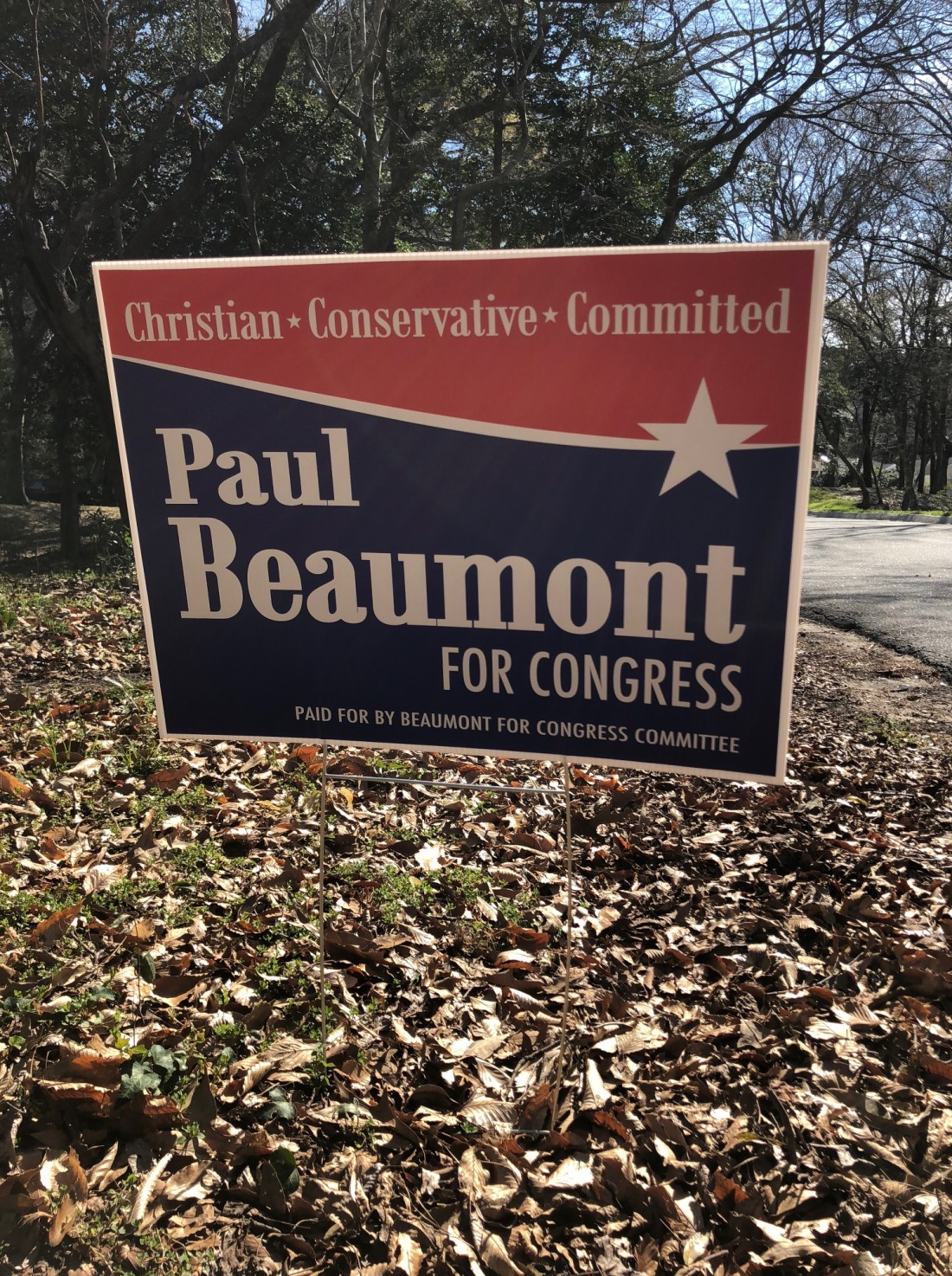
THE ROCKS HAVE TO GO: In its past two newsletters, the Town of Southern Shores has pointed out that yard signs may not be legally posted in the public right-of-way. In the spirit of enforcing the Town Code even-handedly, and without reference to a citizen’s message content, The Beacon would like to point out that obstructions like the large stones/rocks depicted in the above photo in the right-of-way in front of a house on Hillcrest Drive constitute public nuisances in violation of Town Code sec. 28-2. Obstructions “shall be removed immediately upon written notification from the town manager,” according to Code sec. 28-2(a), and are punishable by a $500/day fine.

The Southern Shores Town Council will hold two important public hearings at its monthly meeting tomorrow, each of which concerns a proposed zoning text amendment (ZTA) or amendments that will affect future real-estate development, principally on and near the oceanfront.

In assessing these zoning text amendments over the past two months, the Town Planning Board has engaged in what appear to be procedural irregularities that The Beacon believes the Town Council will have to sort out before it can reach their merits.

The Council will meet at 5:30 p.m. in the Pitts Center behind Town Hall.

Also scheduled on the Town Council’s agenda are a presentation by Willo Kelly, CEO of the Outer Banks Assn. of Realtors, on a possible increase in homeowner insurance rates, and the introduction of a new police officer, Patrol Officer Zach Eanes.

In new business, Town Manager Peter Rascoe will give an update on Juniper Trail capital improvements and recent damage repair, and Councilman Gary McDonald will talk about coyotes in Southern Shores.

PUBLIC HEARINGS  

The first public hearing will take up zoning text amendment 18-09, which is an effort by the Town Planning Board to create justifiable exceptions to the new nonconforming lots ordinance, Town Code sec. 36-132, that the Town Council enacted last September.

The second hearing will address ZTA 18-10, an amendment that came out of the Town Council’s Nov. 7, 2018 special meeting on large houses. It is an attempt to preserve low-density development in Southern Shores by creating a single-family oceanfront overlay residential district and then regulating development within that district by dimensional and other requirements.

ZTA 18-09 arrives at the Town Council in three different versions, the most recent of which Deputy Town Manager/Planning Director Wes Haskett offers—according to his staff report in the Council’s meeting packet—as the Planning Board-recommended final version, even though the Board has not yet seen or approved the ZTA’s actual language.

Mr. Haskett identifies the first draft of ZTA 18-09 as “Original ZTA 18-09.” He has labeled the second version, “Revised ZTA 18-09,” and the third version, “ZTA 18-09PB,” which was filed Jan. 25, after the Planning Board’s last meeting.

The Planning Board took up ZTA 18-09 on Dec. 17, but did not vote on it. Instead, it voted unanimously to amend ZTA 18-09 to allow for a further exception that would benefit Steven Love (and his wife, Katherine Gorman), who own a nonconforming lot at 64 Ocean Blvd. and whose attorney, Starkey Sharp, criticized the Board at the meeting for “exposing the Town to litigation and liability.” (See The Beacon, 12/20/18.)

When the Board took up the Revised ZTA 18-09 on Jan. 22, members did not believe that the ZTA gave Mr. Love the exception that they had sought for him in December. The Board, therefore, voted 4-1, upon motion by member Andy Ward and a second by Chairperson Elizabeth Morey, to approve ZTA 18-09, provided it included a to-be-written amendment that would give Mr. Love his exception.

Board member Joe McGraw, the newly elected vice-chairperson, dissented.

The Planning Board has not yet seen ZTA 18-09PB to know if it reads as requested.

The Planning Board also took up ZTA 18-10, the proposed oceanfront overlay district ordinance, at its Dec. 17 meeting, but it failed to act upon it, taking no vote. The measure, therefore, did not go to the Town Council in a timely fashion for a public hearing at the Council’s January meeting.

No Planning Board member supported ZTA 18-10 in December; and several spoke against it. Ms. Morey, who was elected Board chairperson on Jan. 22, described the overlay-district approach as “regulatory overreach” and said that it “will not necessarily arrive at the resolution that we want.”

The Board acted officially on ZTA 18-10 at its Jan. 22 meeting, recommending by a vote of 4-0 that it be denied. Although new Planning Board member Ed Lawler voted upon the nonconforming lots ZTA, he abstained from voting on ZTA 18-10, saying that he “recused” himself.

The Beacon would be very surprised if the Town Council did not follow the Board’s recommendation and defeat ZTA 18-10. Many options for preserving low-density development in Southern Shores’ residential districts, especially on the oceanfront, have been suggested since Nov. 7, and the Planning Board has made recommendations for preparing ZTAs that include some of them.

The big hearing tomorrow is expected to be about the nonconforming lots ZTA.

NONCONFORMING LOTS: COUNCILMAN NASON’S CONFLICT

On Sept. 5, 2018, the Town Council passed, by a 4-1 vote, with Councilman Christopher Nason dissenting, a ZTA (18-07) that replaced the existing ordinance on nonconforming lots, whose language the Town thought did not effectively prevent the sale and development of such lots. The original Code sec. 36-132 was enacted shortly after Southern Shores was incorporated in 1979.

ZTA 18-07 sought to clarify and expand upon the original sec. 36-132, in order to stop the recent trend in town of 100-foot-wide land parcels being divided, sold, and developed as 50-foot-wide lots. (See the development at 155 Ocean Blvd. as an example.) After it passed, the Town Council decided by consensus to return the ZTA to the Planning Board for what Mayor Tom Bennett called “refinements” and Councilman Jim Conners called “tweaking.” (See The Beacon, 9/6/18.)

The Town Council decided that certain property owners were unfairly harmed by ZTA 18-07, and that these “outliers,” as Mr. Conners referred to them, should be protected from its coverage through an exception. (The Beacon extensively covered ZTA 18-07 in multiple blogs in 2018.) One problem the Planning Board has faced since it received that directive is that new “outliers” have come to its attention. The latest ZTA draft by Town Attorney Ben Gallop posits the following exception:

A nonconforming lot (typically, a 50-foot-wide lot) that is located next to land that:

1)      is owned by the same owner;

2)      has an existing single-family dwelling on it, and

3)      is made up of either:

  1. i) no more than two nonconforming lots (such as two 50-foot-lots that have not been “combined”) OR
  2. ii) “a single conforming lot not adjacent to any other land under the same ownership that was created after January 1, 2015 due to a recombination of two (2) previously nonconforming lots”

does not need to be combined with the adjacent land.

The language I quoted is the Mr. Love exception, as amended with the Mr. Hurd exception (concerning a 90-foot-wide nonconforming lot on Sea Oats Trail), which came to light Jan. 22, after Revised ZTA 18-09 had been prepared. Mr. Gallop acknowledged at that meeting that the Jan. 1, 2015 date was “arbitrary.” It’s a cutoff date. (Planning Board meetings are not videotaped.)

The Beacon believes that, although the Planning Board has been and is well-intentioned, it has not responded very well to the Town Council’s directive about refining the new nonconforming lots ordinance. The sudden loss of its chairperson, Glenn Wyder, in November has left it without clear direction and guidance. At its Jan. 22 meeting, Mr. Ward understandably asked Mr. Haskett to give Board members “prompts” for when they need to take required action.

The Beacon also believes that in the process of “refining” Code sec. 36-132, the Planning Board has allowed its provisions to become more confusing. Rather than responding to individual property owners’ unique situations, and therefore being preferential in their “refinements,” The Beacon believes that Planning Board members should consider the underlying intent of the nonconforming lots ordinance and what is fundamentally fair.

The Beacon’s conclusion is that if, at any time, a property owner owns a vacant nonconforming lot next to vacant property that he or she owns, regardless of whether that adjacent property is conforming or not, all of the vacant property should be combined, as soon as the property owner proposes building on any part of it, so that the whole parcel is conforming.

I opposed the Mr. Love exception at the Jan. 22 Planning Board meeting because this is precisely what happened at Mr. Love’s nonconforming lot at 64 Ocean Blvd.—which he told the Board he purchased from SAGA on Jan. 22, 2016 (the date of the deed) in order to “save” Southern Shores from SAGA’s potential wedding-destination/event house.Never mind that the Town Council approved its maximum-house size restriction the evening of Jan. 22, 2016, by a 3-2 vote.

Mr. Love demolished a flattop at 62 Ocean Blvd., which is his adjacent land to the non-conforming lot, on Feb. 10, 2016. Town records show that his architect, Christopher Nason, of Beacon Architecture & Design, submitted his CAMA site plan for 62 Ocean Blvd. on Feb. 17, 2016. Until such time as builder Allan Hutton broke ground at 62 Ocean Blvd., Mr. Love’s properties were vacant and subject to proposed development.

I argued to the Planning Board that Mr. Love was compelled under the then-existing sec. 36-132 to combine all three of his vacant lots, but Mr. Gallop said I was wrong and declined to talk with me after the meeting about my argument. The Board also ignored my contentions.

I have no quarrel with Mr. Love. But I believe passionately in good government and fundamental fairness and would like to think that the Town Council will ensure both tomorrow night when it considers ZTA 18-09 and the “outliers” the Planning Board sought to protect. Laws are made for the many, not for the few.

It appears from site plans in Town permit files that Mr. Nason has been working on the 64 Ocean Blvd. project since early June 2018. There is no doubt that his building plans for the five-bedroom, 4500-square foot house on the 50-foot-wide lot have been on file for months. (I have not updated these numbers since Dec. 3, when my perusal of the permit files for Mr. Love’s properties led to my being implicated in the vandalism at 62 Ocean Blvd. by a high-level town employee.)

Councilman Nason is clearly Mr. Love’s architect and, as such, he clearly has a financial interest in the final action taken by the Town Council on any version of ZTA 18-09. If he is present at the meeting, he must recuse himself.

When I learned from one of Mr. Nason’s Town Council colleagues last week that Mr. Nason had told him he would not be attending tomorrow’s meeting, I tried to confirm this with Mr. Nason. He refused to answer an email I sent him or a telephone message I left, and when I talked with him at the Town Code public forum on Jan. 31, he said, “I’m not going to comment to the press.”

Pointing out that I was also a town resident, and that he has an ethical obligation to respond promptly to town residents’ concerns, he replied: “You’ll find out when you arrive at the meeting.”

And so we will.

The Beacon reserves for another day a commentary about the public’s right to know and an elected official’s obligation to serve the public interest and respond to the press.

I’ll conclude with The Washington Post’s new slogan, which some of you may have seen for the first time in a Super Bowl ad that the newspaper sponsored: “Democracy dies in darkness.”

Ann G. Sjoerdsma, 2/4/19

2/1/19: TOWN COMMITTEE TRIES TO FAST-TRACK WIDENING OF SOUTH DOGWOOD TRAIL BY UP TO 7 FEET IN SPOTS; DISREGARDS INFRASTRUCTURE PRIORITY LIST; ALSO Notes on the Town Code Rewrite, Feb. 5 Town Council Meeting; The Beacon Seeks Assistance

dogwoodtrail.jpg
This is a view looking north on South Dogwood Trail between Wild Swan and Osprey lanes. If the road-widening and sidewalk-construction plans presented Wednesday to the CIIP Committee by the Town Engineers, and supported by the Mayor and Councilman Conners, are put into effect, all of the trees visible on the right side of this photograph would be destroyed.

Town Engineers Joe Anlauf and Andy Deel, of Deel Engineering PLLC, presented Wednesday to the Town Capital Infrastructure Improvement Planning (CIIP) Committee designs and cost estimates for proposed “capital improvements” on South Dogwood Trail that include a widening of the street to 24 feet, according to Town Manager Peter Rascoe’s minutes of the meeting.

The Town Engineers’ briefing numbers suggest a cost estimate for widening the road of up to $3 million. An additional $1 million-plus would be spent to build sidewalks along the road. [PLEASE NOTE: As of this writing, the design plans for the road-widening project are not on the Town of Southern Shores website.]

Mr. Anlauf also conservatively estimated that from 105 and 129 tree would have to be destroyed in order to widen the road. The reality is likely to be far more removals. How many, The Beacon wonders, would be signature dogwoods?

Mr. Anlauf calculated that 12 trees would have to be removed to build a sidewalk from the North-South-East Dogwood Trails intersection south to Fairway Drive, but he did not hazard to guess how many would have to be destroyed from Fairway Drive south to the Southern Shores Cemetery. The terrain from Fairway Drive to the cemetery is hilly, densely populated with trees, and more irregular.

See the minutes at: https://www.southernshores-nc.gov/wp-content/uploads/2019/02/CIIP-Jan-30-2019-Meeting-Minutes.pdf.

Currently, according to a CIIP Committee member who asked to remain anonymous, sections of South Dogwood Trail measure from 17 to 19 feet in width. Widening the street to 24 feet, or to 20 feet, which the minutes show was also discussed at the Jan. 30 CIIP committee meeting, means an encroachment in the public right-of-way of up to seven feet.

Although the CIIP Committee has previously discussed construction of a 5-foot-wide sidewalk on the east side of South Dogwood Trail, starting at the North-South-East Dogwood Trails intersection and continuing south to the cemetery, it has not explored widening the street in such detail before. The Town Manager’s minutes show that the engineers presented designs for 1) just the sidewalk, and 2) for the sidewalk and the street widening.

Southern Shores property owners have never supported widening South Dogwood Trail. In even considering such a project, the CIIP Committee disregards the FY 2018-19 Capital Infrastructure Improvement Plan and its priority-ranking of road projects that the Town Council unanimously passed last July. The committee substitutes its own judgment for that of the Town Council, which approved the infrastructure plan and recommended road projects, in the form of Ordinance #2018-07-01, after a public hearing was held.

Enacted by the Town Council July 10, 2018, Ordinance #2018-07-01 adopts by reference a priority list of road projects that the CIIP Committee itself ranked in April 2018 in groups from A to C, with C being the lowest priority.

Since this approval and adoption, however, the CIIP Committee has disregarded most of the Group B priority projects in order to focus on the Dogwood Trails. South Dogwood Trail is ranked no. 13 on the priority list, the first project in Group C.

Some of the projects that the committee ignores in leapfrogging over Group B to Group C include improvements to Clamshell Trail, Ginguite Trail, Sea Oats Trail, Bayberry Trail, West Holly Trail, and Wax Myrtle Trail and other beach and dune roads. You may find the listing, designated “Attachment A,” in the minutes for the July 10, 2018 meeting.

The South and East Dogwood Trails Task Force, a citizen group convened to study the addition of walkways along East and South Dogwood Trails, specifically recommended in its Jan. 27, 2017 final report that the Town “continue its policy of not widening roads unless emergency vehicles cannot gain access to their desired location.” (p. 4)

The Task Force, which was chaired by Michael Fletcher and consisted of a cross-section of resident homeowners and “stakeholders,” including now-Town Councilman and CIIP Committee Co-Chairperson Jim Conners, also recommended that the walkway along South Dogwood Trail should:

*be designed to contain the elements of a greenway;

*be separated from the road by a green space three feet to six feet wide;

*meander among the trees thereby limiting the number of trees to be removed; and

*follow the grade of the land, where feasible. (p. 7)

In elaborating upon the issue of rebuilding roads, the Dogwoods Task Force noted that a majority of the Town residents who responded to its public survey (431 responses were received) “enjoy the character of” the Dogwood Trails, and the “sections . . . that are enjoyed the most are the relatively narrow, winding roads with overhanging trees. It reminds people of a small town setting and not a suburban setting with wider and straighter streets.” (p. 3)

Councilman Conners chairs the CIIP Committee with Mayor Tom Bennett. The Mayor made these appointments, absent a vote by the Town Council.

Despite a lack of public support for widening South Dogwood Trail, as documented by the task force’s survey, and despite Ordinance #2018-07-01, Co-Chairperson Conners made a motion Wednesday to “transmit” to the Town Council “an affirmation” of the engineers’ design for a 24-foot-wide street, according to the minutes.

Fortunately, this motion was tabled for a month in order to allow CIIP Committee members, three of whom were not present, to walk the roadway and evaluate the engineers’ plans.

The month delay also will give Town property owners, especially those who live on South Dogwood Trail, the time they need and deserve to make their own evaluations and to communicate with the CIIP Committee and the Town Council. The CIIP’s next meeting will be Thursday, March 7, at 2 p.m., in the Pitts Center.

The Beacon was unable to cover the Wednesday committee meeting firsthand because its correspondent was called away at the last minute.

The design work for the proposed South Dogwood Trail sidewalk calls for construction in two segments, as referenced above: Segment 1) from the North-South-East Dogwoods intersection south to Fairway Drive, and segment 2) from Fairway Drive south to the cemetery.

PLEASE NOTE: The design plans for the sidewalk construction that are available online do not include widening of South Dogwood Trail. 

You will find the preliminary designs for the first segment, updated just yesterday, here:

https://www.southernshores-nc.gov/south-dogwood-trail-walking-trail-preliminary-plan-design/.

The latest designs for the second segment date to March 28, 2018 and may be accessed here: https://www.southernshores-nc.gov/3-28-18-south-dogwood-trail-walking-trail-preliminary-plandesign-segment-1-fairway-dr-cemetery/.

You also may view these plans in hard-copy form in the Town Hall conference room. If the sidewalk construction moves ahead, the committee intends to begin with an initial section from the Dogwoods intersection to Sassafras Lane.

(The Beacon prefers to refer to the proposed walkways as sidewalks, instead of walking trails, the term used by the Town, because they will be made of concrete, not a natural material commonly used for trails. They will look like the sidewalk running along the south side of East Dogwood Trail.

(The Beacon also questions why they must be 5-feet-wide, instead of 3-½ feet-wide, like the much more attractive, earth-tone sidewalks in Chicahauk, which blend in better with the environment.)

Co-Chairpersons Bennett and Conners are joined by five other committee members: Jim Kranda, who was appointed by former Town Councilman Leo Holland; Carlos Gomez, appointed by Councilman Gary McDonald; Al Ewerling, appointed by Councilman Fred Newberry; Andy McConaughy, appointed by Councilman Christopher Nason; and Glenn Riggin, whom the Mayor appointed.

That Mr. Conners, the Council member with the least seniority, is a co-chairperson of this highly important committee, while Councilmen Nason, Newberry, and McDonald have no committee assignments—Mr. Nason serves on the Dare County Tourist Bureau—strikes The Beacon as improper and prejudicial. Inasmuch as Mr. Conners routinely votes with Mayor Bennett on Town Council matters, his selection also limits the diversity of viewpoints expressed in the committee, to the detriment of the public, The Beacon believes.

It also seems improper and biased to The Beacon to permit Mayor Bennett to name a member to the committee—essentially, doubling his vote—and to permit Mr. Holland’s appointment to continue now that Mr. Holland is no longer on the Town Council. A committee of five people is more than sufficient to do the CIIP’s business. The Beacon believes the committee should be revamped.

MUCH AFOOT IN SOUTHERN SHORES: TOWN CODE REWRITE

In addition to this sudden committee move toward widening South Dogwood Trail, The Beacon is tasked with reporting on the draft proposal of the new Town Code of Ordinances, and the agenda for the Feb. 5 Town Council meeting, which includes important public hearings on zoning-text amendments that seek to control high-occupancy dwellings and limit development on nonconforming lots.

Here are links to the agenda and meeting packet for the Feb. 5 meeting:

Agenda: https://www.southernshores-nc.gov/wp-content/uploads/minutes-agendas-newsletters/Agendas_2019-02-05.pdf.

Meeting packet: https://www.southernshores-nc.gov/wp-content/uploads/minutes-agendas-newsletters/Meeting-Packet_2019-02-05.pdf

The Beacon will brief you soon on the zoning-text amendments, especially the one that seeks to except specific 50-foot-wide lots from the scope of the new nonconforming-lots ordinance, which is codified at Town Code sec. 36-132. (You’ll find an update of the ordinance in the draft Town Code, but not in the Code section that is currently online.)

As for the proposed Town Code, The Beacon is of the mind that the draft needs further review and is seeking citizen volunteers to assist in that effort. If you are interested in being a reader/monitor/editor, please write to The Beacon at ssbeaconeditor@gmail.com.

At the public forum last night, consultant Chad Meadows, of CodeWright Planners LLC., advised that Town Attorney Ben Gallop will review the draft this month and the Town Planning Board will consider it in March and April, with an eye toward recommending those chapters that Mr. Meadows said the Board is required by North Carolina law to recommend. They include chapters 22 (zoning); 26 (subdivisions); 28 (flood damage prevention); and parts of chapters two (administration) and four (definitions).

No members of the Town Planning Board attended the public forum. Deputy Town Manager/Planning Director Wes Haskett was there, however, as were Mr. Rascoe, Mr. Gallop, Mayor Bennett, and all other members of the Town Council.

Mr. Meadows, who is a professional planner, not an attorney, authored the draft. The Beacon was not keen on hearing him refer to the Town Code last night as a “development code,” instead of uniformly as a code of ordinances. Ordinances are regulations, statutes, laws. Mr. Meadows has rewritten many of Southern Shores’ laws.

Perhaps the consultant has improved on them; perhaps he has not. Sections of the ordinances pertaining to lighting, street parking, and noise that were read aloud by property owners at last night’s meeting left little doubt that they needed substantial change. Indeed, Mr. Meadows himself referred to the language of the noise ordinance as “loosey-goosey.”

The Beacon believes it behooves property owners to find out how and where the Town Code has changed, especially for the worse, and to report their findings to the Town Council, whose members are not going to pore through the draft’s 381 pages. This requires an organized effort. If you would like to participate, please contact The Beacon.

AND FINALLY, CIRCLE THE DATE: The Town Council will hold a planning session on Tues., Feb. 26, at 9 a.m., in the Pitts Center.   

Ann G. Sjoerdsma, 2/1/19

1/30/19: PUBLIC FORUM TOMORROW: THE PROPOSED TOWN CODE REWRITE: Big, Bloated, and Not User-Friendly; The Beacon Recommends Further Independent Review

code

During an interview that The Beacon had last June with then-Town Planning Board member Elizabeth Morey, she said that she thought Town Code update/rewrite consultant, Chad Meadows, had submitted an “unacceptable work-product.”

And she told me I could quote her on that.

Until today, I have had no reason to quote Ms. Morey, who, as of Jan. 22, is the chairperson of the Planning Board. Today, however, I have attempted to access Mr. Meadows’s December 2018 “public hearing draft” of the proposed new Southern Shores Town Code of Ordinances, and I could not help but recall Ms. Morey’s assessment.

This 381-page document is big and bloated and, despite Mr. Meadows’s express goal of making the Town Code more “user-friendly,” it is decidedly unfriendly. (In my opinion.)

Mr. Meadows, who is owner of CodeWright Planners, LLC, of Durham, will be presenting the draft Town Code at a public forum tomorrow, 5:30 p.m. to 7 p.m., in the Pitts Center. (See The Beacon, 1/28/19.)

The new Town Code does not make a good first impression.

I am not a fan of its page layout—the font size, “navigational aids,” heading text, etc., that Mr. Meadows refers to as “technical changes” and justifies as “modern.” I think they, as well as illustrations and graphics (for example, flow charts, summary tables), just get in the way of important business. They make the Town Code of Ordinances appear busy, distracting, and even frivolous. I prefer well-chosen words.

Style aside, however, The Beacon believes that, at the least, Mr. Meadows should prepare a summary of all of the substantive changes that he integrated into the current Town Code. What key regulations, or sections thereof, were deleted, revised, added?

Mr. Meadows knows the issues of most concern to property owners, who are the ultimate “stakeholders” in this project. He should address them directly.

As the draft is now, you have to go painstakingly through it, finding the new number for the chapter you’re interested in and then perusing a lot of verbiage, much of it unnecessary, to find what you’re looking for.

While doing such perusing today, my thought was one that Ms. Morey expressed more than six months ago: “The consultant needs to do a better job.”

MORE THAN THREE YEARS

Mr. Meadows started the “Town Code Update Project” in September 2015, over the protests of many resident homeowners, 44 of whom signed and submitted a letter to the Mayor and Town Council on Jan. 4, 2016, asking that they suspend the consultant’s authority immediately. (I was one of the signees.)

“Contrary to repeated representations by TOSS [the Town of Southern Shores], including in its Dec. 22, 2015 holiday newsletter,” the homeowners wrote, “the project team will not be merely ‘correcting conflicting and ambiguous language in the Code, addressing recent changes in state and federal laws, and reorganiz[ing[ some sections to make the Code more user-friendly and easier to understand.’ Rather, it will be substantively assessing—and, to a great extent, already has assessed—the Town Code for the purpose of drafting new building and other laws to propose to TOSS for codification.”

There is little doubt that the December draft goes far beyond the Code cleanup that Town Manager Peter Rascoe described in FY 2015-16 budget hearings: Mr. Meadows did not just edit for consistency, clarity, and conformity with state and federal law. His Code rewrite is essentially a new planning document for Southern Shores.

The Planning Board began its review of Mr. Meadows’s work, which was organized into several “modules,” in April 2017. Current regular members Joe McGraw and David Neal were on the Board then, but Mr. McGraw, who is vice-chairperson, was an alternate until September 2017, when he was appointed to a regular, full-voting seat. Sam Williams was the chairperson.

The Town Council “dumped the Code rewrite on us,” Ms. Morey told The Beacon on June 29, 2018, “and it doubled or tripled our workload.”

The Board’s review, she continued, “was made more difficult by how the consultant presented the Code. . . . It was extremely difficult to determine what was old and what was new.” Such difficulty should have been corrected by the consultant.

Although the December 2018 draft does not look the same as the Code rewrite version that the Planning Board spent months reviewing, it still suffers in the presentation. The public, the Planning Board, and the Town Council still cannot readily distinguish old from new, not without great commitment of time and task.

Before a final draft reaches the Town Council, the Planning Board, whose membership now includes Andy Ward and Ed Lawler, must consider it for recommendation. The Beacon strongly encourages the new Board to take a fresh look and to hold Mr. Meadows accountable for an easy-to-read written summary of changes. No public official should be recommending or approving a code of ordinances just to move it along.

Fundamentally, The Beacon finds that the revised page layout, the new graphics and illustrations, and, most of all, the excess verbiage (such as the proposed “Purpose and Intent” sections, but also the language of the regulations themselves) just obscure the core substantive content, and in a code of ordinances, content—the regulations governing the Town of Southern Shores—is everything.

This draft cries out for another independent review—of the zoning chapter and any other important regulations identified by the public and the Planning Board.

‘CODE ASSESSMENT’

A final note for those of you who are inclined to plunge into the December draft: You’ll find before the Code a section titled “Guidance from Code Assessment.”

“Code Assessment” refers to a document prepared by Mr. Meadows in October 2016 that purportedly summarized the “input” he received from the Town Council—Mr. Meadows interviewed members of the 2011-15 Council, all three of whom were defeated for reelection in November 2015; the Planning Board; the Town Manager and other Town staff; and about 900 respondents to a public survey, which was controversial for alleged bias in the framing of questions.

You may access this more than two-year-old document here: https://www.southernshores-nc.gov/wp-content/uploads/2015/10/TOSS-Code-Assessment-Final-10-3-16.pdf. The December draft does not include updates since October 2016.

Each chapter in the draft also has a blue-highlighted section titled “Guidance from Code Assessment,” which refers to this document and will not be a part of the finalized Town Code. None of the blue-highlighted language in footers throughout the draft will be part of the final draft, either. That this language is included in the draft just makes processing it all that more tedious. Perhaps the Planning Board, which presumably did such processing, could release a report on how it tackled it.

The Town Code Update Project has taken far longer than anyone anticipated. The Beacon trusts that Town officials will take even longer to ensure that they know and approve all significant changes within the proposed draft and communicate them to Southern Shores property owners.

Ann G. Sjoerdsma, 1/30/19

1/29/19: WHAT DEFINES A ‘MINI-HOTEL’?: 12 BEDROOM ‘SUITES’; ELEVATOR FROM PARKING GARAGE; LARGE REC./GAMES ROOM; A ‘KIDDIE’ POOL; SPA; LOTS OF BARS: What the building plans for 98 Ocean Blvd. reveal

98sunday
The ‘mini-hotel’ being constructed at 98 Ocean Blvd.

The Beacon has referred to the structures being built by SAGA Construction & Development at 98 and 134 Ocean Blvd. as “mini-hotels” not just because of the large number of people they can accommodate, but because of their design.

Many design features in these structures, which are substantially similar, are common to hotels: for example, large areas for dozens of people to congregate; bedrooms with private bathrooms, each located next to another one on the sides of the building; and amenities not seen in single-family homes.

The Beacon recently reviewed again the building plans for 98 Ocean Blvd., which are on file in the Town Planning and Code Enforcement Dept. The plans, dated Oct. 20, 2019, were submitted by Community Planning and Architectural Associates (“cpaa”) of Kitty Hawk. Its mailing address is 6445 N. Croatan Hwy., suite A, which is an office building near the entrance to Martin’s Point.

Cpaa not only doesn’t have a website, it has no footprint on the Internet. You can’t find out anything about it. You also can’t find a roadside sign or a firm-name plaque at its office location, if you visit there and pop into the suite, as I did today.

Each of the 12 bedrooms in cpaa’s “mini-hotel” structure has its own private bathroom and is designated on the building plans as a “suite.” The dimensions for each bedroom, exclusive of the bath area, and with only minor variations here and there, are 13-feet-8 ½-inches (length) by 11-feet-5 inches (width). (These are the only dimensions that The Beacon could discern from the plans, but estimates are possible based on known entire-floor square footage.)

The “suites” are located on the first and second floors of the dwelling, configured so that they are located on either the north side or the south side of the floors, suggesting a hotel layout. The Beacon wonders: Will each “suite” have a number on its door, too?

The first floor has seven bedroom suites, three of them on the north side, where a 14-person theater lounge with a 120-inch screen, is also located; and four of them on the south side. Most of the square footage of the first floor is taken up by a large combination games/recreation room and a full-size bar, similar to a bar you would see in a hotel lounge. (The Beacon wonders: Who’s going to be serving the drinks?)

There is also a “lavatory” that can be accessed from the games/recreation room by patrons, similar to a restroom in a hotel.

The remaining five suites are on the second floor, three of them on the north side, and two on the south side. An oversized kitchen is also off to the south side. Similar to the first floor, most of the square footage on this floor is consumed by a very large open area outside of the kitchen that is designated on the building plans according to spaces: They include a “gathering place,” an “ocean room,” with a fireplace and a television above it, and a dining area.

The enclosed area on the second floor is 2,958 square feet. If you do the math with the known square footage of the five bedrooms, you’re looking at roughly 2,000 square feet for the kitchen and the open gathering-place-ocean room-dining area. The first floor has an enclosed area of 2,958 square feet.

The distance of the kitchen to the dining area, as well as the location and size of the kitchen, suggest that meals will be catered. The Beacon doesn’t know many cooks who would want to transport food through the “gathering place” to the dining space.

A covered screen porch off of the second floor, on the east side, offers ocean views. Lest one become desirous of a cocktail, a bar area is conveniently located within the porch. Again, The Beacon wonders, who’s going to be serving at this bar? And who’s supplying the booze?

An elevator on the ground floor of the structure-in-progress at 98 Ocean Blvd. carries people up from the six-vehicle parking garage underneath it and from the 11-vehicle parking lot in the front yard. There is also “recreational” space under the dwelling.

Also suggestive of a hotel are the outdoors amenities, which include a six-seater tiki bar (do bartenders come with the structure?), a hot tub/spa, and two swimming pools, one of which is a kiddie pool. The kiddie pool has a “tanning ledge,” and the adult pool has—you guessed it—a swim-up bar with what appear on the building plans to be four seats.

The pièce de resistance of the 12-bedroom dwelling is the “interior garden” that begins on the ground floor and is “open” to the sky. It is rare to find a single-family home with an atrium. Atria are fairly common in hotels, however.

If you would like to display a sign in your yard that expresses your opposition to mini-hotels such as the ones being constructed at 98 and 134 Ocean Blvd., you may request one through nominihotels.com. The petitioners in the litigation contesting the validity of the CAMA permits issued to SAGA to build on the two Ocean Boulevard sites would welcome your support. Their legal argument, which is scheduled to be heard before an administrative law judge in April, is that the permits are inconsistent with the town’s land-use plan, which was adopted in 2012.

With this litigation pending, SAGA is building “at its own risk,” and has been so warned in writing by the Town. Agents of SAGA for both sites have signed the Town’s warning statements, indicating their acknowledgment.

Every sign posted in a yard is evidence of the community-wide opposition that exists to SAGA’s structures. The litigation is not just about the interests of the two petitioner-homeowners. It’s about preservation of the town’s low-density development and residential-district zoning, which has always been exclusive to single-family houses.

According to Ursula Bateman, one of the yard-sign organizers, every sign posted in the town is there at the request of the property owner.

To contribute financially to the petitioners’ case, see https://www.gofundme.com/no-minihotels-in-southern-shores.

NEVER ON SUNDAY: Southern Shores police officers have officially warned SAGA’s construction crews at both 98 and 134 Ocean Blvd. not to work on Sunday, in violation of the Town’s noise ordinance. Police officers went to the sites recently upon receiving complaints from two different town residents.

The Beacon received notification of the noise-ordinance violations from the homeowners who reported them. Although they gave their names to Dare Central, they would prefer to remain anonymous, and The Beacon sees no public-information value in identifying them.

A Southern Shores police officer who responded to one of the reports told The Beacon that, upon a first report, the police issue a warning to violators of the town noise ordinance. Thereafter, the police will issue a citation for a violation, which carries a penalty of $500.

Sec. 22-3(b)(15) of the Southern Shores Town Code, which is a subsection of the noise ordinance, expressly states that construction work shall occur only between the hours of 7 a.m. and 8 p.m. on weekdays and Saturdays—no Sundays—unless a public emergency exists and the town permit officer issues a special permit.

Although The Beacon reported to the Town Planning Director in December that SAGA was working on Sunday at 98 Ocean Blvd., this report did not result in SAGA ceasing this practice. For that to happen, apparently, the police had to intervene.

If you observe any construction work occurring on Sunday in Southern Shores, The Beacon advises you to call the Dare Central non-emergency number, (252) 473-3444, and report it to the police.

(I apologize to all followers of this blog who received two notices of today’s post. I ran into technical difficulties and had to delete the first post and re-post it. I regret the inconvenience.)

Ann G. Sjoerdsma, 1/29/19

1/28/19: CIRCLE THE DATE: PUBLIC FORUM ON TOWN CODE REVISION SET FOR THIS THURSDAY, 5:30-7 P.M., IN PITTS CENTER; Code Rewrite More Than Three Years in the Making

98sunday.jpg
What defines a ‘mini-hotel’? The Beacon will answer that question in a posting tomorrow. Pictured above is the ‘mini-hotel’ being built at 98 Ocean Blvd. Photo date: Jan. 27, 2019

Consultant Chad Meadows, owner of CodeWright Planners, LLC, of Durham, will present his draft of the proposed new Southern Shores Town Code of Ordinances and respond to property owners’ comments, questions, and concerns in a public forum Thursday, Jan. 31, from 5:30 p.m. to 7 p.m., in the Pitts Center.

Mr. Meadows’s draft, which runs 381 pages, is the culmination of more than three years of effort, which included stakeholder interviews, a public survey, and painstaking scrutiny by the Town Planning Board. After the public forum, the draft will be finalized and returned to the Planning Board for its “required recommendation,” according to the Town of Southern Shores website. The final proposal then will be sent to the Town Council for its action.

You may access the draft proposed Town Code here:

https://www.southernshores-nc.gov/wp-content/uploads/2018/12/TOSS-Town-Code-12-31-18.pdf.

The Beacon encourages all property owners to peruse chapter 22 of the draft code, which is the new zoning chapter. The public survey conducted by CodeWright before its preparation of the draft code targeted zoning in residential districts and revealed strong sentiment by property owners on a number of zoning issues.

The Beacon will do a fast study of the draft and try to publish a report/analysis later in the week or at least flag some highlights.

It is unfortunate that this long-delayed draft is coming to the Planning Board and the Town Council for finalization at the same time that members of both bodies are deliberating upon important changes in the town zoning law to prevent high-occupancy houses from being constructed and to fine-tune the nonconforming lots ordinance that was passed last September.

A further delay of the proposed new Town Code of Ordinances, which merits careful review by town officials, would seem to be advisable. At the least, Town Council members should ensure that they have the time they need to give the proposed new code a thorough and thoughtful analysis.

Ann G. Sjoerdsma, 1/28/19

1/23/19: A WORK IN PROGRESS: PLANNING BOARD ELECTS MOREY CHAIR, MCGRAW, VICE-CHAIR; ACTION ON EXTENSION OF CELL TOWER POSTPONED; MOTIONS & THOUGHTS

celltower
Another 10 feet?

Planning Board Vice-Chairperson Elizabeth Morey was elected chairperson, and member Joe McGraw was elected vice-chairperson at last night’s Planning Board meeting. Both votes were unanimous.

The positions are for the current fiscal year, which ends June 30, 2019.

Ms. Morey, a self-employed political consultant, has been acting chairperson since Glenn Wyder’s death in November. In an interview last year with The Beacon, Ms. Morey said she served two years as a Planning Board alternate before being appointed a full member of the Board. Her current three-year term expires June 30.

Mr. McGraw, who owns Albemarle Contractors with his wife Lori, was serving as a Planning Board alternate when the Town Council appointed him in September 2017 to complete the unexpired term of regular member Gray Berryman, who resigned. Mr. McGraw’s term also expires June 30.

All Planning Board appointments are made by a majority vote of the Town Council.

In other business last night, Deputy Town Manager/Planning Director Wes Haskett reported that American Towers LLC/Verizon Wireless had asked that their application to amend an existing Conditional Use Permit in order to extend the height of the cell tower at 148A Ocean Blvd. be tabled until February or March.

According to a letter from an attorney included with the application, American Tower seeks to extend its “Monopole Facility,” which is located in the SSCA’s Triangle Park at the Ocean Blvd./Duck Road split (see photo above), by 10 feet, bringing it to 150 feet, its “final height.” (See The Beacon, 1/21/19.)

The extension would accommodate Verizon Wireless, which is not now on the tower, and expand AT&T’s cellular capacity, improving “network connectivity in the area.”

The Planning Board accepted a tabling of the application “until further notice.”

A WORK IN PROGRESS

I am going to do something unusual in regard to the remainder of the business taken up, and the public comments heard, last night by the Planning Board, and that is not to report on them, except in a broad fashion.  I also will editorialize.

I found much of the substance discussed by the Board last night to be confusing and the over-all process of the meeting to be disruptive. There were quite a few breaches in the order of the proceedings.

I will tell you what the Planning Board did. But rather than explain the actions it approved in any detail, I am going to wait until I see them in writing.

The Planning Board definitely recommended, with amendment, a version of Zoning Text Amendment 18-09, which seeks to except certain property owners’ circumstances from the nonconforming lots ordinance that the Town Council enacted in September. The Board refers to the property owners whom it is trying to shield from the operation of the new ordinance, which rewrote sec. 36-132 of the Town Code, as “outliers.”

A homeowner with an outlier case that the Planning Board had not previously considered spoke during the public-comment period last night. His case drew a sympathetic response from the Board, but it was unclear to me how the Board plans to address it. (The Beacon recalls that Town Councilman Jim Conners tried to bring up this homeowner’s case in a Planning Board meeting chaired by Mr. Wyder and was prevented from doing so. That was unfortunate.)

A public hearing on ZTA 18-09 is scheduled Feb. 5 before the Town Council. I will report on that version of the proposed Code amendment when I am confident it is in final form. The version of the ZTA that is currently online under the Town website notice of the Feb. 5 Town Council meeting is not the one that the Planning Board discussed last night. (See https://www.southernshores-nc.gov/public-notice-two-public-hearings-february-5-2019.)

The legal language of the ZTA is complicated and confusing.

In my opinion, Planning Board member David Neal hit the nail on the head when he said: “We’re trying to stop the cutting up of 100-foot-wide lots into 50-foot-wide lots on the oceanfront and elsewhere.”

There was definitely a sense of frustration last night that this has not been achieved—but not for a lack of trying. Perhaps Town Attorney Ben Gallop, who is creative, can come up with a fresh approach or a fresh perspective. The Board expressed a need for his guidance.

Board member Andy Ward made two motions that amended motions passed by majority vote on Jan. 7, in regard to controlling high-occupancy (“large”) dwellings and population density in Southern Shores. Through these motions, both of which were approved, the concept of using septic capacity as an occupancy control was resurrected, and the movement to limit maximum house size to 5,000 square feet was defeated.

(Note: I think both the septic-capacity limit and the reduction in the maximum house size are options that the Town Council should consider. I have been a proponent in previous Planning Board meetings of the former.)

The vote on including septic capacity in a ZTA, along with the high-occupancy use concept previously approved by majority vote, was approved unanimously. The vote on maintaining the 6,000-square-foot maximum house limit was 3-2, with new Board member Ed Lawler, who did not attend the Jan. 7 Board meeting, being the swing vote.

Mr. Gallop advised the Planning Board that he would integrate these decisions into the zoning text amendments that he was directed to prepare Jan. 7. I will report on those ZTAs when I see them.

The Board also formally voted 4-0, with Mr. Lawler recusing himself, not to recommend ZTA 18-10, which creates an ocean overlay district and regulations within that district. This is the ZTA that came out of the Town Council’s Nov. 7 special meeting on large houses. A public hearing on ZTA 18-10 is also scheduled before the Town Council on Feb. 5.

INTEGRITY OF THE PROCESS

For the newly constituted Planning Board to be successful, the process by which it operates publicly must be fair, open, respectful, and disciplined. I strongly believe that integrity in the process—which is a democratic process—is far more important than the ends achieved.

There must be meeting rules, and they have to be enforced. Members of the public should not be permitted to interrupt people while they are giving public comments, nor should they be permitted to speak from their seats in the audience.

When speaking from the lectern, all members of the public should begin by giving their names and addresses, as they are asked to do. If there is going to be a three-minute rule in effect for public comments, then it should be applied consistently to everyone who speaks—and speakers should be informed that it is in effect.

New Chairperson Elizabeth Morey may wish to consider a sign-up sheet for public comments. That would end the practice of allowing people to speak emotionally in reaction to what they have just heard someone else say in public comment.

Planning Board members also must be prepared to participate meaningfully in the weighty matters before them and to listen to each other and to the public with the goals of mutual understanding and cooperation.  The Beacon believes the Board is a team, as well as a group of individuals with varying personalities and styles.

There will inevitably be differences of opinion and/or interpretation, but they do not preclude respectful discussion. Rarely is there a right or a wrong in a given situation.

I will conclude with a sentiment expressed by new Vice-Chairperson Joe McGraw, who said: “We’ve been good stewards of Southern Shores. I love Southern Shores.”

The Beacon believes that the concept of stewardship is an excellent one to apply to service on the Planning Board. The Beacon loves Southern Shores, too.

Ann G. Sjoerdsma, 1/23/19

1/21/19: PLANNING BOARD MEETS TOMORROW TO DISCUSS EXCEPTIONS TO NONCONFORMING LOTS ORDINANCE, CONTROLS ON HIGH-OCCUPANCY DWELLINGS; ELECT NEW OFFICERS; & CONSIDER EXTENSION OF CELL TOWER


The Town Planning Board will continue its important deliberations about how to regulate occupancy in residential dwellings in order to preserve Southern Shores’ low-density character at its monthly meeting tomorrow at 5:30 p.m. in the Pitts Center.

The Board also will look at proposed exceptions to the town’s new nonconforming-lots ordinance (Town Code sec. 36-132), which the Town Council passed last September, and consider permitting a 10-foot extension to the cell tower at 148A Ocean Blvd., in what property owner Southern Shores Civic Assn. calls Triangle Park.

Before the Board takes up any of this business, however, it will elect new officers for the remaining fiscal year and approve its 2019 meeting schedule.

Vice-Chairperson Elizabeth Morey has been acting Planning Board chairperson since Glenn Wyder’s death in November. With the Town Council’s Jan. 8 appointment of Ed Lawler to serve out Mr. Wyder’s unexpired three-year term, the Board now has a full complement of five regular voting members. They will elect a new chairperson tomorrow night, and, if necessary, a new vice-chairperson.

The Beacon has written extensively about the Planning Board’s discussions regarding available options to control occupancy in single-family homes, in light of SAGA’s proposed 12-bedroom, 12-bathroom, hotel-like structures on the oceanfront and the Town’s inability to limit the number of bedrooms in houses, as well as about refinements to the new nonconforming lots regulation. We will not say anything more here about either subject, but just report on new developments that arise in tomorrow’s meeting.

On 10/10/18, The Beacon reported on American Tower Corp.’s plan to extend the cell tower at the Duck Road/Ocean Blvd. split, in order to accommodate Verizon Wireless, which is not now on the tower, and to expand AT&T’s cellular capacity.

American Tower representative Mark Landers told the SSCA at its October membership meeting that the extension, which he said then would be 20 feet, not 10, would be done to “accommodate” the explosion in cell-phone traffic. Mr. Landers explained that too many people are trying to use the network at the same time, causing disruptions and deficiency in service.

The current “straight pole-like structure,” which American Tower calls its “Monopole Facility,” “will look exactly the same on the outside” as it does now, Mr. Landers said, just taller.

In order for the extension to be allowed, an amendment to American Tower’s existing Conditional Use Permit from the Town must be approved. In a letter accompanying its application for the amendment, an attorney for American Tower writes that the additional 10 feet will bring the height of the Monopole Facility to 150 feet, its “final height.”

This increase, according to attorney David G. Allen, will enable Verizon Wireless to install its equipment “in order to alleviate current reductions and bottlenecks in network connectivity in the area.”

The Planning Board will hear tomorrow from American Towers/Verizon Wireless about the 10-foot extension and then vote on whether to recommend a CUP amendment to the Town Council.

See https://www.southernshores-nc.gov/wp-content/uploads/2019/01/CUP-Amendment-Application_Site-282219.pdf.

Mr. Landers told the SSCA last fall that the expansion would take about five months to complete and would bring in $5400 more in annual rent for the SSCA, making the association’s total income from the tower just under $40,000. These are strictly tentative figures. (Mr. Landers also told the SSCA that a 20-foot extension was needed to bring the tower up to 130 feet.)

PLEASE TAKE NOTE: There are two public-comment periods scheduled during the Planning Board meeting. If you have news or an opinion that you’d like to share with the Board, this would be a good time to do so.

Ann G. Sjoerdsma, Jan. 21, 2019

1/20/19: IN WARNING ABOUT YARD SIGNS IN NEWSLETTER, TOWN SHOWS BLATANT BIAS: Permitting Real-Estate Signs in Public Right of Way Is Unconstitutional, But Town Has Never Cared

nosign

It is hardly a coincidence that less than one week after NO! MINI-HOTELS signs began appearing on property owners’ yards and vacant lots—at their request—that the Town of Southern Shores decided to warn people in its newsletter about posting signs in the public right-of-way (ROW).

The item about yard signs—which appears as the second-ranking item in the Jan. 18 newsletter—asks: “Did you know that signs posted in a street right-of-way may be subject to removal?” (See “Southern Shores News,” Jan. 18, 2019.) It then refers to the Town Code sign regulation, sec. 36-165, and quotes a prohibition against any signs being located within the public right-of-way.

The Beacon believes that this item not only reflects a shocking pettiness and bias by the Town–which The Beacon is hopeful the Mayor and Town Council do not share–it misinforms the public by misrepresenting the law.

Perhaps Town Manager Peter Rascoe can refer The Beacon to the Town Code section that gives the Town the right to remove a yard sign, without first issuing the requisite warning citation, simply because it is in the public right of way.

Even more egregious, the Town’s sign regulation has been unconstitutional, at least in part, for nearly four years. Ever since the U.S. Supreme Court decided Reed v. Town of Gilbert in 2015, a section of the Town’s regulation that permits real estate signs to be in the public right of way, but not other signs, has been clearly unconstitutional.

It’s a First Amendment issue: The Town cannot favor the speech–i.e., a sign’s message–of one speaker (a real-estate agent) over another, such as a NO! MINI-HOTELS proponent, unless it can meet a very high constitutional standard, and it cannot.

How much of sec. 36-165 is invalid because of the holding in Reed v. Town of Gilbert? It’s quite possible that a court would strike down sec. 36-165(7), which the newsletter cites as authority for removing yard signs.

According to the U.S. Supreme Court, a town “may go a long way toward entirely forbidding the posting of signs, so long as it does so in an evenhanded, content-neutral manner.” Evenhanded. Content-neutral. These are weighty words. The Supreme Court always chooses its words carefully.

It is not remotely evenhanded and content-neutral for the Town to prohibit all signs in the public ROW except those in the residential districts that have real-estate content on them. (See Town Code sec. 36-165(8)(c).) In fact, it’s blatantly unconstitutional, if the regulation does not serve a “compelling governmental interest” (the high standard I mentioned above), which an exemption of real-estate signage clearly does not.

Mr. Rascoe is an attorney, and the Town has its own attorney. Why hasn’t the sign regulation been “repaired” so that it’s constitutional? Surely, both are familiar with Reed v. Town of Gilbert.

Now that the Town has made a public show of cracking down on signs in the ROW, is it going to start removing “For Sale” and “For Rent” signs in front of houses that are closer than “8-12 feet from the edge of street pavement,” as the Jan. 18 newsletter item defines the ROW? Or is it just going to target NO! MINI-HOTELS signs, in a discriminatory fashion?

Judging by the Town’s history of non-enforcement, it was quite reasonable for property owners who posted NO! MINI-HOTELS signs to believe that the Town had ceded the public ROW to yard signs.

The Town didn’t warn Mayor Tom Bennett’s supporters to remove their signs from the public right of way during his 2017 reelection campaign. The Town has never taken any action against election signage, even though it’s prohibited by the same Town Code section that the newsletter item cites. (Reed v. Town of Gilbert prohibits election signage from being given special treatment.)

Any signs in the public ROW that protest oil drilling off of the North Carolina coast also violate the ordinance. Town Manager Rascoe did not authorize a newsletter item warning about placement of no-drilling signs in the ROW when those signs started appearing.

Actually, there’s a procedure outlined in the Town Code for the enforcement of zoning ordinances, and it begins with the Town issuing a warning citation to the alleged violator, not with confiscation of his/her private property.

According to Town Code sec. 1-6, a violation of the zoning chapter subjects the offender to a civil penalty “upon the issuance of a citation” for the violation. The Town must “cause a warning citation to be issued to the violator setting out the nature of the violation, the section violated, the date of violation, [and] an order to immediately cease the violation.” (Code sec. 1-6(m).)

Has anyone with a NO! MINI-HOTELS sign in his/her yard been served with such a citation? If you have, please contact The Beacon.

The Beacon has been advised by organizers of the NO! MINI-HOTELS campaign that they will begin moving any of their signs that are in the ROW back onto the private property of the land- or homeowner. They also will be watching to see if all real-estate companies who have posted “For Sale” or “For Rent” signs in the public right-of-way do the same.

The Town cannot constitutionally exempt real-estate signage from its ROW prohibition, nor can it enforce the ROW prohibition only against those citizens whose signs it doesn’t like. That the Town Manager and/or other Town staff decided to target yard signage at this time leaves The Beacon feeling that they are not serving many of the people they were hired to serve. In fact, they are biased.

Ann G. Sjoerdsma, 1/20/19


1/17/19: HIGH-OCCUPANCY ‘LARGE’ HOUSES: SUGGESTIONS FOR TOWN CODE CHANGES THAT THE PLANNING BOARD HAS NOT CONSIDERED; It Must Take Comprehensive Action

demolition2

Early in the Town Planning Board’s special meeting Jan. 7, Board member David Neal reduced its analysis for controlling high-occupancy “large” houses to two basic options: 1) restricting septic-use capacity per home; and 2) restricting occupancy by the nature of the home’s use, in particular, by its use as a vacation rental.

During the ensuing discussion of these two options, several members of the Planning Board brought up a third option: that of reducing the maximum house size in town from 6,000 square feet to 5,000 square feet.

The idea of reducing the maximum house size had been advanced by members of the public at the Town Council’s Nov. 7, 2018, special meeting on large houses, along with other good suggestions. A majority of three Town Council members did not choose to consider any of these suggestions, however. They exclusively endorsed Councilman Jim Conners’s motion, prepared by Town Attorney Ben Gallop, to create an ocean overlay district and to regulate properties within this district by setbacks, landscaping buffers, building height, and other permissible curbs. (See The Beacon, 11/8/18.)

Councilman Gary McDonald made a motion at the Nov. 7 meeting to have Town staff prepare an alternate zoning text amendment (ZTA) that included redefining the concept of living space for determining house size and restricting the number of parking spaces and the septic capacity per home. Only Councilman Fred Newberry joined Mr. McDonald in support of this motion.

The majority, who defeated it, erred.

The Beacon believed then, and still believes, that an alternative ZTA, with a different approach to tackling the high-occupancy control problem, would have been a great help, not a hindrance, to the Town’s problem-solving process. It would have allowed for the expansion of control options available now to the Town, without having to change districting, as Mr. Conners’s overlay “concept” proposed doing. (The Planning Board summarily rejected the overlay concept. See The Beacon, 1/3/19.)

A second ZTA also would have given the Planning Board a better sense of the big picture before it. Mistakes were made by both the Planning Board and the Town Council three years ago, when they hurriedly considered zoning text amendments prepared by Mr. Gallop to address the high-occupancy housing problem then. These mistakes must be corrected now.

Planning Board Chairperson Glenn Wyder’s death Nov. 25 has left a huge void on the Board at an unusually critical time in the town’s history, a time that Mr. Neal, who is a longtime Southern Shores builder and homeowner, poignantly has called a “crossroads.”

The Beacon recognizes that the Board members have been operating under difficult circumstances and empathizes with them in their decision-making task. They are all conscientious people who have the Town’s best interests at heart.

The Beacon also believes that, in order to serve responsibly, all Planning Board members must know the duties and powers that they have under the Town Code and be willing to exercise the latter in furtherance of the former.

The Planning Board is an independent planning agency that has broad authority to ensure a “coordinated and harmonious development” of Southern Shores. Town Code sec. 24-27 gives it considerable powers and duties. The Board’s actions and recommendations are fundamental to an orderly development of the town.

If it chooses, the Planning Board can commission studies and task forces. It can be out front on zoning issues confronting the town, acting in anticipation, rather than always in remediation. And it need not defer to any Town official or adviser.

The Beacon encourages Board members to think about all of the elements that currently exist in the Town Code that have a bearing the construction of single-family dwellings, as Councilman McDonald tried to do in the motion he proposed.

In coming up with measures to control “large” houses, Planning Board members should strive to be as comprehensive in their analysis as the Town Code is in defining their powers and duties.

The Beacon commends to their attention the following Town Code provisions and proposed changes:

Analyzing “Enclosed Living Space”

The maximum size of a single-family dwelling in Southern Shores is no more than 6,000 square feet of “enclosed living space.”

Town Code sec. 36-57 defines such living space as “enclosed conditioned areas within a structure that are designed or constructed for human habitation.” This means that any un-conditioned storage rooms or unconditioned space—no heating or air-conditioning—does not count toward the maximum-size limit, even though a homeowner may convert such space later to a conditioned room, such as another bedroom.

The Code definition of living space leaves a loophole, which SAGA Construction & Development exploited in its design of the “mini-hotel” it is building at 98 Ocean Blvd. SAGA excluded from its living-space calculation a 124-square-foot unconditioned room on the ground floor. If it had been compelled to calculate “total floor area,” which is the standard applied in the N.C. Coastal Area Management Act, then this storage space would have been included in the structure’s size, and it would have exceeded the 6,000 square-foot limit.

This is an important distinction that the Planning Board should know and consider changing.

Changing Minimum Off-Street Parking Requirements

In January 2016, when the Town Council enacted the maximum house size restriction, it eliminated the maximum 14-person septic capacity of single-family dwellings, but it did not change the Code-specified minimum parking requirements, which are based on a dwelling’s septic capacity. This was a huge oversight. It needs to be corrected now.

The unfortunate truth is that the Town Council and the Town Attorney are directly responsible for the 17 parking spaces that SAGA is proposing to construct with its 12-bedroom mega-structures.

The Town Code currently requires a minimum of 17 parking spaces for a “single-family dwelling” with a 24-person septic capacity.

Here’s how the minimum parking for a dwelling is calculated: Town Code section 36-163(3)(a)(1) specifies that each residential dwelling unit with up to an eight-person septic capacity must have three parking spaces. Beyond these three, the Code says there must be one additional space for each additional two persons of septic capacity in excess of an eight-person septic capacity and up to a 12-person septic capacity. Over a 12-person septic capacity, the Code requires one additional space for each person.

If you do the math for a dwelling with a septic capacity of 24 persons, you get 3 + 2 + 12 = 17.

This formula for calculating minimum parking requirements must be changed, and it is within the authority of the Planning Board to recommend to the Town Council a different calculation.

Redefining a “Single-Family Dwelling”

The Beacon has previously addressed the Town Code definition of a single-family dwelling, which turns on the definition of “family.” (See The Beacon, 12/31/18.) The Town Council changed this definition in January 2016 when it enacted the maximum dwelling size restriction of 6,000 square feet. It made a mistake.

The Planning Board must address this definition now, not later. SAGA used this definition to mischaracterize its mini-hotel structures as single-family dwellings. Other developers can do the same.

Town Code sec. 36-57 defines a “dwelling, single-family” as “a detached building designed for or occupied exclusively by one family.”

“Family” is defined in this same section as “one or more persons occupying a single-family dwelling unit, provided that unless all members are related by blood or marriage or that the dwelling unit is being used as a vacation rental under the North Carolina Vacation Rental Act (N.C.G.S. Chap. 42A), then no such family shall contain more than five persons.”

The italicized reference to the N.C. Vacation Rental Act was inserted into the zoning text amendment on maximum house size by Mr. Gallop, who said at the Jan. 7 Planning Board meeting that I have a “misconception” about the intent of the language.

Regardless of what Mr. Gallop’s intent may have been, the effect of the change has been damaging.

The new language is misleading and must be deleted, and the Planning Board has the authority to direct this change.

Last October, the Southern Shores Civic Assn. objected to both of SAGA’s proposed mini-hotels by claiming that they are not “single-family dwellings,” as the Town Code defines such residences. When The Beacon asked Town Permit Officer Dabni Shelton why the SSCA’s opposition was not sufficient, she said that SAGA’s structures were covered by the Vacation Rental Act., which effectively excepted them from the Town’s single-family dwelling requirement.

But the Vacation Rental Act says nothing about the definition of a single-family dwelling. It pertains to leases, the duties/obligations/rights of landlords, tenants, and real estate brokers, eviction, evacuation, and the like. The N.C. General Assembly passed it to regulate “the competing interests of landlords, real estate brokers, and tenants.”

The Planning Board needs to recommend a new definition of family that does not refer to the Vacation Rental Act. The effect of the January 2016 amendment has been to allow residential structures that are not single-family dwellings to be built in the single-family dwelling residential districts, as long as they are vacation rentals. This is just plain wrong.

Regulating House Size on Nonconforming lots

The Beacon also believes that the Planning Board must specifically address maximum house sizes for single-family dwellings that are built on lots that are smaller than the mandatory minimum size of 20,000 square feet. The Town Code is silent on this issue. It is currently possible for a property owner to build a 6,000-square-foot home on a smaller “non-conforming” lot—such as a 50-foot-wide lot—provided the 30-percent lot-coverage limit is not exceeded.

The Beacon has suggested that the following language be added to all of the zoning ordinances that address dwelling size in the residential districts:

“Single-family dwellings built on lots that are 20,000 square feet or larger shall not exceed 6,000 square feet of enclosed living space [or, preferably, total floor area]. Single-family dwellings built on lots that are between 15,000 and 19,999 square feet shall not exceed 4,000 square feet of enclosed living space. Single-family dwellings built on lots that are between 10,000 and 14,999 square feet shall not exceed 3,500 square feet of enclosed living space. Single-family dwellings built on lots that are 9,999 square feet or smaller shall not exceed 3,000 square feet of enclosed living space.” 

In the interest of preserving the low-density character of development in Southern Shores, the Planning Board must limit maximum house size on smaller nonconforming lots. This is an oversight that it must address.

Putting Teeth into Enforcement

In discussing the septic-capacity and house-use options for restricting high-occupancy houses in Southern Shores, Planning Board members considered how enforcement of such options would occur. According to Deputy Town Manager/Planning Director Wes Haskett, enforcement of zoning restrictions and requirements is generally “complaint-driven.” But it need not be that way.

The Planning Board has the authority to recommend changes in the methods of enforcement. It can even suggest penalties for zoning violations. This is something that Mr. Gallop could assist the Board with doing. Although the ultimate decision-maker on enforcement would be the Town Council, the Planning Board can give it much-needed direction.

If the Board decides to recommend a ZTA that limits the occupancy in “vacation cottages” to no more than 14 overnight occupants, how will this occupancy limit be enforced—other than through community complaints? A door-to-door police check is neither feasible nor desirable. Where is a likely point of enforcement to exist? In rental agents’ offices? With online booking agents, such as VRBO.com or airbnb.com?

The Beacon encourages the Planning Board to get past its collective “complaint-driven” shrug—oh, well, what can we do?—and to engage in a discussion about what it can do to enforce the Code and prevent zoning violations.

Comprehensive analysis. That’s what Southern Shores needs from its Planning Board now. The Beacon is confident that its members can deliver.

Ann G. Sjoerdsma, 1/17/19