1/15/19: MAYOR TO MEET WITH SENATOR STEINBURG IN RALEIGH ABOUT LIFTING BEDROOM RESTRICTION; SSCA Discusses Flag Pole at Triangle Park

Mayor Tom Bennett announced at last night’s Southern Shores Civic Assn. meeting that he has an appointment with N.C. Senator Bob Steinburg on Jan. 29 to discuss amending state law to permit Southern Shores to regulate house occupancy by the number of bedrooms.

The Mayor said he expects to be accompanied to the Raleigh meeting by local home builders and a representative from the Town of Duck. Both Southern Shores and Duck are seeking an exemption from a restriction in N.C. General Statutes (NCGS) sec. 160A-381 that denies them the authority to limit bedrooms in homes.

Senator Steinburg was a member of the N.C. House of Representatives in 2015 when the N.C. General Assembly passed Senate Bill 25, which amended NCGS 160A-381 by substantially reducing the power of towns and other municipalities to regulate “building design elements” and “aesthetics” of housing, including the number and type of rooms.

Mr. Steinburg was elected last November to represent the first district of the N.C. Senate, which includes Dare County.

First-term Representative Bobby Hanig represents the sixth district in the N.C. House, which includes Dare County. Both Senator Steinburg and Representative Hanig are Republicans.

The Southern Shores Town Council unanimously approved at its Jan. 8 meeting a resolution requesting that the General Assembly allow Southern Shores to regulate density and occupancy in its residential districts by setting a maximum number of bedrooms within one- and two-family dwellings. (Resolution #2019-01-01.)

The resolution, which Mayor Bennett proposed, seeks the N.C. legislature’s consideration and passage of a bill that would permit the Town of Southern Shores to 1) limit the number of bedrooms in such dwellings, 2) by no fewer than seven. (See The Beacon’s blog, 1/9/19.)

The Beacon will follow up this announcement at a date closer to the Jan. 29 meeting.

FIRE STATION DEMOLITION: During his report to the SSCA membership, the Mayor confirmed SSVFD Fire Chief Ed Limbacher’s report to the Town Council last week that demolition of the SSVFD fire station at Pintail Trail and South Dogwood Trail will begin next Monday. Make your plans now to avoid South Dogwood Trail for at least a week or longer while the demolition takes place.

According to Chief Limbacher, the SSVFD is now operating out of its temporary facility behind the Kitty Hawk Elementary School.

SSCA NEWS: New Flag Pole, Open Positions on 2019-20 Board

Among the news reported last night by members of the SSCA Board of Directors were the following items:

*The SSCA plans to install a three-flag flag pole at Triangle Park, which is the SSCA’s parking-lot-and-park property at the Ocean Boulevard-Duck Road split. Properties Director Joel Newton said he is working with Town Councilman Jim Conners, the owner of Laughing Gull Design Studio, to design the flag pole, which “will be lit.” Mr. Newton presented a full-color diagram showing that the lighted flag pole will be located in the southwest corner of the park, near Duck Road. In response to an inquiry from a member of the audience, Mr. Newton said he would arrange to have the diagram available online.

*The SSCA is currently interviewing people for two open positions on its Architectural Review Board, according to Bylaw/Long-Range Planning/ARB Director Rod McCaughey. After the ARB committee completes its interviews, Mr. McCaughey said, it will make position recommendations to the SSCA Board.

*The SSCA is still seeking volunteers for two 2019-20 Board of Directors positions, one is for treasurer, the other is an at-large seat. You may contact the SSCA at ssca@obxbeach.net or 261-8617.

Ann G. Sjoerdsma, 1/15/19

Ivoted

1/9/19: ED LAWLER NAMED TO PLANNING BOARD; TOWN COUNCIL PASSES RESOLUTION SEEKING ABILITY TO LIMIT BEDROOMS (And a Little More About Monday Night)

98oceanjan7

The Southern Shores Town Council voted 4-1 last night during its regular monthly meeting to appoint engineering consultant and Chicahauk resident Ed Lawler to fill the late Glenn Wyder’s unexpired three-year term on the Town Planning Board. Mr. Wyder, who was chairperson of the Planning Board, started his term on July 1, 2018.

Mayor Tom Bennett expressed his appreciation to all of the Planning Board applicants, who also included Tony DiBernardo and Patrick Regan, and said he was proud to receive so many applications for the volunteer position.

The Council neither discussed nor took votes on Mr. DiBernardo’s and Mr. Regan’s applications, which remain on file, unless withdrawn by the applicant. Councilman Gary McDonald nominated Mr. Lawler, and Councilman Chris Nason seconded the nomination. Councilman Jim Conners cast the sole dissenting vote.

Last night’s meeting agenda was unusually light. In other noteworthy action, the Town Council unanimously approved a resolution asking the N.C. General Assembly to allow the Town of Southern Shores to regulate density and occupancy in its residential districts by setting a maximum number of bedrooms within one- and two-family dwellings.

The resolution, proposed by Mayor Bennett, requests the State legislature’s consideration and passage of a bill that would amend N.C. General Statutes sec. 160A-381 so as to permit the Town to 1) limit the number of bedrooms in homes, but in no case, 2) fewer than seven. (Resolution #2019-01-01.)

Mayor Bennett has sought to make contact with several legislators viewed as influential to furthering the Town’s effort. Council members agreed that the resolution would be sent first to the local legislative delegation, whose assistance would be critical in convincing a majority of both the N.C. House of Representatives and the N.C. Senate to vote to restore to the Town the authority it had to regulate the number of bedrooms before the General Assembly passed Senate Bill 25 (2015 N.C. Sess. Law 86) in June 2015.

S.B. 25, which was signed into law by former N.C. Governor Pat McCrory, substantially reduced the power of towns and other municipalities to regulate “building design elements” and aesthetics of housing, including the number and type of rooms.

The 2019 N.C. General Assembly session begins today.

Mr. Lawler will take his place on the Planning Board on Jan. 22, when the Board next meets. At that time, the Board will hold an election for chairperson. In the event that current Vice-Chairperson Elizabeth Morey is elected to the position, a new vice-chairperson also will be elected.

The new Planning Board appointee is a semi-retired engineering consultant with experience in house design and construction. He has lived in Chicahauk, in a house he designed, for 28 years. In a telephone interview he had with The Beacon Monday, Mr. Lawler said he has always “paid attention” to the environment and water quality and is a proponent of “slow growth” who does not favor accommodating “cluster-use houses.”

Mr. Lawler lived in Corolla from 1977-87 in a house he built himself and moved to Southern Shores after the northern beaches began to “deteriorate quickly,” he said. He referred to Southern Shores as “a place for family” and said he would seek to preserve its “single-family character.”

Mr. Lawler holds a bachelor’s degree in biology and a master’s degree in marine science. He has extensive experience with water- and wastewater-treatment projects. He is also on the Chicahauk Property Owners Assn., serving as its treasurer.

PLANNING BOARD’S ACTION MONDAY ON ‘HIGH-OCCUPANCY’ HOUSES

The Beacon is aware that the actions taken Monday night by the Town Planning Board at the conclusion of its special meeting on “large” houses have confused people. One reader of The Beacon blog posted Tuesday about the zoning-text amendments that a majority of the Planning Board directed the Town Attorney and Town staff to draft asked: “So what does that mean?”

In a reply, The Beacon attempted to distill the Board’s actions to their essence, but also acknowledged the confusion surrounding them. (See Jan. 8 comment.)

Part of the problem was that a majority of the Planning Board rallied around a concept for controlling occupancy and language for implementing that concept that Town Attorney Ben Gallop had just emailed to Planning Director Wes Haskett around 10 a.m. Monday, Mr. Haskett said. This new concept and language—which actually dated back to November correspondence that Mr. Gallop had with Professor David Owens—took everyone by surprise. No one really had time to digest and analyze either.

“It was a very complicated Planning Board meeting to follow,” Councilman Conners told Ms. Morey during her report last night to the Town Council.

Mr. Conners, who was the only Council member in attendance at the Planning Board meeting, indicated that, although he was opposed to the septic-use capacity “option” for limiting occupancy in single-family dwellings, he was “now on board” with it.

(Mayor Bennett also attended the Planning Board special meeting.)

Although Planning Board member Andy Ward did not get a majority to approve the motion he made Monday to ask the Town Attorney and Town staff to prepare a zoning text amendment that would control high-occupancy dwellings and population density by limiting septic-use capacity, that option is still a viable one. The Planning Board has the authority under the Town Code only to make recommendations to the Town Council. It is the Town Council that creates new law by approving zoning text amendments. Members of the Town Council also may introduce ZTAs, if they wish.

The Beacon will have more to say about the actions taken by the Planning Board Monday night, as discussions ensue.

Suffice it to say that, currently, the Planning Board has taken a position 1) in favor of distinguishing single-family dwellings by their use and limiting the maximum overnight occupancy of those dwellings that are used as “vacation cottages” to 14 people; and 2) in support of reducing the maximum house size in town from 6,000 square feet to 5,000 square feet.

The overnight occupancy limit based on the dwelling’s use and the reduction in maximum house size are two separate issues that may well be (actually, should be) treated as such in separate zoning text amendments. But The Beacon is not going to make any predictions. The outcome of the Planning Board’s Monday night meeting proves that anything can happen.

(BTW, if you’re wondering about the construction work on East Dogwood Trail, near Hickory Trail, it has to do with Dominion Energy’s “load-balancing project” in town, which started last August and is halfway done, according to Project Manager Lucian Gregory. The utility company is installing underground cables. The project will improve electric service to an area around Tall Pine Lane, Yaupon Trail, Sassafras Lane, and South Dogwood Trail. If you have any questions, please call Town Hall.)

Ann G. Sjoerdsma, 1/9/19

1/8/19: CONTROLLING LARGE HOUSES: PLANNING BOARD SURPRISES WITH SUPPORT OF 5,000-SQUARE-FOOT HOUSE LIMIT, MAX. ‘VACATION-COTTAGE’ NIGHT OCCUPANCY OF 14, REJECTS SEPTIC-USE LIMIT; Town Council Meets Today at 5:30 p.m., Will Appoint New Planning Board Member

98oceanjan7
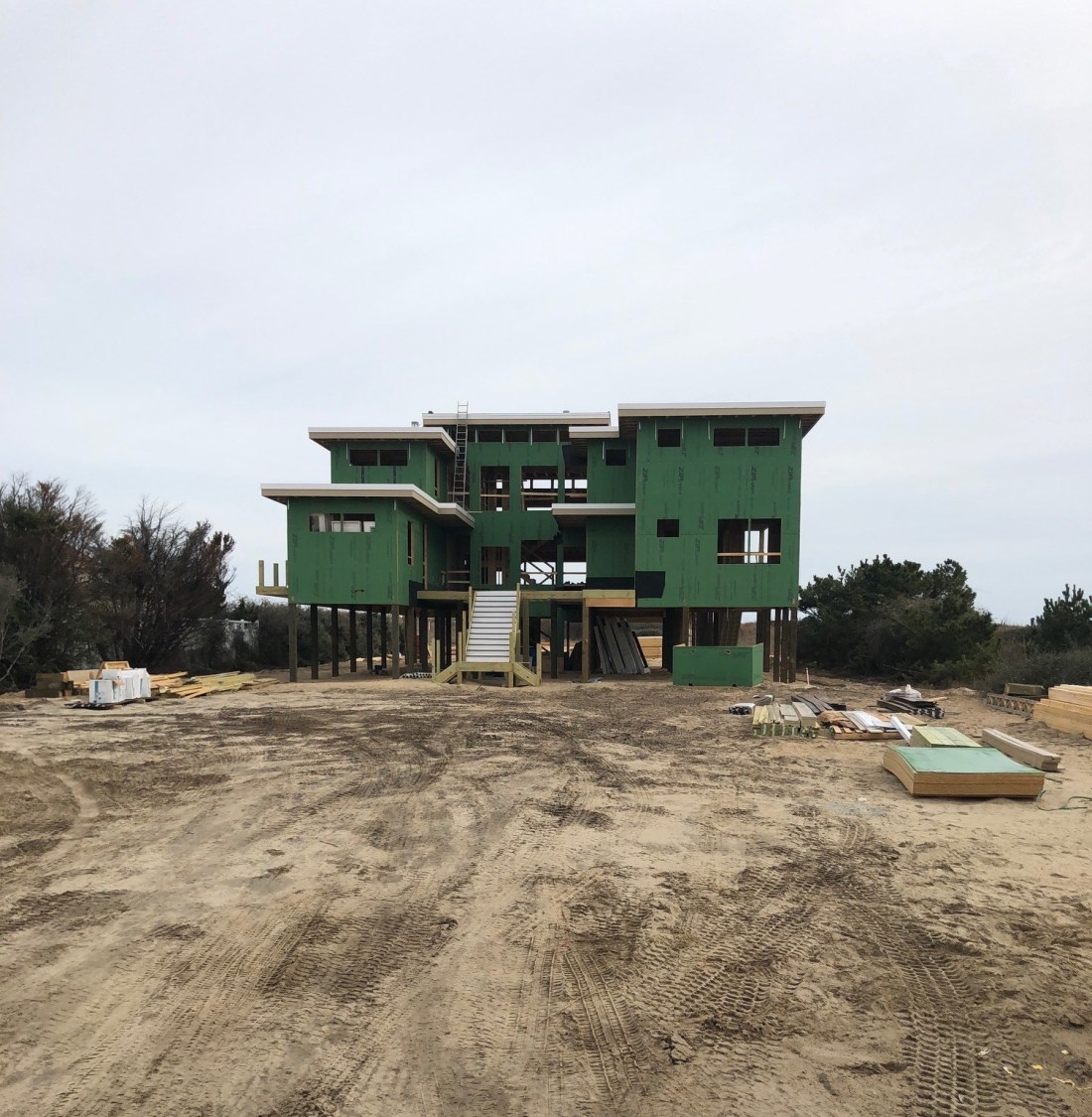
The building site at 98 Ocean Blvd., as it appeared yesterday morning from across the street.

In a surprise move last night, the Town Planning Board voted, 3-2, to include a 5,000-square-foot house-size restriction in one of two “high-occupancy limit” zoning text amendments that it directed Town staff to prepare for its consideration.

Both ZTAs requested by the Board were based on new language emailed to Board members yesterday by Planning Director Wes Haskett, after he received the language in a 10 a.m. email from Town Attorney Ben Gallop. The ZTA language was then posted on the Town website, according to Mr. Haskett, who responded to an email from The Beacon this morning.

Each ZTA requested by the Planning Board would control population density in Southern Shores’ RS-1 and R-1 residential districts by limiting overnight occupancy in “vacation cottages” to 14 people or fewer. A “vacation cottage” would represent a new “permitted use” in these districts.

The Board also rejected, by a 2-3 vote, a motion by member Andy Ward to propose a ZTA that would have controlled high-occupancy dwellings and population density by limiting septic-use capacity to “no more than 14 overnight occupants.”

Mr. Ward, who advocated strongly for a septic-use limit three years ago when the Town Council enacted the 6,000-square-foot house-size limit instead, appeared to be shocked by the new ZTA language, which was attributed to Professor David M. Owens of the University of North Carolina School of Government. Professor Owens is Mr. Ward’s first cousin.

Planning Board Vice-Chairperson Elizabeth Morey, who has been conducting the Board’s meetings since Chairperson Glenn Wyder’s sudden death Nov. 25, is expected to report the Board’s progress to the Town Council tonight during its regular monthly meeting. The Council meets at 5:30 p.m. in the Pitts Center.

According to the Town Council’s agenda, it will appoint someone to fill Mr. Wyder’s unexpired three-year term, which started July 1, 2018. This full member will be on the Planning Board when the two ZTAs authorized last night are taken up by the Board for possible recommendation to the Town Council.

Three Southern Shores homeowners have applied for the Board vacancy. They are Ed Lawler, a semi-retired engineering consultant with experience in house design and construction who has lived in Chicahauk for 28 years; Anthony DiBernardo, a retired parole hearing examiner who has been active in environmental preservation in Southern Shores since he moved here in 2005 and served three years as chairman of the SSCA’s Architectural Review Board; and Patrick Regan, a retired food-industry manager who is involved with the Beach Food Pantry and Caring Hands, a faith-based outreach program affiliated with the Duck United Methodist Church. (See below for more about their qualifications.)

Supporting materials for the meeting, including the Planning Board applications are available here: https://www.southernshores-nc.gov/wp-content/uploads/minutes-agendas-newsletters/Meeting-Packet_2019-01-08.pdf.

You may access the Town Council’s agenda here: https://www.southernshores-nc.gov/wp-content/uploads/minutes-agendas-newsletters/Agendas_2019-01-08.pdf.

SURPRISE TALK ABOUT HOUSE SIZE, NEW ZTA LANGUAGE

Last night’s special meeting of the Planning Board picked up where the Jan. 2 special meeting, which recessed because of a power outage in the Pitts Center, left off.

There was considerable public comment, presented formally from the lectern and informally from the audience, during the two-hour session. Ms. Morey allowed a free-flowing, but controlled interactive and inclusive meeting. Anyone who wished to speak was given an opportunity to do so.

In addition to Ms. Morey and Mr. Ward, Planning Board members David Neal and Joe McGraw, both of whom are builders, participated. Board alternate Michael Basilone, a Kitty Hawk firefighter who lives in Southern Shores, assumed the vacant seat, as he had on Jan. 2.

Mr. Neal sought to frame the Planning Board’s deliberations by summarizing the options for controlling high-occupancy houses as just two: 1) to limit by septic-use capacity; or 2) to limit by “use.”

“We are trying to put a cap on the number of people who can be in a vacation rental,” he said, after noting that the Town is prohibited by state law from limiting occupancy by the number of bedrooms and has already set a maximum house size.

Ms. Morey corrected Mr. Neal by saying that the Board was not capping the number of people in a vacation rental, but rather “the number of occupants in a single-family dwelling.”

When the reserved Mr. McGraw, who has a decades-long history with Southern Shores, spoke up about reducing maximum house size in town to 5,000 square feet, an idea that The Beacon knows has support among town citizens, including me, I was frankly stunned. I thought that a change in the maximum house size, which was suggested at the Town Council’s Nov. 7 special meeting, lacked support on the Planning Board.

“I feel like the 6,000 square-foot limit opened up the door for 98 Ocean Blvd.,” Mr. McGraw said, referring to the 12-bedroom, 17-parking-space mega-house being built by SAGA now on the oceanfront.

Mr. Basilone agreed, expressing support for the high-occupancy/use limit, but saying, “I also like what Joe said about changing the square footage of houses.”

Ms. Morey joined them, saying, “I like the idea of 5,000 square feet, too.”

“Adamantly opposed” to reducing the maximum house size, Mr. Ward argued in favor of restricting occupancy in single-family homes by limiting septic-use capacity to 14 people. His motion to direct Town staff to prepare a zoning text amendment that would limit septic-use capacity for single-family dwellings to 14 persons failed, 2-3, however, after discussion about the risk of liability involved in this option and the ways that property owners could get around it. Only Ms. Morey joined Mr. Ward in approving the motion.

See Mr. Ward’s option at: https://www.southernshores-nc.gov/special-planning-board-meeting-recessed-january-7-2019/1-7-19-occupancy-limt-zta-language/

NEW LANGUAGE FROM PROFESSOR OWENS, WRITTEN IN NOVEMBER

Mr. Neal threw his support behind the new draft ZTA language that, Mr. Haskett told The Beacon today, Mr. Gallop emailed to the Planning Director yesterday morning around 10, and Mr. Haskett immediately forwarded to Board members.

This ZTA language is described in a link on the Town website as “11/19/18: Owens High-Occupancy Limit Language.” See https://www.southernshores-nc.gov/special-planning-board-meeting-recessed-january-7-2019/11-19-18-owens-high-occupancy-limit-language/.

Professor David Owens, of the UNC School of Government, is a highly regarded N.C. land-use expert and author of the textbook, “Land Use Law in North Carolina,” with whom Mr. Gallop has conferred. Professor Owens, who lives part-time in Southern Shores, prepared the septic-use ZTA language that Mr. Ward proposed.

The Beacon did not see this new link before yesterday’s meeting. According to Mr. Haskett, the date assigned to it, 11/19/18, “is the date of the correspondence between David Owens and the Town Attorney that included the language.” Why Mr. Gallop, who has described himself as a student of Professor Owens, waited until yesterday to share this nearly two-month-old correspondence with the Planning Board was not made clear last night.

Mr. Gallop stated at the meeting that the language had been drafted by Professor Owens, but he did not provide the specific context. The Town Council held a special meeting on high-occupancy houses on Nov. 7, before this language was allegedly drafted, and the Planning Board did not meet in November.

This new Owens language, which a majority of the Planning Board supported, would amend the Town Code by adding a definition for “vacation cottage”: a one- or two-family residential structure that is offered for rent or use for a period of less than a month. It further would specify that a vacation cottage is a permitted use in the primary residential districts, provided the maximum overnight occupancy does not exceed 14 people.

The language also includes a paragraph that is being called an “optional standard,” which Mr. Gallop characterized as a separate proposal from the rest of the language to provide a “conditional use option.” As currently written, this standard would allow a vacation cottage to exceed the 14-person maximum overnight occupancy capacity if it were built on a lot of at least 80,000 square feet. A majority of the Board supported increasing that square footage and gave Town staff the discretion to decide an appropriate number.

A motion made by Mr. Neal to draft a ZTA in line with the 11/19/18 Owens correspondence was approved by Mr. McGraw and Mr. Neal—and, belatedly, by Ms. Morey, in order to give them a majority.

Ms. Morey then made a motion to draft a ZTA in line with the Owens correspondence that also included a house-size restriction of a maximum of 5,000 square feet. Mr. McGraw and Mr. Basilone joined Ms. Morey in approving the motion. Both Mr. Ward and Mr. Neal expressed strong opposition to the house-size reduction.

The new Owens language clearly caught the professor’s cousin, as well as the public, by surprise.

“This is the first I’ve heard of it,” Mr. Ward said. “I’ve talked to David numerous times, as recently as Saturday afternoon,” and he didn’t mention it.

Mr. Ward seemed both frustrated and dismayed by this turn of events. Frankly, The Beacon believes he deserved more respectful consideration from the Town Attorney and Town Planning Director than he received—as did the other four Board members. But Mr. Ward, in particular, invested a lot of time and energy in exploring and advocating on behalf of the septic-use option, which the late Mr. Wyder also supported.

Both Mr. Gallop and Mr. Haskett should have made an effort to contact Mr. Ward by telephone to advise him of the new ZTA language, which Professor Owens purportedly drafted. Mr. Ward should have been given time to consult with his cousin, who has been an influential, if absent party to the discussions about high-occupancy houses in town for at least the past three months. Instead, he was blindsided.

The Beacon is concerned that the thoughtful months-long deliberations about the very important issues of growth, development, and population density in Southern Shores seem to have been resolved, at least for now, by eleventh-hour maneuvering and Ah-ha! moments.

PLANNING BOARD APPLICANTS

The Beacon interviewed Planning Board applicants, Mr. Lawler and Mr. DiBernardo. Mr. Regan did not return a telephone message left by The Beacon yesterday.

Mr. Lawler said he is a proponent for “slow growth,” and he has always “paid attention” to the environment and water quality. He lived in Corolla from 1977-87 in a house he built himself and moved to Southern Shores, which he called “a place for family,” after the northern beaches began to “deteriorate quickly.” He has extensive experience with water- and wastewater-treatment projects. He is also on the Chicahauk Property Owners Assn., serving as its treasurer.

Mr. DiBernardo served on the Southern Shores Vegetation Board/Committee that developed a vegetation-preservation ordinance for the town. This work came out of an N.C. State University study, but, unfortunately, did not get the support of then-Mayor Don Smith. Mr. DiBernardo has been vice-chairperson of the Southern Shores Historical Landmark Commission since its inception and was recently reappointed to another term.

Mr. Regan’s application indicates he spent more than 30 years in the food industry, and he holds a bachelor’s degree from the New Jersey Institute of Technology.

Both Mr. Lawler and Mr. DiBernardo also have bachelor’s degrees. Mr. Lawler has a master’s degree in marine science.

Ann G. Sjoerdsma, 1/8/19

1/7/19: GRAFFITI CASE UPDATE: NO ARRESTS, POSSIBLE SUSPECT LEAD, NO LINK TO THE BEACON, INVESTIGATING OFFICER SAYS; VANDALISM CAUGHT ON SURVEILLANCE (The Beacon Knew This, But Did Not Report For Reasons No Longer Relevant)

62oceandec6
A photograph of 64 Ocean Blvd., taken at 3 p.m. on Dec. 6, 2018, from the public right of way.

A month after a luxurious oceanfront home in Southern Shores was spray-painted with obscene graffiti, Town police have made no arrests, but they have identified a “possible lead,” according to the investigating officer.

“Nothing has panned out so far,” Southern Shores Police Sgt. George M. Farrow told The Beacon Saturday about the ongoing vandalism investigation. But, the officer said, “The department is following up on a possible suspect lead.”

The police are trying to get the suspect “to come in,” Sgt. Farrow said.

The Beacon reported Dec. 6, 2018 on the graffiti that occurred at 64 Ocean Blvd., according to police, during the night of Dec. 4-5. It consisted of the word “HOLE” being painted beneath the word “GLORY,” which appears on a house sign above the driveway, and a sketch of male genitalia. The “GLORY” sign is clearly visible from the road.

According to Sgt. Farrow’s police-incident report, which The Beacon obtained from the officer Dec. 13, similar obscene graffiti was spray-painted on the concrete walkway at the Southern Shores Civic Assn. beach access that adjoins 62 Ocean Blvd. Sgt. Farrow did not give The Beacon the photographs that accompany the report, but he did describe the drawings as “crude.”

As reported by The Beacon Dec. 13, contractor Allan Hutton, who built the house at 62 Ocean Blvd. and has a crew working on the house at 64A Ocean Blvd., discovered the vandalism the morning of Dec. 5 and called Town Manager Peter Rascoe, with whom he is friendly, Sgt. Farrow said Saturday. Mr. Rascoe then notified Police Chief David Kole, who, in turn, contacted Sgt. Farrow.

This sequence of events is recorded in Sgt. Farrow’s police report, which also records a 7:45 a.m. incident-report time. The Southern Shores Town Hall and police station do not open for business weekdays until 8:30 a.m. A voice recording on the police station telephone line, however, provides a telephone number for members of the public to reach an on-duty officer.

HOMEOWNER HAD SURVEILLANCE; GRAFFITI UNRELATED TO BEACON

I met Sgt. Farrow at the Southern Shores police station on Dec. 13 at 3 p.m. for a pre-arranged interview.

I had encountered the sergeant the previous day during a visit I made to the police station to request copies of the police reports for the vandalism incident and for a related false trespassing report filed against me. He said he had planned to call me to ask me to come in. We made an appointment.

During the course of the half-hour meeting I had with Sgt. Farrow, he informed me that the homeowners of 62 Ocean Blvd. had operational surveillance at the house, and he had seen a tape of the vandalism being committed.

Sgt. Farrow asked me to keep our discussion confidential, and I honored that request. On Saturday, however, during what I informed him was an inquiry on behalf of Beacon readers, he referred to the surveillance equipment.

Because of this telephone exchange, I no longer feel that I must withhold the existence of the surveillance videotape. I will continue, however, not to report details about the person or persons that Sgt. Farrow told me Dec. 13 he had seen on the tape.

Both Southern Shores Town Councilman Jim Conners and attorney Starkey Sharp, who represents 62 Ocean Blvd. homeowner Steven Love in a matter pertaining to the adjacent vacant lot at 64 Ocean Blvd., which Mr. Love also owns, have sought in public meetings to link the vandalism with this blog. (See The Beacon, 12/13/18, and 12/20/18.)

Both surely knew about the surveillance videotape and what—or, more precisely, who— was on it.

Before the night of Dec. 4-5, The Beacon’s blog reports were focused on SAGA’s proposed “mini-hotel” developments at 98 and 134 Ocean Blvd. I did not bring up the properties at 62, 64, and 64A Ocean Blvd. until after the vandalism occurred.

On Dec. 7, 2018, I published “THE SAGA OF AN ARCHITECT: COUNCILMAN CHRIS NASON AND HIS DESIGNS ON THE SOUTHERN SHORES OCEANFRONT; And What About That 50-Foot-Wide Lot?”

The 50-foot-wide lot between the large houses at 62 and 64A Ocean Blvd.—both of which were designed by architect and Town Councilman Christopher Nason—is a “nonconforming” lot because it does not conform to the Town’s minimum required lot width of 100 feet. According to public record, Mr. Nason is the architect of a 3,600+-square-foot house that Mr. Love would like to build on the narrow vacant lot between the other two houses he designed. (See photo of the site above, taken Dec. 6.)

In 2018, the Town Planning Board and the Town Council grappled over a period of months with revising the Town Code ordinance on nonconforming lots to ensure that development of 50-foot-wide lots is curtailed. That Mr. Nason did not disclose the financial interest he has in the nonconforming lot at 64 Ocean Blvd. and voted on the zoning text amendment, ZTA 18-07, that was proposed to change the Code, was of great concern to The Beacon.

The Beacon’s Dec. 7 blog details Mr. Nason’s professional involvement with the properties at 62, 64, and 64A Ocean Blvd. It is based upon my research in the Town Planning Dept. of public records that any citizen may access and peruse for any reason whatsoever.

On Saturday, I asked Sgt. Farrow if he had found in his criminal investigation of the vandalism at 62 Ocean Blvd. that the graffiti had anything to do with The Beacon, in particular, that the suspected perpetrators had been following this blog.

He answered: “No. I haven’t found that to be the case.”

THE TRESPASS ALLEGATION AGAINST ME

On Dec. 6, the day before I published my “SAGA of an Architect” blog, “someone” falsely reported me to the Southern Shores police for trespassing on the property at 62 Ocean Blvd. which, unbeknownst to me, had been vandalized at least 32 hours earlier.

At 3 p.m. that day, I took a photograph of the nonconforming lot at 64 Ocean Blvd. (see above), so I would have artwork to run with my “SAGA of an Architect” blog the next day. I stayed in the public right of way in front of the properties while I took photos and left the site at 3:15 p.m.

I was stunned and angry when two Southern Shores police officers knocked on the front door of my residence at 4:36 p.m. and asked me if I had been at 63 Ocean Blvd.—the officer’s error—taking a photograph.

I recorded what transpired between Officer Jeremy Hemilright, the policeman who conducted the visit, and me in a blog that I wrote and posted immediately after the two officers left. (See 12/6/18: POLICE PAY ME A VISIT: REPORT IS HARASSMENT BY RED-ROOF HOMEOWNER AT 62 OCEAN BLVD.)

I began to put things together differently than the way I reported them in that blog after I met Dec. 13 with Sgt. Farrow. While discussing with him how I “had been in the wrong place at the wrong time,” he referred to how I had been looking at Town permit files for the three properties a day before the vandalism occurred.

This research was for my blog about Councilman Nason. I was seeking to confirm Mr. Nason’s relationship with the homeowners at 62, 64, and 64A Ocean Blvd. and to obtain dates for his architectural work in their behalf.

On Saturday, I finally asked Sgt. Farrow how he knew that I had been there, looking in permit files, and he replied: “The Town Manager advised me since I was working on the case.” When I asked how Mr. Rascoe had contacted him, he did not answer specifically, saying that my activity was “on the grapevine.”

I had no communication with Mr. Rascoe on Monday, Dec. 3. I saw him pass by the door to the conference room that I used for my file research, but he did not look my way.

Did the police conceal the surveillance videotape from Mr. Rascoe?

Does Mr. Rascoe stalk—or monitor, if you prefer—all citizens who exercise their right to see public records, which, as the North Carolina statute on public records makes clear, are “the property of the people,” or just journalists?

While at Town Hall on Dec. 3, I learned for the first time that Mr. Love had applied for a CAMA permit to build on the 50-foot-wide lot at 64 Ocean Blvd.

I spoke with Town Permit Officer Dabni Shelton about Mr. Love’s legal ability to build there, in light of the recently passed nonconforming lots ordinance (ZTA 18-07), which I believed prevented him from doing so. Ms. Shelton advised me to email Deputy Town Manager/Planning Director Wes Haskett, who was attending training out of town all week, about my concerns, and I did so.

Since my Dec. 13 meeting with Sgt. Farrow, I have done further reporting on the circumstances surrounding the call implicating me in a trespass. I will disclose what I have learned at a later date.

The Beacon’s informal advisory board will be meeting soon to discuss what actions to take on this matter, going forward.

Ann G. Sjoerdsma, 1/7/19


1/3/19: POWER OUTAGE ABRUPTLY ENDS PLANNING BOARD SPECIAL MEETING ON ‘LARGE HOUSES’; RESCHEDULED 5 P.M. MONDAY, JAN. 7


poweroutageparking

[1/4/19 UPDATE: The Town is calling the adjournment of the Planning Board’s Wednesday meeting a “recess” and notifying the public that the meeting will “resume” at 5 p.m. Monday.]

A power outage in the Pitts Center last night ended the Town Planning Board’s special meeting on “large-house” regulations just as Southern Shores builder and homeowner Matt Neal was shedding some light on what has been called the Outer Banks Home Builders Assn.’s (OBHBA) “option.”

When the room went dark, so did an overhead projection of an outline describing the OBHBA’s suggestion to create new zoning in Southern Shores for “High Occupancy Dwellings.”

Although encouraged by some in the larger-than-usual audience to continue speaking from the shadows—there was some light—Mr. Neal stepped aside while Deputy Town Manager/Town Planning Director Wes Haskett went to investigate the problem. When Mr. Haskett reported no hope of the electricity being restored, the Planning Board rescheduled the special meeting to 5 p.m., Monday, and adjourned.

A meeting that Board Vice-Chairperson Elizabeth Morey had predicted in her opening remarks would last two hours, thus, terminated after little more than a half-hour. Mr. Neal, who was 2018 president of the OBHBA, was the only member of the public heard—albeit briefly.

Ms. Morey has been chairing Planning Board meetings since the November death of Chairperson Glenn Wyder. After the Town Council appoints someone at its Jan. 8 meeting to serve out Mr. Wyder’s unexpired term, the five regular voting Board members will elect a new chairperson and vice-chairperson.

Last night, alternate Michael Basilone sat as a full-voting member of the Board, just as he did at the Dec. 17 meeting. Alternate Leo Holland, who was scheduled to sit on the Board, according to the rotation of alternates, was out of town and, according to Mr. Haskett, will be out of town on Monday, as well.

DESPITE OUTAGE, SOME BUSINESS OCCURRED   

In the time they had, the five Board members made lightning-quick work of some suggestions they have received, or have been directed to consider, regarding new regulations to control high-occupancy large houses. (The Beacon’s preference is to refer to high-occupancy houses, rather than “large” houses, but the Town most often refers to house size, not occupancy.)

Member Andy Ward took the lead in the Board’s discussion by referring to the Town Council’s motion, unanimously passed Dec. 11, that the Board consider draft ZTA 18-10, which, significantly, creates an oceanfront overlay residential district and then imposes regulations on structures within it, as well as other “zoning requirements” based on different approaches.

(You may access the text of ZTA 18-10 here: https://www.southernshores-nc.gov/wp-content/uploads/2018/12/ZTA-18-10-Large-StructuresRegulation-HREMv001-2018.12.05-1.pdf.)

Among the approaches suggested by the Town Council was “regulating number of water use fixtures in a residence (using water conversion measures to control occupancy).”

Of this option, Mr. Ward said, “I’m not sure what this is designed to do other than to befuddle enforcement.”

Member David Neal, who is a builder and the father of Matt Neal, agreed, saying the approach is “totally confusing and overkill.” Member Joe McGraw, another builder, agreed with Mr. Neal, and Ms. Morey concluded, “Check that one off our list.”

The Board then decided to veer away from the Town Council’s directive to consider the applicability to Southern Shores of an ordinance proposed by the Town of Duck to “establish standards for the scale of residential development.”

A draft of this ordinance was in the Planning Board’s “meeting packet” because Southern Shores Town Attorney Ben Gallop’s law firm colleague Robert B. Hobbs, Jr., represents Duck, and Mr. Gallop has been working with him.

(You may access the ordinance here: https://www.southernshores-nc.gov/wp-content/uploads/2018/12/12-31-18-Town-of-Duck-Large-Homes.pdf.)

The discussion on Duck’s proposed ordinance sounded much like the discussion on water-use fixtures. Mr. Ward said, “I don’t see a whole lot there that would pertain to us—as far as what we’re trying to do.”

Mr. David Neal then observed, “I think that we’re a different animal than Duck. . . .  Southern Shores is a monolithic oceanfront, Duck is not. I don’t think Duck’s proposal is appropriate for our situation.”

Mr. Basilone added: “I’m not sure it fits what we need.”

The Beacon appreciates Mr. Neal’s description of the Southern Shores oceanfront as “monolithic.” Rather than this being a pejorative term, The Beacon believes it goes to the heart of what makes Southern Shores unique on the Outer Banks: From its founding in the 1940s, Southern Shores has been a tightly controlled, planned community and, as of 1979, town. It is not a patchwork quilt of development; at least, it has not been, historically.

Having dispensed with the Duck ordinance, the Board returned to the Dec. 11 Town Council motion to consider “regulating use of residential properties for rental,” which the OBHBA’s option does.

The Board was able to establish through questions asked of Matt Neal that its use option “came out of the legislative committee of the Outer Banks Home Builders Assn.” and that this committee had legal advice.

Then the lights went out.

(This is the latest version of the OBHBA’s option on the Town website: https://www.southernshores-nc.gov/wp-content/uploads/2018/12/12-17-18-Homebuilders-Large-Home-Suggestions.pdf.)

MY BOTTOM LINE AND SUPPORT OF SEPTIC-USE LIMIT

I was prepared to speak publicly about the “large-house” problem in Southern Shores, which became acute when SAGA Construction and Development secured CAMA permits for its 12-bedroom, 17-parking-space, 24-person-septic-capacity “mini-hotels” at 98 and 134 Ocean Blvd. These commercial properties are a gross aberration in Southern Shores’s low-density residential neighborhood on the oceanfront and elsewhere in town.

The main points I would have made are these:

KEEP IT SIMPLE.

DON’T REGULATE ANY MORE THAN YOU HAVE TO, in order to restore the status quo that Southern Shores had before the N.C. General Assembly took away in June 2015 the town’s power to limit the number of bedrooms. From October 2001 until June 2015, the Town kept a lid on high-occupancy dwellings by restricting the number of bedrooms in a single-family home to seven and the septic-use capacity to 14. That approach seemed to work.

I frankly don’t see how the Outer Banks Home Builders Assn.’s idea of creating a “use” called a high-occupancy dwelling serves the Town’s goal of limiting occupancy in houses and, thereby, preserving Southern Shores’s unique low-density residential neighborhoods. How do you keep the uncrowded beaches that draw vacationers to Southern Shores uncrowded if you permit high-occupancy houses?

Southern Shores was built gradually—over decades—by people whose vision was to preserve open spaces and minimize congestion caused by too much population. High-occupancy dwellings run counter to that vision and to what a majority of Town property owners seem to want.

At the December 2018 Planning Board meeting, one member of the public suggested that the Planning Board (and the Town) hadn’t identified the purpose of any additional Town regulation: Is it to restrict occupancy? To limit house size? To preserve low-density?

I have no such confusion, nor do I think have Planning Board members. The purpose is to limit occupancy of single-family dwellings, and, as the SAGA houses prove, that cannot be accomplished simply by limiting house size.

I support Mr. Ward’s efforts to limit occupancy in single-family dwellings by limiting septic-use capacity to 14 persons—which is what the Town law was before the N.C. General Assembly acted, and the Town passed the maximum house size ordinance.

Southern Shores can—and should—enact this restriction without reference to the use of the dwelling. It does not matter whether the single-family dwelling is used exclusively by the homeowners or is rented as a vacation rental, as defined by the N.C. Vacation Rental Act. All that matters is that the dwelling is in Southern Shores.

I’ll have more to say about this approach and simple amendments to the Town Code after Monday’s meeting. Please try to attend.

Ann G. Sjoerdsma, 1/3/19

12/31/18: THE DEFINITION OF A ‘SINGLE-FAMILY DWELLING’ IN SOUTHERN SHORES: Did It Change in January 2016 Without the Town Council’s Awareness? Why Did It Change?

Biltmore,large
The 35-bedroom Biltmore house in Asheville was built toward the end of the Gilded Age, a term coined by Mark Twain to describe a 19th-century era in the United States characterized by extraordinary wealth and political corruption.

What is a “single-family dwelling” in Southern Shores? How does the Town Code define a “single-family dwelling” for purposes of its single-family residential districts?

These are two of the many questions that the Town Planning Board should take up during its special meeting Wednesday, at 5:30 p.m., in the Pitts Center, when it continues its discussion of regulating high-occupancy, large homes in Southern Shores. The Beacon plans to raise the “single-family” issue in public comments during the meeting.

During the past year, I have had occasion to consult the Code definition of single-family dwelling and have been flummoxed by the awkward and heavy lawyering hand that I found evident in some of the wording. When I connect the dots, I reveal a definition that I consider both nonsensical and damaging—certainly not what homeowners would believe is the case. (See below.)

Most obviously, I consulted this definition in the context of SAGA’s proposed 12-bedroom, 17-parking-space, 24-person-septic capacity, nearly 6,000-square-foot “mini-hotels,” which, if pending litigation is unsuccessful, will be built in the RS-1 single-family residential district on the oceanfront.

As The Beacon has reported, the Southern Shores Civic Assn. objected to the Town’s issuance of CAMA permits to SAGA on the grounds that its mini-hotels are not single-family dwellings and should not be permitted in the RS-1 residential district. The SSCA had standing to be heard on the permits because it owns beach accesses adjacent to the two SAGA properties, at 98 and 134 Ocean Blvd.

Town Permit Officer Dabni Shelton summarily dismissed the SSCA’s objections, and the Civil Association elected not to appeal the permits’ issuance. Board members have told The Beacon that they did not wish to spend SSCA monies on legal expenses.

Here’s the rub, folks: Although the Town Code defines single-family dwelling, in section 36-57, in a clear and unambiguous manner, the Code definition of “family,” which you must look up in order to interpret and apply this definition, is severely compromised and confusing. The Town Council amended the definition of “family” on Jan. 22, 2016, when it enacted the 6,000-square-foot maximum single-family dwelling size.

The Beacon very much doubts that the three Town Council members who approved the change in this definition had any awareness of doing so. And because there is no video or voice recording of the Jan. 22, 2016 meeting—according to Town Clerk Sheila Kane, because it was a “special” meeting—The Beacon cannot determine what was said or not said by Town Attorney Ben Gallop when he explained the various “large-house” zoning text amendments that he had drafted for the Town Council to consider.

The Beacon has confirmed that all of the ZTAs contained the amendment to the definition of family. If they performed their jobs conscientiously, all of the Council members should have been familiar with the wording of each ZTA, including the “family” amendment. Because of the holidays, however, The Beacon has not had the opportunity to contact them.

I can tell you that I attended the Jan. 22, 2016 meeting and elected not to speak publicly because I had not had time to study the language of the ZTAs. I do not recall any discussion about the family definition amendment, and the meeting minutes reveal none.

“SINGLE FAMILY DWELLING” AS DEFINED BY TOWN CODE

A “dwelling, single-family” is defined in Town Code sec. 36-57 as “a detached building designed for or occupied exclusively by one family.” (This is from the definitions section of Chapter 36, which is the zoning chapter.)

“Family” is defined in this same section as “one or more persons occupying a single-family dwelling unit, provided that unless all members are related by blood or marriage or that the dwelling unit is being used as a vacation rental under the North Carolina Vacation Rental Act (N.C.G.S. Chap. 42A), then no such family shall contain more than five persons.”

Before Jan. 22, 2016, when Town Councilmen Leo Holland, Fred Newberry, and Gary McDonald approved the zoning text amendment on maximum house size, the Code defined a family without the italicized reference to the N.C. Vacation Rental Act. Therefore, a single-family dwelling was a detached building designed for or occupied exclusively by an unlimited number of persons, all of whom were related by blood or marriage, or, lacking such familial bonds, by no more than five persons.

I’ve been told by Town staff that the Town sought to discourage boarding houses with this definition of family.

This language is not original. In fact, it is standard, based, as best as I can tell from my research to date, on the N.C. Residential Code, which is a model code of regulations that was based upon the International Residential Code for One- and Two-Family Dwellings, which was promulgated by the International Code Council. The N.C. Building Code Council is the state equivalent of the ICC.

The Kitty Hawk Town Code currently has the same definitions of “dwelling, single-family” and “family” as the Southern Shores Code—absent the N.C. Vacation Rental Act reference.

So far as I can tell, neither Ben Gallop, who has represented Southern Shores since 2008, nor his law-firm colleague Robert B. Hobbs, Jr., who has been the Town Attorney for Duck since 2008, has ever been Town Attorney for Kitty Hawk. Their firm, Hornthal, Riley, Ellis & Maland, has represented Nags Head, but does not now claim the town as a client on its website. Attorney Thomas L. White, Jr., now retired from the firm, represented Nags Head from 1971 to 2001 and Southern Shores from 1979 to 2001, according to his online biography.

EFFECT OF VACATION RENTAL ACT REFERENCE: ABSURDITY

When I asked Town Permit Officer Dabni Shelton in October why the SSCA’s opposition to SAGA’s proposed mini-hotels was not sufficient, she said that the structures were covered by the Vacation Rental Act, which effectively excepted them from the Town’s single-family dwelling requirement.

For me, this interpretation is a mind-bender.

You’ll find the N.C. Vacation Rental Act, which was enacted in 1999, at https://www.ncleg.net/enactedlegislation/statutes/html/bychapter/chapter_42a.html.

Any time I’ve raised the point with staff in the Town Planning Dept. that rental machines like SAGA’s proposed structures are not single-family dwellings, they have told me that they are covered by the Vacation Rental Act. Their interpretation eludes me.

The N.C. Vacation Rental Act is all about leases, landlord-tenant-real estate broker duties/obligations/rights, eviction, evacuation, and such. The N.C. General Assembly passed this act, as it states in its purpose section, to regulate “the competing interests of landlords, real estate brokers, and tenants.”

As a N.C. vacation rental property owner since 1991, I have consulted the Vacation Rental Act now and then, but not often because it’s rarely necessary. I have an agent, and the leases that vacationers sign with my agent include the provisions of the Vacation Rental Act.

The act is all about contractual matters. The only mention of single-family dwellings or homes in the Vacation Rental Act appears in its definitions section, which is N.C. General Statutes sec. 42A-4(2). The act defines:

A “residential property” as “an apartment, condominium, single-family home, townhouse, cottage, or other property that is devoted to residential use or occupancy by one or more persons for a definite or indefinite period”; and

A “vacation rental” as “the rental of residential property for vacation . . . for fewer than 90 days by a person who has a place of permanent residence to which he or she intends to return.”

Somehow, the mere insertion on Jan. 22, 2016 of the phrase, “the dwelling unit is being used as a vacation rental under the N.C. Vacation Rental Act, etc.,” into the family definition in Southern Shores has resulted in the Town recognizing any vacation rental house that is occupied by “one or more persons,” regardless of the relationships among them, as a single-family dwelling. This one phrase has succeeded in knocking the “family” out of “single-family.”

It also has created the nonsensical result that those of us who live in a single-family dwelling in the RS-1 district can live with more than four unrelated people—provided we rent the house out to vacationers every now and then, qualifying it as a vacation rental.

This is ridiculous.

The “intent” behind establishing the RS-1 single-family residential district is clearly set forth in Town Code sec. 36-202, to wit:

“The RS-1 district is established to provide for the low-density development of single-family detached dwellings in an environment which preserves sand dunes, coastal forests, wetlands, and other unique natural features of the coastal area. The district is intended to promote stable, permanent neighborhoods characterized by low vehicular traffic flows, abundant open space, and low impact of development on the natural environmental and adjacent land uses.”

Similar language appears in the Town’s land-use plan. To use the Vacation Rental Act to circumvent the intent, purpose, and scope of the Town’s low-density/low-impact zoning plan is beyond ridiculous. It’s outrageous.

The pre-Jan. 22, 2016 definition of “family” in the Town Code needs to be restored—and frankly, better worded—by the Planning Board and the Town Council and observed by staff in the Planning Dept.

Borrowing from Nags Head’s definition of a family (NH Code, sec. 48-7), The Beacon would rewrite the family definition, for purposes of defining a single-family dwelling, as “one or more persons related by blood, adoption, marriage or law [who are] occupying a dwelling together. A family shall not contain more than five unrelated persons.”

I would like to know why Mr. Gallop thought it was imperative to change this definition and why he did not make a point—if, indeed, he did not, as I recall—of telling Town Council members that he had changed it and what the effect of the change would be.

The Town Attorney has said on more than one occasion that “The Biltmore House is a single-family home.” Perhaps, in the era of robber barons, when the wealthy considered themselves America’s royalty and flaunted their often corruptly gained riches.

Not only was the magnificent 19th century Vanderbilt estate home built some 10-25 years before the earliest U.S. zoning laws—and on a land tract that, I hazard to guess, was as large as the entire Outer Banks—the single spectacularly wealthy family that lived there did not rent out rooms to vacationing transients. And its members would never have condoned a tiki bar.

Happy New Year, everyone.

Ann G. Sjoerdsma, 12/31/18

12/30/18: A PEACEFUL SUNDAY

SAGESunday1230.jpg

What a difference a complaint makes! The photograph above depicts SAGA Construction & Development’s building site at 98 Ocean Blvd. about 11:30 a.m. today. Last Sunday, the site was active with construction workers, one of whom told The Beacon that he expected to work Christmas Eve and Christmas Day.

The Beacon is happy to report that it did not observe construction work at 98 Ocean Blvd. on Christmas Day. At least, not in the morning.

A Southern Shores property owner shouldn’t have to complain to the Town about a builder violating the no-Sunday-construction law in order for the violation to stop. A builder should know and respect the local laws, and the police should enforce them.

My personal opinion is that property owners should supervise the construction of their new homes, whether they intend to live in them or not, and take pains to protect their new neighbors from noise, traffic obstructions and congestion, and other problems caused by the crews they’re paying. Impractical, you say? Why? Those property owners who underwrite construction that lasts a year or two years or even longer show a special disregard for the people affected by the “peripheral damage.”

But back to the noise ordinance, section 22-3 of the Town Code . . . The Southern Shores police should have the noise ordinance on their radar at all times. They should protect homeowners’ interest in the quiet enjoyment of their homes and ensure that “loud, disturbing noises”—such as the loud music that many construction workers play during their work days—do not occur. The police also should be on the lookout for traffic obstructions that constitute a public nuisance under the Town Code. (See The Beacon’s 12/28/18 blog.) A warning from a police officer carries more weight than a request by a nearby homeowner to tone things down or to remove a roadway hazard.

I actually heard a construction worker argue with my neighbor, after she asked him to move his truck, which was blocking her driveway, that he didn’t have to move it because it was in the public right of way! At that point, she said she would call the police if he didn’t, and he backed down. I also quickly put the kibosh on any notion that the end of my neighbor’s residential driveway was a public-parking space.

One Beacon reader commented, in response to recent blogs, that she has had a continuous problem since November with Sunday construction work by a builder on a site across from her home. Rather than call the police, she has sought cooperation directly from the builder, who has complied at times, but has not prevented the practice from recurring. She fears that if she calls the police to complain, the builder will retaliate against her by causing harm to her property.

I’ve heard stories about alleged retaliation—fires, vehicle vandalism, and other property damage—by contractors and subcontractors in Kill Devil Hills, Colington, and Nags Head, but never in Southern Shores. Retaliation is bullying. It’s intimidation by angry, disturbed people. I hate to think that Southern Shores homeowners are living in fear of such ugly behavior if they decide to look out for themselves.

In focusing on those builders who violate the Town Code, I do not mean to suggest that they are the majority in Southern Shores. They are definitely the exception. They’re the bad eggs, and good builders–of which there are many–don’t like them, either.

Reasonable people recognize that builders and homeowners must show each other respect and understanding in order to get along. Builders should understand that they are invading homeowners’ living space and disrupting their quiet enjoyment, and try to keep that disruption to a minimum, just as homeowners should understand that builders have a job to do and contribute to the town’s financial well-being, and try to give them some space.

That being said, The Beacon wonders if SAGA will observe the traditional peacefulness of New Year’s Day, before it resumes its rip-roaring pace. To observe the holiday would be a respectful gesture.

***

PLANNING BOARD TO MEET IN SPECIAL SESSION WEDNESDAY

The Town Planning Board will resume its discussion of regulations to control high-occupancy large houses at an important special meeting on Wed., Jan. 2, at 5:30 p.m., in the Pitts Center.

The Beacon will post a blog about the definition of a “single-family” dwelling in Southern Shores, and how that definition changed in January 2016, before the Planning Board meeting. Stay tuned.

Ann G. Sjoerdsma, 12/30/18


12/28/18: NOISE AND NUISANCES IN SOUTHERN SHORES: A Town Code Overview


SAGASunday3-1-e1546028131753.jpg
The construction at 98 Ocean Blvd., as it appeared last Sunday.

(252) 473-3444 . . . (252) 473-3444 is the number you call to reach the Dare Central Communications Center to report a non-emergency police matter, such as a violation of the Southern Shores noise ordinance.  A Southern Shores police officer will be dispatched to the scene of the alleged offense. Dare Central 911 is the number you call for emergencies. You need not identify yourself when you call.

In The Beacon’s last blog, I reported that I observed SAGA Construction & Development violating the Southern Shores noise ordinance on Dec. 23, by having workers engage in construction activities at 98 Ocean Blvd. on a Sunday. (See The Beacon’s blog, 12/23/18.)

The noise ordinance, which is section 22-3 of the Town Code, prohibits the erection, demolition, alteration, or repair of “any building” on Sundays or between the hours of 8 p.m. and 7 a.m. on weekdays and Saturdays, except in a case of “urgent necessity” and then only with a temporary permit. (Sec. 22-3(15))

I could have reported SAGA’s violation to the police by calling the Dare Central number printed above. I elected not to, as a courtesy-warning, although the Kill Devil Hills developer surely knows, or should know, the local law.

Instead, I informed the construction workers on-site of their offense. I also reported the offense to Deputy Town Manager/Planning Director Wes Haskett yesterday–the day Town Hall reopened after the Christmas break. Mr. Haskett promptly responded to my email, telling me that he would speak to the contractor. If I observe construction activity at 98 Ocean Blvd. again on Sunday, I will definitely call Dare Central and would ask you to do the same. [Update: See my reply to a comment about this blog post.]

All violations of the Town noise ordinance are class 3 misdemeanors, punishable by a fine of not more than $500. (See Town Code sec. 1-6(b)(5).)

A few days after the SAGA incident, I was conversing with a Chicahauk resident about the no-Sunday construction ordinance—he had never heard of the restriction—and he brought up the problem of barking dogs. He had approached his neighbors about the frequent, continuous barking of their dogs, who keep him awake at night, and received no satisfaction. I suggested contacting the police, but he is loath to do so.

Our conversation led to this blog:

PROHIBITED LOUD NOISES IN SOUTHERN SHORES

The Southern Shores Town Code prohibits any “unreasonably loud noise in the town” and declares certain enumerated acts to be “loud, disturbing noises.” On the list of such noises, which is not meant to be exclusive, are the following, which The Beacon believes you are most likely to encounter in your community:

“The use of phonographs, loudspeakers or sound amplifying devices” (sec. 22-3(b)(3): If music is so loud “as to disturb persons in the vicinity,” then the person creating it may be committing a criminal offense. Call Dare Central.

“Loud animal noises” (sec. 22-3(b)(4): Most of us are willing to tolerate barking dogs every now and then, and the Town Code ordinance reflects our neighborliness. The ordinance prohibits “the keeping of any animal which, by causing frequent or long continued noise, shall disturb the comfort and repose of any person in the vicinity.” I think my Chicahauk friend has a good argument about the dogs barking all night in yards next to his.

“Grating, grinding, rattling noises” (sec. 22-3(b)(5): Any person who uses an automobile, motorcycle, or other vehicle in a manner so as to create “loud grating, grinding, rattling, or other noise,” or “squealing or screeching of tires,” or the propulsion of “rocks, gravel, or sand” violates the Town noise ordinance.

These are just three of the 15 expressly enumerated acts deemed to be legally actionable loud, disturbing noises in the Town Code, with the construction noise I previously mentioned being the 16th. Other prohibited noises include sounding horns or signal devices on vehicles; exhaust noises; mechanical devices using compressed air; and drums or devices for attracting attention to “any performance, show, sale, or display of merchandise.”

The noise ordinance of the first-ever Town Code, enacted in 1988, clearly shows an animus toward what I would call “commercial” noise, such as the “shouting or crying of peddlers or hawkers”—who, in my opinion, were quite charming and convenient in their day—“mechanical loudspeakers on trucks for advertising,” and the “delivery of commercial goods during certain hours.” (The first two raise First Amendment issues.)

Subsequent Town Councils have amended the noise ordinance to exempt noises associated with 1) the dredging of the canals and with 2) public beach nourishment projects approved by the Town.

In prohibiting “unreasonably loud noises,” the Town is exercising its municipal authority to regulate for the health, welfare, and safety of the public. This power is fundamental to a municipality’s governance. But a municipality cannot trample on the First Amendment rights, or any other constitutional rights, of individuals in exercising this power.

PUBLIC NUISANCES IN TOWN

Quite separate, but related conceptually, to the noise ordinance is the Town’s ordinance on nuisances, which you’ll find at Town Code sec. 22-39. Unlike noise offenses, however, public nuisances are civil matters, not criminal matters.

Civil penalties levied in Southern Shores for nuisance violations can be quite severe because each day that a violation continues is a separate violation. So, if you’re ordered to pay a civil penalty of $500 for a nuisance, you will have to pay an additional $500 for every day that the nuisance continues, unabated. (But, see the nuisance investigation process, below.)

It is the Town Manager, not the police, who initiates an investigation of a nuisance complaint, after receiving notice. (Sec. 22-40.)

Among the 13 nuisances enumerated in the Southern Shores ordinance are the following:

“Growth of weeds and grass” (sec. 22-39(1): A person cannot allow the “uncontrolled growth of noxious weeds or grass” to cause or threaten to cause a public hazard.

“Accumulations of animal or vegetable matter” (sec. 22-39(2)): These would be accumulations that are offensive “by virtue of odors or vapors, or by the inhabitation therein of rats, mice, snakes, or vermin of any kind,” such that they are “dangerous or prejudicial” to the public health.

“Accumulations of rubbish” (sec. 22-39(3)): Similarly, accumulations of rubbish, trash, or junk that threaten to cause or do cause a fire hazard, or stagnant water to accumulate, or the vermin listed above to take up habitation, are public nuisances.

“Conditions violating health department rules” (sec. 22-39(4): This is a catch-all provision. Any condition that is detrimental to the public health and violates county health-department rules is a public nuisance.

The ordinance goes on to cite burned or partially burned buildings that are unsightly or hazardous; storm- or erosion-damaged structures and resulting debris; the growth of trees and shrubs on canal banks that threaten to cause or do cause a hazard to boating public safety or to navigation; abandoned personal property; and damaged household contents and buildings, etc.

A condition causing obstruction of any public street, sidewalk, alley, or bridge in town is also defined as a public nuisance. That’s one to keep in mind when monitoring a construction site where vehicles spill out on to the road. (sec. 22-39(7))

Similarly, it is a criminal offense in Southern Shores for a person to “cause a condition” that blocks or damages public streets, sidewalks, alleys, and bridges in town. (Sec. 22-2) All public streets must be open for travel and free of unnecessary obstructions.

If the appropriate county health department or Town official determines after conducting an investigation that a condition constitutes a public nuisance, the Town Manager must notify in writing the person responsible for the condition(s) and order a prompt abatement within 15 days of his/her receipt of the written notice.

As I understand the civil-penalty provision in Town Code sec. 1-6(d)(3), it is only after the nuisance perpetrator fails, neglects, or refuses to abate or remove the nuisance-causing condition that the Town may issue a citation for the violation and assess the $500-a-day penalty.

Noise and nuisance laws are important for the preservation and protection of the public’s health, welfare, and safety, but they should be narrowly drawn, so as not to be oppressive. Although we live in a much busier and noisier town than we did 30 years ago when the Southern Shores laws were first enacted, we have not yet become immune to the damage caused by what they seek to prevent.

(Please forgive the multiple email notices you received for this blog. I had difficulty with posting a photograph, so I twice deleted the blog entry and reposted a photo. My original photo, which was clip art, didn’t take. My apologies.)

Ann G. Sjoerdsma, Dec. 28, 2018

12/23/18: SAGA VIOLATES TOWN NOISE ORDINANCE BY WORKING AT 98 OCEAN BLVD. CONSTRUCTION SITE ON SUNDAY


SAGASunday

The photograph above depicts construction laborers working today—a Sunday—at the house that SAGA Construction & Development is building at 98 Ocean Blvd., in direct violation of the Southern Shores Town Code noise ordinance’s prohibition against erecting, demolishing, repairing, etc., buildings on Sundays. The Beacon took the photograph at 2:35 p.m. today.

Sec. 22-3(b)(15) of the Town Code expressly states that construction work shall occur only between the hours of 7 a.m. and 8 p.m. on weekdays and Saturdays—no Sundays—unless a public emergency exists and the town permit officer issues a special permit.

There is no such emergency here. What there is, apparently, is SAGA’s desire to “outrun” pending litigation so that if the petitioner homeowners prevail in their argument that SAGA should not have received a CAMA permit to build on the site, the developer will be able to plead to the administrative law judge: “But, your honor, we’ve already built the house. It would be prohibitively expensive for us to tear it down.”

This is a common tactic used by builders engaged in zoning litigation. In building “at their own risk,” they are just following their attorneys’ advice and counting on judges’ sympathies.

The Beacon will be happy to tell the administrative law judge in this case that SAGA broke local law in order to rush to complete its construction. The photograph above is clearly dated and timed in The Beacon’s records.

While standing in the driveway at 99 Ocean Blvd., which is the property of petitioner Marvin Tignor, who gave me permission to be there, I engaged in a conversation with one of the construction workers, who stood across the street when I spoke with him. I advised him of the Town noise ordinance and asked him if the crew planned to work tomorrow and on Christmas Day. He replied yes.

The Beacon supposes that this is part of SAGA’s good-neighbor policy: to create construction noise on one of the most sacred days of the year for some of the people who live near 98 Ocean Blvd. The Town noise ordinance does not prohibit construction work on any named legal holidays, but again, The Beacon believes that the administrative law judge in the CAMA-permit case may be interested to know SAGA’s holiday schedule.

The Beacon cannot monitor all construction sites in Southern Shores to ensure that builders respect and observe the no-Sundays noise ordinance.

How many Southern Shores police officers drove past the construction site on busy Highway 12-Ocean Boulevard and did nothing to enforce the local ordinance?

I believe it is long past time for the Town Planning Board, in cooperation with the Town Planning Dept., to come up with a cost-effective method for enforcing important construction-related Town ordinances so that enforcement is not solely complaint-driven. Change is needed—now.

Ann G. Sjoerdsma, 12/23/18

SAGASunday3.jpg
SAGA construction site at 98 Ocean Blvd. on Sunday, Dec. 23, 2018, at 2:35 p.m.


12/20/18: PLANNING BOARD VOTES TO AMEND AMENDMENT TO NONCONFORMING LOTS LAW; DISCUSSES OPTIONS FOR NEW ‘LARGE HOUSE’ ORDINANCE (SEPTIC-CAPACITY LIMIT HIGH ON LIST); & LISTENS TO ATTORNEY STARKEY SHARP SLAM TOWN ON BEHALF OF CLIENT STEVEN LOVE

crowdedbeach

PLEASE NOTE: The Town Planning Board will continue its discussions about potential regulations to control “high-occupancy large houses” in town in a special meeting on Wed., Jan. 2, at 5:30 p.m. in the Pitts Center.

For details, please see https://www.southernshores-nc.gov/southern-shores-planning-board-hold-special-meeting-january-2-2019/.

The Town Planning Board continued to express confusion over the new ordinance on nonconforming lots at its regular monthly meeting Monday and also debated the merits and risks of various options for controlling high-occupancy large houses in Southern Shores, with a restriction on septic capacity receiving a strong endorsement from Board member Andy Ward.

The Planning Board is looking again at nonconforming lots, which are typically 50-foot-wide lots, because Town Attorney Ben Gallop prepared a zoning text amendment (“ZTA”) at the Board’s direction, that carves out an exception to the ordinance. After a lengthy discussion, the Board voted unanimously to carve out an exception to the exception. (See below.)

Monday’s meeting was the Board’s first since Chairperson Glenn Wyder’s sudden death on Nov. 25. Vice-Chairperson Elizabeth Morey conducted the meeting, and second Board alternate Michael Basilone assumed the vacant seat.

In an unusual public comment, local attorney Starkey Sharp bombastically argued to the Board, on behalf of his client, Steven Love, who owns a nonconforming lot at 64 Ocean Blvd., that the Town has created “a big mess” and “a big mistake” with its new ordinance.

Mr. Sharp accused the Town of unfairly delaying Mr. Love’s application for a CAMA permit to build on his 50-foot-wide lot. According to Town Permit Officer Dabni Shelton, Mr. Love’s application is “under review.”

Mr. Sharp even went so far as to speculatively link obscene graffiti that was spray-painted on Mr. Love’s house at 62 Ocean Blvd. with the controversy in town over nonconforming lots.

As The Beacon previously reported, Town Councilman Christopher Nason has designed a five-bedroom, 3,600-plus square-foot house that Mr. Love would like to build on the site. The new nonconforming lots ordinance is an obstacle to Mr. Love’s plans; so, too, would be a change in the maximum house size for lots that are smaller in width than the Town Code-required 100 feet, an idea that Planning Board member David Neal brought up Monday in the context of regulating high-occupancy houses.

If you’ve read enough about nonconforming lots, I would suggest that you skip down to the section in this post titled “Potential Regulations to Stop High-Occupancy Large Houses.” If you’re up for more discussion of 50-footers, read on.

EXCEPTIONS TO THE NEW NONCONFORMING LOTS ORDINANCE: ONCE AGAIN, THE LOVE PROPERTY AT 64 OCEAN BLVD. IS IN THE SPOTLIGHT

On Sept. 5, the Town Council voted 4-1 to approve ZTA 18-07, which sought to limit the number of building lots in town that are fewer feet in width than the Code-standard 100 feet, with the understanding that the new regulation would return to the Planning Board for what Mayor Tom Bennett characterized as “refinements.”

What the Mayor actually meant by that is that the Town Council decided that certain property owners were unfairly harmed by ZTA 18-07 and should be protected from its coverage through an exception. (The Beacon has extensively covered ZTA 18-07 in multiple blogs. For reporting on the Sept. 5 meeting, see the 9/6/18 blog.)

ZTA 18-09, which was before the Planning Board on Monday, would allow property owners to sell or develop a nonconforming lot that is located adjacent to other land they own, provided that the adjacent land is made up of no more than two nonconforming lots and a single-family dwelling exists on it. Without this exception, a property owner would have to “recombine” the 50-foot-wide lot that does not have a dwelling on it—which Mr. Gallop called a “satellite” lot—with the two other developed nonconforming lots into a single lot, typically a 150-foot-wide lot.

If, however, the adjacent land under the single-family dwelling has already been “recombined”—meaning that the separately platted nonconforming lots (typically 50-footers) have been legally merged into one conforming lot—then the owner cannot sell or develop the satellite lot.

The reason for this distinction, as Mr. Gallop made clear in his presentation, is that the Town is “trying to minimize nonconformities,” and recombination of lots is now a standard requirement in the construction of new houses. A property owner who is building a new house has the present ability to build on all of the nonconforming lots, i.e., on a 150-foot-wide tract of land.

I call ZTA 18-09 the White exception. It’s also the Ausband exception.

Richard M. White, who attended the Planning Board meeting, bought the land at 85 Ocean Blvd. in the 1990s and built a rental house on it in 1999. The property consists of two uncombined 50-foot-wide lots. Fifteen years later, Mr. White bought an adjoining 50-foot-wide lot, which was a former paper road created by the development company; this property is now known as 85A Ocean Blvd. Mr. White would like to build on the nonconforming, undeveloped lot, but ZTA 18-07 prohibits him from doing so.

In the Ausband case, the property owner owns a 1981 beach box, which sits on two nonconforming lots on Duck Road. In 2017, she bought a nonconforming lot on Trout Run that is adjacent to the Duck Road property, but perpendicular. Like Mr. White, she cannot build on it unless the new ordinance on nonconforming lots is amended.

Application of the ordinance to a given situation can seem confusing but The Beacon believes that if you read the ordinance carefully, you can master it. The language is more confusing than the underlying concepts.

Nonetheless, Mr. Sharp, who is a founding member of the Kitty Hawk law firm, Sharp, Graham, Baker & Varnell, LLP, lambasted the Town for creating a “big mess” and accused the Planning Board of “exposing the Town to litigation and liability.”

There may be no more audacious act by an attorney than to use public comment at a public meeting to threaten public officials with a lawsuit.

Only Councilman Nason voted against ZTA 18-07’s adoption and subsequent fine-tuning on Sept. 5, saying that it takes a sledgehammer approach to the development problems it addresses. Mr. Sharp brought his sledgehammer with him Monday night.

In the process of swinging it, the well-known local lawyer, who has been practicing for more than 40 years, confirmed some facts that The Beacon, heretofore, could only presume, and not prove. One is that Mr. Love did indeed transfer ownership of 64 Ocean Blvd. to a limited liability corporation five days before an expected Town Council vote on ZTA 18-07 BECAUSE of the upcoming vote. Mr. Sharp said this. His client’s ownership transfer was not a coincidence.

This transfer did Mr. Love no good, however, because, as Mr. Gallop pointed out—and as Mr. Sharp would have known if he then represented Mr. Love and had read ZTA 18-07—a property owner cannot create separate ownership on an adjacent lot by setting up a limited liability corporation in which he/she is a member.

(FULL DISCLOSURE: I know Starkey Sharp, or, at least, I did. He performed a lot of real-estate transaction work for my parents in the 1970s and 1980s, and I hired him to prepare my first will many years ago. While doing research on restrictive covenants in Southern Shores, I repeatedly came upon Mr. Sharp’s name in property deeds. I would say that it appears on the majority of the real-estate deeds in our town.)

THE LOVE SITUATION EXPLAINED, AGAIN

The problem Mr. Love has at 64 Ocean Blvd. is that before he built the red-roofed white house that Mr. Nason designed at 62 Blvd., he had to recombine the underlying two nonconforming lots. Mr. Love, therefore, cannot avail himself of the White exception.

You may recall from past Beacon blogs that Mr. Love bought the 50-foot-wide lot at 64 Ocean Blvd. from SAGA on Jan. 25, 2016, three days after the Town Council disrupted the Kill Devil Hills-based developer’s plans to build a wedding-destination house on the site by enacting a 6,000-square-foot, maximum-house-size ordinance, which Mr. Nason opposed. Mr. Love was already then Mr. Nason’s client, as the newly elected councilman informed the Town Council on Dec. 1, 2015.

Mr. Sharp claimed on Monday that his client had bought the lot as a “buffer” from the “monster house” that was going to be built next door.

Comments made during a Town Board of Adjustment variance hearing held four months later for a variance on the 50-foot-wide lot suggest otherwise. They also make clear that Mr. Love had a pre-Jan. 25, 2016 relationship with SAGA, who we now know for a fact was a client of Mr. Nason’s. (See page 5 in https://www.southernshores-nc.gov/wp-content/uploads/2018/07/5-16-16-PB-Mtg.pdf.)

The Beacon has already exhaustively detailed what occurred on this tract of the Southern Shores oceanfront, but it’s worth recalling some of the facts because the Planning Board voted unanimously to amend ZTA 18-09 by adding a Love exception.

Mr. Sharp’s grandstanding served its purpose. The Planning Board decided that it was unfair to give Mr. White an exception, but not Mr. Love. The Board unanimously moved to amend ZTA-09 to permit the sale or development of a nonconforming lot that is next to a conforming lot that is no greater than 100 feet wide (provided the ownership is the same). Mr. Gallop will revise the ZTA.

The Beacon has to wonder if the members realized that, unlike Mr. White, Mr. Love had a vacant 150-foot-wide lot that he could have developed. Unlike Mr. White, Mr. Love himself created the nonconformity.

On May 16, 2016, the Town Planning Board, sitting as the Board of Adjustment, unanimously granted Mr. Love a side-yard-setback variance on the 50-foot-wide lot of 12 feet. This variance was the first of a number of such side-yard-setback variances granted by the Board of Adjustment to owners of nonconforming lots before the Town Council stepped in to prevent the creation and (re)development of such lots via ZTA 18-07.

Planning Board member David Neal recalled this variance as “opening a can of worms which we did not want to allow.” In past conversations with me, Mr. Neal has described the nonconforming lot at 64 Ocean Blvd. just as Mr. Sharp did, as a “buffer.” That was his understanding.

According to the minutes of the variance hearing (there is no videotape), Mr. Love’s general contractor, Allan Hutton, said, in explaining his client’s position:

“It didn’t make sense to add the 50 foot lot to what [Mr. Love and his wife] already had because for what they paid it would not reflect in the overall property value if combined. Now the Loves are in a position to try and make the best decision. They would like to have a structure next to them that would satisfy them, be aesthetically pleasing to the community and also maybe get some return if they needed to rent.”

When asked by Planning Board Chairperson Sam Williams what he meant by the phrase, “maximizing value,” Mr. Hutton replied that “if you added that 50 foot lot to the Loves’ other adjoining parcel it would not add much value in contrast to what they paid for it.”

The land at 62 Ocean Blvd. was then vacant, the vintage flattop on the site having been demolished.

From the issuing of the variance on May 16, 2016, until Sept. 5, 2018, when the Town Council approved ZTA 18-07, Mr. Gallop pointed out, Mr. Love “had ample opportunity to sell the property or to get a building permit,” and, thus, “to have avoided the issue” presented in the nonconforming lots ordinance, but he did not.

Whether it’s called a White exception, or an Ausband exception, or a Love exception, the Beacon does not believe ZTA 18-09 deserves support. The Town’s policy is to limit the creation of nonconforming lots, not to enable them.

The Beacon also believes that Mr. Nason acted unethically in voting on the nonconforming lots measure on Sept. 5 and in participating/voting during every session of the Town Council in which ZTA 18-07 was discussed. It is clear from site plans in Town permit files that Mr. Nason had been working on the 64 Ocean Blvd. project in early June 2018, if not before. But he never disclosed his financial interest.

Mr. Nason should have recused himself. The outcome of the vote on ZTA 18-07 was “reasonably likely to have a direct, substantial, and readily identifiable financial impact” on Mr. Nason, as the State conflict-of-interest statute requires. If Mr. Love is legally prohibited from building on 64 Ocean Blvd., then Mr. Nason loses his business.

Certainly when ZTA 18-09 reaches the Town Council, after the Planning Board acts on it, Mr. Nason should play no part in its disposition.

POTENTIAL REGULATIONS TO STOP HIGH-OCCUPANCY LARGE HOUSES: STRONG PUSH FOR SEPTIC-CAPACITY LIMITATION

Whether you characterize the large-house “problem” as a problem of population density or of residential occupancy, it boils down to this: 12-bedroom houses like the one SAGA is hurriedly building at 98 Ocean Blvd. are rental machines that do not conform to the Southern Shores land-use plan nor do they perpetuate and preserve the character and appeal of the town.

“How do you call a 12-bedroom, 6,000-square-foot house a single-family home?” asked Mr. Neal, who is a builder.

Planning Board member Andy Ward adamantly supported limiting density and occupancy in town by regulating septic capacity. He argued this point at length—for what Ms. Morey described as 45 minutes, but didn’t seem that long to me—with Mr. Gallop, who disagreed with Mr. Ward’s risk assessment.

Mr. Ward has consulted with his cousin, David Owens, an attorney and N.C. land-use expert who is a professor in the University of North Carolina School of Government. (See The Beacon’s 11/13/18 blog for background.)

According to Mr. Ward, Professor Owens sees less risk of the Town subjecting itself to liability for exceeding its authority, if it were to control occupancy through septic capacity, than Mr. Gallop does. (The principal legal argument against regulating septic capacity is that it’s the same as restricting the number of bedrooms, which is no longer allowed by the State, because septic capacity is based on the number of bedrooms.)

The UNC public law and government professor has provided language to be used in a new zoning text amendment to limit high-occupancy houses. You will find it here: https://www.southernshores-nc.gov/wp-content/uploads/2018/12/Owens-High-occupancy-limit-2-1.pdf.

The Owens-inspired ZTA would establish a maximum overnight occupancy for “transient occupancy,” which it defines as occupancy in a residence for less than 30 days, of 14 people. It then specifies that all single-family residences in the RS-1 district shall have a maximum septic capacity of no more than 14 overnight occupants.

(I wish Mr. Ward had read Professor Owens’s proposed language into the record. Because of my recent travel schedule, I was unable to look at any of the Planning Board’s materials before the meeting.)

Mr. Ward was a strong proponent in January 2016 of using septic capacity, rather than house size, to control residential occupancy. He poignantly observed at Monday’s meeting that had the Town left in place its then-septic-capacity limits when it passed the maximum-house-size ordinance, SAGA would not be building now on 98 Ocean Blvd.

Now, as opposed to three years ago, Mr. Ward said, “I’m more inclined to stick by my guns and stay on my soapbox, and it’s septic. . . . I’m going to stick with David Owens and his recommendation and language.”

Beside the septic limit, other regulatory options are on the table, including the overlay-district idea propounded by Councilman Jim Conners in a lengthy motion passed at the Nov. 7 special meeting, which is the subject of proposed ZTA 18-10. The Planning Board has the authority to consider all options. None of the members expressed support for ZTA 18-10.

Ms. Morey described the overlay-district approach as “regulatory overreach” and said that it “will not necessarily arrive at the resolution that we want.”

“I don’t think the overlay district is one I’d like to pursue,” she concluded.

Planning Board member Joe McGraw, who said only a few words during the two-hour meeting, agreed that he’d rather “go after it in a different way.”

Mr. Neal expressed interest in exploring a regulation of density/occupancy by the use of the dwelling. Mr. Neal’s son and fellow builder Matt Neal (of Neal Contracting), who is 2018 president of the Outer Banks Home Builders Assn., has presented, with support from builder Mark Martin (Sandmark), an option that defines a high-occupancy dwelling as one with more than 14 persons and then prohibits such dwellings, when they’re used as short-term rentals, in the RS-1 residential district. (See The Beacon’s 12/13/18 blog for details.)

Another option that has not been discussed much is a reduction of the maximum house size to 5,000 square feet or even less, and a reduction of the maximum house size for nonconforming lots.

The various options now on the table may be accessed through links at https://www.southernshores-nc.gov/southern-shores-planning-board-hold-special-meeting-january-2-2019/.

I will further discuss any and/or all options, depending on the outcome of the Planning Board’s Jan. 2 special meeting. Please try to attend. This lawmaking is very important for the future of Southern Shores, and it starts with the Planning Board.

Ann G. Sjoerdsma, 12/20/18